Unmasking the Sugar Crisis: Dr. Lustig on Obesity, Vitamin D, & Gut Health #SugarCrisis #GutHealth
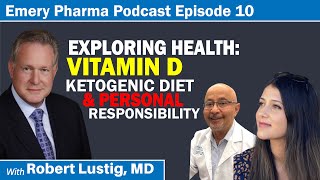
A recorded Emory Pharma podcast (April 11, 2024) in which Dr. Robert Lustig discusses causes and consequences of high sugar consumption, vitamin D metabolism and deficiency, ketogenic diets and how to monitor ketosis, gut-driven inflammation (mucin layer, tight junctions, TH17 cells), obesogens in the environment, and pros/cons of GLP-1 analog drugs (e.g., Ozempic/Wegovy). Lustig emphasizes that sugar and ultra-processed foods drive inflammation and metabolic disease, that vitamin D levels can be lowered by inflammation-driven inactivation, and that public-health approaches (reduce sugar to USDA guidelines) could yield larger population benefits and cost savings than widespread drug use.
Questions this video answers
April 11, 2024.
Urine testing, blood testing, and breath testing.
Medisense from Journeys Metabolic (Dr. Lustig is an advisor), KetoKeyto (Keto Keyto), and Ketotap (Phenotap).
If everyone who qualified used GLP‑1 agonists it would cost about $2.1 trillion; reducing sugar to USDA guidelines would save about $3 trillion and produce twice the weight loss (his claim).
Vitamin D → 25‑hydroxyvitamin D via hepatic 25‑hydroxylase; 25‑hydroxyvitamin D → 1,25‑dihydroxyvitamin D via renal 1‑alpha‑hydroxylase; inactivation/clearance via 24‑hydroxylase (elevated in inflammatory cells).
Chapters
If we just got sugar consumption down to USDA guidelines, we would actually cause twice as much weight loss, twice the degree of weight loss, and save $3 trillion instead of spending 2.1 trillion.
Good morning, everyone. Welcome to another episode of Emory Pharma's Podcast Podcast. It's a pleasure hosting Dr. Robert Lustig here with us again today. My name is Dr. Ana Najafi and I'm actually joined here today by my father, Dr. Ron Najafi. Thank you for joining us. We've had a lot of interactions with Dr. Lustig and as a result, so many questions have come up. So we've invited him back here today to dive deeper into some of those topics. So My first question, Dr. Lustig, is we want to talk about vitamin D. Why are so many Americans vitamin D deficient?
The first thing is you get vitamin D2A's, you can get it from vitamin D, irradiated milk, and you can get it from sunlight. And you don't need a lot of sunlight to generate vitamin D, but you need some. And you know, because of our indoor culture, we're actually not getting that sunlight. You know, there's 7 dehydrocholesterol in the skin. Ionizing radiation will isomerize that diet to vitamin D3. And that's how we used to get our vitamin D for, you know, millions of years. But we also lived outdoors and now we don't. So that's, you know, one reason for deficiency. Pretty much all milk today is vitamin D irradiated. But people don't drink milk. They eat a lot of dairy, they eat a lot of cheese.
Right.
They eat a lot of yogurt. But none of that uses vitamin D irradiated milk.
So what do you mean, Rob, what do you mean by irradiated?
So you, you, Harry Steenbach from the University of Wisconsin back in 1919, figured out that you could irradiate with ultraviolet rays a, you know, carton of milk, and the 7D hydrocholesterol in the milk would basically isomerized to vitamin D. And you could vitamin D fortify milk that way. And that was one of the reasons why the University of Wisconsin had one of the largest budgets. Because, you know, that patent made the University of Wisconsin a friggin fortune. The other one that made them a lot of money was warfarin or, you know, coumadin, and they've had a couple others since then too. But that was the thing that really got them started. So that's another reason why Wisconsin is America's dairyland. But, you know, having you know, been a faculty member there for several years. Point is that, you know, people are not consuming a whole lot of vitamin D unless they're taking supplements. Now, even when they're con consuming supplements, their 25 hydroxy vitamin D levels still are low. And that is a conundrum that doesn't make sense. You, if you take vitamin D by mouth, your vitamin D levels in your blood should show it and they're not. And that's one of the, you know, reasons that everybody's, you know, all upset about vitamin D. Now I'm going to tell you, I don't know the answer to this, but I have a hypothesis based on good data, okay? And I, I have not done the study and I don't know of anyone who's done the study to answer this. But the hypothesis goes like this. Vitamin D is a pro hormone. Vitamin D has to be converted to another pro hormone called 25 hydroxy vitamin D. And that happens in the liver. There's an enzyme in the liver called 25 hydroxylase. So you turn vitamin D into 25 hydroxy vitamin D. 25 hydroxy vitamin D has no effect either. It is a pro hormone. It does not have any benefit on its own, but it circulates in the bloodstream. And then it can go to one of two places. It can either go to the kidney where the kidney will act on it and has an enzyme called 1 alpha hydroxylase. And so you turn the 25 hydroxy D into 125 dihydroxy D and that has activity that is a very potent calcium absorber and also renal reabsorber in everything to basically get the calcium levels in the blood up. And so hypocalcemia drives one alpha hydroxylase because hypocalcemia drives parathyroid hormone and parathyroid hormone drives kidney 1 alpha hydroxylase. And then that 1 alpha hydroxylase drives the active form. So you turn the prohormone into the active hormone in order to get the serum calcium up any way you can, either by absorption or by renal reabsorption. Okay? But that 25 hydroxy vitamin D can also undergo a clearance mechanism and deactivation, a way to get rid of vitamin D. And that is called 24 hydroxylase. 24 hydroxylase is an enzyme that is very high in inflammatory cells, in macrophages, in tissue that is inflamed. Okay? 24 hydroxylase inactivates vitamin D. Now why does it do that? I don't know. I don't know why it does that, but it does that. I think the reason, and again this is hypothesis is that vitamin D, activated vitamin D125 dihydroxy vitamin D is an immune suppressant. It binds to the toll like receptor 4 in various tissues to mitigate, to mediate, to attenuate the immune chain reaction that drives severe inflammation. This is one of the things that, you know, happened during COVID was we weren't able to stop the chain reaction of inflammation. And so that inflammatory response just goes, keeps going and, and going. And people died of the immune response, not of the virus itself because they couldn't suppress the immune response. You know, the there, the immune response is like a chain reaction, like a nuclear chain reaction. So you know, one fission, you know, drives the next fission, drives the next fission, drives the next fission. And it builds and builds and builds. And that's why you get an explosion with nuclear, with a nuclear reaction. Because it's a positive feedback system. Well, the immune system is a positive feedback system, right? And there's only one break on the immune system and it's the toll like receptor 4 and vitamin D. The activated vitamin D is an immune suppressant because it binds to that toll like receptor 4. Well, if you don't have enough vitamin D, you don't stop your immune system. So you basically accentuate, you augment your inflamma. Well, if you're inflamed, you have a way of getting rid of the vitamin D so you can stay inflamed. Because clearly if you're inflamed, you haven't dealt with whatever it is that drove the inflammation. You still need that chain reaction to occur. And so the vitamin D gets deactivated through this 24 hydroxylase mechanism. Maybe, maybe that's the reason. Anyway, it's my hypothesis, it's other people's hypothesis. It has not in any way, shape or form been proven to be true. But that's sort of the way I'm thinking about it, Rob.
There's a lot of buzz around vitamin D. A lot of people are taking vitamin D3. Some people are taking vitamin D3 and K2. There's a lot of questions and are there benefits? What are the benefits and what are their has, what are the risks of taking too little or too much or, well, too little?
You know, if you're, if you take too little, you get rickets if you're a kid and you get, you know, probably osteopenia if you're an adult, if you are truly vitamin D Deficient, it can definitely impact on biology, bone fragility long term. What about taking too much? So there is something called hypervitaminosis D because vitamin D will raise your serum calcium through calcium absorption and also help resorb calcium at the level of the kidney to raise the amount of calcium so that presumably bone could be accreted. There is the possibility of becoming hypercalcemic and hypercalcemia is not a good thing. Hypercalcemia leads to initially dehydration, it can lead to renal ossification, it can lead to mental health issues and ultimately depression and psychosis. And ultimately, if it goes far enough along, it can lead to death. And I've had to, you know, admit several kids over the years to the, you know, intensive care unit to basically wash out the vitamin D that their parents were giving them because that somehow they thought vitamin D was, you know, some cure all and they overdosed them. So, you know, it's, it's a real thing. So yes, because vitamin D is a fat soluble vitamin, you can store too much and then when you, because it's fat soluble, it doesn't leave your body very quickly and so it can, you know, become a problem in some ways.
Vitamin D, if it stops the, you know, essentially it interferes with the inflammation. It might be a way to, you know, stop that chain reaction.
I don't know that that's been studied but I mean, that's a hypothesis. It's possible that that might be true.
What about vitamin K2? There's been a lot of talk. I mean we know some of the.
I'm not an expert in vitamin K2.
Okay.
I'm going to leave that to, you know, to experts. I know a little bit about vitamin K but.
Right. Me too. Not K2.
I'll beg off on that one. I don't want to say something that's wrong.
Somebody suggested that perhaps this alpha hydroxylase, is there a way to supplement with some of these alpha hydroxylase that converts the vitamin D, the pro hormone, to the, you know, to the real thing.
Well, there are, there are medicines. Not, not supplements. There are medicines that have the, the hydroxyl group already added. So for instance, we said vitamin D becomes 25 hydroxy D which then becomes 125 dihydroxy D. Well, 125 dihydroxy D is a medicine. It's called calcitriol and you know, your doctor can prescribe it for you. And if you have hypoparathyroidism, you need calcitriol because since you don't have pth, you can't want alpha hydroxylate. So you basically bypass the enzymatic step. And so that will result in calcium absorption and maintain your serum calcium if you're hypoparathyroid. The problem with calcitriol is it's extraordinarily expensive and it has a very short half life. So it is really only meant for people who have hypoparathyroidism. There is in Europe a version of vitamin D called 1 alpha vitamin D, 1 alpha hydroxy vitamin D. And that way you can take the 1 alpha hydroxy, then have it the liver work on it to add the 25 group and then you get an active form as well. And so that might be a cheaper way of being able to do the same thing. As far as I know, that is still not approved here in the United States.
In some of your previous presentations, you talked a lot about ketogenic diets. And there's a lot of, a great deal of interest from some of our audience. Obviously, we have a very mixed audience of pharmaceutical type people and also general public, but we have a lot of interest in what are the benefits of ketogenic diets and how could ketogenic diet go wrong. You mentioned something about if you do the. If you don't do the ketogenic right, you could get a heart attack.
Yeah, I mean, basically, ketogenic diets are good as long as you're doing them right. And the problem is a lot of people are not. And you need to know if you're doing them right or not. You need to be able to monitor yourself to know that you are actually still in ketogenesis. So what is the benefit of a ketogenic diet? The benefit is that ketones can be burned by all the cells in the body and they are burned better and cleaner with less damage because there's no glycation associated with ketones. The mitochondria can burn ketones to completion even better than they can for glucose. And you don't need insulin, which is the real, you know, key. Because insulin, you know, while it drives energy into cells, it primarily drives energy into fat cells. That's really what it does. And most cells don't actually need insulin to take the energy up, except for, you know, the adipose tissue and the, and the liver and the liver needs insulin as well to be able to take up energy. So the bottom line is, doesn't it make sense to, you know, burn energy more cleanly and independently of your insulin needs, since insulin itself is a bad guy. Your brain loves running on ketones. It's, you know, one of the things it likes best. It's a really good organ for, for burning ketones. Once it's ketone adapted, it takes a couple of days of ketogenesis to be able to induce the enzymes that will actually metabolize those ketones. So for the first five days or so that one goes on a ketogenic diet, one feels really lousy. If you feel tired, you feel crappy. But once, once those enzymes do get induced and once you are ketone adapted, you can actually run on ketones. That's what, basically that's what, you know, the Ethiopian distance runners do. They are ketone adapted because they're not eating carbohydrate, you know. No, no one understands. How come, you know, the, the best runners don't have to carb load before a race. And the reason is because they are completely ketone adapted. So ketones are good. Ketones are not bad. They're good. Now there are people still who think that a ketogenic diet is bad because it raises your serum ldl, low density lipoproteins. And they say LDL elevation is bad because LDL elevation is associated with heart disease. That's what they say. This basically demonstrates their ignorance that they do not understand what they are talking about. So LDL is not one thing, it's two. There's one called large buoyant, there's one called small dense. Large buoyant LDL are cardiovascularly neutral. They do not cause heart disease. They don't help heart disease either, but they don't cause heart disease. They're large. They don't get under the surface of the endothelial cell to start the foam cell formation process, which leads to a plaque. And they're buoyant. They get carried along via laminar flow within the arterioles and capillaries so they don't drop out, they don't sink. So that they approximate the arterial cell wall, you know, the endothelial cells and the arterial cell wall. So it turns out the, the large buoyant are not the problem. The small, dense ldl, they're the atherogenic particle, okay? And they are the remnants of triglyceride after offloading of lipid at the adipocyte. Those are those small, dense ldl, they're small. They get under the surface of the endothelial cells. They're dense. They are not buoyant. They do fall out of laminar flow in the circulation. And so they do approximate those arterial or endothelial cells. And so they can form the. The plaques, you know, the foam cells and the plaques. In addition, because they're smaller, okay, they have greater surface area, so there's. They're more easily oxidized. So you get oxidized ldl. Oxidized. Small, dense LDL is the worst for heart disease. So the question is, what causes those? And the answer is carbohydrate, not fat. Fat does not contribute to small, dense ldl. Fat contributes to large, buoyant ldl. But the large, buoyant LDL are not the problem. So the people who say you shouldn't be on a ketogenic diet because of heart disease do not understand what they are talking about. However, there is one caveat to that, where they actually could be talk under understanding what they're talking about. Except I don't think so. I think that they're right for the wrong reason. And that is if you're on a ketogenic diet, that's fine. But that means you have to be on a ketogenic diet. You have to stay in ketosis. You have to be generating ketones. And the reason is because that keeps your insulin down and that keeps your body utilizing ketones. Because as soon as glucose shows up, that's the end of the ketones because your insulin goes up to handle the glucose, and insulin is the break on ketogenesis. A little insulin ketogenesis stops on a dime. Well, now you're burning glucose again, and you're doing it with insulin. So if you're on a ketogenic diet and you're not monitoring your ketones, you will fall out of ketosis because carbohydrate will enter your diet through methods, mechanisms, and through foods you didn't even know had the carbohydrate because it's so prevalent in our food supply. Okay, you can't. Not. Okay. Every single study in the entire literature where people were basically left to their own devices to do a ketogenic diet within two months, they were not on a ketogenic diet. They regressed to the mean. And now what they're on is a high fat, medium carbohydrate diet instead of a high fat, very low carbohydrate diet because the carbohydrate snuck in. And if you're on a high fat, medium carbohydrate diet, that means you're. You've got insulin, and that means you're not burning ketones. And that means that you are generating lots of ldl, and you're also generating lots of small, dense LDL because of the carbohydrate. So if you're going to do a ketogenic diet, you got to do it fastidiously. You got to do it with supervision. You have to do it with monitoring. And you know that lots of people are not doing that well.
How do you. What's the supervision? What, what are. How do you know? Is there, are there tests? Are there?
So basically, you need to do it with a physician. If you're on a ketogenic diet, you should be under the care of a physician. Okay? You should not be doing it yourself. That's number one. Number two, you need to monitor yourself to maintain that ketosis. And I know of three ways to monitor your ketones. The first is check your urine. The second is check your blood. And the third is check your breath. Now, the good news is there are breath ketone monitors you can carry with you medisense from Journeys Metabolic, which, full disclosure, I am an advisor to, they make one. There's another one called Keto K e y T o that also does this and monitors breath ketones. And now there's also a wearable that monitors ketones in real time called Ketotap and it's from a company called Phenotap. So ketone monitoring has gotten a lot easier and that's good, and I'm for that. But having said that, you know, being on a ketogenic diet without monitoring I think is a fool's errand. You have to know what you're doing.
So one question that I had going back to what you said about inflammation and being inflamed, we all know that, you know, inflammation leads to chronic diseases and, you know, so many problems down the line. Why do you think Americans are so inflamed and how do we stop kind of curb those mechanisms?
Right? Why does everyone have some degree of inflammation today? This didn't used to be the case. And we can prove that, you know, inflammation's gone up because all you have to do is look at high sensitivity C reactive protein in the population and it's higher than it used to be. And also we see the food allergy, you know, pandemic, and we also see the autoimmune disease pandemic. You know, I mean, those are manifestations of degree of increased inflammation in the society. Okay, not, you know, not everybody has food allergy and not everybody has autoimmune disease. But the fact that they are going up says that Something about our inflammatory response and our immune system is, you know, dysfunctional to allow for this to occur. So where is it coming from? Well, obviously, if you have an autoimmune disease, it's coming from your immune system, you know, so there's some antigen that your immune system has identified as foreign, you know, and you have developed antibodies and T cells against it. And so you are attacking yourself. And that is leading to your severe inflammatory response. And that ultimately has negative metabolic and longevity consequences. But that's only one in 10, maybe one in eight. But almost everyone's inflamed. How come the rest of them are inflamed? Where's the inflammation coming from in somebody who doesn't have autoimmune disease? The answer there is almost always. Not always, but almost always the gut. The gut is the source of the inflammation. Now, your gut, as you know, is a sewer. What's the definition of a sewer? A pipe with you know what in it. That's a sewer, all right? And that is your intestine. Your intestine is a pipe with you know what in it. Okay? Now, normally the intestine's job is to extract the good stuff, the nutrients out of what's in that pipe and leave all the you know what still in the pipe so it goes out your you know what on your other end. That's what's supposed to happen. Well, so there are three barriers in your intestine that are supposed to keep the you know what out of your bloodstream. All right? The first is the physical barrier called the mucin layer. And the mucin layer, you know, basically sits on top of the intestinal epithelial cells and acts as a mechanical barrier to prevent junk from making it into your bloodstream. And that's good, as long as that mucin layer stays intact. Well, our mucin layer is not staying intact. Now, what we've learned is you have to feed the bacteria or your bacteria will feed on you. If you do not give the bacteria in your intestine what they need to survive, the bacteria will turn to your mucin layer as a source of food, and it will actually gobble up the mucin and thus exposing the intestinal epithelial cells to all the junk. And that can lead to inflammation by itself. In addition, our ultra processed food diet is filled with something that dissolves the mucin layer. That is called emulsifiers. So water and water, they hold fat and water together. Like tide, like what you put in your clothes washer. Right? Okay, you're swallowing tide all right? Now, if you swallowed Tide directly, you'd have to call poison control because you would have an acute burn in your intestine. Okay. And you might have to go to the hospital for that. You might even need surgery for that. Well, we don't have an acute burn, but we have a chronic loss and, you know, problem maintaining the mucin layer because of the emulsifiers that were placed into the ultra processed food by the food industry to hold the fat and the water together. So polysorbate 80, carboxy, methylcellulose, carrageenan. Okay. Others as well. These are all emulsifiers. They're all used by the processed food industry to hold fat and water together. Ice cream, microwave lasagna. If, you know, if you didn't have emulsifiers, everything would layer out and, you know, you wouldn't eat it. You know, you wouldn't have microwave lasagna if it weren't for emulsifiers. So that's the idea is, you know, we're basically destroying the mucin layer because of our diet. So that's one reason. The second barrier in the intestine is called tight junctions. Tight junctions, these are proteins that basically cross link and hold the intestinal epithelial cells together so that they don't separate so that stuff can't get through the pores in between the cells to enter the bloodstream. So these tight junctions are really important. It turns out the tight junctions are not just in the intestine, they're in the brain, too. Same tight junctions. So often when you have a problem with your intestine, you have a problem with your brain too. One reason why for diet related mental health issues, by the way.
All right?
But in any case, you basically want to keep those tight junctions tight. Well, there are things in your food that will basically undo those tight junctions. The famous one in about one in a hundred people is gluten. So gluten will basically cause destruction of those tight junctions in people with celiac disease. Okay? And so those tight junctions are called zonulins. Okay. And so the zonulin dysfunction in celiac disease, that's what causes this problem. Well, it turns out other things can cause defects in those tight junctions as well. The one that's the most obvious and the one that I study, the one that I'm most interested in is sugar, is fructose. Fructose, nitrates, those tight junctions and causes them to be transiently dysfunctional. In addition, those tight junctions require ATP because it's an active process to keep maintain that tight junction. Okay, so you need mitochondria to work, right? Well, fructose is a mitochondrial toxin. It actually depletes ATP. And so there's the possibility that those tight junctions might not be so tight. And if they're not so tight, then stuff can get through those pores. Like for instance, pieces of, you know, peptides from food. And that can then start the food allergy process. You know, you can develop an immune response against a piece of a piece of a peptide, you know, from a, from a fruit or a vegetable or you know, from a peanut or whatever. So that's, you know, that's. The fact that we have all these food allergies says that our gut is not tight. So once the, it's an automatic, that mean that's a, that's an if, Then you know, we know that our gut is not acting as a barrier. And then finally there's the third barrier in the gut, which is the immunologic barrier. So that's called TH17 cells and they make a cytokine called IL17 that basically is the mop up crew. And they basically keep bacteria, whole bacteria from being able to enter the bloodstream. Well, if you give sugar, guess what? Those TH17 cells disappear. TH1 cells, which are inflammatory, show up instead. And now you've got inflammation and you also have transport of whole bacteria. You get endotoxic anemia. You can actually measure bacter bacteremia in people after they've had a high sugar meal. So, you know, that's driving inflammation. So our diet is the primary source of inflammation that leads to chronic metabolic disease.
Right. So once the damage has been done to our mu and layer our tight junctions, is there anything we can do to help combat that? You know, taking any supplements maybe that reduce inflammation or, you know, supplements are.
Not going to fix the poison. You got to get rid of the poison. Okay? You know, supplements are not bad. They're good. But if you don't fix the toxin, the supplements aren't going to solve the problem. I always tell people, I mean, this is sort of, you know, they're going to put it on my tombstone. Toxin A plus antidote B still equals death, okay? Unless the antidote is for a, for the toxin, Unless the antidote actually combats that toxin, it's not going to really help you very much. The only way to deal with the toxin is not to be exposed to it. So sugar is a toxin. Sugar is a metabolic toxin, okay? It affects the entire gut, liver, brain axis. And the only way to deal with it is to reduce its consumption. Yeah.
Rob, you know, this discussing sugar, obviously, you know, we talked about the sugar. Sucrose is really a combination of fructose and glucose, right? And we all know how you feel about fructose, but there's. There's. There's also, you know, school of thought that says, you know, fruits contain fructose, but fruits are good for you because they contain a lot of other good stuff, and they contain a lot of phytochemicals and fiber and everything. So what is your thoughts on that? And, you know, at the end of the day, it's. It's really moderation. I think that really is name of the game.
Well, let's talk about what moderation means. Okay. The question is, what's the difference between fruit and fruit juice? That's the. That's the question. All right, so fruit juice has everything that fruit has, except for one thing. Fiber. The fiber has been removed. The fiber's been macerated. It's been strained, it's been removed. That's how you turn fruit into fruit juice. Does it matter? Food industry will tell you it doesn't matter. They'll tell you fruit juice is fruit. They even have the USDA including fruit juice in fruit consumption. I think this is a terrible mistake. I think this is one of the reasons why things don't make sense at the USDA is because they is the food for your bacteria. You have to feed the gut, and the way you feed the gut is with fiber. Fiber is the food for the bacteria. Fiber. And you need two kinds. You need soluble and insoluble, and fruit has both. So soluble fiber, we have names for, like, pectin and inulin, like what holds jelly together. Insoluble fiber is cellulose or chitin. Okay? The stringy stuff in celery or, you know, the. The, you know, shells of shellfish. Okay. Or grasshoppers. You need both soluble and insoluble fiber. You need both. And the reason is because they work together, they form in a secondary impenetrable barrier that lines your intestines when you eat both. So think of it like this. Imagine the insoluble fiber. The cellulose is like a fishnet, okay? And the soluble fiber, which are globular, plug the holes in the fishnet. So together they form a secondary barrier. Another way to think of it, a spaghetti colander. Okay? Metal bowl with holes in it. Right? Right. You pour. You. You. You have a colander. You let the water run. It runs right through. Okay, fine. Now take A blob of petroleum jelly. Throw it into the center of the colander, run the water, still runs right through. Bounces off the jelly, but still runs right through. Now take your finger and rub the jelly all the way around the inside of the colander. Now run the water. Now it doesn't run right through, through. Now you've got a barrier. So you need the colander, you need the jelly and you also need the geometry. But when you have all three of those things, you have created a barrier to transport of water. In that case, imagine a fishnet, okay? A fishnet will allow water to transport across, right? But what if the fishnet gets, has a lot of kelp, you know, blocking the fishnet? Now it won't go. Well, the same thing's happening in your intestine. The insoluble fiber will form the lattice work. The fishnet, the soluble fiber will plug the holes in the lattice work and together they will form an impenetrable secondary barrier. And that will prevent glucose, fructose, sucrose, starches from, from being able to traverse from the lumen, from the, where the junk is into the bloodstream and thereby reducing the burden on the liver. And that's the goal. The goal is keep the sugar in the intestine so that the bacteria can chew it up. So you feed your gut, you feed your bacteria. Instead of your liver having to detoxify this metabolic toxin. So the fruit has it, the fruit juice doesn't. So that's why fruit is okay. In addition, fruit is self limiting. You can only eat so many oranges before you throw up, as opposed to glasses of fruit juice which you can keep consuming ad nauseam. And so you will basically overdose very easily. I mean, after all, how many oranges are in a glass of orange juice?
A lot.
About four. Yeah. Okay. Can you eat four oranges, Ron?
No.
Try it sometime. You will try.
I, I know, I know. Actually people who ended up drinking a lot of orange juice over days and days and days ended up becoming diabetic. Just orange juice.
Absolutely.
You know, so it's, that's absolutely. There's a, you know, I think one of the things you're doing is really clarifying a lot of misconception that's publicly pushed by God knows, food industry, USDA and everything. And that's really, I think your work is phenomenal on that, on that front, Rob, just since we're talking about this topic, you know, in your previous presentation on personal responsibility, there was a comment, you know, on our site about one of the Somebody said, but at the end of the day, I choose to eat these things. So it's my responsibility to stop. You know, I am the one that goes and buys these junk from the SE and Lucky and Piggly Wiggly, not the government. So you are trying to, you know, basically institutionalized things and this and that and so forth. So what, what, what do you say to those people that are saying this is not the job of government to, you know, bring bright products?
You know, I, believe me, I've heard this, you know, many, many times before. The question is, do you really have free will to choose? Do you? First of all, if 80% of the items in the grocery store spiked with sugar, how much choice do you really have? That's number one. But we'll leave that aside because you still do have those 20% that you could choose. The concept of personal responsibility is, is predicated on the basis of free will. If there's no free will, there's no personal responsibility. So we have to go to free will first. Do you have free will? All right. The answer to that is, I think, very well stated by a famous German philosopher by named Arthur Schopenhauer. And he famously said, you are allowed to do what you want, but you are not allowed to want what you want. That in fact, the things that you want are biochemically driven. So you can choose between the candy bar and the ice cream and call that free will. I get to choose between the candy bar and the ice cream on any given day. But the fact that that sugar is calling to you in the first place, that is not free will. That is that sugar calling to you. That is biochemical. That is a biochemical drive set up by dopamine in the nucleus accumbens that you yourself had nothing to do with. And of course this is taken to the extreme in addiction. So the question is, does an addict have free will to stop? If an addict is an addict? If an addict. If we now consider addiction a disease, that's just the extreme manifestation of, you know, your friend or you know, the, the person on your website basically saying, I, you know, have free will, except he doesn't for just the same reason. Okay, so, you know, it's, it's, it's a libertarian. What's the best word for it? Subterfuge. You know, for basically making it sound like you actually have control when you don't. So in fact, if you don't have free will, you can't exercise personal responsibility. And my argument is actually we do not have free will. And I'm not the only one who thinks this. There's a book out just from August of 2023 by one of our great scientists, philosophers, Robert Sapolsky, professor at Stanford, who wrote this book called Determined A Life Without Free Will. Okay, I know Robert from way back at Rockefeller days. We were postdocs at the same time. He was in the McEwen lab, I was in the FAF lab. But the bottom line is there are a whole bunch of people who do not believe in free will, that Albert Einstein did not believe in free will. He famously said if the moon had sentience, it would think going around the, the earth, okay, was its choice. You know, like it had, like, like it had some, you know, ability to do otherwise. Bottom line is, you know, we all obey the, the natural laws. So, yes, you can choose between the ice cream and the, and, and the butterfingers. Yes, you can do that, but that's not really free will. That's. That's something else. And ultimately, if you don't have freedom to choose, you can't exercise freedom to blame.
You think you have a choice, but you don't.
You know, the obesogens, and you had a very nice presentation at Emory on obesogens. And there are myriads of those obesogens out there in the environment. And the questions are, who is affected most by them? What age group? Well, who is. Who is affected least by them? If you know, you can comment. And if we're living with them, what's the harm? I mean, I'm. Obviously you're saying that if I, if they get a blood test of me today, they'll find plastics and they'll find plasticizers and they'll find, you know, various metabolites of ddt, you know, all of that. So what's the harm with that? I'm. I'm perfectly fine.
Well, the question is actually, Ron, are you. Do you know that. Do you actually know that we are all pre polluted? And the, the data show that, you know, fetuses are carrying a burden of chemicals that are in the environment that have been put there over the last 50 to 100 years. And the question is, do those chemicals have negative effects? And that's this concept of obesogens. So what are obesogens? Obesogens are chemicals that drive adiposity exclusive of their calories. Okay? So there are a lot of chemicals that don't have calories but drive adiposity. Okay? Like, for instance, bisphenol A, which is in target receipts, phthalates, which are Plasticizers like rubber duckies and binkies for babies. PBDEs, which are flame retardants in the mattresses and in the kids clothing. Parabens, which are in cosmetics, you know, Chlorpyrifos, which is an insecticide. Pfas, polyfluoroalkylating substances, which is Teflon, you know, which is a forever chemical. And still around even though Teflon is gone. Everybody should see the movie Dark Waters, you know, with Mark Ruffalo, came out in 2019 about Dupont and the Teflon debacle. Bottom line is each of these drive fat cells development and growth unrelated to calories. It just so happens we consume willingly another obesogen called fructose. Fructose is calories? Yes. If you blow it up in a bomb calorimeter, you will get 4 calories per gram. But fructose drives more fat generation unrelated to its calories, because fructose is a mitochondrial toxin. And if you don't, if your mitochondria not working, then you have no choice but to take the excess energy substrate and turn it into fat. So, in fact, fructose is an obesogen, even though it's a caloric obesogen. So we're consuming them, we're exposed to them. Okay? Sometimes we do it willingly, sometimes we do it unwillingly. The question is, who is exposed to obesogens the most? And the answer there is almost always the lower socioeconomic status. Why? Because air pollution is an obesogen. Okay? The obesogens are in poorly filtered water, you know, contaminated water. Well, that's who. Who gets that. Well, you know, the, you know, lower socioeconomic status echelon of our society almost across the board. And it's probably, I'm not going to say it's the only. But it's probably one of the chief reasons why the lower socioeconomic status echelons have bigger obesity problem than the rest of us. And the thing that we've learned is that these chemicals have epigenetic effects, that is that they are altering the expression of DNA even before birth. And so these kids are pre polluted, and they are predestined to become obese and develop illness before they've even had a chance to breathe. And so this is, of course, shall we say, unfair. And my job as a pediatrician is to try to make sure that every kid has an equal shot. Well, every kid does not have an equal shot. And it's because of what we did to our environment. So I am, you know, trying to undo the damage that we have done.
Have there been, in your opinion or in your studies, have there been any work done, any research done on effect of obesogens on inflammation generation, perhaps in the gut, perhaps in the liver, perhaps in various organs?
We know that obesogens alter the microbiome. There was just a paper that came out this week, in fact, demonstrating that. And if you're altering the microbiome, you're going to alter cytokine development. So, you know, we're pretty darn sure that that's the case, that these obesogens have effects on the microbiome, and the microbiome has effects on the barrier, and the barrier, of course, has effects on systemic inflammation. So, yes, I mean, we can piece all of those things together. Right.
Just in, since we have only a few minutes left. Rob, you know, what is the latest on Ozempic and Ozempic, like drug drugs? I know, I personally know several people on Ozempic. I know there are companies that are producing Ozempics, are their stock is going through the roof. And you know, what's the latest?
Just to add to that, I think there was a recent new WeGovy indication to prevent cardiovascular complications in people who are overweight. So what do you think of that?
So I have three. I wear three hats. Okay? I wear three hats. I am a clinician, I'm a scientist, I'm a public health advocate. Okay. And each of those hats has a different response to Ozempic and wegovy and Zepp Bound and, you know, Manjaro and even the ones that are coming down the pike even after that.
Right.
So from a clinician standpoint, look, I'm happy they're here because people need them. And, you know, people are dying from obesity and its complications. And, you know, those who are most affected need the most help. And, you know, they've tried and they have not been successful. And so I am glad they are here. From a clinician standpoint, from a scientist standpoint, the question is why do they work? Why do they work? Now, it is true that they have effects on the brain to reduce craving. And that's actually one of the reasons why they have now found that these GLP1 analogs seem to reduce alcohol consumption because they're reducing craving, they're reducing dopamine activation of the nucleus accumbens. And that sounds good. That sounds like a really good thing. And it very well may be a good thing, and it's probably a very good thing for some people. But we also have seen major depressive Disorder come from the use of these GLP1 analogs already. And I remember in 2006 a different drug, it was called Ramonabant, trade name Acomplia. It was never approved in the United States. It was approved in Europe. And what was it? It was an endocannabinoid agonist. It bound to the endocannabinoid EC1 receptor and it also reduced reward. And so it was a very effective anti obesity drug. And within two months of its approval in the, in, in the, in the European Union, there were 21 suicides of people on Raman event. So interfering with the reward system is very dicey at best and problematic and, and highly worrisome at worst. Okay? And this, these drugs have virtually the same effects. Now we haven't heard about the suicides, but we have heard about the depression. So that makes me very concerned. In addition, from a science standpoint, okay, we also have the problem of the fact that these drugs delay gastric emptying. Okay? Stomach basically does not move the food through the, you know, to the intestine fast enough, okay? And that's one of the reasons why you stop eating is because your stomach's still full because you haven't actually digested what you ate before. Well, that's a good reason for why you stop eating, but that's not good because number one, you get nausea. Two, you get vomiting. Three, you get dehydration because you're not taking enough water. And four, you, you know, it's, it's a relatively rare occurrence. It's about 1 to 2%. But gastroparesis, stomach turns to stone. And worse yet, when you stop the drug, the gastroparesis doesn't get better. So from a science standpoint, that's not such a good thing, right? Then you look at the weight loss itself for these patients is equal amounts of fat and muscle. Now they're trying to lose fat. Fat, fat loss would be a good thing, but muscle loss is not a good thing, okay? And you know, loss of muscle is starvation. Loss of muscle, okay, is, you know, that's what makes you die earlier. Sarcopenia is one of the drivers of early demise. Ask any little old lady if she wish she had a little bit more muscle before she breaks her hip. Okay? Point is, if you're losing e equal amounts of fat and muscle because you're not eating, is that good for you? So these are the big issues there. And then number, and then my third hat, the public health hat, from a cost standpoint, if everyone in America who qualified for a GLP1 analog actually got it. That would be $2.1 trillion to the health care system. That would be a 50% overcharge over what we are currently paying now. And we can't afford that because health care would be broke by the year 2026, Social Security be broke by the year 2034. You want to add a 50% surcharge on top of that? Okay, I mean, that's ridiculous.
Okay.
Conversely, if we just got sugar consumption down to USDA guidelines, we would actually cause twice as much weight loss, twice the degree of weight loss, and save $3 trillion instead of spending 2.1 trillion. That's a, from a public health standpoint that I am happy about is that these drugs, the success of these drugs have actually alerted physicians and also the public to the fact that obesity is a biochemical phenomenon. Right. Everyone assumed, well, you were just weak willed, you know, you just had no willpower. Your personal responsibility person, you know, would have basically, you know, you know, condemned the obese, you know, basically saying it's your own damn fault, you know, because it's, it's the easy way out. You know, from, from this philosophical argument. I, you take great issue with that. Okay? No one chooses to be obese. Certainly newborns do not choose to be obese. But we have a newborn obesity crisis.
Right.
Point is, these drugs have made it very clear to the public that in fact obesity is biochemical and that's a good thing. So I'm happy about that. But at the same time, you know what God giveth, God taketh away. What they've done is they have said to people, there is a pill for this, or at least there's a shot for this, instead of trying to actually fix the problem, which is the food. So it's taken our eye off the ball.
Right? The poison versus the antidote, like you said.
Exactly. Get rid of the poison. Don't worry about the antidote. Get rid of the poison. So I have very mixed emotions about GLP1 analogs. I'm happy they're here. On the other hand, I'm worried about them. On the other hand, I'm glad they work. On the other hand, I wish people would actually fix the real problem, which is the food.
What you're saying, Rob, is that if you are at high risk and you are extremely obese and you are at high risk of heart disease, various things, this might be a good thing. But if you're a healthy person, like I know 25 year old who are really not fat, but they want to Go on Ozempic. They want to take Ozempic because they want to lose a few pounds, make themselves look better. I mean that's the risk that they shouldn't be taking. You know, with even the 2% side effect of the gastroparesis that you mention.
I personally think that this has to be a physician driven determination with of course, you know, feedback from the patient. But you know, just basically letting Hollywood run rampant with, you know, a drug with virtually no regulation is I think recipe for disaster.
I have last question is you, you know about direct to consumer advertising of drug companies and of course, you know, we're, we're helping companies develop their drugs. But should there be more guidance on that in terms of direct to consumer advertising where Ozempic as advertising and advertising and other companies are advertising. What's your thoughts on those?
I think that the Supreme Court decision that allowed for direct to consumer advertising by the pharma industry was this the second worst decision that the Supreme Court, I take it back, the third worst decision the Supreme Court made. Okay, the sec. No, maybe the fourth worst. Okay. The first, first was probably the Dred Scott decision. The second one was Repealing Suitable industry versus Virginia Consumers Union. I think it was 1976 which allowed direct to consumer advertising by pharma. I do not think that this has helped anybody. I think it has only hurt. It sold a lot of drugs. I'm not going to argue that that has, but that doesn't mean it was good.
Very good. Do you have any final thoughts on any, any of these topics? Rob?
What I would say is that, you know, you can't fix a problem if you don't know what the problem is. One of the reasons I love talking with you and Anna, you know, here and you know, at, at Emory Pharma is that you believe in understanding the problem so that we can fix it. You know, you can't bypass a problem. You can't band aid a problem. You have to fix a problem at its source. You have to understand the upstream causes rather than worrying about the downstream results. That's how you fix a problem.
And we really speaking with you as well, I know all of our listeners and viewers, you know, love to hear from you. You're just a wealth of knowledge. So thank you so much for being here with us today and we look forward to our next discussion.
And Rob, we always want to promote good science and everything you say, you know, is really the truth. And I, I, we want to promote that truth. We want to make sure people know how much sugar is in a soft drink, for God's sake. We want people to know that. And unfortunately, there's not a huge public health drive to educate people except you and a few other people who are really going against the food industry power and might and, you know, so we salute you and we want to get the word out.
Well, thank you. I appreciate it. There's not a lot of money in it, so, you know, it, it. It definitely falls by the wayside in the grand scheme, so, you know, I'll keep working, but people have to listen.
More from Dr.

Hippocrates said, let thy food be thy medicine #obesity #metabolicsyndrome #lustig #shorts #health



Bill Wilson, MD: Why GLP-1 Drugs Are Overpriced—and How Compounding and Competition Could Fix It

Nitrosamine in Pharmaceutical Products? A Deep Dive into Risk Management by Ron Najafi, Ph.D.

The Subcellular Processes That Belie All Chronic Disease. The Hateful (or Grateful) Eight #lustig

Bill Wilson, MD: GLPs May Reverse Carb Syndrome—Helping Patients Reach Zero and Sustain with Diet

Why Everything You Knew About Obesity Is Wrong | Dr. Robert Lustig on Sugar & Metabolic Syndrome

Robert Lustig, MD: How Fructose Fuels Fatty Liver, Oxidative Stress, and Metabolic Disease #fructose

Robert Lustig, MD: The 3 Types of Fat Fueling Insulin Resistance and Disease #insulin resistance

Bill Wilson, MD: GLPs May Reverse CARB Syndrome. Helping Patients Reach Zero and Sustain with Diet