Watch the full video: Bill Wilson, MD CARB Syndrome due to heavy consumption of processed food
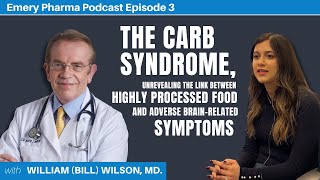
Dr. Bill Wilson proposes CARB syndrome, a condition he links to ultra-processed food consumption that causes 22 brain-dysfunction symptoms including strong cravings for sweets. He says it's reversible through diet changes like Mediterranean eating patterns and reducing added sugar, and calls for clinician adoption of this framework.
Questions this video answers
Carbohydrate Associated Reversible Brain syndrome.
22
December 5, 2023.
Chapters
Welcome, Dr. Wilson. Thank you so much for being here with us today. My name is Dr. Ana Najafi. I am a pharmacist by training. I trained at UCSF. During my last conversation with Dr. Rob Lustig, your name came up. He mentioned that he had worked with you and he's good friends with you. And we thought that we would have you here on our Emory Pharma speaker series today and learn a little bit more about you, your background, your experience, your findings after many years in the field of medicine. So for our listeners, I was hoping you could give a quick introduction on yourself, your background, your experiences.
Yes, I'm a family practice doctor. I attended medical school at the University of Minnesota and followed by a family practice residency. And one thing I can say about that is in med school, I worked under Dr. Franz Hallberg, who single handedly started the field of chronobiology. You're familiar with that term, I assume. He was a crusty old German guy and brilliant though. And I was going to go into basic research and I told Franz that, and he puts his arm around me one day and said, bill, you'd make a pretty good researcher, but you're an empiric guy. You connect dots to the real world. You need to get in the front line of medicine and make observations. So he really stimulated me to go into family practice because it didn't even exist. I had to find the first residency program in the country. So that's what I did. I ended up going, starting my own practice in a small town in northern Minnesota for decades. And that's where I made a lot of these observations. And then I eventually closed that practice when my wife wanted to move back out east where she trained. Subsequently, I worked as a hospitalist. I worked in many different settings. I currently do some telemedicine. So I have a fairly broad background in training.
And after your many years in the field of medicine, you know, how did you find the link between diet and health, you know, psychiatric brain disorders? And how did this all come about?
Well, at the beginning of the obesity epidemic, I started scratching my head and said, what's going on here? Why are we seeing all these people that seemed to be getting obese? And so I did some research and said, well, obesity is excess body fat, so how do we determine what that is? And I ended up purchasing some FDA approved equipment to measure body composition. So I started measuring every patient, every visit, and over decades I accumulated like 10,000 readings. And I also belonged to Stephen Stahl's Neuroscience Education Institute. So I Had, you know, a pretty good understanding of brain symptoms, if you will, when they're normal, when they're not normal. And over time I noticed this weird correlation between changes in body composition and changes in these symptoms. And it seemed like the symptoms preceded changes in body composition, which basically told me when it comes to fat storage, the brain calls the shocks, which really makes sense from an evolutionary standpoint. So anyway, that's kind of how I got started. And I eventually identified 22 brain dysfunction symptoms that seemed to be associated with this situation. And it started to fit the pattern of a syndrome or disease. And eventually I thought, well, if that's the case, what's causing it? And I, you know, I'll explain in my talk. I basically figured out its long term exposure to ultra processed food, which is neurotoxic. And I think the medical profession and scientists have kind of been talking about this. You know, if you eat this stuff too long, your brain will get screwed up. But I took it a few steps further. I think my contribution has been describing what appears to be a distinct disease that explains two things. Our increase, our epidemic of psychiatric disorders and the epidemic of metabolic disorders. And I'm saying they're all connected under one disease. That's a pretty radical thing to be proposing. But I think there's a lot of evidence to back me up on this. And when I sit down and talk to smart people about it, they say, hey, you know, that kind of makes sense. So I, you know, I can't prove any of this. It's all speculation, if you will. But as, as, as a frontline family physician, I've always been driven by results.
And you've seen this a lot.
And if you, if you don't get results, what happens? Your patients leave. If you get results, you get more patients and your patient's health improves. And so I started playing around with different things to manipulate. When I found if I could get these symptoms to improve, two things happened. Number one, their brain function improved, they felt better, they functioned better. Number two, they start losing excess body fat automatically. And I thought, well, that's kind of magic. I mean, you know, and so I developed protocols that consistently did that. And I'm in this little town in Chisholm, Minnesota, you know, home of Kevin McHale, Bobby Dillon, up in the Iron Range. I had patients coming from all over the place, surrounding states, surrounding towns, based on word of mouth. Dr. Wilson has a magic wand. No, I didn't. I simply had knowledge that other providers did not have. And I want to. My goal is to share that, let other people hear what I'm saying, you know, do what you know, see if you can integrate that into your life or your medical practice or into scientific studies. I'm trying to spread the word. That's all I'm doing. Because I don't make my living doing this. My paying job has nothing to do with this concept. I don't make any money off this concept. I don't sell a lot of books or anything else. That's not my goal. I don't need to make money doing this. But I've seen what it can do to help the health of people and I feel it's my moral obligation to share it. And I hope you can help me with that.
That's wonderful. Yes, we definitely would love to learn more. I know we're going to get into this a little bit today, but this syndrome, this disease you're referring to carb syndrome, maybe you could define that a little bit for us, for the listeners.
Well, the term comes from the actual term I labeled it is carbohydrate associated reversible brain syndrome, because that describes the triggers and the fact that it's actually reversible, unlike, you know, cancer or heart attack or whatever, you can actually totally go back to normal. That's why I call it a syndrome rather than a disease. And it really fluctuates from very, very mild to severe. And mild cases have no adverse, you know, obvious medical effects. Severe carb syndrome has a lot, you know, it's the feeding into type 2 diabetes, all the different chronic diseases, heart disease, hypertension, you name it. It's like gas in a fire, if you will. And so that's the term I came up with. The concept, like I said, was based on what I already described. And I think it's sort of unifying concept, if you will. It connects a lot of dots that have been floating around out there that people have wondered, you know, wondering about.
And what are some early signs and symptoms I think you mentioned, and let me know if I got this wrong, that the psychiatric symptoms precede the metabolic symptoms. But what are some early warning signs that.
Well, the number, the number one, if you have strong cravings for sweet and starchy food, you have early carb syndrome. And that's pretty common, I would say, you know, the majority of the population can say, yes, I have that sometimes. And the reason I point that out is because it's not affecting your health now. But if you go down that slippery slope and it gets progressively worse, you can get in real trouble so the time to treat it is early and not late. All right, Much easier. And it's very easy to treat at that stage. It doesn't require medication. All it requires maybe some precursor supplements, some dietary changes, exercise, etc. Boom, you're good.
It sounds like kind of like a never ending cycle. You give in to the cravings and you have more cravings. Is that kind of.
Absolutely, yeah. They're self perpetuating. People talk about sugar addiction and all this and that, and I don't even know what that means because cravings for sweet and starchy food, it's okay to have a desire in certain circumstances. If you're out on the plains of Africa and you have no food, your brain wants you to go find some fruit, for example, which is sweet or starchy. That's the quickest way to get your energy replaced. They didn't have Twinkies and Big Macs back then. And so today when people crave that stuff, they eat the bad stuff. And ultra processed food is what you know, if you ate fruit, no problem. If you eat ultra processed food, you're going to fry your brain eventually.
So the sweet and starchy cravings are kind of early signs. What do you typically see after that?
Well, you start seeing like mood changes, like maybe some excessive anxiety, moodiness, feeling down more often, you know, occasionally some mild ADHD symptoms, trouble concentrating and focusing. But if you read through the list, they overlap with many common sight disorders. That's where the confusion is created. Here's a good example. Major depression, well that's been around since God was a baby. And you know, it's defined as a person gets severely depressed, you know, lose their appetite, lose weight, et cetera, et cetera. Well, then they started seeing some folks in the last four or five decades that kind of looked like that. They had some depression, but it wasn't as severe, it was milder. And so they decided to call the first one major depressive disorder. And the second one atypical depression. And atypical depression they described as having increased appetite and weight gain. Is that a little clue there? That's carb syndrome. It has nothing to do with major depression. Totally separate. If you put them on an SSRI without knowing what you're doing, you're going to make them worse. Same with.
Because that could increase appetite and weight gain.
Absolutely. You have to combine it with a monoamine precursors, which I can describe in my talk. And these are simple things that actually just come from the diet. They're five HTP L tyrosine D L, phenylalanine. They're what your brain needs to make more neurotransmitters. And that's lack of neurotransmitters or dysfunction is what causes all the psych symptoms and the carb syndrome symptoms there. They're both associated with problems with neurotransmitters. It's just major depression is probably a hereditary problem, has nothing to do with diet. Same with bipolar. There used to be just one bipolar. You became psychotic and depressed with interspecial with depression. And then in the last 30, 40 years, they started seeing some folks that became hypomanic, never got manic and some mood swings. And they thought, well, it's kind of like looks like bipolar. Not totally. Let's call the original one Bipolar I and we'll call this one bipolar two. That's carb syndrome. It has nothing to do with bipolar. Put them on an atypical psychotic. What's going to happen? They get worse and they gain weight. Okay. We're seeing tons of patients now that fit fit into that category. And I feel that's a horrible tragedy. I want to tell patients, you know that that's not where you want to go.
Right? Right. No, definitely. And it seems like you've kind of come up with a treatment regimen, you know, some ideas as to how to treat these patients without getting too much into, you know, your presentation. But are there any populations that you see that don't respond to your treatment regimen? Anybody that's kind of refractive?
Well, patients that are, their brain function is so bad they can't comply. We'd have to admit them to the Wilson Medical Prison. And even then, when I was in practice, I could sometimes get those people, I get their relatives and so forth involved. And they're tough to treat because they. You tell them to do these 10 things to get healthy and they can't even remember what you told them. And so in that situation, medications are almost always necessary to jumpstart the brain and control symptoms. And that gets a little bit complicated. I mean, I, I was one of the early users of the notorious fen phen combination, but I never used it for weight loss. I used it short term to control brain symptoms until the rest of my program kicked in to improve their brain function. So it's hard for people to kind of understand that, but that's what I, you know, there's medications today you can. Phentermine is available, Wellbutrin, dopamine, norepinephrine, drugs combined with a little SSRI to jumpstart their brain, put them on a precursor supplement, get their diet changed, get them exercising, boom, they get better. So. But patients can't self prescribe, so you know, that's where it gets complicated. We have to have more doctors to kind of on board with how to manage these patients.
Right? Definitely. And spreading awareness, bringing these things to light. So I think my last question that I have for you today is what does an ideal diet look like to you? How does one avoid carb syndrome and keep a healthy brain?
Well, I think the Mediterranean. I'm married to a wonderful Greek lady. Mediterranean diet, okay, that's probably the best. Someone with major brain problems. Ketogenic can be really good, but you got to do that under the supervision of a physician. If you don't do it right, it'll actually make things worse. And I think just cutting out excess sugar and ultra processed food. Now the Greeks have been eating sweets for thousands of years, like baklava, et cetera, et cetera. But they're honey based and some of that is okay. You know, the Greeks didn't have carb syndrome until recently when they started eating our junk. So if you go in the grocery store and you walk down the aisle and it comes in a package with a long list of ingredients, don't buy it. Stay in the fresh food section. You know, mix perimeters of the grocery section. Absolutely. You know, fresh fruits, vegetables, you know, grain based beef, you know, all the meats are okay. Fish, I don't like farm raised fish, but, you know, wild caught fish. And I'm a big fan of getting an adequate omega 3. And most people need to supplement a high quality supplement to get that.
Okay, so whole food diet is really. It sounds like your philosophy.
Yeah, it's not complicated. Easy to do if you're craving. If you have strong cravings though, you can't do that.
Right.
You could tell people to do it. They got to go to the store and they're gonna head down the wrong aisle because their brain is pushing in there. So you, you know, it's very important to get those cravings under control.
Very important. And I think the first step in all of this is education and awareness and educating patients, educating doctors as you've been doing.
Well, a lot of people don't know that those cravings are abnormal. They think I just have a sweet tooth. And they don't realize how it's kind of controlling their food intake really. And once you treat them, they say, why, my goodness, I can't believe it. I didn't realize how good whole food tastes, you know, because they're not craving the other stuff now. They crave good stuff. So if your brain's working like it should, you crave healthy food. That's the normal human status. We want to get you back to that state.
Right? Exactly. Definitely. Well, we're very excited to hear from you today to listen to your presentation. Thank you so much for your time, Dr. Wilson. And we look forward to hearing from you.
Yeah, I look forward to working with you folks more in the future.
Thank you.
Sa.
More from Dr.

Hippocrates said, let thy food be thy medicine #obesity #metabolicsyndrome #lustig #shorts #health



Bill Wilson, MD: Why GLP-1 Drugs Are Overpriced—and How Compounding and Competition Could Fix It

Nitrosamine in Pharmaceutical Products? A Deep Dive into Risk Management by Ron Najafi, Ph.D.

The Subcellular Processes That Belie All Chronic Disease. The Hateful (or Grateful) Eight #lustig

Bill Wilson, MD: GLPs May Reverse Carb Syndrome—Helping Patients Reach Zero and Sustain with Diet

Why Everything You Knew About Obesity Is Wrong | Dr. Robert Lustig on Sugar & Metabolic Syndrome

Robert Lustig, MD: How Fructose Fuels Fatty Liver, Oxidative Stress, and Metabolic Disease #fructose

Robert Lustig, MD: The 3 Types of Fat Fueling Insulin Resistance and Disease #insulin resistance

Bill Wilson, MD: GLPs May Reverse CARB Syndrome. Helping Patients Reach Zero and Sustain with Diet