Five9 CEO on company's approach to customer care
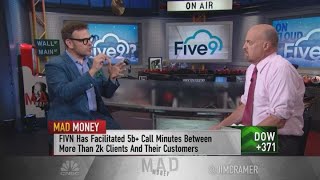
Five9 CEO Rowan Trollope tells Jim Cramer why the company's stock jumped from $49 to $57. Legacy call centers are slow and costly. Five9's cloud platform uses caller data to route customers to the right agent, a shift that Estée Lauder, Lululemon, and Expedia are already making.
Chapters
Wanna know whether this market's gotten its groove back? Just look at Five9. That's a cloud-based software company that helps companies manage their customer contact centers, allowing them to cut costs and, of course, improve engagement. Here's a stock that barely even got dinged during the big market-wide sell-off because its business is so strong. On Wednesday of last week, Five9 reported a magnificent quarter, big top-line beat, huge bottom-line beat, and a raise for your forecast. It was a grand slam, people. Stock exploded higher, running from $49 to $57 in a single session. I think it would have kept running because the quarter was so good. Then, of course, the market rolled over. Today, though, investors circled back to Five9 like they do so many of the high-growth stocks that are really working. And it jumped another $4, nearly $4 or 7%. Can keep climbing. Let's take a closer look with Rowan Trollope. And Rowan is the CEO of Five9. Now, happy to have him back. Mr. Trollope, welcome back to Mad Money. I got to tell you, Rowan, I can't— I can't resist. I know you might think it's unfair, but This weekend, I'm sure you saw the article in the Wall Street Journal. Everyone hates customer service.
I did read that article.
Okay, do they hate Five9?
Absolutely not. You know, that's the problem that we're fixing. This is the problem that everybody has, right? You call into a call center, you're given the runaround, you can't reach, you can't reach somebody. And why is that? It's because of these old legacy on-premises systems. They're too complex, they're too expensive, and they're hard to maintain. So that's what's really driving the success that you saw with Five9 in the last quarter.
Okay, so I am an Estée Lauder associate, uh, and I am concerned. There was an issue involving some sort of manufacturing issue, was cleared up immediately. People were concerned about whether they, they have something that was wrong with the product. What does Five9 let me do that I couldn't do if I just hired a bunch of people, very considerate and nice?
Yeah, so it's all about intelligence, right? When you think about you as the the consumer, when you're calling into a brand, you want to get to the right person as quickly as possible. And finding that right person is critical, like finding the person who can answer your problem.
Right.
So Estée is a customer of Five9. And think about the old days of Estée. The front door to that business was you walk into a retail outlet or you talk to somebody in a white coat. And what do you do now?
Right.
You buy something online, you're going to call into a call center. The call center has moved from the basement up to the front door of every business. Is that why you said it's all about intelligence?
Okay, now this is important because you said in your conference call the market is huge and customer interactions are absolutely exploding, and that's because the e-com—
e-commerce is a huge driver.
Yes, absolutely. So, you know, so Lululemon, when they have a catalog that they want to know whether the catalog is doing well, they can monitor, uh, through you? Absolutely.
So Lululemon is a customer, and they, you know, when you want to call in to their call center or get help That's, you know, you're actually going to be routed by Five9. We're going to have all that intelligence that's about connecting you to the right person, whether it's on a phone call or on a message or email. So we're sort of multichannel or omnichannel. We do all the ways that a customer want to connect.
Okay. So we own an inn in Summit, New Jersey, the DeBary. We use Expedia. Let's say we have a problem. We're not a customer of Expedia, so to speak, in terms of someone calling up and getting a booking something. But we need to speak to someone and we need special service because it's a very important thing. How do we get routed by Five9 versus some other system.
This is a great, great example, actually, Jim. So take Expedia, who's a Five9 customer. So imagine that you— we have some information on you before. Like, let's say you've called in, right? Okay. Or sent a message. We can gain information about you and we can know information about you based on your caller ID. So we'll know who you are. We can link that back into Expedia's system. We can understand that you are living in this city. And let's say that we understand also that you're interested in travel to a specific— you know, maybe you've been on their website and we've— they've tracked you, understanding what you are clicking on and where you're going. So let's say you're interested in traveling to beautiful California.
Okay.
And so what they do is they say, well, who are the representatives here who know about California or have been to California recently? So instead of just connecting you to anyone, okay, they connect you to someone who's actually been to California recently, and they use intelligence from companies like Five9 and others. And we're sort of— we sit in the middle and help orchestrate.
Okay. So in that chair the other day was someone from LivePerson and they told us a very good story. And when we were in California, we met with Zendesk and they're very good. Is it just a giant scrum, a land grab?
It's a rich tapestry. So, so Zendesk is a good partner of ours. You know, often you'll see companies buy Zendesk because they are transforming the customer service landscape and moving to a lot of self-service. And we help them when they move into the large enterprise and they want to sell larger businesses. We help and we actually partner with Zendesk and we integrate deeply there. So, yeah, no, it's actually, it's a big team effort. Service Cloud at Salesforce is a big part of this. There's a whole bunch of companies in this landscape. You mentioned LivePerson that are actually helping and we're all doing, we're all doing different parts of the ecosystem.
Well, I just, I kind of try to figure out what the differentiator for, for a LivePerson for you, because LivePerson, honestly, they were just here and I said, wow, they use this text message. That seems like a great thing. Millennials like this. Text.
Yes.
Do you offer a similar feature? We do, we do.
Now they, they are more exclusively on the text front.
Yes, they are.
That's how they got started and they're adding intelligence there. We tend to be more focused on the live interactions, so live interactions including phone or SMS. And, you know, we are bringing that same kind of intelligence to the live interactions, but that's where you would see the difference between us and a live person is they're more focused on the messaging side. They don't do anything to do with, with, with voice or with other things. We're really focused on that. So a lot of companies actually use both of us.
Okay. And I know that they may say, listen, we do have some voice, but I understand when you say message. Now, is there such a term as breakpoint or is that something that the journalists were using?
I had never heard of that.
Oh, come on.
I swear.
You sure? Yeah, I stack up Bibles at Five Nine. Does not know about the breakpoint where people get fed up and angry?
No, I've never heard of that.
Well, but you're the largest—
I'm in the industry.
You're the—
Yeah, I'm surprised. So maybe some people look at it that way. But here's the macro, Jim. So the, the real recognition of what's going on, the real recognition of what's going on from these businesses is that you can't afford to have customer service be an afterthought. You can't afford to have it be in the basement. You need to have it become the front door. So that's what's actually driving the investment. Why? Why is— why are companies like ours doing so well? Because businesses are more willing to spend money. It's a strategic— in fact, Morgan Stanley last quarter did a research note and they said that in the cloud, the number one priority for tech spend is on customer experience transformation. So while there are companies out there like the Wall Street Journal referred to, I think increasingly more companies are recognizing they've got to spend more money and deliver a way better service experience to their consumer or else they're going to lose them.
All right. Fair enough. That's Rowan Trollope. He's the CEO of Five9. If he doesn't know about Breakpoint, maybe it's— Maybe it's a surfing term. Mad Money's back after the break.
Don't miss a second of Mad Money. Follow @JimCramer on Twitter. Have a question? Tweet Cramer, hashtag Mad Tweets. Send Jim an email to madmoney@cnbc.com or give us a call at 1-800-743-CNBC. Miss something? Head to madmoney.cnbc.com.
More from Rowan

95% Prompt Cache Hit Rate: How LLM Cost Reduction Actually Works in Production


Office Hours with Guy: Building an external memory store with Redis CEO Rowan Trollope





Helpful Cost-Effective Customer Service Solutions for Every Industry With Rowan Trollope, CEO, Five9


Patrick Moorhead & Daniel Newman talk with Rowan Trollope, Five9 CEO for a Six Five INSIDER!
