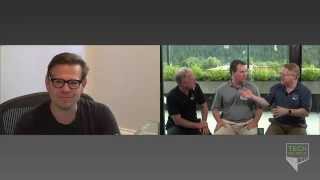
In a Tech on Deck interview recorded at Sun Valley, hosts Scott Jordan, Robert Scoble, and Thomas Hawk speak with Cisco Senior Vice President Rowan Trollope about the company’s strategy to bring high‑quality telepresence to a broad audience. Trollope explains Cisco’s mission to "evenly distribute" premium video conferencing, previously limited to billionaires, by offering affordable, plug‑and‑play hardware such as the $1,500 SX10 (also called the Telepresence Touch) and the MX300 all‑in‑one unit that can be set up in 1.5 minutes. He highlights the design focus on industrial design, user experience, and a dedicated video‑compression processor, differentiating Cisco’s solution from consumer tools like Skype or Hangouts that rely on multipurpose CPUs. The conversation moves to Cisco Spark, a cloud‑based messaging and video platform that integrates with the hardware, enabling free small‑group calls and paid business plans that can attach the telepresence devices. Real‑world deployments are discussed, including connected classrooms at Wharton, remote medical support on oil‑rig EMT bays, contact‑center video integration for brands like American Express and Rackspace, and media production use cases such as Jimmy Kimmel Live. Advanced features such as SpeakerTrack (auto‑tracking camera), pan‑tilt‑zoom, and experiments with VR, 360° cameras, wall‑scale displays, touch‑enabled Telepresence Touch, and future holographic interfaces are mentioned. Trollope also notes Cisco’s internal startup approach, acquisitions, Red Dot design awards, and the broader vision of video becoming the new voice in consumer and enterprise interactions.
Chapters
I want to welcome everyone back to Tech on Deck. We have a really exciting session here tonight. I'm here with my co-host Robert Scoble, Thomas Hawk. I'll let you introduce our guest, Robert.
Well, uh, Rome is the Senior Vice President in charge of collaboration, but let's back up at Cisco, by the way. Which is how we're having this whole Tech on Deck experience. But we should back up and explain why this happened this year. Because you've been bothering me to come to Sun Valley for, I don't know, 2 or 3 years because you keep talking about this Allen Company thing that's happening down the street where all these billionaires, 100-and-something billionaires, are in town.
I thought it was a great opportunity for us to, while they're talking about the future of technology, and media privately to do it publicly and to form Tech on Deck as an opportunity, a form of venue for us to talk about these things and have these great guests on and have you guys out here and have an opportunity to rub shoulders with the billionaires, perhaps. Yeah, as we did today. We met Elon Musk.
Yeah, Bob Iger, Bob Iger, Disney. Yeah, good interview with him today.
And you What I didn't realize is the press gets to sit right next to the car park.
Right next to where they pull up.
Where they pull up in their cars and they come over and talk to you and say hi.
Some of them do.
Some of them.
Most don't, most don't. But I mean, some of them. I was surprised, someone came over with their kids and just started chatting. What it does is there's 400 billionaires here, the number. Is private, but that's the speculation. And they're here. Their guard is completely down. They're not allowed to have private security, their own private security. They're so used to it. Mark Zuckerberg's here and the like. George Soros, Murdoch. So for them to, to be with their families and build these relationships is really meaningful to them.
So, well, and so we started talking about, well, what if we could get some of these people to your house. It turns out that's actually pretty difficult because they don't want them outside their security bubble.
No, they're very controlled.
But we started saying, what if we could video conference them in? That's exactly right. Because then they'll be in the security bubble inside the protected zone. And they could come and we could have a conversation. And we visited a Cisco team a couple weeks ago. And I was like, damn, this— the video picture that you guys have on this thing is so much better than anything else I've seen. Why don't we get a couple of your devices? I was thinking maybe the $1,500 devices that Cisco was selling. But they sent us a whole team who helped set up the network and make sure everything was copacetic and sent us some really awesome equipment. We have— I think we have, what, 4 or 5 video cameras here.
Spread throughout.
Spread on your house.
Decks and levels.
Which is actually sort of why they wanted to do it. Well, let's hear from the Cisco guys.
Yeah, have a guess.
Why did you spend some effort to send your best team out here and send so many pieces of equipment? What's your goal here for being part of Tech on Deck?
Yeah, well, Robert and team, thanks for having me on, first of all. Definitely exciting. And I think that your view is a little bit better than mine here in Russian Hill. But—
We do have an amazing Sunset tonight here in Sun Valley.
You do, you do. You know, I've been on a mission, Robert, as you know, since I started Cisco basically 2 and a half years ago, to take this sort of little secret that no one knew about, this incredible technology that Cisco has with telepresence, and actually bring it sort of from what was previously only really available to those billionaires kind of people and make it available to everyone. And now we have, you know, like we've shipped a unit to you or one of the units that's there, it's $1,500, right? Something that anyone could have in any room with this kind quality. And so it's what I've been experiencing is people are just, you know, frankly even myself when I first saw this, the technology that was kind of hidden in Cisco, I was like, this stuff is incredible. We need to bring this to the world. And there's that great quote by William Gibson which is, you know, the future is already here, it's just not very evenly distributed. Well, our mission is to evenly distribute it to everyone because it's available now.
Yeah.
You know, Elon Musk said that exact same quote today.
Did he really?
He did. That exact same quote.
Well, he has a self-driving car and we don't.
Yeah, exactly.
So, you know, that's, that's an example.
So how are you going to go about— how are you going to do that mission? How are you going to get consumers? Obviously not everyone does a Tech on Deck event like that. So what is the marketing and branding strategy for you?
Yeah, well, first and foremost, we had to, we had to build the products, right? So we spent the last 2 years building the products, and one of the most important things was industrial design, user experience, just the most incredible, easy-to-use, and simple sort of form factor that we could put it into. And so we have a simple range from the do-it-yourself little guy that's this big for about $1,500, you know, just about the price of a TV, all the way on up to, you know, small, medium, large, and extra-large conference rooms. So very, very simple, something that, for example, the system that we're both talking to each other on, the model number is the MX300. It's an integrated all-in-one unit. You can set it up. I think our world record is someone took it out of a box and set it up in 1.5 minutes. So it's very, very fast. There's no cabling to plug in. Everything's pre-integrated directly into the screen. So you get this incredible experience that's crafted with the hardware and the software together, and that's something that's really, really important. And then another big part of that was price. So simple, streamlined set of products with an incredible experience that's very compelling, at a great price, at a price that frankly anyone can afford. And then the third part of it is backed by a cloud platform. So we launched our cloud platform earlier this year so that you don't need to deploy any infrastructure.
And backed by a world-class company with a world-class reputation too.
Exactly, all that support and service and everything else that you would get from Cisco. Yeah, so I figured this was the place to do this. There's not very many, there wasn't anywhere else in the world that actually had this kind of a team with this kind of a technology to actually be able to make this happen.
So tell us a little bit about the alternative before you jumped on board and made this happen for Tech on Deck, was Skype.
Yeah.
Or Google+ or Google Hangouts.
Hangouts.
So why is this, I know why, but I would like you to explain, why is it so much better for a consumer, not an event, to contemplate this solution?
I think the first thing is that it's really no compromises. So you are experiencing it now, and hopefully our viewers are getting the same quality, but it literally looks like you're in the room here with me. We've tuned the audio, we've tuned the video and the picture. We have a dedicated processor handling the hardware. So if you think about when you run on your computer on Skype or whatever, and nothing against those technologies, but you're using the processor that's a multipurpose processor that wasn't necessarily built for that. It's doing all kinds of other things at the same time. You know, your virus scan kicks off or something else happens, the next thing you know your picture quality degrades. We're using a dedicated processor that's only built for doing video, doing this kind of an experience. And it's really, we've optimized the hardware and the software specifically to have a no-compromise experience. And we haven't changed the bandwidth. So if we kicked off a Skype session right now between us and you, it's not gonna be anywhere near this quality. And that's all because we've been able to take hardware and software together and blend them to give this very, very unique experience.
Yeah, it's really cool. How are you, you know, now that you're able to get this kind of quality into normal people's homes, well, maybe Scott Jordan kind of people's homes.
High-end homes. High-end homes.
Small businesses.
But, you know, $1,500+ is not, you know, out of reach of a lot of us, right? What else are you thinking of doing to enable new kinds of collaboration amongst people? Because Now, if Scott had one of these units here in his living room, which is where we are, he would start thinking about having team meetings here and having people call in from home and think about working differently. What else is Cisco doing to enable a new kind of working?
Yeah, so the big thing is a new platform that we've launched called Cisco Spark. And you can find out more at ciscospark.com. But basically what it is, is it's it's a complete communications platform delivered as a service from our cloud. So we've already got one of the largest B2B SaaS clouds in the world with Webex. It's a billion-dollar business all by itself doing conferencing. And we've got a network that I would say the most powerful SaaS network actually in the world for businesses already deployed with Webex, 'cause we run millions of meetings per day and billions of minutes. So we have this incredibly powerful cloud service already there. And what we've been doing is we've now built a brand new service to host video conferencing like what we're experiencing today. And you can download the app right on your phone. So it starts— Cisco Spark really starts as a messaging application. So you download the app and it's a messaging app not unlike what you people have experienced with Slack or with Huddle or a lot of the other business messaging apps that are out there. We thought that was the perfect place to get started into a technology like this. And so You can actually download the app right now. You can do video conferencing for free on the Cisco cloud, up to 3, 4 people in a conference. And then you can pay for the business version and you'll be able to add these hardware devices on as accessories. But it's really blending business messaging and video into a single kind of cohesive experience. And so, for example, if you wanted to have that business meeting here at home, you download the app, You'd buy the product, you'd plug it in, plug it into your TV, you'd add your contact, you know, and that person would download the app, and you know, you'd hit go live and you could be messaging, sharing documents, and then also boom, now be in a video conference just like this. Yeah.
Photography, I mean, you know, it's hard for me to imagine photographers use it, but are you thinking of using this kind of video conferencing in your work at all?
Well, I would certainly think for a high-end photographer or for a photo studio, video as a way to share work and even say, look, here, this is— these are the proofs, these are the prints. I mean, one of the problems with Skype and Google Hangouts and some of those lesser quality avenues are, particularly with photography, I mean, you want to see it. And yeah, you can send large files and you can send them back and forth, but that gets cumbersome. So certainly I can see where if you're doing a photo shoot for Coca-Cola or you're doing a photo shoot for some business and you want to show them this is what I've got on my computer. You know, this would be a great avenue for that.
Are you—
Go ahead.
At this conference, right, it's a lot of media, a lot of media folks, right, at the Allen Company conference. This product's been heavily adopted by the media because of the fact that it handles video transmission so well. So if we wanted to share a live video right now, we could see that. A lot of movie producers are actually using this to do remote production because you can get that You want to be able to see the movie dynamically and see the people at the same time and do all that stuff. And the thing I was going to say is like, we shouldn't be talking badly about any of the products that came before, like Skype or Hangouts or anything else. Like, those were fine, you know, for what they did. But it's sort of like, the way I think about it is, you know, before iPhone 1, we had a lot of smartphones. They just weren't very good. They were proving the case that like people wanted it. But until you had that first product that really had a breakthrough, people just weren't really that, you know, weren't thrilled by it. And I think people are now starting to see this and go, whoa, that's, that's really thrilling.
But this is the first time I really feel like you're here and I don't have to worry about the technology. I don't have to wear a headset. It's so clear. I mean, it's so clear that I feel like I'm going to work with you. And now I'm starting to think about how would I use this for training? And I'm sure photographers around the world are doing things like on Lynda.com or CreativeLive, trying to train people on, well, you trained me on how to use Lightroom, right? Why are you only training one person? Why not give a class where you're pushing this video out to thousands of people?
Sure, yeah, absolutely.
Is education a big part of your business?
Yeah, big time.
With Khan Academy and Pluralsight and Lynda.com.
What are some of the actual business cases that you're already seeing right now?
A great example is Wharton.
Wharton has created, you know, they have a class, They have classrooms all over the place, and so they're connecting their classrooms. So connected classrooms is a really big use case, so they've actually deployed this technology. Lots of universities have deployed this to connect their classrooms together. Another big use case is health. So I actually had a call about a month ago with a gentleman on an oil rig who was the EMT on the oil rig, and he has a little room about the size of my office here, which is his little sick bay or whatever on the oil rig, and people come in all the time with broken arms and whatever. Well, he has one of these systems connected back to a full hospital. And so he can connect in with this kind of quality to any doctor in the hospital. So any kind of specialist he needs. So this guy's just an EMT, but all of a sudden he has the full resources of the hospital at his fingertips. And he can bring in experts, he can learn how to set a bone, he can figure out what to do about a heart defibrillator, all that kind of stuff, right? So it's like, it's making, it's that kind of stuff, it actually saves people's lives. So everything from healthcare to, to education, it really is gonna transform, it is gonna transform a lot of industries for sure.
Scott, Scott, both Thomas and I don't really run businesses and don't have employees and don't think about communicating in this way and you're stuck in Sun Valley which is a damn beautiful place. Not a bad place. But we have so many people in San Francisco that we can just go and meet with down the street. You really have to run an international company. Your supply chain's in China. How are you thinking of using this?
Well, it's interesting because we have utilized video and Skype primarily and among other solutions for a while. And as we're talking about this, I'm trying to think through how this is going to fundamentally change the way I am going to interact with people. Because in Sun Valley, most of our contractors and suppliers are elsewhere. And what I struggle with is the perception is that you need them on both sides. And I will say this, that the reception here with this conversation with you is amazing, especially as compared to those that have not had this, the hardware on the other end. The guy—
and we should point out, I mean, I have a standard, you know, $40 per month Comcast home internet connection that we're using right now.
But are you using your hardware? I assume you are. I mean, is that what makes the difference? Because The last guy we spoke to had a lousy Wi-Fi connection and it wasn't—
He was using a webcam on his laptop though.
Right, so it does take both sides.
Oh, it definitely makes it better. So if you have our hardware, I mean, look, we build the glass in these cameras. I mean, we have engineers to do everything. It's completely integrated end to end. But you can— in fact, Jimmy Kimmel Live is a great example. If you turn on that show on any given night, we built— he's using these products. And you can go to JimmyKimmelLive.com through your web browser, and that uses a technology we call Jabber Guest, and you can, on the backend, and right on the web, you can connect live into Jimmy's show. And the quality is much more surprisingly better than you would think, actually. Because a lot of it has to do with the software, and we're dedicated and focused on the experience, so we don't compromise on that. And as a result, we actually have software, in fact, the codec we're using in this hardware, we've open-sourced. And it's actually now powering Firefox and it's going into Chrome. So you're gonna see WebRTC start to really take off where you can just go into your web browser. Now you're still limited by the little rinky-dink camera in your laptop and the microphone and speakers, so it's not gonna be like this, but we're gonna see that that's gonna get better and better over time, which is what we want.
I believe that there needs to be, and this might be the cusp of the breakthrough, I remember I must have been 14 years old, I'm 50, so quite a while ago when I saw my first telecommunication, it was just really fuzzy. I forgot what store it was. Was it You See Me? It must have been. It was You See Me where it was like one little video.
Yeah, yeah, yeah, I remember that.
It was going to change everything, and yet here we are, you know, 36 years later, and we still haven't— even though Skype's readily available, a lot of people, when I want to have a Skype call, "Oh, I forgot my number." They just don't They don't feel comfortable doing it yet. It's not easy. And I'm hoping that with what you're offering here, it will make it easier.
It does.
It does.
I mean, yeah, again, with minutes to set the thing up. One of the things we had to do to make it easy, we had to totally rethink the technology. So we had the basic clay that we needed. We actually formed a startup within Cisco, a real startup environment. Robert, you came and visited us there. In San Francisco, just down the road here. And we hired, we actually brought in all kinds of new fresh blood. We bought 3 other startups that we integrated, small companies, brought in a whole bunch of new talent, and we just kind of put everything on the table and said, what if we could start again and design something from the ground up to just totally smash through a lot of the preconceived problems that existed with this space? 'Cause what we fundamentally knew was, if you go back to first principles, like, getting this kind of a quality of experience, an HD, video over a home internet connection should be possible. So why is it that it's not working? Why is it that we're not seeing that kind of an experience using sort of off-the-shelf technologies? And so by looking at it and breaking it down and then applying hardware and software together, that is really what transforms the experience and makes it magical. So it was a combination of like the people really thinking about the problem differently. And again, you can experience this yourself. Go to ciscospark.com, right? And take a look at the app. Or you can go into any one of our briefing centers or whatever, and you can see this technology as well and get access to it.
Now, because you built your own cameras, you can zoom and—
Yeah.
Some of your cameras actually even followed me as I walked around the room.
You were the first track? Yeah. So here's my full office there. You can see my office.
So if you got up and walked around the room, would it follow you?
Not this camera. I save those for customers. That one, we do have a, we built a, it's called SpeakerTrack. We have built a double camera and what it does is it uses face detection and audio detection and it will track you as people move around the room and as the active speaker switches. And that's again another transformational experience and that when people see that they're like, holy cow, like this is really, really just really incredible.
A little earlier we were talking about virtual reality. So has there been any thought of bringing virtual reality into this experience?
Yes, we've been thinking a lot about it. A buddy of mine is the, there you go. So we're gonna, I'm gonna demonstrate for you the problem with virtual reality and telepresence today, which is it's hard to talk to Robert when he has that big thing on his face. That's a part of the issue. So for the purposes of talking to one another, virtual reality is gonna be quite difficult because you're gonna need to use avatars. And until we really evolve some technology on the avatar front, I won't be able to see your face.
But what about 3D?
Go ahead.
For remote presence, for remote presence, we think it's a very, very— so not for talking, but for remote presence. So we actually— so I've got an Oculus here, and I have a robotic head that we've developed in Oslo. And I can put the Oculus on and be connected to the robotic head using two of our cameras, and just move my head around and be transported to a remote place. And that's very, like, we're gonna see that be useful in oil and gas manufacturing. We already have a robot on the market called the AVA 500 that uses, it's a partnership with iRobot, and that's technology that you can connect with this kind of quality, but then drive it around. And so folks are using that in business as well. So VR is definitely gonna become a huge, it's gonna have a huge impact on this, 'cause you can transport yourself, to another place, but the face-to-face contact that we're getting right now that I think we think is so powerful, that there's the physical limitations of something on your face.
What about 360?
Well, 360 is good for the, on the remote side, but if I'm talking to you and you wanna see inside my office with a 360-degree camera, no problem, but you have to put on a headset, and all of a sudden I'm looking at you with a headset on, so that's not very helpful.
Yeah, there's— I just visited 20th Century Fox's VR lab, and one of the guys had an office with white walls, and he had projectors on all walls, and he could call people in onto his wall and talk to them on their wall.
Yeah.
So some, some cool stuff is coming, but you have to have a workspace that has white walls all around you. This workspace, you know, why would you want to pave over This beautiful view you got here. Not gonna happen, right?
Exactly. Well, but we're gonna get to the place where, you know, within 5 to 10 years, you're gonna see whole wall— like, it's gonna be cheaper to put screens on your walls than to paint them. You know, it's almost cheaper to buy a screen and a camera than it is to— like, a 30-inch screen and camera— or sorry, a 30-inch screen and computer than it is to buy a poster that's 30 inches. So this is, you know, we're getting to a place where it's going to be cheaper just to, I mean, imagine, you know, roll-on screens where every wall just becomes a display surface. Or even I just saw technology the other day that's actually doing in-air holograms. So we'll be able to see just a, you know, 3-dimensional image kind of springing up out of nothing. Which, you know, that's obviously a few more years out, but it's coming.
When I visited Microsoft, they were showing off a new touchscreen that had gesture, had sensors around the edge of the screen where you could actually walk up and touch it. Are you thinking about that? Because that's sort of the affordance here is I sort of want to click on things on the screen and maybe pull up a spreadsheet we would be sharing or a visualization of some sort of data. If Scott was hiring me to do something, we would want to share a lot of data like that on the screen. And we would want to be far more interactive than we are just looking at each other across the room.
We do have that already. It was one of the products in this lineup, and it's the Telepresence Touch. So it's a small unit, I can show it to you over here. It's a small guy, but it's basically, it's an Android tablet, but it's 24 inches big. So let me just pull it up and show it to you, might as well, why not? And this again, here you go. So this is using a PCAP display, it's right here. This is using a PCAP display. And which is the same thing on your mobile phone, but it's nice and big and it's running Android and it's got the great camera and you can see it looks very similar to the device you have there. Yeah.
So tell me about this device, because the device— and we should have had a couple of cameras so people at home could see what we're actually talking to, but we'll put— you have some photos of the screen that we'll post up in the comments. What is, what is this device, and how does this compare to the one that you're using in your home?
So that's the Telepresence Touch, sorry, the Do-It-Yourself Telepresence, which we also call the SX10, that's the model number. It's got a pan-tilt-zoom camera, it's an all-in-one device.
Yeah.
So that entire thing is all you need, and it just has two cables, power over Ethernet, and then an HDMI out, so you can just plug it right into your TV. Yeah. And so then you get the, then you get this same quality of experience. That is kind of designed for a small room where you've already purchased a TV. So if you already have a TV, you can use that device and just add it on top of the TV or below the TV, HDMI in, and boom, you're off to the races.
And what does this cost?
About $1,500. About $1,500.
So this is the $1,500 one?
Yeah.
Yeah.
That's cool. And you get—
And then that can be serviced by our cloud infrastructure. So you can sign up for any of our, any of the service providers actually provide cloud infrastructure as the service backend for it.
This is pretty incredible. Where else do we want to talk about this?
I'm interested in just consumer service. You were talking a little bit about American Express and the future of— right now I have a problem and I get on the phone and I call the airline and I'm talking to somebody on the phone. And I could see a future where video is much more integrated into that experience. Is that happening already today? How is it happening?
I work at Rackspace. We have teams of hundreds of people who answer phones. We're using some of this technology, and we're certainly going to expand it as more and more people get this device and expect this kind of level of service. I mean, Scott, now that he has this in his home, is going to expect to be able to call his airline or his restaurant and see somebody at this kind of quality level and talk with them and say, what's going on with my orders or whatnot, right?
We even have a restaurant, I think it's Finnegan's or Flanagan's Steakhouse, what's the name of that place? Do you know the place in Blaineville?
Flanagan's, I think.
Flanagan's, yeah. They actually have these products in there, they have business meetings held there all the time. You can actually book a business dinner meeting with video, and so you could have two different sites go into Flanagan's and have like a business dinner, but actually have two different locations, which I thought was pretty cool. So we're gonna see more of that. You know, in terms of where it's going with—
Take a picture of the Flanagan's.
Yeah. They don't have to be a phone. Well, no, they can be anywhere, but—
No, I know, but that's their—
That's their pitch, yeah. So, you know, really with contact centers, we do think that video is the new voice, so you're gonna see a whole bunch of new use cases. Amex is a great example. Amex recently built an iPad app with us. We helped them on the video side to integrate video right into their iPad app. So if you're one of their high-net-worth customers, you could hit a button on the iPad Amex app and boom, be talking in video to one of their reps. Like I said, Jimmy Kimmel Live is in play. There's a bunch of other places that are doing video contact centers as well. So I do think that you're going to come to a place where you're going to contact everybody and it's always going to have voice video unless it's just totally inconvenient.
7 years ago, we started using video for live customer support and we were well ahead of our time at that time because people want to understand how to put their stuff in their pockets and how to wire it and how to show it.
Amazon did that.
If you're buying clothes, I mean, you know, The higher the quality, the better. I mean, it's hard to see what clothes look like if you're on a shitty video camera, right?
No, it's true. You know, it has been surprising to me just quite, even though the technology has been there and now it's even better, I still feel like we're more likely to see self-driving cars than we are to see video really truly integrated into homes the way you aspire them to be and that they should. It just seems like It just hit a wall. It's like, oh, Skype, and then there's the video conferencing. And I'm still struggling to wrap it.
That's why I came to this company, is because we had the opportunity to make this happen. With these products that we released just last year, we won 7 Red Dot Awards. So that's like the product design Oscars that usually is dominated by Apple. Our team in Norway actually built all this hardware and this amazing stuff. I believe that it's totally possible that we're gonna have both video in every room and self-driving cars. What?
Why? Why does—
and video in my self-driving car. That's what I really want.
Why does this have to be quite so large? I mean, compared— when I look at it, it's, it's not massive by any means, but yeah, when I look like an Apple TV unit, it's, you know, it's like a deck of cards.
When I look at it, the reason why it has to be large is because that thing is doing the video compression at high definition. Actually uses a lot of heat on the processor. It uses, takes a lot of processing power. To get the quality we're having right now, the reason we have this quality is because we have hardware compression. And that's what's sitting in that device. Actually, what's in that device is an OMAP processor. It's a mobile phone processor. And we have to, you know, get a lot of heat venting off of it to make it work. Now, you're gonna, of course, see those get smaller and smaller over time as we do the next generation, the next generation. But You know, it's not really that big when you look at the size of a soundbar or other things. It's quite small.
No, no, generally speaking. I really want to thank you for coming on. I want to thank you and your team for everything that you've done here for Tech on Deck. It's been amazing. You are our lead sponsor. I also want to thank Ustream for their help, Rackspace, and Robert Scoble and Thomas Hawk, NewTek, and Saringa. We have a We have fiber optic coming through here, so we're fortunate to have a pretty good pipe.
Scotty vest, don't forget about Scotty vest.
I keep forgetting Scotty vest.
Scotty vest, pants. Underwear, shirts. Oh yeah, lots of pockets. Scotty vest, that's what I have.
I need me some Scotty vest.
There's 2 pockets in the underwear.
The team's amazing.
Awesome. Hey guys, thanks a lot. And again, everyone who's been watching, go check out ciscospark.com. That's where you can download our messaging app that has integrated voice and video, test out the service. And then contact somebody to look into adding the hardware on.
Great, thank you so much.
Awesome, thanks a lot.
More from Rowan

95% Prompt Cache Hit Rate: How LLM Cost Reduction Actually Works in Production


Office Hours with Guy: Building an external memory store with Redis CEO Rowan Trollope





Helpful Cost-Effective Customer Service Solutions for Every Industry With Rowan Trollope, CEO, Five9


Patrick Moorhead & Daniel Newman talk with Rowan Trollope, Five9 CEO for a Six Five INSIDER!
