Rowan Trollope, Cisco | Enterprise Connect 2016
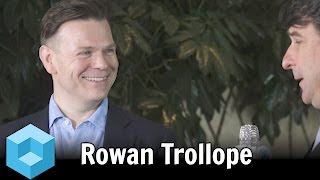
Cisco's Rowan Trollope announced the U.S. launch of Spark, a cloud collaboration platform, backed by a $150 million developer fund and a strategic partnership with Apple. Cisco's collaboration business is now a $4.5 billion unit growing over 20% yearly, with cloud as its fastest-growing segment.
Chapters
Live from Orlando, Florida, extracting the signal from the noise, it's The Cube, covering Enterprise Connect 2016, brought to you by Oracle ZDLRA, Vonage, and CafeX. Now, your hosts, John Furrier and Jim Burton.
Hello everyone, welcome to The Cube's special on-the-ground presentation at Enterprise Connect, sponsored by Oracle ZDLRA Zero Data Loss Appliance, Vonage, and CafeX. Thanks for the support. Appreciate that, the sponsors. I'm John Furrier with Jim Burton with BC Strategies, analyst for our next guest is Rowan Trollope, the SVP and General Manager of Cisco Collaboration and IoT. Welcome to theCUBE.
Thank you, good to be here.
So you just got off stage, big announcements, lots going on. Give us the quick news updates. You have an announcement with Spark, acquisitions, a lot of stuff. What's happening for you?
Yeah, Cisco Spark is available in the US today through our partners, ciscospark.com. Just go there and you can find out more. It's all the capabilities that Cisco has delivered through the cloud. We've also got 6 phones released with the Spark operating system, and all of our room systems. We have SX10 available today, and we got the rest of them coming. We also announced $150 million developer fund. So we're going to fund development startups and other companies, partners, to actually build on top of the Spark platform. So we're excited about that. We also did also have— we had an acquisition today of a little company called Sonata. It's an incredible enterprise search company that's going to integrate directly into Spark.
A San Francisco-based company, congratulations. Great to see you guys getting the checkbook out. This is the transformation that's happening in digital. Unified communications is your wheelhouse in Cisco. Obviously networks, but now software is coming into the whole picture. Software-defined data center, you guys, software-defined networking is moving up the stack. This is what you guys are doing really, really well. This is showing the customers a new way. Talk about the dynamics, because now software is the driver of the unified communications. It's not just siloed, applications. Why is this important for the people, and what's the impact for their jobs?
Well, everything is converged onto IP, and so we can use generic off-the-shelf hardware if we need to have premise-based capabilities. Cisco have UCS, right? So we can run our software there, but everything my team does is software, with the exception of our phones and our video endpoints, right? That is hardware. But other than those, all of our compute and infrastructure runs on software today, and most of my business is software. It's a $4.5 billion business. At Cisco, and most of it is software. In fact, the fastest growing component of the business is cloud, and that's growing at over 20% year over year.
You know, I have two questions for you, but I'm going to start with the one about you made this big investment or make available funds for people to do development. What are the areas that you'd love to see developers come to you, and where would they spend the time and money and develop products to help you out as well as help themselves?
I think first and foremost is integrations. Taking Spark and integrating it with all the existing business systems that are out there is really important. It allows for like really dynamic experience where you can get information and content directly into the Spark messaging application from your apps. So that really improves productivity. So that's the first area we're focused on is getting people to write integrations. The next area is bots. We think bots have the ability to make life a lot easier for our customers. I showed an example on stage of a flight attendant bot, right? All you have to do is "Ask them to get your flight rebooked." And you're just typing in natural language. It's recognizing what you're saying and it's figuring out how to accommodate that on the backend. So really, really exciting around the bots front. And then beyond that, we see people building full-blown collaboration apps on our platform. We do the heavy lifting. We get that plumbed into enterprises. We do all the security. We do the infrastructure. You can just focus on the unique value-add. So our partners are excited about that. Startups are very excited because that's what they're they're already doing, and they don't want to do that heavy lifting. So Cisco's basically saying, we're going to do the heavy lifting. We're going to even pay and help you to build on top of our platform.
That's fabulous. Another question for you, and this is an interesting one. For years at this conference, people have been saying the telephone's dying, the telephone's dying. I know you sell a ton of phones. What do you see that market looking like going forward? What are the endpoint markets? How is it going to evolve over the next couple of years?
Well, that's one of the reasons we struck up the partnership with Apple. We announced this big partnership with Apple, and the whole idea was that, look, we all carry around mobile phones, but a lot of people still feel— find the need, even though they have a mobile phone, to have a desk phone. And there's a strong desire from users to say, why do I have to have both? Why can't I just use one? Well, we all know that the iPhone can't do everything that your desk phone can do. So we have a partnership with Apple to actually figure that out. So we've been working with them, uh, our development teams have been co-developing on the next versions of Apple software to actually build in more capabilities, business class technologies into iPhone so that we can deliver a much better experience for customers. And that's something that Apple couldn't do alone and Cisco couldn't do alone, but together we can develop that. And that should allow people to start saying, well, now more of my workloads can go from my desk phone onto my iPhone. Now look, our phone business is still growing. We're growing and taking share from our competitors. So if people are buying less desk phones, my team doesn't know about it. We are growing our business. So I wouldn't say that that's happening today, but what I would tell you is that's definitely where we see the future going. And so that's why the partnership with Apple, that's why we're extremely focused on Spark, because that gives you the capabilities to make calling directly from your phone.
And this is a consumption question. You bring that up, obviously how they consume voice or anything at this point is whatever device the user wants. So also you mentioned integration, and the cloud is a big driver of this, because now it's a horizontally integrated model, and integration matters. So in the cloud world, they talk about DevOps. IoT's an area you cover. The data's everywhere, so all these data points are out there. So my question to you is, for the folks out there in the enterprise, the digital builders, the architects, the doers, they're like, this is impacting my world. How should they be thinking about the architecture? Not 5 years, 1 year. What should they be doing?
Well, number one, I think, you know, as we've launched just today, made Cisco Spark available, you have to go take a look at your existing infrastructure. And the first thing you need to do, like, look, when companies are digitizing, they need better collaboration tools. That's the first thing you need. And every company is digitizing. I mean, everybody knows that. So as you go there, you say, look, I can't just rely on the old tools, the old communication technologies, email and phones, right? Old Faithful to get me by. You need new tools. Your teams need new ways to communicate. They need a better way to collaborate with their team members. So that's what Spark's all about. It's a better way to communicate. It's not the same old stuff redone, right? This is a completely new way of communicating. We think it brings together all the old ways too. You can still have a desk phone, right? People still want that. You can still have a meeting room system, but we have this amazing new capability as well that people can use to communicate. So it's really step one, is get the latest collab tools for your employees.
And the developers out there, certainly in the DevOps cloud, cloud variety, the Gen 1 of cloud and DevOps, has always been about developing agile, and they don't want to become network guys. They're localhost under the desk, pushing stuff to the cloud. How are you guys making it easy for them? Because you mentioned that earlier. Because what they want is they just want the infrastructure to work. They want infrastructure as code.
Well, we, of course, we started this 3 years ago. We've implemented Spark on the latest cloud technologies. So it's a DevOps model from start to finish. That's why in the last year we've delivered 40 new versions of the iPhone and Android app, 40 new major capabilities. I mean, almost every other week we're shipping an update to that application. So if you saw it 6 months ago, you come look at it again, it's got a whole bunch of new capabilities. So that continuous delivery and integration is what people expect today. What you buy today is a service. That service is evolving. It's getting new features, new capabilities, new integrations all the time. People are excited about that.
Well, I want to congratulate you on the release of Spark because I know that that's been your baby. When you took over that group at Cisco, you made this happen. And the analysts, by the way, my analyst friends, are very excited about what you've done. They say praising things about it, which they don't always do, by the way.
Yes, I know they don't.
Congratulations on that.
Thanks. You know, I've got an incredible team. That made that happen. Jonathan Rosenberg and Jens Meggers, who we'll hear from, we just have an amazing team at Cisco making that happen, so thank you.
One of the themes here at Enterprise Connect that theCUBE's covering is this digital transformation. Old side of the street, old way, new way. Cisco has been there from day one, present at creation of the internet, obviously we saw that. In fact, there was some sad news, the email creator died this week, Ray Tomlin. So you're seeing that you guys have been there from the beginning, moving packets around, but now it's a software-driven world. How have you changed within Cisco? Share with the folks out there, because Cisco's an incumbent. They're one of the old guys. I'm old, we're old. But you're also new. You're doing new things. You're pushing code. You mentioned 40 updates. That's agile. Share with the folks that might not have insight inside the curtain of Cisco. What's going on? What's this new Cisco look like, and why are you relevant?
Well, my wife tells me I'm old too, so let's not forget about that. You know, it has been a transformation, but I was an outsider, and I was actually a frustrated user. So that's where I came from. Now I built my career on focusing on building great experiences. In my entire life, that's what I've done. When I was an engineer, I was a front-end engineer. I was building user experience and front-end stuff. So I really love that kind of thing. I like taking technology and making it simple. It's been a cultural change at Cisco, really, inside the company. We brought in a lot of fresh faces. We've opened new offices in really hot development spots like San Francisco. We've hired a lot of new talent. We've acquired some incredible companies, Tropo, Akano, right? Most recent companies, Sonata, Collaborate.com, Assemblage. We've bought 5 or 6 of these companies that brought us amazing talent. They've formed the core of this team, and frankly, it was because they were all on this mission too, right? It's not like the idea of joining Cisco was the thing that drew them in, because these are serial entrepreneurs. It was because we share the same mission. And so when you've got a mission-driven approach like that, you can get the best people in the world the world to come work for you, and that's what we've done.
And they want to solve hard problems and work with great people. A players attract A players. So I got to ask you, the next generation stuff that's happening right now, certainly it's great, you said you're a front-end engineer. You also mentioned integration is a key point. This is a big thing that no one's really talking about right now, that integrating is actually the hard part. That's the new barrier to entry. You can have a great solution, be born in the cloud, and be a startup, but now the table stakes for the enterprise business is integration. Share some color on why that's important, some things that you've seen?
Well, I think that the web, and particularly REST, has really— that standardization on that protocol has made it so much easier to integrate stuff. I mean, non-developers— in fact, when we did the Tropo acquisition, I made a bet with our CFO, our Chief Financial Officer, Kelly Kramer, and I said, "My bet is you're going to build an app on this platform, and you're not a developer." Okay? She's a finance person. And so she took that bet, and, you know, now that the platform is launched, I can go settle it with her and she can go on the app and actually try and—
How much is the bet for?
It's very, very easy. It was a gentleman's bet.
Dinner, yeah. Bragging rights.
If I can win a bet with the CFO, that gives me a lot of credibility.
But the problem is they have a little bit of control over it because they say, "Oh, I'm not going to do that app." Yeah. Even though it'd be the best thing.
So I think it's just critical that it's easy. Number one, why we're seeing this happen is because it's become so much easier and all of these systems are now interoperable through these APIs. I said yesterday that APIs are the new interoperability, and I meant it. That's how you integrate things together. We don't need to develop protocols. We have the protocol, it's called REST. You need to develop interfaces that can—
And the software's the glue.
And the software's the glue, right.
Okay, so I got to ask you the question around, okay, that next generation, because you mentioned the software CFO building an app. This is the new normal. The technology companies of the future are going to be non-technology companies. That's an enablement model. How are you enabling that to happen?
Well, I think you're absolutely right. The shift to digitization across all industries means that companies who don't think about themselves as technology companies become technology companies, right? And they have to reconsider everything, right? So when I mentioned Tesla earlier, that is a brand new technology-oriented company. When you look at a car, it's not so much like 4 wheels and a transmission and an engine as it is 100 million lines of code with a cloud service behind it, self-driving and self-learning algorithms. There's probably more people at Tesla working on software than there are working on mechanics. So you think about it as a car company, it's a totally different world. That's a data center on wheels, okay? It's not so much a car. Do you think a non-technology company could build a connected data center on wheels? No. Really, really hard. In other words, every company has to become a technology company. The question is, how many of them are going to be able to make that transition? That's a hard transition to make.
Yeah, it really is. Well, Rowan, again, congratulations on the launch of Spark, and thank you very much for being here today.
Thanks a lot. I appreciate it.
Thank you very much. We are here on the ground. This is The Cube. We'll be back. Thanks for watching.
More from Rowan

95% Prompt Cache Hit Rate: How LLM Cost Reduction Actually Works in Production


Office Hours with Guy: Building an external memory store with Redis CEO Rowan Trollope





Helpful Cost-Effective Customer Service Solutions for Every Industry With Rowan Trollope, CEO, Five9


Patrick Moorhead & Daniel Newman talk with Rowan Trollope, Five9 CEO for a Six Five INSIDER!
