Johnny C. Taylor, Jr. on Modeling Civility and Disagreeing Better - Chief Influencer - Episode # 050
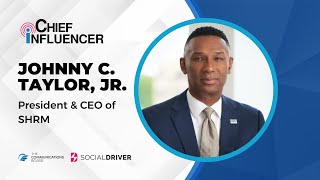
Johnny C. Taylor Jr., CEO of SHRM, discusses his book Reset and how COVID forced companies to rethink work. He explains SHRM's shift to hybrid schedules and trusting employees, and why leaders must model civility and teach people how to disagree respectfully in polarized times.
Chapters
You're about to listen to our live recording with Johnny C. Taylor, the CEO of SHRM, which we recorded in front of a live audience at the Alexandria campus of the College of Professional Studies at The George Washington University. Now, sometimes glitches happen, and unfortunately our main audio feed didn't work the way we had hoped, so we're using our backup audio. But I think you will find that despite the audio not being quite at the standards we like, it is a great interview. Johnny is an amazing leader and he left from our interview to go right to the Today Show for one of his next appearances. So I hope you enjoy the conversation with Johnny C. Taylor. Have you ever noticed that some of the best ideas come from unexpected places? Your next breakthrough may come from a leader facing similar challenges, but in a completely different sector. Welcome to Chief Influencer. I'm your host, Anthony Schopp. Join us as we explore how today's successful leaders inspire, influence, and connect with others. Chief Influencer is a production of Social Driver and the Communications Board, who have teamed up to spotlight how great leaders and communicators are making their impact in the world. This episode is brought to you by the George Washington University's College of Professional Studies, with in-person and online programs ranging from master's degrees in public relations strategy to certificate programs in digital communications. GW offers more than just the credentials to help working professionals get ahead. It prepares them to be leaders in their field. As a proud GW graduate myself, I can attest that faculty members combine academic rigor with real-world lessons that can't always be found in textbooks. Check out cps.gwu.edu for more information. You know, if you wanna know who makes things happen in Washington, you don't have to look much further than the alumni of the College of Professionals. College of Professional Studies at GW. It's the Master's in PR, it's the Graduate School of Political Management, it's the Center for Public Leadership. And so you go to Congress, the White House, K Street, the Pentagon, you find those alumni there and they're making things happen here. So they were the perfect sponsor for Chief Influencer and we were just so grateful to have them in that role. To all of you who are here in person, we want to welcome you to Chief Influencer, the show that explores how today's successful leaders break through to inspire and influence others. Social Driver and the Communications Board have each helped great leaders and communicators make their impact in the world, so we decided to team up and spotlight some leaders. And I want to thank our executive producer from the Communications Board, Robert Krueger, who's here with us tonight.
Thanks, Robert, sir.
Over the last year since we launched this, we've been on a quest to identify leaders who are more than chief executives. They're chief influencers. We have featured a member of Congress, a top diplomat, an Oscar winner, an orchestra conductor, a reality TV star, the founder of a leading fashion brand, and more. And tonight, we are so thrilled to feature Johnny C. Taylor Jr., a dynamic revolutionary leader whose thought leadership is shaping current and future generations of the global workforce. Johnny is the president and CEO of SHRM. As the voice of all things work, workers in the workplace, SHRM is the foremost expert, convener, and thought leader on issues impacting today's evolving workplaces with 325,000 members in 165 countries impacting the lives of more than 235 million workers and their families globally. And Johnny's career is incredible. It spans over 20 years as a lawyer, human resources executive, and CEO in the for-profit and nonprofit sectors. He's the author of the national bestseller. We have a copy of it here, Reset: A Leader's Guide to Work in an Age of Upheaval, a fantastic Wall Street Journal bestseller that challenges leaders to embrace change in the face of adversity. I loved reading it. I also then listened to it. And Johnny has been called many things: a valedictorian, one of Washington's most influential people, a member of Ebony's Power 100, bestselling author. Distinguished Executive of the Year, a trailblazer in gender equity and diversity. The list goes on and on, but today we are thrilled to call you a Chief Influencer. So welcome, Johnny.
Thank you. Well, how's it going, everyone? I will tell you the title that I hold most dear in my heart is dad, though. I have a 14— she's 13 now— 13-year-old daughter who is top of my list right now, which is the only reason I'm about to run out of here when we're done today. But I'm so I'm so excited to be here. Honored, indeed, to get this opportunity to spend time with all of you. This is amazing.
Well, thank you, Raymond. Your daughter sometimes shows up on your social media. We're going to ask you about that in a little bit. But I would just love to start with your book.
Yes.
Reset: A Leader's Guide to Work in an Age Above Evil. You challenge leaders to think of those assumptions that we all have about workers and the workplace. You call them to take action. And it occurred to me reading this, you know, people don't really like change too much. And it's what you ask people to do, you ask leaders to do. And I'm wondering if you could share what kind of reaction you have gotten from this.
So the funny thing about change I've found is that people like the word. But change in action actually scares people to death. Because the reality is most of us kind of like things to be constant. We like the world that we live in and you get used to it and you can plan accordingly, et cetera. So what we found is when we introduced the book, the concept of change, people were like, okay, got it. Yes, right, right, right. Until it started to happen. And frankly, I wrote this book while we were in the middle of one of the biggest change moments of our generation. And hopefully no other generation has to experience it called COVID. We're sitting at home and I was joking, I had both my kids, my son and my daughter at home. And it's the first time I realized I don't I love them, but I don't always like them. Stuck in a house, there was nowhere to go. You couldn't go get coffee, you couldn't do anything. No restaurants, no movie theaters. So we were spending time together. It's interesting, this book, the working title was initially The Great Pause. Because if you all think back to March 2020, and our government leaders told us 21 days, 30 days, 60 days, let's just hunker down and we can control and eradicate this this thing called COVID. Well, I'm at home with them and about 60, 90, 180 days, it became clear that I was not going to be chronically in pause. In fact, this was a reset moment. Because the funny thing about the pause, but if you think about your tape recorder, you push pause and you pick up just where you left off. Well, that's not what this was going to be. We were going to have a total— the way our relationship would work. People were questioning if they wanted to work, for whom they want to work, what kinds of work, like everything. Where we wanted to work, right? At home, remote, hybrid, work from anywhere, not just work from home, work from anywhere was all being thrust. So all of this change happened. And I said, let me write the book about the Great Reset because I tend to think, and our strong research proved this out, that when we come back, whatever back is, it's going to be significantly different. Right? Right. And I'll think about— no one was working remote and demanding that they work remotely Right? We didn't— we were trying to sort of really separate work from home and our work-life balance. So you didn't want to bring work home. Well, that's exactly what we did. We were forced to in March of 2020. So we blurred the lines. And from that point forward, everything changed. Most importantly, I'll tell you here, it was how people would agree to be managed going forward, which, you know, people management is very much an art and a science, right? Because human beings are these pesky little things that change. They say one thing and mean something and do something different. But we had to really get very, very much in tune with what our employees wanted and how they expected to be managed. That was the biggest takeaway that came out of reset to me is everything that we thought we knew as employment experts changed in March of 2020.
And we've all figured it out.
Totally. I just ordered Mo Biggie and got it.
I wonder, you know, you're advising so many leaders on this. I know you're a go-to, they ask you, but what are some things that you've changed inside your own organization, Sherm, since March of 2020?
Wow. So the first is we're hiring. And I must admit, I was one of those guys who said, you come to work, come to work every day, you work a long day, and that's how we decided who gets promoted, et cetera. Out of sight, out of mind. All of the closely held and long held ideas about how you work, you're not productive if you're not at work. And so we changed that. We now remotely work Mondays and Fridays. We're in the office Tuesdays to Thursdays. And the idea was Monday is the day we learned that everyone hated. Think about it. Sunday you're like trudging to Monday, doldrums, right? I don't want to do this. And so we said, what if we allow people to come back to work on Tuesday? So sort of take the sting out of Monday. So that was it. Then I was really apprehensive about Fridays because I said they'd just be long weekends. And I would not have productivity. So we resisted that. So that's an example. We started hybrid work, which was a big deal. The second probably biggest aha moment, the biggest shift that we, we started to trust our employees more. And I think they're sort of related, this notion that the reason I wanted you in the office all the time was to ensure that you were working and being productive and giving me a return on my investment called were paid. And we had to literally let some of that go and trust that people would be adults, that we hire adults, not children, and that they would act responsibly and keep their part of the bargain. So we literally saw our trust barometer go up significantly post-COVID when people were coming back because we said, you don't have to punch a time clock. You don't have to prove to me that you're doing my work at any given time. I just have to trust that you're going to do right by the organization. It's going to do right by you.
Those are the two biggest observations I want to talk a little bit more later about trust because you can't influence people if they don't trust you, right? You know, some leaders seem to have a way of breaking through. You obviously do this very well in person for people who followed you. You speak to huge crowds with a great audience. You also though do it digitally on social media. LinkedIn recognized you as one of their top voices. You have nearly 500,000 followers on your personal LinkedIn page. When did you decide to prioritize your digital presence, your social media presence? Why do you think leaders should build their own personal brands? Does that play a role in trust?
Right. I made the decision, it happens to be in 2019, but more importantly, when I had something to say. Too often I find that people want to be famous for the sake of being famous. I go, okay. I actually am very much an introvert. So I had no desire to be out there in the media, but I decided that we actually had a responsibility. I'm sure responsibility was more than just to the HR profession. It was to HR, meaning human resources, people. We needed to elevate the importance of people in the workplace and get our leaders to think differently about this really incredibly rich talent pool and resources. And so we decided we're going to talk about it. We're going to talk about it with all of its foibles, all its pluses, minuses, you know, to really be honest about what it meant to value people. So we said, now we need to tell the story. So I joined Sherm in 2018, and a friend of mine, Roy Abdo, who happens to be in the room right now, who runs a firm called Digital Rebound, he sat down and he said, I want to make you famous. I said, I don't want to do that. That's exactly what I don't want. I can tell you a long story about walking into a store and someone walking up and making— debating. This mother and her daughter were in there and they were debating whether or not I was Jake from State Farm or the guy from CERN. I said, what? But I don't want that pressure. I want to be Johnny Anonymous and just make a difference in the world quietly. Roy and his team said, that's not good. If you have something to say, especially if it's about making the world a better place, particularly work. 161 million Americans go to work every day out of 335 million people. And so, and you're going to spend an important amount of your time at work. So if you can make work better, then you can make the world better. And so I decided at that point, working with Roy and his team, to build a digital profile. And again, the really important message here is to do it just for the sake of doing it is egotripping, but if you do it because you think you can actually make the world better, because you can introduce new ideas, some controversial, some not so controversial, you can force people to talk with each other, talk with people who are different. I don't want to talk about that, hopefully we talk about diversity. Like, if you do that, then it's worth doing and sort of trading off your— my desire to be very, very anonymous in life.
I think that's actually the good point that you have to think about, what do you actually want to say? Because people may say, well, I want to be a thought leader. And it's like, well, what's the thought? If they don't have an answer to that, then sometimes it makes it hard to achieve that. What do you say to other leaders that say, I'm too busy to do this, or I'm not good at this, I'm not a social media person, Jonny. What recommendations do you have for those? Because I know you spend a lot of time with other CEOs that are probably looking at you and you're inspiring them and they're feeling that peer pressure that they need to do more.
Well, it goes back to that point. If you have something to say to make our society better, then you have an obligation to do it. So it's really not about me. I, I, and that's what I say is you have to make time for things that matter. When we talk about, for example, seeing all of our employees, knowing that they're valued, giving them, that means if you have an approach to doing that, that is not currently being practiced in the workplace, you have an obligation to do it. So the CEO's job is not what it was in times past. I came from a for-profit CEO role where it was return shareholder value, maximize shareholder value. That was very simple. And so you didn't have an obligation to make the world or the workplace any better. You just did your job, made your shareholders money, and you got a lot of money in exchange. Now we have a much broader remit, and it is actually to ensure that the place where people spend most of the time of their week, at work is a good place and it actually makes us better as a society.
When you think about the audience you're trying to reach on LinkedIn, is it people who work at SHRM? Is it members of SHRM? Is it the broader public? Who do you think of when you're working with a team to create content and get those messages out there?
Everyone. And it literally is. Now, you know, you marketing folks will tell you about channels and personas and all of those, but at the end of the day, What our message is about, it could be talking to some 13-year-old girl who we want to understand what she can become. That, you know, you're not in school trying to become a nurse if you actually have the capacity and desire to be a doctor. But the world has told you that women do this, men do this, Black people do this, Black people do this, straight people do this. Like, we think that when we're messaging, we want to message for the broadest of audiences because there's too many work. With the exception of people who are born trust fund babies, at the end of the day, you kind of have to work. So if you've got to do it, you've got to find a way to do it in a dignified way such that you get something out of it. So our audience is intentionally very broad, and it's actually very satisfying. I'm going down to Morehouse College, an HBCU, all men's HBCU down in Atlanta, to teach a course because some of their students heard us talking about on one of my many digital appearances, how to be all that you can be, stealing from the U.S. military line, and saying, you know, it's okay if you go to college, it's okay if you don't go to college, it's okay, like, there's so many ways to maximize your human potential and actually find dignity in work. So they called me. That wasn't my intended appointment. When I went out and said, let's deliver a message to Black men, in Atlanta, Georgia, Morehouse College. It was a broad message of you really can chart your own course to success and invest in it.
One of the things that I think many people might observe about your LinkedIn, you know, you can look in and see somebody's activity beyond just what they post. And you'll see, you'll wish happy birthday to somebody who works at Sherm, or you'll comment on somebody who won an award. And I learned this hear a little bit about that. Sometimes people think social media is just about posting what you want to say rather than joining other people's conversations and kind of giving them a pat on the back.
Right, so one thing about, I don't know, social media, it's so big, right? But I'm blessed, really, really blessed to have a half million and growing audience. But people want to be seen even in the virtual and digital world. And so if I know it's your birthday, for example, just to shout it out. If I see someone who presented at a conference, and I say, "Hey, I heard you really nailed it from the other comments." I didn't have to be there. It's amazing how you can lift someone's day and their spirits by seeing them, literally, and recognizing them. And the most satisfying part of this game is when I do it for someone I don't even know. And I send them a note, and they write back and say, "I was having a really bad day until you called that out." Which is just randomly doing that gives me such, even Bobby says, I got this heavy, heavy satisfaction out of it. And I also know that I made someone, you don't know what people are going through, my friends. You don't know who's a step away from making a very different decision in their life because they're in a bad place. And just saying the kindness, when we talk about kindness and seeing people, that's one, I think, the upside of social media if you do it responsibly. Is you actually see people and get their feedback. Now, I need to say this. There are times when they're pretty mean on social media. I mean, social media can get pretty darn dark. And what we try to do on occasion is just to lift it up. It's okay for us to disagree. I gave a talk just recently to the governor of Utah. And he has this great phrase, disagree better. So the notion that we aren't going to disagree with people is insane. Of course you are. Our diversity is our strength. And diverse people will see things differently by definition. But how can we do it better? And that's part of, again, the messaging. So you asked, tying back to your earlier question, I'm talking to everyone. I'm talking to my employees. I want to make sure that we have a civil workplace and that you treat people with dignity and respect. I'm talking to people who don't work for us. I'm talking to our members. I'm talking to members down the street in Washington, D.C. on the U.S. Capitol. We're saying we all owe it to ourselves and as society members to be better at this existence that we call our life as we know it. Absolutely.
You know, you mentioned to this broad audience, could be a 13-year-old girl, you gave an example. So I want to kind of lead into that for a second. A lot of leaders tell us they struggle to navigate that gray area between the personal brand and the professional brand. And I want to know how you balance that. Your daughter, for example, part of your personal life has been featured on your LinkedIn. And so what's your approach to that? What advice do you have for other leaders that are trying to navigate? Because you can't separate those in today's world like you used to be able to.
Right. Authenticity. You've got to be you at all times. And the people who I've seen— I've even seen some people who have significant followings, millions of followers, but you don't know who they are. And frankly, I'm not so convinced they know who they are. So they put on a face and a lie and that person shows up, over time that person will be figured out because it's kind of hard to not be you consistently. And so my advice to those leaders is it's okay to be you. We have to give people permission to be authentically themselves. And that person is the person who should show up on social media, or if I'm at an event and I see the person, they should say there's no space between the Johnny I'm seeing online and the Johnny— so today, classic, my daughter has, and then I got to do something at 7 o'clock. That's called work-life balance, work-life integration. And I have to— I can't just preach it online and then in practice not make the time for those things that I tell everybody else on social media matters. I've got to live it. Authenticity online allows you to be authentic in life, and it's a much better life. So that best keeps authenticity. Yeah, makes sense.
You kind of started talking about difficult conversations in the workplace earlier. So it's a really polarizing time right now in our country and in the world. What advice do you have for leaders about how to navigate those turbulent times, and particularly thinking about workforce that has a bunch of people working together for a common goal, but they disagree on a lot of stuff too?
And increasingly they disagree on everything. I mean, it's amazing. So What we have to do is step back, and I talk about this in the context of diversity. We have all said for 34 years in corporate America how important diversity is. Well, once you say that, by definition that means you're going to interact with people who see the world differently, who experience the world differently, who have different points of view. You and we have to create an environment where, again, we can disagree better, where we can have civil conversations. And that doesn't mean you compromise on your values and those things that you believe, but respect that other people may experience life differently for any number of reasons. Where we are right now is it's not that you and I disagree, it's that you're bad, that you're evil for not agreeing with me. That is a very bad place for society, right? You can't build societies on that. So I'm very, very intentional about saying when we One of the ways that we've approached diversity in times past is to focus on our differences. Well, first, that's not logical. The reality is if I walk into a room and I've never met you, for example, I don't walk up and say, hey, how are we different? Nobody does that. I say, where'd you go to school? What are you majoring in? Where do you work? I'm trying to find those things that we have in common, not our differences. And I think what we have done over the last 3 or 4 decades We're so focused on our differences, tolerating our differences. We don't have to tolerate them. You're probably— get past that. Actually embrace them and get to the point where our diversity is our strength. And that in doing so, you acknowledge and expect that we're not always going to agree. That's okay. I think we have to give permission to people to not agree. And then, like I say, there's some requirements. I say at my workplace, all the time right across the street. And Sharon said, listen, you don't have to always agree, but you will be respectful. You will be civil toward each other. And if you don't, there will be serious consequences. We cannot exist as a culture, as a workplace, if people aren't civil toward each other, even and especially when you disagree.
One of the things I love about Sharon is that you're very focused on meeting the moment. Talked about how you did that with your book, Reset, kind of helping folks navigate that pivot. And right now you're doing a lot around civility, which is meeting the moment of what we're going through right now. Can you talk about what Sherm is doing around civility? Because I know it's a major focus.
Yeah, so here's the deal. Everyone sort of knows you're supposed to be civil, but our conduct is not playing itself out. I was talking to one of my colleagues, Amanda, and she said she's seen in the last 2 Every 24 hours, 2 people nearly get into a fistfight on the road.
Just road rage.
Just silliness. And so tensions are high. And we have begun to notice— the story is 2019. I'm showing you some research. And for the first time, we started seeing the word toxicity or toxic workplace show up. We assumed that that data suggested that it would be on the basis of race and sex and national origin or something like that. In fact, it was people disagreeing on political views and perspectives. And we were seeing data that said 1 in 10 employees have actually witnessed like these really, really bad situations at work. And increasingly they're quitting because of it. It's not because of your manager. It's not because of pay. It's because of the people around you. The toxicity makes it not worth it. So in short, we decided— that was 2019. Then COVID happens. Fast forward. 2020, the election, and we know how that worked out, right?
Fast.
Here we are 4 years later and we're in the same point and it's hitting an even deeper pitch. And the data is telling us that people don't want to come to work because of the toxicity associated with people being uncivil toward each other. So we decided we've got to do something about it. And it's not enough to just say be civil because of course everyone knows that. What we've got to do is show people how to be civil. So SHRM is committed to, one, encouraging everyone to engage in these conversations, giving them tools so that we understand how do you in a workplace take a member, someone who's pro-Palestinian and someone who's pro-Israel, and how do you keep these people in the workplace at once? How do you do that? And these are the things. How do you get someone who's a BLM supporter and, you know, name it, a Proud Boys supporter, I don't know, that may not be very good. But you get my point here. Is diverse people in a workforce— that's what we said we wanted, right? Is a diverse workforce. And then when we got it, we didn't know how to manage it. So fast forward to Trump's term, we're going to force people when we have them captive for 8 to 10 hours a day in a building, right, in front of screens, and we're going to say, let's figure out how to be more civil to each other.
When we think about the role a leader can play to influence their workforce, what do you tell your What do leaders need to do to model that?
Right. So first of all, we've got to equip leaders with the skills to do it. Because we make the assumption— you know the story— you're getting good accountants, you do it long enough, you become the manager of accountants. We never teach them how to manage people. They just get promoted because. And so we have put people into management roles, people management roles, and we've not shown them how to be great managers. That's the first thing. But then the second thing is tell them you have an obligation to model that behavior. It's not okay for you to be mean-spirited towards someone else. So do as I say, not as I do, that doesn't work anymore. And what I'm really pleased to see is corporations are holding people managers accountable for that kind of behavior. You have to walk the talk. So we're saying, hold them accountable, but let's make sure that we give them the tools, the know-how to actually manage people because it's really complicated. Managing human beings is It's more complicated than anything you could do because there's some mercury there.
You mentioned diversity, equity, inclusion a couple of times. That's something that you're really interested in talking about. I'm going to ask you, a lot of leaders are telling me, we really care about DEI. We care about ESG. But in some circles, those are four-letter words. We're feeling really concerned and we're worried about backlash. We don't want to do the right thing and then that cause a catastrophe. So what are you telling leaders who are dealing with that challenge?
We're saying rethink diversity. The fact of the matter is most of the construct, the way that we've thought about diversity, equity, inclusion is we did it in a very binary world where you were Black or white, old or young, male or female, Christian or not. Like, it was very binary. Fast forward, the world doesn't work that way. Off the table. All of the assumptions that we made about— so it was easier. Our construct was very much left or right, and we dealt with it in that context. Now everything's been blurred a lot more, and people are intersectional. Like, on so many— you can be, you're not a black woman, you're a woman who's mixed race. Like, there's just a lot going on right now. And so we're helping redefine diversity for the 21st century. And for those of us who follow this work, it started as diversity, if you remember, 30 or so years ago. And then it became diversity and inclusion. Then we added equity. Then we added belonging. Now, A for Black kids is just going out the window.