Connect & Impact: Mastering Non-Profit Communication!
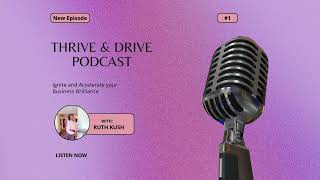
Ruth Kusemiju breaks down communication strategies for nonprofits, from building a plan and defining your audience to finding your brand voice and using social media. She covers storytelling, email marketing, influencer partnerships, and how to repurpose content across platforms.
Chapters
you can, um, talk about, um, what you've done, the impact that you've had. But they definitely won't just remain as stories. You can take those stories and repurpose it. Um, just imagine turning a heartfelt story, um, into, let's say, a captivating video, um, for YouTube or Instagram, sharing behind-the-scenes moments on Facebook. So it It's all about, um, trying to find creative ways to reach your audience. Hello and welcome to the Thrive and Drive podcast, the podcast where we unravel the intricacies of modern business through the lens of strategic marketing, digital expertise, and the power of effective communication. Hey, I'm your host Ruth Kush, And I'm absolutely thrilled to have you on this journey with me to ignite and accelerate your business brilliance. Yay! Okay, back to business. Welcome to another episode on the Thrive and Drive podcast. Yes, it's great to be back again today, and, um, I say welcome to our new listeners, welcome to the old listeners. And welcome to those that are yet to hear this episode. Okay, so, um, I did promise you that every month you're gonna be hearing from me twice, and today is the day. Okay, so, um, we'll be talking about communication strategies for the nonprofit space. Um, I did, um, if you missed the first episode, um, that talked about basically who I am and what I do and the purpose of this this, um, podcast and this series that we'll be doing, I advise you stop where you are right now and then just either you click in the show notes and go listen to the first episode, or you could just, you know, get— go to the show itself and listen to the first episode about, um, the Thrive and Drive podcast. Okay, so today we'll be discussing, um, about, um, how both startup nonprofits and, um, existing nonprofits can improve their communication efforts to reach their target audience and achieve their goals. Now, the reason why I'm doing this is because currently I'm in the nonprofit space. I've been in the for-profit space, now I'm in the nonprofit space, and I basically specialize in communications. And I know, um, what it feels like to be part of an organization that's a startup, and then you're thrown into the deep end of the communication game game, and then you have to figure your way out and around. So this is for you if you're a newbie. And if you are not a newbie and but you have been in the game for a while, I'd be sharing my journey basically with you, um, how I was able to thrive and drive myself in the nonprofit space. Okay, all right, so, um, One thing that, um, I had to learn, or I came to learn in my journey, was that it's crucial to establish a strong communication plan from the beginning, from the get-go. You can't say you're into communications and there's no strategy, there's no plan, there is no, um, how do I put it, that there is no work plan that you have to tick off. How do plan to strengthen your image? How do you plan to, um, what you call it, establish relationship with stakeholders? How do you plan to engage influencers? How do you plan to promote your campaigns or your projects or the initiatives that you're working on? All right, so it's very crucial for you to establish a strong communication plan from the beginning, right? And this includes defining your target audience. And target audience, we're talking about, are you— are your target audience the general public, or are you looking at donors, or are you looking at HNIs? And if you don't know what HNIs is, that's high network individuals. Or are you looking at the ultra HNIs or the HHNIs? So then create a compelling mission statement. So after you define your target audience, create a compelling mission statement, and then develop a consistent brand voice. And you could make use of social platforms like Facebook, like Instagram, like LinkedIn, like YouTube, like Twitter, or X as we know it now, to help you reach a wider audience and build a community around your cause as a nonprofit. And literally, in my journey as a communication specialist, I had to build that brand voice on Facebook, on Twitter, on LinkedIn, Instagram, YouTube, Google+, TikTok. So like, it had to go around, right? And, um, one effective strategy that I, I, I, um, sort of had to put at the forefront was to, um, be very intentional about my collaborations. Yeah. And because the fact that no man can be an island by themselves. You have to work with people to be able to get to where you want. So that comes— that ties a lot with how you manage your relationships with influencers, with key stakeholders and stuff like that, or even nonprofits in your space, right? And collaborate with these influencers and other nonprofits in the same space to be able to amplify your message, to be able to reach new supporters, to be able to reach new donors, to be able to reach partners. And not just only that, another strategy that also I had to adopt, adapt, and imbibe was email marketing campaigns and creating engaging content on our social platforms, on the website, on the blog to help the organization connect with our audience on a deeper level. So it wasn't just all about, um, this is who we are, this is our vision, our mission, our objectives, our core values. No, there still had to be that ongoing constant content that gave everyone that came to our pages an insight of who we are, what we are about, and what we're trying to achieve. So, um, yes, there's a whole lot to communications, and it's not just, um, because you sort of have set up these pages and that, that's it. No, there's a whole lot to it, but that's just one aspect. And we would be able to take this to like a deeper level as episodes, um, ongoing. In fact, um, I thought I was not going to be able to do it on this episode, but, um, if you stay tuned Um, to the next episode, um, I do plan on bringing in, um, on board a communications consultant with over 5, 6 years experience in the nonprofit space. And, um, I'm just gonna leave it at that, but I, I, I, I would probably drop a name in later, but, um, you'll be so thrilled to hear from her, let me put it that way. Okay. Okay, so now that we talked about the startup nonprofit organizations, let's shift our focus to the existing nonprofit organizations. Okay, so we know basically these are the organizations that are already doing amazing work, but they need to keep their communication strategies fresh, engaging, to be able to stay relevant. I mean, I could read off the numbers of different nonprofits that probably have that challenge or are struggling to stay afloat. And it's absolutely true because for existing nonprofits, it's all about staying connected to your audience. I mean, this could mean updating your website, your social media profiles to reflect current projects that you're doing and the impact that you are having or making with your community, with the states, with the local governments, with the— in the country at large, really. And I mean, one thing I, I wouldn't fail to, to point out here is storytelling. Ah, because the heart and soul of effective communication is in storytelling, sharing stories of impact and successes. And this leads to you creating powerful connections with your supporters, with your donors, with your partners, with, um, the public in general. And to create these stories, I mean, you can create these stories, you can, um, talk about what you've done, the impact that you've had, but they definitely won't just remain as stories. You can take those stories and repurpose it. Um, just imagine turning a heartfelt story into, let's say, a captivating video um, for YouTube or Instagram, sharing behind-the-scenes moments on Facebook. So it's all about trying to find creative ways to reach your audience. I mean, you could be having a webinar on, let's say, on Zoom, but you can take that same webinar and break it up into chunks, um, bite sizes, and share on Instagram, share on YouTube Shorts, share on TikTok. Just certain snippets that would spell out specifically, specifically some important nuggets that each speaker or presenter is bringing out and just throwing a whole new light or a whole new meaning to a presentation or topic. So think about how you can also repurpose the content that you share and create to appeal to the different audiences across various platforms. To every nonprofit that's already been existing, remember that you need to stay adaptable and you need to keep experimenting with new ways to communicate because your stories are worth sharing. I mean, that's something I had to learn as a communication specialist that I needed to know how to tell stories. I used to be this shy— not shy in the sense, but I was very, um, formal and very, um, how do I put it, very professorish with my content. Like, you're always writing like you're writing to a corporate organization, you're writing to this. But you gotta realize that people consume information in several creative ways. So you have to see, how can I take this information? If I want to break it down to a 5-year-old to make a donation, I need to figure out what I need to do to be able to pass that message across without losing the, um, the major meat of that content that I'm sharing. So figure out, keep experimenting new ways— videos, reels, stories, infographs, infographics. Um, uh, it's, it's, it's a whole lot. Slideshows, um, just think podcasts like we're doing now. Yes. So it's— you have to be very, very, very, very creative in communicating to reach a wider audience. Yes. And that brings us to, I would say, the end, or the concluding part of, um, how to communicate effectively as a nonprofit. So you might be fresh out of the box, or you might have been in the system for a couple of years, but the key that, um, you both need to realize and put to mind is that you need to be able to communicate authentically and be able to engage with your audience. I know the time it took me to— not, not necessarily a long time, but, um, I— because I had to do a lot of influencer marketing, influencer engagement, I had to learn how to speak their language. I had to learn how to communicate with them, how to be their friend. So for me, communication is all about, um, the friendship before the transaction. And it works so well that sometimes you are able to get them to do things for you at little or no cost. So, um, figuring out how to connect with your stakeholders is quite, quite important. So one thing that I think I would leave with you, which I, I, I believe should help you in your communication strategies, is that remember that communication is a bridge that connects you to your supporters, to your partners, to your donors, to your communities. And so when you listen, when you engage, and when you share your stories, you can really make a difference in the world. So they say facts tell but stories sell. And so as we wrap up this episode, I want to encourage to every one of you listening out there to take action. You might not even be in a nonprofit space, but this can help you. You might be in the for-profit space or whatever space that you are in. Communication is always paramount wherever we are, right? And take action. Figure out how to portray you, that voice. Is it an empathetic voice? Is it a fun, entertaining, exciting voice? Is it an educative one? Figure out how to portray that voice carrying your vision, your mission, your impact to your audience, right? And if you haven't already subscribed to the podcast, I, I would say hit that bell button right now and subscribe to this podcast, the Thrive and Drive Podcast, for more insights and tips on how to improve your communication efforts, because we are going to be talking about this a lot. So communication is just one of the aspects we're talking about. We're gonna dive deep into digital marketing. We are going to— and, and it's not just going to be me. I'm going to be bringing experts on board in various industries and sectors and spaces, those in the profit space, those in a nonprofit space, to just show you guys that, hey, there are people out there that are making a killing, and it's the— it's time for you to be able to glean from their years of experience, the impact that they have had in, in their work as a consultant, and just learn and learn and learn and learn. So don't forget to reach out to us, reach out to me if you have any questions, if you have stories you want to share. I mean, we could literally take a— to have an episode where we just share, ask, and try to answer your questions. Or try to bring— share your stories and get feedback. And we love hearing from you, we love hearing from you. And let's just continue to communicate for good together. So this is me, Ruth, your host of the Thrive and Drive podcast, saying thank you for joining us today on our journey through effective Communication, and, and you could follow us on social, you could subscribe to this podcast, you can share this podcast with your friends, your family, your colleagues, everybody at large. And until next time, keep communicating for good.
More from Ruth



Day 14 Write Record Challenge - 5 AI Terms You Need to Know (Without the Confusion)



Day 11 WriteRecord Challenge - 3 Ways to Stay Productive & Efficient with AI Tools

Day 10 - Write Record Challenge - 4 Ways to Build a Digital Ecosystem for Your Business That Works

Day 9 WriteRecord Challenge - 3 AI Automation Hacks That Save You 10+ Hours a Week