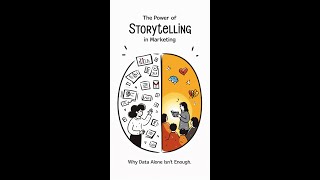
Ruth Kusemiju argues that storytelling beats data in marketing because people buy stories, not products. She breaks down a three-part structure—Problem, Solution, Transformation—using Airbnb as an example: the traveler feels disconnected from local culture, authentic stays reconnect them, and they feel at home anywhere. Make your audience the hero, not your product.
Chapters
Hi and welcome to day 4 of the Write, Record Challenge. And before I go on, I do have to say one quick shout out to my girl Ella. Thank you for the pep talk, and yes, you're officially my brand manager. So no problem, I took your words to heart, and so as you can see, I look different today. Okay. Thanks. Okay, so moving on today. Um, so I was thinking through my day, like, what, what am I going to talk about? Like, okay, this is day 4, I should have something to say. And then I was thinking, I don't want to go down the AI rabbit hole again, SaaS. And then you're like, we keep on hearing the same thing every day. So today, um, I think, um, while I was kind of doing my, you know, sort of discovery, book summaries and stuff like that, I thought of something and I was like, storytelling. How, how do I— how can I tell good stories? Because I know I'm not a good storyteller. I don't know how to tell stories. I try, but, um, the power to grab the audience, I'm learning. So maybe it's the geek in me that knows how to work with these tools but not connect, but then I have to work on it. Okay, so one phrase: people don't buy products, they buy stories. Okay, and if as a brand I don't have a story, then I'm just another name in the crowd. I need to have a story. You know me already, Ruth Kush, and Today I just want us to talk a little bit about the power of storytelling, and, um, I'm not going to go through my journey into AI anymore. I think you've had enough of that for 2 days. But definitely, as I, um, I'm going through this, I definitely would give you insights to maybe some of the tools that I'm using that makes stuff easy. Right now it's just face to camera and trying to make this work. Okay, so one thing I realized is that people always connect with stories and not statistics. Stats are good. I'm a numbers girl. I love, love dealing in numbers. I used to hate math though in school. I wasn't really a good math student. Sometimes my report card would come in and And then usually math was always the first subject, and then we had others. I had— when I was in high school or college— no, high school or secondary school as we know it here in Nigeria, um, math was always the first. And math is always where I would have a red, and then the rest would be blue, blue, blue, blue, blue. But you just see that red, and that red always seems to stand out. So, so why I like numbers, I don't know, but then again, because it's not math, because it's data, and I could easily tell, interpret, or come to a decision based on the information that I have. I think that's why I like numbers. But the thing, the fact is that people connect with stories and not stats. Stats are good, as I said, numbers are good, facts, features are good, but people connect with stories. And so the question you'll be asking yourself is that, how do I craft a story that turns my audience into loyal fans? I'm just going to break it down for you the best way I know how, and I promise not to bore you with the details. Now think about brands that you love— Apple, Nike, Tesla— what do they have in common? They don't sell products, they sell emotions. Apple, for instance, doesn't just sell phones, um, they sell innovation and creativity. Nike doesn't just sell shoes, they sell determination and resilience. Tesla doesn't just sell cars, they sell the future of sustainability. So the best brands actually make their audience the hero of their story. The products are just the tool that helps them win, right? But, um, your audience has to become the hero of your story, as in you selling the emotion to them. Now, every great marketing story follows a 3, a simple 3-step process or 3-part structure or however you want to call it, right? 1 is the problem, 2 is the solution, and 3 is the transformation. Okay. So when we talk about the problem, what pain does your audience face? What are they going through? What keeps them up at night, right? The solution is that how does your product or how does your service solve that problem? How does it take them from a state of B, right? What they— from point A to point B, a state from a state of— this is their before state and takes them to an after state, right? And then the third is transformation. How will their lives improve after using your product or your service? Okay. So the problem, the solution, and then the transformation. So let's apply this formula to like a real-life example, and I'm just going to use an example that, um, you all know— Airbnb. Very simple, very basic, right? Now, Airbnb could have marketed themselves as a cheaper alternative to hotels, right? But instead, they told a deeper story because the problem travelers had was that they felt disconnected from the local culture in the traditional hotels, right? And then the solution was that Airbnb provided unique local stays that offered an authentic experience. And what was the transformation? Now travelers, tourists could feel at home anywhere in the world. And really, that's the power of story-driven marketing. It makes your customers feel emotionally connected to your brand. They are able to— you're able to, you're able to feel their pain. They're able to feel the solution or the joy that your product or your brand provides, right? And so whatever niche you're working in, whatever product, whatever service that you're offering, storytelling is the key to engagement and conversions, right? So people don't really care about the features, the facts, whatever. They care about the results. So if you're building a brand, I advise that you focus on the story first and then the product. And that's it for today. Let me know what brand story has stuck with you. And you can put it in the comment section below, and I will see you guys again tomorrow. Take care, bye!