
4 Money Models in Chiropractic
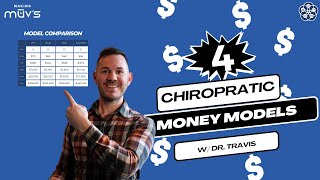
Ryan Desanti compares four chiropractic revenue models: pay-per-visit ($70/adjustment), discounted packs ($63/visit), membership ($49/visit), and care plans ($94/visit). Combining care plans with membership membership generates the highest lifetime value ($1,974 vs $280-$588) and ROI, despite higher upfront costs.
Chapters
What's up guys, welcome back to the channel and thanks for watching as we take a deep dive into money models in chiropractic practice. This video is taken from a live speaking event that I did and it talks through all of the different practice models and how you can leverage your practice model by packaging your offering to increase your PVA, your collections per visit average, your lifetime customer value, and your overall revenue generation. If you enjoy these practice growth resources, go ahead and subscribe to the channel. It gives me a sign of validation to continue producing this content for you guys. Also, if you're looking to improve your digital marketing and bring your Facebook marketing in-house, we have our Chiro Ads Academy. You can click that link in the show notes. Otherwise, I hope you guys enjoy the video.
4 most common models in chiropractic: pay-per-visit, discounted packs, membership model, and the care plan model. Now what we do is we combine 2 of these. We combine the care plan model with the membership model. What we have is a defined upfront, defined-in care plan model of 90 days. So So they come in for an initial corrective, custom corrective care program where we actually set a goal. We set a baseline on where they are, we set a goal of where they want to be, and we help bridge the gap with our 90-day custom corrective care program that combines high-level chiropractic care and functional movement specific to their spine so that they can get to the true root cause of their pain and limitation. We are becoming the bridge for them, and then after that, we are then moving them into our Continuity Wellness Membership. But what does it look like if you use these in isolation? Well, in a pay-per-visit visit model, what do we know that chiropractic is just incredible at? Why are most people seeking chiropractors? Pain. What is chiropractic really freaking good at? Relieving pain. Okay, so if people come in and they're just looking for pain relief because that's what they're associating chiropractic with, and chiropractic is phenomenal at relieving pain, then how long do you think that somebody's going to stay in your office if they get what they want within the first few visits? Not very long. Industry average of pay-per-visit model in the PVA, which is the patient visit average, is 4 visits. People make get into your office 4 times if you're running a pay-per-visit model. Does that make sense to everybody? They get out of pain, they go on with their life, maybe they come back if it comes back. Some people only get adjusted once, then they never get adjusted again. That's on us, the chiropractor, based on our ability to package and model and then be able to acquire the skills to actually convert them into long-term chiropractic patients. So next metric here is the collections per visit average. We have the pay-per-visit model, and what we're using is $70 per adjustment in this example. So let's say you're charging $70 per adjustment because you've done your research in the area. People are charging $50, $55, some people $75, and you're like, I'm a high-level chiropractor, I deserve to be paid, you know, what I'm worth. I believe that my product is worth $70. I'm putting a $70 price point on my adjustment. Well, because you're a pay-per-visit office, that means you're not offering any discounts or any bundle options. So every time they come in, they're paying your per-visit price, which is $70. So your collections per visit average is $70. Now we have in the PV model, 4 client visits, which is the PVA, times the collections per visit average of $70, which comes out to the lifetime customer value of $280. That means that on average, John, every John that comes into our office in this model is worth $280 to our practice. What did we say that it cost us to acquire a customer? $117. So we paid $117 and we received $280. That is a return on the investment, but that's a gross on the investment, not a net return. We haven't factored in all of the expenses yet, not a super profitable model. And we know they're probably not getting the fullest potential of what chiropractic can offer them because all they used it for was natural ibuprofen. Let's go into the packs model. So in the discounted packs model, what you're doing is you're taking adjustments and you're now bundling them into larger packs, and you're asking them to purchase a pack of adjustments of 8, 16, 24, whatever those packs look like, and you're giving them a discount to purchase the pack. So the only incentive to buy more adjustments is because it's going to be less money per adjustment. So you're giving them a menu essentially, and you're saying, I recommend that you come in here like once a week for the next so long, but that decision is totally up to you. You know, I'm not going to pressure you, but here's my pack options, and it looks like this. If you want to pay per visit, you can, but also you can buy 4 adjustments and that'll save you X amount. You can buy 8 adjustments, that'll save you X amount. So whenever we take the discounted packs option, and maybe they buy an 8-pack and they use that over the course of 2 months, so now your PVA is 8 but you took your $70 adjustment and you gave a discount on the discounted pack option. And so because you ran a discount for all 8 adjustments, your collections per visit average went down. So now it's $63 collections per visit average, which means every time John comes into the office, now he's worth $63 to the practice instead of $70 because he bought 8 adjustments in a single purchase. We're moving in the right directions PVA-wise because we're getting him to the table more frequently, or in an increased number of times, what we're moving in the wrong direction monetarily, because we want people to be worth more to our practice than worth less to our practice. We want this to be a win-win scenario, which is what conscious capitalism is all about. So we took the 8 visits that John got, multiplied it by $63, which is the collections per visit average, and that came out to $504. We have moved in the right direction LTV-wise as well. So with PVA and LTV, we moved in the right direction. Collections per visit average, we moved in the wrong direction. And an important thing to remember is that you have a cost of fulfillment, that every service that you provide in your office has a specific cost. If your cost of fulfillment is around $60 per adjustment, you're only making $3 per adjustment in this model. This is an incomplete picture, but I'm trying to give you the full story. Okay, so membership model, we're moving in the right direction PVA-wise. Again, the membership model is becoming more normalized. People are open to, for a cash flow perspective, objective to put something on a subscription for less amount of money, and then they kind of like fire and forget. They just like sign up for the subscription. You gotta come in person to cancel it or whatever that looks like, and it continues to hit their debit transaction once a month on the same day. People are okay with that. They budget it in and it's cool. So if you're signing someone up for a subscription, the highest number that I'm sure someone is willing to pay is about $198 or $200 for their chiropractic care subscription. So this is like the joint-based model. They're actually way cheaper than that. Their adjustments are very inexpensive and it's kind of like the Planet Fitness model. They get people on the subscription model and whether or not they use the services, that's up to them. It's actually illegal for us to do that in Colorado. We can't do that. As soon as they've gone 3 months without using any of their membership, we actually cancel their membership for them because first off, it's unethical. And second of all, we don't want them to come back and ask for refunds because you actually have to render their services. They can always ask for a refund on unrendered services. So this is not a great model in chiropractic for that recurring revenue intention. Is a good model if you have a super freaking low overhead and you just want to serve the masses and you don't care about money. So what that looks like is now, because they've subscribed to your chiropractic care for a very low price point, maybe they make it in 12 times, maybe they come in 3 months, once a week for 4 weeks each month, and then things start to get in the way. You don't have a lot of room for communication in that. Your entire onboarding process didn't provide them the requisite education. You don't have the resources to provide more workshops and more opportunities for them to learn and connect and plug in. So because of that, it becomes very transient. That's what happens. They come in, they get adjusted, they enjoy it, they're riding the high for the first few months, then they fall off of care. We have a 12-visit PVA now, and because we have now taken our adjustment price from $70 into a 4-visit subscription per month for $198, that brings it down to $49 per adjustment. If you multiply the 12 visits visits times the $49. And now the LTV, the value of John to the practice is $588, but we've increased now the amount of adjustments that he received by 30% in comparison to the PACS model. Does that make sense? But we only increase the revenue generation by $84. So now if our cost of fulfillment is almost $60 in order per adjustment to fulfill on that service, you're losing $11 per adjustment. This is not a good model. I know several people that started with this model right out of school because they had the Jim Parker mentality or the Sigafuse mentality or the Reggie Gold mentality, which is just like the box on the wall, just like serve people, build it, they will come and they will pay. And they started going down really fast because they had no life force. They couldn't actually sustain their practice on that much revenue generation per adjustment. So there's a better way, the care plan model. These were our numbers at the time. Our collections per visit average is now, now actually higher. So previously at about 2.5-year mark, our patient visit average rather was 21 visits. That means every single new patient that came into our office averaged out to 21 visits received in our office. That's awesome because we already talked about some people come in for day ones and they don't convert to care. So there's a lot of people in our system that it only shows one visit, but we also have people in our system that show 120 visits. So that averages out to 21 visits per person that walks in the front door of our office. Now, because we value stack and we bundle our care into offering way more value than any chiropractic office in our area. And we have a very formulaically driven, or formula-driven, conversion process where we're doing all the things that I mentioned previously. By the time we get into our sales presentation, as you want to call it, or our report of findings, they're ready to commit to transformation in their body. They're not looking at how much they're paying for the service. They're putting the value on the outcome that we are describing, and we've set as a team, and then they see the value in the bridge that we've built enough to pay an upfront high-ticket price point in our Defined In Care program. So now we've taken our PVA up to 21, which is awesome. Anybody who's got adjusted 21 times is much better off than someone who got adjusted 4 times, and we've increased the value per adjustment to $94. So now John is worth $94 to our practice versus $49, $63, or $70. We have a lifetime customer value now of almost $2,000. So 21 times $94 equals $1,974. That is a huge return on the investment when we talk about spending $117 to actually acquire John versus the $1,974 that we made. So the ROI on that is immense. So we'll continue to put money in that machine over and over and over again until it stops. That's how you actually build a profitable chiropractic practice so that you can offer them an astonishing customer experience and make sure that you're able to pay yourself and your team what you're all worth for serving this amazing product to the general public, all the while increasing the results that people get, the conviction that they get, and the understanding that they get of chiropractic because they spend more time in a chiropractic office. This to me is like one of the biggest decisions that you can make as a young chiropractor. And this right here is one of the biggest like appreciations that I have for the mentor that I had previously is because this wasn't a question in our office. He was like, this is what you're gonna do, bro. And I was like, all right, cool. Didn't know how to do it, but I knew this is what we were doing. So this led us to the promised land. And you know, even though this is what we were told we were going to do, I didn't understand why we were doing it until I broke it down like this. So now you have the numerics. This is the why. Build your business on a why. Once you have the why, all else will follow. We had the why. Now I have the conviction. And honestly, a lot of the why can be right You could just use the top line. I could have blacked out all the rest of this and been like, which model would you choose? Oh, that's easy. 21 visits.
Okay.
Which model would you choose? Oh, that's easy. Okay. $94 and 21 visits. Which model would you choose? Pretty easy. $1,974 lifetime customer value. And which model would you choose? $450,000 a year or $336,000 a year? Pretty easy.
More from Ryan









Making MŪVS (Vlog) - Episode 1: Inside Acquisition.com's First Ever Marketing Workshop
