
Episode 27: Building a Million-Strong Audience and Profitable Practice w/Dr. Stratton Poulson
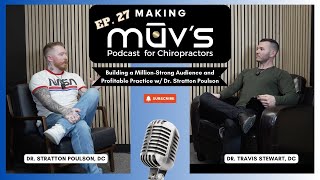
Dr. Stratton Poulson built a million-person audience by pulling back from constant content creation to avoid burnout. He shifted from strict evidence-based practice to adjustment-focused work, delegated rehab to other clinicians, and now handles hundreds of daily DMs. He argues chiropractors waste energy on semantic disputes when 90-95% of their core beliefs align.
Chapters
What's up, Makin' Moves? I'm Dr. Stratton Poulsen with Apex Chiropractic in Dallas, Texas, and welcome to my office.
Welcome back to Makin' Moves: Rapid Practice Growth for Chiropractors. Today I have the Dr. Stratton Poulsen here. Uh, we're deep in the heart of Dallas at Apex Chiropractic, and it's been just over a year, I believe, since our last podcast episode. I'm excited to be sitting here with you today in person. The first, first one we did was over Zoom. It was my second episode that I'd done with a guest. I went back and listened to it a few days ago, and it wasn't the best quality, but we had some great dialogue. And so I think there was room for a second conversation, especially you being in practice now for a year longer, and you have a few accolades now, some accomplishments that I'm sure you're proud of. And, you know, I definitely recognize those and the consistency that it takes. So I'd like to talk about that too. But just talk me through over the past year, you know, I know that you've, you've had a lot of growth on these social media platforms, but I'm sure you've had a lot of growth as a person and as a practitioner. And I'd love for you to just tell me like what's developed for you over the past year since we had our last conversation.
Yeah. I mean, the, the last year has had a lot of changes in the practice, had a lot of changes in my personal life. And it's been interesting to see the way that things have changed because now I've been in practice for about 2 and a half years and some of the things I thought in the beginning till now have changed and some of the ways that I run the practice have changed over a lot of different systems. So, you know, I'm sure we can get into all the different things that are like on a technical level that have changed, but for me it's just been kind of trying to take my foot off the gas a little bit at the beginning of this year. 'cause I was posting constantly, constantly, always on my phone, always just stuck in to the point that the focus on social media and the focus on content creation was eating up my entire life. I mean, it was like from the moment I woke up to the moment I passed out with my phone in my hand. And so at the beginning specifically of 2023, I was like, okay, I need to reset this. So I like pulled back on my posting frequency, down to like once a week, which was much more manageable. And I pulled back on some of the different projects that I was working on in the process of trying to launch. I kind of put a little halt on some of the seminars and things that I was teaching and just really tried to kind of like recenter myself and get back to a place where I felt like I had energy to commit to these different projects, because I felt like I was running myself into the ground, which is— it's interesting because There was a point about a year, year and a half in where I started to feel pretty burnt out. It wasn't actually feeling burnt out that made me want to pull back. It was just not having enough energy all the time to commit to the different things that I wanted to do. Yeah. And so I was like, I want to be more present for my patients. I want to be more present for the people in my life, friends, family. And so I really pulled back at the beginning of 2023 and for probably about 6 or 7 months, really not until about more than halfway through 2023 did I go, okay, and start ramping things back up again, start planning more seminars, finishing more online modules and things like that. So it's been an interesting learning curve to see, okay, just how much can I give? How much can I push the pedal to the metal before I start to feel like things are breaking down in my life? And then pull back from that a little bit and see if I can keep it, you know, right on the edge where I'm doing as much as I think I can handle.
Yeah, that like edge of sustainability. Yeah, I mean, that's— I think that's a great point to start this off, is there's trade-offs in everything. And I think, you know, a lot of times— and we immediately jumped into social media, right? Which has been, I think, a big kind of fruitful pipeline and channel for you in your growth in practice and obviously the growth in your audiences. But, you know, a lot of people, I think, would sit at home and when they're scrolling on their phone and they see the audience that you've built, they'd be envious of that. They'd be jealous of that. First off, they don't see the work that goes on behind the scenes to actually achieve that. And also, they don't see, you know, what you're having to deal with to manage it. And so there's definitely trade-offs, like you said, like going to bed with your phone in your hand, you know, that's part of it. And I think I'd love to talk through that, you know, maybe a little bit later on in the podcast episode of some of the things that you've had to manage the challenges that you faced with growing the audiences that we're always acknowledging and recognizing in this social media era. But first, I'd like to talk about, you know, some of the major shifts maybe in perspective or philosophy or in your practice that you've experienced over the past 2 and a half years. Because I know, you know, both of us going to Park University and me graduating like a year before you, I had a lot of a lot of dogmatic viewpoints, and, and my mindset was very fixed, I would say. Even though I felt like I was growth-minded, I wasn't necessarily very open-minded. And now that I'm 3.5 years into practice, that's changed dramatically, not just in how I treat the people on my table, but also how I view chiropractic and other chiropractors. You know, I, I see it now as like, if you're helping people in the name of chiropractic, like, we're on the same team, we're banded together. Like, I want to unite with you, you know, not be divided. And so how has your perspective and philosophy and practice, you know, like anything even technical or mechanical that you do differently now in practice based on the results that you've seen and the experiences that you've had? So let's start with perspective. Like, have you had any big perspective shifts?
Yeah, it's, um, the past 2 and a half years since getting into chiropractic has been a big shift in that. And like, when I was in school, I was more on like the evidence-based crowd, like evidence-based camp. And I was very much like, almost to the point of like, if there's not a research study to support it, I don't want to do it.
Yeah, right.
When I graduated, and they drilled into you, and so I had this almost like a little bit holier-than-thou type of thing. It's like, well, I practice chiropractic by the evidence, therefore I'm a good chiropractor. We're not one of those chiropractors. Yeah. And that has changed tremendously for me, like, in practice. I'm not, you know, up at night reading Green Books or anything, but, you know, I think my, my kind of fixation on research and supporting that and trying to be a good chiropractor, or be, I think, in some sense, a real doctor— I think some of us all struggle with that a little bit— that has been a big, a big shift for me because I've seen things in practice with patients that you would, you know, that vitalistic chiropractors would claim. And I would say that's bullshit. Like, you know, someone's ear infection clearing up, someone's vertigo that they've had for 10 years cured in a single adjustment. You know, things like that, that you can't really go back and explain. There are no randomized controlled trials to explain what's happened there. And yet I watch it happen in the office, right? And in addition to that, Just from spending more time outside of chiropractors' opinions, I think that's a huge one. It's like when you're in school, you're way overly concerned with what all the other students are doing, what they think, what they're learning, what techniques they're using, right? Because you're constantly inundated with chiropractic information. And then you graduate and you go from having hundreds of chiropractors around you all the time giving you their input and ideas and opinions to having just you, especially if you go into private practice. It's like, you know, It's just you in your office. And I'm a solo doc for a long time, so you don't even have any staff members to chat to. So just having that kind of like silence over chiropractic really gave me some time to think about the way that I viewed chiropractic, what I was seeing in the office, and what I was doing. You know, when I first started, I did a lot of rehab. And I still think that rehab is very valuable, and I have a PT in the office that, you know, you saw the PT area over there earlier. That's great. So, you know, if I have someone that needs PT, I send them to the PT now. But when I first opened, I was doing tons and tons of rehab myself because I thought in order to be a good chiropractor, a good evidence-based chiropractor, I need to do not just manual therapies, but I need to do active therapies. I need to have evidence-based explanations for care. And so over time, I found myself just dreading coming to the office because I would have like 6 hours of rehab lined up and I didn't like it very much. You know, I was a personal trainer for about a year and I stopped that because it's just not that much fun to watch other people exercise even if you're helping them get wins. And so it's not something what do I enjoy? And so I had to battle with that early on too. I was like, well, to be a good chiropractor, a good evidence-based chiropractor, I need to incorporate active care, but I hate delivering active care. So now what do I do? And so I finally had a moment where the girl I was dating at the time, you know, I came home and I was just frustrated. I'd been doing rehab all day and I really like adjusting. And she goes, you own your own business, why are you doing something that you hate all day? And I sat there for a moment and I was like, you're exactly right. You know, there's no reason for me to be sitting here administering the rehab myself if it's something that I don't enjoy, because I'm not going to be giving them 100% either, right? And I didn't enjoy rehab that much, so it's not like I was coming home at the end of the day and doing more, filled up and learning, right? Or, or trying to deliver better rehab. I was just doing, you know, what I'd been taught. So, you know, I really reframed a lot of those things. And so I stopped doing a lot of rehab. I stopped doing very much soft tissue work. Almost never bill a unit of soft tissue now. I might do a few minutes here or there. Just spot work. But if someone needs a massage, I'll send them to the massage therapist. There's a massage therapist right next door. If someone needs rehab, I'll send them to the PT. There's a PT right next door. I don't have to do those things myself. And so that's one of the big paradigm shifts. And I also realize that I think a lot of times, especially in the chiropractic profession, we're saying the same things or approaching the same concepts but using different language, and we're triggering each other with our language. Yeah. And it's creating misunderstanding. So even just like the word subluxation, versus joint restriction, right? That could start a whole chiropractic civil war right there, you know, in the comments section. But at the end of the day, we're all kind of trying to communicate the same type of ideas. And so when I stopped that knee-jerk reaction of, no, you said subluxation, you're wrong, that's not supported by the evidence— when I stopped having that knee-jerk reaction, I could just listen to what the doc was saying. I was like, okay, I get it, I get, I get the, the train of thought that you're on, I get what you're trying to say. And so it took a lot of the anger and fight out of it. And now I just kind of like, do your thing. You know, we all do our things. We're all helping patients as best we can. And so I think a lot of the infighting really is kind of about semantics. And we're all just trying to do the best that we can for our patients.
Yeah, I agree.
So that was a big paradigm and perceptual shift that took place for me. And it really chilled me out. And it helped me exist online too. In an easier space where I'm not feeling the need to argue or go back and forth with people. I was like, cool, thanks for your opinion. You know, we're gonna continue to do things the way we do things.
Yeah, yeah. Well, how has that, uh, so I, I feel like that's a kind of like a perspective shift that you've had based on your own desires, right? Or you, at least that's how you just explained it. So like you didn't enjoy doing rehab, so you came home and she was like profound, right? Like, you own your own business, why are you doing rehab if you don't enjoy it? Well, that's a great question to ask any entrepreneur. You know, we want to be doing the things that we enjoy that fill us up, that are also in the best service of our people, which would be doing the things that we enjoy so that we can serve at our highest level. But also, like, what have you seen? Now, I know you mentioned like the vertigo and, and, uh, what, what else did you say?
Um, I've had ear infections, ear infections. Yeah, I've had people who had, you know, tinnitus clear up after a single adjustment. Vertigo, a lot of things that the, the strict evidence-based crowd would tell you there's no evidence to support that, there's no mechanism There's no mechanism by which that should even be possible with chiropractic, right? You know, the, the auditory nerve is nowhere near the, the cervical spine, and yet here someone is with improved hearing after adjustment. Or, you know, the vestibular system has a loose connection with the cervical spine, and yet someone who had, you know, vertigo for 10 years, taking medications, has done all kinds of interventions, ENT's cleared them, all the scans are clear. I mean He's done every conventional doctor approach, and then we adjusted him one time. Now that was an atlas. I usually don't subscribe to like bone out of place theory.
Yeah.
When I touched this man's atlas, it felt like it was half an inch to the right. It would be one of those rare cases where I'm like, this really does massive lateral shift.
Yeah.
This really does feel like maybe that's not in the place it's supposed to be. And I adjusted him and that went off like a gunshot and he came back, has been gone.
Yeah.
And it's like ever since that first adjustment, now he just comes in for wellness adjustments just occasionally.
Yeah.
You know, there's lots of different things like that that I've seen in practice that have changed my tune on what's possible in chiropractic. And that also broadened my kind of perspective. You know, I still don't go making promises to anyone that I'm going to restore your hearing or I'm going to cure your vertigo or clear up your asthma or anything like that. I don't make those promises. But now I just refer to them, you know, to patients as like, Sometimes we have happy accidents. So I'm gonna treat you for your neck stiffness, your neck pain. I'm gonna treat you for your low back stiffness, your low back pain. If you have better digestion, that's a happy accident. If it helps your PCOS, that's a happy accident. If it helps your depression, that's a happy accident. You know, I kind of treat it like that now.
[Speaker] Yeah, yeah, but I think it was a reinforcement in experience, you know, that also aligned with what you enjoy. And I think, you know, I was interviewing Dr. Tim Young here I don't know, a few months back, and he mentioned that you don't truly understand the essence and the premise of chiropractic, the power of chiropractic, until it happens in your hands. And so now you've had, you know, 2 and a— how long? 2 and a half years?
2 and a half years.
2 and a half years of having these things happen under your hands to where you know, like, I'm best serving the people in my practice by using my hands. I mean, you're a great adjuster. Like, you worked on your skill set. Obviously you came from a massage therapy background. You understand the anatomy, you understand the physiology, but you also have a martial arts background. So that was a skill set, um, that you were able to take and translate immediately into adjusting. You're a great adjuster. And so there's clearly power in providing a great adjustment into an open system that's ready to receive it, and then just being unattached to the outcomes. And like, whatever happens happens. And I think, you know, one thing that you talk about with your marketing is like, You show, don't tell. And I think it's the same in chiropractic. It's like the philosophy's for us, you know. And I think if we continue to try to like scream it from a rooftop and scream at each other and infight and all of that stuff instead of just showing the people on the table, they get to experience it themselves, right? And they get to walk out and they have whatever experience that they have. And a lot of times it's, it's profound, especially in our office too, you know, things that, um I had read the Green Books, you know, and I had wondered why we had this one camp that was just so unapologetically strongholding this philosophy of what chiropractic is and can provide. And then this counter camp that was trying to abolish like any materials that stated anything more than a neuromuscular facilitation for improved coordination and range of motion or whatever, you know. And I just wondered why you had two camps that both thought that they were so right that they were willing to go to bat and fight over this instead of just treating the people that needed the help and just letting the results speak for themselves. And so now I'm just, I'm in this place where obviously I'm trying to be this bridge of information and I'm going and trying to talk to anybody that's willing to talk to me, um, no matter what camp they're in, you know, because I just want to better understand this. And so I think that there's, there's a place for this, uh, as we move through, because I do have some questions a little bit later on about some of the things that you experience online. And I think that that's going to be a great opportunity for us to talk a little bit more about the division, uh, either between chiropractors or from the medical system or other professions and how they view chiropractic. But first, I have a quote that I would like for you to just kind of speak to, and it's kind of like the mantra, the heart of what Making Moves is all about. But it goes, "Heart of a servant, hands of a healer, and the adventurous spirit of an entrepreneur." What does that mean to you?
So, heart of a servant, hands of a healer, adventurous spirit of an entrepreneur. I mean, that kind of sums up chiropractic pretty well. You know, I think you do have to have your heart in it. And I can tell there will be days where— because, you know, when you're in school, you think, I can't wait to be a chiropractor, I can't wait to own my own practice, I get to just adjust all day, I don't have to fill out all this paperwork and go through all these hoops like when we're in school. And you get into practice, and I think that happened to me about a year, year and a half in, there are days where you get up and chiropractic is a job, right? And I think it's probably one of the best jobs in the world. I mean, you get to show up You get to help people feel better. They're happy to see you. Everyone tells you how great you are. I mean, it's one of the best jobs that you possibly could have. But there are days where you get up and you just don't feel like doing it. There are days that it does feel like a job to go into practice. And I don't think I was adequately prepared for that or to experience that in real life once I graduated. And so that also was kind of a shock to me, like to wake up and feel like, ugh, I'm not feeling like doing this today. But you also notice it in your patient care, like when your heart's not in it and you're not present with your patients. You know, even though I'm a great adjuster, I'll know, like I'll adjust and I'll be like, "Hmm, that was not my best work." Right. That was not the cleanest adjustment. That was not the most successful. Or you have somebody who gets up and this happens occasionally, they get up, they're kind of like, "Oh yeah, you really got it." And you're like, "Hmm, yeah, that was not a clean adjustment through an open joint that was ready to receive force." And so you really have to police your headspace. You have to police your heart space and make sure that you're in it when you're in the office and that you're going to be delivering adjustments. And so, you know, I have some things that I do, like come in and I have the lights off and I'll say a little prayer. And then I'll get into some like Tuli board strikes and things like that. And then just trying to like sit there and focus on my breath before the first patient shows up so that I can make sure that I'm in the right space to then go deliver those adjustments. And I'll even do it when I come back from lunch and I feel like I'm now out of sync with where I need to be because I've gone out into the world, I've been eating, you know, taking care of me. I've got to get back into a space where I feel like I can take care of other people. And so that's huge. I mean, you have to make sure that your heart is in it. And even on those days when you don't feel like coming to work, just knowing that the satisfaction of doing good work will help bring some of that up. Because to me, even if I'm having a bit of a low morning, once I get in there and I treat a few people, I see some smiling faces, I see some of my favorite wellness patients, my mood comes right back up and I feel better about being there for the day. So I think, you know, that's a huge part of the profession. Hands of a healer, you obviously have to be good at your craft. I think I'm preaching to the choir talking to you about that. You know, you really do have to put the skill and the time in. To be able to deliver an incredible adjustment. And that's where you'll see the difference. I think, you know, talking about even just about the divide in the profession, I think some people view the adjustment as being less powerful because they've never seen powerful results from the adjustment. And that's huge. I mean, if you've never seen some of the things that we've seen as the result of an adjustment, then sure, it's easy to think, well, it doesn't matter that much where you adjust, how you adjust doesn't matter that much, just crack something and move on. Right? But once you start to have some of those experiences and you really have the skills and, and, and that starts to open up to you, then you can appreciate how important the adjustment is. And that's become more and more important to me as my career has progressed, to the point where now if I can only do one thing for a patient, I would rather adjust them. You know, even someone who's chronically ill, overweight, obese, I would rather adjust them. And hopefully that feeling and that relief that you give them then gives them the ability to go in and change their lifestyle factors and do these other things.
Yeah, right.
So I think that's huge. And the entrepreneurial spirit, I mean, you really do have to be able to roll with the punches. You really do have to be able to, to eat a lot of crow and, you know, get punched in the face and get back up and go ask for another one in order to have a successful practice. Because it's not, you know, it's not easy. And I know that you know that, especially because you started when COVID was a little bit more of a big deal than when I started. And so there's a lot, a lot of challenges that go into being an entrepreneur. And you really have to, you really have to focus on becoming the person who you need to be to meet those challenges.
Yeah.
You know, and it's okay to not be that person at any particular moment, but being an entrepreneur means identifying a problem and then improving yourself and becoming the person who can then deal with that problem and solve it. And then you just do that 100 times a day, 100 times a month, you know, over and over and over again. So I think that that's an awesome quote. It really is very much what it's like to be a chiropractor. There's a lot of things that go into that.
Yeah, and, and I, I would, I would say, just to add on, I think, uh, as a student and as a young chiropractor maybe coming out that doesn't have any entrepreneurial experience, a lot of times because of the bubble that you mentioned, right, we're in this bubble surrounded by X amount of thousands of chiropractors, and then the 10 to 15 people that you surround yourself with that are typically like-minded. They typically come from a similar background. You have strong commonalities and, you know, you all think in a similar way. Like, even if you're infighting about the philosophy of chiropractic, you're still chiropractors. And because of that, you have very strong commonalities regardless of what you'd like to think. Then you get out into the real world and you realize that nobody really cares about chiropractic. You know, most people don't care about their general health and well-being enough to even see a chiropractor, even if the benefits were true, that we like to preach and talk on. And so becoming an entrepreneur is pertinent, you know, to being a successful chiropractic practice, or at least being in a successful chiropractic practice. I think even as an associate chiropractor, an independent contractor, like you have to have an entrepreneurial spirit because in most of those practices you're going in to add value. Even if you are seeing people to like adjust people, you still need to be able to communicate. You've got to be able to convert people. You got to be able to retain the, the patients. In a lot of, a lot of practices, you got to be able to go out and get them. And that's what being an entrepreneur is all about, or at least having the entrepreneurial spirit. So I think that's one thing that I would like to continue to share with young chiropractors is that it's not easy. The road's not easy. And so just like you said You don't really understand the profound nature of chiropractic or what you are providing for people until you've delivered a skilled adjustment into someone and seen a before and after effect that kind of just like surpassed your, your prior thought around the potential of what the adjustment can provide. And then that happens over and over and over again until you have unequivocal data or anecdotal data at least to support your belief in how powerful chiropractic can be. But that only comes through a skilled adjustment. I don't know any, you know, we're talking now only, I'm only bringing this up because we've been talking about it. Evidence-based chiropractors or who would claim to be evidence-based chiropractors or say that they're solely in that camp who talk about what the adjustment cannot do for someone. That is a skilled chiropractic adjuster. I just don't know any, you know, I'm not seeing any of them delivering just like lightning fast, really smooth, really comfortable adjustments into people that are open and able to receive them, that are entrusting, um, in the hands of the chiropractor. And I think you're right. I think because when you can deliver it, there is some type of threshold, and I'm not sure— Heidi Havoc does some research on this, and I think it's like 200 milliseconds to effect the largest neurological change and effect change on the prefrontal cortex and whatnot. So I think there is some research that's starting to come out to support that. But outside of that, I don't understand it other than maybe intention. And I think that's what a lot of like the vitalistic chiropractors like to kind of stand on. The ground they like to stand on is all about intention. And I do, I do feel that and agree with that to a point. But I also think it comes through the skill. You know, like there's something to do with the speed, the accuracy, and the comfort, the comfortability that you always kind of speak to that is just, yeah, it's, I don't know. I think it's hard to detect and it's hard to measure, obviously, but there's something to it.
There absolutely is. And I think where a lot of the evidence-based docs get hung up is there is research that shows that, you know, our palpation between providers is not that reliable. There's research that shows that the type of technique that's applied doesn't seem to matter very much for the outcome. There's research that shows that, you know, you can get just as good results in the cervical spine for pain, disability, and function by adjusting the thoracic spine instead of the cervical spine. And so they'll argue that the, the site of application doesn't matter, right? So there's a lot of research for that. But I think what you have to be able to do is you have to look at that, and then you have to be able to reconcile that with the experience that every chiropractor has had, which is that we've all gone through chiropractic school, we've all had horrendous adjustments from our peers. And hopefully we've all had a truly amazing adjustment at least once, you know, in our career by a doc that maybe we respect or whatever. And so every chiropractor for the most part has had the experience of a really excellent adjustment. And then we can compare that against some of the awful adjustments we've received. And so it's undeniable there's an experiential difference between receiving a really skilled, smooth, you know, what many would consider life-changing adjustment and your average kind of student-level adjustment or your average just Doc Hart's not in it, just whatever adjustment. And so there's a qualitative difference, an experiential difference, a qualitative, not quantitative. So I may not be able to plug that into a randomized controlled trial and get data out of that that makes any sense, but there's a qualitative experience that's different. And so I don't think that to say because it's not data-driven or hard that it's, somehow not true or significantly unreliable enough that we should discard that information. And so when you open up the fact that there is a difference between skilled providers— it's funny, one study even showed that the students in the study had got better outcomes than the more experienced doctors in the study. So they had doctors that were in practice for 4 or 5+ years, 10+ years. And then the doctors who were in practice for 1 year, or the students, were actually getting better outcomes with their patients than the seasoned docs. So evidence-based crowd will look at that study and then say, okay, well, even your experience doesn't matter. So you think that you've got all this experience or all this skill in palpating, but the research shows it's not true. It just shows that there's a lot of variability within the profession that we all know.
Yep.
But I think you have to understand that there's obviously some room for skill, right? There's obviously some room for someone to deliver a better, more powerful experience. I don't think that you can chalk that all up to expectations. Like, they'll say, oh well, you got adjusted by someone who you would consider as like a guru, so you look up to them, you're expecting a better experience, and therefore you have one, right? There are contextual effects, but I don't think that you can say that it's entirely contextual. You know, if a patient sees my videos, they come in to get adjusted, and they see me giving all these people relief, they see people crying after getting adjusted, right? They say, I have to go see this doctor. And so they come from across the state or across the United States to come see me instead of a chiropractor near them, sure, they may be a little bit more motivated to have a better experience because they're so looking forward to it. But I don't think that that fully encapsulates everything that's happening. I think you can have both. You can have a contextual effect that's elevating their personal experience for the adjustment, but you also have a technical aspect to the adjustment. And I think that that truly can be better or worse. If it wasn't, there would be no need for, for our instructors in school. Right? After the very first time I made a joint made noise, I would need no further instruction because there's no technical aspect that is relevant to adjusting. I just think that's completely ridiculous. And so this is where I get with the evidence-based camp. I find myself smooshed in the middle a lot, which is why I take heat from all sides, you know, on socials. Although I would consider myself more of an evidence-based doc, I don't use the word subluxation. I'm very like mechanistic in my explanations with patients and things like that, or biopsychosocial in my explanation with patients as well. I only adjust, or I just adjust. And I always laugh at just adjust, because I think that's the best part. But so that puts me at odds with the evidence-based doc, because all I do is slang adjustments. And so to me— to them, they're like, OK, well, all your explanations make sense. We like your explanations. But the way you deliver care, I can't tell you apart from a vitalist. So are you really doing the right thing? And then the vitalists, or the more philosophy-based docs, they go, well, we love the way that you adjust. You're slinging lightning out there, and you're doing good things for the profession. You're watching the miracles happen in your office. But the way that you communicate with patients is just so cold or so, you know, based on the evidence. And so I end up getting heat and praise from both sides. So it's an interesting place to be in. And I think that that has really shaped some of that growth for me, like we were talking about in the beginning, that perspective shift. Because as I started to really lean into the adjustment, I noticed a lot of my peers in the evidence-based community giving me a lot of pushback and a lot of, you know, questioning on focusing on that, or even just posting videos of adjusting at all will get you heat from people in the profession. So getting heat from the evidence-based side pushed me a little bit away from them. Getting heat from the vitalistic side pushed me a little bit away from them. And I kind of found myself sandwiched in the middle. I was like, well, what the hell is even going on now? I think you can just deliver an incredible adjustment, and then you can deliver explanations that you feel are true to you, resonate with how you believe and how you think about chiropractic. And you'll attract the people that resonate with that. You know, my office is not filled with crunchy moms and hippies. It's just not the vibe of the office. It's not the way that I message or communicate. And so that's not my patient base, right? Whereas someone who focuses primarily on prenatal or does a lot of, you know, stuff with those types of communities, their office is gonna have that type of patient demographic. So you can be true to yourself in your explanations and you'll attract patients that resonate with that. And you can focus on excellence. And the way I focus on excellence in my practice is through the adjustment.
Couldn't have said it better myself. I think that that's, that's something that we have and we are experiencing in our office, uh, right now. Just to kind of give a little bit of feedback from, from my perspective is like whenever we started practice, we were attracting us, like just different versions of us, people in similar phases, similar age range, similar class, you know. And now that we're getting ready to have our first child and Dr. Emily came into the practice, like, now there's babies everywhere. There's pregnant moms everywhere. Like, as soon as Sarah got pregnant, pregnant moms started coming out of the woodworks, you know. And so now our practice is being more filled with people that are bringing life into the world. So it's an interesting thing to experience now as well. It's kind of like a mirror. Like, your practice is almost a mirror of your value system and just like the, the, the actions that you take every day, the behaviors that you have, the habits that you maintain, uh, just start to show up in your practice. So it really is a reflection of like who you are and what you prioritize. Um, one thing that I, I did want to get into, and you already segued into it naturally, was the— first off, the hate that you receive on social media, which I'd love to, to kind of dive in and get a little bit of kind of a psychological analysis on how you manage that. But also kind of the second part to that was that a lot of the profession holds a strong opinion around showcasing adjustments on social media. You hit on both of those. So the fact that you naturally in conversation or in your response just now spoke to both of those points, which are two questions that I have here, means that it's something that you have thought a lot about and have probably had to endure over the past 2 and a half years. So let's start with how you manage the mental aspects and the challenges of being what some would call a social media influencer as well as a chiropractor.
Yeah. I mean, one of the things that I think we talked about in the first podcast was the difference between like your organic content and reach and then your paid reach. And I talked about the fact that you don't need a big social media following in order to start attracting lots of new patients. Because when you run paid ads, you can target them locally and you're not competing with all of the biggest chiropractors on the platform. You're just competing with the chiropractors running ads in your area. So you can start to get new patients. I was getting like 50 new patients a month when my page had like 5,000, 10,000 followers. Now that may sound like a lot if your page has got like 600 followers, but in the grand scheme of things, it's not that many followers to get a high level of new patients.
[Speaker:RYAN DESANTI] Yield, yeah.
[Speaker:CHRIS] And so, you know, I think you gotta be careful what you wish for when you start thinking, oh, I wish I had 100,000 followers, I wish I had 200,000 followers, I wish this, I wish that. Because you end up getting much more of the nonsense that kind of clouds and obfuscates, obfuscates, whatever. It clouds what you're trying to do. It gets in the way of what you're trying to do. So, you know, having tons of comments and people are either leaving hey or they're saying inappropriate things about the patient that's on the table or whatever. Now you've gotta go moderate your comments. And moderating your comments is not doing anything that's generating new patients, right? And so you add all these layers and then you're getting tons of DMs. That's been the biggest thing for me to deal with is the fact that I get on any given day between 50 to 75 DMs usually.
[Speaker:RYAN DESANTI] Wow.
[Speaker:JOSHUA MACHT] And so, I mean, I wake up with 20 DMs of people asking me questions, wanting to know things, wanting to share things with me, wanting to talk. And, you know, I go for a few hours in the practice just treating patients, I open my phone and it's— Instagram's got 45 notification bubbles. I mean, um, the amount of mental effort and load that goes into just managing people talking to you is tremendous. And I try and be very available because, you know, I'm mentoring students and trying to be— trying to be for students the mentor that I didn't have when I was in school because I never had a very strong role model or chiropractic mentor. And so I wish I would have had someone And so I try to do that for students and be very available, but then it does take a personal toll trying to have so many conversations and so many things. And that was part of what ends up creating that thing where I would literally be on my phone, and I would wake up in the morning with my phone on my neck because I'd fallen asleep on my phone and dropped it on myself and just passed out. So dealing with the amount of inquiries and things becomes a little bit of an issue, and it's one of those things that Those are not generally activities that are creating new patients. Every once in a while you get somebody who just sends you a DM and they're in your area and they're interested. But a lot of them are like, you know, it'd be a gentleman from India. He's like, I broke my back. I've done these scans. They're telling me this. Does that make sense? Will you look at my X-rays? People sending me unsolicited pictures of X-rays and MRIs. You know, you have to sit there and be like, hey, I'm so sorry. I'm sorry to hear about your suffering. You know, I can't help you over there.
You respond?
Yeah, usually. I can't help you over the internet. I'm really sorry that you're suffering with that. It has to do with my license and I can't consult with you because you're not my patient. I hope that you can find someone near you that can help you. But then, you know, it's heart-wrenching because then they'll respond to you like, I'm suffering so much, no one can help me, there's nothing I can do, isn't there anything that you can do? And you have to be like, I'm so sorry, I really can't, like I can't help you. I hope that you find someone near you that can help. So there's that, that aspect is heart-wrenching to it. And just the pure amount of conversations and interactions that you're having can get overwhelming. But I think at a certain level, you do almost get used to it, almost like the same way in chiropractic school, you just get used to having, you know, 15 tests in one week and you're constantly under the threat of failing some quiz. You know, it's just, it's like that meme where the house is on fire and the dog's sitting at the table. He's like, this is fine. It's fine. Right? It feels like that sometimes. 'Cause it's like, you know, yeah, I have, 75 notifications on my Instagram app, but it's like, this is fine.
Would you ever trade it?
Would I trade it?
Would you trade it?
Um, I like the opportunities that it's presented to me. I like the— I see where this is going in the path, and, um, I don't think I would trade it unless it was going to somehow be done for me and I didn't have to deal with it and I could just reap the, the benefits and rewards without having to do that. And you can hire a social media manager. You can choose not to respond to people. Yeah, I get that I get patients who are like, "I can't believe that you responded to my comment." Yeah. "I can't believe that you responded to my DM. I never thought that I'd be talking to the doctor." And they've told me that they've come in to see me specifically because they were able to speak with me, you know, as opposed to just a chatbot or, you know, someone who is paid to be your social media manager. So I think there's things that are important about that. But, you know, as I've gotten on the path, you know, I didn't set out to be like a social media guru or a social media influencer. I set out to not go bankrupt and have the practice completely fall apart and fail and then be forced to go be an associate and take a lower paying, less satisfying to me position than I thought that I would have enjoyed. So as it built, I started to then see the potential and, you know, it was like at first I was just targeting 20,000 because that was how many followers another guy here in Dallas had. And then I was targeting 50,000 because that was how many the next guy had. And then all of a sudden I was the biggest on Instagram in Dallas. And then all of a sudden I was much bigger than that. And I was up, you know, at the tier with other people at other places in the nation. And that's kind of how YouTube went is as we started getting into YouTube, it finally caught some traction and it's like, now I'm up there. You know, at first I was just looking at local Kyros and other people in the area. Now I'm looking at, you know, Dr. Tubio, Dr. Cipriano. I'm looking at these Kyros that have millions and I'm seeing our metrics. I mean, the last 2, 3 months in a row, ever since December, we've been getting about 80,000 subscribers a month. On YouTube. And so now I've got like, okay, well, if you take that out over a year, we're going to be approaching a million, right? And so I'm like, I've got some of the biggest chiros in the nation now in my sights as my goals. Um, and so I know the opportunities that that provides you. Dr. Tubio's booked out for months in advance. It's like $400 a visit. I mean, the guy has really got some tremendous growth and opportunities in his personal life and practice that have come from that amount of fame.
Yeah.
And people wanting to come from all over the nation to see you. And I already see that. I mean, I've had patients come from Mexico. I've had patients come from Canada, California, New York, Florida, New Jersey, I mean, all over the nation to come get adjusted. I always recommend, hey, so happy to see you, so glad you came and saw me, go get you a chiropractor back close to your home. This is ridiculous. Don't come out and fly to see me. Don't put yourself up in a hotel just to come see me for a quick little adjustment. Um, but undeniably it comes with opportunities that I wouldn't have had if I wasn't in that position. And so I don't know that I would trade it. And also I'm down this path now. Right, so it's, you gotta walk the path that you're on. And I think that right now my goals are all kind of aligned in that direction. I don't think I would undo it or walk any of it back. But there's a lot of heat that comes with it. You know, I mean, from chiropractors, from physical therapists, from medical doctors, from just the general public. And you do have to kind of decide how you wanna deal with it. I know you talk about my clapbacks where I'll post in my stories, you know.
[Speaker] I think you handle it really well, man. That you handle it really, really well.
I try to strike a balance because I'm a little bit of a confrontational person. Like, you know, I've done martial arts my whole life, jiu-jitsu. Not an aggressive person, but if you come looking for a fight, well, you found one. Sure, right? Yeah. And so I kind of take that, but I usually only get into these clapback situations if there's a good educational point that I think the general public or other chiropractors would benefit from seeing in my response, or if there's something that's funny and I can just make it like hilarious to dunk on someone. You know, I do get a lot of, a lot of people who I think they come to the comments, especially usually when it's other professions, it's someone who thinks they're— they know better than us, we're stupid chiropractors. They're going to come into the comment section, dunk on the dumb chiropractor, and walk off into the sunset. And I think a lot of times they're surprised to find an intelligent answer or intelligent reasoning in the conversation when I respond. And so I'll pick and choose what I respond to. If it's something like, you know, chiropractors are quacks, you kill people, that, uh I'll either leave it, sometimes I'll delete it, sometimes I'll block them if they're doing it over and over, because every once in a while it's like, I recognize that username, you left a nasty comment last week. I recognize that username, you left another nasty comment today. It's like, okay, you've lost your privileges, right? I was gonna let you, you know, I was gonna delete your nasty comments, but let you continue to watch, but if you're gonna come in and comment on everything, then you know, you're gonna get blocked. Or if it's overtly sexual or inappropriate about the patient. My number one thing is protecting my patients in my comments. So I get a lot of just nasty shit that gets said in the comments section. I'll go delete it as fast as I can if it's something inappropriate about one of my patients. If they say something about me, like, "Your tattoos are ugly," I'm like, "Yeah, well, fuck you." You know, it's fine. But yeah, you know, I think when it's worth fighting, or when it's not even just fighting, when it's worth presenting a counterpoint, then I'll do that. And if the counterpoint I think is a good lesson, either for other chiropractors or for the general public, Then I'll screenshot those conversations. I'll post them in the stories. That's what people talk about, like calling people out, or my clapbacks is usually there's some type of lesson, or it could even just be an explanation that I like. If I explain the way that joint restriction works in a way that I think is concise and good, then I'll share that as well. Yeah.
So yeah, I mean, you do really well. I think, uh, whether it's physical therapists, whether it's MDs or chiropractors, you know, I think you, you typically have a great way of receiving their comment and, you know, appreciating that they engaged. First off, you're like, "Thanks for the engagement, and here's my rebuttal." And like you said, I think they're not typically expecting an intelligent human being on the other side of this social media account. So you do great. But I want to ask you about a specific video that I saw the other day. And this specific video actually came from a Parker University professor. And this was someone that— I don't know if you know his background. He actually was one of the lead club facilitators for Kairos Training Culture in Florida. Really? Yes. He was really big into KTC, and now he is a professor at Park University. And he made a video, and it was actually a video that I thought was very well delivered by you. and it was during one of your seminars, and you were— I can't remember if it was in California. It may have been.
It was actually here. It was at a—
Oh, was it at Parker?
There was a philosophy-based, like vitalistic-based student organization at Parker, and they were having an off-campus event, and Tim Young was there. I was invited there. There was another doc, I think Dr. Hu.
I'm familiar with the event and the day that it happened on, yeah.
And so the context for that video, which you're going to talk about, is I was the only evidence-based speaker, right? Self-entitled evidence-based speaker out of philosophy and vitalistic-based event. So the context of that video was semantics, was semantics, right? And especially if you're going to be an evidence-based chiropractor like I am, who primarily adjusts, right? We can say a million different stories about what we're doing. You know, you can have a story about what your adjustment does, how it works, what's happening. I have a different story about what my adjustment does, how it works, how it's happening. But at the end of the day, if what we're both gonna do is go to that table and adjust, then that really truly is semantics, right? It truly is just our own internal narrative that we have about what's about to happen on the table, but we're gonna provide the same method of treatment, right? And so I think the point of it was basically kind of at the beginning of my talk, don't shoot the messenger. We have different philosophies, different ideas, but we have a lot that we can learn from each other. And a lot of what we do day to day is very much the same.
Yeah.
Trying to drive home the point of like, you know, I adjust all day long in my practice. You guys believe in the adjustment. We're on the same team. Now let's talk about business.
Yeah. What's crazy to me is that a grown adult and someone who is now a facilitator of learning and growth and evolution for the future of our profession will take time to not only watch a video on social media, but record their face over that video on social media and try to troll another chiropractor who I think just said something beautiful that the entire profession needs to hear repeatedly, you know, is that if we continue to infight, we are a profession that is divided, not united. And we're all on the same team, you know, um, we are all under the umbrella of holistic and natural health and wellbeing to keep people away from drugs and surgery. Like, that's what I truly believe. I don't know if that's what your, like, mission is, but I just find it very odd. Like, how do you see that in our profession?
Well, I think, I think any way you slice it, it's, it's undeniably in poor taste, right? And, you know, I'm generally a good sport about stuff like that. If you want to take a shot at me, you can take a shot at me. I didn't make any type of response video, one, because I just, I don't have the time and I can't be bothered to do it because it's not that big of a deal to me. I did leave a comment on the actual video to explain the context behind what that section of the talk was about, which, you know, if you weren't there for the event, you may not have full context.
There's no context, yeah.
But, you know, I think undoubtedly it's in poor taste. And there was a professor, I wish I could remember his name, maybe you will, he always talked about pizza and he was the philosophy professor at Parker for a while.
Mm-hmm, yep, I know.
He always talked about pizza. And one of the things that he said that stuck with me is, "Speak for, not against." And me and him used to argue about philosophy and I used to take the evidence-based stance and he used to, you know, defend the— philosophical stance. And what he'd always say is, "Speak for, not against." So speak positively about your points, what you think should be done, and how you think things should be. Not against what you see in the profession. I think these types of videos, they're obviously controversial. I'm sure that he got some good engagement off of that. And also, I'm a bigger target online as well because of the following. So that may have been just some type of— I don't want to say—
Publicity stunt?
I don't want to say clout chasing, but it could have very legitimately been something like that. Either way, it's in poor taste, right? One of the things that I've seen, and I watch his content, there's lots of his videos that I agree with, lots of his videos that I disagree with, I think he's got poor takes on, but that stands for anybody. But what I think is interesting is across most of his content, there is very little speaking for. So there's lots of, here's a video of someone saying something, doing something, here's everything that's wrong with it, why it's bad for the profession, da da da da da. But there's never a counterpoint, which is, Here is what would be good for the profession. Here is a proper way to communicate this idea. Here is a proper way to describe what's happening with an adjustment and things like that. What's worrying to me about this person being a professor and being around students— well, there's two things. The first is that you really want to be presenting with the students the proper way to do something. I'm sure in class or in the classroom in sanctioned events, He's teaching, you know, speaking for the way that you should communicate with people. But then why does your content not match that? Why is your content tearing people down and not showing any of your audience the proper way to communicate? So if I was to make a suggestion for his content, it would be talk more about the things that you— I mean, imagine I hold a seminar and for 4 hours I teach you all of the things not to do when you're adjusting someone.
Yeah.
You're not gonna leave the seminar with any takeaways, right? You may have things to avoid, but if you don't know how to adjust someone or You're not going to learn a new technique. You're not going to learn the proper way or a way that I'm trying to teach you. You just learn, well, don't do it like this because of this reason. Don't do it like this because of this reason. At the end of the day, that seminar wasn't very useful to you, was it? That's how I feel about this style of content. You're putting up an example of what not to do. If that's not counterweighted by an example of what to do or how to communicate, you've kind of lost the majority of the usefulness of that piece of content. And so that's number 1. And then I think number 2, and this may just be, you know, this would be more along the lines of like my clapback, is just, you know, you're used to being around students all day. And students generally, no offense to students watching this, but you don't know your head from your asshole. So, you know, you don't know what you're talking about. You have a lot to learn. And so if you're used to being around people who can't rebut you intelligently, who don't know the things that you know, it's very easy to come and talk talk down to people. But when you get out into the profession, you're speaking to everyone, you're speaking to other docs, you have to realize that I know what's up. You're not talking to some dumb student who doesn't know what's going on and doesn't know how to play the game. So when you come, at least come correct and let's have a conversation about it. 'Cause there was no DM, there was no comment, not that he owes me any type of—
It's cowardly.
Yeah, not that he owes me any type of explanation or owes me any notification that he's gonna post a video of me. But the slightest bit of communication could have cleared up the context around the scenario and I think he would have understood exactly Yeah, but you know, that didn't have the opportunity to rise. So I mean, that's generally my thoughts on it. It's giving kind of an Aaron Koubal type energy of shock jock, tearing people down, almost an Adam Meekins and Aaron Koubal. And what's interesting is that with some of those guys, like Meekins still does it. I think he just gets a kick out of it. But Aaron Koubal, like, as his following grew, he then moved into speaking for, not against, right? So in the beginning when he was growing his following, it was this shock jock calling out chiropractors, trashing the profession, da da da, getting all of this controversy, and it built up his platform. And it's funny how all of a sudden it's now changed into almost educational. And I don't know if that's what he's going for. I know that this particular person is getting ready to go into school to become an MD as well.
Yeah.
So he's moving away from the chiropractic profession. He says that he loves the chiropractic profession, you know, and I'm sure that he loves it in his way, but he's going on to another profession. And I just— I hate to say that I see the track that his content is going down, but I can just see him doing a similar thing. I can see him tearing— rather than advocating for chiropractic and its benefits inside the medical community, I can see that this is already going the other way. Yeah, it's going to be calling out bad chiropractors, which— not like that we need any more calling out of bad chiropractors. The public already thinks we're all crazy and witch doctors.
Yeah.
Um, and so it's just a shame. It's a shame to see someone who says he loves chiropractic do things in that way because he could very easily make content about how to be a great evidence-informed, biopsychosocial-informed chiropractor, and yet instead he chooses to make low-hanging fruit content of just calling out people who are doing crazy stuff or calling out people who have a different viewpoint on certain topics. Yeah. So I think it's in poor taste. It's disappointing to me, but I'm disappointed often on Instagram, so.
It's very well put. Yeah, I think the thing that pains me the most is the fact that he's a professor at the university that we graduated from. We're both alumni from that university. You're not that far removed from the university. You go back and teach at the university. Like, you're constantly pouring into the students of the university. And so to see him put a bullseye on your chest and use your content for his own publicity stunt or for clout, I think is is, like you said, very poor taste. So I think you gave some great points there and we can move on from that.
I think one last thing before we move on from this is just, I think, in the spirit of like that divide in the profession is, I think if me and this person sat down at a table and we just laid out, here's what I think about chiropractic, here's what you think about chiropractic.
You'd probably get along.
The ironic part is that probably would be 95, if not more, percent aligned.
Exactly.
Right? So it's these, these little differences that I think we allow to cause fighting and break these interprofessional relationships. And it just, it makes us all look kind of silly, and the infighting does. And so I think when you have the experience of helping people with the adjustment, you have the experience that is shared amongst the profession of that. You know, most of us have 90, 95% of our concepts about chiropractic aligned. It might just be a patient communication, a treatment frequency, a philosophy of the mechanisms that's different, and then we allow that to completely blow up discourse, which I think is— it's sad. It really is sad for the profession.
And one of the saddest pieces is that it's done publicly and not privately. He could have sent you a message and got the contextual frame.
If he wanted, I would have sent him the whole hour-and-a-half-long talk.
Exactly.
I'd be like, here's a link, you know, you can watch the whole talk and get the entire context behind everything I say.
That's right, yeah. But instead of it done privately like a mature adult, I think it's done publicly.
Well, you know, I would never make a video where someone else is adjusting in the background behind me and then shit on their lack of skill.
Yeah.
Right? It feels similar, so.
Yep, yep, exactly. Seguing into social media marketing, obviously you've been extremely consistent. Right. Like those two plaques. I watched a video the other day of Dan Martell. And do you know Dan Martell?
I haven't heard of him.
Okay, well, he's a SaaS guy, software as a service, but he's just a great entrepreneur and now, now just teacher and mentor in like the entrepreneurial business space. And he— they were showing his video of him receiving his plaque, his 100,000 subscriber plaque on YouTube.
And he—
it was like a 12-minute video and it was pretty emotional. And he was like, this is the thing that I'm the most proud of in my career because all the other accomplishments that I've had came easy for me. This did not. This took a painful amount of consistency and time and effort and attention and even money. And there's always trade-offs to everything. And so it took me X amount of years, X amount of videos, X amount of time preparing those videos, um, in order to achieve this, and that's why I'm so proud of it. So can you speak to, first of all, the consistency that it's taken for you to actually achieve some of these kind of like monumental achievements in the social media era?
I mean, this, this is one of my proudest accomplishments as well. And it's, it's funny, I mean, YouTube took so long. I mean, so long. Instagram was one of those ones that took off for me pretty quickly. You know, there was like, once we jumped from 10K to 20K, I feel like it was just a couple of weeks later that we jumped to like 35, 40K, and then it jumped to like 60K, and then it jumped to 100, and then 120, and now we're at like 160 or something like that. So Instagram, now granted, there were long periods of months where we'd have almost no growth, and then something would pop off and you'd jump again. But YouTube has been one that has just evaded me for like my whole career. I mean, 2.5 years of posting, And up until December, in December I think we had 35,000. Oh, wow.
Wow.
So I mean, and now we're at like 240,000. That's amazing. And so, you know, for almost 2 and a half years, constantly posting videos, constantly posting content, trying to optimize, focusing on YouTube, trying, trying, trying. I mean, it was just, I was a year maybe, maybe 8 months before I even hit 10K to get monetized on YouTube to make any money from the YouTube videos at all. Not that it could even pay the electric bill here, but you know, at least you're getting paid something.
Yeah.
Um, it took so long just to even get there, and then it took so long to get to like 35,000, 40,000 where we were, and then the, the jump was just astronomical. Uh, and it's the, the headwind that we're now sailing with— or I'm sorry, the tailwind pushing us that we're now sailing with— has just been awesome. So very proud of this. When it came, I did almost cry when I was opening it the first time, just because it does represent all those things. It represents all the time. I mean, learning to edit videos, learning to light. I mean, we did a $12,000 redesign of this room to make it look better on video. Overhead lighting. I mean, there's, you name it. There's so many things that have gone into that process and so much time and so much money and effort. To see that rewarded in that way is tremendous. And it's something that not very many people will do or accomplish. And so for me, it is a little— it's a little cherry on top. Hey, enjoy this. You can stick this on the wall. Everyone can see how hard you've been working and what you've reaped from that. And so it's been tremendous. It is one of the accomplishments that I'm most proud of. I think at this point, though, I may have forgotten what the original question was.
That's okay. I mean, that's what I was hoping to get from you. It was just like, you know, obviously the question was, you've been consistent on all of these platforms and it's led to the success, and I wanted you to just kind of explain what it actually took to get there. Yeah, but it's— you answered that through, through the emotion of what it actually meant. But now I want a little bit more of a tangible answer here. Those platforms were obviously intended to be new patient platforms for you. They weren't intended to build an audience for vanity metrics on social media. That doesn't pay the bills. Like you said, the bank won't take Instagram likes and exchange those for currency, unfortunately. So you were intentionally building new patient pipelines on these social media platforms. So you've got Instagram, which— are you on TikTok? Yep.
How many TikTok?
What's your—
on TikTok, we're at like 42,000 or 44,000.
Okay.
So TikTok has also been a platform I've had more resistance.
Okay.
Some of the sillier things or the more over-the-top dramatic patient reactions perform best on TikTok. Yeah. But yeah, TikTok's been one that similar to YouTube, Instagram really took off for me. I resonate with the platform on Instagram. That was much easier. Not that it was easy, but it was much easier.
Right.
There's a ton of resistance to growth for me on TikTok. And then there was up until very recently on YouTube.
Yeah. So I guess my questions are, being that they are new patient pipelines for you, how have you seen that produce patients in volume from each of those platforms? So how many new patients are you generating per month from Instagram would you say on average?
Yeah. So if I had to like, tier it out, I would say on an average month, probably 30 to 35 new patients from Instagram.
Organic?
Uh, that would be through my paid ads.
Okay.
Yeah. And so I'm not really sure how many organic new patients come in from each platform. What I do know is that the reason I decided to start advertising on TikTok— so I started with just Instagram, then I went into Instagram and TikTok, then I went into Instagram and TikTok and YouTube.
Okay, paid. You're talking about paid.
I'm talking about just starting on the platform. Okay. Organic. Got it. Then very quickly I started advertising on Instagram, seeing success there.
Okay.
And so I started allocating more and more money towards the Instagram ads and saw more and more success.
Are you, are you running a send message campaign from inside the platform?
So what I usually do is I will boost a reel or a video of me adjusting. So adjusting is the content, which is the lead magnet. And then I'm going to run that as profile visits.
Okay.
The reason I run it as profile visits is because I don't necessarily need a DM from the patient and I don't necessarily need like a lead form or something like that to capture a lead on social.
Yeah.
Because as soon as someone likes, comments, or follows, they raise their hand. You have the lead. You can send an outbound DM.
Okay.
And so that's been the strategy on Instagram because if they land on my profile, the odds of them following or watching other content and potentially commenting or liking other content is high. Yeah. When the button sends you to a blank DM screen on Instagram, that then requires a lot more courage on behalf of the patient to come up with something to say.
Yeah.
They now have to tell their story. You're putting pressure on them.
It's a larger barrier to entry. Totally. Okay, so who's doing— sorry, I just want to get into kind of some of the nuts and bolts here. Who's doing that outbound DM?
I'm doing it.
You're doing it?
Yes.
Yeah.
Okay.
And are you checking their profile to see if they're local before you DM them? No.
So the goal— Instagram will separate your notifications. This just recently changed, and this is one of the problems with social, guys, is like these platforms change how they do things constantly. They're constantly keeping me on my toes. And so for a long time, you would have separate-looking notifications for ads versus organic content. So let's say I post a reel, right? My organic likes would say, "So-and-so liked your reel." If I ran that video as an ad to the local area, when a like came in, it would say, "So-and-so liked your video." And so the word "video" automatically sifted paid from organic traffic. And the ability to differentiate between paid and organic traffic is very valuable when you're running the outbound DM campaign.
Totally.
When I crossed 100,000 followers, the way that they show me my notifications changed and it compacted them so that you're not getting, you know, 'cause I might get thousands of likes on a video. I don't want thousands of like notifications individually listed that you have to scroll through. So what you end up getting is you end up getting an icon of your video and it'll say so-and-so and 955 others liked this video.
Yeah.
You can then click it and it expands into only the likes on that video and you can go through. And for a long time, that was still, I would say up until about 5 months ago, that was still video versus Reel. And so my ad traffic was separated from my organic traffic. I could very easily send outbound DMs to only my ad-based traffic. What's happened recently though is they've stopped doing it. And now even my ads say Reels.
So you can't differentiate.
I can't differentiate anymore. And so what's happened?
How are you overcoming that?
So I've stopped the outbound campaign. No. So I've pivoted to a comment the word below type of framework.
Yeah, like a softer call to action, but still, yeah.
And so what happens now is I use ManyChat, which is a DM automation platform. And so that's how the guys do it. So if you ever see a video, it's like, comment the word camera below and I'll send you my video about Nikon cameras. That's exactly how they're doing it. They're getting an automatic DM from this program called ManyChat, and the trigger word is camera. So I do the same thing with my content now. Say, you know, it's a video where I'm adjusting someone with migraines. I'll say, "Comment the word 'headache' below, I'll send you a link to book with me in my practice." When someone comments, it automatically sends them a DM. It's something along the lines like, "Are you ready to feel better than you've ever felt? Time to get rid of your headaches. Here's the link to book." Right? Now you can do more of a lead nurture process there if you want. I keep it short and sweet because The growth organically has allowed me to step back how much I'm engaging with people before they're willing to come in, right? When I had like 5,000 followers and I was a small chiro in Dallas online, I had to do much more communicating back and forth. Yeah, well, tell me about your neck. How long has it been hurting for? What's it stopping you from doing in your life?
Right.
You know, finally getting down to here's the link to book, come on into the practice. Now I have people that just click the link in my bio, just look, they just find me online. So there is a little bit more organic or a little bit less nurture required to convert new patients off of that with the social following. So that's how organic has helped. But so, you know, I'll have that comment that sends out the automatic DM and then they can book like that. You could alter that though to be more nurturing. You could just have it say something that's automatically sent. Hey, I noticed that you commented on our video. You know, we've worked with a lot of patients who are suffering from headaches. You know, I would love to help you too. Have you ever been to the chiropractor before? Is it something you've ever considered? Considered. And you can use that automated first message to then start a more personal conversation with them and walk them through that nurture funnel down to—
Is that where the ManyChat stops? It's just the outbound DM and then once they respond, okay.
Then you're gonna go into manual DMs. And the way that you do this, and everything has to be very efficient, right? Or you can't do it. I couldn't possibly do this by myself if it wasn't efficient. So I have a variety of saved responses in Instagram. You can create a saved response that you use frequently. So when you're in the DM framework, and this is also subject to change all the time, right? But right now there's a little plus button or a little plus icon on the chat. And if you go in there, there's something called saved replies. And you can set like a keyword that I might put in like first. And it will pull up a pre-written paragraph or whatever that's, you know, what I've written. So I have one for my hours, right? So instead of just, well, when are you open? Right? I can just type the word, the letter O, and it pre-populates, you know, our hours are Monday from this time to this time, Tuesday from this time to this time, so on and so forth. Here's the link to book online. It's the easiest way to do it. And it just sends to them. So that rather than typing these things out over and over, or even putting them in a notes app and copy and pasting them over, I can just type the keyword and then press send and it goes. Now you can do that on each platform, but you can also do this in your— if you have an iPhone, I'm sure there's a way to do it. Android. I have an iPhone, so I don't know the Android way, but you can go into your— I believe it's short phrases or shortcut key phrases, something like that. Or what's called text replacement. That's what the setting's called. You go into text replacement in your phone settings, and then you can create something. So I did this with jiu-jitsu because I was constantly misspelling jiu-jitsu. So instead of having to do J-I-U hyphen J-I-T-S-U, I just put JJ. When I type on my phone JJ, it pre-populates, it autocorrects. To jiu-jitsu.
Yeah.
So now I can just go, on my way to jiu-jitsu. You do the same thing with my hours. So I have R for response and then open as my keyword. So if I type into my phone anywhere in the Notepad app, anywhere in a text message, R open, it automatically fills in my hours. So I have that for everything. I have my hours. I have, you know, do you take insurance? I have my response that I have to that. What are your rates? I have my response that I have to that. And I have a basic flow. Conversational flow, it's like a 3-stage flow based on yes or no questions which can only go one way or the other. So, you know, my opening thing might be, "Hey, I noticed you liked one of my videos. I'm actually here in Dallas, Texas. My first visit is only $80. Have you ever been to the chiropractor before?" Well, the answer to that question, "Have you ever been to the chiropractor," is either yes or no. So then I have a separate response for no. "Awesome. Well, I would be honored to be your first chiropractor if you've never been." "Tell me about what's going on. Do you have anything that's bothering you at the moment?" Right? And then the other version of that is, "Oh, awesome. I would be honored to be your new chiropractor if you're looking for one. Tell me about what's going on. Do you have anything bothering you at the moment?" So you get this conversation tree.
[Speaker:RYAN DESANTI] Yeah.
[Speaker:CHRIS KIRKHAM] It starts to flow down. The next phase would be kind of a semi-generic but personable response. So they've just told you presumably about something that's bothering them. So it's like, "Ah, I see. I've worked with many patients who have similar issues." How is it affecting your life? Is there anything you can't do anymore? Then they're going to tell you that, right? Well, the next phase of that is, I say, I'm so sorry that you're suffering with that. It sounds like a problem I would be able to help you with. I've helped many people who had similar issues. I would love to help you. You can book online through this link. And that's pre-written. So even though I'm having hundreds of these conversations, the flow of it is, you know, keyword, send, keyword, send, keyword, send. Keyword sent. And obviously, if you want to go in and change anything, make it more personable or more tailored to that particular conversation, you can. But if you don't want to, you just have quick key phrases that you can just pop through this algorithm, ends up in them online booking. They feel heard and listened to. You did listen to them. You know, if you recognize the name when they come in as a new patient, you have an idea of what's going on because they told you, I've got neck pain, I can't check my blind spot, I can't sleep comfortably, my migraines make me feel like I can't focus at work. They fill out their intake form. Well, that's gonna be on their intake form too, and you take them in as a new patient. So we got real technical there, but that's how I execute that.
That's brilliant. That's good stuff. Thank you for that. Yeah, thank you for sharing that. A lot of people won't share shit unless you pay a lot of money for it, and you just gave absolute gold there. I love that nurture sequence, you know, and how you've been able to automate that. I think automation is huge when you're working at volume, and if if you're trying to scale and/or drive a profitable business, like, your conversion percentage is typically gonna be low. So you gotta be willing to go play the numbers game, especially when you're at, you know, your place here with like that size of audience and that many notifications and that many DMs. Like, that's brilliant.
I think a lot of docs, they hear automation, they think impersonal.
Yeah, totally.
Automation is only as impersonal as your— what you decide to write is, right? As your automation.
Yeah, absolutely.
So, you know, you can have a very— canned response, but it can be very empathetic, like, oh, I see. I'm so sorry that you're suffering with that. That sounds like it's really affecting you in a lot of ways. I've worked with many patients who have similar things, and we've helped them a lot. I think I can help you too.
These are the same doctors that run the same sound bites over and over and over in their practice anyway.
Exactly. It's not really any different than when a patient asks you, well, what does an adjustment do, doc? And we go into the same answer, 60-second elevator pitch on how the adjustment works. It's the same thing. So the idea that saying one paragraph to multiple different people as a copy-paste is somehow wrong.
Impersonal. Yeah.
Or impersonal. It's only as impersonal as your explanation is.
Yeah. Right. We have a limited vocabulary as human beings anyway. So we're constantly saying the same things over and over in every conversation and dialogue that we're in. So I totally see that point. Awesome. Well, talk to me about, have you seen a difference in type of new patient that comes from each of the different platforms?
Yes. So patient demographics are tremendously— sorry, patient demographics are tremendously different across the platform. So, you know, the millennials, we tend to be on Instagram, right, for the most part. So you're looking at now, you know, anywhere from like late 20s to, I suppose, late 30s, that kind of like framework there. Yeah, they're primarily on Instagram. Then we get into our kind of mid-20s and younger is primarily on TikTok. Then you get into your kind of late 30s, early 40s and up, primarily on Facebook. And then where you get the curveball there is everyone's on YouTube.
[Speaker:RYAN DESANTI] Yeah.
[Speaker:MR. NELSON] From toddlers to grandpa, right? Everyone's on YouTube. So that's been interesting about YouTube. But yeah, like when I'm running Instagram ads, I'm targeting the local area and my age window is 30 to 50, right? I don't get a ton of people up to 50, but I do get a ton of people between 30 and 45. [Speaker:RYAN DESANTI] Yeah. [Speaker:MR. NELSON] And so that's my key demographic there. I'm also targeting between 25 and 45 on TikTok. And at the moment, I treat YouTube more like a public relations campaign. Mm-hmm. So YouTube, there are ways that you can use Google Ads to, to do local advertising on YouTube, but that's not my goal at the moment. My goal with YouTube is basically brand awareness, growing a bigger platform to open up more opportunities, have more people start coming in from across the nation to get adjusted. And open that pathway up. 'Cause my goal for the end of 2024 is to cross 1 million subscribers on YouTube. Mm-hmm. And see what kind of opportunities that pays out. So I'm putting ad dollars through YouTube, but I'm doing it through promotions to drive more views to my best performing organic content. Yeah. And see if that can drive more subs. So right now I am spending a decent amount on YouTube, but I'm treating it more like public relations and I'm hoping that the money I'm spending there is going to pay off big dividends in terms of opportunity investment down the road. Whereas on Instagram and TikTok specifically, I'm looking for direct results.
Yeah, return on investment.
I want to get ROI.
Yeah.
So Instagram's huge. I think you asked about numbers. So roughly 30 to 35 a month from Instagram. I would say I get probably around 10-ish, sometimes a little more from TikTok. And then on average, I am actually getting around 5 a month from YouTube. Okay, so people, even though I'm not advertising locally on YouTube, people are finding me on YouTube and then choosing to come in.
I mean, it's a great search engine now, and it's—
YouTube is owned by Google, and so it's plugged into SEO and things like that. So the more that your name and your videos are showing up in YouTube, the more that your practice page and things like that will rank in local search. So chiropractor near me, I see your content actually feeds into that chiropractor near me type of SEO type thing. And I'm no expert on SEO, But obviously your reviews and things play a big role in that.
Yeah.
But YouTube's the biggest— the second largest search engine in the world behind Google. So the other thing too is you, you don't realize how many people are looking up my city chiropractor on YouTube.
Yeah.
And so all of my YouTube videos in the— oftentimes in the title, almost always in the description, in the keywords and the tags and the metadata of the videos all have chiropractor, Dallas chiropractor, Dallas, Texas chiropractor, DFW chiropractor. And so I'm getting a lot— I'm getting 5-ish new patients a month off YouTube without paying for local targeted ads on YouTube because of search.
Yeah.
So when people look up chiropractor videos and then they decide they want to go to the chiropractor, they look up Dallas chiropractor and then they're getting served my videos because all my videos show up there, and that's how they're finding me there organically.
Follow-up question: have you noticed a difference or a variation in retention when it comes to what platform they come from. So just so that you have a little bit more context, I— the way that I would kind of classify or categorize this, the people on TikTok I think would be more instant gratification people who were just coming to or looking for a single one-off experience. They want the thrill ride. People on Instagram, a little bit longer form. I think there's a little bit more attention investment on on Instagram, so maybe they are a little bit more interested in sticking around for a few more appointments. Whereas maybe YouTube videos, you know, I don't know if you're mainly posting Shorts, but, uh, for the most part, YouTube would be like a longer watch time. So there's slightly more investment, there's a little bit higher barrier to entry. And so if they're coming in, typically if we're using like a trust formula, um, the amount of time that they've actually taken in your content is gonna increase the trust that they have in you as a practitioner. And just like what you were talking about previously with the kind of the credibility that you've created now, so you don't have to have that same nurture sequence. That's because of trust. That's why people use celebrity endorsement in all their marketing. It increases credibility, which decreases the— it increases their perceived likelihood of achievement, as Alex Hormozi would put it, which I really enjoy that way of viewing it. But I think that that's how I would see it in my mind from kind of like a layman's place. Is that what you have noticed?
It's fairly accurate. I think obviously TikTok is usually a younger demographic. Now, if you run ads on TikTok, you can limit that to 30 or even 40 or up, so you can try and target the older demographic on TikTok. What I find with TikTok is I tend to get a lot of mid to young 20s, and what they just can't do is they just can't afford care. Yeah. So they can come in for a handful of visits. I might see them 4 or 5 times, That would be good, honestly, out of one of these younger kids. 4 or 5 times is probably good. A lot of them are going to come in once or twice. And then, you know, I see them every 3 or 4 months when they're really messed up, give them another adjustment, and I don't see them for another 4 or 5 months again. So I see a lot of that on TikTok. And you just really see that out of that demographic. If you are getting lots of early to mid-20-year-olds, especially right now in this economy, you know, we're filming this in February of 2024.
So, I don't know what it's gonna be like in the future, but right now, it's not looking great.
Inflation's crazy, people can't afford anything. And so, it's very difficult to get some of these younger patients to be able to afford care or to come in at a frequency that would be ideal for them. So, you end up making either compromises on treatment frequency, which I explain is going to affect our results. I don't sugarcoat this at all with patients. I don't let patients just, Oh, well, I prefer to come in. Okay, that's fine. I'm like, okay, well, listen, when you come in once a month, I want you to understand we're taking one step forward, one step back. And every time you see me, you are most likely going to be right back at where you were last time. So I will let you come in monthly, obviously, but what I don't want to hear is 6 visits from now when it's 6 months later, Doc, this isn't working, I'm still where I was. Because like, we had this conversation on day 1, and I'll have it with you again 6 months from now if you bring that up, because we're not going to play game. I told you this is the frequency that you need to get better. Yeah. Okay. If we're not going to do that, we have to understand that every step back from that frequency we take, we are equally stepping back the likelihood of having our success that we want.
Yeah.
So that's, that's one thing. But yeah, the demographic on TikTok, younger, they usually can't afford care. That tends to be one of the problems. Um, on YouTube, you get this really interesting split demographic. You get people who see the videos, they want to come in for a one-off. Have the chiropractic experience and then dip. And then you get people who have been watching chiropractic videos because they have some type of really horrendous chronic issue. Yeah, I had a woman come in with cerebral palsy last week, um, and she's just— I mean, having a lot of issues, right? Um, but she came in, found me on YouTube, and they tend to have more consistent care because they have a chronic or more serious condition that we're now trying to manage. So YouTube's interesting because you get a lot of one-offs that are here to try it chiropractic curious is how I call those patients. Or you have these chronic cases that are actually going to stick around for a while. Instagram's the bread and butter. I have much better retention out of Instagram patients on average, but you're going to get tons of chiro curious. So, you know, I get those patients that they've never been to a chiropractor before, they just want to try it. They try it, they go tell their friends that they got cracked like a glow stick, and then they never come back, right? One of the things I will say to docs when you're, when you're doing this is Social media patients are patients, right? So if you're getting them from social, they're not any different than someone you met at the farmer's market, not any different than someone that you met at a spinal screening or whatever. They're still patients. They still have brothers, sisters, aunts, uncles. They can still give you organic word-of-mouth referrals. They're not some weird freak class of patient. Yeah, exactly. So your retention is gonna be as good as your retention practices are in your office. So how good are you at retaining patients in general in your office? How good are you at retaining a 30-year-old? How good are you at retaining a 35-year-old? How good are you at retaining a 45-year-old? That's going to be true across demographics, whether they come from social or not. It's your retention processes and what you do there. It also has to do with financial means and stuff of the patient. So you can't, you know, the best chiropractic TikTok in the world, T-I-C talk, is not going to help you when the patient has $100 in their checking account and they can't come in. Right. Right. So there's certain things that are just unavoidable. But in general, I would say retention is a bit of an issue for my practice. I have historically, over the course of my practice career, been under-recommending care. I think that comes from the very heavy evidence-based background that I had coming out. Where I try and just give them, essentially, what I was trying to give patients was the bare minimum amount of care that would likely improve their condition. Rather than giving them the amount of care that is going to 100% improve their condition based on my experience. So I've recently been increasing my care frequency recommendations, and, and I feel like part of it too is— and it's easy to do as a chiropractor— I think you can abdicate your duty of leadership to your patients. You have a duty as the chiropractor, the one who understands the natural history for this neck pain. You've seen a thousand cases like it. And you know that this frequency doesn't work, this amount of visits doesn't work, this frequency works very well, this frequency works exceptionally well. And so you have a duty to communicate that to your patient, what's going to be the best for them. And that's a leadership role that you need to take in your practice for that patient. And it's very easy to abdicate that role of leadership and to step back and kind of let the patient decide, well, you know, that is a lot of visits, or that is expensive. And so you know, yeah, I guess it would be okay if we did less, or instead of seeing you next week, I'll see you in 2 weeks and we'll try, we'll see how you're doing and we'll do our best to fix you. And I've gotten a lot less that way recently, and patients are coming in more often. I'm making more money, which is great, but what's more important is patients are getting better faster. Yeah. And they are more happy with their care. Yeah. You know, a standard, you know, first round of care might be once a week for 4 to 8 weeks is what I was doing before. And I've recently started doing twice a week or even 3 times a week for the first week, then taper down on the second week and taper down again on the third week. And they're getting better faster with more care. And, you know, it's— at first I kind of thought about it like, okay, well, I want to do chiropractic the way that I would like it, right? Like, one of the reasons why I adjust on the first visit, unless their arm is falling off, right, is because if I went to a chiropractor I went through a whole day one exam, x-rays, everything, and they're like, "All right, we'll come back tomorrow, we'll get you adjusted." I'd be pissed off, right? I went there, I wanted the relief. I want that relief today, unless, you know, you're going to physically hurt me by adjusting me. And so I let that kind of, that concept dictate a lot of what I've done in practice, which is be the chiropractor that you would like to go to. And so one of the things though is I think we as chiropractors can take a little bit more of a casual attitude towards chiropractic 'cause I can go meet up with a buddy and go get adjusted before we go out to go have dinner, right? We're probably gonna adjust each other after this podcast.
[Speaker:RYAN] We are.
[Speaker] So we have a casual attitude towards chiropractic and because of that, I'll take an adjustment where I can get it. If I end up running into a chiropractor that I know, I'm like, "Hey, you wanna sit down and adjust my neck real quick?" Where patients actually have conditions going on. We're wellness patients for the most part. And so I had to break that mindset of what I would like from a chiropractor is to be able to go when I want, get in easily, and come and go as I please. But that's not necessarily what the patient's gonna want, and that's not necessarily what's best for a patient, 'cause I've got nothing wrong with me, right? And so I was trying—
That's debatable.
Yeah. I think there's a lot of people who've met me who would argue otherwise. I was trying to treat from my own perspective too much. And I think in doing that, I got a little laissez-faire with a lot of things, because I tend to like to patron businesses that have a casual environment. And so I think that that was hurting a variety of factors, not just in revenue retention, but in outcomes. And so that's important. I think I've gotten way off track here.
No, no, no, I mean, this is good. This is good, 'cause you're actually answering the next question that I had, which you've done very well throughout this podcast, so great job of just—
Like, 1% psychic.
Your navigational beacon is on point here. But yeah, I think that's one of the perspective and paradigm shifts that you have throughout practice, you know, because I would say that I'm just a few exits ahead of that. You know, I've seen now that I was under-recommending care for early on in my career and in practice, mainly because I did start out with the care plan approach. And I knew that if I recommended the lower tier care plan, I knew it was gonna help them. And I knew that there was a higher likelihood that they would say yes. There was a lower financial barrier and a lower time commitment. Less sacrifice and effort that they were gonna have to put forth.
[Speaker:RYAN] Yeah, actually make the sale.
[Speaker:CHRIS] Yeah, and so I would make the sale. I would have a higher conversion percentage. And then once I kind of surpassed that, because I stored enough experiential data to now have the confidence and the experience and the knowledge to know that, okay, they actually truly do need X amount of adjustments over X amount of weeks and then taper down to X amount of adjustments over X amount of weeks, because based on what I've seen now in my experience, this is what I know is going to help them reach the goal that they're looking to reach. And I started to see that I now like to err to the side of over-recommending care as opposed to under-recommending care. Mainly because I know if I over-recommend care, that they're going to achieve the results, that there's at least a higher likelihood, higher potential. Obviously, you know, we can't dictate the future or how they're going to respond.
And your patient's not going to be mad that they get transitioned to wellness faster, once or twice a month faster. Yeah. What they're going to be mad is that they've been coming to see you for 3 months and they haven't— once a week.
Exactly.
And you're stuck at 4 out of 10 pain. Yeah.
Right.
Or you're stuck at some plateau.
Yeah. What— whatever the metric that they're using to determine their success.
Yes.
Yeah.
And I used to think, okay, we've plateaued, now I need to get x-rays, what's wrong? Now I need to refer them for rehab. Yeah, because they're on the wrong— like, what's— and what was actually happening is it was just not— for them to go live 6 days of their life doing the same shit that brought them in the first place.
Exactly.
And me to try to fix that with 1 day of care, 1 adjustment every week, I was just not making enough forward progress, right? And so when I started— especially I started this with acute cases, it was easier, right? Someone comes in here draped over their friend because their low back is 9 out of 10, it's easier to be like, hey, I need to see you every other day until we can get this to stop feeling like this, right? Way easier. And then I started applying it to patients who were not so acute and not with as severe symptoms, and I saw the same thing. I saw that I could still taper care, I could still taper care down quickly, which is what I like to do. I like to get people onto wellness as soon as I can. But if you just do a little more frequency, you don't even need more total visits, higher frequency in the beginning, they will do much better, much faster, and then you can taper down. And I think that it's absolutely right. I think we're almost scared.
Yeah.
We're almost scared. And I don't know if it's a fear of them saying no, if it's a fear of losing the patient entirely, if it's a fear of who could afford it, who— I can't afford it. When you first open, you're looking at— when I first opened, my top package is $1,200.
It was like, you're like, I can afford $1,200. So I'm not going to recommend $1,200.
Exactly.
Dr. Emily is behind the camera over there, and I know that she can relate to that.
So you're sitting there getting ready to sell something that you could never buy, but you have to get over it. You have to realize that people are going to be able to afford care. They're going to value the care, and they're going to get better, and they're going to get better faster.
Yeah. Yeah, I had a talking point there that slipped my mind.
Oh, I'm sorry. I interrupted you.
That's all right. No, it's good. Yeah, I mean, that's a— oh, what I was going to say was the ironic piece to that is that the acute cases I see actually respond to care way faster than the chronic cases. So the chronic, you know, if we're just using pain right now as this topic of conversation, the chronic 7 out of 10 pain versus the acute 9 out of 10 pain, the chronic 7 out of 10 pain is, you know, from my experience, takes a lot longer to make any substantial change. You know, if it's 3 to 5 to 7 to 10, 11, 12, 15 years old versus someone who comes in an acute 9 out of 10 pain that's never experienced back pain in their life. A few adjustments and they're like back on their feet. They're 100% recovery. As opposed to the chronic pain patient, you know?
[Speaker] When you think, you know, one of the things that we always have working for us, and this is another incentive, to me this is another incentive to do higher frequency care in the beginning, is because you're always working with/against, you're working with natural history. It's a mini chronic injury, or sorry, mini acute injuries. When you first get injured, they've got a natural history of like 2 to 4 weeks. So if I'm saying, okay, well I'm gonna see you once a week for 4 to 8 weeks, and we're gonna expect to get "get rid of this." Well, did you go from 9 out of 10 pain to zero because of my adjustments that I gave you once a week for 4 to 8 weeks? Or did you just get better over the course of 2 months?
Totally. Right?
So if you really want to know whether or not you're being effective, you increase that frequency. And that's the thing too, is like, you know, when we talk about natural history or regression to the mean, this is something evidence-based docs will say as well. All of us are just entertaining the patient while they get better on their own. Chronic patients are a great case study where that's not the case.
Yeah.
You know, because their natural history is long come and gone. And if you can get those results with chronic pain patients, then you know what you're doing is working. But even better than that is what I love about the adjustment and what counteracts these arguments of regression to the mean or natural history is you have someone come in who's had vertigo for 10 years, you adjust them once, they get up without vertigo. Are you telling me he naturally history cleared his vertigo during the 5 minutes that he was on my table? There's not a chance in the world, right? So those instantaneous results, I think are the things that make you really believe in chiropractic. And then when you start to take that belief and transfer it into the way that you prescribe frequency and visit amount is where you really start to beat natural history, right? If I can take someone who should have a realistic recovery time of 2 to 4 weeks, I can get them better by the end of this week, but it takes 4 visits. You know, that's great.
All right, so we had too many hot takes here. The camera has overheated, so we are now going to abruptly transition into our adjustment, which I'm looking forward to. Looking forward to getting those hands, which I know are rated E for everybody.
Rated E for everyone.
The hands rated E for everyone. So I'm excited for that. Thank you for being here on the podcast. Seems like the 90-minute hard shut-off point happened with the camera. So thank you for allowing us to come into your space. It's beautiful. Just, you know, really, really grateful for you taking time away to give a lot of value. Time and knowledge here because it was a lot of free value. If anybody listened to this, there are major takeaways that they got from this podcast alone. I enjoyed just sitting in this chair and listening for the most part. So thank you for everything that you're doing in the profession, Stratton. I think that you deserve some recognition and some acknowledgement publicly or privately, both, because what you're doing is not easy. You know, it's really challenging to voluntarily put yourself in the spotlight, you know, and to be able to share your message authentically and unfiltered and be willing to take all the backlash that you do. So thank you for everything. Thanks for being here today. If you have any final words—
I was always happy to do these with you. You know, I feel like you and I could probably sit here and talk about chiropractic for 5 hours. So, you know, a podcast almost can't even contain that, and we're burning out the batteries.
We need a few cameras.
Um, I guess the only thing I would say is that, you know, if you liked what you heard or you want to see anything more from me, Instagram is probably the best way to find me. It's @stratpoulson, S-T-R-A-T-P-O-U-L-S-O-N. I've got online technique seminars, I've got online social media marketing seminars, one that I'm getting ready to completely revamp. So if you're interested in any of that, you can shoot me a DM or you can click the link in my bio. And I'm also— I make myself very available, so, you know, if you want to actually have a conversation in the DMs, I will respond to you. It will really be me.
It might be automated, but not impersonal.
Not, not impersonal. Um, and so we can actually have a conversation if you want, um, if you're interested in talking about anything that we talked about on the podcast. So I try and make myself very available.
Cool. Well, thanks for being here, dude. Looking forward to the adjustment. All right, so we got the table back in here now, and we're about to go through an adjustment flow. So Dr. Stratton's going to walk me through his typical adjustment flow, and then we'll probably switch roles and I'll take him through an adjustment. So I hope you guys enjoy.
So typically we're just going to start by checking out the neck. I may have already had them do range of motion like chin down to your chest as far as you can, look up to the ceiling, back as far as you can, look over your left shoulder as far as you can, and your right. Just looking for asymmetries. And I'm going to come in here and kind of hunt. Now if they don't have anything going on, then I'm not going to do a lot of orthos or anything like that. We're just going to get get in here and see where they're restricted. I'm feeling some upper cervical stuff here on the right and lower on the left, which we tend to see that. So we're going to come up in here. You ready? Yep.
Oh yeah, let's go!
Doing okay?
Yes.
And then a little lower on this side. Right here. And tilt back a little. Okay. Nice, dude. I'll kind of take a look at these upper ribs from seated and see what we got going on here.
Right shoulder blades.
Yeah. Yeah. Almost seems like anterior ribs. Let's go ahead and have you lay face up for me. Okay. And scoot down right there. So we'll have this hand on the back of your neck.
Good.
Yeah, we got some ribs anterior over here. So, all right, big breath in. Out. Mhm. Nice.
And then super smooth.
Some posteriors over here.
There you go.
Nice. Good. Okay, let's have you go on your side facing me over here. Okay.
I felt that in my ear. Explain that.
Just another chiropractic miracle.
I expect that.
Okay, breathe in. Nice. And then the other side. Okay, breathe in.
Out. Nice, nice work, sir.
And the most important for a Cairo. Yeah, yeah. Beautiful. Good. Nice. Love the barefoot shoes.
Yeah, thanks.
Good.
I broke that one back in the day.
The thumb or the thumb?
Yeah, and the wrist.
Yeah, yeah, juicy.
I knew that ulna was going to blow up.
Okay, and then the finale. Scoot on up a little bit.
Yes, towards you. Yeah, yeah.
It's funny enough, people get all bent out of shape out of this one. But you said this is your favorite, right? My favorite. Lift that head up. Yep. And set it down. Okay.
Yeah, money shot.
Cha-ching.
Yeah, we got to put a cha-ching over that.
All right, brother.
Oh, nicely done.
How's that feel?
Feels great.
Not much. I've been having just a little bit of like neck tightness and stuff, especially at night and in the mornings, because I feel like my pillows have gotten a little like wimpy on me. So, but other than that, just a little bit of stiffness.
Too much, too much.
I think they're just— I'm sinking in weird.
Okay.
Yeah, so I've been waking up with a little bit of like upper right tension for the past week week or so. Okay. And I haven't been adjusted in probably about 2-3 weeks. Okay, so cool.
Then sit at the edge of the table for me.
Cool. Facing this way?
Yeah, facing the apex.
Yeah.
Who adjusts you typically?
Usually— I hate to say it, I'll go to The Joint if I have to, um, but my buddy Austin, who's in my class, he's up in McKinney though.
Okay.
So I go see Austin if I'm truly screwed up.
Yeah, if you're upper right, for sure.
We'll roll the dice if it's not that bad.
Mid-left.
I feel that for sure.
Yeah, right there. Let's work our way down here. Okay, now go face down for me.
Okay.
Got a— you got any props, any blocks? You got books over there?
Uh, yeah, you could use books.
You got a tubi board?
I do have tubi board.
Speeder. Nice, let's go. You got a few of them.
Yeah, for when we do the cervical strike trainings at the seminars. Great.
Get low here for this side. Not that I'm tall, but I'm used to it.
Just the table is 18 inches.
Yeah, I'm adjusting on 23 typically.
Yeah, I can't see the TV on, but I'm seeing it. I like— well, I like looking at the house. I'll put that on the background.
Yeah, yeah, more coronal there. A little bit of sacrum there.
All right, so face me this way. Pillow. I think I forgot.
Yep, I got it. All right, see if I can orient myself to this table. Inflow. Yeah, right there.
All right, so I'm going to go paesi mammillary right there.
Roll with me. Nice, nice. Other side. I'm going to drop a little bit right There. Nice. And sit at the edge of the table facing the apex sign. All right, hug him.
Mhm.
You okay there?
Yeah.
Yeah, let that left shoulder relax.
There we go.
Oh, nice. All right, now let's see about that neck. That was a lot. Face— sit there, face that way.
That was a juicy one, man.
Was it?
Yeah, thoracic like that in a minute. Yeah, upper right there, then like mid right there.
All right, let's do it. Like this, slight side bend.
Smooth.
Nice. All right, I'm going to lift this too. I got you. Let your right ear fall to your right shoulder. There we go.
Check. Yes. Nice, nice.
Now go face up.
You know, I've never had the lift done to me.
Really?
Yeah. Nice. Yeah. How was it? It was great.
You get to experience like the whole setup process too. Yeah.
In the anticipation. I've never had it done to me.
Nice.
I actually learned that adjustment on YouTube.
Don't tell anyone. Better than learning it on TikTok, I guess. Is it? I don't know. Does the platform matter? All right, let me see if I can just give you some y-axis with my hands here.
Nice.
Yeah, it was okay. All right, so let's do—
that was great. That was a little bit of flexion, helps a lot.
Huge gap there. All right, stand up. I like to get the wrist and elbow standing.
Stand up. Yeah.
How are these?
Doesn't hurt anything.
You do any striking?
Um, no, pretty much just grappling these days. The only rapid movements I do now are adjusting. Yeah, adjusting is kind of striking. Totally.
That one always makes me apprehensive, but if you could do it with finesse— yeah, sweet.
It's a big one. Thank you, brother. Yes, sir. And it's been a long time since I've had like a proper adjustment.
Nice. Yeah, that was nice.
Yeah, good.
Really good stuff. All right, hope you enjoyed.
More from Ryan









Making MŪVS (Vlog) - Episode 1: Inside Acquisition.com's First Ever Marketing Workshop
