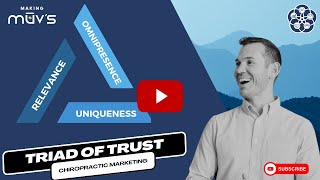
In this recorded live presentation for the Making Moves YouTube channel, the host introduces the "Triad of Trust," a three‑component marketing framework used to attract high‑quality new chiropractic patients. The framework consists of (1) Uniqueness – defining a clear unique selling proposition (USP) and power statements to position the practice as a category‑of‑one; (2) Relevance – focusing messaging on the immediate pain‑relief needs of prospects rather than abstract nervous‑system benefits; and (3) Omnipresence – ensuring the practice is repeatedly seen across multiple touchpoints to leverage the exposure effect. The speakers explain how each pillar builds trust, mention that the model is applied across internal, external, and digital marketing efforts, and plug the Cairo Ads Academy for chiropractors wanting to run Facebook/Instagram ads in‑house. The tone is conversational and instructional with a promotional undercurrent, aiming to help chiropractors improve both the quantity and quality of new patient acquisition.
Chapters
What's up guys, welcome back to the Making Moves YouTube channel. In today's video, it was also taken from a live event that I did, and I'm talking through the Triad of Trust, something that we use in all of our marketing efforts and marketing collateral to ensure that our new patients are coming in trust matured and we're able to maintain a quantity of new patients, but more importantly, a quality new patient. So the Triad of Trust breaks it down into 3 distinct components, and like I said, we use that no matter whether we are running our internal, external, or digital marketing efforts. So I hope you guys really enjoy the video. Also, if you're looking to dial in your Facebook and Instagram marketing and bring it in-house, our Cairo Ads Academy is live. We have docs all over the US absolutely crushing it with our systems. Click the link in the show notes to learn more about that. Otherwise, I hope you guys enjoy the video. Give me a like and subscribe to make sure that we keep pumping out this valuable content. For free. See you on the inside.
All right. So in the triad of trust here, the first thing that we're looking at is uniqueness, is your unique selling opportunity, your unique selling proposition. You become a new opportunity, a category of one. You determine what you want to provide to the market that only you can provide so that you stand out from the rest of the crowd. And you're going to use your power statements to do that. We've gained a little bit of trust here through our uniqueness and our unique selling proposition. But let's build that trust.
All right.
So now we're working into relevance. We need to become relevant to the prospect right now. So we need to either solve a current pain point that they have or give them an aspirational desire that is strong enough to kind of compel them to act in accordance with their desire for optimization. We typically don't go that direction. We typically stay with the aversion of pain because that's the strongest motivating factor. That's what we found. The largest motivating factor is pain, the aversion from pain. We want to meet people where they're at. We want to solve a problem that they have right now. And again, reiterating the strongest motivating factor for people is pain. That doesn't mean we're reducing the possibility the potential of chiropractic to pain. It just means that we're meeting them at where they're at right now. We know what chiropractic can do. We just need them to experience it for themselves. Let them experience the potential of chiropractic care over time. Just kind of breaking down the comparison study here. So if we're talking about like meeting people where they're at, a lot of people talk in their marketing collateral about like nervous system optimization in chiropractic. And I think it just doesn't compel people because we're working towards the wrong end of that spectrum. Doesn't mean that we can't talk about that. It just means that if we want to go out there with our direct response marketing, brand awareness is okay. And more like chiropractic awareness and education is okay. But if we're looking to get people, grasp them, and bring them into our, into our office, then we don't really want to use that end of the spectrum. We want to use more of that largest motivating factor, which is the pain aversion. Because as you can see here, the comparison of chiropractic to meditation would be like the nervous system optimization. And whenever we're doing that, what you see is on the left-hand side, chiropractic is less known for nervous system optimization. It's more known for like car wrecks, injuries, and pain resolution, right? Chiropractic also is expensive. That's why everybody always asks the first question they ask, how much does it cost? It's expensive. That's what they think. There's a time commitment that is unknown. They don't know how much time they're gonna have to spend in our office. There's unknown effort and sacrifice. How much time am I actually gonna have to commit? What am I actually gonna have to do in order to achieve the results that I'm looking to achieve through chiropractic? So we have meditation on this side, which is best known for nervous system optimization. It's free, it's always available, there's low effort and sacrifice, there's a low time commitment, it's mainstream, it's approachable, and a universal positive association. And/or you could do Wim Hof, you can do cold plunges, you can sit in a sauna. So like, why would they go pay for chiropractic when they can do all of these other things if this is what we're offering, right? So like, let's kind of hit them somewhere else, bringing them in and let them experience the benefit of chiropractic. And we can meet them where they're at, sell them what they want, give them what they need over time. Here we built a little bit more trust now through that uniqueness, and now we're going to hit them with omnipresence. So we've been unique, We've become relevant and now we're going to be omnipresent through the exposure effect, which means we're everywhere all at once. So we want to be all around them all the time. We want them to see us in digital media. We want them to see us at the screening event. We want them to see us at the Boulder Chamber. We want them to see us at blah, blah, blah. People coming up and they're like, I've been seeing you guys everywhere. That's great to hear. That means we're actually touching them multiple times before we have the opportunity to touch them directly. We had a guy that came in last week and he was like, man, you guys were in my consciousness because I had randomly looked up like a pizza place in your area or something like that. And then you showed up on my social media and I had seen you and you hit me again. And then he was walking down Pearl Street and we were at one of the screening events and he walked up and signed up for an exam without even going through our process because he was like, it was a sign. He was like, I was already thinking about reaching out to you guys and you were here. I'm buying what you're offering. And that is the exposure effect. Typically what you want is, or what happens is someone has to see you 7 times before they buy your offer. It's like 7 touchpoints before you finally get them. That's really what we want to do is we want to touch everybody 7 times, as many people as possible 7 times, build familiarity, multiple touch points. Largest factor in the trust formula is the omnipresence. And then people come trust matured, which is what you want. They already know, like, and trust you. They've been following you for months. They know who you are before they even come in your office. They come in, they're like, Dr. Travis, Emily, you must be Ryan. You know, like, they've already been watching us, right? They know us and we don't know them from Adam. And that's a cool place to be in the community. And then lastly, bonus Trust, social proof. This is the kicker. This adds more credibility. Character interchange, which means that we can tell a story here about John who reached his aspirational goal of making the podium spot in the biggest race of the year as a cyclist and saw immense performance gains in his recovery and in his output after starting chiropractic care. And we could put that out there and people are like, I want to be like John. So that's character interchange. You're like, man, what if I got this chiropractic care stuff? That they're talking about, could I also increase my performance to reach my aspirational goals? It increases the perceived likelihood of achievement like we talked about in the value formula, and it kind of increases the bandwagon effect, which is what you want. Most people do what most people do. Everybody wants to hop on to the new trend, the new fad. So if they see more people are doing it, they feel a little left out. It kind of like initiates some FOMO. They're like, okay, I got to get on that, which is a cool thing too.