TechTO Together — Ryan Hoover
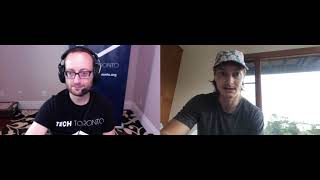
Ryan Hoover founded Product Hunt as an email list that became a product-discovery platform acquired by AngelList. His distributed team across Paris, Canada, India, London, and the US hired full-stack engineers and independent makers to work asynchronously. COVID-19 drove a surge in product launches and traffic, leading to a Makers Festival focused on COVID relief.
Chapters
Thank you first of all for coming on. Hopefully you got a strong connection here. Can you provide a brief, you know, like one minute description of how you and why you created Product Hunt?
Yes. Well, first, thanks. Thanks for the invite. This is really cool. We're using Hopin for a Product Hunt event later in the year. So it's a school diet. This is good practice. Yeah, I know this is my dry run, but yeah, for those that don't know, Product Hunt is a community of people around the world launching new products. So a lot of new tech companies, whether it's new mobile app or a new physical product or gadget, it's kind of like a fire hose of here's what's new and cool in technology. And we see a lot of Canadian entrepreneurs, of course, launching on Product Hunt and people around the world and I guess, I don't know, you want the backstory, the short version or give us.
Give us a short backstory version. I think it's important for most founders to hear it if they don't know it.
Yeah, yeah, I'll give you the short version. So it started a little bit over six years ago, Product Hunt began. And I am a weirdo that likes to just play with new apps and play with new products and I just love technology in general. And I ironically used to browse Angellist, actually looking for new companies just as a consumer, out of curiosity. But obviously Angellist was not built for that. And you know, back then I was thinking, well, why isn't there just a site that lists here the new cool products today? And that was sort of the initial idea. So it started off as an email list with me and my friends. Super simple way to kind of kick things off and get started. And that grew into, you know, a website and then a community. And, you know, fast forward three years later, we're acquired by Angellist, ironically, after it was in part, you know, had some inspiration in the design of Product Hunt. And yeah, we're still, you know, going strong.
Cool. And then what was interesting, I think about Product Hunt is from what I understand was you started off with a remote team and it's predominantly remote now. So tell us a bit the secrets of success with remote team.
The secrets. Well, if I, if it was, if I told everyone the secret, then I'd have no competitive advantage.
Well, just give us the ones that everyone should know. By now I know you're like, keep, keep the deep, dark secrets.
No, I really don't have many secrets. Yeah. So Product Hunt, it's, it's been Distributed since day one. We used to have, I used to be in San Francisco, I'm now in la, if you can't kind of tell by a little bit of the background and maybe the longer hair that I've been growing out. But I'm in LA now and today the rest of the team is distributed across the world from Paris to, you know, we're in Canada, India, you know, parts of the Midwest, London, so all over the world. And initially it was very organic in how it formed. It was largely inspired by Andreas was CTO early on he hired some people that he knew in Europe and they hired people they knew in Europe. And then eventually we just adopted this sort of lifestyle and this way of working because it allowed us to of course have access to the world's talent. It also allowed us to be competitive in San Francisco Bay area. It's really hard to recruit people and keep them retained. So this kind of allowed us to bypass a lot of that kind of competition and for us a lot of, I guess going back to your original question around secrets, I think a lot of what we're focusing on is on the engineering side. In particular we focus on hiring full stack engineers, which is pretty typical for most startups in general. But for distributed teams it's even more important because it allows you to allow that engineer to really build the entire product or feature end to end without waiting on someone else. And that's a big thing that no matter what tools you have, you can't really get around the fact that you live in different time zones and work in different times.
And so you need to independent makers, basically, they don't rely on integration with the whole team.
Yeah, and it's not that we all work in isolation, it's just that we allow and try to build projects that allow people to run and make progress even when everyone else is sleeping or when other people are sleeping. And so having hiring in a way that allows us to hire for entrepreneurial people that can kind of fill in the gaps or in this case like engineering specifically, they don't need to have a back end engineer do something before they can do something on the front end, for example, that allows us just to continually make progress, you know, effectively 24, 7. The other benefit too. A lot of people talk about the benefits of remote teams, but I think the other one is really you get a global perspective as well. Because we have people around the world and also a community that's global. We in some ways just have, I think a little bit more empathy in terms of like what our audience is wanting because we have presence across the entire globe.
So interesting. I'm going to actually take a question from our audience around building a global team. So, Nora Bradley, I don't know if you see that question asks, how do you find and attract independent employees that are remote? So I guess, how do you get the right mindset?
So how do you attract them in terms of recruiting?
How do you find them? Recruit them? Yeah, because obviously you need a certain mindset.
Yeah. I think actually former founders or people who actually. It doesn't have to be a founder in the traditional sense could be a founder or someone who's built side projects and launched them on their own. I think that's a really good test to evaluate someone who has the ability to build something independently and be entrepreneurial on their own. So I would. And that's a lot of what we see on Product Hunt. A lot of these people are independent makers building something for their own.
I'll ask you a question based on what I see on I say venture Twitter. Everyone's saying the current situation is going to accelerate work from home. So do you believe this forced work from home is going to work and do you believe that's going to accelerate remote teams and work from home teams?
Yeah, I actually think it's gonna. It's gonna accelerate. It's gonna actually have this, this, this. It's gonna create a fork in the road for some people. So some people are going to now have this, this flexibility in their life where they're working from home. They're gonna love it, they're gonna enjoy it, and they're gonna go back to work when all this is over and realize, actually, I kind of like working from home. I like that lifestyle. Let me try to get my manager to allow me to work from home more often or let me move to another company. So on one side, I think it will accelerate for some people. On the other side, there'll be an extreme aversion to working from home from another subset of people. Probably those maybe. Yeah, with kids, you is probably one of them because this is not a normal situation by any means. So I don't think this is going to be a great illustration of what that lifestyle is for those people. But for some people, they're going to enjoy it. And then on the other side, the companies. Companies are being forced, some of them for the very first time, to figure out how to work as a distributed team. And I think we'll see the same thing too, where some of them are going to hate it they're going to be like, I can't wait until we're back to normal kind of office environment. And then some might realize, oh shoot, actually this is working. And now we don't have to only recruit and hire around, you know, in our local city or where we live. So Interesting. I think overall it will accelerate, but it's going to be divisive. It's not that everyone now loves working from home.
People have stronger opinions is what you're saying?
Yes, I think so, yeah.
So let's go to other. Let's go to the subject that's actually forcing people to work from home. Covid, you know, Product Hunt is a community of makers. So how's this impacting your community and Product Hunt?
Yeah, for. For better or worse. Probably for better though. We've, for the past three weeks, I would say we've seen Covid related products launching every day. It's basically all Covid related stuff. Not entirely, but it's. See more and more people are working on side projects to support different things, whether it's to try to get masks to nurses and doctors or other ways to just support other people who are disadvantaged during this time. And it's really cool to see that kind of people around the world aggregating, coming together. I'm actually a part of some WhatsApp groups where people are just hacking together and communicating and sharing ideas around this project that they're really excited about. So in some ways we're seeing this like, I wouldn't say revival because we've always had it, but this like surge of maker kind of entrepreneurial mindset happening and a lot of the output that is now showing up on Product Hunt. So in some ways, like that's great, our traffic is actually up as well, which is consistent with a lot of other online communities that we've seen. So in terms of how our business is going, it's I guess we're fortunate that it hasn't been negatively affected like it has for many others. And I'm glad that we can maybe support kind of indirectly by promoting these different efforts and projects. We actually have a Makers Festival going on right now which is kind of our version of an online hackathon dedicated to Covid relief efforts primarily. So the output of that will be another week or two, I believe.
Very cool. We only have a minute or two. So I'm going to go to one question which I stopped there. I think it was from Annabel, who will take me to last I wanted to cover today is how does working remote impact doing something that's usually very in person intensive, like angel investing. So you're a very active angel investor. How does it impact you?
So, funny enough, I rarely actually meet founders in person, and it's partly I'm able to do that because I'm writing small checks and not leading rounds. Very different than if I was Inreessen Horowitz and trying to lead an A. I I think I'd probably have to meet them in person and go through those motions, but I don't know. This is basically my world, what we're doing right here. Alex, I rarely meet people in person. It allows me to invest everywhere around the world. So you're the one that introduced me to Voice Flow, which was the first Canadian company that we backed. And so it hasn't changed. Hopefully a few more. Hopefully a few more. I enjoy it. Yeah.
More from Ryan
How to launch and grow your product | Ryan Hoover of Product Hunt and Weekend Fund
Ryan Hoover on Startup Growth Hacks, Products, Silicon Valley Success | Product Hunt | TRS 130

01: Ryan Hoover (Weekend Fund) | "101 Guide For Emerging Fund Managers" | 1947 VC

Learn How Ryan Hoover Transformed the Startup Ecosystem with Product Hunt's Explosive Growth
Behind the Scenes of a 2-Person VC Fund with 120+ Investments - Vedika Jain (Weekend Fund) | E58
How to launch and grow your product | Ryan Hoover of Product Hunt and Weekend Fund