In Full Light 001: Survival Mechanisms and Essence w/ Rachel Connor
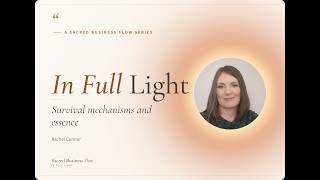
The episode opens the new "In Full Light" series with host Phil Powis interviewing creative coach and space‑holder Rachel Conner. Rachel explains her journey from university professor and writer to a "Creative Courage Guide" who helps accomplished professionals reclaim their hidden creative selves. She describes how early life messages created survival mechanisms—inner critics and protective behaviors—that block authentic expression. Through her coaching, clients move from these defensive patterns to a state she calls "essence," a deep, always‑present creative core. Rachel shares two vivid client transformations: a workshop participant who uncovered a specific creative project after confronting inner critics, and a seasoned writer who, after deep work, rewrote a book from a more soulful place, affecting her relationships and confidence. The conversation explores the moment of her own turning point—a flat‑no from a dean that forced her to leave academia despite financial risk—highlighting the importance of integrity and faith. Rachel contrasts the detached, head‑focused posture of academic performance with the embodied, grounded feeling of speaking from essence, describing somatic cues like feeling grounded in the feet versus being eye‑focused. She emphasizes gentle, healing‑oriented guidance over harsh coaching, and offers practical advice for stuck creators: break tasks into tiny, non‑threatening chunks, practice short timed writing, and cultivate deep internal listening akin to meditation. Visibility is reframed as allowing the whole self to be seen, not just performing a role. The interview ends with Rachel’s future vision of a retreat‑style creative center, deeper spiritual practice, and possible books, while inviting listeners to explore her Substack, the Creative Courage Circle, and upcoming live coaching demos. Throughout, the dialogue underscores the interplay of inner work, embodiment, and creative expression as a pathway to personal wholeness.
Chapters
So welcome. This is actually our first episode of a brand new series that we are calling In Full Light. And this is really just an opportunity to celebrate people who have, in our opinion, answered their calling. They're heart-led practitioners coming from within our community who are really stepping into their power and sharing their gifts in a really meaningful way. And so today we are joined by Rachel Conner. She is a coach, space holder, and Creative Courage Guide. And, um, yeah, Rachel, welcome. We're so happy to have you here with us.
Thank you so much. Very thrilled to be here for the first one. Feels great. Thanks for having me.
Yes. Thank you. Thanks for being here with us. And, uh, we would love to make this interactive. So if you have any questions, uh, and you're watching, just put it in the chat and we're gonna do our best to respond to your questions. Uh, so Rachel, I would love to ask you kind of like a 3 questions in 1 question. So who are you? What do you do? But the most important thing I would love to get from you is why you do what you do.
Yeah, great questions. If I was coaching, I'd be like, you can't ask 3 questions in one, just ask one question.
I want to see what's coming out of you.
No, that's perfect. That's perfect. So what I do is I support I support accomplished professionals, competent professionals who feel like they're living a kind of hidden creative self to step more fully into their wholeness and integration. That's really what I do. So if you'd asked me that question a couple of years ago, I would've said I'm a writing mentor or I'm a coach. And actually that kind of the who is really interesting because I feel like where I am now in business and in my life is a shedding of those identities of I was a university professor and then I let go of that. And then I was a writer. And even the word coach, I hold that word kind of lightly. So I think everyone knows, most people know what we understand by coach, what we mean by coach. But I feel like my work kind of goes to depths often that the term coach doesn't fully capture. So I support people with creative expression to be more brave, So my Substack publication's called Creative Courage, and really it's about how do we find that courage to be more fully ourselves? And courage is often like, ah, we've gotta harness the courage and really force ourselves to express and to show up and to do the things. And really it's about, I think more and more, the more I do this, the more I think it's actually about allowing and allowing ourselves to be more of who we really are. And we can talk about that through the rest of this conversation in order to sort of be who we're becoming in a sense. So drop all the stories, all the conditioning and so on. So that answers like who and what. The why, I mean, it's so fascinating because the why is always tied, isn't it, to we serve the people. To do the work that we need to do. And for me, like ever since I was young, certainly as a child, as a young adult, for me there's something about my expression having been blocked often very unintentionally by people close to me, loved me, but for various reasons because of their fear, there were messages that I received, transmission of this is not safe, this is not good enough. This is not perfect, whatever, all of those things. And I realize how much that has blocked me over the course of my life. And even though I published author and I published academic books and papers and did lectures, actually I was hiding all that time and the real me wasn't on show. And so that's really why, because I have such a mission to find that within myself and to really support other people to be more fully who they are, whether that's working with people one-to-one or working in a community, which I also do as well.
That's beautiful. Thanks for sharing. And it connects a lot with like my understanding of like what calling is. And I think we all have different callings, but it's often, uh, when we see is like a solution that we found for ourselves, right? Like something like a struggle that we had for whatever situation in a relationship, within our business or any area of our lives. And then through our experiences and our journey and then our failures and and, you know, the things that you learned, the knowledge, being a professor and all of that, like you kind of like pack that in a unique way and like, hey, here I am with, uh, this thing, right? And, and often like it feels so good to be on the other side that now you just want to share with other people like the, you know, um, the discovery maybe, or the embodiment of like what you learned. Um, you spoke a little bit to that, but if you could tell us about like the transformation that you create for people who work with you? Like, what would you say?
Yeah, I mean, so many. It's such a great question. So I'll give you two examples. So one from like my community, my group. So one person actually did a workshop with me last week and said, oh, you really took us on a whole journey. Like we started from, you know, what gets in the way, like the defense behaviors, the inner critics, the things that block us with our creativity. And then then we kind of went through into, I suppose, the light and what's the vision that you want to do? What is it that you want to create? And she was like, that was such a powerful journey. I hadn't really faced into my inner critics in that kind of way, and certainly not in a group situation. And it was so powerful that actually the thing at the end that she shared was, oh, I didn't realize that I really wanted to make this thing. There was a specific thing that she hadn't realized she wanted to make, and she wouldn't have got there had she not been on that whole journey through the course of the workshop. So there's that. And then another client that I've worked with one-to-one came to me. She's a very, very accomplished writer. She's a very competent writer. She's published stuff. And there was this book she was tussling with and just couldn't quite kind of get to the heart of what it was. And the work that we did together actually led to her really deconstructing, taking apart the books that she had written. And by this stage, she'd invested, she'd done 3 drafts or something. And she was kind of reluctant in a way to kind of go back to the heart of it, to the essence of it. And through the work that we did together, she was like, "This is a completely different book. It's bringing in a kind of more soulful part of me that I didn't know was there, that I wouldn't have been able to get to without the work that we had done together." So there's a very tangible outcome in terms of her writing. And I didn't read a word of her writing. It wasn't like I was reading the drafts of the novel and saying, "Okay, let's look at sentence to let's look at this, let's look at that. I didn't read the writing. And that to me was when I thought, I know I've arrived, I've got to where I want to be, which is I'm so used to that technical input, which I, you know, I still enjoy and I can do that. But for me, it was the working at depth, you know, on the level of who she is as a creative and that the transmission of that folding into the book that she is, and then she's working on. And the last I heard is she had really excellent feedback from professionals in the industry. And so I'm really— almost certainly it will be published. I just have no doubt because of the level of confidence.
Yeah.
And also through that work, I mean, that was a creative outcome, but also like interpersonally, like her relationships began to change, the way she showed up for her family and various people in her life, she was more herself, I suppose. And so it kind of rippled out into all aspects of her as a person and not just as a writer. So that was pretty cool. Beautiful.
Yeah.
Beautiful.
Yeah.
Thanks for sharing. And one of the things we've seen, and I've had this experience for myself as well, you've had this, from what I understand and know about you, you've had this kind of long, successful career before you kind of moved into doing this deeper work you're doing. And what I've seen is there's usually this moment, and we'll just for term, we'll call it a turning point, where you kind of knew that you needed to go all in on this work. And so I'm just curious, did you have an experience like that? And if so, what was that moment for you?
Oh, I feel like I've had a series of moments that led to the work. So it's almost like I kind of, you know, I famously say I left the academic world 3 times, you know, and it's almost like I tried to and then I kind of came back and it was fear, I think, and resistance that kept me back. So I feel as if, yeah, I'd been heading towards this work for maybe the last 20 years or so. But I think the moment, if I had to put it down to one moment, the most recent moment was when in my academic job, I'd done my coaching training. I was doing a lot of coaching practice at that point in time with all kinds of people, not just with creativity. And my job was as a professor in creative writing. And I went to speak to the dean of the faculty and said, look, I feel like I could really do a huge amount in this faculty to support the students and support the other faculty members as well with research, with writing, with productivity, with creativity, and proposed a coaching approach to the pastoral care of the students and the staff. And it was a flat no. An absolute no. And I think it wasn't so much, oh, he won't let me coach. It was more, I cannot, I cannot stay in an organization and a workplace that is so inhibited when really it's all about vision and possibility. And I can't be a stand for, you know, I'm a stand for that, and I can't stay in a place that doesn't support that. So that was it. And then I, I was kind of heading out anyway, but that was the moment. And I literally left before I should have in terms of financial stability and all of that kind of stuff. I just leapt off the cliff, no safety net, trusting that actually that I trusted the power of that, knowing that I was doing the right thing because it was just, I couldn't not.
And I feel that's kind of the gift of doing this work. You kind of mentioned how we're called to the work that we're doing for ourselves. And I think I was talking about this on a coaching call myself earlier this week, that one of the gifts we receive is that, you know, I often have to check myself and say, hey, am I in integrity or am I embodying the things that I'm speaking of? Right. So it sounds to me, at least the way I'm understanding you, and correct me if I'm wrong, it's like you found yourself in this situation where the things that you desire to take the stand for were no longer kind of in alignment. And to kind of stay in that space, it's kind of contradicting what you're trying to encourage other people to do through your coaching practice. Is that true? Because that's kind of how I see for me when I catch myself, you know, I think I was talking about in the context of planning, but, you know, when I catch myself not being, you know, not doing things that I truly believe in, you know, it's just a check to come back to myself and be like, hey, like, these are the things I believe in that I'm going to stand for. And I'm going to ask my clients to stand for in themselves. I need to kind of walk the walk. So it sounds like it was kind of a moment like that for you. Yes?
Exactly. I think the integrity, the lack of integrity was so painful that I just had to change it. I had to change the context. And it's not easy. I mean, there are so many challenges, I think, in being an entrepreneur. And for me, I'm 4 years in now to this business. And every single year in some way has been a challenge. There've been various challenges, but that feels more true. At least I feel like I'm in that integrity. As opposed to hiding, which is what I was doing before. And so much of the work that I do with people is around coming out of those hiding places in a way that feels supported and needs to feel safe enough. And so creating the conditions for becoming more visible, coming out of the hiding place. And for me, I realized all these years of hiding and being out of integrity, the feeling of that, even if it's uncomfortable on the level of, oh, I've got to show up and write a marketing post today, or my income's dropped or whatever, whatever it is, whatever those challenges are, you know, that's far better than being in a role that doesn't serve me where I'm not really being true to myself in that way. So yeah, I absolutely agree with that for sure.
Yeah, that's, that's very powerful. And that's kind of like the way I see business and this entrepreneurial journey. Like for me, the, the way I say it, like it, it it's almost as if the business is an excuse, right? It's the way that life has to put us on a path of transformation. And then the transformation is like letting go the parts of you that is not connected to your essence. And I know you use the word essence a lot. And I think it's like a process of like self-discovery. Like if I want to get this business that it's very aligned with my values, I need to transform myself. Into something that, you know, it's a pure expression of my own essence. And that it's a lot of like letting go. Is there like one thing about yourself or about your business that maybe you believed that was truth before and you had to let go in order to be where you are today? It could be a belief or it could be like, um, I don't know, a way of being.
Um, oh, I mean, the main thing has been you know, absolute faith in my capacity to do this, you know, because it's such an entire process as opposed to being, I don't know, an academic where you have credentials and you have the, you know, you have the kind of feedback, I suppose, within the organization. I've had to really develop my capacity for faith and to grow that and to stick with it, you know, day by day by day, even if I can't see the end result. But there's a feeling, and the feeling is that calibration of integrity that you were talking about. And also, I guess, just again, you're talking about walking the walk. I mean, I work with people on— it is about self-discovery of essence, but it's more about uncovering what's always there, right? So I think in a way, I feel like, yes, there's a process of transformation, But it's always as if I've always moving towards that point because this is always who I was going to become. And so it's just about a willingness to step into that and to deal with the external conditions of life and work and business as they come up. And it's always a dance between those two things because there's always the conditions and the context and the things that hold us back and our conditioning and all of that stuff. But actually, if we're moving towards who we were always going to be, who we always have been anyway, I think if we see it like that, I feel like that's how I've begun to kind of hold my sense of faith and make it make sense for me. And that's actually how I work with my clients as well, which is like there's this essence that we're not discovering it. I don't give them their sense of their essence. It's always there. I just help them and support them and guide them to reacquainting themselves with it. And once that happens, then for me, creativity is the vehicle for essence. It's the vehicle for who we are and who we are always becoming, if that makes sense. It's just the sneaky conditioning and the survival mechanisms or the protective behaviors that get in the way. And that, of course, is where we mostly focus our work because that's the thing that stops us showing up and having that sense of ease and surrender that we need in the state of flow to create and to live. Yeah.
And I know earlier you kind of spoke to this a little bit about kind of visibility and that that's been part of your path, like allowing yourself to be seen. And so this is so common, like so many people that I meet that are doing this kind of work from the heart, they struggle with this. They struggle with putting themselves out there. They struggle with putting words to things that feel so like it's a felt sense. So I'm just curious if you could share more about your own journey with that, like what your story has been with visibility and what shifted for you around that.
I mean, it's so ironic because as an academic, I was on a stage lecturing often to hundreds of students on a regular basis. I was going to conferences and sitting on panels and giving papers and doing all of that stuff. I learned from quite an early age, from my 20s, how to perform in that way or how to show up. And it's a certain way of being visible, but it's always like I wasn't truly being seen for who I am. If you are lecturing, you have a script and you assume a mask of the professor, let's say, or the academic. So it's very different. So I feel like for me, I was like, oh, visibility is no problem. Until I started really doing this work and then, ah, okay. So for example, the concept of essence. As an academic, I had that knocked out of me. It was breaking all of the theoretical and philosophical rules to talk about an essential self. The self was like culture, it was how you're shaped by culture. To talk about the essential self was like an absolute no-no. And then here I am, my work has become something that's really rooted in in essence. And so to begin to talk about it, especially to people in that context, has been mildly terrifying to say the least, because I'm conditioned to kind of be the intellectual who has all the answers, who's the theoretical sort of intellectual, whatever. So things like that, it's like actually I'm more true to myself now. So the visibility is not so much the sort of standing up and speaking as more allowing myself to be seen for all the parts of who I am. And that's been a huge journey, I would say. And I'm still engaged in that journey, I would say, on a daily basis. I show up in my community and I'm as honest with them as I expect them to be with me. I'm not there with all the answers. I'm honest about how I find things difficult. We do creativity sessions in which I say, oh, I really struggled with that. At the end of the session, we talk about the process and how it was, the experience of it, rather than the outcome. And, you know, I'm honest when I struggle, and I think that's important. And that's part of my philosophy, is, you know, we have to stand together with this stuff and support each other because it's really hard. And if we do it alone, which I did for so many years, you know, I didn't reach out for support. I just, like, locked myself away and got on and performed then. Actually, we're really cutting out huge possibilities for connection and witnessing, like, in that true way, you know? Yeah.
Yeah. I'm just curious on this topic a little more, like, how would you describe that is your, maybe like your body experience, like, because you've been on stages performing and now you're being on stages and talking to people from your essence more and more and more. And I'm sure it's a process that keeps like unfolding and keeps getting better and better. So what is your body experience like speaking from performance? And then when you leave that, like you end your talk the way you feel it, and then when you speak from your essence and then you leave your talk, how you feel it, if you can notice the difference. Um, I'm just curious about your personal experience on that. Yeah.
So the, the kind of the former, the of speaking not from essence, let's say. Very disconnected from the lower part of my body, I would say. So very much head up, noticing what's going on, very much noticing with my eyes and not maybe the rest of my body. So really kind of honing in on the sense of sight rather than the full kind of awareness, the energetic awareness of the presence of people in the room. So not tuning in in that kind of way to the space between us and of how other people are showing up and the resonance of the energy of the other people. With Essence, it feels very much like I feel open to— sounds strange to say open to another dimension, but that's kind of how it feels. There's a sort of dimensionality that opens up in a way. And I'm also at the same time much more connected to the lower part of my body and feet on the ground and gravity, like the earth beneath me. That's kind of what comes up as you ask that question. It's a great question, I think. Yeah. How do we know we're in essence and how do we not? Yeah.
Yeah. Because I think sometimes when people are just in the beginning of their journey of speaking from their essence and moving from their survival mechanisms or their survival ship into being creators, Um, sometimes, I don't know, like, at least like in my own experience, like sometimes it felt that like it was a different, like, what is the difference between the performing that I have before to the way I'm doing right now? And I love the way you bring the awareness to the body. And that's also my experience. Like, I, I feel that I'm fully present. I feel that I don't need to hide. I feel that there's no way for me to get it wrong. Uh, and then when the talk ends, for example. I feel energized and the performing is more like drain, like, oh, I need to, you know, I need to, to rest. Um, but I, I don't, I just think it's helpful to bring attention to that because you've been to that transition and you're speaking from that space right now. And a lot of people like, like, I don't know what it is. Like, what is the doing in that? And we're doing the same thing in a way, right? Like the doing is the same. The action outside is the same. but the experience inside when you're being creative and taking action from your essence is like completely different. So I, I just love the way you, you describe it.
Yeah. Yeah. Thank you. And I love that you brought the question. Thank you. It's very helpful because I think talking about essence is so, um, it's so vague sometimes. Like, how do we describe it? It's kind of mysterious. So it's hard to put into words. And so actually to ground it in a physical somatic experience is helpful. How do I know when I'm, or how do I feel like when I'm in essence and when do I not, is helpful because that's a compass that we can understand, feel. And it's the same with writing and even with coaching. I feel it. There's a palpable feeling of dropping down and that the air seems to thicken and there's a kind of sense of the relational space between us seems to open up. So it happens in that space too, right? I mean, I really feel in essence much of the time in these kind of conversations, I think for me, any kind of conversation and particularly the coaching space conversations are a huge form of creativity and expression, which I couldn't have predicted I would end up doing really as an academic. I'm like, oh, it's about writing, it's about teaching, but actually it's a very different thing having a conversation where intentionally connecting with the other person or people and that dropping down is something that I really feel now on a regular basis. Yeah, feels very joyful and connected.
Yeah, that's a good space to be.
Yeah, that's great. That's great. I'm very grateful to be working and living in this space for the most part. And yes, there are difficult days and yes, there are conversations that don't go so well, but for the most part, why would I not be one of— what would I not want to be doing this work? I love it.
Yeah, that was a really nice description of the experience there. And yeah, I don't know if Yeah, I agree. It's very helpful for people to kind of hear it in that way for something that can be hard to put words to. Is there anything else you can think of that you like when you, when you're talking with clients or you're writing for your audience, you know, something that you wish more people understood about the work you do, like something that you feel might get misunderstood around this kind of coaching essence, creative courage, you know, or maybe even overlooked, you know, that people should maybe draw a little bit more attention to.
Yeah, thank you. That's a great question. I mean, I feel like the essence stuff is the hardest to describe, and it's really about how do we— I suppose with creative coaching, a lot of it is like, how do we solve the problem of not being able to create? How do we find our voice? That kind of thing. And often, so often, people will go to strategies and systems and the resources and that kind of stuff rather than the more inner work that we've just talked about with the essence and looking at kind of the, what gets in the way, that to kind of go deep in that way actually supports the process sort of from the inside out. And I think that's, there's a lot of, in the kind of creativity space, I think it's not often given as much attention as it needs. There's like a kind of, do this course or do this time management course. It must be about time or it must be about the techniques that I don't have. And so I feel like that is, yeah, something that is helpful to know is like, actually, if you are down to do the deep work and really look at yourself and the first thing I always do with clients is get them to make a list of their 10 core fears around creativity. And it's really challenging thing to do, But to look at those and look at for each fear, a corresponding kind of protective behavior that goes with it. And it's incredible how people already begin to see, oh, that's what holds me back. Oh, that's how I see myself. So I think, I guess, if I had a wish for people to know what I do, it's that kind of, yeah, we start there, which is challenging, and we gently support those parts of ourselves that that have kept us safe. The survival mechanisms, the protective behaviors, they have been there and they have served us and they've kept us safe and in many cases have allowed us to thrive. But I think it's that dismantling of that which can feel terrifying and not everyone wants to do it. But on the other side, the experiences I've had in leading clients through essence is just astonishing to give people back their essence, which is part of the process that I do. I I've had tears, I've had people feeling like they're in a kind of trance. It's really quite a powerful process and it's hard to put it into words in a conversation as opposed to experientially. But I think if we are willing to go to those depths and to really take apart those things that have held us back, then actually it's not just like solving the problem of this particular creative project, but actually it's a different way of living life, I think. I think, which is going back to the example of my client earlier, it wasn't just the project she was working on, it was how she shows up in her life, how she shows up with her loved ones, how she is in her day-to-day. And so I think working on creativity, because everything's connected, it's not just one separate part, it's the whole self is brought into being. So for me, it's led to you know, a more joyful and easy way of being. And I see that in the clients that I work with, and it's, you know, I would want that for anybody.
Yeah. You know, go ahead, Kelly.
I just want to make a comment because I think, um, we are all born to awaken to our creativity because we are all creators. And then we all go through the process of like learning how to survive. How do we operate in this this world, in this dimension. So, you know, like you just don't jump off the cliff so you don't die. So it's kind of like, this is a mechanism of like surviving here. And then as we evolve, life starts teaching us or showing us that like, this is the path and you will awaken to your creativity no matter what. Um, this lifetime, or maybe it's going to take a little more, but I just love that. And, and that this is a belief that I have that we are all doing this journey and it can be really hard, but it could also be gentle. And I feel that the way I'm feeling that you guide your, your clients, like, yes, you gotta, you know, face your fears and you've gotta do this and you gotta like, uh, face the stuff that kept you safe, that brought you here. But there's a lot of like kindness and gentleness that this process does not need to be painful. Um, but I don't know, it's just, this is just the way I'm feeling. Like, am I wrong? Or, you know, I feel that it's very like, yes, just let's just walk together and it can be fun, beautiful, even though it can be painful.
Right. So, um, yeah, that's exactly right. I mean, yeah, you're absolutely right. And, and actually, I, I, I think when I first sort of trained as a coach, a little bit like almost apologetic about it. Like, am I not challenging people enough? Am I not being tough enough? You know, um, because I think— I also think the job of a coach is to, to point out, you know, what the blind spots of what the client's not seeing. And so that, that's also true. Um, and I think in a way, I suppose the work I do, it feels a bit closer to like healing work than coaching in that kind of way of coaching of pointing out blind spots and things. I mean, we do get there, we get to that place, but it is around, yeah, it's like, and that's why I call myself a guide into creative courage. It's like walking alongside the other person and saying, hey, what do we see? What's going on? And reflecting back. I'm a big reflector. And in fact, that is also my human design type is a reflector. So it's like, that's what I do. I kind of mirror back. And that That's, yes. So I think the gentleness of healing, I think when we've got these parts that have been locked away, often through some kind of trauma, small t trauma, I think we have to be gentle and careful. And what I see is that I help people sort of excavate the bits that the parts that are missing and that they've hidden away. And then later, the time comes to maybe get the harder feedback or the critique or whatever. And I can do that too. And I have worked with people in that way. But I think that one client that I'm working with described it as like a bridge between the life she's living now where things are hidden and visible and she's too ashamed, if you like, to kind of show her creativity. And we build a bridge together into a different kind of life and a different kind of context where that creativity can be brought forward and it feels much more part of who she is. And so it's that bridge building that I think is really part of what I do. Yeah.
And I, and you know, we'll back you up on the whole, it's an inside game thing. You know, that's the same way we kind of approach how we support people, especially around sales and marketing. It was fun. We were just having a conversation before this with Billy, who is another marketing friend of ours, and we were kind of going deep on marketing and fear and all this sort of things. And, you know, it's as you said, You know, all these tactics or things like productivity or like in our world, it's like taking a course on, you know, growing on Substack. Like these things aren't inherently wrong. Like, in fact, I do a lot of those things myself. But what I've found and what I feel you're pointing to with the work you do around creativity is that first we need to kind of go back inside and just see what's there and, and get centered and grounded in ourselves and build that from that foundation. And then, you know, once we kind of come back out and emerge from that, then yeah, you go find the tactics and things and these become the amplifiers, right? They make things move, move faster. But if you haven't done that kind of deeper work for yourself, this is what I often point to. It's like, hey, you know, if you're trying all the tactics and it just seems like you're hitting a lot of resistance or you're doing the things and you see like, hey, seems to be working for this person, but it's not doing anything for me, it usually, in my experience, points back to, hey, I should kind of go inside and look at the inner side of things. And so, yeah, I really appreciate the way you described it with your work. And I feel that so many people that we resonate with feel that same way. So thank you for sharing that. And just kind of to kind of close on this area, you know, and you spoke, I think you gave already some pretty practical suggestions in certain ways. But if, you know, if someone happens to be watching this or catching the replay and they find that they're, you know, sitting at home, they're feeling stuck or blocked with their creativity, like they have so much they want to express or share, but they're, they're really struggling to get traction. Like, what would you want to say to them right now?
Yeah, I mean, first of all, I think bring it down to the very smallest thing. So often in my experience, people are like, oh, I want to write this thing, I want to create this thing, and they're imagining the whole thing finished. It's just like, really chunk it down and bring it down to the very smallest thing. So I'm a big advocate of, like, with writing, for example, of just writing for 7 minutes, you know, set a timer and just, you know, find yourself a prompt. And so it's really about that, I think, making it as small and unthreatening as possible. But it's also about, I mean, I really think it's all down to listening, really being able to get quiet, get still, create the conditions for actually what am I really trying to say here? And not thinking about who might read it or who might judge it or any of that. It's like really listening on the inside. I think that is the primary thing to listen to what's coming up. And so to make a practice of that and to not worry about outcome or product, just create a practice of that deep listening and seeing what comes from there. And I think that's true for whatever we want to create, whether it's we have an idea for a business or I have someone else I'm working with at the moment who wants to, she wants to kind of create circles, embodiment circles. And she sort of keeps coming back to what am I wanting to create and why? It's that question of why and what is it that's wanting to come through me? And in that sense, I think, It's a meditation practice really. It's listening to what's on the inside and tuning to the field. Like, what is it that's needed and where those two things meet? So that's the kind of inside work. And then to kind of put the tactics to it, I think it's about making that time as often as possible for that deep listening as we would in meditation, for example, but really not making a big deal of it. Just 7 minutes or 4 minutes or whatever it is. Make it messy. Find the messiest sketchbook or exercise book. It doesn't have to be a fancy journal. It doesn't have to be a fancy pen. Really bring it down to what's the most doable thing. I guess those would be my main kind of pointers. Yeah.
Yeah. It's very interesting because I agree with you and I think As much as it sounds very simple, the way the world is developing is probably one of the hardest things to do right now is just to be with yourself, right? Like, it's so, I think that like when I, when we want to step into creativity, like one of the, probably like the way you were saying, like you have to go back within and when you go back within it's like stop consuming. But the minute you open your phone to see something and it doesn't mean that you're looking for something like you might be like, oh, I want to talk to someone. There is already something popping up in front of you that like, so I think that this, that self-discipline right now is so important of like creating the space, creating the time. Um, yeah, that sometimes we, we don't realize that it's like in the simple things of like being quiet that you're going to find what is trying to emerge through you. And I love the words that you were like the why, right? Like kind of like the beginning of our conversation and like like why you're doing what you're doing. And this is the combination of like you coming together. So it's, it's just a great reminder that like coming back to foundations, coming back to silence, coming back to like slowing down, consuming less. And, um, it's simple, but it's, uh, the, the way the world is going feels that it's getting harder and harder to do that.
Yeah, I agree. There's so much competition for our attention and our presence. And it's hard actually, the other thing is to say it's hard to do it alone as well. I mean, it's sort of easier when we're with people who feel the same and we intentionally create spaces where we can slow down and be silent and bring our attention and presence. I think we try so hard to do everything alone. We're sort of such an individualistic culture in a certain way. And it can be vulnerable and challenging to kind of open up ourselves in that way and to challenge, to create in company. But I think creativity in company, it's a phrase that I'm very keen on at the moment. Creativity in company is something that I like to kind of write about and think about quite a lot. I think because of the way the world is going, I feel like to reinvent or to rediscover ways to be together, and to create together, it's just so important, so vital. And I think if we can be present to each other in that embodied way, even if it's on a screen, even if it's in a virtual room, if we can be present to each other, switch off the phone, switch off the notifications, then that's a way to achieve that. And I see that every week in our creativity circles. It's incredible what people kind of not just get done, but experience as well. You know, so beautiful.
Yeah. Well, I know, Rachel, you've been at this for a while now, and, you know, just in the time that we've known you, I've seen incredible— what I've witnessed is incredible growth in your ability to kind of own your message and what you're creating and all of this. But like, for yourself, what would you say you are most proud of? And, you know, I'd love to hear about any results, of course, but I'd also love to hear even more so, I think, just like how you're feeling about being proud of yourself or who you've been becoming through this process?
Yeah. Well, I mean, it's a bit huge thanks to you guys, actually. You talk about messaging. So when I arrived and started working with you, I had a writing practice. I had my Substack up and running. I've been on there for a while, but I feel like the work that I did with you really really helped me to kind of strip it back and to kind of think more about who I was writing for. So I think I was in this habit of writing in a certain way because of the context I'd come from, from the work that I used to do. And I was— so I've clarified my message a lot and I feel like that's been my biggest— that's the thing I'm most proud of, to be able to clarify my message not because of the messaging itself, although it's beautiful, isn't it, when messages are clear and simple, but more because I'm doing it from a place of service that I'm really understanding and I'm there to benefit the people who might want to read my stuff and all want to work with me. And that is the internal shift that I have made the most, I think, and that I'm most proud of. I remember there was a penny drop when I think Phil, you said something, I'm like, oh yeah, I've not been humble with this thing. And it's not like I was particularly kind of arrogant, but just there was something in my writing, there was something in the way of the connection between me and the reader, which is kind of like, given that I am a writer, and I've said this before, I feel like I've had to unlearn how to write in many ways. And so unlearning that, unbecoming, that dropping away of that kind of old identity or those old identities is just amazing and yeah, just very nourishing to me and I'm sure makes me a better holder of space and all of those things. And that's the main thing really. I mean, the external things, it's great, kind of clients have come and gone. I mean, I'm proud that I've not just, I think when I arrived to work with you, I was sort of just about scratching by and kind of making a living and now, there's a lot more abundance, you know, the clients are coming. I'm more able to back myself in terms of the value that I can bring and the value that I know will be there for other people, the people who work with me. Like, you know, I've kind of got out of my own way in terms of naming my prices, I suppose, and all of that kind of stuff. Because it's not about me being greedy or, you know, like, am I worth it or not worth it? It's actually You, client, potential client, you know, there's a transformation here that I know is coming if you were to commit to this. And so I'm much more confident with that certainty than I was before. And that's translated into, you know, more income, more work, more clients, connections, all of the things. So yeah, those two things really are the things I'm most proud of.
I, I, I want to make you an invitation that I felt right now with your answer, because I feel it's so, so powerful what you shared that maybe one day, if you want to, you could write an essay about this process because what I see, and I think you are like a huge inspiration, is like we are so attached to our identities in ways that we are not even aware, right? And the identity of like a professor was very clear translated in the way like you're writing. But the minute you realized that that was not helpful for how you serve and the people you helped, that wasn't a second guessing. Like you just dropped that. Like it was instant.
It was really cool to see. I remember we were on a call and it was like, I think we were looking, I think we were, uh, you were screen sharing your, your website or think like this. And I, and I can't remember the exact conversation, but And it felt like the light bulb went off and it was just like, yeah, it was, it was really cool to witness.
Sorry, Carolina, I just kind of jumped in there, but no, and because it's like, it's truly inspiring for me and to witness that. And that's what I would desire, like for myself and for people that we help and for everybody, like the minute you see that, that identity no longer serves you and the thing that brought you there, because you were like a successful professor and all of that in that career. It's not in the name of the service that you are being called right now. Instead of like, this is how I do it, or this is like the way, like you just drop that quickly and you're like, I'm serving. And I think, I don't know if it was like in 24 hours, like it was like day and night, or it was like such a quick shift that when we read the next thing, like I remember commenting with Phil, I'm like, this is another person. Like, this is not the same.
You haven't told me that before. I love that.
Because it was very, very quick. And I, and I feel that that ability to like answer your, like for me, this is that you answering your calling. And this is probably like why you do so well the work that you do with your clients. And like, yes, I'm, I'm being creative right now and I'm creating my own way of like writing and I'm here to serve. And if service means that I need to drop this, I'm ready to drop this and let go. So like, it's a beautiful. Embodiment of like surrendering and letting go and like following the flow. So I would be curious, like if one day you want to just write more like the behind the scenes or, you know, just maybe it was automatic and it was just like an open heart in that moment that you did what you did, but I think it was really inspiring and I have that and I remember like reading it and like, oh my gosh, that was like, like, you know, an instant, not an instant transformation, probably that thing was already like pulsing inside of you. and the space was just created for you to give birth to that. But, um, yeah, just a huge, huge, huge inspiration. And I really appreciate like, oh, like if you're lucky witnessing this process.
So thank you. Oh, well, and instrumental in it, not just witnessing it actually, you know, you two were instrumental in it and, you know, I do remember. Yeah. I mean, keep coming back to that moment of like, oh, I feel really humbled in this moment like that. How could I not see this? This, my writing's actually getting in the way. And so, yeah, and that's been the biggest shift, I think, the biggest pivot. So interesting that it kind of showed so quickly. So to answer your question, yes, absolutely. I accept the invitation. I will definitely do that. And I feel like actually at some point there may even be a book in this in some way in terms of the work that I'm doing. And it's interesting because I've sort of dropped any kind of desire to write my own book. I have a novel that it's sort of abandoned because I'm like, I'm not that kind of writer, at least not now, you know. I'm like unlearning and unraveling, and so, you know, I don't want to go too quickly to go, 'Oh, I'm going to write a book.' But definitely there is something to be written about in terms of the process that you've just spoken about. And again, it comes back to essence, because I feel like I was always this kind of writer, actually waiting to become this kind of writer. It's just that I learned the language of the institution of academia, of theory, of all of that stuff that when I think back, I think how I'm writing now, it's more like how I was writing as a child before I learned the clever, clever stuff and how to construct an argument and all of that stuff. So that's been the biggest joy really. I feel very liberated from that. Beautiful. Yeah.
Thank you for sharing that journey. So I'm going to put you on the spot. This is the last question I have before I give you the opportunity to, you know, if anyone's listening that might want to check into your work. But what I, what I want to put you on the spot a little bit on is, you know, that we, uh, you've been in our community for a while, you know, we're big on this idea of this 25-year vision. And I'm just curious, like, what you see the future holding for you from where you, where you, where your vision is now. What are you, what are you building towards? Like, where would you all, where would you like to see this going? I know you mentioned the possibility of a book, but But when you let yourself dream, kind of what other possibilities do you see for yourself as your work continues to evolve?
Yeah, I don't really feel put on the spot actually, because I'm so connected to this 25-year vision process and I have my statement and I read it, not every single day, but frequently, regularly, I would say most weeks. I would love to, I'd love to hold roots I just think in-person working and that kind of residential setting, it's just something really beautiful. I'd love to have a retreat center that I could hire some help to kind of do all of the stuff so I wouldn't have to do the practicals, but just to have a space where people could come that was a place that I could also, that was also my home as well. So opening my home, I've always had that vision. Well, for a very long time I've had that vision of it being of welcoming spaces and having a studio for people to move in and a big table for people to sit around and create together. So I think that's the most tangible thing. Yeah. And I think there's just an ongoing deepening of my spiritual practice, whatever that means. I think I'm in a phase of consolidation now, but I can feel like, yeah, there's kind of a deeper calling, I think, to kind of deepen my spirituality and relation to this stuff as well. So I'm not quite sure what that looks like. That's definitely, definitely it. And then maybe, yeah, maybe a book or two as well, but they're very different and a very different process from the ones that I have written and published so far. So, which is a relief because other than my first novel, which was a joy to write because I still felt I was in that beginner's mind, you know, the other stuff was just an effort to write, you really. So just shows how much my process has really shifted since then. Mm-hmm.
Cool.
It's beautiful. Well, thank you. I know we're coming up on time here, but I always, whenever we do these lives, I always love to leave space if someone has heard something that's kind of piqued their interest or curiosity, whether it's here with us now or on the replay, if they'd like to kind of tune in a little bit more to your work, like, what's the best first step, you know, that they could take just to learn more about what you have to offer with your coaching and anything else?
Yeah, just go to Substack. It's all there these days. Everything's there. So everything I write, um, I also do, um, podcasts like this. So, you know, I kind of do regular live series as well called Stories of Creative Courage. So all of the kind of archive stuff is there. People can go and see those conversations. And tomorrow, in fact, I have a different thing. So you are innovating tonight with this conversation. I'm innovating tomorrow where I'm actually having a live demonstration of, you know, my coaching. So rather than having a chat, it's gonna be like creating an intentional coaching container to talk to someone about their creativity. And let's just see how that that shows up. So watch out for that. But yeah, everything's there on Substack. I've got a community called the Creative Courage Circle. So there's information about that on there. I work with one-to-one clients as well. So yeah, go to my Substack and everything's there that you need to know.
And what time is your live tomorrow?
Oh, it's, well, it's 11 AM UK. So it's going to be too early probably for US. People, but okay if you're in Europe, I suppose. Yeah. So 11:00 AM UK tomorrow, I'll be going live with Joey and we'll be having a conversation like we've never had before. And we will see where it goes. Talk about presence and attunement. We'll just have to follow where it goes. But that's really what the Qing process is. And the reason that we're doing it is because I was hosting a Substack Live a few months ago and the other person sort of challenged me to kind of put on my coach's hat and we dropped in very quickly to this quite deep conversation. Like again, the energy sort of dropped and the air thickened and it was a kind of really intimate connected moment. And so I'm like, ah, that's it, creating connection. That's a beautiful way to do it. So that's what we'll be doing in the morning, 11:00 AM UK.
It's beautiful. It's bold. Yeah, I, I have, this is very inspiring to me. I'm, I'm hoping, I don't know, I actually don't know what that is. I'm horrible at doing the conversions in my head, but I'm gonna look up when that is and I would love to, love to tune in if I'm available, cause I'm sure it's gonna be a, yeah, it's gonna be a powerful conversation.
Yeah. Cool. Yeah, I think so. That we recorded, so it will be, it'll be there as well. But, um, yeah, if you can attend live, I think it will be, it's a big experiment. But I think it will be powerful for sure. Yeah. Ah, thank you so much for having me. What a delight. What a delight and a pleasure it's been to talk to you. Yeah.
Yes. Thank you so much for being with us and sharing your wisdom and the magic that you do. And thank you everybody for watching and we see you soon.
Yes. Thank you, Rachel.
It's great to see you again.
Yeah.
Thanks everyone. Yeah, thank you. Bye. See you.
Bye-bye for now. Bye.