Sam Illingworth on changing his mind in public | Sacred Business Stories 44
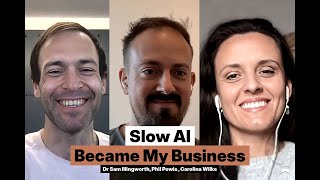
In this episode of Sacred Business Stories, host Phil Powis and co‑host Carolina interview Sam Illingworth, a professor, poet, and creator of the Slow AI Substack. Sam explains how his interdisciplinary background (atmospheric physics, theatre, poetry, and science communication) led to the launch of Slow AI in July 2022, a newsletter that now has over 16,000 subscribers and about 300 paid members. He discusses the challenges of moving from an open‑access mindset to charging for content, the pricing model (£100 per year or £25 per month) and the value‑add of a CPD‑accredited curriculum with monthly webinars. Sam shares practical tactics for growing on Substack – turning on paid subscriptions from day one, restacking others’ posts to break out of one’s feed bubble, and deliberately building a small ecosystem of supportive peers. He reflects on the emotional side of public work: fear of factual error, tall‑poppy syndrome in academia, and the responsibility of providing accurate AI literacy. The conversation also covers platform experimentation (TikTok, podcasts, blogs), time‑management as the audience scales, and the importance of aligning strategy with authenticity. Throughout, Sam emphasizes service as an amplifier, the need for humility, and the value of genuine, reciprocal community building.
Chapters
So yes, welcome to Sacred Business Stories. This is our weekly Substack Live where we really just have an honest conversation about what it looks like to build a business that aligns with your truth. And today we are super excited. This has been a long time coming. Uh, we have our friend Sam Illingworth with us. Uh, for you that— for those of you that don't know him, he is a professor and poet based in Edinburgh. Uh, he's the creator of the Slow AI curriculum, the Slow AI publication here on Substack and author of Critical AI Literacy and, I'm sorry, author of GenAI in Higher Education. So welcome, Sam. It's really awesome to have you here. I've been looking forward to this conversation for quite some time.
Yeah, thanks so much. Hi, Phil. Hi, Carolina. Hi, everyone in the chat. And yeah, just like to give you flowers straight up, like everyone knows this, but Phil and Carolina are such kind people and like we've been trying to arrange this chat for a while and just really looking forward to it. Um, and yeah, already struck by the fact that you two look far healthier than I do and that I look incredibly whitewashed in this central picture. Like, this, this is what happens when you live in Edinburgh versus Brazil though, right? So that's, that's my, that's my defense.
Well, I guess you were coming off the winter and you're just coming off the summer, so that plays a big part on it, right?
Yeah, I definitely got a few new shades of color when I, when I moved to Brazil. I lived in Boston for 10 years, so I had a, I had a similar thing going on to you for Sam, but it's gotten better and better over the last couple of years.
Yeah.
Yeah. So thank you so much for being here with us, Sam, and thank you everyone for watching. Like, if you have questions, please post it in the chat and we're going to do our best to respond to all of them. Um, I like to remind ourselves, our guests, and you watching why we do Sacred Business Stories. And it's purely for inspiration. We like to go into the behind the scenes of like people creating from their hearts. Um, just so you can allow yourself to create from your heart as well, if that's your, it's your intention. And I'm very excited to have you here, Sam, and I would love for you to just guide us through a little bit on behind the scenes of like you creating your business and you could create like, it's, it's up to you where you want to take us, but I would love to hear a little bit about like your story here on Substack, why you decided to create that and how your pets your path has been.
Yeah, of course. And, you know, really interesting you use the word business. I always struggle with using words to identify myself, like, in this, like, poet, scientist, entrepreneur, business writer, like, so it's always nice when someone else uses that word instead. I guess my Substack journey and what I'm trying to build with Slow AI officially started on the 1st of July last year. Um, and you know, what I really wanted to do is I wanted to create a space where people could engage around what AI actually is and what it's not, to try to tackle some of the misinformation, to try to adopt a broadly centrist approach, and to genuinely try to give people advice that wasn't prompt engineering and that wasn't mistruths and that wasn't trying to con people. Um, and so we started Slow AI and then we've been really successful, grown to just over 16,000 subscribers. I've got, I think, just under 300 paid subscribers now as well. And just speaking honestly, I found the journey difficult. Um, mainly the pricing, you know, I'm a, I'm an academic, like a career academic. I don't know anything about marketing. Or business at all. You know, and Mia Kuraki, who does Robots Take My Homework, who I know you've had on here before and who's become a really dear friend to me through Substack, you know, she always just used to take the mick out of me saying, what are you doing? In the nicest possible way. And, you know, I originally started off by saying everything's going to be free, like open access. And then I kind of had this realization that I should probably start charging for stuff, not only because it would be good to make some money from this, but also because it was undervaluing the product, not just of myself, but of other creators as well. So then I kind of had this really, I guess, like genuinely soulful discussion with myself in terms of what, what would a paid product look like? And there'd be some element of paywall, but I thought what I'd like to do is to create something that I could offer to people if they decided to become a paid subscriber. And that would be a series of monthly webinars where we really look in depth at what AI is and is not. And then, yeah, I've just been trying to build the brand from there and genuinely trying to learn about, like, from people such as yourselves and other people on Substack, like, what it means to build a business, what B2B even means. I have no idea what B2B meant until about 6 months ago. Like, what a funnel is, what B2C is, what a I don't know, like what a mail merge is, all of this stuff. And it's been, uh, yeah, it's been a really interesting learning process. And so for me, I think I'm in a position now where I still personally wouldn't call it a business because it feels more of a, like a side project, but it's certainly becoming more than that. And yeah, really happy to answer any more questions that you might have. Just briefly, like, you know, my background is, like I said, an academic. I have a PhD in atmospheric physics. And then I spent several years looking at the intersections between science and theater, and then looking at how we can use poetry to diversify science and platform the voices of marginalized people. And then when ChatGPT launched in 2022, I was like, this is really interesting, but it's going to create a disconnect for those who do and those who do not have access to these tools. So a lot of my work then transformed into this idea of how can we use AI to meaningfully try to reduce the digital divide rather than expand it. And through that, I realized that there wasn't many academic voices speaking in an accessible way. And that's where Slow AI originally emerged. That's a very long answer, sorry, to your question, but I hope it's a good starting point.
No, that's, uh, that's, that's a, that's great. And so, yeah, so you started, I was curious about that, like how long you've been in this space of AI and how you decided to kind of bridge and, or at least start to insert yourself into those conversations. So, so well before you started the Substack, you know, you were starting to use ChatGPT back around 2022. Is that, is that what you said?
Yeah. And using it a little bit before then even as well. And I guess speaking honestly, like throughout my academic career, I've, if I'm being unkind to myself, I'd say I've always flip-flopped. If I'm being kind to myself, I'd say I've looked for opportunities to divest and to diverge. And, you know, starting from like very, very physics-based degree, then looking at like science communication, social science, then into education and pedagogy, and then into ChatGPT. And so it seemed to be a logical progression into doing those things. And I should say prior to Substack, I have like a decade of doing public engagement. I had a fairly successful blog on another platform prior to that, looking at poetry and science. I used to run a podcast. I had quite a good Blue Sky and Twitter following until I realized that both of those didn't really work for multiple reasons, opposite ends of the spectrum. And then recently I've just tried to experiment with TikTok as well, just past 1,000 followers on that. And for me, that's going to be a really God, I sound so professional. It's going to be a really interesting top end of the funnel into my—
Wow, that's impressive. That's impressive. And you're going to places that I haven't even been willing to go. You're actually making me think like, oh, maybe I should go hang out with you over on TikTok.
Honestly, Phil, and this came from my really good, again, really good friend I've made through Substack, Gem Banford, like, you know, Divergent Alchemist. She's amazing. And she was like, look, I'm on TikTok. 'You should play with it.' And I was like, 'Okay.' And she like really encouraged me to have a go, and now I'm loving making that content. It's slightly different, like the stuff I do on TikTok is a bit more investigative journalism work. Um, but yeah, I'm really, I'm really digging that. Do you like— I don't want to like jump on you. Do I just— should I just pick up questions as they come in the chat? Because some of these things—
let's hold a couple of those towards the end. But well, I, I've seen a couple of good ones come through, and we will make sure we, we get to those. So thank you for those of you that are, um, dropping those into the chat. But one other thing I wanted to say, Sam, one thing I really appreciate that you just shared was that in a way, like, well, when people and when I see kind of what you've, you've done on Substack in such a short period of time, it's very, very impressive, you know, and again, and I'd love to get into this a little bit further in the interview around connection, the way you do it so authentically and how you have been growing is really, really impressive. But I also appreciate that you shared in some ways this isn't your first forum. And I think that's really helpful for people to hear because a lot of times people come on and they say, oh, like, how are they doing this? And I'm not having that result. And it's something that I often remind people, like, you know, sometimes there's things that you don't see. For example, I've been doing versions of what I've been doing here for 10 years, essentially. And so for me to experience certain things, it's not always apples to apples. And so I don't want to take anything away from your growth. I think it's incredibly impressive, and I share your story a lot with our clients, but I think it's also helpful for people to hear that, you know, you've had these other attempts and in some cases successes, it sounds like, on other platforms.
No, definitely. And like, for everyone watching as well, it's, you know, it's realizing that you're not starting from scratch. So even you've got all of the learning that you had in previous lives and in previous hats towards this. And, you know, like I said, I had a blog that was fairly successful. Like, it was called The Poetry of Science. I ran that for like a decade. It started off with 3 views a month and it got up to, at its peak, like a quarter of a million a year. So it was, it was quite good. And again, I learned from that, like what was working, what wasn't working, what did I want to involve myself in the process and it was a little bit didactic. And then, you know, all the, I guess the academic learning that went into it and lots of, lots of things that haven't worked along the way. Like, you know, I, When I teach, I do a lot of work with early career academics talking to them about how to use social media. And I always say to them, look, try out lots of different platforms and just find the ones that work for you and experiment. You know, I've— for me, I'm not— I'm a creative person, but I'm not a visual person. Like, I'm banned from taking photographs in my house. Like, they're objectively terrible. So when I started— when I played with Instagram a few years ago, it was just It was garbage. It just didn't work at all. And interestingly, through Substack, I'm like, you know, my friend, again, I've genuinely made lots of really good friends on Substack, but one of my really good friends now, like Rebecca Wicker, who's the Strategic Linguist, we talk about this a lot in that we're both quite good at this kind of work. Just, I'm a lecturer, I'm a university professor. I give, I speak to tens of thousands of people a year. I'm not being falsely modest. I just, I can do this quite straightforwardly and it takes me much less time, ironically, to prepare and to do a live like this than it would to do a written piece. So for me, that's about learning with Sutthak and also the business, like how I can make use of that and my time. So I now have like a Slow AI live every single Monday with my friend Leo from Exploring ChatGPT, um, because I love doing it. And then I've do the live videos for TikTok. And for me personally, it's easy. Like, it's very straightforward to record all of that, to like do some basic editing, which I use AI for, to write the scripts. You know, I, again, I have a past history of being an award-winning playwright and actor. So that for me is part of that past life, right? And it's just saying to everyone, you can bring all of those identities together. Exactly as you say, Phil, when you see someone having what looks like a moment or a success, you haven't seen the And in my case, it's many like failures and learning opportunities over the last 15 to 20 years as well. Mm-hmm.
Yeah, that's really beautiful. And thank you so much for sharing because, um, that's exactly like what we share of like what a sacred business is, right? It's like, it's a business that actually, uh, brings all of who you are forward. So it's not that like sometimes we see what other people are doing and because it's working, like just to, well, Phil was pointing is like, we don't see the behind the scenes. And we just had a conversation with someone else, like a couple of hours ago. And it's like, people get attracted to you. Yes, because of what you do, but mostly because of who you are. So the more you can bring all of that forward and kind of like connecting to like, yes, like Instagram works for me, but Substack doesn't, or TikTok works or whatever it is, but you need to experiment yourself, like in many different ways. And find the old, your own voice into what you're doing. So then it's kind of like, how can I bring all of that forward? And people get attracted to you, um, in an easy, not easy, but like with easiness, right? Like in that feels like flow. And I think you found the perfect recipe for you. And then how can I keep like putting myself outside my comfort zone? So writing is not as easy for me, but I'm inviting more of that as well. So we kind of like keep growing. So I truly appreciate you sharing that because sometimes We think it's just a one thing. Let's just repeat this. And it doesn't feel good to me, but I'm going to keep pushing because everybody's doing it. And it's, it might not be, I don't believe it's about that. I think it's about like looking inside and like what works for me. What do I truly want? So thanks for sharing.
No, definitely. And, you know, and again, just, I don't know, Colleen made a good point in the comments that relates to this as well in terms of, um, You know, your identity as a, as a creator as well. And look, everyone has opinions on what platforms they do and don't want to engage with. And I am not going to tell anyone which platforms they should and should not engage with. That's not up to me. Like everyone needs to make their own decisions that sits with their own ideologies. And when, as you're saying, Carolina, when you're able to do that, you feel more comfortable because you're not forcing yourself into working with a platform or working in a medium in which doesn't feel naturally harmonious. So, you know, for me, you know, I use Amazon, I use Substack, I use TikTok, but for me personally, and this is only me personally, like I was unable to engage with X after certain actions were taken by the, by the CEO of X. And that, that's just a decision that I made. Other people have a very similar set of belief systems with regards to Substack or TikTok or Google or Gemini or AI in general. And I think what's really important is just making those decisions for yourself and also for your business. Because as you said, Carolina, that inherent flow and that inherent honesty, people can see through that. And it doesn't feel right for you. It feels incongruent and it feels like you're fighting against something. Whereas if you find the systems and the people and the medium that line up with, like, you know, as you would put it, with your sacred business flow, then it really does just feel like it's moving in this direction that's, I mean, I'm quite a spiritual person, but that's going with the universe rather than against it. And so, yeah, I think that's a really important point to raise.
Question for you, Sam. I'm curious because the way I experience you is very centered, very balanced. And as you said, you have this experience speaking to tens of thousands of people, which is something I don't, you know. So for example, when we started the show, I had so much anxiety about allowing myself to be seen on camera. And it's still actually— I still feel that tickle, but I've started to kind of recast that in a new way. But I'm curious for you, like, one of the things that we like to talk about is that it's pretty normal to have fear and resistance kind of coming up, especially as you're— if you're sharing something that's very close to your heart or it's meaningful or it's a message that you feel needs to be shared. And so I'm curious, you know, and maybe there's not, but is there any area with what you've been creating currently or in the past where you've experienced kind of these sorts of things coming up and How do you allow yourself to kind of keep moving through that? Uh, you know, if you feel yourself challenged.
That's a really good question. I would say that for me, it's probably the things I worry about and feel fearful for and anxiety about, and maybe slightly more intrinsic. And at a base level, it's, have I said something or given advice that is factually incorrect? Or which has led somebody to do something that is regrettable. And so, I mean, part of that's the academic in me, right? Like, I don't like getting things factually wrong. And I will have, like, not, you know, sometimes when I hit, we all do this, but sometimes when I hit send or like publish, I'll be like, have I got that right? Is there something I can change? And I do get things wrong. And that's, that's okay. But that, that other thing really of, have I given someone advice that should they act on it would be, would lead to a difficult situation for them? That, that's the thing that makes me anxious. And I try to get around that by genuinely being, look, and this is my approach as an educator as well. Here are the facts, the facts. Here is my interpretation of the facts. Here are the tools. For you to go away and interpret the facts, but I'm not going to tell you what the right answer is because a lot of the times there is no right answer. So yeah, I don't think it's necessarily any particular medium or form. It's just those two things, like getting something factually wrong and then more worrying giving someone bad advice that has led to an unfortunate incident for them.
Yeah, and I can relate that like the more, uh, it's connected a little bit with, um, well, at least the way I see it, like with the fear of visibility, right? Because the minute you start putting yourself out there, uh, you need to stand for what is true for you. Uh, it might, it doesn't mean that it will be true to other people and you have zero control on how other people will perceive you and what they're going to do with the information that you're sharing. So sometimes like, and then as you grow, like imagine that now you have like 16,000 people like watching you, right? So it could like, for some people that, that's like scary and like, oh, I'm not going to put myself out there because of the sense of responsibility that, you know, rises when you're like starting to, um, to do that. So like, is there anything related to you in that sense of like, You mentioned beautifully, like, yes, I'm going to do what I, what I, what I can with, uh, kind of like what's in your power, but what keeps you moving? Like, what keeps you like sharing, knowing that you cannot control other people's reaction and what they're going to do with that information?
That's a great question. So I'll take, I'll take a tangent first. So one of the things that I guess holds me back sometimes is I don't know if you know what the expression tall poppy syndrome, but that's something that's rife in academia. And it's basically the idea that if you see tall poppies, you're supposed to cut them down. So, and it's a very British trait as well, right? Like we don't like people to be seen to be doing well. So if people are seen to be doing well, they will be, people will have issues with it. So I get a lot of personal emails sent to me. That not necessarily, they're not hateful, but they're basically saying you're misrepresenting academia and, you know, I don't like what you're doing and why are you charging for this? And they're all fair points, but it's that it's very much this line of within academia and others, people don't always like to see people succeed, whatever success might be. You know, my attitude is there is more than enough room for everybody to succeed. In everything. The thing that keeps me going, like, honestly, especially with AI, is that it's really important. We are at a moment where people need to have that information and they need to be guided down a route of meaningful dialogue and discussion so that they can make informed decisions that will then help us going forward as well. So like, you know, how do you use AI in your workplace? How do you use AI with your children? How do you use AI in your personal life in the courtroom, et cetera. So the thing that keeps me going, and it sounds so trite, but it's a sense of, I guess, civic duty, that this is really important. And that's why there's always that tension of, is this a business, right? Because should I be charging for this or should this be something that I do for service? And that's a tension I always carry.
Yeah, I just like you, you mentioned a little bit of that at the beginning of this conversation about like deciding to charge. Right. Um, and I, I think, um, just sharing my opinion about like deciding to charge, like the, a lot of people, they, they're trying to be generous and they hold a very powerful and important message. And then in that sense of like, I want more people to get access to that. They think that the answer to that is like not charging, but I'm going to share with you that I truly appreciate that you were sharing because I think money is just an amplifier of generosity. So if you have all your means covered and it doesn't matter if you want to turn this into your full-time thing, or if you want to keep being a professor, like that's not the point. It's just, um, so if you're listening to us here and some people ask like how, How would you do decided that you're going to charge? Um, charging does not take generosity away. Asking for money for your services does not take generosity away. And the way I see it, it's quite the opposite. Like, it's just a way to amplify more, like, the way you can serve and more people that you can reach because you can now, you can have money for yourself, but you can also have like money to invest more in your message, in your business, and that service gets amplified. So just sharing that out there because sometimes it gets this I'm not going to charge, and then you don't even have time to do it because you need money coming from another source, right?
No, definitely. And, you know, as I touched on briefly, that service amplifier, I always remembered with poetry as well, because I used to do a lot of poetry work just for free because, you know, I've got a position, a full-time job. And then someone said to me, like, as a poet, look, if you go and do these workshops in schools or talks for free, you're theoretically taking paid work. Away from the people who need it as their full-time profession. So I think there's that risk of dilution of service as well by saying, look, if it's all free, then that's something that people should expect from all creators on this platform. And again, going back to the previous point in terms of like what you feel comfortable with, it's what resonates for you, right? And like, I mean, we can get into the weeds of it, but I have like a pricing structure, but if If people contact me saying, look, I have very low income, or I'm from a country where it's very difficult to get access, I'll of course give discounts away for the fee and stuff like that. Because that's then, and then likewise, because I believe in karma, what will tend to happen is a week or so later, someone will join as a founding member, which will just offset all of that anyway. Right. So I think you're absolutely right, Carolina, that like it does amplify service. Um, although really interestingly, you know, when I joined Sacred Business Flow, it was like the circle, and you sent me through the questionnaire, which I found extremely helpful. Like, service was the one area that I definitely needed to improve on. So it's, yeah, I told Phil in like a direct message, I was like, Phil, I'm sure you don't need to hear this, but what you've created really works. This is like, this absolutely pulls out exactly what I'm good at and what I need help with as well. So yeah, it's really interesting that service comes up in the conversation.
You're referring to, I think, yeah, you're referring to the Harmony Map. Yes. Yeah, that's, that's okay. Um, yeah, I don't know if you want to say anything about that, Carolina. It's interesting because service is one that, uh, often comes up, um, with people that truly are of a heart of service. And I think that there's a, there's a little bit of a misconception of how we interpret that. So I don't know if there's anything you want to say about that, Carolina.
Yeah, no, I think it's one of the, we call like the 9 frequencies of a sacred business. And, uh, often we see that like service often comes like with, uh, discipline, for example. So sometimes, and we see that often, like people are very successful in a career here and they hold something very close to their heart. So then they like, but then turning this into a way of living, it's almost like this is not service, right? But not always they are connected with the way they make money. Um, so it's just interesting. And then the whole work is like, hey, you can serve and you can do something from your heart and you can make good money. It's not either or, uh, but it's often like changing a belief system that if it's coming from my heart, like money is not part of that.
That's a really good point.
And, uh, just since we're on the topic of money and pricing, we did have a question in the chat. I guess, I don't know if I'll say this right, but Omix or Omixintel. Asked about how you decided to charge for your products. Like, you know, kind of, is there any sort of a brief explanation of how you, how you arrived at the pricing that you have chosen to run with for the time being?
Yeah, so I guess just watching lots of other creators to see what they did and see how my pricing point matched that. And, you know, for people who don't know, for Slow AI, like, if you become a paid subscriber, like, you get access to all my paywall posts, but you also get enrolled on a curriculum where we have monthly webinars. And basically at the end of it, if you write like a short reflection, you actually get an accredited certificate. So this is continuing professional development. So you can write that off as a tax expense. You can use it as actual credits in your own developmental work. It's recognized globally. And like that came with a cost for me to have to do that as well. Um, but I mean, my current model is, it's £100 for the year, which they're like, what, $120? And if you actually look at what a year-long curriculum continuing professional development course costs, and like, which I've been to and which I've been involved with, it's like a tenth of the cost, if not, if not less. And again, that was for me, everyone's slightly different, right? And I know you guys offer like things away from Substack as part of the paid membership. I know other people do that as well. And I was like, look, this is— I'm an educator, I'm a teacher, that this is something I like doing and that I'll be able to do and it will feel like a natural extension of the Substack platform. So that's why I ended up doing that and how I arrived at a pricing point. And just speaking honestly, really, people being like, you're charging way too little. I was like, okay, I'll charge some more and, you know, and we'll see, we'll see, we'll see where that lands. But I I'm— one thing I'll say about doing like doing a PhD and being in education is you genuinely realize how little you know about many, many things. I have very, very detailed domain expertise on a few topics that genuinely puts me in the top 0.0000001% of the world, of course, but everything else I know very little about. So I genuinely come into a lot of this thinking, I don't know much. I'm willing to learn from people. I'm willing to make mistakes and I'm willing to be like humble about it. And also willing to change. Like, and I'll be honest, if you look back at my early Substack posts, a lot of them are like, I will never charge for this product. It will be completely open. And then I had these conversations with many people and myself and was like, this doesn't feel right. And so it felt like a natural progression to change. And I think having that, um, I guess having the confidence to be able to realize that your truth can change with you as you evolve, that's something that's quite difficult to square.
I really, really love that you're saying that because I think this is another thing for people that kind of paralyzes or freezes them to putting their offers or putting their work out because they, um, they fear like, oh, am I making the right decision? This is something that we often say. It's like, you always hold the right to change your opinion. Like, you're not a static, you know, thing. You're a, you're evolving human being. And what you believe tomorrow may be completely different a year from now. And that is completely valid, you know, and especially if you're, you know, and I feel you are someone that approaches everything with humility. And as you said, like, you're not trying to force your belief structures on others. You're just sharing from your best perspective of what you believe and understand about the world and yourself today. So I just, yeah, I just really appreciate that you, that you call attention to that because I think it's a very important point to know, like, hey, if you're looking to put something out and create your first offer on Substack, for example, take your best educated guess. And guess what? It may not be right. In fact, there's a more than better, more than a good chance it won't be right. And, you know, let it Let it be messy is another thing we tell our clients a lot. But it's through that process, I'm sure you would be able to share that you learn, you know, you learn what works for you, you learn what works for others, what resonates. And this is how it's done, in my opinion.
Definitely. I mean, and, you know, following people like yourself, like Matt Collier is a great person to follow. Backstage Pass, I call him the AI whisperer, like, so the Substack whisperer. He's just really on it. And I think One piece of advice I would give unilaterally across the board is just to turn paid subscriptions on from day one. I really wish I'd done that because theoretically I didn't turn it on till I had like 7,000 subscribers or something. And that's 7,000, I mean, getting into the weeds again, but the most impactful thing you'll ever do on Substack is that initial email that gets sent out. To people when they subscribe to you. It has the highest open rate of anything you will send. All of the statistics back this up. So if you haven't got paid on at that point, you miss an opportunity to engage with them and to bring them on with that journey, not just for the money, but to bring them on with that journey. And like, for me, having those paid subscribers is great for the money, but it's great because they really are hugely invested in the project. So I would say key thing, I definitely turn on subscriptions from day one. And the other advice that I got that was really smart, I thought, was think about the kind of subscriber that you want. So I want people who are locked in for a year because I want people who are there on that whole journey. So for me, it doesn't make sense to charge like a tenth of an annual subscription for the month for people to keep going. I want people to lock in for the year. So I have like £100 for the year and £25 per month. Which really encourages, I hope, people to go for that annual route instead. So they're the two things I'd say are really important, like turn on paid from day one and really think about the kind of paid subscriber you want and why that is. And it might be different. I have other people I know who want monthly subscribers so that they can just like rack that up and bring them onto a system. And that's fine as well. It's just whatever really works for you. Yeah.
And I think that, um, That's good advice. I think it's, um, but the second part I think is almost the most important part in my opinion. It's understanding what your intentions and where you're trying to lead people, right? Because this is where I think people get really stuck sometimes because you can't see like what's below the tip of the iceberg. And so many people are running their publications or businesses on different models. For example, majority of our business doesn't happen on Substack. We do have a paid subscription. But we run it very differently than a lot of other people do. And it's not right or wrong, but it's understanding the experience, right, that you're guiding people towards. And this is where I see— we actually have been talking about this a lot lately around Substack, where, you know, we say like growing a Substack isn't necessarily growing a business, right? Like, and there's nothing wrong with just growing a Substack. There's nothing wrong with just pure self-expression or sharing of knowledge, but it's kind of understanding, you know, what your intentions, what your motivations, what your goals are. And then yeah, there's no shortage of really good people out there that can help you kind of figure out how to dial that in. And yeah, you've been surrounded by some— I love Mia's work. I love Max's work. I follow him as well. So yeah, there's a lot of people that can help you dial that in. But one thing I would, you know, with the time we have, the piece I think Caroline and I were most excited to to get into with you is around this idea of connection, because we shared with our community, and I know we shared with you before we even started this, like, we share you as an example all the time of just like, feel like you're just like a Jedi at this. Like, it comes across, and I believe it's completely sincere, the way that you connect with people, how you share their stuff, how you're generous. Like, I don't know if you're still doing this because I feel at some point it might be challenging, but I remember one of the things you had when I first started following you was You literally stated, you're like, hey, I reply to every comment, I reply to everything. And, you know, you can expect to hear an answer from me. And sure enough, like when we start chatting, that was, that was true. And, you know, and there's so many other things I could share about my observations of you. But yeah, I'm just curious, like, because I think this is one of the biggest challenges creators face is how do I create these like meaningful, authentic connections? How do I share my message? It doesn't come natural to a lot of people online. Even we talked to a lot of people, either introverts or they say, hey, like, I'm really good at doing this if I'm in a room, in a physical room with people. But the minute I get online or on somewhere like Substack, I freeze. And so, yeah, I'm just curious, you know, did that come natural to you? You know, what advice do you have for someone who does want to share and connect in a meaningful way more consistently?
No, thanks, Phil. I mean, it, it, I guess it does come naturally to me, but only because I've practiced it, right? Like, my research for like over a decade was about developing community. So like, it's not that I know how to do it, it's just it's something that is genuinely I love, and I love connecting with people, I love meeting people like that. I am an extrovert, like, in not in the boisterous sense, but in that, you know, the true meaning of the word. I get energy from engaging with other people.
Right?
Like I'm hugely extroverted in that way. And so the genuinely best advice for all of this is to find an ecosystem. And what I mean by that is like 5 or 6 to start with, 5 or 6 people who you just vibe with. And I found that and I was like reading their work going, I really, really get this and direct messaging them saying, I love your work. Like, You know, not even, not even an ask, just I really love your work and then just trying to build those relationships up. And, you know, again, going back to the previous point, that's okay to change because people change as well, right? So the people, some of the people that I started off engaging with in Substack back in July last year, I'm still in touch with. Others have drifted apart because either they're off the platform or they do less or we move in slightly different circles. Others, I have like 5 people I would genuinely consider to be good friends now. And I think it's about reading their work, like, and then feeling as though you want to engage with it. I definitely read all of my comments still. I try to respond to all of my comments on my posts. It's not possible for me to respond to all of the comments in my notes. And I guess two things, like, it's You should do this, you should do this because it's, it gives you support. And then you've, you found people you like, you know, me, I'll message Mia all the time saying, Mia, I have no idea what I'm doing. Can you help me with something? Or Mia will message me saying, oh, have you got an opinion on this? And it's great. And you know, several friends, we communicate off Substack now as well. But having that ecosystem of support is really helpful and it makes you want to keep coming back to it. I also came off most of the forms of social media so that I could invest my time in it. And, you know, non-altruistically, the algorithm rewards that behavior. So like one small example, like, I didn't know this at the time, but I restacked people's work because I was like, this is really interesting. But if, if you restack somebody else's post in Substack, it puts you in front of their audience. So literally, it Makes so much sense to restack other people's work because especially outside of your bubble, the thing I don't like about Substack is your like feed is basically the people you normally engage with anyway. So you have to look a little bit further. But I, as a habit, try to find one person every day whose work I restack just so I can break out of that bubble. And then I find someone every day who I thank. I mean, and that is genuinely altruistic. I'm a white heterosexual cisgendered man. I'm the epicenter of privilege. And I should use my voice to help platform others whose voices haven't been heard as much. So that's why I try to do a thank you note every day. But then I'm, you know, I'm one of my faults is I'm very honest. So like speaking honestly, I think that whole thing's changed. I think up until about 5,000 subscribers, like genuinely it's possible to read lots of different Substacks, comment on lots of Substacks. I used to have a rule that for every post I'd put in, I'd comment on 5 other posts. For every note I put in, I'd comment on 5 other notes. And, but then I would say once you get past about 5,000, that, that becomes a bit more difficult to manage in a, in a way that feels authentic without it feeling, feeling like a chore. And when something feels like a chore, it's not authentic anymore. So, so I, I, and then now I'm at like 16,000 and I'll speak honestly. I look at some of the conversations with people that I used to engage very readily with who have maybe got a slightly smaller subscriber count than me. And I'm not as engaged in those conversations. And I'm like, oh, I wish I was kind of engaged in that more. But then I realized that I've got all these other different conversations and the purpose of my Substack has changed slightly. Um, and so I personally feel at the moment a little bit between— I'm not like at that early stage where you can make all these meaningful connections, you can sink a lot of really meaningful time into having these connections and building these ecosystems. And honestly, I'm not at a level of like 1,000 paid subscribers where you're effectively in a flywheel, whatever happens, you're just going to— engagement is going to accelerate, accelerate, accelerate. So I genuinely feel in this moment of I'm doing a lot of work in creating my own content. I still want to engage with people, like both because I love doing it and also because I know it helps. But that has become not unmanageable, but just different to do than how I used to do it 3 or 4 months ago. And that's like an honest, an honest response. Anything is possible.
Yeah, it's interesting. Like, uh, well, you're actually an example. There's another guy I was thinking about. I don't know if you know— do you know Landon Poberan?
He's another— oh yeah, yeah, yeah, great.
He's a very nice guy. Did you say great beard or great guy? Yeah, uh, well, he has a great beard and he is a great guy. But, uh, yeah, like, and you were like, like when we— when I first got connected with you, I felt like we were all over each other's stuff and it was a lot of fun and I, I just love everything you're doing. And then at some point you kind of like, similar to what you're talking about, you kind of fell off my radar. And, and sometimes I notice that, like, people I really appreciate, like, it's like a month or two will go by, I'll be like, where, where's, where's Sam? I haven't seen him. Or where's Landon? And sometimes I'll go through and I'll actually just like start commenting on people's stuff very intentionally because I'm like, I want to make sure that like I keep seeing those people because I really, really value seeing them in my feed. So it's just interesting the way you describe that because I've, I've had various different, you know, experiences similar to that.
Um, yeah, and it's like friendships, right? Like genuinely, like friendships change. Like, whereas I have like a group of pals— I mean, I'm 42 now— I had a group of pals that I grew up with school, and we meet every year, and it's like we've never been away, right? Like, and like sometimes I won't see them for a year, but then we'll come back together, and it's like that. Some people I might not see for 5 years. Some people I used to see, like work colleagues, I'd see every day for like 5 years, then change jobs, and then suddenly never see them again. And like you know, that's transient. And it comes back to that thing that you were saying, Phil, that we, we change. We're human. It's okay for us to change. Um, as long as what we— as long as I genuinely believe, as long as what you're doing has resonance with your belief system, it, it feels much more of a natural flow. And again, I'm, I'm honestly trying to find that space and where that sits at the moment for me, um, of wanting to create genuine service, wanting to have these relationships and engagements with people and wanting to platform, you know, voices because I feel as though that's my responsibility to do so. And, you know, I, as you'd expect, I don't have any answers. I have things that have worked and things that haven't worked for me, and I'm still trying to figure a lot of it out as well.
Yeah, I think you spoke beautifully in the, to the intersection of like when strategy meets authenticity. And I think that's the sweet spot of like when it really works, right? Because if you just do the, if you just take action because you're interested on an outcome, it forces, like it's like, it doesn't feel good. And then when you just do stuff, like if you're trying to grow a business or if you're trying to grow your Substack, whatever, if you just do stuff without really connecting to like what you want, um, it feels off too. So thanks for sharing that. I think it's very powerful too. Find your own recipe and like, yes, maybe it is finding other people's work and you're not doing this because we're growing your Substack, you're doing this because you're generally trying to find people doing like cool stuff out there. So, um, I appreciate that. Uh, we are almost, uh, on time here. Just, uh, this Kennedy asked, like, how do you manage your time? Because you do a lot. So he was just asking, um, a little bit, uh, how you manage your time, if you can share.
Well, that's— thank you, that's very kind. I guess I am very efficient with time, as I have to be. Um, but it's an off-trade, right? Like I was saying, when I started like Substack, I'd spend a lot more time reading and commenting on other people's work. And as— to use your word, not mine— as the business has grown, other things have happened outside of Substack as well, which have taken me away from all of the time that I spend on Substack. And that feels like a natural place to go. So Yeah, I, I, all of us do a lot of work. I'm probably just quite vocal about what I do as well. That's probably the difference.
Yeah. And, um, and yeah, just to close, and then I want to give you the last couple minutes just to share, uh, where people can connect with your work if they're not super familiar with you. But yeah, I wanted to kind of echo what Carolina said because I think it's so important. I think there's a lot of people that don't believe that strategy and authenticity can coexist. It's like I'm either being authentic or I'm being strategic. And then if I'm being strategic, there's this guilt because I'm not being authentic. And, and yeah, I think that everything you described is a perfect example of like, oh, it can actually be both. And for me, that's when I feel the most lit up and when there is that, that alignment. So yeah, thank you as well for sharing that. And gosh, yeah, I'm glad Carolina mentioned the time because I'm so into this conversation. I'm usually really good at wrapping time, but I'm not doing as well as I normally am, to be honest. But I did, you know, with the last bit of time we did have left. Yeah, I just, you know, a lot of people here probably are very familiar with your work, but, you know, we'll also be sharing this in the form of a recap. So if someone hears something or reads something here that kind of stokes their curiosity, obviously you're on Substack, but what would be a first best step for someone that wants to kind of engage more with your work and what you're sharing with Slow AI?
Yeah, for sure.
Thanks, Phil.
Thanks, Connie, for this opportunity. Yeah, just you can follow me on slowai.substack. Like, if you really like my work and want to connect, send me a direct message. We'll happily pick it up and talk about it. And I'll be honest, I'll be like, look, it'd be cool for us to chat some more, or I'm a bit like, I'm a bit inundated at the moment. You can follow me on TikTok, which is The Slow AI. And again, that's just a little bit more investigative journalism work. And then my website is just samillingworth.com. I'm a, as well as a full professor, I'm also an education consultant as well. And I do a lot of AI consultancy work as well. So yeah, just Delighted to meet you all. Thanks very much for such an engaging conversation and for a really interesting chat and for the opportunity as well to talk a lot of this through with you both. I really appreciate it.
Yeah, thank you as well. And it's wonderful. So we'll definitely be putting the recap together. I'll share it with you just in case you feel it's valuable to take a peek. And yeah, as always, I hope we stay connected and continue to follow your work and love everything you're doing. So thank you again for being here with us. And thank you for everyone that joined us live. Really good stuff in the comments. So appreciate everyone that was able to be here with us today.
Yes, thank you everyone. And thank you, Sam. It was very nice to connect. See you around.
Bye for now.
Bye everyone. Stay safe.









