She found more joy in a prison than in church | In Full Light 005
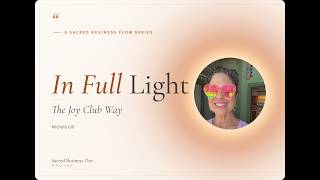
This content was created by Phil Powis. This content was uploaded by Phil Powis. This is a live YouTube/substack conversation titled "She found more joy in a prison than in church | In Full Light 005" (In Full Light Substack Live series) recorded May 27, 2026. Participants are Phil Powis (host), Michelle Gill (guest; developmental and educational psychologist, founder of the Joy Club Way) and Carolina (co-host). The discussion is a guided interview about Michelle's work creating playful, individualized practices to cultivate joy and aliveness—covering her Joy Club pilot, non–one-size-fits-all approaches to spiritual and wellbeing practices, teaching in a prison, tensions around credentials and visibility, and practical attitudes (curiosity, welcoming emotions, enjoyment) for cultivating presence and transformation.
Chapters
So, um, welcome to In Full Light. This is our Substack Live series where we celebrate the heart-led practitioners inside our community who are really stepping into their power and sharing their gifts with the world. So today we're excited to have Michelle Gill with us. She is the founder of the Joy Club Way, and she described herself as the creator of playful spaces that help us become more awake Free and Alive. So welcome. We're so happy to have you here with us today, Michelle.
I'm so grateful to be here. Thank you, Phil. Thank you, Carolina. And hello to everybody here. Happy to take questions.
Cool. So, um, so Michelle, really the way we just like to start this off is, um, just giving you an opportunity to tell us who you are, what you do. But I think the thing that we're most importantly interested in is why you do what you do. So what is the deeper calling behind the work that you're choosing to step into?
I love working with people to help them become more fully alive. I became a teacher for that reason, and I'm a professor now at a university, and I love to help my students. I create schools where people can thrive. I teach teachers how to help people thrive. I'm a developmental psychologist and an educational psychologist, and I love all of that. It's been really great. But in the last few years, I have found myself taking on all these volunteer side projects to incorporate everything I know, not just the academic part, but also the spiritual development part that I've been studying for 30 years, my yoga training and all of that, and just put it in a way that can help all people, especially women who I think have a lot of extra burdens and struggles, and especially if they're raising kids or having to be caregivers for a lot of people, just to help them. and be supportive of them. And it's been really, really fun and I've been scattered. And it wasn't till working with you both that I realized that I needed to concentrate my energy so that I could have a bigger impact. So, um, I did a pilot group called the Joy Club, um, a few, like about 8 months ago, and it was really amazing. And I thought I could make it a little bit bigger and offer it to more women.
Yeah, I truly appreciate that you're creating that, and I think it's such an important work, uh, would you be able to share with us a little bit about the transformation that people go through, um, with this pilot group, for example? Like, what was the before and after that you see with them?
So I saw that in the beginning they came in just curious and interested to learn, but what was really neat and what I'm concerned about sometimes with other groups is that sometimes people tell you a one-size-fits-all way that this is what you need to do to grow. This is what you need to do to change. And that can lead to kind of overriding your instincts and overriding your inner wisdom. We all have like a deep inner compass that lets us know what's right and what's good for us. So what was really cool about this club, this Joy Club that we did, this small group, is that we took practices. We were doing a book group and we were trying to practice different spiritual practices, but everybody tailored them to their unique life circumstances. And we would check in every week and talk about what, how it worked. And sometimes it just didn't work. It was just an experiment. They're like, I'm never doing that again. Like we tried fasting and one girl's like, I'm not doing that one again. And other people are like, yeah, I really like this. I'm going to do this one again. And everybody got to tailor it to the way that worked for them. Because I have such a depth of experience in this area, I've been studying this and I have the psychology academic background. I'm able to kind of curate or put some guardrails on it. So it's not anything goes. It's not like just whatever, right? Like there's some guardrails around it. But, um, but it's not, I'm no guru here. Like I'm just the facilitator saying, try this, try this. This is what research says here. This is what my experience says. And people try it on like different hats till they find something that fits in their existing lives. I don't want to give people something that's just something else they're adding to their lives. And I see it everywhere. Like, oh, just do this. Add a 10-minute walk after dinner. Add 15 minutes of meditation. It's nothing. It's 15 minutes. But if it doesn't fit in your lifestyle, it's just increasing the pressure, like trying to optimize our lives and it's exhausting. And as someone with chronic illness, I got exhausted by all of that. So I wanna create a space that honors people, especially women, where they are at now and just finds ways that they can open up their existing life to not just more joy, but more sense of fully being fully alive and listening to that deep inner voice. Like kind of, I give permission to listen to that deep inner voice. Um, and the things I saw were amazing. Like I saw, I said, not only women trying some things and not liking them, but also liking them and incorporating them. Um, as the weeks went by, they found more and more joy in their lives. Like, oh, I'm taking walks and I'm doing this because this fits my life. I knew I should be doing it. I kind of wanted to, but I found a way to make it fun for me. One woman found just painting her house. She'd been wanting to do it forever. And that was her way to find joy in a particular week. Another woman had never tried meditation, was kind of, um, came from a Christian background and it was scary to her. So she found a way to incorporate a kind of contemplative prayer approach. So super eclectic. And I've tried so many, my own self, I've tried so many different classes, so many different approaches, so many different religions that I feel like I have a really wide spectrum of offerings to share with people.
Oh, I love that so much. And I just want to comment on like, it's fascinating because everything that we, most of the things that we see. Out there is like, do this, this, this, this, never really taking in consideration like where you are in your life, the things that you've done. And I just love the fact that you are inviting people to try and like, hey, you have the right to say no, I don't like that. But from experience, right? Like I'm fasting and I don't like fasting, so it doesn't work for me. But then I see that it works for other people and just creating the container so people can go back. Within. I think it's so necessary in a world that it's always inviting us to go outside. Um, so yeah, just, just want to comment on how important I think it is.
Yeah, I wanted to talk about that. Like, a good teacher sees where someone is at and stretches them. Like, they're not a guru. They're not telling you have to do things this way. And that's what I've been like for over 3 decades, for over 30 years. That's what I do, right? Like, I meet people where they're at and can stretch them. And we were programmed biologically to grow, but life presents obstacles. There's a great book called The War of Art that says every time you're trying to do something good in the world, there's a, a force called resistance. And unless we have some kind of scaffolding, we get stuck. I get stuck. We all get stuck. It's not like I have all the answers. I just know I've been helped out of my stuckness by other people, by community, or by books or by coaches or different things like that. I want to create a community where we can help each other when we get stuck, not only just providing resources, providing maybe a well-timed writing piece, or like I said, the Joy Club Lab, the community that I'm going to do that we can bring all of our, whatever we're working on and kind of workshop that to find a way to move forward.
Go ahead.
Go ahead. I was going to talk about my gutsy, but I'll do that in a minute.
Yeah.
Well, I would love to hear more, but, um, Yeah, first off, I love Steven Pressfield, who is, I believe, the author that you're talking about. It's like one of our favorite authors. So we have that in common. But the other thing that I really love that you said, I just really love this not no one-size-fits-all approach. And I know, you know, you're in our community and I think we see eye to eye on this. This is like what— this is one of the biggest problems I see kind of in group programs that get created online. And especially, you know, my experience is more in, you know, business coaching, but I think it's probably prevalent across the board where, you know, people come in and you don't really have this much context about them. And, you know, for example, in our community, maybe someone's going to have 10 minutes to speak and be worked with, but, you know, if you just kind of come in at this like cookie-cutter level, it just doesn't serve anyone. So that's why we structured our program the way we did, because I don't believe in that. I don't, I don't think it's helpful to, to do that. And, um, and I think it sends people off in directions or puts them into shame or guilt or thinking they're not doing things right because, you know, we don't have the context to be speaking at that level. And so, so anyway, I just wanted to kind of say I love that aspect of what you are bringing to your approach. And yeah, I'd love to maybe just even hear a little bit more around how that philosophy is embedded into what you're creating and what I know you're still, still creating with your new, new offering.
So I think what teachers miss or people who offer these programs miss is that they're offering a practice, but they're forgetting the goal. For example, I teach yoga, I have my yoga teacher certification, and too many times yoga teachers will say, this is the pose. And oh, if you can't do it, here's a modification. Like the modification is like the, the consolation prize, you know, and you feel guilty, you feel bad. Oh, I can't do the real pose. I'm having to do this stupid modification. But that's not the point. Like real yoga, the point is not to reach some pose. The point in yoga is union of mind and body. The point is to meet where you're stuck. The point is to meet that point of resistance. So any pose that gets you there is the right pose for you. In fact, I say if you're not flexible, yay, that's even better to do yoga because if you're super flexible, you need to do a super fancy complicated pose just to find your point of resistance. So if you're not flexible at all and you can't even touch your toes, great. Then you touch your, you put your hand on your thighs and you bend forward. You meet that point of resistance and then you bring the scaffold in. And in yoga, the scaffold is breathwork, attention, and the cueing, the expert cueing by the instructor. All of those things allow you to stretch a millimeter more than you could before. That's how you grow, and that's how the muscles grow. That's how the muscles become more flexible. And it just bothers me when someone confuses and says, this is the goal. And it's not just yoga. I took a class once for someone who was trying to help women take on more courageous, um, to challenge themselves in there and become more uncomfortable because we live in a world of comfort, right? So it's a, it's a good goal, right? But he lost the practice. It wasn't just about discomfort. It was, you have to take a 10-minute cold bath every day. You know, you have to, there was no modification. I asked him, he's like, oh, well modify it on your own. I'm like, that's not right. You're the expert. I don't know how to modify that. What do I do? A 3-minute bath? Is that as good? Let me look at the research. Like I'm paying you, well, help me out here. And I have a chronic illness. It turns out that being in cold, ice cold water flares me up. That's not the point. He forgot that the point was discomfort. It isn't the specific practice of the cold bath. And I think that's where so many people, you know, go off track or a nutritionist who says, this is your diet, but then turns out like you're allergic to dairy. So no, I can't do your diet because of dairy. And you somehow feel like you're less than because you're not doing the prescribed program. And we're overriding our inner wisdom, our own internal constraints. And that's not how we grow. Like I said, I'm at heart, I'm a developmental psychologist. Children, babies grow naturally. We have the desire to grow and good teachers and parents remove the obstacles to that growth. And that's where I meet people. I have a gift for doing it. I've done it my whole life. I even, I even taught at a prison recently. I volunteered at a prison. That was one of my side projects. And, um, I didn't just teach intro to psychology. I showed them how to use what we were covering in a basic intro to psych course to find more freedom in prison. Like, if you can find more freedom in prison and more aliveness, you can do this anywhere. And they did. And their final projects blew me away. They were so full of joy. I don't know how you find joy. I would have a hard time finding joy in a prison, but they found it. They found a way to find their gifts. We found a way to tap it because I think joy is about Um, and joy is not just like a, and I talk about this in the, in my, um, Substack. Joy is not just some superficial positive emotion. Joy is a sense of being connected to your purpose, to being oriented towards growth, to being present and to being connected. Those are critical things for growth. And they're, we're oriented, we're biologically programmed to want those things. But like I said, War of Art, a lot of obstacles get in the way. They had a ton of obstacles in the prison, right? They had guards who were yelling at them, no air conditioning, you know, really difficult circumstances. but what was in their control were a lot of things like their attitude and their ability to serve. So a bunch of them found ways they could do small service and, and it lit up their lives and they would come into the class truly joyful. I felt more joy there than probably than I felt in church for sure. So, okay, I've been talking.
I love that so much and everything that you're sharing resonates a lot with also like the work that I do. I am also certified in yoga and all of that and often I, Well, you know my work, but I'm like, hey, if I'm guiding you towards something that it's different from what your own energy is guiding you, just follow your energy. Like, I'm not here to tell you what to do. I'm kind of here to help you to go back within. And just back to, I love your definition of joy. And it's so powerful to think that in a situation where you are like in prison, you can find that within. That for me, it's almost like a statement that there's no excuse. It doesn't matter how hard it is. There is always a point that you can come back within and connect with your, with your source, which is, I think what joy, joy truly is. Um, is there like a, a point, like a turning point in your life that you decided like, hey, I need to do this work like that, you know, I'm going to go full in. Like, can you, if there was one, like, could you share with us when was the point of like, Yes, I need to do this.
Yes, thank you. The great question. So most of my life I was obsessed with like making schools places where kids can thrive because it breaks my heart to see kids bored in school. Kids naturally love learning and schools. If you look at Erikson's developmental psych— um, lifespan theory of development, schools are where kids learn to feel inferior. Schools are where kids learn to doubt their academic potential. And as a, I used, I was a public school teacher and I used to love getting people who thought they were bad at math. To realize they were amazing at math. They just had to find a way into it. So I did that for a while. I taught in a really cool middle school, took my kids rock climbing, ended up going back to school to study how to make schools places where kids can thrive. Got into the mindfulness research, motivation, and belief change and wrote books on it. Um, I started a school that's now an award-winning school that, um, that the American Psychological Association gave an award saying it's the Golden Psi Award that we have shown that this school promotes kids' optimal development. Social and emotional, not just academic, which I can't tell you, that thrilled me. And then a few years ago I felt like, okay, I've, I'm a tenured full professor. I've done a lot of this work and I still have a lot more to contribute. So that's when I started doing those small side projects. I'm gonna teach it to prison. I'm gonna write this lay book for parents. I'm going to start a small Joy Club group with people I know from social, you know, my social media accounts. I'm going to, I did two different book clubs. I had two Substacks going, one for schools, one for personal development. I mean, I had. Tons of stuff out of there and I was starting to get exhausted and honestly not feeling like I had, was making a lot of impact. Um, but I, so I tried to ignore it, honestly. Okay. I wrote this down because I'm not going to sing it to you, but there's a quote. Have any of you guys seen Frozen 2?
Okay. Yes.
Carolina probably has. I haven't.
There's this song. Okay.
Maybe Thai.
I love this song and I'm not going to sing it because like I've been told I have a terrible voice. I mean, I sing when no one's listening, but, and there's a song and it goes, you're not a voice. You're just a ringing in my ear. She's talking to this voice that's calling to her. She hears this song. And if I heard you, which I don't, I'm spoken for. I fear everyone I've ever loved is here within these walls. I'm sorry, secret siren, but I'm blocking out your calls. I've had my adventure. I don't need something new. I'm afraid what I'm risking if I follow you into the unknown. And guys, that's what was happening to me. I felt this pressure to just give something, like to build something that was not just academic, not just personal development, but integrated all my passion for spiritual development. And like I said, I didn't want to do it. It was terrifying. I would much— I have no credentials for that. Like I have credentials to teach college and doctoral classes. I don't have credentials to do personal and spiritual development. So how could I prove my worth? And then I met you and I thought I was going to start an educational consulting thing. And, um, and when we talked and I did the deep dive and reflection, I realized that maybe this dream, I didn't have to put it off anymore, that I could do it. So I'm doing it. I don't know. I'm giving myself a year. We'll see.
I, I love that so much. And like, just back to the credentials thing, like. You brought joy to people in prison. Uh, and that was not because of your credential. That's because of your own connection with your source. So I think if we could all use that as an example and just like, oh yes, like my connection to source is a credential. Um, yeah, I just want to say that because I, like, I have goosebumps. Like every time I see someone saying yes for all of who they are. And yes, it is a combination because your credentials also brought you here, but there's so much more than that. And I'm like, yes, like this is, this is what we came here for. Like we are, we have a combination of tools, but there's so much more than just the tools that we've learned along our path.
Yeah, I have found that listening to that voice brings, it itself brings joy. Even when I have a, like something doesn't work out, there's certainly been projects I've tried when I've listened to my voice and they have not worked out. The school worked out. One of the books I wrote did not work out, but it doesn't matter. On my deathbed, I want to be able to say I said yes to those deep inner calls. And I want to empower other women to say yes to their own call, not my call, not some other guru's call, but their own inner call, whatever it may be. Yeah.
And I just want to say, like, if you don't have kids and you haven't watched Frozen 2, this is for you too, because it's freaking awesome.
I love that show.
Is that pointed at me? Is that pointed at me, Camille?
I think so.
Yeah.
Cool. Well, Michelle, as you've kind of stepped into this new phase of your work, is there anything that you used to kind of believe about yourself or your business that you've had to let go of? Because we see this often that kind of to move forward, there's often, you could call it sacrifice, or you could just call it letting go of a belief that's not serving. Has there been anything like that that's shown up? You kind of spoke to it a little bit with like this idea of of like, you know, who am I? You know, I don't have these credentials, but is there anything else that comes to mind or that you relate to with that statement?
I think it's mostly the credential thing. I think it's because I have so many of so much of that and I've made, you know, I've been a professor for 23 years that it's really hard to step aside and build. I was listening to your earlier conversation with Sam and he talked about how deep dabbles in all these areas. And he had that same thing I had, which is what's— it's a unique shame to academics that if you don't specialize, if you have like variety of interests, somehow you're less than because you're rewarded in my field. In fact, you're literally rewarded. Part of the tenure process is to show that you're not too broad. You are very focused on one tiny area. So that's been ingrained in me. And the fact that I've always had this interest in spiritual development too, I've had to like just shove under a rock. So now that I'm bringing it in, there's some fear and wonder, like, what are my academic colleagues going to say? Are they going to just think I'm cringy? Like, honestly, and having to say, I don't care. Like, I do care a little bit, but, um, but it's okay. Cause I, I think I wrote about this in a post. I want the experience more than I want, than I want the fear to control me. I want the experience.
Yeah, and it connects to my, my question, um, because, uh, it, it's, uh, around fear of visibility. So I've, like, we see that very often when we step into, like, doing work like this that challenges in many ways your old identity, like fear of visibility, like that people struggle, like being seen is like huge. So is that part of your story and there's something that shifted for you there?
Yes. You know, they say that people who want to be seen were not seen as kids, but also they do things to hide. Like they perpetuate— Joe Hudson calls it the golden algorithm. You perpetuate the very thing you don't want by your behavior. So I'm, um, not being seen, even though I want to be seen when I put these masks on of credentials and credibility, that's a way of hiding. Too. Um, so yes, so I think this process, it's been not just like building something. It's honestly been a psychological process and a growth process for me to walk into places of vulnerability, to let myself be seen when I don't have the mask and don't have the credentials, like showing up. I was the first person who signed up for your, these, the series, even though I was so not ready. And I'm like, I'm just going to keep doing it. I'm going to keep doing it because That's, you know, but it's terrifying. I mean, on some level. And, and like I said, there's a part of me that's like, oh, it's going to be cringy. And, and, you know, Sam talked about getting those emails. Other academics were yelling at him. Like, that may happen to me too. Like, they're saying, no, you can't talk about that stuff. Academics will— what do they call that when they, um, they, um, censor you? You know, they'll try to keep you in line. And I have a really strong suspicion that I am going to be coloring outside the lines here. I already am. And so I fear, I'm, I don't fear, I know I'm going to get some of that backlash. I'm like, curious, but I'm in a state of curiosity and wonder about it. Like, oh, I wonder how I'm going to react when I start getting people doing the, the, the negative posts. We'll see.
Yeah, I thought of you when he was sharing about that too. And I'm like, because I saw that you joined and I'm like, well, And, and I think you answered the question already, but like just this sense of curiosity and wonder, um, helps you to keep going, right? Because you are not like, uh, the fear is not taking over. Like the fear is there, but just like, I want to explore and see who I am when they reject me or when I receive a critique from other people. Um, I think it's really helpful, like way of thinking. So you don't stop, you don't let this blocking you from taking action.
You're so right. Like, that curiosity is a key. It unlocks so much. I used to be so much in self-judgment because I wanted to be good, I wanted to be whatever, you know, like many people. And that can be— that can, like, you know, stifle your development. But when you become curious, when you're not living according to who your ideal version of who you are, instead of judging it, but become curious, it becomes super playful. Super interesting. Like, oh wow, there's anxiety. Oh wow, I'm, you know, whatever, staying up too late, even though I know going to bed is right for me. Instead of being like, oh, you bad girl, you should go to bed on time. You're not optimizing your sleep schedule. And I just was like, oh, I'm curious. What do you need right now? What do you want? What's going on here? It's so much more fun. Like I have become a much lighter person in these later years of my life, much more free. Than I used to be. I was so controlled trying to be, have the, you know, I had such a vision for my life and who I wanted to be. Even when I was little, I looked at my old diaries. I posted them on Substack recently. Just wanted to be this good person and have a good life. I still want to be a good person, have a good life, but it's much lighter. It's much lighter.
Yeah. This idea of just bringing playfulness, curiosity, wonder, joy, which is your word, to the process. That's everything. I had a mentor back to the kind of the the hateful emails, I had a mentor called this haterade, and I really loved that term because it was just such a— it invoked for me that playful feeling of like, oh, this is like this child playfulness of like, oh, like, what is it like to experience haterade? And can you bring that same sort of curiosity to that experience? And I think when you're able to start to do that, it transmutes and it's just a— it is a joyful experience and you start to Yeah, just relate to everything in a different way because there's also that, and you've probably heard this term, that usually when you start to receive things like that, it means you're hitting a nerve. So as much as you're getting that back at you, you're also reaching the exact people that need to hear your message the most. And I really appreciate that as well. But the next thing I wanted to ask you about is like back to this concept of joy and then specifically how you want to support more women in creating this in the containers that you are creating. Like, what is one thing you wish more people understood about this concept or joy or the work you do or something that you think gets misunderstood or maybe overlooked as people kind of go through their, their busy daily lives?
I think we forget about enjoyment now. We're always optimizing for the future and people say, be present. My goodness, I was around when Ram Dass was still alive telling us to be here now. And that just felt like another prescription. Oh, in addition to all taking care of my kids and working, I got to be here now. That's not the, I think that's the misconception. I've used enjoyment besides curiosity. I think I've used enjoyment as the key to unlock presence in a way that, that has been transformative. I'll give you an example. I've been, I'm a longtime meditator. I was practicing Theravada Buddhism for a while, done Vipassana retreats, et cetera. And I don't love it. Turns out later in life, I realized I'm kind of a hyperactive, energetic person and sitting still for hours and hours is painful. But I still thought that's what I had to do. I was younger then. When probably about 5 years ago, I was really being more curious about meditation and letting myself kind of explore what worked for my inner voice. And I have to tell you, I had another part of me saying, no, no, no, that's not how meditation looks like. But I was able to set it aside and explore how meditation worked for me, how I could have more enjoyment. And when I just tuned into enjoyment, like literally just sitting there instead of like trying to silence my mind or watch my thoughts, that just felt so cognitive and so onerous. I just said, what is enjoyable about this moment?
Wow.
Breathing feels good right now. Like it feels good for the air to move in and out of my lungs. Ooh, that feels juicy. That feels really good. And oh, just kind of decentering myself and kind of like looking up and connecting to some just incredible beauty right now. That, that feels awesome. And I just let joy move through my body. And if I was sad, it's not like I faked emotions. I just let myself feel sadness. Like that's another misconception that feeling negative emotions is not joyful. It's not true. Um, again, Joe Hudson says like joy is the matriarch of emotions and she won't come in. She won't let you in the house unless you let her children come. So feeling grief is a deep presence and there's joy under there, right? Like, 'cause you're present to what's really true for you right now. Feeling your anxiety, feeling your fear, and letting it be there. You could feel it literally somatically. I'm not talking cognitively, like, ooh, look at, there's bubbles here in this part of my stomach and my right side of my jaw is tight. Oh, that's interesting. Okay. And when you tune into that, it brings you into presence. So it's not, you need to be present. You are present cuz you're enjoying that. You're finding enjoyment. So to me, when I'm doing something, especially when I'm doing something onerous, like washing the dishes or, um, maybe hearing my kid do an hour diatribe on a YouTube game or something, you know, I will try to find a way. How can I find enjoyment here? How can I negotiate it too? Like if it's something someone wants me to do and I don't wanna do it, What's a way I can find enjoyment in doing that thing? Like, I just can't tell you, it's been a key that has unlocked so much freedom. And so enjoyment, I think enjoyment is the way.
Yeah. And I, I think what you're saying is so, so important because there is this misconception around, uh, being positive all the time. And then that joy or happiness is like when life is happening the way I want it. So I'm kind of like.
Feeling happy.
And in my own experience, like I'm at a point right now and I've been working on myself like for many years that like I can be sad and happy at the same time. Like I can know, like I can enjoy, like I've had something like a few weeks ago and I was so enjoying my own anger and frustration because I was so connected to that moment. And like, it's not about rejecting all the negative. It's kind of like the opposite. And the way you said that, um, Like, I believe that like joy is only possible when we honor all of the emotions. And this is the frequency of joy. Like, this is not the, oh, excitement and, you know, about life all the time. It's like joy for me is like our, our essence in many ways. And when we welcome anger and when we welcome sadness and when we, we're like frustrated and then we feel it, like the more we do that, the more we open up ourselves to like, oh yes, I can enjoy that and know that I am not. That I am not anger, that I am not frustration. And then everything combines and you're like, oh yes, now I'm free to feel it all. And then joy is welcome to, to come. I think it's so, so, so important to make this, you know, you explain it in a beautiful way.
Yeah, Carolina, that idea of welcoming is actually a practice as part of centering prayer in the Christian contemplative tradition. Thomas Keating talks, has a welcoming prayer, and that is the whole practice. You welcome whatever shows up on your door. Whatever emotion shows up, whatever horrible, complicated situation shows up, you just welcome it. And I would say add, try to find enjoyment there, cuz I kind of think like the divine is getting to experience what it's like to be human in our limited bodies, right? It gets an experience of being human by living through us. So if we're crying, beautiful cosmic love energy is getting to experience what it's like to cry, what it's like to weep, what it's like to care. What it's like to feel and hear the breeze through the trees or a particular bird sing or to comfort a kid who's sad. I mean, this is our life. This is all we have. We're not trying to— what are we trying to get to? This is it. Absolutely.
Yes.
So maybe I'm going to set you up for a hard question here because we just talked about how, uh, we just talked about how everything, you know, is, is not one size fits all, but you know, if someone If someone, you know, maybe is catching this live with us or they catch it on the replay and, you know, they hear something here and they're like, you know, I'm having a hard time connecting with my own experience of joy. And they feel like they have so much to give and they want to feel this. What would you say to them? Like, what would be, you know, how you would give advice, you know, without having had the luxury of having a direct conversation?
Yeah, I would say start by just welcoming the, the bad feelings, welcoming the, whatever the stuckness is, just welcome it. Some people prefer to journal. So there's, like I said, I have a large curated amount of resources that I'm slowly putting up on my Substack, but some people are writing people and that, that helps them to just write about their pain or write about their stuckness. I like singing about it and walking outside. That works for me. So I'll walk and I'll remem— there was a time, like 2 weeks ago, I was, it had been a couple days of being really stuck, frustrated with some things going on in my family. And I just walked. I just walked and kind of connected with the universe, and it just moved it. It just moved it. Other people, you know, do other things, but you have to start by welcoming what it is and not trying to like jump over it. No spiritual bypassing. So I'd start there and then, um, and find a way to enjoy just even being stuck. When I had, uh, there's been times where my flare-up happens and my autoimmune illness happens, and at first it was so frustrating, but now I'm like, oh, I'm off the hook today. I don't have to cook dinner. My husband knows when I have a flare-up, he's cooking dinner and I'm going to lay on the couch today. I have permission now to goof off on my iPad a little bit more. I won't feel guilty about it. So there is a way to find joy, even, you know, like I said, or at least to find a kind of peace or presence of what's going on. So I'd start there.
Are you sure you don't want to sing a song for us today? You've mentioned it a few times.
Maybe one day. I thought about it. I thought about it. I'm like, I'm going to sing this song, but no, no, I'm not. But my husband got me one Christmas, a little doll of singing that song. I'm so sad because it broke, but I used to play it for inspiration every so often. I'd sit there on my computer desk and I would hear Elsa sing me Into the Unknown. So I encourage everybody to listen to Into the Unknown if you haven't heard it yet.
All right. We'll give you a little time, but we'll get you back on here at some point in the future singing a song for us.
Yes.
That's too vulnerable. That's too vulnerable.
We'll see. Never say never.
Do a sing-along or go to karaoke bar. I'll do it at a karaoke bar.
We're going to invite Michelle to sing and you, Phil, to play guitar. So that's like that. And I'll be here watching. So Phil will be playing Into the Unknown and Michelle will be singing.
There you go. Cool. Well, Michelle, like, as you've thought about the journey you've gone, you know, which has been a really beautiful one, what would you say you're most proud of? And I would love for you to connect with, you know, not just in, you know, measurable results, but just kind of like who you've been becoming. Through this process? What comes up for you? What would you say you're most proud of?
I'm really proud that I listened to that inner voice, like wherever it takes me. I remember when I was out of college and I wanted to go out west. I was sick of Florida at that time. I mean, I bought a stick shift car, learned to drive it, and a week later I just drove out west, moved out there, not knowing anybody. I found a job. I rented a room from someone, became a waiter in Santa Fe, New Mexico, and It led to all kinds of adventures, but they come from like a deep inner knowing. I can't explain it. It isn't just like a whim or I just do whatever, you know. I remember I got married saying I didn't wanna have kids. Husband was on board and that changed in grad school. I had started dreaming about kids and I knew I wanted to feed people. Now I'm Italian, so feeding people is our love language. And I had this vision of feeding a family. And that was so scary for me because we had had a negotiation, like we had a contract, we weren't gonna have kids. And to go to go to him and say, I think I've changed my mind. Like those kinds of vulnerable conversations have changed my life. I don't do it well. I don't do it gracefully. I don't do it without a ton of fear, but I do it. I have to say, that's the thing I'm most proud of in my life. I started that school from a Facebook post saying, I have a dream of a school where kids can play and have time to read and go outside. Like not just be, you know, stuck doing, you know, worksheets all day. And this was back when Facebook was not full of ads and people actually followed you and they're your friends. And it was one of the only posts that like tons of people were interested in. So I just set up an impromptu meeting at Panera and said, anybody interested, let's show up. And I thought maybe we would do a little private school. It turned out to be a major charter school. That's like a national A-ranked school. And it's crazy. Just came from this desire. And the more I think everybody has a desire, it doesn't have to be for giant things. It could be small things. It could just be. Or whatever, but not tapping into those desires. Erikson's Lifespan Theory says the last stage of development is ego integrity versus despair. And you guys know, like, suicide is really high in the elderly. Like, there's a lot of despair. I saw it in my own family with my elderly relatives. It's not paying attention to that call and then being, you know, then dying. Like, that's what I want people to pay attention to now while you can. At any age, at any age, just paying attention to that call now so that you have no regrets. You listen to that because we're all meant, like my mirror fable says, we're all meant to heal the world in a unique way. All of us, all of us have a gift. I teach my students that everybody has a unique gift and no one can replicate it. Everybody has their unique quirky gift. Some do it more serious. Some do it with more grace. Some like me are quirky and like sparkles, whatever. We all do it in our own unique way. We all have that and it's beautiful. And to me it is a heartbreaking wound. It's when people don't find that, especially when I was a teacher, when I saw kids giving up on themselves and thinking they were dumb. I had a 4th grade student once, she was, um, back in the day you couldn't get special ed services if you didn't have low enough, like you had to have like a discrepancy between your ability and what your IQ said. Her IQ was so low that it was just a point or two above, um, where we considered mentally handicapped, but it, she didn't qualify for services cuz she was performing at the level of where her IQ was. So she didn't qualify. She struggled, she couldn't spell. The class kind of shunned her because of the way she dressed and looked. But I kept looking, I kept looking to see what was her spark. And we had a poetry unit and most of my like good, good boy and girl students wrote like typical poems that rhymed about flowers or Halloween. But she wrote a poem, 4th grade, that was the most profound poem I've ever, ever read. It was terrible. The spelling was terrible, but I paid attention enough to see it and I read it to the class and I had goosebumps and I pronounced her our poet laureate. It changed everything for her. All of a sudden, everybody wanted to be her friend. She had like status and acclaim for that 4th grade year. She found her spark. Like, I wanna, I see that, I can see it. It's my gift to I see it in everybody I meet and to unlock it is what I want to do. That's my mission, you know?
Yeah. So I love it.
It was all over my mind.
Thank you.
So let's, let's talk more about that. Like coming back to the Joy Club Way, um, what would you say is the vision you're building towards? Like where would you, you know, if you zoom, let yourself kind of dream and think about what you truly want, where, uh, where do you see this all going?
Okay. So first of all, my love language is gift giving. I want to be able to give people stuff, but you guys have taught me I can't just do it all free because first of all, it costs a lot of money to set this stuff up. So there has to be an exchange. So I'll do some kind of exchange, but right now I have a free Substack where I share articles. I'm still getting my voice. I'm still trying to feel it out. Um, I'm doing, I did one kind of long form story and then I do one that's more like psychology and spiritual development, little snippets they could try. Um, but eventually, and I'm working on some free offerings. A quiz where people can look at their life and kind of diagnose where they're stuck. The framework of the Joy Club, and this comes from developmental psychology too, is that we have, um, there's like kind of 3 intelligence centers. I hesitate to call them intelligence. Psychologists would not call them intelligence, but I'd say, let's say 3 areas of knowing: mind, body, and heart. There's 3, um, stop me if I go a little bit too far astray here. There's 3 ways or forces or ways that we can, those, those those can derail our lives too. We can be so concerned with, um, security. We can be so concerned with connection, overly concerned, and we can be so concerned with control or power. These come from natural desires, but we can be overly controlled in those areas such that we end up shutting down our lives. We end up, you know, kind of restricting them. So I, the Substack, the free Substack's going to, um, talk about mind, heart, and body practices, just bringing awareness. Insight into that so people can have an idea of how that's operating. Mind, I spent my career studying belief change. Beliefs are powerful frameworks for interpreting reality. Like they're so powerful. My, I have a handbook on it. It just got published 2 weeks ago for teachers' beliefs. That is really a passion. Heart is also a passion because heart relates to how we connect to people and our energy and connection, how we receive love, how we give love. And that's the hard thing, but that can also get messed up. You guys know about people who are codependent, people who grasp on for love, people who push people away, and those energy channels can get messed up. And then the body, that's our grounding in the world. And I've been very interested in health and wellness forever. And there's a lot of really great resources and people doing good work in that area. But also there's people doing stuff that's like kind of leading people astray from their bodies. So mind, heart, and body, I'll be offering that. Eventually I may have a paid Substack. That's way down the road where I would, um, do either lives or WhatsApp or some kind of connection where people could ask questions and they'd get more personalized, um, connection with me. But the thing I'm most excited about is this, and I don't have a name. You guys want me to have a name for it. I'm still working on it. Uh, I called it the Joy Club Lab this morning. I was like, it's going to be called Camp Joy Club. And then I'm like the Joy Club Playground. If anybody here right now on Substack, if you like one of those names better than the others, put it in the chat because I'm crowdsourcing it. I don't know. But this community, I want to start with women, um, for a variety of reasons. I'm a '90s feminist and because women still make less money than men, women still do overburdened of all the household chores and work and all that. I want to provide this beautiful community. Um, that is like a camp. It's not a course. It's not academic at all, but it's going to have resources to meet women where they're at to help them, you know, come unstuck with the head, heart, um, and body. I'll bring experts in. I'm going to provide lots of free resources, free goodies. Um, I'm just super excited. I even have stickers. I can't wait to mail people.
Of course you do.
Of course I do.
That's totally in line with the sparkles.
The stickers don't have sparkles, but they're clothes. Okay. They're clothes. So I just want a group that I could love on. I really do. I know that sounds so cringy, guys. I just want a group of women I can love on and support. That's what I'm really excited about. Eventually I'm gonna take on some one-on-one people who kind of need a little more handholding for short periods of time. Um, if they coaching and, um, spiritual direction, all that kind of stuff can help when you are, some people are facing a particularly stuck or difficult issue. I'm a mom of a kid with neurodivergent needs. I'm, you know, I have chronic health issues and sometimes I've needed to have like that one-on-one help over a particularly difficult time. I feel like I can speak to women in those areas. Did I answer your question?
Beautifully. Yeah. And I, you know, I think the last thing I have, and we can see if Kevin has anything, but just to kind of wrap it is, you know, I know you're here on Substack now, so I'm assuming this is the best place, but yeah, if someone wants to connect with your work, whether they've been listening here or they catch us on the replay and they get curious about what you're building, what would you suggest as a good first, good first step for them?
Yeah, I think, um, first of all, they should have patience with me cuz like I said, I'm building in public. Um, but definitely subscribe to The Joy Club Way. Lately I've been getting a lot of followers. That's new on Substack. Oh, I see someone writing Camp Joy sounds good. Woo.
I love it. There you go.
Thank you, Claire.
Thanks, Claire. It's good to see you too.
But subscribe. If you follow, I can't give you the gifts. Like, I can't give you the stuff. But if you are a subscriber, I can email stuff to you. So I can email and tell you when something's launching. I can— like, when I come up with this quiz that I'm working on, I can send it out to you. I can't reach the followers that way. So I want to be able to give you goodies. So to get that, you have to subscribe. So just subscribe if it's interesting to you. And, and for the Substack, even though, um, the community is going to be women only, the Substack's for men and women. It's for everybody, or however you identify, non, non-binary. Everybody's welcome to the playground, to the general, to that, because this is applicable to everybody. It's just that when I do the concentrated group, I want to work with women. They're my sweet spot.
So that's very nice. I just want to say thank you so much for being here with us. Thank you everyone for watching. And again, like, I love everything that you're creating and I think We dream the same dream in a way. I think for me, like that, that was like my pain during my life was like frustration and not enjoying my career and then needing to do stuff and just keep asking the question, like, where's my joy in this? Like, how can I be joyful and have a business and make money and have a cool life and all of that? And I think in different ways, um, like our purpose is the same, you know, which is kind of like finding joy for myself and then sharing this with others. So I just want to say. A big, big, big, big thank you for having the courage to do this because yes, it takes action from the heart. It takes this listening to this voice, to this whisper, to what's in here that not always feels logic, that not always like, yes, it's a clear path and it makes a lot of sense, but the feeling here is the guide. So I truly appreciate, uh, people like you doing this type of work. So thank you.
Well, you know, I appreciate you, Carolina. What you're doing with Radiant Flow is mind-blowing and body-blowing, somatic-blowing. So awesome.
Thank you.
All right. Well, thank you, Michelle. And yeah, we'll be sure to share this replay with you once we get the recap up. And yeah, for anyone that may have joined us midstream, we always share the recaps and the replay afterwards. So we'll be getting those published to our Substack probably today. So yeah, thank you again for being here, Michelle, and we'll be seeing you around the community.
That sounds good. And I'm going to say one last thing for everybody listening. You don't need to change your life. You don't need to add anything more to your life. We're already so overburdened. We get to just be and enjoy this life we are given. So blessings on everybody. Thank you.
Thank you. Bye everyone.