She thought business was evil. So she built one. | Joey Clifton | In Full Light 008
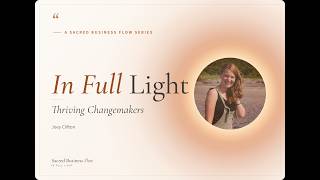
In this In Full Light interview, host Phil Powis talks with certified coach, facilitator and retreat host Joey Clifton about her journey from a sustainability activist who once viewed business as evil to a purpose‑driven entrepreneur serving mid‑life women in sustainability and social change. Joey explains how she reframed her belief about business, built a coaching practice focused on deep connection, joy, and community, and developed a six‑month transformation process that helps clients move from burnout and isolation to self‑authorship and aligned purpose. She discusses the importance of visibility, overcoming the conditioned "good‑girl" mindset, and the role of collective resilience. Joey also shares her vision of a future where changemakers work together in nature‑based walking retreats and supportive ecosystems, emphasizing that transformation is an ongoing practice, not a one‑off event. The conversation highlights themes of joy‑centered work, ecological awareness, the poly‑crisis context, and practical steps for people seeking similar support.
Chapters
Welcome to In Full Light. This is our Substack live series where really we just celebrate heartlight practitioners inside our community who are stepping into their power and sharing their gifts with the world. And today we are joined by Joey Clifton. She's a professional certified coach, facilitator, and retreat host with over 15 years of experience. And currently she is guiding experienced and values-driven midlife women working in sustainability and social change, um, to support them in their personal expansion and make the next chapter of their lives the best one yet. So yeah, thank you, Julie, for joining us. We're really excited to have this conversation with you.
Thank you. Thanks for having me.
Yeah, yeah. So, um, really just to kick off this conversation, I would love just to give you an opportunity just to tell us who you are, what you do, but more importantly, the thing that I, I feel we're interested in hearing more is what is the, the deeper calling behind your work that you're choosing to take on at this particular moment in time.
Yeah, thank you. Yeah, well, you've introduced me, so I feel like there's not much more to say on that front. I do want to say that I live in England, in Cornwall, in the countryside, and that's something that really matters to me. And thanks to a wonderful internet system, can speak with anyone anywhere in the world. So yeah, I spend a lot of my time outside with my dog in the sea, like being outside in nature. And the why behind my work, yeah, you kind of have to go really big to go really small. So we are at this incredible, incredibly sad but also incredible opportunity point in the world's history of all of these poly crisis coming together.
And for me, Did we lose Chewy?
I think so.
It's all right, we'll give her a moment to come back. Let me go check on her. I think that's a, uh, it's a first. Sorry for those of you that are watching, we'll, uh, Hopefully have Joie back here any moment. There she is.
It's a great irony of me saying the fact that I'm on the internet and how wonderful it is, how hilarious. Sorry about that.
All good.
Yeah, it's a time of polycrisis and so huge opportunity, right? There's an awful lot of problems in the world and there's an awful lot of brilliant purpose-led people doing brilliant work in the world to solve and find solutions to many of those problems. And those are the people that I really love to work with. And I guess that there's, so the why is about doing that work with, there's a culture around doing that work where it's quite often like work harder, kind of burnout, grind more. Like it's very, like it has to be hard and it is hard. I'm not saying the problems aren't hard, they're awful, so many of them. But approaching the work as if it's hard doesn't make it any easier to solve the problems. So some of the things that I stand for are doing this work with other people, first of all, not doing it alone, not doing it in isolation, not finding it, not feeling that loneliness around this work is really, really important. But also finding some joy in it. We're human beings, we need joy. And when we approach these hard topics with joy, there is some lightness and some ease that maybe wasn't there otherwise. So that's kind of part of why I do some of the work I do. But the other part is also about helping people to really feel agency and alignment in the work they do, particularly with the people that I work with. I'm sure we're going to get into this, but there's a big context, social context around growing up in definitely in the UK in the '70s, '80s where there was this whole people being raised in this kind of good girl context. And what that then means for people who are now in their 30s, 40s, 50s is that we've all been heavily conditioned to show up in a way that's easeful for others and nice and doesn't make too much of a fuss. And what that then also means for our professional form is that it's really hard to stand in our power. It's really, really hard to build boundaries and show up for yourself and know what you want. And so that's a very rambly response to my why, but there's like lots of moving parts in it, which all feels like people doing this work with more ease, with more joy together and in their strengths and their alignment.
Thank you for that. And I couldn't agree more. And it's part of my why too, like it's to build my business. From joy and then help people to do the same. And I think at the end of the day, that's kind of why we are here. And even if we are approaching like hard topics or challenges and trying to, I don't know, make this world like a better world, it needs to come from joy because I don't think a better world will be built from pushing harder anyway. So I could not agree more with you.
Yeah.
Would you be able to paint us like the transformation that you create with your clients, like the before and after when people work with you?
Yeah, yeah, yeah. So just to pick up on your last point though, I do also really believe that the energy that we approach something with is also the energy that it's imbued with. So if we push harder, we're going to have that same energy in what we create, and that really matters. So yeah, painting the picture. Yeah, so people might come in my direction feeling really, really burnt out, frustrated, disillusioned, overwhelmed, feeling alone, and also just feeling really, really stuck in themselves. They don't know how to connect with their own source of power. It's very individual, this, but my own experience of this, and I know we're going to get onto this later, but is this kind of sense of maybe feeling stuck in a bit of a straitjacket or underwater or something, not able to fully express. And through a consistent process and lots of unpicking and then reflection and reforming, the transformation they experience in this process is one of, I would say, re-self-discovery or self-discovery and self-authorship. So To the point about the social conditioning, connecting with what they want. They have very likely spent a large part of their life either on autopilot or in safety conditioning and being able to connect with what they want and who they are. And then to do this amazing work from a place of alignment and connection to purpose and really in their lane in terms of contribution, not in where they think they should be. So very aligned, very on purpose and focused, but also connected. Connected with others is a part of the transformation and hopefully connected to joy as well. I think there is something in the permission to be joyful. I think there's almost a bit of a like, this work is so hard that maybe it's not okay to be joyful doing this work. And actually, I think feeling the permission to, yeah, do this good work from a place of goodness in ourselves is also part of the transformation. Yeah. Does that answer your question?
It does. Absolutely. And I think that I love the way you're expressing that because I feel that like part of the conditioning, at least I'm You're in England, I'm in Brazil, but I feel that it's a worldwide situation where we were conditioned, or most of us, to believe that work comes from happiness and, and, you know, it's like separate from joy. So then when you step into the work, the making money, the making difference, it has to be hard. Um, and we can't see for ourselves, right? It's very hard to see that we can do differently. So I, I just appreciate having people like you that can actually like, hey, There's another way, you know, there is a way that you can build from, uh, and I don't, yeah, like that you can build, that you can serve, that you can make money, that, you know, you can, uh, do the work that you came here to do, um, without the heaviness around. And because it's so in us, I often feel that we need people to tell us that there is a way of doing differently. Otherwise, like we don't see, we don't know what we don't know, right? At least for myself, like when, like years ago, I'm like, the question that I like to answer for myself, like, what do I truly want? Like, I needed that reflected back to me so I could also like, oh, I, I can be honest. And what I want is not what these other people told me that I want. So I truly appreciate that. And I think more and more people are stepping into that and like, hey, you can build from joy.
Yeah.
Yeah.
Yeah. Absolutely. Yeah. And, and that's what the world needs, right? Is people from aliveness and joy doing their work. Yeah, absolutely.
Yeah.
Yeah.
And, uh, what was, if there was one, uh, like a turning point for you that you're like, I have to do this work, like, or maybe it was, uh, gradual. It wasn't like a one moment, but when was the moment that you're like, I need to step up and, you know, speak my truth and step into my own power that you decided to do the work that you now do?
Yeah. Yeah.
And if I Joey, if I could, and also just, just for my own curiosity, and I'm sure we've probably talked about this at some point, but connected to that, um, you know, I feel like so many different people and occupations need this kind of support in different ways, but I'm also curious about, um, like the sustainability and social change aspect specifically, like in that space, you know, how have you chosen to step more into that? And I know you're probably passionate about these topics, but yeah, I'm curious. Yeah, I'm curious as well, like, what part that has played in your journey, um, if that makes sense.
Yeah, yeah, yeah, yeah, yeah. It makes me think about maybe going a bit further back, um, in my journey. So, like, I started out in sustainability, um, that's what I studied in my late teens, and that's where I thought I would end up. I didn't know I wanted to be a coach, um, and I spent the first decade of my working career kind of, um, There's a really wonderful lyric in a Paul Simon song about drifting before you set the sail. And I feel like that's what the first decade of my working life was about, drifting and finding what worked, what didn't. And then towards the end of my 20s, I came across coaching and for me, this was one of my milestone moments. So, I'll talk about how I knew I wanted to do the work, but maybe double back to your point. Phil Powis. But, uh, um, and so I had this experience of coaching which I regale at every opportunity, which is just that I was sat in this, in this coaching room with coaches, trainee coaches, and very experienced coaches, and I wasn't coaching and I wasn't being coached, and I was moved to tears by the depth of the connection and the communication. And I just had this like I have to, this is good. I have to do this stuff. I need more of this. And I've never really reflected on whether it was kind of, there was a contrast in that. And I don't think we have enough depth. I don't think we have enough real connection in life. So maybe there was something about finding something that I'd been yearning for that I didn't really know. But I've also had other kind of magnetic moments in my coaching career as well. When I ran my first retreat and I I was absolutely terrified. Sorry, I don't know if you can hear that, something's just fallen down. And, but after I'd like started out, like just this feeling of like, this is amazing, like helping people and helping people to think about things and like connect with things that matter to them. And then knowing like, knowing a bit further on that actually that really helped them to make decisions or take opportunities that helped them to step up and me more them, which was really like, you know, you can see I could probably talk about that for a very long time. But so, but back to your point, Phil, like sustainability has been a world I've always played in. I was a vegetarian since I was 10 because of animal welfare reasons. Like I've have always played in a space of wanting to do the right thing by the natural world and our more than human friends in it. So, um, yeah, I think that kind of answers your question. Hopefully it's also where, like, when you've spent enough time somewhere, it's also where most of your connections live, right? Like, it's also kind of how your community starts to take shape and stuff. So yeah, yeah.
And it's very, it's very cool when you can find that intersection, right, between the topics and the, the ways of living that you're already passionate about, and then your ability to serve those people in a way that maybe you're uniquely served, uniquely able to, you know, because of your background. And so, yeah, I love all that. And I also love the retreat stuff. It's one of my favorite experiences as well. In fact, Caroline and I are talking about maybe making some decisions in the next month or so around getting something on the books because it's been a long time. And I agree with you that we need more of that in-person connection. So I love that part of your story as well. What, kind of shifting gears a little bit, just as you know, and it could be something recent, it could, you know, I know you've had a pretty, pretty good journey with as being a coach, but like as you've stepped into this work and what you're doing now, what's something that you've kind of used to believe about yourself or maybe about doing business in general that you've kind of had to either let go of or change your relationship with in order to kind of stand where you are today?
This is such a great question. I feel like you two will particularly appreciate this answer. So, I actually really used to hate business. Like, I really used to hate it, like with venom. I used to feel like it was the root of all evil. And then I started a business, of course, because the universe has all the answers. And I've really had to work on that because you can work on it on one level, but that doesn't mean that you've like really worked it through your system. And I have had to really work on that and maybe I still am, I don't know. But I do genuinely believe now that business can be a very, very powerful source of good and positive change. So like that has something that has enormously, like I've done 180 on it in this time. Yes. But I did start my business from a place of business is evil, which is kind of hilarious. And maybe goes some way to speaking about the fact that it took me a little while to get going. But yeah, that's probably the main thing that I used to believe about myself that I had to let go of. I'm sure there's lots more, but yeah, that's definitely one of the harder and bigger kind of meta topics.
So it's so fascinating though that you, uh, yeah, to hold this belief that business is evil and then, yeah, also choose to step, you know, step into it is, is really— yeah, I'd be curious to hear a little bit more about that. And I know I'm sure Carolina has some, some thoughts as well.
Yeah, yeah, I am actually curious, like, do you think— and this is just my thought right now as we're sharing, like, how much we hate business, and just before you were sharing how much you're connected with nature. And, you know, like, so in my mind, I was like, wow, it makes sense because it feels to me that a lot of the business that we see out there, they are the ones destroying nature the most too. And there's this capitalism. Do you see any relationship with that? Or, you know, I thought that's just where my mind was going. Um, and then you were kind of like, you know, we just reject business because maybe business is associated with, you know, destruction, disrespect with nature, disrespect with earth and all of that.
Yeah, no, no, you are absolutely right. That was a big part of it. And in my early years, I would say I was quite heavily into activism. I did work for Greenpeace and yeah, the organizations that they work against are enormous corporations that have often very negative impacts on the world. So I think that's a really well-connected piece of information and And it's a great example of things can be true and they can also not be true at the same time, right? Like, yes, that is true. Like lots of companies do have a really negative impact and also business can be a profound source of good all at the same time.
Yeah. And so, like if you go back, if you can remember, it might be difficult, but because I think this could be helpful for folks that might be listening, like When you and I've seen you've come such an enormous way in how you're showing up now in your business. But if you could take yourself back to that beginning when you were holding that strong belief that business is evil, like, I'm just curious, like, how did you— did you have a coach or did you coach yourself? Like, how did you get yourself to the starting line and allow yourself to step into that space holding that? I'm just curious how that— if you can remember, like, what that negotiation was like or how you related at that time.
Yeah. So I made a series of life choices all at the same time that sort of didn't force my hand, but I sort of forced my own hand around starting a coaching business. So I trained to be a coach while I was still living in London, and then I moved 400 miles to very rural Cornwall to be with my now husband and started a coaching business at the same time. And part of the kind of the forcing of the hand bit was there isn't a huge amount of opportunity around here. And I, I knew I wanted to be a coach, and the way that most coaches start out is by starting their own business. So I sort of made my own bed. And, and I actually, with hindsight, I think that like quite a lot of the time these things happen because they're meant to, and because we're meant to go on these journeys and we're meant to learn these things. So for me, like, yeah, there was, there was a lot that was very uncomfortable about that point in my life, but Uh, in hindsight, I can see there was also a huge amount of transformation and learning that was necessitated or needed, and that's kind of why those things unraveled in that way or formed in that way. Yeah. I don't know that that gives anyone else anything else, but I think it does.
And it's, for me, it's like, it's really awesome to see how life is perfect, right? Like you hold this belief here about business and then you meet someone and you want to be with that person that makes you move to a place where there's no other option besides creating your business and then reframing your own beliefs about the thing that you rejected. So you can actually bring like a new perspective, uh, to that different from the one that, you know, so there's nothing wrong with business itself, but you can create your own way of doing business. And that's like what we did. So I, I just find fascinating to see like life putting out together.
So yeah, yeah, I agree. I agree. It was so thick. You can't see the stepping stones in advance, can you? But when you look back, the thread is there, like it makes It all makes sense if you want it to. Yeah. Yes.
Uh, another question on that, like a lot of people is tapping into this work of, you know, sharing from the heart. Um, they struggle with like being seen. So was that a thing for you? Is that a thing for you? Uh, it has shifted. So if you can share a little more about that.
Yeah. I mean, I'm smiling because I mean, it's like one of the biggest things Yes. And it totally relates to what we were talking about earlier around social context, right? Like the thing that I work with my clients on, the things that I work with my clients on are quite often the things that I've experienced myself. And so visibility, yeah, like such, been such a struggle and like I, I think I've been kind of working on it a little bit for a very long time, and then more recently, very consciously. And I think the thing that shifted it the most for me has been the consistency of looking at it and looking at it and looking at it. And a bit like if you've got an object and you are looking at it from all angles, it's felt a little bit like that. You just keep coming back to this thing of like, does this make sense? How does this work? Why is this here? And so what I would say now around my journey with— well, maybe I can also say a bit more about what invisibility looked like for me was just this kind of avoiding opportunities to be seen, not going on social media, not making up lots of very reasonable stories about why that was okay, and not going, not putting myself forward for opportunities, not Speaking up, not like difficulties in lots of spaces, which we can totally unpack. But what I would say now is here, having kind of done this endless mosquitoing at this one object, is that I just feel this sense of ease or carelessness. I mean that in a good way. I'm here to be seen, man. We're all here to be seen and I'm not gonna be for everyone. And I kind of feel okay about that. It's not, yeah, I'm not here for the pleasing of others. I don't know. It's a funny thing because Genuinely, I think if you'd asked me the same question a year ago, I, well, I probably wouldn't even have been here, right? You guys know that.
You would not even accepted the invitation.
You would have had a perfectly reasonable excuse.
Exactly, exactly. So like, uh, and do you know what's really lovely about this question is this is genuinely a thing that a lot of my clients really struggle with, and, um, and it shows up in a multitude of different ways professionally, um, like not speaking up in a room, avoiding conflict, avoiding difficult conversations, difficulty making boundaries or saying no, or all of this stuff that just feels inordinately complicated when you're trying to be invisible and you're navigating all of this safety stuff. And then when you start to unpick all of that, there's just this level of ease. It's a melting away, is my experience. And then suddenly you can just be in a place or say a thing or do a thing that you couldn't do a short while ago. So yeah, yeah, it's a great question. It's almost as if it was written for me.
I'm here to be seen, man. I think that's a good t-shirt slogan. I think you should trademark that and put that on your red shirt.
Oh, that's gonna be in my song, isn't it?
It might be now that you said something. I'm sure it'll— I'll make sure to pick that up in the transcript. So yeah, yeah, yeah. Um, well, kind of coming back to the work that you do with these clients, and you've kind of— you've touched on this in so many different ways already, but, um, for someone that maybe does find themselves struggling, maybe they do find themselves stuck or feeling heavy under the weight of their work, um, You know, I think there's probably more people in that category than the ones that often step forward to get the help. Like, what is, what is one thing you wish more people understood about kind of the work you do and how you serve, or maybe something that gets misunderstood or overlooked about the coaching process?
Um, yeah, it's a great question. I think it's just this, um, I think it's our culture again of like, we don't necessarily mean to do this, but we sort of hope that things might get solved very quickly, like this kind of instant gratification thing. And we want these problems to kind of go, not that they're problems, but we want them to go away and overnight ideally. And honestly, it's just that the change process takes time. We are always evolving, aren't we? There is no done, there's no destination. It's just a chapter to a chapter to a chapter. And so for me, the process I work through with people is longer because it involves a reflection, like a process of reflection, insight, action, rinse and repeat, right? You have to keep doing it to peel the layers back, to rebuild the layers. And that takes time and it's not, yeah, it takes intention as well. So I'd say that was probably the main thing, um, that gets overlooked. Um, maybe I'm not sure if there's anything else.
Yeah, I see that. And I, I, I, I like to relate to transformation, like, and I kind of like say that about the work that I do. I'm like, it's kind of like taking a shower, right? Like you don't take a shower once and then we're done for life. You keep like showering every day. Yeah, that's nice. And like doing some repeat things. So it's a, it's a, like Transformation is a practice. It's like, it's not a one-time done thing.
Yeah. Yeah. I like that a lot, Carolina. Yeah. Yeah. I'm going to steal that. Feel free to.
And being, and it's interesting, it's being patient with yourself because I've experienced that for myself with, you know, some of my health goals I've been working on, fitness goals. And it's almost like when you step up to the plate, so to speak, and maybe, and it doesn't have to be investing to work with someone. In my case, it was working with a trainer. It's almost like you've been waiting so long, uh, maybe to get the courage or get the, the momentum to step onto the field of play in a way, if we use that analogy. But then, yeah, it's like, okay, and now I want it because I'm here in my mind. But that's— it's almost like that's where the, the real work kind of starts. And that's, that's been my experience in some cases. So I don't know if you relate to that or not, but that's, um, yeah, like where I've experienced that. Like when I was like, I set this goal of like, I want to have a six-pack, you know. And I've been working out for like years now, but I never set that set that goal and then hired the trainer. And then it's been going slower than I thought. And Carolina and I were just having this conversation yesterday, like when we were walking and just how to relate to that and how not to give up and yeah, just to keep going and not have it be more pressure, right? Because that's the other thing. I think sometimes when you make that commitment, it becomes like a— at least for me, I can start to feel that as a source of pressure. So I don't know if you relate to that, but it kind of— that's how I I relate to some of what you were saying.
Yeah, no, I, yeah, I appreciate all of that. Yeah, I agree completely. I think, um, what I, what, what I just want to say to that is that it gets to be fun. Like, all of this stuff gets to be fun. Like, back to our earlier point about joy, right? Like, say this to my clients all the time, like, if we have fun and we laugh, like, you're going to want to come and have this chat again, and you're going to want to do the work. Um, and that really matters. Um, it doesn't have to be There will be times of discomfort, of course, and the breakdowns of old patterns can be uncomfortable, but the process can be joyful. And I think then, to your point, Phil, then it's less likely it's going to be like a, I'm succeeding or I'm failing. It's more like, oh, hey, we're having fun in the process. Maybe the outcome matters. Like it doesn't not matter because of course we all want to get somewhere, we all want to progress and grow, but it— there's a little bit less pressure on getting the six-pack, or, you know, in my terms, the transformation, the feeling of ease. And it kind of comes a little bit more easily. Um, but, you know, the other thing that came up for me when you said that was, um, there's no right time. Like, you know, there's a lot of pressure on, like, I'm not— I— things aren't really terrible, or I don't know, um, I'm not da da da da da But there's no right time to do any of this work. Again, to my point about kind of chapters, it's just what's here for you in the moment and unpacking it and unraveling it and looking at those fears and looking at those limiting beliefs. And then also asking those questions of like, what do I want? And what is the contribution I want to make? And what do I need to make that? So that when you come out, you've you've kind of, yeah, you've, you've asked good questions and therefore you've got good answers, um, wherever you are in your journey.
I think it's about any goal. Like I sometimes I think about like how boring it will be if manifestation was instant, right? Imagine like, I want to expect it's here. Like, oh, then what? Like I want da da da, then what? Like, you know, like the whole fun is the transformation is actually like I want this. So what else do I need to do to, you know, have a six-pack? And like, what do I need to stop doing to have a six-pack? And then you get to know parts of yourself that you never met before. And if it was just like this, like, I don't know, it's just so boring. Sometimes I think we have a, just relating in a different way. Like we have a hard time with the unknown and we think that we want to know, but how boring life would be if you like were born and like, when you were 1 year old, you're going to do this, this, this. When you're 10 years old, you're going to do this, this. Why?
Yeah. I love that. I really love that. That resonates so much. Yeah, absolutely. Well, we'd be done within months, wouldn't we? We'd be like, what?
Be like, why are we still here?
What do I do now? Yeah.
Yeah.
And honestly, like, I think if I, like, let's say we were born today and then we had everything already in the nun for us, I think we would just like, I don't want to do this. You know, if I knew when I was 5 everything that I had to go through, for example, I would probably like, I'm out. And then it would kill the fun.
Yeah, yeah. I agree with you. I agree with you. The fun is in the transformation. So, so finding ways to make it fun, like owning that fun, like being a curator of that fun rather than kind of, um, yeah, expecting it to be really hard or yeah. Yeah. I like that.
I like the curator of the fun.
Curator of the fun.
Yeah.
Maker of the mischief.
Yeah. I think that's why we probably hang out together in community, is the whole fun value. It's a big thing, as you know, for Caroline and I as well. Which brings me, yeah, to kind of, you know, I think is the perfect tee-up for the next question, which is like, on your own journey of creating what you've created with your business, what are you most proud of? And, you know, results are great. So if there's results you specifically want to share, that's great. But I'm also very curious about, you know, to who you've been becoming through the process over the last 15 years, or however, whatever frame you want to use. Um, yeah, what comes up for you around what you're most proud of?
Um, depth of connection. That's what I'm most proud of. Um, it's, it's what I strive for in the community that I run. It's what I strive for in my working relationships and, um, obviously in my personal life, but also in my one-to-one clients. You know, it's like I think we really need it. We need to be seen. We need a place we feel is safe that we can be our most vulnerable and honest. And I'm really proud that I create that with my clients. I co-create that with my clients. And I just wondering, I think that's probably in a personal sense, that's probably also the thing I'm most proud of, just in like, like who I am. I think I show up as someone who— I hope I show up as someone who cares and is really in. Like, I don't ask, how are you, because I don't care and I look away. I ask, how are you, because I really care and I like, I really want to know. And yeah, and I think that's what we— again, what we need more of in this world is people like genuinely caring and asking each other how we are and listening to the answer. And that's again, going back to the beginning of the conversation, that for me was one of the things in that coaching room when I was having that moment of like, oh my God, I need more of this in my life. It was that depth of listening. It's not in coaching context, there's like 3 levels of listening and it's not that what's actually being said, it's like what's going on in your body as someone else is talking. And what are you hearing in their energy or how they're breathing or how they're standing or all of that stuff. It's like that depth of connection. And I get it's not everybody's jam and that's cool, but I do think that really matters and it's really what the world needs more of. So yeah, that's what I'm really proud of.
Cool. And yeah, where you are today in your journey, what is the vision you're building towards? If you kind of I don't know, put yourself out in the next 5 years or whatever frame again makes sense to you. I'm just curious, where do you see the evolution of your work, your business? Where is this all going for you personally?
Well, in an ideal world, the polycrisis would be solved and I would be out of a job. So that's like the dream. Scaling back from that a little bit.
Yeah.
I mean, I want, I really want to help people show up as themselves and step into, you know, again, for the people that I work with, really like find that inner alignment, that inner purpose, and stand taller in themselves. Not be that kind of constrained, kind of submerged version of themselves because they deserve that. And I know how uncomfortable that is and it's not fun. Like when you have such a strong yearning towards making a difference and being purposeful, that kind of self-restraint actually feels really, it feels awful. So that's a part of it. But the other part is we get to do this good work together, not individually in our own little silos, never talking to each other. We get to do it together, having fun. Thinking about ourselves as an ecosystem of changemakers and mutually raising each other up and the joy and the resilience in that. I was talking to somebody the other day about resilience is a— resilience on an individual level is actually a bit of a mirage. It's not a thing. We are not like in nature, nothing exists on its own. We are human beings, we're part of ecosystems. We are not resilient on our own, we're resilient with each other. So there's also something about just being a stand for doing this work differently with fun and with each other. And that's what I'd love. I'd love it. And then I think we'll contribute more and we'll do more good and it'll be more fun. And the future that we are creating will have that joy imbued into it as well, which really matters. And the togetherness as well, right? So yeah, that's the vision. I think, I don't think I've missed anything.
And how is that currently taking shape for you? So I know you work with people individually. I know you have a community, which I'd love to hear a little bit more about if you'd be willing to share. And then yeah, any more events on the horizon? I know that's, as we talked about earlier, that's been a big thing in your past. I'm just curious, Yeah, if there's any of those things on the horizon for you.
Yes, yes, yes. Thank you. So one-to-one work is ongoing, and I'd love to share a link at the end of this that people can find me if they want to find out more. But essentially, it's a 6-month transformation process where you do what we've talked about today. It's unpacking, unlayering the onion, reflecting, finding insights, and moving forward to this space of alignment and purpose. In a community sense, I've been running a community with a very dear friend of mine for a year and we're through the pilot phase and we're building and it's exactly what I've been talking about. You know, it's like this really gorgeous ecosystem where we raise each other up. We're there for each other's messy muddle and chaos and, but we're also like there to support each other and like find answers together and and yeah, keep the hope, keep the hope, keep the joy alive. So again, if it's okay, I'll share a link. And if anybody wants to find out more about like changemaking done differently through my community, then I'd really love to share that. And the other thing that is on the horizon, it's not in-person retreats, but it's— so I live, for anyone that knows the coast down in the Southwest, there's 500-odd mile coast path that runs like around the leg of the UK. And I live about 15-minute walk from where that starts, or not where it starts, a point in it. And so this summer I'm starting walking, like solo, small group walking retreats with changemakers who need to be in nature. Maybe they're feeling burnt out, maybe they need a bit of time to recalibrate. Maybe they've got an idea they wanna think about and the best way to think is to walk and to move. Carolina, I'm looking at you again. And so I'm playing with it this year. I'm gonna launch it properly next year, but that's the plan to, yeah, to be in as wild as it gets in this country, in wild nature. Yeah. Resourcing ourselves and working through opportunities and reinspiring hope through nature. So that's what's on the agenda this year.
Um, yeah, I love that because I read that on your Substack, uh, that you made a note about like walking and, and I love that. And I think it's, um, I was just writing an essay for, for tomorrow and a lot of the insights that we get and a lot of clarity that we get never happens on a work session sitting side by side. It's always like. I could say like 100% of the time it is walking. Like we walk and talk and then we do wonder walks alone and it's like the insights and the good ideas and the clarity, like it's always born out of like walking and moving. So I, when I read that and I even shared with you, like I, I've had before like wonder walks with clients, like on my phone and the person somewhere else that we just go to like inspiring locations. And I think there's something to that, that it's underutilized right now. Like, we should walk more, right? Yeah, for health, for body, but for, uh, clarity as well.
Yeah, yeah, yeah, yeah. Well, there was a session that you gave a while ago as well about the densities of our being that really stuck with me, about how, like, the, the thoughts and the movement together is a really powerful, um, thing to put together. And humans have been doing it unknowingly for ever. And yeah, but the other piece that, well, there's two other pieces in this that really matter to me. And one is being together, in-person stuff. The more techy we become, the more important it is that we get together and we share food and we light fires and we sit with each other. And the other part is being in nature. Nature is so healing. Nature really is like even in our world right now, it's an incredible abundance and it gives us so much. So putting those 3 ingredients together feels really exciting to me and I'll keep you posted.
Yeah. It's so cool. And yeah, and I am not anti-AI by any means. I use it quite extensively, but I do feel like from a balanced perspective, we are often so too quick to just jump to like that loop of like feeding the machine and like, and having that go round and round with us. Whereas, you know, if we were to pause and then go take the walk, go in nature, reconnect with ourselves, like noodle on it a little bit, like see what kicks around there and then come back to using the tools that we have available to us. I think the answers will be almost so much better every time. So yeah, I love that. And I think it's going to become more and more needed. So yeah, it's really, really cool. So yeah, just to kind of close, I know we're kind of coming up on time here. You know, definitely share those links with us. We'll make sure we get them from you. We'll include them in the recap. But if, you know, if anyone just wants to kind of follow along, I know your, your Substack is pretty much your, your main home these days, right?
Yes.
Yes.
It's my main home these days. You can find me on LinkedIn, but I don't hang out there quite so much. So yeah, yeah, please connect. I'd love that. That would be great.
Yeah, that's, uh, that's what, that's why one of the reasons I love these interviews, cuz usually, you know, if you do an interview off platform or something, you're gonna be like, oh, where can we find you? And so usually it's, if we're here on Substack having these conversations, this is where you can find people. And it's just such a, yeah, it's just a better experience. So, so yeah, we'll definitely make sure people find you here on Substack. Is, is there anything else you'd wanna share in terms of someone wants to explore your work more closely? Any first steps or suggestions?
Uh, no, but I want to give you guys a shout out. Can I do that?
Please do. We will, we will receive.
Yeah, anything you need. Um, yeah, I'll share all the links to my work, but, but for anyone watching that, that needs kind of business-specific support, like, I have been a part of the Sacred Growth Club for more than a year and a half, and, um, yeah, it's been a game changer for me. So if you're in doubt, like, these two people are your are your people. Yeah, that's all I can say. Thank you, Jo. Thank you. Thanks for giving me this opportunity. I appreciate it.
Yeah, you're welcome. And yeah, we'll be sharing this recap, so we'll share it with you as well in case there's anyone you want to share it with. And yeah, I know the theme for our song now, so I wish I had time. I have a few more things I have to do before I get to working on that, but I I know exactly where I'm going with it now. So thank you for making sure that didn't slip my mind. And, um, yeah, we'll be— Cringeville.
Yeah.
Oh, it's gonna be so good. So yeah, thank you so much for spending your time here with us. And yeah, we'll look forward to seeing you again very soon.
Thank you.
Thanks everyone for watching.
Bye-bye.
Yeah. Bye for now.
Bye.