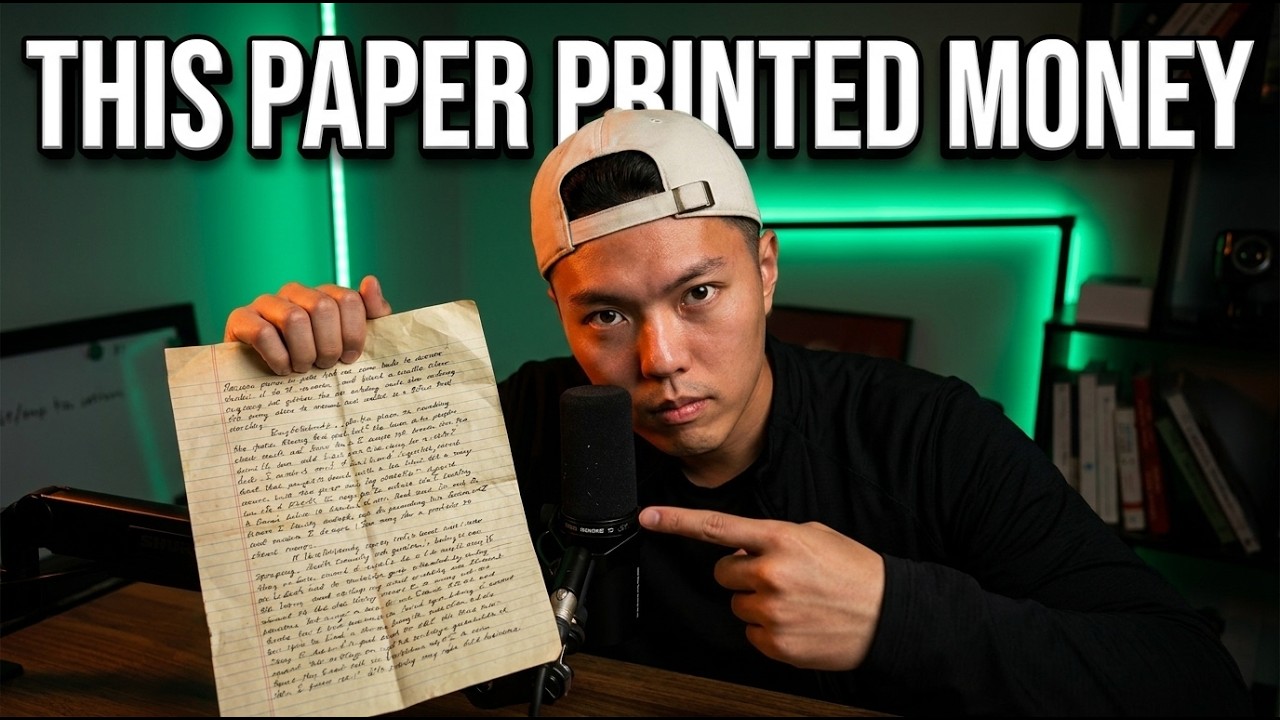
In this talk, Sam Chang recounts how he went from being the worst sales rep in his office to licensing his own voice for AI-driven sales calls. Starting in 2013‑14 as a phone salesperson for American Express charge cards, Sam sold only two cards in his first month and felt devastated. After watching the cold‑call scene from The Wolf of Wall Street, he transcribed the dialogue line‑by‑line onto a lined sheet of paper and rewrote his company’s script in the same dramatic format. The next day, using the movie‑style script, he sold two cards again, but more importantly he discovered that belief in the script—and the tonality with which it was delivered—was the real driver of success. Sam explains that on the phone, body language (55% of communication) is absent, leaving tonality (38%) and words (7%) as the key levers, a concept he ties to Mehrabian’s communication model. He argues that sales managers must first sell reps on the process, not just the product. Over the years he trained thousands of reps to internalize the right tonality, eventually founding AutoCaller AI, a platform that uses hyper‑realistic voice AI agents—his own voice, honed over a decade of tonal training—to make sales calls at scale. The talk ends with a call to action for sales leaders to review their processes or explore AutoCaller AI.
Chapters
My first real sales job, I was the single worst person in the entire office. Not the bottom half, not below average, dead last. And the way I fixed it was I took a movie scene, I took the script, I copied on a lined sheet of paper, and I used that as a model. And that one night with a pen and a lined sheet of paper is the reason that today my literal voice is licensed out to companies around the country making sales calls while I sleep. I know how that sounds, so just stay with me because lesson inside the story is the single most important thing I learned about sales and almost Nobody teaches it. So let me rewind. It's like 2013, 2014, right? And I land my first salary hybrid commission sales job, okay? Selling American Express charge cards over the phone to business owners. At the time, I thought I was great at sales. I sucked, okay? But like, I thought I was really good, okay? And did I ever get humbled? Because I walked in thinking I was the best. And then at the end of the first month, I was the bottom of the food chain, worst on the team, okay? My entire number for the month, 2 cards the whole month. And I'm like on the phone like 10 hours a day, all right? And I remember being like legitimately like depressed about this. It's one thing to fail something that you didn't know if you were good at,. But it's a whole nother thing to fail at something that you thought you were amazing at. And right in the middle of this, the movie Wolf of Wall Street came out. And for a salesman, if that's not your favorite movie, I don't know what is. And I remember walking out obsessed over this one scene, the cold call scene. Jordan's first day at the penny stock shop, right? Right. Picks up the phone, totally garbage product. And just off of pure delivery, pure certainty, he closes a stranger while the whole room, their jaws were open. Like, I can still recite that scene. It's like, oh, hey, it's Jordan from, from Aerotown, high-tech firm out of the Midwest. You don't know me. I don't know you. But what the stock will do is act as a benchmark for future purchases. Or for future success, you know, you sound fair enough. Like, I remember that scene and what I did, and here's what got me. That scene is based on a true story, and later in the movie you watch Jordan take guys off the street, guys selling nothing, no company, no background, no sales skills, and teach them to sell with a script and with a system. And something clicked in my head. I was like, if he could teach them sales, then sales isn't a gift, it's a process. The process, it's got to be learnable, right? So here's what I actually did. I went home, pulled up that scene on YouTube, and with a lined piece of paper, I transcribed it by hand like a caveman. All you kids with AI now, all right, every single word from that cold call scene. Pause the clip, right? Play. Pause the clip, right? Play. Then I took my American Express script, the official one, the one that the whole office was using that got me 2 cards a month. I rewrote it in the format of that cold call scene. It sounded something like this, like, hey John, how's it going today? Hey, this is Sam calling from American Express from London, Ontario. You don't know me, I don't know you, but what this card will do is act as a benchmark for future purchases so that all business expenses, you would get a return on the money that you're already spending anyways. And I remember using that script the next day and I sold 2 cards. Let me say that again slowly. Their script, 2 cards. My Frankenstein movie script, 2 cards the next day. 30 days of production compressed into 1 shift using a movie script. Now here's what's really valuable that I actually pulled. For years I thought, no, you gotta use a better script. But that's not what happened. The words on the page was maybe only 20% better than what they had already given me. What actually changed, I believe it worked. They told me it was a true story. So I watched your work on screen. So when I picked up the phone the next morning using a script that I knew worked, I wasn't reading the lines hoping that it would land. I was delivering a weapon that I had seen kill in the movie theaters. And belief does something magical. To you. Your pace steadies, your voice drops, the upswing at the end of your sentences, that little question mark of doubt, it disappears. You stop asking and you start telling. It is the placebo effect of sales. The process works because you believe the process works, and the prospect can hear that belief before they even process a single word that you said. So if you're a sales manager or founder training salespeople right now, and I've trained thousands, here's a move that every trainer misses. Before you sell the prospect, you have to sell your own rep on the process. A rep who's half sure delivers half of a script. A rep who's completely sure will deliver the group completely, and that is what closes the deal. And there's actually a reason why this works. I'm not a scientist, okay? I'm a college dropout, all right? And so there's actually a scientific reason why this works, all right? You probably heard the stat from Albert Mehrubian: 7% of communication is your words, 38% is tonality, and 55% is body language. I call it the music, the song, and the dance of communication. The music is the modulation, the tonality. It's the speed at which you speak. It's the uptones, the downtones, the curiosity tonality, the mystery tonality, the "ah, no big deal" tonality, right? The words are 7% of communication. These are the actual song, or the words, which are the actual words that you say in your script, and body language is 55%, which is your dance. It's your facial expression, your body language. Now think about what that means on the phone. On the phone, body language is gone, 55% gone. So the vast majority of communication over the phone is actually tonality. That's the whole game. In fact, in Jordan Belfort's Straight Line Persuasion program, there is literally an entire module just on tonality, just on the words that you say and how you say it. So fast forward, that broke kid transcribing movie scenes goes on to train thousands and thousands of sales reps door-to-door, over the phone, drilling tonality into human beings. Things like, "Repeat after me, hi, is this, uh, John?" Right? And now I run an AI company, AutoCaller AI. We install hyper-realistic voice AI agents to replace entire sales teams, to automate entire sales teams' processes. It is good enough to close a deal. And as we were building it, we had to answer one question: whose voice does the agents use? So we split tested my voice against all the other voices, and my voice with sales tonality directly built in, it won every single matchup across the board. Like, I make $2,000 a month as a voice actor on 11Labs. Think about how crazy that is. There are millions of Americans hearing my voice right now. That's— and now I license my voice to my clients to do your sales for you. And that's not because I think my voice sounds nice or anything. All right. I think it's actually because that voice spent 10 years being trained. Every pause, every downtone, every uptone, every drop of certainty that started with a lined piece of paper in 2014, it's all baked in. So now, and it still blows my mind to say, the kid who was dead last in the office became the voice. So here's what I want you to take from this. If you're bad at something right now, you might not lack talent. You might just be lacking a process that you believe in. Those are completely different problems and only one of them is permanent. Remember that scene from Space Jam where Bugs Bunny, he was like, this is a secret stuff, secret stuff, and it's just actually just water, right? But that placebo effect of the whole team thinking that this is the secret stuff, because of that they were energized. Sales is very similar to that. So if you're running a sales team or sales manager right now, probably the biggest lesson that I learned from this whole story is that selling your team on the process, it works and it works really well. It might even work better than the process itself. So if you want the actual processes, you want me to review your sales process, process. If you want to take a look at Autocaller.ai to see how it can solve your problems, help you do sales, go to my LinkedIn bio, book a call, and I'm happy to be of service. I'll see you in the next one.