Reduce Your W2 Income: Investor Presentation
A recorded webinar (May/Aug 2024) hosted by Sarah Sullivan (Sugo Capital) presenting an oil & gas investment (Program 65) managed by G2 Petroleum and Newport Operating (Cotton Graham, Joe). The presentation covers the fund structure, strategy (drilling shallow conventional wells in Wichita Falls, TX), track record, projected returns (targeting 20M raise to ~520 BPD, 2–5 year exit), tax advantages (large first-year intangible drilling cost deduction), operational details (vertical integration, in-house rigs/crew), and investor logistics (data room, K-1, subscription process).
Chapters
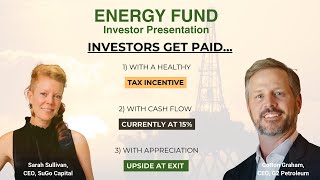
Let's see. There we go. I just wanted to take the screen for about 10 minutes. So we do have Cotton and Joe. They are in the waiting room, the green room, you could call it. I'm going to take just a few minutes to talk about logistics with all the Sugo Capital folks who are on here. Thanks everyone for being here. And then I'm going to pass the mic over to Cotton and Joe to tell you about their the investment that we're going to talk about today. So first, yes, hello. Hello, everyone. First, I want to hear who here was in the due diligence webinar last week. Put Deedee for due diligence in the chat. I want to see how many of you were here. Ton of people. Great. So now I'd love to hear how many of you feel more prepared or you feel ready to do due diligence on an energy investment, on an oil and gas investment. All right, Brian's ready. Brian's ready. What about anyone else? All right, Christina? Great. So maybe Jonathan. Mike? Great. So, so, sure. Okay, so I would suggest that you go through the checklist with this investment. So in, in the data room for this investment, I'm going to share my screen and, and show you there's a replay of last week's webinar and there's the actual checklist. So let me show you. So if you want to follow along with me. Hi, Jay. Thanks. Happy Thursday to you as well. Oh, let me say something about the chat. So this is being recorded. We'll share it out today with everyone who's here. In the chat, you can select that you're talking to everyone or host and panelists. I see a lot of people are talking to hosts and panelists, meaning only me, Joe and Cotton and Cynthia see it and not the rest of everyone else who is here. There were almost 600 people, 700 people who signed up for this webinar. So it's great when you guys can use the chat and select everyone. It makes it much more interactive for us and it's more interactive for each other, more interesting to each other. So, Sara, what are we talking about? We're talking about an oil and gas investment. So if you want to follow along today, even if you're not thinking of making an investment in energy or oil and gas, I suggest, you know, maybe you're thinking about doing it in October or next year. Use this as practice. So if you go to sugocapital.com backslash oil, it will take you to this page. And so if you want to see the documents, the presentation that they're going to show today, you click on the documents tab and so you can see G2 petroleum presentation May 2024. So that's what we're going to go through today. We're going to touch on tax benefits. So there's a tax benefit detailed worksheet in here for you guys if you want to take a look and say, what's an actual K1 from this investment that we're going to talk about today? An actual K1 with the name of the investor changed to Joe Sample. It's in here so you can take a look. You can share any of this information with your cpa, with your attorney, whoever helps you with your tax strategy, with your investment planning. Feel free to share all of this. Also in here is year to date production and year to date field activity. So near the end we're going to talk about, you know, next steps. And part of what I think is really cool about Cotton Joe, their, their team and, and G2 petroleum is that every Friday they give a production report to all of their investors. So it's not like everyone's wondering what's going on with their investment. It's every Friday they get the information. So that's, that's fabulous. And then this last thing which I started to talk about, number eight in here is the oil due diligence checklist. So you can click on that. And it's a checklist of everything I went through last week. So if you missed last week's webinar, this is a summary of it you can go through and you can review this investment with that checklist. And you know, part of your due diligence is to decide whether it's, you know, a decent investment. But a lot of it is to make sure it's the right investment for you and your goals. You know, there's some great oil investments and you're in one well, and it continues for the next 20 years. And that's great for some people. That's not great for me, but it doesn't mean it's not great for someone else. So part of it is just making sure you really understand it during your due diligence. So this checklist has all those questions that you can ask and start practicing your due diligence. So now I clicked back over on Overview and so before I was in the Documents tab, now I clicked back over in Overview so you can scroll down. And this is what we're going to talk about. So everything that Sugo Capital shares with Our investor community. And I sit Sarah Sullivan I'm a co gp. I am a general partner on the projects, when it's real estate, when it's the hedge funds, when it comes to this oil and gas investment, I want to be really clear that I am not the manager of this investment, which is fantastic for you because it is not. I can do due diligence, but I can't operate in the oil and gas space. So that's why we have partners who are running this. So a lot of people emailed me saying like, what are you doing in this oil fund? I am not running the oil fund. I am working with G2 Petroleum, advising them on capital raising, investor relations, that sort of thing. But we don't have a formal written agreement together right now, anything like that. We are talking about in the future code gping on a fund because I really like what they're doing. But a lot of people said, you know, so what is it right now? So what I really love too about this fund is that it started in October of 2023 and currently you can see this highlighted space. Currently Investor partners are receiving 15 annualized cash flow. And so that's fabulous. You know, as with any, any oil investment, it's not going to be the same every month, but on average that's what they're receiving right now. That's the annualized return. It's not 15amonth, it's 15 annualized. And so I think that's really strong. You know, it's producing currently. So as an investor coming into this, you know, that's part of your due diligence check, what's going on for current investors. But it also tells you it's already in, you know, a very strong financial position. And so they're going to talk about what happens when new investors come in and the additional wells they'll drill and all that kind of stuff. But I wanted to share that. I think it's really strong. Then when you scroll down the additional resources here that you see the link to last week's presentation is here, the presentation we're giving right now, it's going to be A link is going to be put here this afternoon. You can look at the drone footage of the different wells that are currently owned by the team who's speaking today. And then the full business plan, the tax benefit, everything, you know, this is where you can find it. And so if at the end of today you're interested in joining, we're going to send you a link on your phone and you can Just click it and enter and register for it. And so normally when you do that, then Sugo Capital helps you with your paperwork. Since I'm not the manager of this fund, Joe, who's one of the speakers today, he'll be the one who will send you an email with the subscription documents and the legal stuff. So there'll be a handoff. So Joe's going to be presenting. It won't be a stranger who contacts you. I want you to know ahead of time, if you do put in a reserve, that means that we're going to share your reserve with G2, and they'll be the ones to contact you in order to continue your investment. So I want to share that because it's also a little bit different of a process than we've done before. And then as far as the rest of the timeline, we'll talk about that today. But there is one deadline. If by next week, you get in a wire, your distributions will start October 1st. However, this fund is open until the end of the year or until it's fully funded, whichever comes first. So a lot of you said, hey, I'm going to have my funds in October. I'm going to have my funds in November. That is totally fine. You can join in another month as well. Returns will just start later, obviously, but know that it's open until the end of the year. So if you're listening now and you like it, but you don't have the funds, you can add some now, top up later, or you can wait and add some later, or you can come in now and get that cash flow right away, whichever you like. And then you can see step four here weekly. So every Friday, the production report will come to you as an investor. And we'll also do some monthly webinars with Cotton, who's one of the speakers today as well. So you get a verbal monthly report of what's going on. It's super fun. So all the details in here, I won't go through everything else because I want to bring Cotton and. And Joe to the screen. I will stop sharing. Let me just look and see if there's anything else that I wanted to cover. I also do want to cover. So I got a ton of questions around. Hey, last year you were. You were talking. You had another energy partner. So why do you have a different energy partner now? And so we have. If you look at real estate, we have 36 apartment complexes. They are not all in the same city with the same operators in the same partner. And so as real estate Investors, you want to have diversification, right? So you have diversification in asset class and markets and operators. And so I suggest the same thing in energy and oil and gas and is find various partners to work with in various markets. And it's a little different because in, in oil, and I'm sure cotton will talk about this, but it's even more niche. Like if you're great one area, usually people like really stick to that area. In real estate, you might see someone who's like, oh, I got some stuff in Texas, I got some stuff in North Carolina. And you know, you can be a little more hands off in real estate because you have property managers and asset managers, but in, in oil it's more niche. So if as an investor you want to have some diversification of locations, then you also usually have diversification of operators and partners. And so that's what I was looking for when, when I met G2 about nine months ago. And so for the past nine months, we've been doing due diligence on each other, making sure we, you know, we want to work together and that, you know, that they're a great team and I've been really, really impressed with them. They're. Their plans to scale are not. I see some questions saying, like, you know, is it going to be a $200 million fund? Nope. They, they're not jumping from, you know, up a cliff. They're going to climb up the cliff. And I really respect that. And they're looking to do that so that they can maintain the quality that they have been performing at over the last decade, two decades. However, along Cotton, you, you've been in this space. I know you have so much great experience that you're bringing to the table. So, so I want to share that with everyone right off the bat as the elephant in the room. And let me see, what else do I want to say about you guys? Ah, yes. Another thing I really like about cotton, the way that you have structured this opportunity is that it's really similar to real estate, it's really similar to multi family and that investors get paid three ways and then we're out in about five years. And. And so those of you who are in our syndications, such a similar model where you get a great tax benefit upfront, you get cash flow and then there's an exit in, you know, roughly five years and you get the equity, equity upside on the back end. So I love that structure and I love that cotton over at G2, you guys have that same structure for your fund. And so, so I, you know, that's another one of the reasons that I really am looking forward to partnering with you guys. All right, with that, I'm going to hand it over. Everybody else, I'm going to go off screen, but ask your questions in the Q A, ask your questions in the chat, and I'm going to be answering questions that I can, and those that I can't, we'll save them for the Q A at the end. Cotton, thanks so much for being here. Joe, I know you're here as well. Thanks so much for being here, both of you. And you know, we gave some introductions last week, but I, I'm really looking forward to working with you guys this year and, you know, for the foreseeable future. So let's get started. Take it away.
Absolutely. Well, I just want to say thank you and thank you everybody for joining. Sarah, I appreciate you so much. I think you're doing an incredible job. I really do. And I am extremely excited to work with you moving forward here now and in the future. And I'm also excited about what we're doing here at G2 Petroleum. I've built this company over the last many years and I really think we're at a point right now with all the wells we've drilled in the past, the experience, the equipment, the crews that we've built up to this point. I think we're at a really good point to take this fund and drill some wells, acquire production, consolidate existing production and just generate aggressive returns and reach that mark here in the next three to five years where we are able to sell out, you know, take tax write off right out of the gate, which is incredible. You know, domestic drilling programs. The government is, is asking small oil companies and high net worth investors, just like everybody out there, to invest in American energy independence. And they're giving you a great incentive, allowing you to write off the investment virtually 100%, you know, 75% the first year for intangible drilling cost and then 25% over the next several years for the intangible, for the tangible stuff that goes into drilling the well. So, you know, American energy independence is huge. But private investors can make money in this business and we've been doing that for many years now. And I think this program 65 is a great program that will allow us to, to consolidate production from wells that I've drilled in the past, acquire new leases, but continue to drill and develop wells on the acreage that we already own and control and generate pretty aggressive returns. And that does come in the form of monthly cash flow. Everybody likes getting a check every month, month in and month out from the production that we pump and produce every single day.
100%. 100%.
But. Well, I just wanted to thank you again, Sarah, and thank you everybody for joining. I appreciate your time. I know time is valuable. I appreciate you spending your valuable time with us. But, Joe, if you're there once, you say a few words and let's get this thing kicked off.
Yeah, I am here. I cannot share my video, so you.
Might let me turn it on. That would be me.
Okay. Oh, there we go. There we go.
Hi, Joe.
Hi. All right. Hi. Thank you very much. And would you like me to share my screen so I can kind of walk through the deck?
Yes, please.
Okay. If you. I'll need that permission from you as well, Sarah.
Oh, you don't have that as well. Oh, there we go. All right. Didn't mean to leave you out, Joe. I was just on a roll.
No, that's okay. Let me see. Yeah, exactly. That's fine. So let me get this. Perfect so hopefully everyone can see that it looks perfect.
Thank you.
Okay. Excellent, excellent. So we will. I'll just kind of get walking through here because I know we're, we're trying to keep this to an hour. Like I said, this is available to everyone and, or we can send it out, but I believe it's available in your data room. What we're going to discuss today is in program 65, our strategy, also the value, what's in it for our partners, and then a bit of our track record. And as you had stated, Sarah, it's, it's 20 million that we're going to raise between now and the end of the year. If we get there sooner, then, you know, it will end, but if not, we're, we'll keep this open and see as, as far as we get of the 20 million by December 31, we feel confident that we will raise all of the capital and we do want to turn that into 50 million in, in a three to five year period which we will break down. And as Cotton was talking about, we're going to do that in multiple ways. So I guess the way I typically like to start off is about a typical drilling program is going to be, hey, we're going to go drill these two or three or four wells and we're going to go raise 20 million to do that. And then we're going to see what we get out of those three or four wells, out of, out of one zone. If you Will and if you get the production that you're looking for, then that's wonderful, that's great. And it can do very well. If not, then, you know, you're, you're going to hear from the operator, well, we didn't achieve what we thought and maybe they'll send out, hey, but there's other zones or we can drill more wells and they're going to want more money of course to go do that in the form of assessments. So we're taking a different approach here, sort of a fund approach in that we want to drill. We will drill. We'll have multiple wells probably in the neighborhood of 30 to 35 wells that we want to drill. So very diversified there. Not two or three wells. We, in some of the wells we already have, we can go what's called behind the pipe and we can in a very economical and much cheaper than drilling a new well. We can go back up into zones to get production. That way we are going to assign interest we have from some previous programs. So we're rolling in some production that benefits everyone at very good prices. And then we are, we can also acquire some new leases and some new production. So we're going to take a, I'll say, you know, multiple vertical approach to achieving a certain number of barrels per day. And again we'll break this down as we go through the, the deck. But at, at, at 20 million it would be a minimum of 520 barrels a day that we are trying to achieve and then we can, we can reach all of our goals. And of course if we go above that then, then that would, we're certainly not going to stop. That would be all the better. So just want to kind of give everyone that little bit of a background as we, as we walk through our strategy. And, and the strategy is that we will drill what are called shallow conventional wells in proven areas or puds proven undeveloped. We know there's oil here. We're not wildcatting going out to areas where we're hoping there's oil. They've been pulling oil out of this area for 40 years and they're conventional, meaning we only go vertical, we don't go horizontal, which can add a tremendous amount of cost. So we can get very quickly to production. We can drill the wells quickly. And the oil that comes out of this region when we, again, we'll talk about this in a couple of slides. But the oil that comes out of the region, it's fairly predictable. I mean we can, we can within a relatively small amount we can we can determine exactly how much oil is going to come out of there? We have a 95% success rate in terms of pulling oil. We haven't had a dry hole in the last two or three years and we haven't had any on the current leases that we're drilling on. Two main reasons for that. One is the topography of the area. There's many, many, many multiple pay zones that we go through as we're drilling down to 4,300ft again. You'll see that here in the upcoming slides. And we also have a geologist, Barry Hanks, that has worked this area for 40 years. So if you're talking about the right guy in small little Wichita Falls to tell you where to drill and where the oil's at, you know, we firmly believe Barry's the guy. We know he's the guy. Again, born there, raised there, went to school there and been a geologist in this area for 40 years. So another difference between us and maybe some others are that we are the operator. We're not syndicating for another operator. We are the operator. So G2 Petroleum is our, what I would call our finance arm. And then Newport operating is our 100% owned drilling company in Wichita Falls. All owned by, by Cotton Graham. So we have a, we have a 25 person crew up there. We've got rigs, we've got trucks, we've got pipe. So we really can control the production and make sure that the wells are up and running. We're not going to do things like going into fracking or acidizing. So we will use some vendors. But then it's our guys that come in and again, make sure that the wells are up and pumping and continue going. We drilled over 150 wells up in this Wichita Falls area. We'll continue to break this down throughout the deck. And as I mentioned, part of the strategy is with the additional leases potentially picking up production as well as moving between 15, 100 barrels of production from previous programs in. And the other thing that I like, we are in Dallas. We're in McKinney, Texas, just north of Dallas. Wichita Falls is about a two and a half hour drive. So if there are any issues, Cotton is in his truck. You know, he'll, he'll do day trips at least, you know, three, four times a month or more if necessary. But driving up there to make sure, hey, what's going on? Talking to the crew, talking to Barry, making sure that the, the wells are up and producing. Anything you wanted to add to that, Cotton?
No, I think you covered a lot of it there. I mean again, we're drilling conventional vertical wells between 2,040 300ft. You've got stacked pays, multiple sands that you're drill through that produce oil as you're drilling these wells. And you will get that to that in the presentation. But no, again, we are the operator. We raise our own capital and we drill our own wells. Again, you said we've got our own drilling rigs, our all the equipment that it takes to drill a well, complete a well and manage that well through the life cycle of a producing oil well. We have everything in place to be able to do that. And again, it's important to understand that we're not contracting the heavy lifting out. We do it ourselves with our 25 man crew and all the equipment we have. And that streamlines the operation. It ensures that we're able to pivot, to use a term that Sarah has used before, which I really like. It enables us to handle anything that's going on in the field immediately without having to wait on a vendor to get to us, whether they have a, you know, six day, six week or six month waiting list. We don't have to wait on that list because we have our own equipment, we have our own crews. We're able to diagnose issues and then handle them and get them resolved and get that production back online by operating that way. And it also streamlines the cost because again, we have our own crews and equipment. We're not subject to being, let's say, promoted or overcharged for any of these services. We control that, streamline that and pass it on to our investors. And that's another way how that we're able to minimize our operating expenses of the wells monthly.
But.
Go ahead, Joe. I didn't want to take over.
Well, well, I do want to take over, but just for a second I jump back on because I really want to point out, I think that is a really, really big benefit of the structure of this investment opportunity for our investors. Because you know, I have other, I have lots of investments, but I have investments where groups are not vertically integrated. And it does create a lag in the timeline and it's not the operator's fault all the time. But you know, someone else might be using that rig or someone else might be using that construction team if it's in multi family. And so the same for, you know, my, my current partners and multifamily are vertically integrated and I love that it reduces the expenses that get passed through to the property and it really helps with, you know, really seamless management of the property. Everything is very aligned and everyone's working to the same priority. And so I, you know, perked up when I first met this team and I heard that they were the same because I see that work so well in multifamily and so I'm excited to see it work so well in oil for the G2 team as well. Just want to point that out back to you, Joe.
Okay, great, thank you. And this, this slide here just, you know, talks about what I was saying earlier about data and Barry, we have a ton of data on the fields from wells that have been drilled going back, I mean, maybe to the 80s before. Like I said, they've been pull well out of this area for 100 years. So these are all areas Barry has already identified as potential great drill zones for us. These, the blue, are water wells where, you know, you're always going to pull water up out of the ground and many operators have to get rid of that water. That's a big line item expense that we don't have. We'll take that water, we'll pump it back into the ground and it can actually increase pressure and extend the life of the wells and the pressure of the well, which is, which is wonderful. So we were drilling on this lease. We're also drilling on this lease here. There's been a fantastic channel that we've had that we, we want to pull from. Like I said, we're also looking at some other leases maybe a mile or two away. We are very tied in between. Cotton and Barry work in this area forever. Know all the landowners, know where to drill, know where we can get some fantastic leases with some, with some really great pay. So. And when you look at the topography, and this is very important, this here is kind of the first 2,000ft. So that's this piece here. And this is what we were talking about. When you drill down to 4, 300ft, you're literally going through about 15 different pay zones. And so I liken it to a straw going through a stack of about 15 pancakes. And even every one of those pancakes potentially has oil. And so we already have a ton of data. But when we do drill down, we're going to get even more data about this specific area. And when we drill down to 4, 300ft, if we're getting the production that we're looking for, that's fantastic. If we aren't, we can cap it and we can go back up, pipe and, and harvest more oil from some of the pay zones from these other pay zones and turn it into a profitable well. If we are getting the production well again then we're going to have even more data and we can potentially just drill an offsetting or another kind of sister well 300ft away, 600ft away and we can harvest oil from again these zones, perhaps even multiple zones. It's 2,000ft. So it's again it goes back to why we are pretty much always will pull oil. I always say with the investment or investing with G2 I'm very confident I'll say we're going to pull oil. The question is always going to be how much and for how long. Of course will will the zones produce and then the main driver is always going to be the price of the commodity and that's probably going to be the number one driver. When we look at again at this strategy, when we drill a 4300 foot well, we're at, we're looking for about an average of 22 barrels a day. Some are going to do more, some, some potentially could be less, but about 22 barrels a day and sub 2,000ft, about eight barrels a day, eight, nine barrels. And again we can achieve our goals. So a deep well for us is probably going to be in the neighborhood of about $800,000. A shallow well can range from 150 to 2, $250,000. So again these are, these are not, you know, 5, 10, 20 million dollar wells there. We can drill them, we can drill them in about a week and we can be to production after fracking and coming back in casing and all that in about four to five weeks so we can get to production very, very quickly. And again, when we look at these averages we know what this area produces. So again we can be very, very comfortable in saying that we can hit those averages. Now if you only have two or three wells, of course it's more difficult to hit your averages which is why we wanted this program and 20 million to be 30, 35 wells or more. Now we have a much better opportunity to hit our averages again. We may purchase some additional leases in production and we're rolling some production in from, from previous programs. And of course the strategy for our partners is to reduce your tax liability, achieve monthly revenue in Q1, which we, we have, we've been sending out monthly checks since February. Our goal is to return your invested capital in 18 to 24 months which, which we will break down and then again a multiple in, in three to five years. Anything you wanted to add there, Cotton.
No, I think you're hitting all the targets.
Okay, perfect. This slide again, I tried to, we tried to. A lot going on in this slide but just kind of show our partners. This would be on the first eight and a half million comes in. You can see how quickly we can drill these wells, these, these deeper wells, shallow wells, and it's cumulative here. So you know, if we were to drill 14300 foot well, that would be a projected 5% annual for the full 8 1/2 million. So again as capital comes in and we're able to deploy it in the field, shallow well, you know, 2, 2 more, 4, 300, that's going to be 10% and so on up to about a 45% annual income. Again we feel very good about. And we're running our numbers off 75. West Texas Intermediate. You could look lately we've been in a very nice trading range between 70 and 90. We've been up in the 80s. It just kind of came back to 75. Now it's popping back up because there is definitely some tension around the world where there we could potentially get into some conflict. So you know, we think 75 is a very good average. Over the next couple of years we're going to spend some time above it. We might, we might be below it as well. But we think it's a really good average to run our projections off of. So again we achieved monthly revenue distributions in February and then we also began adding some production from previous programs here in May. This little here at eight and a half million. Our goal is 220 barrels per day. Again we go all the way to 20 million. That bumps up to 520. And we continue with diversifying more wells and, and you know, Sarah had a great point earlier. It will fluctuate. Right, right now we're really, we've got some two or three new wells that are going to come online that are really going to add production. But if we do get a significant amount of capital that comes in in the next, say four to six weeks, it's also going to take us some time to deploy that in the field. So there really is a back and forth there capital coming in, us deploying it. I can tell you in the first quarter we had a lot of rain in Texas and so Wichita Falls was, was a swamp. It was underwater. And so we were sitting on our hands for February, March into April. We really couldn't do too much. So that can happen in an oil and gas investment. You know, when you, when you're drilling into Mother Earth. And it's frustrating for us, but it can take some time to deploy that capital. So I think right now is a great time because we are dried out through the summer, into the fall. As capital comes in, we can really deploy it very, very quickly. So I just wanted to kind of reiterate what Sarah pointed out there. It's not going to be steady there. You know, there are multiple reasons why it could be up, then it could be down a little bit. The other thing that's fantastic is when you drill these wells, you can get initial production out of a well that could be, you know, 20, 25, 30 barrels. That might not last very long, but even for a few months, that's really wonderful for us. That's a fantastic well. It can help us return your capital and then we get out to that settled production of what we expect in that eight, nine barrels, you know, per well. And that settled production, when I talk about this 220 or 520 barrels, that's what we're talking about, settled production, because that's an asset that we can go sell. Okay? So when we talk about the value, this breaks down. And for those that are used to investing in oil and gas, working interest and net revenue is, is always a, a big topic, something that they want to know, what is my working interest? What's my net revenue? And we'll kind of even break that down a little bit more. But especially for like myself and maybe some, some newer investors, you're not really as interested in that as much as am I going to make my 25 to 30 or 35% a year, am I going to get my invested capital back? And what's the multiple? So on this slide, I did want to point it out. I mean, it really, it's, it's just as the pie gets bigger, the working interest just decreases, you know, in, in line, it doesn't change as the net revenue interest, but again, total new wells. This is the point out that it's really, we want to diversify. We're gonna have a number of wells in this program and this will give you an idea of our goal of again that total barrels a day per day that allow us to achieve our knowledge. Okay. And then of course this slide. So when we talk about the two, two and a half X in three to five years, you know, that really comes down to a vote by the partners. If you were to look at 520 barrels a day, basically what that you can, you can, you can value that a few different ways. Either the revenue that you can achieve over a couple of years or you can. There's a price per barrel that you can take and it can range, but based on a lot of factors, based on depletion into different leases, how many wells you have, the price of oil, so it can range but 55,000 to 75,000, you know, or more per barrel. Is that, is that fair, Cotton?
Yeah. And again, speaking on that, you know, when you're negotiating the sellout, it can be done on different platforms, right? You have the monthly income which could be sold for, you know, 24 to 36 times that monthly revenue or price per barrel. And it just depends on the buyer and the seller how they're negotiating that. And, you know, wherever the price of oil is, for instance, today it's at, you know, 78, $79 a barrel. A fair transaction price is around 50 to $60,000 per producing barrel. And, you know, when you're selling out leases, you have a lot of things plugging liability, what the cash flow, what the decline rate is. It stabilized production. But right now I think a fair estimate is between 24 to 36 months of current revenue and. Or on a price per barrel rate, around 50 to $60,000 per producing barrel.
Okay, so at 520 barrels, that's 189,000 barrels a year. If you were to multiply that times, say 2.5 years, 474,000. If you multiply that times $75, you're sitting on roughly 35 million, an asset worth somewhere around 35 million. At two and a half years, and again, $75 oil, and again, 60, 65,000 a barrel, you're going to run into roughly the same numbers. So that's where our upside can come from because the wells are assets held by the program. So we can either sell the leases, you can sell the individual wells, you can sell the production. And by having 520barrels, it really opens up the door to a number of either private equity groups or potentially endowments, other people that are just looking for this production and they're willing to, to get that production for 5, 10, 15, 20 years. So that's an option. The other option is we continue to receive the mailbox money for 5, 10, 15 years ourselves with depletion. And again, so that would be a vote up to the partners, I think. But going into it, our idea would be to build this production up and we'd want to sell it, get a multiple for our partners and then go do it again. But in terms of the first year, I always say with grace, 25 to 35% is what we're looking to get our partners along with the tax savings, which we'll talk about again. What 25 to 35%. Because it can take time to deploy the dollars into the field. And so we would hope that goes up in year two when all of the dollars in and they're all deployed and working for us. So like I mentioned earlier, sometimes you could be sitting on your hands for a couple of months and there's really not anything you can do about it. So with a little Grace, I say 30% in the first year. And then we can get what basically equates to a 30% first year return in your, in your pocket due to the tax savings which will break down. As Cotton said, it is a hundred percent that you're able to write off. We shoot for 75% in the first year and then the remaining 25% can be written off in, in years two through five and, and on the monthly revenue, of course, if you were to participate in, let's say, August, you would receive your first check at the end of September, basically October 1st. So all of the production from August, we would invoice our midstream company that comes and picks that up. They have about 25 days to pay us, and then we would distribute that out at the end of September. Okay. And when we break down the, the tax benefit, so the, the 20 million, we've broken up into units of 200,000. Of course there are, there is the opportunity to do fractions of units, half units and so forth. But when we run our, our numbers here, we do it off a unit. So if you were to write off 75% of the investment, and this is against your adjusted gross income, this is one of the benefits of investing in oil and gas drilling programs, not mineral rights, but drilling programs. We have what are called intangible drilling costs, and the IRS allows you to write those off against your adjusted gross income. So that's W2 income cap gains. However you and your CPA arrive at your AGI, you'd be able to write off roughly 150,000 in your first year, 2024, and then depending on your marginal tax rate, we talk to people all over the country, so especially in New York and California, where it's certainly going to be higher, that would equate to about $60,000 in your pocket from day one in 2024. I also like to say, you know, you would get, you will receive a K1, you will be part of the general partner in 2024. Not on the operations side, the Newport operating side. But you know you're, you're considered a, a active investor with G2 Petroleum on the, on the financial end of it. Right. But after 2024 and you get that deduction, then we will convert you automatically to limited partners for the remainder of the program. And here, and this really does go back to again investors that have participated in oil and gas before that net revenue. And it really touches on what Cotton was saying earlier about lease operating expenses. So the way you break down a barrel of oil and this is not now obviously drilling the wells, but this is selling production. So we are not the landowner, we just own the lease to drill on the land. So in essence we own the hydrocarbons underground. So you do pay the landowner a mineral interest royalty, typically 20 to 25%. On these leases we're paying 20. And then of course you're going to have your lease operating expenses which we'll break down here in on another slide. But your lease operating expenses are going to be having your, your pumper and a roundabout go around and, and check out the production of the wells. If you have any mechanical issues to get the well up and running again, electricity, insurance policies. So these lease operating expenses, you know, you're just going to have them. But what we do is we keep them to 8 to 10% which is much lower than you're going to see on a number of other programs or syndicators are just syndicating for an operator. I've seen these at, you know, 20, 25, 30% plus the mineral rate royalty that you're paying. And again this is why it's so important to people that understand, okay, what is my back here real quick, what's my working interest but what's my net revenue? Because the net revenue is going to go right in here. And so after you have that, that for us, let's call it 30% now we're into our, our profit split and we split that 87.5% to our partner, 12.5% to G2 Petroleum. So this is, this is where we make our money. And I always get the question about break even, right, that's always going to be very important. So when you keep your lease operating expenses down and if you keep, you know, if you're not paying 25% right per barrel to a landowner, your break even lowers. And so sustained 25, $30 oil, we are still profitable. Although of course we're not going to be able to achieve the numbers we're talking about here because we're running our numbers off 75 oil. But I always like to break it down like this. Let's say we have a shallow well and it's not doing eight or nine barrels. Let's say it's doing three barrels a day. Okay? So if you multiply three times 30, you get 90 barrels in a, in a month and let's multiply that times thirty dollar oil. So that well is going to produce about twenty seven hundred dollars for us for that month. If we, if we take the 20% off the top of that and we're going to be left with $2,100. Probably costs us in the neighborhood on a monthly basis to run that well, about 6 or $700 on average. And that includes, you know, even at some point that well having some mechanical issues. So you can see we're still profitable. We're not sending out assessments, we're not folding up shop again. Of course the checks are going to be lower at $30 oil, but we can keep going. And this is exactly how we were able to keep going through Covid when a lot of other operators and, and smaller, smaller operators and syndicators weren't able to stay in business. I think about 80% of them actually went out of business. So hopefully that answers the question on, gives you a better understanding on the break even and of course, you know, $100 oil. Then you can see how our lease operating expenses aren't going to change. We are going to have to pay the mineral, the landowner, a higher royalty. But the majority of that's falling to the bottom line. You know, I always say we don't need 100 or 120 oil. It's, it's a double edged sword, right? It's, it's, it's good for our partners but kind of bad for America type of thing. We don't need 100 oil. If, if we're in the 65, 70, 75, 80 range, you know, that's wonderful, wonderful for us. So when we talk about the track record, G2 Petroleum and Newport operating, I will definitely turn that over to Mr. Grant.
Yeah, well you talk about the track record. I mean I've been in this little, the oil business, I don't know, going on 25, the mid-90s. And I started G2 Petroleum in 2008 and simply, you know, syndicating, raising capital for programs all over the country, you know, conventional wells, non conventional wells, horizontal wells, royalties, all kinds of oil and gas programs or deals. So I'VE got a vast experience in deals, deal structures, what they mean, what kind of deals they are. But in 2008 again, I started G2 Petroleum and, and just continue to raise capital, doing deals. And you know, right now we've got interest all over the country in North Dakota, Colorado, South Texas, you know, West Texas, Permian. And those are non operated, working interest or royalty interest positions. So I don't really have any control over those. I'm simply an investor, a passive investor, much like you, much like you would be. But in 2014, when oil prices crashed again, I started up my own operating company in Newport, operating just to have full control, transparency of everything that was going on. And we continued picking up leases, buying wells, buying leases, drilling wells, producing oil, making money. And in that meantime, I was introduced to Mr. Barry Hanks and he's really the spearhead to our operation out here. I mean he's really the brains behind picking good locations, drilling wells, completing wells, where to drill, where not to drill. And again, Joe hit on it earlier. He's, you know, over 40 years in this business in this area. He was born and raised in Wichita Falls, went to school at Midwestern State University and went right to work with a petroleum geology degree in the fields in this area. And so something remarkable you might see in there, it says Barry served as head geologist and ran the operations for BTO Resources where he held the company for 10 years from its inception until it was acquired in 2012 for $48 million. So again, over a 10 year period, Barry has executed the same strategy that we are, we are executing right now. Go out, buy leases, drill wells, consolidate production and build that production up to a level where you can take it to market and cash out again. You get the tax write offs, you're generating income every month from that production. But you have an exit strategy. And he has executed that strategy. And on the leases that we're operating right now, the First National, First National Company, the pace the Taylor leases these leases that we're drilling and operating right now, we're surrounded by leases that vary sold out. So he's got an intimate knowledge of these leases that we are drilling and operating in this area right now. So we lean on him very heavy on, you know, what to pick up, what to drill, how to complete it, how to produce it, and just moving forward. And again, Michael Vilava has been with us for many years now, I don't know, going on six or seven years, and petroleum engineer, he's got a reserve report showing how much oil is.
In.
Place and he also helps in, you know, water flood patterns and just the engineering of how to pull the oil and get the oil moving out of the ground. So this team, you know, myself, Barry and Michael Vilava, we've got a lot of experience and again have the tools and the leases to be able to I believe execute this, this strategy of the program 65.
And we had a question about your, the geologist, how long has he been on the team or been working together with you guys?
Since 2017. I hooked up with him right after we came out here and started drilling our first wells on the Roller B lease. And just to tell you how that went, you know, again in 2014, oil prices crashed and, and here I was an investor with investors like yourself that had invested in non operated working interest programs all over the country. You know, North Dakota, Colorado, Texas, all over the country. And they were being operated by big, big operators. You're talking about Marathon Oil, Anadarko Petroleum, Noble Energy, I mean big public companies that are operating this, these wells and me and my partners would have anywhere from 5 to 10 to maybe 20% of some of these huge horizontal wells. I mean you're talking about, you know, wells that go down 10,000ft and then horizontal 10 to 15,000ft. So these are 20 million dollar single well bores. And when that well goes down, it's quite expensive and it's even more expensive to work on the well or refrack it or to get it back online. So those factors caused me to lose interest in that type of play and look for something that was controllable, easy to get in and out of as far as drilling and operating. And the economics were right. You know, I didn't have to put out $20 million to drill a single well bore. And if that well is good, great. If it's not any good, that's a lot of money to lose and, or more money that you could be assessed to continue working on the wells, which, which happens. So 2014 I started looking around and making some talking to connections that I had and I discovered this, this niche area up in Wichita Falls where you could go out and drill shallow wells very inexpensively and put them online very quickly. And you don't need a lot of production in order to actually make money. You know, again, I'm not looking for hundreds of barrels of oil a day. You know, on a shallow well, if I make, you know, between 5 to 10 barrels a day, that's a good well. On the 4,000 foot wells, if I make between 15 to 25 barrels a day. That's a great well. And so we went out and bought a lease called the Roller B. It was a small 67 acre lease and it had some existing wells on it that were making about two barrels of oil a day. Nothing big, but it was generating a little bit of cash flow for the cost associated with buying the lease. We went out, bought the lease, started operating it, pumping it and producing it and generating revenue. But we also drilled three wells on that lease. The first well I went out and drilled, came online, it was making maybe five barrels a day, which we were really happy with. The second well we drilled, we stepped out off of a existing location and that 2000 foot well came online at over 30 barrels a day. 30 barrels a day from a 2000 foot well is remarkable considering that I'm looking for 5 to 10 barrels a day. So as you that, you know, right then and there we were hooked, right? I mean, you hit something like that expecting five barrels a day and you've got a 30 barrel a day well that hangs on for six or seven months. You make your money back really quick and you're in the profit mode really quick, so your investors are happy. And then we went out and drilled it well offsetting that well and we hit another 30 barrel a day well. So by that time, after drilling three wells and now making 70, 80 barrels a day from these three wells, I was hooked. I went on a leasing campaign and leased all of the acreage around me that I could pick up. We continue drilling over the last, the next several years, you know, two or three or four well programs just raising a little bit of money, drilling the wells, getting them online, making production. And is it some of these wells that we will be consolidating or folding into the program 65 to add immediate production. But like I said, after I drilled that, that first 30 barrel a day well, you know, there was a lot of talk in this small town in Wichita Falls of hey, can you believe what these guys did? These crazy guys came out here and drilled a well and they hit a 30 barrel a day well. Nobody's done that since the 80s, right? And this was 2015, 2016. Nobody is really doing any heavy drilling out here since the mid-80s. Well, we come out there, word gets around what we're doing. And my local driller that was drilling for me at the time, and this is before, before I had my own drilling rigs and before I had crewed up to the capacity that we are now, introduced me to Barry. He saw what we were Doing and said, man, you gotta, you gotta meet this guy, Barry Hanks. He's a world class and remarkable man. So introduced me to Barry, I talked him basically out of retirement, you know, because he had sold out for 48 million in 2012. So he was, you know, going on cruises, going scuba diving, you know, living the life of a semi retired of a retired guy. But it's in his blood, you know, he can't get away from it. He loves what he does. But he, I was introduced to him, I talked him semi out of retirement to come do some consulting on wells that we were drilling and things were going good, we were hitting wells and then I talked him basically to come on full time for us for. So now, you know, Barry is a full time employee, over 40 hours a week. The man works for us and he's just, you know, world class man, salt of the earth. I can't say enough about him. I've got tremendous amount of respect for him, for, for the man that he is, but also for what he's done for myself, my company and the guys that work for us. I mean, we've got 25 guys out there that's like a band of brothers, you know, they work for each other. They show up every day and work hard. I mean, it's, you know, 95, 100 degrees out there right now, and they're out there right now pulling on wells and working on wells. So it's kind of a, you know, a big family that we've created here over the last several years and we grew it to this point. It didn't happen overnight as we continue drilling wells, picking up production, buying our own equipment. Now we own a drilling rig. Three different workover rigs, you know, water trucks, backhoes, everything that it takes, like I said, to drill a well, complete a well and put it online through the life cycle of the well. So, you know, in the long and the short of it, that's how I met Barry. I was introduced to him by a good driller friend of mine that was drilling for me at the time. And we just hit it off and he's like I said, you know, I, I wouldn't be where I'm at today without him. He's been remarkable in leading us into the right areas and drilling good wells and consistently making production. And that's what leads to such a high success rate. You know, number one, you got to be in an area where oil is. And if you looked at that slide a few slides back, you see we've got multiple Layers. I mean, if you drill down to 2,000ft, you have five to seven different intervals that produce oil in a 2,000 foot well. The 4,300 foot wells, you have anywhere from seven to nine different pay zones or different intervals that you're able to intersect and commingle that production, which could make a really good well. And so Barry, you know, again, I lean on him pretty heavily to keep us in the right areas, to keep us drilling the right wells and keep the wells pumping and producing, generating returns for everybody. And so if you can see this slide, you know, and this is pre Covid, right? We were rolling really hard and heavy in 2018, Newport operating. We drilled 47 wells that year. We were the number three driller for non Shell basin conventional well drillers. And if you look at the companies that beat us out, Hill Corp, that's a huge company, Frostwood Energy, those are big companies. Here I am a private guy raising capital myself through private investors and going out and really, you know, drilling a bunch of wells, making production. And we were number three in 2018 for conventional drillers. So coming back to 2019, we were still on a roll. We drilled 33 wells that year and we're the number three driller in, in the state of Texas for conventional wells. So then Covid hit and that kind of changed the game a little bit as it did for everybody. We continued drilling. I kept my crews working and you know, here we are today with the same, same, same crew, same guys that have been with us, you know, over that time period, drilling wells, producing oil. And so, you know, I think that's important to show 2018 and 19, we were really on a roll, building up, growing. And then the COVID hit and that changed the world. And you know, here we are four years later, we're finally settling out of it, coming out of it, producing out of it. And now we're ramping up to, to, you know, consolidate all this production so that I have an exit strategy for my new partners and my old partners projected here in the next three to five years.
I don't want to interrupt you guys, but I do want to. We're at the top of the hour. We're not going to end, we're going to keep going. But I did want to say for those, some folks need to jump off. They've been telling me. So everybody should get on their phone right now, a text message if you registered and you put your phone number in at least and that text message has a link in it. And if you put in Your name and your email and your phone number. That's how you register for this investment. So we're trying to make it really easy for you. So the link you're going to get on your phone, open it up, click on it, enter the information, and that's your first step to move forward with this investment. If you, if you want to move forward, that registers you. That allows us to then send you the legal paperwork so you can review the subscription documents and all of that. So everyone look at your phone and you'll get that. Also when we send the replay, I'll send you the link as well, but wanted you to know what's popping up on your phone. But I'll let you guys continue because I know we got a lot of good stuff. And then we have a ton of really, really great questions. And so I see a lot of people saying, like, hey, are we going to get to these? Yes, we are. Some have been answered by the presentation, but we'll, we'll wait till we get to the end and then we'll go back to Q and A. All right, thanks. Back to you guys.
Thank you, Sarah. And yeah, well, we've got four more slides here. We'll try to get through them fairly quickly, but they really are important. Going, continuing on with our track record. And so for those of you that don't know, here in Texas, oil and gas drilling is heavily regulated by the Texas Railroad Commission. And so this is just public data. I always say it's a red flag if you're dealing with a syndicator or whomever. If they don't want to give you the operator number, kind of a red flag either. They don't have a track record. Maybe they're not proud of it. So this is our operator number for Newport operating. And if you see here, District 9, which is where Wichita Falls is the operator, Newport operating. And then we go back to 2016. So since inception, as Cotton was talking about, we're coming up on and soon going across over 250,000 barrels of oil that we have pulled out of this Wichita falls area since 2016. And as you can see, a number of different leases. And we, we try to continue to update this as it gets updated by the Texas Railroad Commission. But again, I, I hear the horror stories. I invested with this oil company or with this, you know, syndicator, and they never drilled or went out to the field. I didn't, I didn't see any. I didn't see anything, any wells out there. Well, hopefully this will give you comfort. That we are out there and we are really drilling. Again, these are screenshots just taken directly from the trc. And then at the same time, we also have, we are bonded, right? So depending on the number of wells, the Texas Railroad Commission requires you to have a cash Bond. We have $300,000 with them. And so basically, if we don't capital well properly, if we don't dispose of some salt water properly, they are going to find it. They come out, they walk the leases, they walk every corner of them. And if they find that we did something wrong, you know, they're going to force us to fix it or they're going to use our money to do it. And so we, you know, we, we don't want any issues with them. We don't have any of those problems, but we are, we do have a $300,000 bond, you see here cotton grand at G2 with the Texas Railroad Commission. And then should those of you that would like to participate, of course, we'd love to have you. Every single month, in addition to a check, you will receive a gross revenue statement. And what this does is it breaks down what I was talking about earlier. Now this was a small two or three well deal. And you can see this is over six months. So for these, you know, couple of wells. So the administrative overhead for that period was $700 electricity, $630 insurance pumper. And along the way those, the wells, you know, had some issues. I wanted to show something that pointed that out again to show you how we're not overcharging our partners. I mean, the costs are the costs and that's what we allocate. And during this period, I think, yeah, oil was at $100. But you'll see, you know, when you look at our expenses and the net well under the 10% that we were talking about. So. But you will receive a gross monthly revenue statement and then you will also receive an individual statement as well based on your percent ownership of a program 65. So we're very transparent in, in what we, what we show our partners on, on a monthly basis. And then finally, should you decide to participate and, and many of you, I've sent docusign agreements out, but we do make it very simple. Docusign and wiring funds. A couple of questions that I've gotten about participating, first of all, yet, you know, you. I will send the sub doc out in a PDF form but, but look for the docusign so it makes it a lot easier. The wiring instructions are in the docusign agreement. So I forget exactly which page, but, but not too far. In third or fourth page you will see the wiring instructions. And then also, as we mentioned earlier, we break up the. The 20 million into units of 200,000. If you were to decide to say, do a half a unit, then you would just put 0.5 in there. 0.5 units for a hundred thousand. Obviously if you did a unit, it would just be one unit. So those are just some of the questions that, that I've been asked and, and wanted to, you know, make that clear for, for anyone that's interested. And that is the. That's the deck, sir.
Awesome. Love it. So you guys can access the deck in the data room. This recording will be in the data room. I see a ton of people putting in reserves right now. And so that's exactly how you get access to the data room. Just put in your name and your email and we get access. And then that'll be an indication to Joe that you want some more information. There are some questions in here that we won't get to, that seem like really detailed questions. So some of them I would suggest you get on the phone with Joe for. But for the others, I'm going to try to run through and see if we can kind of clump them and answer some questions kind of all together. Let's see if you want to just stop sharing. There we go. That way our faces are big. Yes. So let's start with. Let's see. One of the. One of the big questions that people were having discussions around were the elections and the future of oil. And so I want to give an anecdotal story. So last year I had someone invest in one of the. One of the oil investments that we were promoting. And they were a VP at one of the largest. I won't say the name to protect their innocence, but one of the, if not the largest, alternative energy company in the United States. And he was like, there is no way that we are moving away from gas in the next five to 10 years. And he's working at the biggest alternative energy company. He said, we need so much oil to make everything we need for any sort of alternative energy that's going on. He's like, it's a long time until that switches. And people don't realize that the amount of gas needed to produce, you know, all the equipment, the infrastructure, everything that goes towards all the ev green stuff. It's really not like vehicle produce. He's like, it's kind of net, net this now invested like 500k last year it was like. Yeah, because it was like straight from the horse's mouth, right? Someone who's in invested half a million in a gas fund because they knew 70 of oil was not going away due to EV and policy and all of that. And, and so you know, not saying that one day it won't, it's just this country doesn't move that fast that we could make that switch in five years. And this is not a 30 year fund, it's a three to five year fund. So those are really important things to think about and look for. Maybe in a few years when you're investing in energy and you pick something maybe besides oil or maybe oil is still doing great, you kind of take a look. So I wanted to answer that because there was a huge amount of conversation around that. That's my opinion. I'm sure you guys have a similar opinion.
Yes, absolutely. You know I say that we've spent 5 to 10 trillion dollars trillion over the last 5 to 10 years on green energy but it hasn't reduced our dependency on hydrocarbons really at all. And we're still in a global recession. But yet you still have oil up you know in the high 70s, 80s. So there, there's they're not drilling as much as they were pre Covid when I say they, you know, the Middle east, opec, Russia, China's economy is still not where it was. So they could be adding a million barrels a day to product of production to the global markets. And you know it goes back to, you're always been kind of your points there. You're always going to need hydrocarbons. You need food, water and energy to run a country. And hydrocarbons are just such a big part of that. Even if you are for green energy, you know it, it in order to get a ton of lithium out of the ground, you have to move 50 tons of earth. Well that's all diesel, that's all hydrocarbons. And then you have to get it to a plant, you have to turn it into a battery. That's all hydrocarbons. So I, I think a better now and there's some great technology that's coming out and it will change over the next 10, 15, 20 years or more. But, but yeah in the short term we, and in our lifetimes we are absolutely never going to be off of, off hydrocarbons. And when you talk about the election, you know, if now Kamala were to remain, they're not pro hydrocarbons. At least they haven't been and so if they don't increase production, then that's going to keep the price high. I mean, that's just, you know, like it is and like it'll continue to be if Trump were to win and his drill, baby, drill well, hey, we're for that. We're for American independence, the Strategic Petroleum Reserve. And everybody can, can look at this, but they've been draining the SPR now for years. I think it was 800 million barrels were down below 300 million. Trump will, at least he did before refill that. So you're talking about hundreds of millions of barrels in addition to our daily production. And I also read where OPEC and in the Middle east, their, their reserve is, has also been depleted. So they've been depleting the reserve, but calling it production, you know, calling it as if we're drilling. And so that does, that doesn't put us in a good position if there is some sort of conflict. And that's where you can see oil really move. So, you know, if Trump gets back in there, oil was still solid 60s, 70 before COVID hit, of course, and then you saw it go down. But then of course it had to come right back up because we need hydrocarbon. So that, that's my answer on that, on that question.
Thank you. Then I'm going to kind of clump some others together and they're around debt, so debt and liability. So some people are saying, okay, so if we're, and we're active partners, at least in year one to qualify for the tax benefit, what are our risks? Are we liable for anything related to debt or losses or capital calls? So I'll stop there with that question.
Okay, I'll answer. And then, you know, maybe Cotton can add to that. But this is why we keep G2 and Newport operating separate. Right? So all of the employees, anybody that could really get hurt or God forbid, killed in the field, I mean, that's Newport operating. We have workers comp. We have insurance policies, and then we have an umbrella policy on top of that for G2 Petroleum to protect our partners. While you are in that GP position, I'll say we've never had a claim against one of those insurance policies. And I've heard about issues where people are seriously injured out in the field. Not, not our, again, not our employees, but, but others, let's say just in the state of Texas, losing a hand, something like that. And it's never actually gone above and beyond the insurance policy that I'm aware of. So, you know, our, we have our, our Policies. We have an umbrella policy to cover that. We've never had that, a claim against one of those policies. But you know, that that's how we protect our partners while. While they're in that GP position. And again, you'll convert to limited partner at the end of the year. Anything to add to that, Cotton?
No. I mean, I think you covered all of that. The insurance and everything we have in place is why we do it the way we do it. But, you know, at the end of the day, you know, all you're really liable for or exposed for is your investment capital, right? If we go out and you put $200,000 in this deal and we go out and fall on our face, we can't find any oil. I can't consolidate any of the wells that I previously drilled, and we just fell, then, you know, you could lose some money. I mean, we're generating cash flow right now, but at the end of the day, you know, that's really your only exposure is if we go out and just fall on our face and can't generate the returns, can't find oil, can't consolidate production from wells that we already have online producing, and the program just falls on its face. Well, then that's, you know, that's your real liability. You know, any insurance or, you know, past debt or, you know, accidents that might happen. There's so many layers of coverage in between you and that I think that everything, everybody's protected other than, you know, your capital outlay. That's the risk. And again, you know, full disclosure, we're drilling oil wells, right? It's risky. There are no guarantees and, you know, things happen. But that's why we've created this particular program to kind of ensure that this is going to be successful. We're not just going out and drilling wells. You know, if I went out and drilled 15 wells and hit 15 dry holes, we would lose some money. But our ability to consolidate existing production builds in cash flow. Our ability to go out and drill wells offsetting existing wells that I've already drilled, you know, we're not going out into acreage that is exploratory or undeveloped or ranked wildcatting. We're utilizing the blueprint to how you make money in the oil business. Infield offset drilling, you're offsetting existing wells that are producing. That gives your well that you're offsetting a good chance of producing. Infield offset development is the blueprint to how you make money in the oil and gas business. And I think by coupling, you know, existing Production, new well drilling, but also wells that we're consolidating into the program and we haven't hit on this much, have what's called behind the pipe pay reserves. You know, let's say we drill a 4,000 foot well and we hit the zones down at 4,000ft, but we still have three or four or five zones up at the 2,000 foot level that have not been produced yet because you've been producing oil so long out of the bottom reservoirs that you can ultimately go uphold and recomplete or tap into that behind the pipe pay. So I think, you know, there is risk in every business that you get involved in. Real estate, oil and gas, private businesses, whatever it is, there's risk involved. But the government allows you to write off this investment 100% because of that risk and trying to push American energy independence. But I believe the way that we've put this particular deal together, I think we're going to be successful at it. And I think I can definitely meet the returns that we're projecting and the exit strategy in the next three to five years and have success for everyone.
I'm super excited about it. All right, so then the piece about debt. Is there any debt on this, this fund or in this well?
I mean, no, there's no debt. I mean we're raising capital and that capital is going right to work into the field. I own, I own all of our equipment. For instance, our drilling rig that I spoke about earlier, the pulling units, you know, all of the equipment that we have out there, we own it 100 debt free and clear with, with the equipment.
Okay, awesome. So I'm going to respond because a few people asked because they want to use the retirement account. So they were asking, is there any debt? Because then we have to pay ubit. So to answer everyone who asked that no Debt equals no UBIT, there is a K1 in the data room, so you can share that with your tax preparer. So anyone who's saying, you know, asking really specific questions around tax, there's an actual K1 in the data room, just download it and send it to your tax preparer, your tax strategist or your CPA and say, hey, like how can I use this? And you know, I was just talking to someone who does tax strategy strategy just before this meeting and they were, you know, looking at G2 in order to recommend it to all of their clients that they do tax strategy with. So your tax strategist probably knows how to use it. So I wanted to say that as you know, clumping all those questions together.
And if they don't, didn't mean to barge in on you, sir. And if we can connect you with a, with a CPA that does because believe it or not, There are some CPAs out there that, that this is foreign to. They've never really been introduced to this. So, you know, it is a very powerful tax strategy. You know, not only does it reduce your taxes, but you can generate cash flow and make money in this business.
Another question is Terry, I, I wish I could get to all your questions. I wish I could sort by Terry's questions. Terry's questions are all fabulous and they're all sprinkled. Okay, so one of them or the most recent question which a lot of people also asked, they were asking me how much am I capital invested into this fund? Capital is not investing into this fund. Theo, my husband, he's the, he's the go in Sugo and I'm the Sullivan and Sugo, we're investing in our personal names. And so as far as how much, you can ask me in October. So October is when we make a decision about how much we invest in energy for the year is based on our income and how much we need for tax strategy. And our income fluctuates being, you know, the company that we are. And so ask me in October. I'm very happy to share. Folks also ask that of U Cotton. They were asking how much is is Cotton investing? 12% of this fund? Is that what they're understanding from the previous slides?
That's a great question. And you know, my 12 and a half percent is a carry. Okay. So you know, I've got all the equipment, I've got the crews, I've got the strategy. I, you know, Newport owns the leases and everything. Instead of, you know, taking this $20 million fund to $40 million and making that spread. What I've, how I make my money is by pulling oil out of the ground and retaining a carried 12 and a half percent. So that's a carry. It's not actual cash investment. It is a carry. And you know, you'll find, find a lot of ways that, and I spoke on this earlier, there's a lot of different deals out there structured a lot of different ways. And the way that I found to be the fairest to the partners is to take a carry on the production as opposed to over promoting the project or the buy in. You know, a lot of companies out there, they'll promote the project, you know, two or three to one. So that they're making money hand over fist by you buying into the program. This is structured differently. You know, I've got a marketing cost and cost associated with funding the program, but where we actually make our money is off of our 12 and a half percent interest of the reserves and the oil that is pulled out of the ground.
And in addition to that, I mean you personally paid for the leases. I mean in addition to, like you said, the, the, the rigs, the crew, the three hundred thousand dollar bond came out of your pocket. But I mean you're running a business. So you, you absolutely have invested in the business.
Oh absolutely. Blood, sweat and tears and hard work.
But there's another question, and maybe I missed it because I was answering questions, but they, someone is saying how come production after was strong in 2019 it dipped and it hasn't recovered Again, good question.
That's, you know, I hate to use the bailout of COVID but I mean that changed the world. You know, it really did. They, they shut the world down, shut down demand and you know, I kept my employees working. You know, we kept guys in the field instead of like Joe said, you know, going out of business and closing the do. I made a choice to keep everybody on payroll and keep working in the field. We didn't continue drilling as much as we had previously. So you know, what you see is some stabilization in wells as far as production rates and just, you know, a slower drilling or not as much drilling as we had done the previous years where we were number three in the, in the state, you know, in 2018 for drilling conventional wells. And I mean you can see in that, that slide that, you know, in 2016 we made 700 barrels for that, for that half year that we were, that we were producing. But then it consistently continued to grow and you know, here we are, you know, a few years after Covid. It did take time to come out of that it and continue drilling and managing the field and getting wells on online and buying additional acreage, acquiring the first national company lease that we did just about a year ago. So, you know, I hope that answers your question. Covid just kind of tapped the brakes on, on everything, everything in the world, but especially the oil and gas business. And like I said, it took some time to get through Covid. Right. 20, 21 was tough. 22 you started coming out of it. 23, we started having success and building up more production and you know, just forward thinking is, you know, what are we going to do for my existing partners that have been with me for years Well, I think the best game plan is to raise capital, go out, continue drill wells, acquire more production, but consolidate all of this oil or production that I've developed in the past and roll it into something like the program 65. That gives everybody, my past partners and my future partners, good tax benefits, good cash flow, but a exit strategy in the next three to five years. If. If everybody, you know, wants to do that.
Appreciate that. And then, Cotton, this is. This is a sensitive question, but we had a lot of people ask it, and so they continued to ask, can we please address it? So, you know, we do really thorough due diligence on our partners and our investments, and we encourage our investors to do the same thing.
Sure.
So some of our investors, in doing their. Their background checks and their research on the team, they found some tax liens.
I can speak to that. Yeah.
Yep. It ties into just what you were talking about, so I think it's a good time to talk about it.
Okay.
No, I can totally speak to that. And that leads into Covid. I mean, you know, at that time, I decided to keep everybody online, and what you'll see there are payroll taxes, and you'll know if you've ever dealt with the irs. It's tedious, it takes a long time, and it costs money. So I'm going through that and getting all that settled. I've got a good hold on it and a good line on it, and I should have that settled here, you know, in the interim. But, you know, what you're seeing there is basically 941 payroll taxes. So I hope that kind of sums that up.
Yeah, it does. Sum up. And so for those of you, you know, I did that as well when I was doing my due diligence. And Cotton, I talked about it, and I was like, actually, that is like, the best reason that he wanted to make sure that he kept his employees during COVID instead of, like, a lot of other companies laying off everybody in order to break even on your company. So it came from a good place and to know that. So I think it's a great story. I appreciate you sharing, Cotton.
Well, I appreciate it, and that's, you know, that's the reality. And like I said earlier in the pitch is that these guys that I have out there working with us, 25 guys, we are like a family. You know, I know their kids, their wives, we break bread together. And, you know, I just had a hard time at that time looking at myself in the mirror saying, okay, I'm just going to lay everybody off. Fire, Everybody off, close the doors, and, you know, see what happens in this world. You know, I made it the decision to keep everybody employed, food on their table, and at the end of the day, I had to take the brunt of that through the payroll taxes. But at the end of the day, you know, we're working through it and it'll be handled and, you know, we're moving forward.
Yes, thank you. I think that's fabulous and very respectable. So Paul is asking one. Yep. Thank you. How much of the 20 million offering is available? So, Joe, I think you said it's around. Well, I'll let you answer that.
Yeah, I think it's roughly. We've got about 5 million in maybe a little bit more than that now. So there's still about 15 million. We're planning on rolling about 2 million of production, previous production in. So that leaves 18 million of new capital that we can bring in. And we're talking to a couple of other groups. So, you know, you know, we were, Sarah, we were talking about, you know, maybe 5 million from, from this group. And if we go a little over that, then that's fine. But. So that's kind of what we were, we were allocating, which is a great position to, to, to be in that we're getting a lot of interest. And like I said, we think through third quarter and into fourth quarter, when people really focus on their, on their taxes, we'll raise a lot of capital pretty quickly. But it's a, it's a great question. And, you know, again, the faster it comes in, the, the better it is for us operationally. We know what we have to work with, and we can deploy it in these months where we can really get a lot done.
Paulo, I'll let you know that before this, before this webinar, we had about 6.5 million in reserves from the Sugo community. And then we saw about 4 million more come in during this webinar. So it said about 10 million. And again, that, that soft reserve. So people, still, you need to continue your due diligence. Look at the ppm, the legal documents, make sure you understand everything. But that, that's kind of where it's at from the Sugo community. All right, I'm going to try to scroll up and again, if you're like, wait, how do I get started? There's a link sugocapital.com backslash G2 access, access. Or maybe it's forward slash, but yes. All right. Terry, Terry, Terry, can you re. I'm trying to scroll to get to the room for your questions. Terry, would you repost anything you can remember that we didn't get to yet? Because I know yours were so great.
I do, I saw the question about fees and so we touched on that and that. But that's obviously a, a very good one. So especially if you look at other programs, the syndication fees alone, I've seen them at, you know, 20, 30% percent. They really can get kind of crazy. But they'll hide them, they'll hide them in different management fees, you know, different ways. And so for us It's a straight 15 on the capital raise. And that is for raising the capital, sales, marketing, our team as well as overseeing the drills, the wells, going back up high, going and looking at new leases and so forth, so that we allocate 10% of the sales and marketing, 5% to the management. And so that's where, like I was saying, we're not getting rich off raising capital. Where we make our money is alongside of our partners when we're, when we're pulling oil. And I also saw another question which I, I like, which was is it, is it luck? I think I saw is it science or luck when you're drilling a well? And I think that's a great question. Maybe for Cotton. I would say. Barry would say it's not luck. He does a ton of, he has an unbelievable amount of data and stacks of paper and just a tremendous amount of data that, that he's looking at on every single well that we are going to drill. And I know we've shared some of that with, with you, Sarah. We do keep that proprietary because we don't want that information getting out. It does make it harder for us to buy and sell. We'll buy leases anyway. If people see what's out there, it's going to make it more difficult for us and then for our partners to continue to buy leases and get, and get great deals. But I can tell you there's a tremendous amount of data that goes into this.
Yeah, I agree. And let me just dip in on that. You know, is there a degree of luck? Yeah, I believe it's called blessed. Right. I've been blessed, you know, at the end of the day to, to be able to find this little niche area, starting with a 67 acre lease in the middle of nowhere and then have success drilling wells and then be led to a guy like Barry Hanks and then just have the build up that this company really experienced over, you know, the last many years. I think that we're truly blessed but you know, finding oil is not easy. Number one, you got to go to a spot where, you know, oil is. And again, I just lean on Barry Hanks so heavily because the guys like a walking encyclopedia, a history book of this particular area. And he's so well connected with, you know, anybody and everybody in the area. It's just been, you know, for lack of a better term, a godsend for me and my company. And so his experience, the area that we're drilling in, saturated at just so many levels with oil. I think all that culminates in your ability to have a high success rate. So.
Thank you for that. You want to do some of Jeff and Terry's questions? You see them, Joe?
Sure. Well, I saw a question again on total capital Loss. Insurance does cover. I mean, we have to say, you have to say, you know, there are risks. But I do also like to point out if 97, 98 of our investors will come in as, as general partners, but if you are someone that really is opposed to that, you can invest as a limited partner. Partner. Again, this is something to, to talk about with your CPA. My understanding there is you would just receive 20% a year for five years and, and then that's how you would you get your 100% write off. So you don't get the 75% in year one, but you can do 20% if, if that really is a, I'll say, Achilles heel for you.
Oh, awesome. I didn't realize that. Thank you for that. All right, we got Terry asking about what are the first outsourced expenses? Transport of oil from rig to wholesaler, question mark.
Okay, that, that question was about the transport cost for oil.
Yeah, I mean, it may be. So it's, it's. What are the in house expenses and versus the outsourced expenses you guys do? So they're actually outsourced expenses.
I'm sorry you broke up there, Sarah. I didn't catch that. I'm sorry.
If you can, it's saying in house versus outsourced expenses. Cotton, what are the differences? And then they asked if transport of oil from rig to wholesaler.
Okay, so we'll just start there. The cost associated with moving the oil and that is picked up by the purchaser. Right? We don't move the oil. That's a whole nother ball of wax. But the purchaser right now is a Red river crude oil. They come out in their tank trucks and they pick it up out of our storage tanks. Our storage tanks are 210 to 410 barrel, huge steel tanks and that's what the oil is stored in. Whenever we get a load of, let's say 150 barrels minimum, we call in that load, they come out in their tanker truck, load up the 150 barrels oil, take it less than 10 miles to the pipeline that they tie into that sends it up to Cushing, Oklahoma, which is the end in spot for the oil that we sell. The gravity is anywhere from 38 to 42 gravity oil. But the cost associated with picking up that oil for that transport to come out is about a dollar a barrel. So for to have that transport truck come and pick up the oil and take it to the pipeline cost us about 150 bucks.
I know I'm cutting up a lot, so if you guys want to just grab questions, a lot of people said I'm cutting up, but I'll keep talking, tell me and I'll go off.
Sure. Terry asked about again oil production and the price assumption. So again, our goal is to achieve at least 520barrels a day or more of production. And we've run our numbers off 75 West Texas Intermediate to achieve our 2 1/2 x in 3 to 5 years. Hypothetical return of 100,000. We don't include the tax deduction. So when I say 25 to 35%, that is cash on cash where our goal the first year and then that going up in year two again when all the capital is deployed. So you know, you could look at that as a hundred thousand dollars. So let's say $30,000 the, the first year in addition to the, the tax benefit. So and again we, we try to get investors their invested capital back in 18, 24 months. Again, that's our goal. And so we'll see and as Sarah said at the top, they're not going to be steady. The, the returns you could see some months where it's 7, 8%, then all of a sudden it could bump up to 35, 40%. So you really have to judge us where after 12 months, you know, did we achieve our goal? Other questions? EPA regulation.
Yeah, the epa. I mean, you know, you see a lot about federal leasing and federal bans on fracking and all that stuff, which is a big topic right now. We're in Texas. Texas is a private state. Right. Private land. And for all intents and purposes, we do pretty much what we want to do. We're fracking wells, drilling wells, completing wells, continuing to buy acreage. So you know, a lot of the stuff that you see in, in the news regarding the EPA and leasing and fracking bands. That's. That's got a lot to do with horizontal wells because those are huge wells that are fracking. And especially in, like, Pennsylvania, North Dakota, those areas that the administration really puts, you know, a stranglehold on those operators and drillers out there. But, but Texas is private land, and, you know, we drill, baby, drill. And we do utilize fracking because that's just a technology that helps open up the reservoir to allow oil to flow through the channels.
Right? Yeah. The EPA regulations, as Cotton said, that's primarily federal. We drill on.
This is another one I, I saw often, especially when you were talking about Barry. So a few people ask, well, what if Barry wants to go back into retirement in two years? Please describe your staff succession plan in the event of incapacity or retirement, stuff like that.
It's a great question. Barry's been mentoring a young man named Jared Salcedo. He's not in the deck, but he does just, let's say, hang around our office a lot, especially when they're drilling and developing. He's actually working for another outfit that's doing a lot of drilling in the area out on the Wagner ranch, an outfit called Dry Fork, that's actually partnered up with a big name Cronky, that owns the Ram, the. The. The Rams football team. But regardless, he's mentoring a young geologist right now that's been out of school for about four years. Four years. And he set up that if Barry, you know, does want to, you know, ride off into the sunset in the next few years, then we would face him into the. The head geologist, chief geologist position. So we do have a succession plan. And in unison, with Michael V. Still around, I mean, he's been around for years, and he knows what we're doing and has studied under Barry, you know, in addition to his, you know, high degree that he has from Texas Tech University. So he's an incredibly brilliant young man as well. But, so we do have people that we've been cultivating or mentoring that could come into that position. But, you know, again, that's why we're targeting this kind of three to five year timeline is because, you know, in five years, Barry might want to ride off into the sunset, but right now, he can't get enough of it. He loves what he does. I mean, you know, if you come out while we're drilling a well, you would love it because he, you know, he gets his hands dirty. He's that kind of guy. It's in his blood. And, you know, and I Tap on this time and time again. But the team that we've built, the family that we built here at Newport, Barry takes pride in that and he takes ownership in knowing that, hey, you know, these decisions that I'm making affect, you know, Chuck, the guy that drives the water truck in his family or everybody else. So he takes a tremendous amount of pride of that. And we've had these talks, you know, Barry, what are you thinking over the next few years? Do you want to slow down? But, you know, every month or so, every couple of months, Barry will go on a trip and go scuba diving and come back refreshed, ready to, ready to go again. But, you know, that's kind of why we're targeting this, this exit strategy in three to five years, because it works for everybody, myself included. I've been doing this a long time. I've drilled a lot of wells and I just want to, I've got to have the foresight in the future of, okay, you know, what are you going to do? How are you going to wrap this up? How is it going to be successful? So everybody can walk away with a smile on their face. And I think this program, 65 is, is the plan.
Love it. We have some more questions around that you need to hit in order. So definitely very clear that 30 or $30, that's the break even price. But in order to get the good returns, what price do you need?
Again, we've run Our numbers off 75 West Texas Intermediate as a, as a projection. And so we've been in a very nice trading range between 70 and 90. And we think we're going to stay in that range. I mean, could we certainly go into the 60, $65 range? Sure. And that's fine. That's okay. We're still making money at that. I, I think we'll spend some time above 75. So it's, it's an average. The other main driver is the production. Right. Can we get to more than 520 barrels? I mean, that's really going to be the goal. We've, we said 520 because we think that's achievable. But if we, if we can get to 540 or 560 or 600, well, then that makes up for, even if there's a drop in price. And, and then if we're above 520 and the price is up, then obviously all the bumpers. So. But again, to answer the question, $75, West Texas Intermediate is what we run our projection.
All right, thanks for that. And Then I think we'll do one more question and wrap up. And then what I'll suggest everyone we're going to send out the replay. We're going to send out, sign up and, you know, see the paperwork and move forward at the investment. And we'll send out how to book a call with Joe. So some of you have super detailed questions. And so I, I feel like they're more like a half an hour conversation directly with Joe. And so I'm going to send out in the email a calendly link so you can book a call with Joe. You're welcome. Joe, you're going to get bombarded. So if you didn't get your question answered, know that that's coming out. But I want to do one more question before we wrap up. A couple people asked this, sorry we missed it before. Looking at the environment. So not like, what are the regulations? What is the future of oil and ev. But more as far as far as how you and your team do business, how clean and green are you guys?
Well, it's the oil business. You know, it's a dirty business, right? I mean, you're dealing with a crude oil. It's tough, rough, hot and sweaty work most of the times. But I mean, we, you know, we're regulated by the Texas Railroad Commission, right? They do lease inspections all the time, you know, surprise inspections. You'll see guys driving around your leases just looking for, you know, small oil spills or major catastrophes. So, you know, we have to operate under those guidelines and keep everything clean, intact, operating efficiently. And I mean, you know, you can't have catastrophes. You can't have salt water pouring out on the ground or oil spilling out of a well. You know, those are things that you have to address immediately and clean up immediately. So we're governed by the Texas Railroad Commission, which, you know, ensures the fact that we're operating under, you know, these guidelines to operate efficiently and clean and, and continue to produce oil in that manner. Because, you know, at the end of the day, we're operating on, you know, pasteurized land where there's cattle or there's, you know, mesquite trees all over the place. So, you know, there is land that is out there that we have to take care of. We've got to be good stewards of that property. We can't go out and tear up the land or, you know, have salt water spills that just, you know, you know, does, does negative things to the ground out there because you got so much salt water, you know, dried up on the, on, on the ground that the cattle, you know, if they lick it or eat it, you know, they could die. If they're licking on oil wells and eating oil, well, they, they can die. And that's cost that we've got to pay. But, you know, we operate under those guidelines of the Texas Railroad Commission that make sure that everything is cleaned up, buttoned up, and operating efficiently. You know, as far as operating green, as far. I'm sorry, but as far as operating green, you know, we don't have any electric vehicles out there. You know, we don't have, you know, Tesla trucks or anything moving this heavy crude around or. I don't, I don't think they've made a drilling rig that operates on battery yet. But. So, I mean, as far as operating green with, you know, solar. We're not using solar. We utilize electricity to move the pump jacks and to pump the oil out. I hope that explains it a bit.
It does, it does. All right, well, with that, I'm going to say thanks so much and I would love it. I'm going to do screen capture. So if you guys could, you know, put on your best smile, do away, just screen capture. Hello.
Hello.
You wave to Cotton. All right, Perfect. Okay. Cotton and Joe, thanks for being on for almost two hours. That was a ton of information. Investors. If you have additional questions, watch your email. You're going to get a link to book a call with Joe if you have additional questions. We didn't get to today. I want to let Joe and Cotton go. It's been two hours, but feel free to think about it and know that it's open through the end of the year. So, you know, it can be next month, it can be October. Or if you're ready to go and you want your cash flow to start right now, then let's get going right now. So again, thank you everyone to the audience and thank you to Cotton. Thank you, Joe. Thank you. Appreciate it all.
Thank you so much. Really appreciate you, Sarah. Thank you, everybody.
Appreciate you guys, too. Thank you. Bye bye.
Thank you.
More from Sarah


Multifamily Real Estate Investment Webinar: The Park at Ashford - Full Presentation & Q&A
Who Are You Investing With? Mastering Due Diligence for People, Markets, and Properties
Who Are You Investing With? Mastering Due Diligence for People, Markets, and Properties
Investing in The Park at Ashford | Arlington, TX Townhome Community | Equity Growth Opportunity