Turbocharge Your IRA or 401(k): Take Back Power
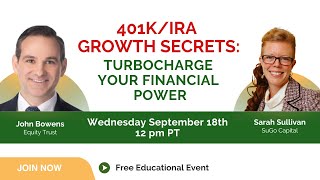
Webinar (YouTube) hosted by Sarah Sullivan (Sugo Capital) with John Bowens (Equity Trust) on turbocharging retirement accounts by using self-directed IRAs and solo 401(k)s to access private market and real estate investments. Topics covered: what a self-directed/universal IRA is; types of eligible alternative investments (real estate, syndications, private lending, cryptocurrency, precious metals, etc.); syndication mechanics (GP/LP, capital stack, cash flow vs annualized return); Roth conversions and strategies (staged conversions, deal-specific, discount conversions); solo 401(k) benefits (higher contribution limits, Roth bucket, UDFI/UBIT exemption); UBIT/Unrelated Debt-Financed Income (when it applies, filing Form 990-T, examples); checkbook IRA/LLC considerations; practical investor examples and resources (Equity Trust starter pack, John’s course, Sugo Capital links). Recordings and links promised to attendees.
Questions this video answers
1974
Over 300,000 accounts with over $52 billion in assets under custody and administration
Close to 20 years
Founded Sugo Capital in 2019; became job‑optional in 2021
Traditional/Roth IRA: $7,000 under 50; $8,000 if 50+. Solo 401(k) employee deferral: $23,000 under 50; $30,500 if 50+. Total solo 401(k) limit including employer contribution: up to $69,000 under 50; $76,500 if 50+.
Chapters
What I want. That's what I want. That's what I want. That's what I want. Your love give me such a thrill. But your love don't pay my bills. I hate what I want. That's why I want what I want. That's what I want. That's what I want. That's what I want sa. That's what I want. That's what I want. That's what I want. Money. A lot of money. That's what I want. Feel that money. I love the money. It's I found someone new he's waiting in the car outside I know how could you do it before each other Everlasting flow after the air know what we did There was one thing we but lots of money Money changes everything I said money money change is everything we think we know what we're doing that's all made us it's all in the past now wanna changes everything. Let's shake your hand and smile and they buy you a dream this there will be a friend who will stick with you till the end I'll put everybody on us looking out for themselves and you say well who can you trust? I say it just nobody knows it's money money changes everything I changes everything. You think you know what you doing without. It's all in the past now you understand? Changes everything.
All right, let's rock it. Good morning, everyone. It is noon in California. Top of the hour. John, welcome. So happy you're here. You ready to get started?
I'm ready, John.
I started this half an hour ago, and as soon as I started it half an hour ago, there were already a dozen people waiting to get on. It's like, wow, okay. People are super eager for the content today, so that is excellent. John, why don't you start out by introducing yourself and Equity Trust to the audience. About half of them might not know who you are or your company, so why don't you give a little background on yourself, then I'll introduce myself and then we'll dive in.
That sounds great. Hey, thank you so much, Sarah, and really appreciate you and Cynthia hosting this event. I know we have a number of Equity Trust clients and prospective clients on the call, and then obviously a number of folks from your group and community. And so welcome everyone. As a brief introduction, John Bowens. I'm here with Equity Trust Company. For those of you that aren't familiar with Equity Trust, we are a directed IRA trust company. What that means is we allow individuals to use their IRAS 401ks solo 401ks. We'll talk a lot about that. Roth IRAS, of course, I'll talk a ton about Roth IRAS and the different strategies that you can utilize within these accounts. Even a health savings account. We allow individuals to use these accounts to invest in what we call private market investments or alternative investments. So most people are only. There you go. Most people are only familiar with investing in traditional stock market based products. So individual equities, mutual funds, exchange traded funds. Now our firm Equity Trust, we can still allow individuals to invest in those types of investments, products, but we go much broader than that. We allow individuals to really take control of their retirement Savings accounts, their IRAs, their 401ks, the other retirement accounts and invest in private market investment opportunities, real estate rental properties, we'll talk a lot about that. Investments in real estate, syndications, private money lending, so lending money secured by real estate. And it really runs the gamut in terms of the different types of private market investments. We've been doing this since 1974. So our company founder Dick Desic is widely known as the pioneer of the self directed IRA industry. Started the predecessor to Equity Trust back in 1974, put together one of their very first real estate transactions in the early 80s. Fast forward. Today we have nearly 500 associates servicing our over 300,000 accounts with over 52 billion in assets under custody and administration. And then just on the personal side, Sarah, I've been doing this now for close to 20 years. I'm a real estate investor, I'm an entrepreneur. I met Mr. Desic nearly 20 years ago, changed my life because he became my mentor and taught me that I didn't have to be at the mercy of the traditional financial markets. Saving with my IRAs and 401ks and only being able to invest in stocks, bonds and mutual funds. I spent as I know a lot of people on this call. So spend thousands of dollars academically to learn about finance, the stock market, economics. But no one taught me that I could use an IRA and invest in real estate and other alternative assets and as I always say, leverage, compounding interest in the absence of taxation and start to create an environment where I don't have to needlessly donate money to the IRS every year. I'm compounding tax free returns within my Roth ira. So thank you for the time allowing me to do the introduction. And back to you, Sarah.
All right, thank you. So for those who are just joining, we are going to talk about 401k IRA growth secrets, how to turbocharge your financial power. I Hope most of you were able to receive and print out our worksheet for today. Pardon the camera. If you don't have it. Cynthia, can you please drop the link in the chat and you guys can print it out if you have a printer near you. But this is what, this is our. Oh gosh, sorry, how do I do this? Okay, here I have to stand right in front of it. So this is our, our what we're going to follow today. So we're going to talk about over 15 different ways you can make money, different kinds of investments that you can use your self directed accounts, your self directed account, retirement accounts for. We're going to talk about syndications. And so there's a section in here for terms that we're going to define for you guys. Then we're going to talk about UBIT solo case. What's the best way to invest in different things depending on what you like and what you have. So this worksheet is really meant to help you take highlight notes. We are recording this and we will send it out to everyone who registered. We almost had 2,000 people register. So we'll send the recording out to everyone and with that I'll do my intro and then we'll dive into the content. So I'm Sarah Sullivan. I'm the founder of Sugo Capital. And I started investing in real estate in 2020 12. And it was right around the time I was starting to have a family and I was working so, so many hours and I was commuting an hour each way every day. And as I started to have a family, I said, wow, I really have very little time with my children, especially my young children. And on this path that I'm currently on, I'm going to be working this hard, you know, until I'm 75, I got to learn about investing. I have to learn how to take the money that I'm earning for my W2, put it somewhere and have it grow faster than 2 or 3%. And so I was ravenous. I started the first book I read was Rich Dad, Poor dad by Robert Kiyosaki. And then I took all of their coaching programs, all of them, you guys. So that's some of the. I'm going to put a summary together for you that we're going to talk about today. But I studied everything that I could and it wasn't just like, let me look online and hear a webinar. I took the coaching courses and I did the six month thing and I decided that's not for me, that's not for me, but this is for me. And back at that time, I wish someone had a summary sheet for me that said, okay, you can look at all these things side by side, pick out what works for you, and then only take coaching on that piece of it. Long story short, in 2019 I opened Sugar Capital. And in 2021 I was job optional. I decided I'm no longer going to work for someone and I quit my W2 and I did that all through apartment investing. And over 50% of our investors invest in our apartment complexes with their IRAs and their solo 401ks. And so I'm super passionate about making sure that everyone's really equipped with the knowledge they need to make the right choices. So make the right choices as far as due diligence on your investments. But also that there's so many ways that you can, you know, you can have different accounts, you can use an llc, you can use a trust, you can use a self directed IRA solo K what is the best given the investment you're going into? And so I love meeting with all of our investors. And one year I had over 700 one on one calls with our investors and I heard so many questions about IRAs. And so that's why we have so many people here, John, is because it's like, it's a mystery to everyone what is, you know, there's so much to uncover. So I'm glad that we're going to do that today. So I'm going to go ahead and share my screen and jump into the first, into the first set of content. And that is actually I'm going to start with a disclaimer. Isn't that, isn't that more fun? Because I'm going to talk, Cynthia, if you could allow me to screen share, that would be great because we're going to talk about some actual examples. John will go through examples, I'll give some examples of what we're seeing in the market. And they're not actual investments that we're asking you to join or anything like that. So I want to say that disclaimer that Equity Trust has not done due diligence on our offerings. They're not suggesting Sugo Capital, they're not suggesting our offerings. We're simply here to co educate both of our audiences. So I want to say that and I want to say that numbers change all the time in the market. So even though I am sharing some information that I've gathered over time, next year these numbers might be totally different. So there are Risks associated with investing, including principal loss, do your own due diligence, all that great stuff. Okay, so the first thing I'm going to talk about are different ways you can, different types of investments that you can put into your self directed IRA or your solo 401k. But I'm going to put them on a comparison chart based on these things for over 15 types of investments. So I'm going to talk about annual ROI and cash flow. And you know, when I was first starting out and even with some of our investors who are seasoned investors, it's not always clear what's the difference. You know, when you see a number on an investment that says like, oh, this is a, you know, this percent return and it has some like, it's an air is ir, like, what is it? So the difference between an annualized cash and annualized return and cash flow is, cash flow is what you get every month or every quarter. And so it's real time money that you get from your investment. And then the annual ROI is how much money have you made over the lifetime of that investment. So if you're in an investment for five years, you add up all the money you receive, including when you exit, if you had some appreciation and if you divide it by the number of years you're in, that would be your roi. Level of effort and risk are really real. And a lot of times people don't take these into consideration. They just look at the ROI and the cash flow when making a decision about what type of investing is right for them. But really think about how much time do you want to spend? Sometimes, you know, investors like to set it and forget it, let's put it in a five year hold. And some are like, no, I really like short term loans. Like I'm in and out in three months and they go find a new one. Now there's like, that's crazy. I don't want to do that much work. And then, you know, different investments, especially private investments that are passive or hands off, they'll have a hold period, they'll have a certain minimum investment. And so, you know, looking, being able to look for those and making sure it aligns with what you're looking to do is very important. All right, so I am not going to take a lot of time. I have an event next week which I'm going to invite everyone to and it's called Freedom in three. And I'll take a lot of time to go through this. But basically for today what I want to say is, you know, there's single family home rentals, which we'll touch on. This is one type of real estate and it's usually the type of real estate investing that people know about and that's the extent of what they have heard of. And so I, I'm not going to go through each number in each cell, but I'm just going to share how to read this. So a single family home, most people invest in those for cash flow. Usually your cash flow if you're doing a long term hold and your annual ROI are really similar. I think level of effort is high on those. I think level of risk is high. So you see that H in those columns because I've had those, I've had those and they were so annoying to me. It's great for some people, wasn't great for me. And if you have someone who doesn't pay rent, then you have to pay the mortgage. So that's kind of how this chart works. There's land, house flipping you can do in your IRAs, you can invest in hotel developments, you can invest in private hedge funds that do leverage, commodities trading, private lending. This one's usually the most flexible that I see out there and I know a lot of you probably really love it. Apartment syndications, so active, this cannot be in your self directed ira, but being a passive investor in apartment syndication, that can work in your 401k solo 401ks. You can invest in ATM funds. So that's cash machines. There's a lot out there. Storage unit syndications, mobile home park syndications, retail parks, commercial parks, industrial medical, office buildings. It's like any kind of real estate you can think of. People put them in a syndication, mark their private investments and you can invest in them with your retirement accounts. So how do these, how do these work? Oh actually I'm going to pause here. These red boxes, it's the first, it's time for the first thing on your worksheet, guys. So I know I went through that really fast, but if something piqued your interest. So these red boxes are my favorite. This is what I personally invest in. So if something piqued your interest, go ahead and put it in this first section that says my favorite investments were if there's like, oh my gosh, I never knew about that. But that sounds really interesting. Write down, just write down three, if that's really actionable, that you can go do some more research and, and learn more about those. If you like the idea of the syndication or you're like, what is it? I'm going to talk about what it is right now. And this is obviously is just a fake one round numbers for easy. And I'm using an apartment complex, but know that anything I said on the chart before can go into this example. So this works for mobile home parks, retail, medical, office parks, etc. So a syndication is simply you pool people's money together to make a purchase. And so a syndication is really great for individuals who don't want to be on the loan they wanted, they want limited liabilities or they be an lp. They don't want to have to deal with tenants, they don't want to have to deal with property management companies, they want to be completely hands off. So it is best because there's usually leverage in these. Use your solo K if you can, and John's going to talk about that in a moment, but you can use your self directed IRA or your solo K to invest in any of these. So what we do, what syndicators do, again, no matter what the asset is, we create an LLC and that LLC becomes the owner of the asset. And so when we make the purchase, we'll have this example of an apartment building. Say we want to buy it for a million dollars, there's a down payment and then we get a loan. All right, so where do we get that money? So obviously once, twice, maybe three times, we could do this on our own. But if we want to buy 36 apartment complexes that cost over $20 million, we need some investor partners. So we have the general partners and that would be folks like me and other syndicators out there. And then there's limited partners. So that would be folks like you who are on this call. So the capital needed. So say this pie represents all the capital needed to acquire this apartment complex. So gray is the loan. Usually right now we're seeing around 65, 70% loan to value. But we need even more capital than that because we're going to do some value add. So green represents a piece of the pie. That means money that's coming from limited partners. The ones who just put money in, they don't have any responsibilities. They sit back, relax, watch us do all the hard work. So, so let's say that 30% of the money needed to make this purchase comes from investor partners. So how do we divide up the equity and the ownership of the LLC that holds the asset? This is typically how it's structured on the ownership side. So again, the circle represents the entire pie, all the ownership and the limited partners get 70% ownership or 70% equity in the LLC that holds the asset. And so you can see if you compare those two green pieces of piece of, they are not the same. They're not even. It's not even 2x, it's more than 2x. And that's really important to understand because that's how investors get such a nice return on their capital, because they get the appreciation on 70% of the asset and, and the rest is reserved for the GP for the work that they put into creating it. But appreciation on 70% of an asset for putting in 30% of the money needed to acquire it and then doing nothing, we feel that's a pretty fair structure. And when you go out there and you look at investments and you know, if you, you wrote down three that are on here, there's a different.
What'S.
The word I'm looking for? There's a different market norm for different asset classes. So know that these numbers will be different. So the ownership might be 80, 20, it might be 65, 35. So when you're out there looking at different investments, make sure you know what these numbers are and that you're comfortable with what they are in each situation. So some terms that are really important when you're looking at private investments, like John said, cash on cash. So I'm going to do a chart next that's going to show over time, when does the money show up? So cash on cash, again, this is not a real investment. I'm just giving an example of if you see an offering that says 8% cash on cash, what does that mean? It means that in one year you'll receive 8%. So if you receive quarterly distributions, it means every quarter you receive 2% return on your original investment. Then let's say on the same investment you see an annualized returns of 20%. So what's the difference between the 8 and the 2020 is when you take all the money that you receive from the investment. So including when you exit and you divide it by the number of years you're in that investment, that's your annualized return. And so usually these types of structures are great for people who are looking to maximize the. They're really looking to build their net worth because they're looking to maximize the back end on their investments and not as concerned with cash flow investment profile. So once you start looking, it's the door is going to be open. There's development, there's value add. There's so many different things. So we do value add, which is where we take an existing asset and we make it better, we remodel it, we get better marketing, all this kind of stuff, and then we resell it. And so appreciation is really strong for the investors. Development is, you know, it's a piece of land, build a hotel on it. That's also very attractive in different markets. So you want to get really good at market due diligence as well. I'm not going to dive into that today, but next Tuesday we're doing that three day series and, and on Tuesday we talk about how to do diligence, do due diligence on markets. Super important for passive investors. You know, lots of offerings. They'll say a 506C and folks wonder what that means. It's an SEC REG D. 506C means that the SEC says that, you know, the way that you've structured this investment can only be offered to accredited investors. Which means either you have a net worth of a million dollars or more, or you have an income of 200,000 annually, or your household has an income of $300,000 annually. It's an or. If that does not apply to you, then you want to look for something that says 506B and again, that's for anything that you're looking for in the private space. If you're not an accredited investor, look for something that's a 506B and like I said, hold period is really important to pay attention to in private investments because their hands off, you're not in control. So you can't decide. Like a single family house. You can say, oh, I want to sell it this year in order to have some cash to send my kid to college. You can't do that with most private investments. Some do have liquidity, some do not. So if you need liquidity because your kid is going to college in two years, then make sure you really pay attention to. Especially I see this all the time with new investors who are, who are just getting into the private investment world. They don't pay enough attention to this and then they end up asking during the term period, oh, I want to buy a new house. Can I pull some money out for a down payment? It's like, no, it's not how it works. We all bought the apartment together, we all, we all have to leave together. And then obviously pay attention to the minimum investment and make sure it aligns with you. So how does that all play out? And then, John, this is my, this is my last slide before we move into your content. So how does it all play out? To say what I just had on the last slide, say we put $100,000 into that investment. So it said it was a five year hold. So I'm going to put on the spreadsheet five years. And it said it was 8% cash on cash. Okay, so 8%, 100,000, easy math. So that's $8,000 per year. So a lot of people say, okay, so how do you get to the 20% annualized? It looks like I've only got, I got 40% over five years. That's $40,000 on my hundred. That's not exceptional. All right, well the big bang comes from the exit. So like I said, we do value add. Lots of other syndicators have something they do. So at the end when you exit, you get a bump or you get a big check, you get some capital gains that comes to you. So this column proceeds from sale is represents, in our case appreciation on apartment buildings. So if someone's doing retail, park, medical, office park, it would represent the appreciation of that asset over time. So in this example the investor gets a check for $60,000 at the exit and they get their principal investment returned $100,000. So I kind of skimmed over it, but on that 15 Ways chart. But this is really important. Do get your principal returns at the end is a very important question for passive investors to ask. So lots of times people assume you always get your principal returned. That is not a safe assumption. So you always want to check that fact. So in this example, investors do get their $100,000 their principal investment back. So that bottom line, we're going to add it up. So this investor received $40,000 of cash flow, $60,000 of appreciation at the exit and their hundred thousand dollar principal investment back. So they have turned their 100,000 into $200,000. And so you can see that's 100% more than they started with and well, 200. So they gained 100%. It was, you know, a gain that was equal to what they put in. So if you divide that by 2, you get 20%, right? 100 divided by 5 is 20%. So that's how the 20 annualized is represented on a timeline. Now there's also some tax advantages that go along, bonus appreciation, etc, they are not very applicable in your self directed IRAs and solo 401k. So I won't really get into that. But there are other advantages which we will go through with John. So I'm going to stop sharing and just say what I just went over was this section, what is a syndication? So if there are three important terms that you were like, oh, I didn't know that, or oh, I want to go do some more research on that. Go ahead and put that in the section. What is a syndication? Now, in my opinion, if you can hold your money in a solo 401k when you're investing in, in syndications, that is much better because you don't have to pay UBIT tax, but you don't have to be afraid of UBIT tax. And so what is ubit? How does it work? What's the difference between an IRA solo K when you're investing in leveraged real estate, even if it's a single family home, Whatever it is, John, I'm going to let you take it away. So, folks, we're going to start in this section ubit, and let's go ahead and hand it over to John.
Excellent. I appreciate that, Sarah. And before I show my slides, I did have a question that, you know, not, not so much for me, but I think for the broader group that's on today's call because you work with so many investors that are investing as a limited partner in real estate syndications, but I also know that you work with a lot of gps, so you're working with a lot of operators out there and you're, you're very much immersed in the business. Yes. And so you see individuals investing in these different types of projects. And in my experience in doing this for close to 20 years, I see real estate investors that of course are using their IRAs and 401ks and their Roth IRAs and even their HSAs to invest in real estate syndications. Yes. But then in addition to that, I also find a number of folks are using their non IRA money. And so I always, I always like to point out that of course we're talking about using IRAs and 401ks, which I'm going to jump into in just a moment. But that doesn't mean that one couldn't use their non IRA money to make the types of investments that, that we're talking about. But it might be good, while I share my screen here, to maybe speak to sort of what you see and maybe some of the examples of, you know, folks that you've worked with that are using both IRA and non IRA funds to conduct these types of transactions.
And I'm glad you brought that up because in a single syndication we'll even see someone who comes in and they say, hi, I'm Susan. I'm going to invest with my solo 401k. I'm going to invest with my trust and I'm going to invest with my llc. And so you can even invest via multiple entities and avenues in the same investment if you really like it. So thanks for bringing that up.
Excellent. All right, I'm going to take it away from here. And of course Sarah, if you have a question that comes up on your mind, feel free to interrupt me. And then if you see questions that are coming in from the chat box that you think are salient questions to answer, feel free to do so. I'll do as Sarah had mentioned. Disclaimer I think it's important for us all to understand that this is for educational purposes only. So I nor Equity Trust nor Sarah. As Sarah was mentioning before, we're not here to provide advice, recommendations. We're certainly not here to sell any type of investment product or any type of solutions. Equity Trust and myself, that's not what we do. What we do is we create a space for you and as a custodian we provide an account that allows you to be able to take control and make all of your own decisions. And we find that a lot of investors look to a self directed IRA as we call it, as a destination for them to be able to take control of their retirement account and invest in private market opportunities. So what I'm showcasing here on this slide is on the left hand side of the screen you see most financial institutions. So when you go to most financial institutions that will allow you to establish an IRA or a 401K or HSA or Roth IRA or SEP IRA or SIMPLE IRA, any retirement account. All right. I'm just, I'm just pointing out there are number of different retirement accounts and when you go to most financial institutions they only allow you to self direct if they will allow you to self direct. Some won't allow you to even self direct at all. The ones that will allow you to self direct will generally only allow you to self direct into stocks, mutual funds, ETFs, maybe individual bonds, bond funds. There might be pre built managed portfolios. And so this is how most financial institutions run their business and work with their clients is only investing in the traditional financial markets. Self directed ira. I just want to point out for everybody, especially for those of you that are brand new, it's an industry term. It just indicates to you that you have the ability to self direct and go beyond the traditional financial markets. So when you go to the right hand side of the screen here you see self directed IRA or as we very commonly in our industry we refer to it as a universal ira. We call it a universal IRA because you have the ability to still invest in stocks, mutual funds and exchange traded funds. So within one Iraq, you can have a brokerage account investing in traditional stocks, bonds, mutual funds, but then in addition to that with that same ira. Or it could also, by the way, be a solo. For a 1k, you have the ability to invest in a broader diversified portfolio of alternative investments. And the beauty of this is that you get to take control. So you get to, you get to determine how you want to diversify your retirement portfolio. So you see there are rental properties. Can you buy a single family rental property with your ira? Absolutely. I'll show you some examples of that. Can you do a fix and flip type transaction in your ira? Yes. Are there rules you have to follow? Yeah, of course there are. And if we have time, we'll talk about some of those. But we do have other trainings and education that go through that. Real estate syndications. I'll show you an example of that. Investing in land. So I have clients that buy vacant lots and then they hold on to those lots and they sell those lots and they make a profit and that profit goes back into their IRA. Roth IRA solo 401k, HSA, etc. Obviously a big point of the topic of conversation today is investing in real estate syndications. So I'm going to show you some of the mechanics of that and the different ways in which you can look at the different types of accounts that you could use. IRA Solo 401k. As Sarah had mentioned, there can be a benefit of using a solo 401k when investing in real estate syndications or debt leverage real estate. And I'm going to show that mortgage notes and trust deeds, private money lending. So what a lot of investors aren't always thinking about is that with an IRA or Roth or any of the accounts we're talking about, not only can you own real estate or invest in real estate syndications, but you could also be a private money lender. You can lend money secured by real estate to other investors. Investors investing in privately held companies, private equity, private credit funds, investing in online platforms. Actually, someone asked the question, can I use my IRA to invest through one of these online platforms? The answer is in most cases you can. All right, the law isn't going to prevent you from doing that, most likely, but there can be software challenges sometimes in being able to navigate those waters. But the short answer is in many cases you can physical gold and silver cryptocurrency cattle Contracts. I just put cattle contracts up there because it's interesting. It makes you think, wow, you can get really Creative with your IRA or 401k or other retirement plan. I'm not suggesting people go out and invest in cattle. Again, I'm just showcasing that so you understand that you're really only limited by your own creativity. Real estate, joint ventures, that's another concept of being able to use your IRA and partner with another investor. That brings capital to the table. And if we have time, I'll show you some examples of that. What you're going to find is there's very few limitations in terms of using your IRA or 401k. There are prohibited transactions that can occur, which means if you try to use your IRA in self deal, you tried to take a property and put it in your ira, you tried to lend money to yourself. There are certain transactions, we call them self dealing prohibited transactions that you have to be aware of. And we have other education where we talk about that. And then you can't invest in things like collectibles, like artwork, you can't invest in alcoholic beverages, you can't invest in an S corporation. But the idea is, is there are a lot more investments that you can do than you can't do. So in 1974, when the employee Retirement Income securities Act was passed, that gave birth to IRAs, 401ks eventually, and other retirement accounts. And when the law was passed, it was exclusive, not inclusive. So the government tells us what we can't invest in, not what we can invest in. So this concept of the universal IRA is the ability to be able to hold a brokerage account and invest in stocks, mutual funds, ETFs, traditional market products, but then also be able to invest in private market investments such as real estate, syndications, private money lending, rental properties, etc. So I just wanted to underscore this concept of self directed ira. And universal Iraq is just merely an industry term. And what you're going to learn is when you roll over or transfer money from another retirement plan into a self directed ira, or as we like to call the universal ira, there are no taxes or penalties. As long as you follow the procedures and you follow the rules and you follow the system that we're laying out here, there are no taxes or penalties. Okay, let's move on to foundationally traditional Iraq and compare it to a Roth ira. From a tax perspective, you're going to hear me talk a lot about compounding interest in the absence of taxation. This is just a very basic time value Money compounding interest. Example, if I put $6,000 away every single year for the next 25 years, which comes out to be $16.43 a day, and I make a 12% return on investment. So I'm just using very basic, easy math here so we can paint the picture of the different tax environments. So if we apply these numbers and then we apply a 30% tax rate while we're making contributions, and then a 20% tax rate when we distribute from the account, we punch this into our financial calculator. I know Sarah, she uses financial calculators every single day and does a great job of pointing that out. So if I punch this into my financial calculator in a taxable environment, I have $601,000 saved. That's just the reality of it, right? We have to pay taxes every single year. Now, investing with taxable dollars isn't necessarily a bad thing. So Sarah talked a little bit about, you invest in a real estate syndication. There could be tax benefits associated with doing that. That's not for this call. That would be for a different discussion, separate. But there can be tax advantages in a taxable environment still. You just have to understand those tools. The tools that we're talking about here are specifically irascible Roth IRAs, even more importantly. So then we move on to a IRA environment. So we have a traditional ira. What does that mean? That means when you make contributions to the traditional ira, you get a tax deduction for it. When you take money out of the traditional IRA on or beyond the age of 59 and a half, when you distribute money, that money is added to your ordinary income. It hits your 1040 as ordinary income, and then you pay taxes accordingly. So to give you an example, let's say you had a 401k, you're putting money away, you're getting deductions for it. So you're not paying taxes on the seed. If you don't pay taxes on the seed, you got to pay taxes on the crop. So eventually, what do you do with a 401k or a traditional IRA or SEP or simple IRA? Well, eventually, if this is what you want to do, you can self direct it so you can move it over into a self directed traditional Iraq. From a tax perspective, if we grow a traditional IRA, putting $6,000 away every year, making a 12% return, we have, as you can see there, almost $900,000 in savings. So if we compare the traditional to the taxable environment, we have about $300,000 in tax savings. So tax deferred growth can be beneficial, of course, as represented by this example. But then we move on to the Roth ira, which I know is the conversation that a lot of folks want to have here and learn about. So the Roth IRA is the opposite of a traditional ira. You put money away into a Roth ira after tax, it grows tax free. You take the money out. After 59 and a half, you pay 0% tax. So in a Roth IRA, we apply these same numbers and we have 1.117 million saved in the Roth IRA. So we compare the Roth IRA to the traditional, and you notice there you have well over $200,000 in savings. You compare the Roth to the taxable environment, you have over $500,000 in tax savings. So as you can start to see here, traditional and Roth IRAs can be really powerful when investing in private market or public market investments. From a compounding interest in the absence of taxation perspective, you eliminate the variable of taxation. And that can have magnifying effects over long periods of time. Now, let me just pause for a moment and talk about the elephant in the room, so to speak. Let me pause for a moment and talk about the question that I'm sure folks are putting in the chat box. In fact, I think I already saw one of the questions. And you're going to see this happen, folks, all the time if you start going on TikTok and Instagram and these other social media channels, not Sarah's channel, okay, I would encourage you to check out Sarah's channel because she likes to give the facts, of course. But you're going to see there are people out there, YouTubers, Instagrammers, they have no tax credentials at all, period. Yet they want to go out and tell people that you should never own real estate in an IRA or a retirement account because you lose depreciation. By the way, when you dig a little bit deeper, a lot of times when you start to look at that person's real motives, what they're trying to do is sell turnkey real estate. They're trying to do something, okay, that's a little bit different. Or maybe they have an incentive to tell you not to use an IRA or retirement account. Or maybe they're paid to do taxes for individuals that own real estate outside of an ira. So you want to be very, very careful with that. Now, I'll also say there are plenty of folks that are in the turnkey real estate business that heavily promote IRAs because they understand it and they believe in it. So be very careful what you see out there. Let Me explain how this works. If you own real estate, not in an ira, do you get depreciation? Yeah, you get depreciation. What does depreciation do? It offsets your income. It can even put you in a position where you have losses and those losses can carry forward. That can be beneficial. But keep in mind, when you sell said property, all of that depreciation that you were able to take advantage of gets recaptured. They call it recapture depreciation. And you have capital gains. So eventually, at some point or another, you're going to pay the taxes. Now, are there strategies around 1031 exchanges when you get into the real estate syndication world, that's not a bad thing. Are there strategies around investing into another syndication and being able to take advantage of bonus depreciation and losses? Absolutely. So I'm not here to suggest don't invest with your taxable dollars in rental properties or real estate syndications. But what I want to be very clear on is do not allow someone to influence you to think that you shouldn't own real estate in an IRA or other 401k or retirement account. You need to look at it through the lens of the economics. Is it good for my ira? Is it the right deal for my ira? Let me give everybody a framework that you can think about. I want you to write this down. There's three components to my framework that I use as an investor myself. Number one, does it make business sense? Does the deal make business sense before you even think about using an IRA or not use an ira? Does it make business sense? Did the economics make sense? Number two, tax efficiency. Should I use an ira? Should I not use an IRA from my personal perspective? I'm not saying this should be your perspective. My wife and I buy real estate. We invest in real estate. We do private money lending. We do that inside of our IRAs and outside of our IRAs. Some opportunities make sense in our IRAs, some make sense outside of our IRAs. Or maybe we don't have any liquidity in our IRAs because we've deployed all of our capital and it's out working for us and we don't have any money left over in our IRAs. So when we have a great opportunity that comes up, we have to use our non IRA money. That's okay. There's nothing wrong with that. And then number three of the framework is, does it meet my lifestyle? Does it meet my lifestyle for some people? I saw someone in the chat box mentioned I don't want to own rental properties anymore. I don't Want to deal with tenants. So someone like that might want to look at a real estate type syndication or a turnkey real estate opportunity or passive private money lending. That's not advice or a suggestion. Right? That's just something from an educational perspective to think about. Does it meet your lifestyle? So from the top, those three are, does it make business sense? Tax efficiency, how do I do it? In the most tax efficient manner. And there's lots of tools to use that go beyond just retirement accounts. You can add 1031 exchanges in there. That's another component of our business here at Equity Trust is 1031 exchanges. And then does it meet your lifestyle? Okay, and then funding your self directed account. Roth or traditional account. If you have a 401k.
I saw a lot of people asking, okay, if I have a traditional and I want to move it, I want the Roth, how do I do that? How do I, how do I move a traditional to a Roth?
Perfect timing. Thank you, Sarah. So we're going to cover that right now. If you have an employer plan like a 401k, a 403b, a 457, a thrift savings plan or other employer plan, you would initiate a rollover to a self directed ira. As long as you met a qualifying event, which is usually you met the age of 59 and a half or you left that employer, you roll your money over into a self directed ira, no taxes or penalties. Now most of these employer plans are pre tax accounts, meaning you didn't pay taxes going in, so you got to pay taxes coming out. Right. If you have an existing ira, Roth traditional sep, simple, you can simply transfer that into an equity trust ira. Then you can make a contribution, of course. And there are contribution limits to IRAs every single year. Then the Roth conversion. Okay, what is a Roth conversion? So we talk a lot about Roth IRAs. After tax dollars, it grows tax free. You take money out, you pay 0% tax. A lot of folks want to find methods to convert money to their Roth, grow the Roth and never have to pay taxes ever again. The logic of it is pay taxes on the smaller seed rather than the larger crop. To give you an example of this, I have two clients, Kevin and Cynthia. They started with about $117,000 in their 401ks in 2011 and 12 over two years, they converted all their money to their Roths. They've since grown their Roth IRAs to over 2 million in property value in cash flow coming in every year. They have over $200,000 in net tax free Cash flow coming in every single year. They pay 0% tax. They're over 59 and a half. They can harvest from the Roth and pay 0% tax. No long term capital gains tax. If they sell properties, no recapture depreciation. They're not worried about depreciation. They're not letting their CPA influence them and say, well, don't buy real estate in your IRA because you don't get depreciation. Because their strategy is grow their Roth IRA far in excess to what they ever could have done in the traditional financial markets. And their words, not mine, they fell victim to the Great financial crisis in 07 and 08. They actually call themselves stock market refugees. And so in 11 and 12 they rolled their 401ks over, converted it to Roth, started buying and selling real estate. And all of that profit, all those profits went back in tax free. So Roth conversion, to define it for everybody is this. You have pre tax money. You convert that money to a Roth ira. When you convert that money to a Roth ira, which is just a simple movement of money from your traditional to your Roth. We do these every day for clients. When you do that, whatever amount you convert is added to your ordinary income and you pay taxes accordingly. So let's say you convert a hundred thousand from your traditional to your Roth. Yes. You will pay taxes on that. A hundred thousand. Let's say you're at a 20% effective tax rate. That's just a hypothetical. Let's say you're a 20% effective tax rate. 20% of a hundred thousand is $20,000. So you pay $20,000 in taxes to get a hundred thousand dollars in that Roth. But what if you grow that Roth to a million dollars? Would you pay more in taxes on the seed or on the crop? Probably you would have ended up paying way more on the crop had you not converted to a Roth ira. That's the logic. I'm not saying that's for everybody. You want to pencil this out? Meet with your cpa, come up with a strategy very quickly. Sarah, let me give three strategies away for folks. I actually didn't have this plan for this webinar. So this will be a bonus, if you will, for everybody. Three strategies on Roth conversions. Number one, convert in stages. What does convert in stages mean? It means convert over multiple years, folks. Keep in mind we're close to the end of the year. Let's say you have a hundred thousand in a traditional IRA right now. Convert 50,000. Now you're going to pay the taxes. When you file your return for 2024, prior to April 15th of 2025, you then convert more money over. Let's say you convert another 50,000. Once the turn of the year happens, we're only three months or so away from that. So now you convert that money over and you've effectively spread your tax burden out over two years. It doesn't have to be two years. It could be three years, four years, five years. Just depends on how much money you have. And sharpen the pencil and determine what makes the most sense. All right, number two is convert deal specific. Convert deal specific. Let me give you an example of this. The example is a client of mine, real example, Scott, who did a real estate option on a self storage building. He found a motivated seller, he tied it up, took control with an option. He used his Roth IRA, but he didn't have a Roth IRA to start with. He had a traditional IRA. He only needed $2,000 for the option fee. So the investment was only 2,000. He converted 2,000 to the Roth, paid taxes on 2,000, which was only for him, 300 to $400 in taxes. And then he executed on the option, sold the option contract to an investor buyer. Again, this was a self storage building. It was about a three quarter of a million dollar deal. He didn't have that money in his Roth. He tied it up with an option, sold the option, made $20,000 in profit. Would you rather pay taxes on 2000 or 22,000? The logic for him was very, very easy. Convert deal specific. All right, number three. And by the way, Sarah, let me mention that number three is probably going to open up a massive box. The chat is going to probably explode. I wasn't going to talk about this.
That's important. People are asking.
Yeah, I want to talk about it because I think it's a real powerful strategy. Yeah, Discount conversion. Discount conversion. Folks, let me mention before I explain this, that you need to work with a CPA on this. You need to be very, very careful how you approach this. But here's the strategy. When you invest your IRA or even non IRA in a real estate syndication as a limited partner, there are two things that are happening, which aren't bad things, by the way. They're, they're good things in many cases. Number one, you have a lack of marketability when you invest in a real estate syndication or privately held company. Not a bad thing. There's what they call a lockup period, or it's just illiquidity. Right. You're investing in a hard asset. You have to understand, you can't get your money back like a stock or mutual fund the very next day. The lack of marketability can allow you to argue from a tax perspective that if you invested, let's say, 50,000, it's not actually 50,000, but maybe it's only 30,000 of value. Now, do you get the value back and recognize that eventually, yes, of course you should, if it's a good deal. So with a discount conversion strategy, think of it this way. You invest in a real estate syndication or a privately held company. You go to a cpa and the CPA does an assessment. And the CPA says because you have a lack of marketability and because you have a lack of control, you're a limited partner, not the general partner. Because you have a lack of marketability and a lack of control, you could potentially get anywhere between 30 to 60% discount from the amount you invested. So let's say you invest 50,000 and now the value represents 25,000. You convert 25,000 of an asset instead of 50,000, you just cut your tax bill in half. So those are the three strategies that I wanted to showcase. I'm not going to go further than that because it's a much lengthier conversation and I want to get back to the regularly scheduled program here. Sarah, it sounds like you got something.
Yeah, I want to add one more. So everyone, all of that was really important. Put on the back of your sheet. Roth conversion and those three that John said. And I want to say the discounting is real and often our investors see 50%. So you know, it'll cost like 800 to $1200 to have someone do the assessment for you. But then if you don't get taxed on 50% of your conversion, that's really strong. And then I'm going to add a number for a lot of our investors do this. They invest in oil and gas and oil and gas fund or minerals. And so then you get a 75% tax reduction of whatever you invested in that. So it's not using your IRA or, or your Roth to invest in the oil. You have to make another investment, but then you get the tax benefit from that investment to offset this taxable event over here on your Roth conversion. So that's another one, a fourth one that we see a lot of our investors do.
Yeah, you said that, Sarah, because it showcases that there are certain investments that might make more sense for a non IRA environment like you described. And then other investments, you reserve for your IRA and I'll jump into solo 401ks and show a couple examples there. And lastly, on the Roth conversion, keep in mind, when you convert from traditional to Roth, you don't need to cannibalize the IRA dollars as I call it, meaning you don't have to pay the taxes from the ira, you pay the taxes with non IRA money. That way you preserve those tax free dollars because those tax free dollars create more tax free dollars and you get to leverage compounding interest in the absence of taxation. Okay, let's jump to solo for a 1k. When you hear solo for 1k, you also want to think Roth solo for a 1k. Sometimes people get caught up in the vernacular, the vocabulary. A solo for 1k is a solo 401k is a solo 401k is A Roth solo 4 1. It's all the same thing. It's a plan. Now, it's not a traditional Roth ira. For some of you, you might be investing just with your traditional and or Roth ira, that's fine. But for some of you, you might want to use a solo 401k. And we're going to describe in a second what those benefits are. And on your worksheet, get prepared because on your worksheet I'm about to go through the three bullets on the benefits of the solo 401k. So here with a solo 401k, you actually have two buckets. So think of it as a plan with two buckets. You have a pre tax bucket and you have a post tax Roth bucket. And you can contribute to either pre tax and get a deduction and then eventually pay the taxes. Or you can contribute after tax into a Roth bucket. You don't get a deduction, but you have tax free growth and tax free distributions. So if you're someone that says, hey, I'd rather pay taxes on the smaller seed than the larger crop, then this is something you're going to want to make sure you pay very special close attention to. Let me start on the right hand side of the screen so you can fill out your worksheet benefits to the solo 401k. Number one, higher contribution limits, IRAs. Right now in 2024, you can contribute $7,000 when you're under the age of 50. When you're 50 and over, you can contribute up to $8,000. That's an IRA contribution. Now that's just how much you can contribute. Earnings, growth, transfers, rollovers, you can do as much as you want to. But in terms of making an out of pocket contribution, you're limited with an IRA to $7,000 or $8,000. With a solo 401k you can contribute substantially larger amounts. So let's flip over to the left hand side of the screen before we hit our last two bullets. Contribution limits to a solo 401k when you are under the age of 50, $23,000. That's what we call an employee contribution. So how much you take from your salary or your earnings, your earned income and contribute can be up to 23,000 when you're under 50. When you're 50 and over, you get a nice, what they call catch up contribution. So for those of you that are getting a little bit older and you're trying to play catch up, that's okay. You can contribute 30,500 when you're 50 and over. But it doesn't stop there with a Solo 401k because there's also an employer contribution. Think of it this way. As a business owner, you're an employee and an employer. As an employer, you can do a 20%, what's called profit sharing match or contribution. If you're set up as a W2 so you're an S corp, for example, and you're on an actual W2 system. If you're self employed, paying taxes as a self employed individual, use 20%. Don't get worried about the actual percentages. This is where your CPA or tax account is going to come into play. All said, what you see here is you can contribute when you're under 50, up to 69,000 when you're 50 and over, up to $76,500. So if you have enough earned income, you can contribute up to these amounts. And the beauty of it is you get to choose. Do you want all of that money to be in the tax deductible bucket or do you want all of that money to be in the Roth bucket? See, there's a way that you can take this, even this employer contribution and you can contribute it to the pre tax bucket and then convert it all to the Roth. It's called an in plan conversion. A lot of people don't know about this. They think that their pre tax money is locked up in a financial prison. No, you can convert that over into the Roth bucket. So if you are structured right, it's all about how you're structured. If you're structured right, you can get up to 69,000 into the Roth bucket of this solo 401k76.5 when you're 50 and over. Now the last two bullets ability to contribute more to the Roth Type account. I think you're already seeing that the ability to contribute more to a Roth type account. And then the last one, which applies to real estate syndications in most instances, and of course I gotta say most because there are some rare circumstances. But in 99% of cases, when you invest in debt finance real estate deals, whether that's through a syndication or it's direct buying a property, the 401k including a solo 401k is exempt from a special tax that I'm going to go into called unrelated debt financed income tax. All I want you to do for now in your worksheet is write down that you are exempt from unrelated debt financed income tax when you use a solo 401k. Now here becomes the challenge for some folks, not everyone, but some folks say, well, wait a second, what about eligibility? I have to be eligible to Open a solo 401k to be able to take advantage of the benefits. What are the eligibility requirements? Well, you can't have any W2 employees. Could you create a 401k? Yeah, you actually could do that. That's a different discussion. But you could do that. And you have to have income. So the business that you have that is Supporting the solo 401k has to pay you a salary, if you will. You have to have self employment income. You have to have income that you're paying Medicare and Social Security tax on. Do you have to have an LLC or an S corp or a corporation? No, you could just be a self employed individual. Here's a great example. Uber drivers, doordash folks that are working in the gig economy, independent consultants, independent contractors. Sometimes they don't have an LLC or corporation or entity. That's okay as long as you're filing your taxes. As long as you're claiming the income and paying self employment tax, you can have a solo 401k micro business. Why couldn't you? If you don't have one now, why couldn't you set up a micro business like an ebay business? Doordash, Uber independent consultant. There's all sorts of things that we can do creating a micro business so we have some earned income to support the contributions to the solo 401k. So in conclusion here, before I touch on unrelated business income tax, you got traditional IRA, Roth IRA, solo 401k. You might need to do a little bit more work to qualify for a Solo 401K. But as you can see on the right hand side here, the three benefits can be really, really powerful. Let me pause on that. Sarah, any questions or items you want me to address before I touch on my last topic?
Yes, lots of people are saying it's the top of the hour, they need to jump. What's the best way for them to get in touch with you or your company? John.
And yeah, I will post here, let me stop sharing my screen. I will post a link.
Everyone, we'll keep going. John and I will stay on. We'll have Q and A session and all of that. But I know some people are like wait, how do I get in touch? What's the best way?
So thanks for asking. I am going to post a link that everyone can follow if you are interested in establishing an account. You want to move forward with establishing an account. I'm going to post a calendarly link right now that you can use and that will be assigned to one of our IRA counselors so that way they can walk you through the process. So let me post that first. This is the calendarly link. This would be for if you want to open an account. Now let's say you are interested and maybe you just want some more education or information. You can go directly to our website. You can go to our YouTube channel. It's very easy to find us, very easy to get more education information. So if you are interested in opening an account you can use the calendarly link and then you have our website address there.
Beautiful. And, and you guys, John has a course as well. And so when we send out the replay we'll put the link to book a call with John's team. We'll put a link to book a call with my team@sugocapital.com Bookacall if you could put that as well Cynthia. And then we'll put a link to John's course as well and we'll put a link in the replay email to the mini series next week which is diving into more of these and talking about passive investing and figuring out what's right for you and due diligence and that sort of thing. So thanks John. I just wanted to interrupt because I see people going like wait, how do I get in touch before I go, I hand it back to you.
Not a problem. Thank you. Okay, so this will be the last segment and then I'll pass it back to Sarah. Q and A and hopefully folks can stay on. If not, as Sarah mentioned, plenty of opportunities to be able to engage. All right, so the big topic of course is UBIT and unrelated debt financed income tax. It's really all one in the same. So understand that Unrelated business income tax unrelated to the primary purpose of the tax exempt entity. Unrelated debt financed income tax relates to if your IRA is investing in a debt finance real estate purchase that could be owning an individual property or it could be investing in a syndication. All right, and we'll show that. So here are the three scenarios that you need to be aware of when an IRA or 401k is engaged in a trader business activity that is regularly carried on. So let me give you an example. Let's say my IRA or 401k invests in an LLC that's taxed as a default LLC pass through, not like a corporation and that LLC owns a car wash. All of the income from the car wash flows through the LLC into my ira. My IRA is going to have UBIT tax. The reason why is the way the government looks at this is my IRA is an unfair advantage over my tax paying counterpart. So I have UBIT tax. Do you always have UBIT tax? No. I'm going to show you that in just a second. Number two, an IRA has acquired a property with debt financing directly or indirectly or the borrower, I should say the retirement account is borrowing for the purposes of improving a property. So could you own a rental property free and clear in your IRA and then go to a non recourse lender and borrow money, pull out cash to go buy another property? Yes, you could actually do that. So IRA specifically note there is an exception. So if you go to section 514 of the Internal Revenue Code, you'll notice that there are some exceptions and one of the exceptions is a qualified plan which includes a solo 401k. So what we're showing you here is a door that is not widely discussed in the industry and that is you could effectively through a micro business startup strategy, create a solo 401k, dump your pre tax money into that solo 401k, maybe even then convert it to a Roth, invest in real estate syndications and debt, finance property acquisitions and no unrelated debt financed income tax. That folks is incredibly powerful. That's the biggest takeaway I would say from this program that we want folks to understand that they can create wealth in their solo 401k using leverage, not pay unrelated debt financed income tax and you can have it all in a Roth. So that way long term when you harvest from that roth you pay 0% tax. The third that you'll see and we won't spend a lot of time on is if your IRA or 401k leases personal property. So real property is real Estate buildings, houses. Right. Real personal property, I should say personal property are things like boats, RVs, coffee makers, blenders, couches, TVs, Internet access. Why do I say those things? Well, your short term rentals, your Airbnbs in an IRA could actually trigger unrelated business income tax. Okay? No UBIT or udfi, you have a rental property in your ira, it doesn't have any debt, you don't have to worry about ubit, it's passive income. Kevin and Cynthia, who I shared before, who have converted their money to roths, they have 14 cash flowing rental properties. They don't have to worry about UBIT interest income, you're lending money secured by real estate. You don't have to worry about UBIT dividend income, you're investing in a corporation. You don't have to worry about ubit. Long term capital gains, you don't have to worry about. You bet. You bet comes into play when you have an ongoing trade or business. If you flip too many houses in your ira, I always get the question, well, how many is too many? I can't give you that exact number. The rule of thumb that's used in the industry is don't do more than two flips a year. But rental properties lending, you don't necessarily need to worry about that. And then of course you have your ira, hsa, cisa, borrowing to purchase real estate and then leasing personal property. So a solution can be a solo 401k. Another solution by the way, is just pay the Yuba tax. So if you're paying Yuba tax, that means you're making profit. How does this work? How this works is if your IRA or Roth IRA or HSA invests in a debt leveraged real estate deal, your IRA or account will pay unrelated debt financed income tax on the percentage of the profits allocable to the debt finance percentage of the property. So for example, let's say you buy a property for 100,000 and you borrow 50,000. So now you're at 50% debt. So 50% of your net profit will be subject to unrelated debt financed income tax. So it's not 100% of your profits, it's just the percentage that's the percentage of the debt finance portion of the property. Okay? So just remember that solo 401k is exempt like we've been talking about. If you incur UBIT or udfi, don't be afraid. It's not your enemy, it's your friend. Because if you can take on debt and you can use leverage to really grow your IRA, and I've seen some folks really grow their IRAs and accounts. Then you bet becomes your friend. So don't look at it as an enemy, look at it as a friend. What do you do? You file a 990t tax return. Are there companies that can help with this? Yes, Equity trust. As a custodian, we don't give tax or legal advice, but we can prepare a 990t for you. So let me give you a quick examples and wrap. Tim from Texas bought a house for 55,000 from a motivated seller. He didn't have enough money in his Roth IRA. He didn't have a Solo 401K at the time. He had a Roth IRA. He bought a house for 55,000, put $5,000 down, carried $50,000 in financing. So the seller carried the $50,000 in financing. The Roth IRA was 91% leveraged, so he took on 91% of the debt from the seller. He flipped the house, the Roth IRA, paid for the repairs, sold the property, made 38,000, nearly 39,000 in profit. Now he had to pay taxes on 91% of the profits because he was 91% leveraged. But when you look at the math here, only 35,000 and some change was subject to the unrelated debt financed income tax, not the full 39,000. If we did this investment outside of the IRA, we'd have to pay taxes capital gains on 100% of the profits at least in this case he only has to pay taxes on 91% of the profits. So 9% of the profits are totally tax free. In the Roth we apply this to the estate and trust tax schedule. Tax rate at that time 39.6%. That comes out to be $14,000. So he paid $14,000 in taxes, but he saved 25,000 tax free in his Roth IRA. So his Roth IRA with only $36,000 in the investment returned to 24,000, $25,000 profit. Sarah was giving examples of cash on cash return on investment. What's the cash on cash return on investment here? Well over 70%. Still a good investment. This client Lee used his daughter's covered all education savings account, flipped the house using almost 100% leverage. Only had $1,400 into the transaction with the covered L Education savings account, ended up making 28,000 tax free even after paying $16,604 in UBIT tax. Unrelated debt financed income tax. And this last one is just a buy and hold example. So I'm not going to go through all the details of the numbers. But I put it in here because this particular investor, Craig, used leverage. It's a rental property. And with a rental property, guess what? You get depreciation. You get to write off your operating expenses from your taxable income. So when it all comes down to it, you see here, he only paid $964 in taxes. He's making a 19% cash on cash return on investment. So know that if you have leverage in your IRA because you don't have the luxury of having a Solo 401, you still get the benefits of depreciation to be written off the income, you get the benefit of the operating expenses, and ultimately you follow the estate and trust tax schedule. Long term capital gains is only 20%. So if your IRA is investing in a syndication, don't run for the hills. Don't try to figure out a way to do a solo 401k when you're not eligible. When you invest with your IRA in a real estate syndication, your long term capital gains are only 20%, not 37%. So again, UBIT can be your friend, not your enemy. And I think that's really important. I have plenty of clients that use their IRAs to invest in syndications. They file a 990T. And I'll wrap it up with this, Sarah. When people I find come to me and say, well, I don't want to file a 990T, my response is, usually there's a great way to never have to file a tax return again. You know what it is? Don't make any money. Then you don't have to worry about filing a tax return. Is that a good, logical way to go about things? No, it's not.
It's not. I had a family member and we exited a property and they were invested in our syndication and they were so grumpy, they said I had to pay taxes on this. I said, yeah, because you made like 45% in 10 months as our best indication. I was like, really? So, you know, there's ways that you can mitigate tax strategy, but really if you're paying taxes, it means you're making money. So it's not all bad.
Absolutely, yes.
John, do you have any additional slides or can we pop. Do you have a slide on the best way for people to get in touch? We. We put it in the chat, but is there anything else?
You know, I have one other slide that I wanted to show folks, and that's four methods to invest in real estate. You can just take a snapshot of it. We won't go through it in detail, but outside of taking on debt and some of the other things that we talked about, which was the topic, also know for those of you that are maybe a little bit more active and you want to go out and own a rental property directly, this is an example of a client that bought a rental property free and clear with their IRA for 91,000 and some change. And all of the rental income goes back into the IRA and then all the expenses are paid from the ira. And outside of that, you'll also hear me share stories about partnering multiple money sources together. So this example is a client by the name of John who partnered his Roth traditional and his non IRA money together, bought a house for 63,000, sold it two years later for 115,000, and then all the profits were split pro rata. So you can actually partner with yourself, partner with a spouse, partner with other IRAs. You have to make sure you follow what we call pro rata rules. So all the income and all the expenses flows pro rata. But this on the screen is a great example of a client made a 32% cash on cash return on investment by buying a house, fixing it up over two years, renting it out and then selling it turnkey, and made nearly 39,000, saved about $5,000 in taxes. And this is an example of a husband and wife and their daughter who partner their Roth IRAs together. They flip the house, made $163,000 tax free. And then lastly partnering with financial friends, joint ventures. So this one here, Doug and Ron, Doug did a deal where he had a three bedroom, one bath fix and flip deal, needed 105,000, didn't have 105,000 in his Roth IRA. He partnered his Roth IRA with an investor friend, not a family member, but an investor friend, a money partner. Doug's Roth IRA put in 13,000 and some change for the 105,000 RON, his investor friend put in his money happened to be his ira. Didn't have to be, but it did. And they split the profits 5050. So 50% of the profits went back to Doug's roth, which was 34,000 and then 50% went back to Ron. So Doug was able to, with this joint venture structure, was able to grow his Roth IRA to over $47,000 tax free. So obviously there are other ways to go about this, but these obviously are a little bit more active approaches. Someone mentioned in the chat box, you know, not wanting to deal with this and wanting to be more passive in their real estate investments I just wanted to show these at the end. For those out there that are maybe a little bit more active. You're out finding opportunities, finding real estate transactions. You're thinking, hey, how could I grow a smaller $ira in a shorter period of time? This could potentially be one of the ways to do that.
Love it. And John, in your course, do you go into more examples like that? Because I see a lot of questions in the chat. There is no way we're going to get to all of them. It's a massive amount of questions. However, when looking at them, I. Most of the questions you would cover that material in your course, is it. Cynthia was going to go grab the link to your course. Is that okay for us to post here?
Yeah, absolutely. That would actually be great. So we do have a course and I actually have a slide for it here. So I can just pull this up just so people have a visual.
Okay.
But this, this is a course that folks can take advantage of. By, by the way, there's no, we're not selling anything here for anyone that's on the call. So this, there's no cost to this. But this is our ultimate self directed IRA starter pack.
So you can guys, the links in the chat.
Yeah, you can, you can follow the link and you can get a copy of this course. It's all digital, it's all online and you can go through all the various video con, there's video content, video modules. So if you like the format of this, a lot of the videos are the same, but then there's more condensed, shorter form videos in there as well. So if you're thinking, I don't want to sit through a 60 or 90 minute, you know, lecture or discussion, you have those shorter form pieces of content in there. So yeah, certainly I invite everyone to take advantage of that. And if there's anyone out there that says, hey, I've been looking at this already and I just wanted to attend this webinar and get started. We have the consultation link in there as well. Our IRA counselors can help walk anyone through establishing their account, answering their questions and making sure folks feel comfortable with what they're doing. That's really important to us, Sarah, is we want folks to feel very comfortable what they're with what they're doing because they're in ultimate control. They're in the driver's seat. So we want to make sure that investors are informed and educated before they move forward.
Yep, I'm totally aligned with that. We, we are all about education at Seagull Capital. I want people to understand everything. We're not high pressured sales. We want somebody to self choose what works for them, their situation. And Cynthia also put book a call with John's team the link in the chat again. So I see people asking like hey if I just want to know, you know how to just get started. The link is in the chat. And then Cynthia also put the link to, to meet with me and my investor relations team. If you want to figure out what type of investment, like if you want to drill into the actual investment, not the structure of your ira, then that would be me and my team. So link to book a call is in the, all the links are coming in the chat guys. So then, then third there's the, the link toFreedom and three dot com. So that's kind of our version of John had his, has his course and we have a three day live. It's one hour each day, Monday, Tuesday, Wednesday next week. And I do a deep dive into more, you know those 15 types that I had up on the screen, I'll take an hour to really go through those. So you can self choose what works for you, what doesn't work for you. And then I spend the second day on how to do due diligence. So a lot of people, especially with so much out there, you know John mentioned people on social media and you know they're projecting the rosiest picture you've ever seen. So how do you really do due diligence on a team, on a market, on a property, on an investment? Because when you're hands off, you don't have any control. So due diligence is so important. So I'll go over that on the second day and then on the third day we'll talk about creating a, a financial plan for yourself, A, an investment plan that meets your goals. So The Freedom in Three link, it's freedom in3.com. Some people are saying it doesn't work. It worked for me guys. It'll also be in the email that comes out all these links. So maybe you can check it out there. All right. Yeah.
And Sarah, I'll add for those that are new to Sarah and Sugo Capital educational webinars and forums, I'll encourage you to stay on the email list. Sarah and Cynthia do a great job of sending out emails letting you know when these free educational workshops are coming up. So many great speakers and educators across the country. A lot of folks that I've networked with. She not too long ago had the top IRA tax attorney in the country who I know personally, I'm not going to mention the name, but top, top attorney in the country on self directed IRAs. And so those are the caliber of individuals that she gets onto these different educational webinars and forums. And it's so that you can make informed decisions. I was on one not too long ago that was more about exit strategies on businesses. So it didn't just have to do with syndications and promoting certain things that, you know, someone might have a benefit to. It's, it's about educating people holistically so that they can make informed decisions. So I encourage you to check out her other educational workshops. And I saw a question, Sarah, I wanted to make sure I answered for folks. Folks were asking about a checkbook ira. Yep. So to answer that question, there is a mechanism by which your IRA could own an LLC. So your IRA becomes the 100% owner of an LLC. And that's the diagram I'm showing you here. You open up your self directed Iraq, you then form an LLC. Your IRA becomes the 100% owner of the LLC, and then you have an LLC bank account set up. The money goes into that LLC checking account, and then you self direct the money. You're the manager of the llc. It does give you a lot of speed and control, especially if you're going to own rental properties in your IRA. If you're going to maybe partner multiple IRAs together. I do see this very commonly in the industry. We can accommodate this here at Equity Trust. Now I will tell you there are pros and cons with this and you need to understand that. So you have to understand there are rules you need to follow, prohibited transaction rules. So in the starter pack, I do go through specifically those rules and those guidelines. So a checkbook IRA is not for every type of investment opportunity you might be doing. So, for example, and Sarah knows this well, if you're going to invest in real estate syndications and that's it, there's no reason to have a checkbook ira. If someone tries to convince you that you need to have a checkbook ira, they're either misleading you because they make a lot of money on forming the llc, or B they're incompetent. I'm just going to be blunt and say that it's one of the two. It can't be anything in between. So be very, very careful with that. Make sure you get good education and information from people that don't have an incentive to say one thing or the other. Now, from my perspective, do I have an incentive to promote self directed IRAs. Because that's what I do. Of course I do. That being said, I look at everything as an investor myself and like I said before, I do investments inside and outside of my ira. So I think it is important to mention that when you look at investing, maybe not every investment is right for your ira and that's okay. Are there great tax efficiencies with an ira? Of course there are, but it doesn't mean that you have to use an IRA when investing. Hopefully that answered that question.
Yes. Awesome. Well, thank you, John. I am going through. You guys have seen me looking down the whole time because I'm looking at the chat and answering the chat. All right. I think that we got to a lot of the questions and we provided so many great resources for folks to dig in and learn some more. So I think it's a great time to wrap up. And everybody again, we're sending the replay out. Feel free to share the replay. It's not private information. You can share it with whoever you make your investment decisions with, whoever you know helps you with your tax strategy, whoever helps you with your financial planning, you can share this with them. The replay email today will have all the links of everything we talked about. You wanted to say something, John?
Yeah, I'm sorry, Sarah. I saw a question that came in which is a great question and I didn't get a chance to touch on it and it's a really good one. Fabio Vasquez asked the question to everyone. Great question, Fabio. By the way, Sarah, I should say I tried to answer a lot of the questions typing when you were speaking at the beginning. Incredible group here. The, the questions I could tell people are thinking they're create and they're creative. I really, really like that. So anyways, just wanted to mention I admire that. So to answer Fabio's question, if your IRA does take on debt, so you're not doing the solo 401k strategy where you don't have to worry about it, your IRA takes on debt, but then you pay off the loan. Once you wait 12 months in a day, you no longer have any UBIT or unrelated debt. Finance income tax, it goes away. So that's the beauty of it. The strategy could be use an ira, lots of leverage, take advantage of the depreciation as much as you can over the course of time, lower your unrelated debt financed income exposure, eventually have the debt all paid off and then when you sell, let's say it's a whole portfolio of properties. I actually know a guy in Ohio that used this leverage strategy has well over 2.5 million in properties and they're going to be paid off. And Once he hits 59 and a half, he's got a Roth IRA that he's going to be able to distribute 100% tax free or leave it to his children and grandchildren 100% tax free. And by the way, you can do a 1031 in your IRA, meaning if your IRA has debt finance property and you want to buy properties of equal or greater value, one or multiple, you can do a 1031 and defer the capital gains. So instead of paying the 20% long term UBIT capital gains, defer it into, through a 1031. That's part of the reason why we do 1031s here as well. So if anybody has questions about 1031, that's something that we can accommodate. In addition to that great question, Fabio. There's lots of nuanced strategies that go even beyond what we're talking about here today. Using leverage, paying off that debt and then selling after 12 months can be a great way to eliminate the sting of unrelated debt financed income tax.
There you go. That was like a really big strategy summarized perfectly. Thank you, John. Thank you. Do you see any others as you go through that you want to. Before I wrap up, anything else you want to answer, John?
You know, I have a tendency on these to stay on for hours answering questions. I have a terrible reputation for that. Then I start getting phone calls from my wife who's worked in the business here for close to 20 years, who Sarah, you know, and Cynthia knows. So I, I should, I should probably just pause there. There's lots of education out there obviously that we have. And, and Sarah, you're a great resource for I think the investment type education, like due diligence on syndications and how that works. That's, that's Sarah's world for everybody. My world is obviously the IRA and 401k world. Sometimes I like to say that my world is more boring than Sarah's world.
I don't know, people are pretty excited about it, John.
But important, right? So sometimes I know you get to have a little bit more fun than I do, but that's okay. We'll, we'll have fun together here. And again, I'll, I'll pause there. Sarah, again, thanks for being such a great host. Thank you to all of your team members that help put this together. If I can help out going forward for anybody, just, just let us know. We'll be here.
Beautiful. Well, John, thank you for that. I know all the Sugo investors, our community loved what you presented. They're always asking me and I defer to the master. So thanks for all your wisdom. It's truly helpful if you can see what's going on in the chat. Everyone is saying how helpful it was. They wish they had seen this 20 years ago, those sorts of comments. So that's really, you know, that warms our heart. John and I are so passionate about educating, so we're so happy that it's helped you guys and we look forward to continuing to work with you on your journey, on your education journey as well. So with that, we'll wrap. Thank you so much, John. And again, thanks to your team and audience. You've been amazing. This is actually really fun. So I appreciate that you were so engaged. All right, have a good rest of your day, everyone.
Bye, everybody.
More from Sarah





Multifamily Real Estate Investment Webinar: The Park at Ashford - Full Presentation & Q&A
Who Are You Investing With? Mastering Due Diligence for People, Markets, and Properties
Who Are You Investing With? Mastering Due Diligence for People, Markets, and Properties


Investing in The Park at Ashford | Arlington, TX Townhome Community | Equity Growth Opportunity