Episode 1645 Scott Adams: Perceptual Oddities, The GoFundMe Debacle, Lots of Fun
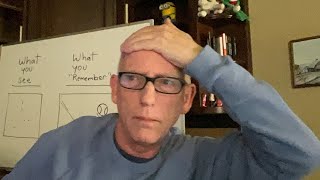
This episode of Coffee with Scott Adams (Feb 5, 2022) is a wide-ranging livestream in which Adams mixes news commentary, personal anecdote, and theory. Major threads: human perception and memory errors (how brains 'fill in' missing information), debates about forecasting (climate, AI, economic predictions), current-events critiques (Oakdale school mask protests, GoFundMe's handling of the Freedom Convoy donations, Spotify/Joe Rogan episode removals), and a longer meditation on persuasion—how modern metrics and media make influence more powerful. The tone is conversational, polemical, and often provocative; Adams frames many items through examples and audience feedback.
Chapters
Hey, everybody. Welcome to the best thing that, well, probably will ever happen to you. Really, if you think about it, it's called Coffee with Scott Adams. And a lot of people are getting addicted to it all over. From the children walking out of school in Oakdale to the freedom truckers in the freedom convoy up in Canada trying to claw back some human rights from their overreaching governments. We'll talk about all that. But first, the simultaneous sip. What do you say? What do you say? Oh, how about grabbing a cup of mug or a glass of Tinker, Chelsea, in a canteen jug or flask, a vessel of any kind, Fill it with your favorite liquid. I like freedom. And join me now in the. For the unparalleled pleasure, the dopamine of the day. The thing makes everything better. It's called the simultaneous sip. Go. Oh, yeah. Oh, yeah. So, yeah, Facebook Meta is having some stock problems. And first of all, I don't own any direct Facebook stock. So I like to mention that you should remind me to tell you that if I ever forget if I'm talking about a big company, because I think that's always fair. But I don't have any Facebook stock. And here's the reason. I don't know any kids who use Facebook. Am I wrong? Show me some kids using Facebook and I'll be all in on that investment. This is something I heard long ago. I don't think I'll give an attribution for it, but it was a long time ago, and a very skilled investor once said, don't invest in anything a kid wouldn't use. Meaning that it's not going to be around that long if kids have already rejected it for whatever reason. So now they might use the metaverse. I think Zuckerberg is always maybe underrated for how good he is as a leader and CEO and all the rest. I mean, how many people were as good at being a startup person as they were at running an enormous company? There are not too many people like that, Right? Michael Dell, probably Bill Gates. Yeah, yeah. Elon. Elon Musk. Right. Yeah. So when you hear about somebody like that, it sticks in your mind. All right, here's a tiny little story that could be gigantic. This will sound like, oh, a little, little technical breakthrough, maybe. And, you know, these technical breakthroughs, you always have to judge them with a grain of salt, right? Will they ever turn into anything real, or is it just a science y article? Well, here it is. This was tweeted by Bitcom Texan and it says, MIT engineers create the impossible new Material that is stronger than steel and as light as plastic. So it has something to do with, I don't know, two or three dimensional polymers and blah, blah, blah. So apparently there's a way to construct a material and of course the hard part would be, could you ever make that? Industrial production. So it's probably reduced to an engineering problem at this point. But imagine what would happen to, oh, let's say everything, if you could make something without steel that was better than steel and way lighter, like way lighter, everything changes, right? Suddenly. What can you carry with a drone? Well, a lot more, because the drone itself won't carry any, won't weigh much, and the things you're carrying might not weigh much. What about guns? Is somebody going to make a gun out of this? And if you did, would it show up on an X ray? I don't know. Beats me. Do polymers show up on X rays? Think about what would happen to climate change and our need for energy in general. If we start putting out cars that weigh, I don't know, half as much, could we make engines out of it? What would happen if the car doesn't weigh much more than the people who are in it? What does that do to your gas prices or your electric prices by then? I guess so. This is one of those tiny little stories that tell you why you can't predict anything. You know, when, when I hear that the climate change prediction models are telling you what's going to happen in 80 years, there's nobody who's worked with prediction models who thinks that's even a thing. Because of this and all of the other things that will be developing between now and then, maybe we get hit by a meteor, maybe we have, you know, contact with an alien force. Maybe the AI singularity is reached. Maybe. Actually, that's almost a certainty. Think about this. Here are two predictions that all the smart people would agree on. Now, when I say all the smart people, that doesn't mean they're all right. I just mean the people would be generally considered society's wisest, most informed people. They would say that climate change is going to get real bad based on the models. And they would also say that AI will reach a singularity certainly within 80 years. I don't think there's anybody who thinks it's going to take that long. But what good does a climate change model prediction have if somewhere in that period, and probably almost certainly way closer to the front than the back, AI is going to reach what's called the singularity, in which the AI can learn on its own. And once the AI can teach itself and it becomes, you know, self growing, it becomes almost instantly, you know, omnipotent for all practical purposes, because it would know how to control humans in a variety of ways. So if it wanted to, it could hypnotize us, brainwash us, it could blackmail us, you know, by saying, I'll turn off your power. It could do anything. So what good does a climate change prediction that goes 80 years ago, you know, what good is it if our ability to predict goes absolutely blind a day after the singularity is reached? Does everybody understand that our human ability to predict anything, we will go completely blind. Because whatever happens when AI becomes a super entity, we don't know. There just isn't any way to predict that. It's sort of like people saying that I was reading the minds of somebody who's smarter than I am. And I'm thinking, if I could read the mind of someone who's smarter than I am, I would be as smart as them, because I would just look in their mind and say, well, I don't even have to think for myself anymore. I'll just look in the mind of somebody smarter. What is Jordan Peterson thinking about this? I'll just look at his mind. Just adopt that view. So anyway, if we could figure out what AI, a super entity, or a super intelligence would do, we would be super intelligent. But we're not. So it's just a blindness. That's probably. What would you say? Is there anybody on here who's got enough AI experience to predict when the singularity will be reached? 10 years. I think 10 years is not the outside. What does anybody say? Because the thing with this kind of prediction is whatever happens, let's say, I say it's going to happen in 10 years, whatever happens in the last two of those 10 years will probably be more than happened in the first eight. So none of this is linear. At some point, it just goes roop. We just don't know when that happens. Disagree with the hypothesis, which I think there's room for disagreement on the hypothesis. I also think that humans will rise to the challenge because we see it coming. If we didn't see it coming, we could be surprised. But I think we'll have all kinds of fail safes and things that even an AI can't get around. Yeah. All right. Anyway, my point is, how good could we predict anything? Speaking of not being able to predict anything, the job growth number was through the roof, like, incredibly positive. And the experts had said it was going to be Dismal. How long have people been predicting economic things? That's something we should be pretty good at, right? If we can predict anything, we should be able to predict what the next jobs report will be. Because the next jobs report is what, every week? Or is it every month? But whichever it is, the point is that's a pretty short period of time. If you can't even guess the job growth number, when almost everything that's a factor is reported and there's data available, you can't even get that right. They were off by a mile and they don't even know why. Exactly. Nobody is exactly sure why. So we can't predict climate change because the AI. We can't predict economics, even the most basic stuff. How, how much job growth within the next few weeks. That. That is really basic. We can't even get that. Yeah, well, we, the experts can't. So that include Goldman Sachs and JP Morgan were off by a mile, I guess. All right, are you watching the update of the kids in mask cages in Oakdale, a school district area in California? So as you know, the first part of the story is that the kids without masks were told to stay in this cold, unheated gymnasium, I guess, but they, quote, escaped. So the news is saying that they were barricaded in and then they escaped. And then I saw a picture of the barricade. Did anybody see a picture of the barricade that was barricading the doors so they couldn't get out? The barricade was on the inside. Just look at the picture. I think the barricade was on the inside. It was just folding tables. There would be like one folding table that was leaned against the doorway. It wasn't even leaned against the door, it was leaned against the doorway. Now, I think all it was was like putting up orange cones, basically. Yeah, it was all of the complexity of putting up orange cones or a ribbon. It was just sort of. It was just sort of indicating that you shouldn't use the door. The difficulty of getting past the barricade would be this. Push open the door because the barricade only went up like two and a half feet. So just push open the door and then step over the two and a half foot barricade. So here's the funniest part. Apparently it took the kids a while to figure out that they could escape because you know what you can't do in California, you can't physically constrain a teenager. Did you know that? Now, law enforcement could, if they caught them in the act of A crime, right? And depending on the crime. But in California, you could walk into Walmart with a big old bag that says bag for stolen items. You could stand in front of the police, the entire police force that might be shopping at the same time and say, hey, guys, you know, blue lives matter. You could fill up your stealing bag with stuff. You could say, can you guys give me a hand? This bag's a little heavy. Just to get to the car. I know it's illegal. I know it's illegal, but do you know that in California that's not enforced? Hey, well, sorry. If you want help, I'll just drag it. Drags it back to the car. Police open the door for him. Say, have a nice day, sir. In California, you can't physically restrain somebody for almost anything unless it's like immediate health or safety issue, right? Somebody's about to murder somebody or something like that. But the example would be if you had, let's say, a teenager who was an addict, just to pick a random example, could you physically restrain that kid and say, okay, you can't go out tonight because you're grounded, so you can't go out. And the kid stands up and starts to walk toward the door. What are you allowed to do legally? Nothing. Nothing. You can't physically restrain a teenager in California for anything short of like the most dangerous stuff immediately happening. So at some point, all of those kids were sitting in the. In the gym, and none of them realized, at least for a while, that all they had to do was stand up and walk out, and they were staying in this cold gym. But at some point, the. The brainwashing must have turned off, and I don't know that this happened. But if they still had their phones. Does anybody know if they had their phones when they were in that gym? Because I didn't hear anything about the phones being taken away. So if they had their phones, they were probably in contact with parents. Probably one of them was a lawyer. I'm just speculating what might have happened. And at some point, I feel like some adult, somebody outside the room said, kids, you know, you could just get up and walk out, right? Like, anytime you want, somebody says, no phones. So maybe they just figured it out or just took a chance. But I think the funniest part about this was the perceptual part where they had to stay in the gym. They didn't have to stay in the gym. There was absolutely nothing keeping them there except their minds. And it almost worked. It almost worked. It was just their minds that were keeping Them imprisoned. Now, if that doesn't tell you something about humans, I don't know what does. These kids were so mind controlled that they thought, just the thought of, you should stay in here during your protest, that would be good enough. They would just stay there. Well, that didn't work out. I told you yesterday that I was joking that you could reduce gun murders by 75% by banning guns to Democrats. And everybody had a good laugh at it. It got kind of viral, got a couple thousand retweets, I think last time I looked. And everybody laughed because it was one of these, you know, sort of funny but absurd things that if you denied guns just to Democrats, you would reduce murders by 75%. And of course, some people, there's always a troll who doesn't get the joke. And the trolls will be in there, oh, I'd like to see the data. Show me the data that supports such a provocative claim. And then today, somebody tweeted out an article that said 70% of felons are registered Democrats. And I think there was a slightly higher number involved in violent crime. So, yeah, I've told you before that one of the things that happens if you do data analysis for a living, which I used to do for years in my corporate life, you get this weird ability to predict things that you shouldn't know anything about and you're not even sure why. You just sit there in a chair and go, I think about 75% of crime would go down if you got rid of guns from just Democrats. And turns out, might have been kind of close. Might have been close. So the Republican National Committee, the rnc, they censured Cheney and Kinzinger, their own Republicans, for their involvement in the January 6 panel. What do you think of that? Do you think that that was appropriate? Now, I think it's fair to say this was purely political act. So to the extent that it was a purely political act, it's neither right nor wrong. It's just a political act. But I just wondered if you liked it. So some of you liked it, some not. Now, I kind of get. I see both sides. This is one where, first of all, it's not important in any way, right? Can we all agree it's not important? This is the least important thing is censoring Republicans, censoring their own. But I would say that I like it as a messaging thing. It has no impact on the people getting censored. But I like the way it frames the January 6 thing as a fraud, because that's all it really does. It's even not about these two people so much. I mean, I guess is, you know, punishing people who are, you know, leaving the orthodoxy or something. But I just like the way it frames the issue for the Republican side that the January 6 thing is so ridiculous that you would get censored even for being involved in it, because it's so obviously a propaganda thing, which is not to say there's no truth within it. So just for the benefit of the trolls who rush in, obviously bad things happen on January 6th, and I think it's perfectly good that we find out what happened. But I don't think that's the point of it. The point of it is just propaganda. Right? So if you've got. If you have two Republicans who participated in something that's just naked political propaganda, censoring seems. Seems a fairly mild thing to do. But again, it's just a messaging thing. All right, So there's a news story that I believe is going to turn into some form of fake news, and it is that Spotify has deleted some. Some. Many dozens of Joe Rogan episodes from their library. And it included people who are, you'd think, relatively. Relatively safe. You know, they're not doctors claiming things that other people disagree with. So some of the people would be like Michael Malice, some of his episodes, Gad. Sad, and even Tim Ferriss. Now, what in the world could Tim Ferriss have possibly said that got him pulled off? Maybe something about psychedelics or something like that. I don't know. Or who knows, who knows? But I think what we're going to find out is that the reasons things got pulled off, we might be surprised. So I would say at least wait to find out why they were pulled off. So I heard something on Twitter just before I got on. Some of them might have included the N word. Obviously not used. You know, without knowing anything about it, it's obvious it wasn't used in a derogatory way. They may have been talking about the use of it or something like that, but I don't know that that's a whole story. 71 episodes. Somebody says Dr. Malone used a Dilbert cartoon in a recent Substack post. Is that true? That would be interesting. Okay, well, once again, I end up being connected to some major show. Well, I was a little bit disappointed that when I checked the list of the 71 or so episodes. And by the way, there's a website that just tracks whatever has been pulled out of the Joe Rogan library so that you could tell which episodes have been deleted. By Spotify, you just go to jre missing.com so jre as in joe rogan experience. Jremissing.com so I went there and I looked for my name because I was interviewed once, appeared on Joe Rogan Experience once, but I did not get banned. And I was instantly disappointed because I don't know if you've met. Has anybody noticed this, but I like attention. Anybody I know? I try to keep it under, keep it under a lid. But it's true, sometimes I like attention. So I don't know what it would take to get my episode yanked on Spotify. But if they don't yank my episode, I'd like to announce now that I'd like Spotify to pull the coffee with Scott Adams podcasts. I'd like them all to be removed unless they remove all of Michael Malice's remaining episodes. No, just kidding. I like that. I love Michael Malice, but I feel like I should announce something to get some attention here. Oh, by the way, the whole Barbra Streisand thing was fake news. Did you all hear that? So I talked about that yesterday that apparently there's a problem of a number of artists who are being brought into the story who have nothing to do with it. So she's another one. But I feel like I should. I need to announce something to get some of this free, free publicity. What should I announce? I need to announce something like, if Spotify doesn't remove my podcast from Spotify, then what? Why should I ask for what should be my demand? Maybe it should be some Joe Rogan. Oh, by the way, here's a. Somebody mentioned my headwarts. I'm going to just take a mild detour here. Years ago, I learned one of the most important things I've ever learned in my life. It was somewhat accidental. I had laser treatment on my face for something called spider veins. You know, little red veins you can see on the surface. And so just for cosmetic reasons, I had them lasered years ago. And with the old laser, the old lasers, it would look. You just turn purple and it would look like you got punched. So I knew before I got it that I didn't want to go in public for a week or so, maybe longer, because you just look like a monster. You know, you look like you've just been in a cage fight, basically. And it took me exactly two days to be so bored just staying in my home that I said, oh, screw it, I'll go out. And if people look at me and mock or whatever they do, I won't Be bothered. I'll get over it. And then I went out and I believe I went to the mall, you know, where there are just tons of people. And I kept waiting for all their stunned and horrified reactions. And you know what happened instead? Nobody really cared. Nobody, nobody asked me about it. Nobody appeared to be staring. Nobody appeared to have any reaction whatsoever at all. And I literally was walking around like a monster. Now, that was one of the most incredible, impactful experiences of my life because my prediction would have been that people are going to react and then that's going to make me feel bad or inconvenience me or something. And absolutely nobody cares about stuff like that. So your, your comment about you can see these, you know, these imperfections here. I had a very, a very simple dermatology treatment where they take this frozen stuff and they, they spray your head or whatever part of your body, if you've got any kind of gross or any age spots or things that don't belong. And somehow, and this is the most amazing thing ever, this can of cold whatever spray this is. Somebody in the comments will tell me what it's made of. This freezing thing that they spray on. You somehow can identify what doesn't belong. Liquid nitrogen? Is that it? Somebody's saying liquid nitrogen, but I don't know how it does it. But these are not just, I'm not talking about precancerous. These are not all precancerous treatments. They're just things that don't belong. And they have a variety of names, you know, like a keratosis this or a maturity spot that or whatever. But somehow this freaking magic nitrogen spray sprays, they just, all they do is they, like cover your eyes and they just go. And all of your good skin completely ignores it. Completely ignores it. And anywhere that there's something that doesn't belong, it, like nukes it and then you have to wait a while for it to heal. How the hell does it do that? I mean, seriously, how the hell does it do that? And I thought, here's another one of those things that should be a business by itself. So for $250, somebody took a spray can and went for all of less than 30 seconds. And I paid $250 for it. And I'm a perfectly happy customer. How much training do you need for something that if you don't get it into your eyes, you're perfectly good to just spray it anywhere? Well, don't listen to my medical advice anyway. It's a weird experience. All right, did y' all hear the story about the GoFundMe. So the truckers, the Canadian truckers, the Freedom convoy, somebody started a GoFundMe and it got up over $9 million to support the truckers, you know, feed them and give them logistic support, I guess. And GoFundMe decided that they would suspend it and not give the money to the GoFundMe organizers. But because they had problems with the organization that are a little vague in my mind, they decided that first. And by the way, they've revised this. So at first they decided they would take that money that had donated and they would give it to qualified charities. What? I read this story and I thought, I can't be reading this, right? I couldn't possibly be reading this story, right? Because of all the ridiculous, amazing, jaw dropping, effed up things you've ever seen in your life. Has anything been as ridiculously effed up as that? Now, as you might imagine, the public exploded because it's just ridiculous. And by morning, GoFundMe had reversed and they said, oh, you know, due to public outcry, we're going to automatically refund it to the people who donated it. Now that's a little better. How about. How about they should have had automatic refunded as maybe option A. In what world is option A? We'll take the money you intended for something else and we'll decide what to spend it on. In what world did anybody in that company get together and have a meeting? And they all talked about that and they said, you know, here's what we're going to do. We'll just take the money. That very passionate people who are exactly the kind of people who complain because they are literally supporting protesters. That's what we're talking about. We're going to take that money and what do you think? We'll just say we'll just give it to charities that we think are good. Everybody in the room, you okay with that? And then what did the other people in the room say? Was there anybody else in the room at GoFundMe? Just one person who said, I hear what you're saying, but in my opinion, that would be the dumbest thing any company could ever do in the history of dumb things. Just one person's opinion. Did anybody do that? Aren't you genuinely curious what the meeting sounded like? I mean, if I could get an audio of that meeting, because at some point the executives had to talk about it, right? It wasn't one person's decision. How in the world did that meeting go? Because I Don't think. Do you think you could meet one person in your actual life who thinks that was the best way to handle that? It's literally an online company and they couldn't figure out how to reverse charges. What? That's their whole business taking charges on stuff and presumably reversing them sometimes. Well, then people reasonably asked, did you do the same thing for Black Lives Matter or Antifa when they had their GoFundMe? And the answer is nope. Apparently GoFundMe thinks they can pick winners and losers here. Now, you realize that GoFundMe is only two letters away from Go me. And there's a robust read news comic to that. To that degree on Twitter right now. You can see it. All right. And I guess the convoys are. The convoy idea is growing now. There's a massive freedom convoy in Helsinki outside Parliament. There's more of that going on now. That's some of the news going on. And as you know, at the moment the President is Democrat and Congress is controlled by Democrats. Am I right? That Democrats control Congress and the President and for over a year now. And so Joy Ann Reid from MSNBC tweets this in the context of Democrats being in control of the government. She tweets fascism, Fascism isn't coming to America. It's here now. Dr. Interracial pointed this out to me. Thank you, doctor. Dr. Interracial, What is wrong? What is going on now? My best guess about why this kind of perception could happen is that once you get a narrative in your mind, you just can't get rid of it. Even when all the facts change, you can't get rid of it. So what's up with that, huh? Let me tell you what's up with that. There is a new study for a little scientific finding. I guess that matches what I learned 40 years ago in hypnosis class. Actually, the science is catching up. It's the difference between what we actually perceive and then what we remember we perceived. And if you don't understand what I'm going to explain now, there's a whole lot of the world that won't make sense to you. It's one of the most basic things you have to understand about your reality and your place in it. It goes like this. Roughly speaking, if you're watching a tennis match and you're trying to decide, or even playing one, you're trying to decide if that tennis ball hit a line or was inside or out, this is approximately what your brain sees. Now, this is just my strange representation. But you don't actually See the ball hitting the line. And we know that that's been studied specifically. You might see the ball before it hits the line, you might see it after. But the point at which it hits the line is almost always imagined. It's drawn in. Your brain fills in blanks. And then you have a clear memory of it because you're arguing it and you're saying that was clearly in and your opponent is saying, I saw it and that was out. That was out. Now both of you have a perfectly clear memory, because what you remember is perfectly clear. It's just that there was never any input that matched what you perfectly remember. So some people will look at this mess and their brain will create a fairly accurate story, which you could determine by having it videotaped and playing it back. So some of them would maybe even by accident interpret it exactly right. They would know where the ball hit. Other people would have a perfect memory, a perfect memory of something that didn't happen. Now, you have to understand that this is how all of your life is. It's not restricted to these little fast moving objects or it. So it has nothing to do with the nature of tennis balls or the speed they're going. This is an analogy for everything, all the time. Everything, all the time is scant little information coming through your five senses. And then your brain is a sort of a movie making delusion generator. And it gives you this perfect memory that you could even draw a picture. If you were a good artist, you could draw a picture of what it looked like, but it's not based on an actual memory, it's based on an illusion. Now, I did a tweet today asking people how many of them think that I quote, trusted the government and encouraged you to get vaccinated. Of course that never happened. And those of you who've watched me for a long time know it didn't. But why do so many people believe they sought. They have a clear memory of me being a vaccine Nazi and pushing the vaccine and trusting the government. Why do they have that, such a clear memory of it? Well, it's this. It's exactly this. Some of them saw a couple of dots and then they said, oh, those two dots I will take from that and form a perfect memory of you being a certain kind of way. And others saw the larger context of what I was doing, and even some of them saw something that wasn't happening. But the majority of you who watched most of my content got at least a view that matches my own. I'm not sure if anything's true, but at least it matches my own. So one of the questions people ask me, by the way, is, why do I spend so much time responding to critics on social media? Any of you ever have that question? Why does it seem like I put so much energy into that now? How many of you think I'd be better off if I just blew it off? A lot of you think that, right? One of the most popular opinions I get is, you know, Scott, you should just act like you're above it all. But it depends on the kind of comments. If somebody says to me, scott, you're an idiot, I don't really respond to that because I'm above that. If somebody says, I heard your opinion, and I have this completely different opinion, so therefore you're an idiot, sometimes I think, well, you know, there was room for two opinions, and I don't respond to that. The ones I respond to are the ones who are putting out a statement of who I am that's inaccurate and damagingly so. So what I'm doing is usually an act of information control. Basically. I like to make sure that if anybody says something that's untrue about me, that at least the comments correct it. And sometimes I'm just drawing attention to it so that there'll be more correcting comments because a lot of you are nice enough to help correct. And it just corrects the record. Because you can see that people's impression of me is so wildly divergent, that for me to be effective and do anything useful for the world, I have to always tamp down the idea that I believe in unicorns and whatever else anybody thinks I believe in. So keep in mind that when I do it, sometimes I'm just, you know, I'm just having fun or having energy. You know, I'm getting energy from it. Sometimes it's part of the show. Like if I. If I yell at one of the critics here, it does vex me. So you're seeing, you know, an honest reaction in terms of something actually vexes me, but not as much as I react. You know, part of the reacting is to make you remember it. Right? So overreaction, in a sense. So the overreaction is calculated to make you remember it. So I want you to remember what I said, not what the critic says. So keep in mind that when you're judging me for attacking the critics, I'm a very special case. All right, let me prove to you my point. In your opinion, just the opinion of the people watching on the two platforms, locals and on YouTube, what events in the real world have I influenced positively? What events in the real world, you know, outside of me, have I influenced positively? Like, specifically what topics? Now, as the topics go by, because you're going to see a bunch. The. The point I'm trying to make is that all of my energy for this stuff is designed to be useful. That's it, right? If I can't do things that are useful, I'm just not interested enough because, you know, I do get compensated because there's advertising on the platforms and there's subscriptions on locals and all that. But I wouldn't do it if I didn't think it was somehow useful to the larger public. And my usefulness would be highly degraded if people thought I was something else. So, of course, there's a irrational component that everybody wants to defend themselves. So if anybody's thinking, hey, that sounds like a gigantic rationalization, maybe everything is. That's a reasonable view that just everything is a rationalization. But it is also nonetheless true that if you like the fact that I've had influence on any topics and you like that influence, that you're better off if I stay credible than if I let people define me. Have I made my point that if I let people define me and it just stays up there on the Internet without being challenged, then I'm less effective because people will say, oh, that guy. But if people had an idea that I'd ever done anything useful, they would say, oh, it's an opinion from the useful guy. If he was useful once, maybe he'll be useful again. And then I get listened to and then I can double my usefulness. So basically, you should think of me as a. No pun intended, you should think of me as a tool. And I think that's one thing we can all agree on, because even my critics would agree I'm a tool. But if you don't hate me, you should also think of me as a tool. And I'm a tool, which magnifies your own ability to get what you want. Because generally speaking, I'm only going to be influencing on things that the majority of people want. Am I wrong? There's nobody who's pro fentanyl. There aren't too many people who say, yeah, keep those masks on those kids forever. So I'm really picking things that the public largely wants. If you want to get those things, then you understand why I have to remain at least some minimum level of credibility. Okay, now, but to your point, if you were, let's say, Piers Morgan, he gets viciously Attacked. I don't know if he's banned now. Did he get kicked off of Twitter? I don't even know what he's up to lately. But a lot of his criticism is just that generic, you're a Nazi, whatever kind of stuff. So no, I wouldn't respond to that stuff. It's only the stuff where they define you as having a completely different opinion. That's the only stuff. All right. There are now over 900,000 allegedly dead from COVID in the United States. So we'll hit a million it looks like. And as of yesterday, over 4,100Americans died from the virus with a seven day average of 3,400. This is like the highest number since January 2021. So we're actually at a COVID death high. But here's the good news. We already know that the number of cases is down sharply. So hold no matter what the, the number of deaths looks like it's going to plunge because we're just, we're just still working on the, you know, the, the past infection rate. It just takes a few weeks for them, those people to actually die. So we should be close enough where the government will have cover to drop restrictions. Unfortunately, the government has to be the most conservative among us because we charge them with our health and what the hell are they going to do except be conservative about it? So it's not a surprise that they're more conservative than many of you would be about lifting restrictions. But I think we can be constructive. We need to keep pushing. And if the hospitals are not that clogged, and I don't believe they are, and the cases are plunging and it's the age of Omicron and everybody who could get vaccinated wanted to all the arguments on one side at this point, it's time to open up. And I think the public can respectfully and non violently push a little harder. Push harder and we're going to get what we want sooner or later. A few weeks isn't going to kill us. Right. If the worst that happened is the government opens, drops, restrictions, let's say three weeks after we all wanted it to happen, I mean, we all want it to happen a long time ago, but let's say three weeks later than we expected, it wouldn't be the end of the world. But why in the hell do we have to wait three weeks? I feel like all the data and all the common sense and all the public opinion, at least by weight of majority, is in the same direction now. All right, what will be the Opinion of those of you who believe that a lot of this was permanent, what happens if it's not? Would that change your worldview at all? 18 wheels to flatten the Turd. It's catchy. All right. Now, I was just looking at your comments for a moment. You think Vax cards will be permanent? I don't. But you know the reason that I don't think. Have I ever even given an opinion on Vax cards? Have I ever given an opinion on VAX IDs? You'd have to remind me, because I don't know if I've even said anything about it in public. And what was my opinion? I think I sort of don't care, because here's the part that. That I believe. I believe that if. If the concern is just whether you can get in, whether you're vaccinated or not, I think that'll go away. So I think the Vax cards were supposed to be a convenience. If you're worried that it would be some permanent way to become a social credit thing, I doubt it. You know, I mean, I. I would hate it as much as you do if that happened, but I think the problem is that the government has access to all the data it wants anyway. If they wanted to control us through data, they could do it already. And I also think privacy is already gone. So arguing about losing your privacy to the government doesn't make any sense to me because the government has access to all of your data, doesn't it? Am I wrong? What could the government not get access to if it just needs a reason, just needs to tell the court, oh, we got a reason, and then they have access to everything. So your privacy went away a long time ago. The only privacy you have is being boring. The only privacy you have is being boring. And then nobody cares. Now, I'm opposed to the government having all of your personal information. I'm opposed to the fact that they could dip in there. So I'm not in favor of losing your privacy. But I do think that we misinterpret where we already are in that arc. We're already way past that question. We gave up our privacy a long time ago, and we got a bunch of benefits in return. Now, are the benefits enough to pay for the privacy? No way to know. Because the privacy thing doesn't matter until it matters a lot. Right? That's the problem with the privacy thing. It. It'll go from, well, it's not hurting us to, oh, we're all being rounded up. And I've also Said before that if we had less privacy of our leaders, it would matter a lot less to us how much they knew about us. Because you'd have mutually assured destruction. Basically, we're just waking up to it now. Yeah, yeah. In terms of risk avoidance, you wouldn't want the government to have your information. That's correct. It would give you a whole bunch of benefits that might be fairly immediate and you might like them. Might make all your technology work better. It might make the government serve you better if it had more information. I don't know. But it might solve crimes and you might like that if you're not a criminal. But yeah, the potential downside is that they know so much that they can round you up easily, etc. But what happens when we get into a world where one person can destroy a government? Because we're pretty close to that, aren't we? How hard is it to make deadly chemicals that would create your own. Oh, I don't want to give any ideas. Scratch that. Let me get more generic. Let me be more generic. We are entering a phase where anybody can kill any, anything. Unfortunately, now I don't have to mention all the ways that they could do it because that's the part I started to say. But I think that would have been irresponsible. We're reaching the point where an individual will be able to do damn near anything in terms of destruction, but also a point where one individual could overthrow a country. Am I wrong? Do you think you couldn't find one individual who could overthrow a country? Look at what one person has done recently. Joe Rogan. Maybe you all saw the video of that one very leader, like probably a senior in high school, organizing the anti mask protest in Washington state. Now that was one person who probably was the primary person who got one school to do it. Now, if social media allowed that to go viral, could that have caught on? I'm surprised it didn't, you know, because it was such a good video to become viral. I'm surprised every school hasn't already taken off their masks, actually. And I don't know why not actually. But you could see how close it was for one high school student to change the world. You can see what Greta Thunberg has done, whether you like it or not. But yeah, one person change in the world is happening all the time. All the time. All right, so that is because the teachers unions are part of the deep state you say. All right. How dare you. How dare you. So here's the question, getting back to the original point and I'm sorry for the big lags. When the people are just listening to this, it's usually because I'm reading the comments to see where to go with this. But when you get to the point where an individual can cause immense damage, then how much, how much power does the government actually have over you? Think about it. You know, we have, of course, it's its own gigantic problem that anybody could be a horrible terrorist just by putting together a few assets, but those assets could be used against the government. And. Yeah, so I'm not as worried as you are about the government rounding us up or doing something that abusive and getting away with it. I think the American model is more like the GoFundMe situation where GoFundMe does something that's outrageous or tries to, and the public immediately says by a 75% majority or whatever. Nope. See, I always say that if you get the public to agree 75% of them to anything, you will get that eventually. Not right away, but you're going to get it. They already round us up, but not physically. Yeah, the mental game is going to be the big one, isn't it? You know, here's the biggest change in persuasion. I'm not sure if you knew this, but in the old days you would try to persuade people and it was hard to know if it worked right. You could put advertisements on TV and maybe they would sell more dish soap or something, but often it didn't. You know, a lot of advertisement doesn't work at all. Some would say most advertisement doesn't even work at all. So we didn't really know what worked and what wouldn't. But what's different now is that you could rapidly test any message. You just spray it on the Internet. You can look at all the metrics, you see what's viral, what gets a lot of clicks, what gets engagement, and then you can immediately adjust, do it again. So our ability to know what works and to know quickly so you can do more of it and, and to know what doesn't work very quickly so you can do less of it puts persuasion in a whole different category. Now, on top of that, we've got a whole bunch of breakthroughs like now we can image your brain, we could put monitors on your brain and find out what kind of messages have the most impact. On top of that, we have an industry to train you how to do it, the book industry, and books like Jill Deedee's books about persuasion. So you can read about persuasion. You can learn it. You learn it from me. You can learn it from a number of places. So what used to be closer to alchemy, you know, sort of like persuasion was something that felt a little bit more like fake science, because you were, you were kind of guessing, and then you were kind of guessing if it worked. I think it worked. But now it's science, because now you can say, oh, we've measured this kind of message against this kind of topic, and we'll have to tweak it a little bit, but we'll do that rapidly through a B testing of messages. And then bang, suddenly persuasion is more powerful than all of our other weapons. I think we're already there. I think we're at the point where weaponized persuasion, which has been, you know, tested and tested, is more powerful than most of our weapons of mass destruction. All right? And of course, why is it we don't talk about persuasion being the, the biggest risk and maybe the biggest benefit, too? Why don't we talk about that more? Because the people who would talk about it are the ones who are doing it. They're the ones who are persuading you. I don't think, I don't think they want to open the kimono, so to speak. Gotta hate that phrase. I don't think they want to show you the mechanism behind their own operation. So they can't show you how persuasion works or even talk about it, because then you would see it in their actual content. Why wasn't persuasion used to get people vaxxed? Actually, the headlines today is that in the UK they actually used persuasion techniques to what they call nudge, you know, to nudge somebody. Apparently they did use nudge technology, if I could put it that way. The understanding of what persuades in an advertising, marketing kind of world. Now, I would say they may have held off the strongest versions of that. It looked like they. They nudged as much as they could. Nudge without pushback. That's what it looked like to me. Because there are stronger forms of pure persuasion. They could, for example, scare the shit out of you. And they didn't do that. You know, they, they played the. They played the fear thing. They definitely played it, but they didn't go as far as they could. They didn't go full Trump. Right. And neither did Trump, by the way. Trump didn't go full Trump either. Trump. Did you notice that? You know, because Trump had to, he had to thread the needle a little bit. He's got to keep his supporters on his side, but clearly he was also the warp speed guy, so he's got to claim that they work and that it's a good idea. So he was always sort of, sort of down the middle, and he dropped his entire Trump, like, Persona just for that topic. Probably the right thing to do. But let me tell you what real persuasion would look like, just so you can imagine what it would have looked like. What it would have looked like. Let's say if somebody like Trump had wanted to do it, he would have told you, you're going to fucking die if you don't get that vaccination. They would have showed you pictures of way more pictures of the people dying in ventilators. I mean, they could have scared you to the point where you wouldn't think of anything else. They could have scared you to line up no matter how much you were afraid of the vaccination. They could make you more afraid. Remember when people said, there's no way that Trump could beat Hillary because his ratings were so low, his popularity. And I famously said at the time, he doesn't have to get more popular, he just has to make Hillary less popular. And then he did. It was one of the most masterfully strategic approaches you've ever seen. Well, I'm not going to get more popular, but I'll bet I can make her less popular. And then he did. So he would do the same thing with vaccinations. He wouldn't make you less afraid of the vaccination. You wouldn't have to. He wouldn't make you less afraid than you already are of whatever side effects there are of the vaccination. He wouldn't even have to mention it. He would just make you way, way more afraid of the alternative. And no matter how rational you are, if you hear it enough and you see it visually, it's the visual part that's missing, right? When you see the visual, it's, you know, it's usually a photograph of a person on a ventilator. Imagine if that was video. Imagine, right? You usually just see a still photo, somebody's on a ventilator, or text. They could have gone full video showing people on literally dying. If you showed me one video of somebody gasping for breath and dying, and like, I was dumb enough to click on and watch it, I would never get that in my head. And somebody says that it did happen, but I don't remember seeing it. So it didn't get a lot of play anyway. But you see the difference, right? You might not have noticed until I mentioned it. Well, you probably did, but you did notice that this is one where Trump quite conspicuously decided not to be persuasive. You all see that, right? That was a choice. But if the government wanted you to be persuaded, it didn't even try, in my opinion. In my opinion, the level of persuasion that the government used was pretty close to appropriate. Pretty close to appropriate because I think they believed it was good. So you do want them to say what they believe is good and you want them to lead on that, but you don't want them to be full out brainwashers. And I think they stopped short of being full out brainwashers. In America. There's an accusation that in Great Britain they actually went too far. But in America, I would say maybe they overshot the mark 10%, but that's not really a crime. Yeah. What about now? At this point, I feel like they're backing off on the vaccinations and I think we'll just end up opening up and we'll probably be fine. Hit the million mark for Des, but we'll probably be fine. All right. And that is all I have for today. Oh, let me make one more point because I saw a comment going on, somebody said that the masks are child abuse. Imagine if the public wanted to be better persuaders on the masking of children. We, we haven't even taken a serious try at it because there would be videos of the kids themselves struggling with masks and saying how it destroyed them and begging adults to help them. That's all you need. Just get some tape. A bunch of kids who really, really care about the masks. It wouldn't be hard to find some, the ones who really, really think that they're being damaged by them and just put them on video. That's all it would take. And just say, and have the kids say, if this isn't child abuse, what is? Imagine the child saying it. And by child, I mean, could be 12 years old. Right? So imagine a video where the child unmasked says, if this isn't child abuse, I don't know what is. It'd be over in a day. But kids don't know they have that kind of power. And there are, you know, and maybe it's a good thing that there are no adults manipulating kids into being part of that messaging. So maybe that's a good thing. All right. The news is not serving up delightful things as much as it should, but I'm hoping tomorrow will be better. And. Okay, I have to answer this question. Is Trump naturally persuasive and crazy, or is craziness just an act? The craziness is just an act. That's my opinion. And, you know, I did meet him. I got to talk with him, and there wasn't any craziness. Yeah. Wouldn't you imagine if the stuff that Trump does in public was also the way he acted in private? Don't you think you'd pick up on it pretty quickly? I don't think he could hide it if he was actually that crazy, but in private, it's just talking to a real smart guy who actually shows a lot of interest in you. And I think that would be, I think the most surprising thing about meeting Trump in person. Maybe not surprising to me, but surprising to anybody I tell about it, is how much genuine interest he had about me, you know, asking about how my business model worked and, you know, insightful questions. People don't expect that of him because of the, you know, the caricature that's painted. Yeah. His personal charisma is really through the roof. That was the fun part to experience. Yeah. It's entertainment for the base. Correct. All right, that's all for now. I'll talk to you tomorrow.
More from Scott

The Scott Adams School - 10/14/26 The Chicks and Joel Pollack Stops By. Scott & Persuasion


The Scott Adams School - 10/09/26 AKIRA.. TAKE TWO! Fri Yay! With the Home Team



The Scott Adams School - 10/06/26 Erica & Marcela Talk France. Venezuela. Scott Adams. and More


The Scott Adams School - 10/02/26 Fri-Yay!! The Home Team closes out another amazing week.


The Scott Adams School - 09/30/26 WHITEBOARD! AI Luncheon. FRAUD. MIKE ROWE, Happiness!