Scott Adams explains that formal forecasts and business predictions are fundamentally guesses built on explicit and implicit assumptions. Using the vaccination debate and his experience making corporate financial forecasts, he argues that forecasts are "educated" or "informed" guesses presented as definitive predictions to audiences, and that assumptions, incentives, and presentation often mask their true uncertainty.
Chapters
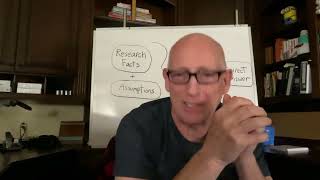
This might look like a rational process to you. It should, because it is a rational process. So a rational process is no matter what the topic is. So it could be any topic. You would do your research and try to figure out what the facts are. What things do you know for sure? But because it's the real world, you have to add some assumptions. For example, if you were looking at should you get vaccinated or. Or get the shots or whatever, you might make the following assumptions. I assumed that most of the injury from the shot would show up in the first six months. But I don't know that. I don't know that. I assumed it. And I assumed it because that's how other shots have worked. Most of most of the problems showed up in the first six months. So I waited six months before I got mine. Now, other people made a different assumption. Other people said, well, I assume that there could be lots of bad things that happen later. Now, that's true. I would share that assumption. But I assume that most of the risk was in the first six months. I think most people would agree. Other people assumed that the long Covid thing was artificial and that there wasn't really much of a long Covid risk. So they assumed that wasn't much to talk about. I assumed that since I didn't know if it was a big risk or not, and there were lots of anecdotal suggestions that it was a risk, that it should be considered as one of the big risks. But other people assumed differently. Now, those are just some of the assumptions there were a whole bunch of assumptions about. For example, some people assumed that the medical communities in all places were making decisions based on fear of being fired or going along with the crowd or a bunch of other things. So a whole bunch of assumptions about how people act. I'm not saying they were wrong. I'm just saying they were assumptions. Now, I made different assumptions. My assumption was that even if you had lots of people who were afraid, there'd always be a few people who weren't and there would be enough people to make it more of a fight. But there were in fact a number of rogues, people who were bucking the mainstream, and some of them ended up being right in the end. So what would you call this whole process where you research facts? Of course you have assumptions. You can't escape this. You cannot escape assumptions. Then you analyze it all. You use your best judgment and your reason and you come to a correct answer. What would you call this process? Go. How would you label that? Somebody say Risk management, deductive reasoning. Now I did this stuff for a living, so it used to be my job to make financial predictions for the companies I worked for. So I would say, oh, here's our budget, here's what we plan to do. This is what it will look like three years from now. And I always made a bunch of assumptions to back the things I did know. So assumptions plus things I knew. So do you know what I call this? I call it guessing. When I presented it to people, did I tell you it was a guess when I presented it to managers? No, no, it was a forecast. It was a forecast. So when I talked to the people who were the audience for it, I said it was a prediction and it was a forecast. If you talk to me in my cubicle and you were my co worker and you said, you know, how'd you come up to this? I go, well, the assumptions were so important to the outcome that it's basically a guess. It's a guess. Now you could say it's an educated guess, you could say it's an educated guess, but that's still a guess. That's just a form of guess. It's a guess, it's an informed guess. But the educated part and the informed part don't have any predictive value. They don't. If you believe an educated guess is going to be the guest guess. Well, I would argue that almost all guesses are educated guesses. Like in the real world, it's just that we're educated differently. So the education part doesn't help because we're educated differently. So guess lighting. Oh, that's pretty clever. Guest lighting instead of gaslighting. I like that. All right, so if you made this one change where people who do this kind of work know it's guessing, we know it's guessing. When we do it, we know it's guessing. You don't know it's guessing because I don't present it to you that way. I present it to you as a well reasoned forecast. And then you think, oh, well, he says it's a well reasoned forecast, showed all of his work. I saw the spreadsheets, I saw the columns, they seemed to add up. Yeah, that looks like a pretty solid reasoning you got there. No, it is absolutely just a guess. And all the rest of it is to launder your guess so that people like you will believe it was something other than a guess. But it wasn't. It was always a guess, always guess. And since I can guess either way, sometimes it's worse than a guess. Sometimes you're just forcing the data to be what your boss wanted it to be. So that's even worse than a guess. It's purely fraudulent.