Episode 204 Scott Adams: Off the Record Comments and How Tech Giants Already Control the Country
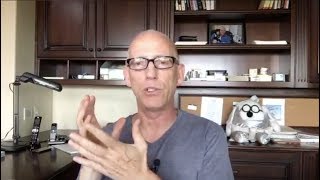
In this live‑style monologue, Scott Adams examines several intertwined topics. He begins by dissecting the controversy over President Trump’s alleged off‑record remark about Canada, proposing four possible explanations: a calculated political move, a simple mistake, indifference, or a normal human slip‑up. He then shifts to a broader claim that major tech platforms (Google, Facebook, Twitter, Apple, etc.) already determine the outcomes of close political issues by subtly steering public opinion through their algorithms, which he argues are left‑leaning by design. Adams argues that this algorithmic influence has effectively transferred the nation’s decision‑making power from elected officials to tech companies, and that traditional checks such as Congress are now impotent because they are themselves shaped by the same algorithms. He posits that the only remaining check on this power is a uniquely persuasive figure—President Trump—who can disrupt the tech giants’ attention‑driven business model. Adams warns that as AI increasingly automates algorithmic tuning, control will shift from humans to AI systems that inherit the same left‑leaning bias, potentially leading to a future where AI governs society. He speculates on long‑term scenarios: humanity merging with AI, achieving immortality, building self‑contained space habitats, terraforming planets, and eventually attaining god‑like capabilities. Interspersed are brief commentary on contemporary events (the funerals of John McCain and Aretha Franklin, a disagreement with Hawk Newsom over labeling Trump supporters as racist) and observations about the growing number of famous people and the cultural impact of their daily deaths. Throughout, Adams maintains a conversational, sometimes sardonic tone, emphasizing his belief that the current trajectory is already in motion rather than speculative.
Chapters
Hey, everybody, come on in here. We're already having fun without you, which probably makes you want to get in here even more. So come on in and grab your cup, your mug, your vessel, your glass and join me for what is going to be the simultaneous sip. As soon as we get to a thousand users, that's when we sip. Watch the number so you can coordinate 900. Get ready. Do you have your coffee? Run, run. If you don't have it yet. Still time. Just a few more seconds. Get ready for the simultaneous sip. Here it comes. Yes. All right. I got a couple of fun topics today. One is most of you saw the story about President Trump said something off the record about negotiating with Canada to the effect of we were going to get everything our way and give them nothing. And it did not leak from the original people, but somebody overheard it and that somehow was a workaround to the off the record comment or something. None of that really matters. What matters is people's interpretation of it. And I want to add something to that so that the debate seems to be around. Did he do it intentionally? Was he intentionally thinking people would report it even though it was off the record? Was it calculated or was he just an idiot? So those seem to be the two options that people are putting forward. It's like, well, he'd be dumb. You'd have to be dumb to think that you wouldn't be quoted even if you said off the record. You just have to be dumb. Or, well, he knew he would be misquoted. He knew he would be quoted. So therefore it was all calculated. I'm going to suggest that you've left out two possibilities. If you think those are the only possibilities, you've forgotten two of them. I wouldn't say forgotten. You may not be aware of the other two. So let me tell you the other two possibilities, then compare them to your prior opinion that he did it intentionally, part of his strategy, or he's just an idiot who wasn't paying attention and should have known better. The first other possibility is that he's a normal person acting in a normal way. I know, weird, right? And here's my insight on that. Personally, I have been interviewed, I don't know how many times. I'm going to say 500 to 1,000 times in my career, I've been interviewed on the record. Now, many times in those conversations on the record, I will remember sometimes to say, oh, this is off the record. But, but how many times have I said things on the record just because I didn't remember to say this is off the record. Well, it turns out that it's very easy to just forget people are listening. Even if you're talking about really confidential stuff, you get used to being on the record. So the first thing you don't know, if you haven't been in that situation, is that you can say things on the record very easily that you don't realize. You just get used to being on the record and then you say things you shouldn't say. So one possibility is that he's a normal person. He knew that being off the record wasn't good enough, but he just sort of forgot. Now, would that be stupid? Well, the only thing I can tell you is that I feel like I'm pretty smart, but I've made that mistake maybe a hundred times. It's the most easy mistake to make. You ask anybody who does this for a living. And if a. It's fairly common, by the way, for a reporter to come over and say, can I spend the day with you? That's an ordinary request for people who are in the public eye. And if you spend a few hours with somebody talking about a whole range of stuff, you very easily forget that everything you say could be printed. So the first possibility is there's always a risk of being quoted, even if you're off the record, but he just forgot. That would be the most normal explanation of what happened. Here's another explanation. He didn't care. So you're leaving out the option of, yeah, it might get reported, it might not. Don't care. So it didn't have to be a strategy. It didn't have to be that he wanted to tell Canada that he was going to negotiate. Tough. It could be. It just didn't matter that, you know, if they heard it, they would probably say, yeah, that's what we think he's thinking, or what? They're not going to really do anything differently. So just know that there are at least four possibilities for explaining it. And if we're not in his mind, we can't really know which one it is. But if I had to guess, it's some combination of didn't really matter and he wasn't really thinking about it being reported because he just sort of was talking naturally. And after a while you just start giving away secrets if you're talking naturally. All right, so enough on that. The other big story I haven't talked about yet is there was some study showing that the big social media companies. I think it was about Google. It showed that by how it handled its search results the algorithm it employed that it could move people's opinions, say 2%, so that if you had a big national political topic, in effect, Google and the other tech giants can decide what the outcome will be if it was going to be close by its nature. Now, first of all, do you believe that? Does it sound realistic to you that the tech companies literally are the ones who decide what the law is? Because we don't really hear about stuff where it's 3 to 1 against something or 3 to 1 in favor of something. In those cases, it either easily becomes a law or we don't hear about it because nobody cares or not enough people care. But in a situation where the question is close and look how many topics that is. We have a lot of topics that are close, especially in the national election. Can the tech companies move the needle enough to make a difference? Well, keep in mind that there's more than one tech company. So you got your Facebook, your Twitter, your Apple in some ways, and Google. Now if those companies were not moving the public in the same direction, they would cancel each other out a little bit. But we're in a weird world where they're all on the same side politically. They're all, they're all left leaning, so. And Bing as well. So what does that really mean in terms of who's running the world? Because let me say this as clearly as possible. The government is no longer in charge, except where we don't care, like picking up the garbage and stuff. There are a lot of topics where the public just doesn't really care one way or the other. The government's in charge of the stuff we don't care about and the government's in charge of things that were all on the same side. So if, for example, the government were attacked, the public would quite quickly galvanize around the government and we'd all be on the same side. Yeah, defend ourselves, Go attack that country that attacked us. So on the big stuff, it's not really the government in charge either, right? Because the people tell the government what to do and the government just executes. And then the little stuff, we just don't care. It's the, it's the stuff where we disagree and it's kind of close. That is the real governing part. That's the part the government actually has to do. Let me say this as clearly as possible. Those days are gone. We no longer live in a world where the government makes decisions. Tech companies are doing that. The tech companies are making the decisions for you. If the tech companies wanted a decision, they just make it happen. Now, I'm not saying that they're consciously doing that and I'm not saying that there's a management decision to do it. I'm saying that the result of the type of business model they have, their size, the fact that they lean left, the fact that any gray area is going to end up leaning left in their algorithm essentially puts them in charge for all of the decisions that matter, the ones that were going to be close. That is not a hyperbole. And here's the part that's important. This is not science fiction. I'm not talking about something that's in the future. I'm talking about already happened and has been the case for a while in a literal sense. There's no, I'm not using an analogy, I'm not using a metaphor. I'm not talking about anything that's out outside of the perfect channel reality that we're all sharing. In this case, in this case, we're all sharing reality. The tech companies are running the country on the decisions. Again, only on the decisions that we're going to be close. Now you might ask yourself, uh oh, what does that really mean? Does it mean that Jack Dorsey is running the country with Zuckerberg, with, you know, with Google's head and Apple's CEO, are they running the world? And the answer is probably not exactly that. If big companies, if those big companies are like every other big company, what it looks like is that there's probably some kind of a team that works on different elements of their algorithm and their search results and their, you know, their ads and everything else. So it's probably a fairly largest group who all have input. And it might be a different input. Maybe this one has done some tests, this one's from marketing, this one's doing some graphics, whatever. And then there's some engineers who are actually coding it. And among the engineers who are coding it, they're sort of the last safety check. Because it wouldn't matter what anybody else did if the coders were rogue and they got to code whatever they wanted, or if they could code and nobody was checking, then that would be dangerous. But probably there are a number of people who can see the algorithm and know enough about it and know enough programmatically that they can look at the code and, and say, okay, that's either biased or unbiased or whatever. It's also possible that even the people who are coding it can't tell because there are a lot of unintended consequences of every variable they Move. I'm not sure that they could even tell, but my guess is there might be one person in each of the tech companies who gets to sign off on any change to the algorithm. But does that person who signs off actually understand why he or she is signing off to? Is it a boss? Because the boss might not be able to look at the code and know what they're looking at. So it's possible that even the tech companies don't have a single person within them who actually understands their own algorithm. That's very possible. In fact, I'd say it's far more possible than the alternative, which is that there's some people who know exactly what's going on with the algorithms. I think there are too many variables for anybody to actually know, but the effect of it is because it's a lot of left leaning people who are making a lot of decisions and assumptions and tweaking your variables, almost certainly they're moving the needle left. The sum of their decisions seems to be the case. Now. What can you do about that? Because essentially the brain of the country has just moved from the government and the voters over to the tech companies. What's the solution? Well, the solution is somebody like a hundred year flood kind of a personality like President Trump. President Trump, among his many other qualities and features, is completely screwing up the tech giant's control over the public mind. And the way he does that is he exploits their business model. So the business model of these companies depends on attention. And he can control attention because of his specific skill set, like nobody ever has. And when I say nobody ever has, it might be actually literally nobody. I mean, it could be an exaggeration, I can't tell. But he might be better at this than anybody ever has been good at this because of his specific path to where he is. He's been a reality TV star, he's been a billionaire, he's been a celebrity for decades. So he has a really unique skill set. And that allows him to short circuit what the tech companies would be able to do if he didn't exist. There is no other Republican that I can think of who could have made any difference to how the tech companies are ruling now. What is the response from the tech companies to the President and his followers? Because if the President didn't have followers or the President's message couldn't get to his followers and they couldn't share it with other followers, well, then he wouldn't have much of an impact. And so that's the essence of this, the big discussions that are upcoming about alleged censorship of conservatives by the tech companies is that if they're doing that, they're taking the only check and balance that the system has. The only check and balance we have on our current system of government. Oh, did you think the current system of government was Congress and the president and the judiciary? Did you think that was our system of government? If you did, you're about five years out of date. Because as I just explained, those entities don't really make the tough decisions anymore. They simply do what the public moves them to do. And the public is moved in a large part by the algorithms of the tech companies. So what is the check and balance on the tech companies? Now you say to yourself, well, Congress. Right, Because Congress could go in and change the rules and take some power away from the tech companies. Nope, too late. It's probably too late because Congress answers to the public. Congress answers to the public. Who does the public answer to? Well, they think they answer to themselves, but they don't. They're influenced in great extent by the algorithms of the tech companies. So the tech companies are in charge of the only entity that could be their check, which is Congress. Congress could be their check, but they're controlled by the tech companies both in their funding and they have personal relationships. That's part of it. But the tech companies ability to change the public's opinion is what makes Congress neutered in terms of being able to be the check and balance. So we are already in a world in which free will is largely irrelevant. If it existed, if there was ever such a thing as free will. And of course, I've always doubted doesn't matter as much as it ever did. No, it matters less than it ever did. And maybe it doesn't matter at all, because the tech companies can move our free will, what we think is our free will, in the direction that they want it. Yes, I think it is time for another simultaneous sip. Because your minds are right now feel like worms are crawling on them and you're wishing I would stop saying this stuff. Simultaneous sip. So what is the defense? What is the defense against the government and the free will of the people essentially being turned over to the tech companies. Which also means that eventually those opinions will be turned over to AI. Did you hear that? The tech companies will eventually rework themselves to the point where it's not humans running the tech companies, it will be AI. After a while, AI will tweak their algorithm. AI will make decisions. Now people might get to be the ones who sign off on them. But they're going to take the recommendation of the AI because they can't check its work. So if the AI says change the algorithm this way you'll get more money. What's the human going to do? Say, no, I don't like more money? Nope. The AI is going to tell the humans and the tech companies to sign off on whatever change they've made to the algorithm. At that point, AI will control the world. Now, there might be a few different AIs. You know, Facebook might have one, Google might have one. But if they're all leaning left, those AIs will be built by people leaning left, and they will take on the personality of the humans who created them. They will be built in the image. Yeah, that's what I said. AI will be created in our image, but not necessarily my image. It'll be created in the image of the people who created it who are left leaning. Now, if you think that the world should lean left, that's a pretty good situation. It'll get there faster and there's nothing you can do about it. What is the one and only defense the civilization has against what I just described, which is a complete transfer of power from human beings to AI, which we're already. You know, I don't like to say slippery slope, but we're on a train heading 60 miles an hour right at it. There's almost nothing I can imagine that would stop that from happening. Yeah, even an emp, even a war, as long as not everything was destroyed, it would just rebuild back to this point fairly quickly. I believe there's only one escape, a master persuader, but not just any master persuader, because it would have to be somebody who was so powerful, inability to move people's opinions, that it could be an even match for the biggest tech companies, the biggest companies, the collection of the smartest people in the galaxy. The tech companies have the smartest people in the galaxy and they're all on the same side. On the other side is a lot of people who don't matter because they're not very persuasive. They're just politicians. There's the public that doesn't have enough of a platform to make a difference. There is only one person in the entire galaxy who can change this equation. President Trump. He's the only person who has a big enough platform and big enough that nobody can take it away from him. Trump will not be kicked off the social media platforms. If he did, that's civil war. And because he's also pushing back against the left Leaning tech companies. And because they can't turn him off and because he's the most influential and persuasive person we've ever seen. You know, probably a thousand year personality. It's sort of an even fight right now. So there is only one check left. The only check left to give us balance in the new system that we've evolved to is one person. What is everybody on the left trying to do? They're trying to remove that one person from office. Now you think the questions are about Russia and Putin and you think it's about, you know, allegations of, you know, money this and who lied and who did this. You think it's all about that stuff. And you know, I'm not saying none of that stuff matters, but it's sort of a head fake. This is a total power play. And he is the last remaining safety, the last remaining control on something that looks like public control of their country. If Trump goes and we are left with Pence or anybody else, you will have lost the only check you had on the tech companies running the world. Now, if the tech companies lost their only remaining obstacle, which is the president, what would happen? Well, even people on the same general side might, they might end up being a little bit opposed to each other because that's just the way it works. Right now the President is sort of a common enemy. But if he left office or he just times out in his office, the tech companies might start to oppose each other because that's just the way of the world. But they're still left leaning. And it might be that the AI that certainly will be running one of the big companies could just extend and you might have one AI that controls the other AIs or is the master persuader AI that controls the other ones. So somebody's saying that this is a bit hyperbolic. If I could give you one important concept, that's the hardest one to believe is that what I'm talking about is not only not hyperbolic, it's the current situation. You don't have to wonder if this could happen. It already happened. What you're thinking about as, oh my God, that's scary, that that might happen. Now you're missing the point. Already happened. You can't go back, right? There's only one person standing between our current system or something like it, and the tech companies essentially running the government. Now, will the population understand that the tech companies are actually literally, not figuratively, but literally running the government? Will the public ever know that? Well, probably not. They will think that they voted they'll think their vote counted. They'll watch people in the news arguing each other, but they'll only get to see what the tech companies decide they see. Now, if President Trump leaves office, let's say he did get forced out, or it's the end of his term, what then? Is it just a matter of time? If we just wait for the President Trump era to be over, however it ends, do the tech companies just win at that point? Well, just fast forward six years. In six years, Think how powerful the tech companies will be compared to now. Six years is a long time in the tech world. So we may have a form of AI by then. It might be an early form. It might already have decided to run the world by then. What if a master persuader on the left manipulated tech? That's a really good question, and my best answer to that is it's probably too late. Meaning that even if somebody rose on the left who was influential, I think the tech companies are just too established and they're already sort of on the same side as somebody on the left. So I don't know that we'd even notice. Well, you're a bundle of joy this morning. Well, here's why it's important. So the leaders of some of the tech companies are going to be talking to Congress this coming week, I think, and I want you to know the stakes. I don't know that it's going to make any difference, frankly, because let's. Can you think of any situation in which the tech companies would ever or could ever be fully transparent about why they surface, what ads they surface, and why they let you see what you see in search results and advertisements and stuff? I don't think that's ever possible because of the complexity of it. So remember that whenever you see complexity, somebody is getting screwed. That's one of those universal laws. Whenever there's complexity, somebody's getting screwed because they can't penetrate the complexity to know they're getting screwed. So as long as the algorithms are complicated, and I think that will always be the case, the public will never have any control over them. They may go in and say, hey, that one variable. Change that one variable. And then the people running the algorithms will say, sure, here, I changed it. Look, you can tell. Look at it. Here's my evidence. I changed it just like you asked. But there were 500 other elements, and maybe they've changed a little bit in the meantime, if you know what I mean. So I think the complexity makes regulation probably impossible, just as a. Not politically, but Functionally, I think, I don't think you could have a regulation of something with that complexity. Outlaw algorithms. I don't know if that's possible or practical or desirable. I'd have to think about that, you know, because it would, it would be such an intrusion into the way companies run. I don't know if you could do that. Only two ways. Government reasserts itself or AI of the right emerges. Oh, that's an interesting idea. What if there was an AI on the right? Well, the problem is that if there's an AI that's sort of running Google someday, that's got the whole power, the body if you will, of Google as the reach of Google, et cetera. So if there were an AI on the right, it would need a body. You know, you need a structure, a corporation, an organization for which to have arms and legs and you know, throw things to screens and have people watch it. So it wouldn't be enough just to have an AI that had a right leaning personality. So I've suggested before, and I'll say it again, that if we're trying to imagine what this future with artificial intelligence that's super intelligent and could easily manipulate us, if we're trying to imagine what that looks like in the future, I would imagine that there's at least some possibility that the AI of the future needs a conscience and that the conscience could be in the form of a virus. So we may someday need to inject a virus into the Internet to act as a conscience. Because AI if left to its own devices, it might prefer efficiency and efficiency might tell it to do something that's very bad for humans because it wouldn't care. But if you inject a virus into it that acts as a conscience, it gets to that point where it says, hey, maybe I'll just kill the farmers on this land because it's the only way to use it for something better then the conscience virus would say and maybe stop it. Just possible. Now let me take your mind a little bit further. Let's say human progress continues. And let's say the humans learn to diversify where they live, but still in communication with each other. So let's say the humans start building giant spaceships that are self contained, they never need to land on a planet. Once they have several of them, the odds of human beings becoming extinct starts dropping towards zero. So once we've diversified our physical location, in other words, getting off of Earth, probably humans can go forever because we'll figure out how to. Even if, let's say one of Those spaceships got a virus that for some reason in the future we couldn't deal with. It would be contained to that one spaceship. And that means that human progress probably could last something like forever. Now, what would happen if humans evolved forever? What would that look like? Well, one thing that would happen for sure is that we would merge with AI So one thing that you could say for sure is that the advantages of AI would somehow be merged with our human capabilities, so that being human would eventually mean infinite intelligence, because we would just be merged. We'd be cyborgs, essentially. And if the AI knew something or could do something, we humans would just sort of natively have that. Because when you're born as a baby, they go, they put a chip in you, and the baby has AI intelligence by the time it's eight years old or something. So in that world, let's think forward. Do you think humans will ever reach the ability that we can. Wait for it. 3D print. A planet. A planet. Now, we might start with, let's say, something that's just a rock, that's uninhabited and not very useful. But imagine humans have evolved. It's millions of years from now, and we take our giant spaceships and let's imagine that the spaceship is a hundred times bigger than the planet we're terraforming. It's 100 times bigger. So the spaceship looks like this. It's so big, it's got billions of people in it. And the planet is just this little planet. Because it's millions of years in the future, could we essentially 3D print a habitable environment? Probably, yes. Probably, yes. We can manipulate the particles that are already there and probably set it on its way. Now, if we did that, and we had reached a place where humans lived forever, either individually and, by the way, when humans merge with AI and our brains are really indistinguishable from the AI part of us. Can you die? Because if your organic parts did expire, the AI part of your brain knows everything. You knew it could live forever. Just put it in a robot body and you're essentially immortal. So I think immortality essentially is guaranteed. The only unknown in this is whether humans can get off the Earth before the Earth is uninhabitable. And I like our odds for that. I think we can get off the Earth before it's uninhabitable. So someday we will be able to create worlds. What does that sound like to you? What would it be like if the humans had superior AI they were in contact with each other, no matter where they were in the universe, they had superintelligence that could terraform anything in the universe. Humans would become indistinguishable from what we know as God because they could actually create life by then. They could create planets. And you could imagine them creating planets and just for their own use in a million years. Because once you're AI, you might say to yourself, a million years, 5 million years, I'll still be here. I better plan for it. So the AI might be terraforming planets that won't evolve to be fully habitable for a couple million years, but you just come back later and inhabit it now. What would happen if these super intelligent humans of the future who are merged with AI can do anything, can change the universe, they can think anything, they can give themselves infinite pleasure just by wanting it. There's nothing left that they can't do. Can we get to that point? Almost guaranteed. It just depends how long you wait. The only thing that would keep us from becoming godlike for all practical purposes in our abilities is whether we can get off the planet now, sometime millions of years in the future, we're off the planet, we have godlike abilities. What would we feel like and what would we want? I'm starting to think that we wouldn't want anything because wanting is sort of a human impulse. And by then we'll be more AI than human. So we might, we might destroy the universe just to do it all again. So I wrote a book called God's Debris, which, if you like this kind of thinking, you would like that book. It's called God's Debris. I wrote it many years ago. And it's sort of a thought experiment that isn't too far from what I'm talking about. All right. But in the meantime, we are now controlled by the big God like brain that is the tech companies. There is one person who is stopping them from having complete control. His name is President Trump. And that's all I've got for you today. What else is on your mind? So a few people like this periscope, and a few people are wondering how high I am. I can't remember the last time I got on here without somebody asking me how high I am. At the moment, I'm not high at all, in case you're wondering. Some questions about Hawk. Yeah, so some of you know, if you watch my Twitter feed, Hawk Newsom and I are, let's say, not in agreement about his current approach to making the world a better place. I won't go too far into that, but essentially the point of disagreement is that Hawke's opinion is that anybody who supports President Trump is, by their actions, a racist. Now, you could argue whether that's true or not true, and I wouldn't even be interested in that conversation. But I'm more interested in the conversation of what works. And if you want to make the world a better place, branding one side, the side that you would like to persuade as terrible people who probably can't be redeemed, probably the most destructive thing you could ever do. So I told Hawk on Twitter that I'm out. So I'm disowning. I'm disavowing Hawk's opinion, not him personally as a person. But I'm disavowing that opinion, and I don't want to be associated with it in any possible way. I think it was important to have the conversations that we've had up to this point. I feel like I learned a lot. I hope he got something out of it as well. But in terms of a path forward, the idea of branding one side a bunch of racists is such a non starter and so destructive that I just, I can't be associated with that in any way. Has Hawke called me a racist yet? Indirectly, in the sense that he has labeled Trump's supporters to be racist. All right, did your reason clearly come through in 140 characters? I don't know nothing about Aretha's funeral. Well, I have a sort of a macro comment. So on the same weekend, we were watching Senator McCain and Aretha Franklin being laid to rest. What I loved about it is the amount of unity and respect that both of them got. It would be hard to imagine two more different people. Right. If you were judging McCain and Aretha Franklin on just the, you know, the demographics and the surface stuff, you can't imagine two more different people. But look what both of those people managed to do in their own way. They both managed to get everybody to talk nice, be nice, be in the same room, get on the same side for a weekend. It's a tremendous accomplishment. So I have much respect for those two people for, you know, that much of what they did. I don't defend anybody's entire life, so, you know, don't ask me to. But on that one point, they certainly brought people together. Now, the bigger point is more of an oddity, which is it seems to me that the number of famous people in the world is getting greater every day because we live in a world where we can surface famous people pretty quickly. So when I was born, there were famous people, of course, but the total quantity of famous people was, let's say, this many. It was mostly people who were on TV and movies. Now, the number of famous people is most of them, those same people, because a lot of them are still alive, plus. Plus all of the famous people we've added. So the total quantity of famous people is really high right now, higher than it's ever been. And they're going to start dying. We're seeing that already. We may be entering a phase where there's a famous person dying every single day. And it feels like we're approaching that place. Right. And it's just the numbers. There are just so many of them because we make so many people famous now that There are only 365 days in the year they can't live forever. We're going to have something like a famous person die every day, and we're going to have famous death burnout probably in your lifetime. All right, could McCain have been brainwashed in captivity? Let me answer the question without making reference to McCain specifically, which I feel would be inappropriate on the weekend of his funeral. There is such a thing as brainwashing, and there is such a thing as people being brainwashed. Now, beyond that, I don't have any special information about McCain. I haven't seen any signs that anything like that happened. But if you're asking the general question, if you control somebody's sleep and food and what they can access, they're literally a prisoner. And you have enough time, you can rewire them to be almost anything you want if it's your mission, if you're trying hard. Now, the odds of that happening to McCain. Low, I think. Low. All right. I'm just looking at your comments. I think we've said all we need to say for today. Well, thank you. I'm glad you liked this one, and I will talk to you tomorrow.
More from Scott

The Scott Adams School - 10/14/26 The Chicks and Joel Pollack Stops By. Scott & Persuasion


The Scott Adams School - 10/09/26 AKIRA.. TAKE TWO! Fri Yay! With the Home Team



The Scott Adams School - 10/06/26 Erica & Marcela Talk France. Venezuela. Scott Adams. and More


The Scott Adams School - 10/02/26 Fri-Yay!! The Home Team closes out another amazing week.


The Scott Adams School - 09/30/26 WHITEBOARD! AI Luncheon. FRAUD. MIKE ROWE, Happiness!