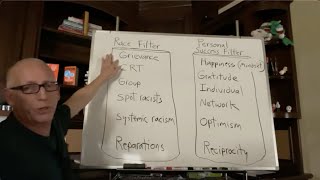
Scott Adams argues that conversations about race should focus on personal success tools like mindset, gratitude, and networking rather than systemic discrimination and grievances. He uses a Larry Elder anecdote about reciprocity to show how giving builds networks, and says teaching success tools will improve outcomes more than grievance-focused narratives.
Chapters
This is a micro lesson on race and how to reframe it to fix everything for everybody. And it goes like this. If you were to have a conversation about race, it would include, but not be limited to stuff like grievances for past discrimination. You talk about critical race theory. You talk about one group compared to another group. You'd look for racists because you want to spot the racist to know how to deal with that. You'd be looking at systemic racism and you'd be looking at maybe reparations. Now, this is not a complete list of all the things you'd be talking about, but it's sort of a representative list. If you're in the race conversation, it'd be this stuff. Now, I spend most of my time, and a lot of people don't know this, a lot of people don't know this, but I spent. For the past 10 years, I've been more noted for my work in personal success. The book behind me had failed. Almost everything was the entry to that domain for me. And that became, in my opinion, it's the most influential book on personal success. Other books on personal success refer to it. It's the most common way that people will give advice is directly out of things that I came up with in that book. Talking about talent stacks systems over goals, passion is, you know, BS, etc. But if I'm talking about personal success, I will be talking about keeping positive attitude, having the right mindset. I'll be talking about gratitude as a. As a superpower for success. I talk about the individual and how to network and have lots of contacts. I talk about keeping your optimism up because that really helps for success. And I would talk about reciprocity as an operating system. You do things for people, they'll do things for you. Maybe not directly, but eventually. Now, you might have already noticed something about these two lists that they're in conflict. For example, if you're looking at the grievances of the past, either with CRT or just generally, you're saying that there's discrimination and you've got to focus on the grievance part of it. That is the opposite of what somebody would do for success. If you're focused on personal success, you'd want to have a gratitude frame. But how can you have gratitude about slavery if you're a black American? How could you ever think, oh, that slavery worked out well? Of course not. Nobody could have that mindset. I'm not suggesting you should have that mindset. I'm saying that this is in direct conflict with the basic prem. The basic tools of success. But it goes deeper. Talking about a group doesn't help you at all. But talking about you as an individual and what you should do would help you a lot. Spotting racists is good to do. You want to be able to spot the racists and deal with them. But far more important to success would be open yourself to everybody. Have the most contacts you can have. Don't worry so much about what their personal thoughts are. Just make sure that everybody has a good opinion of you because. Because you've connected with them, you've done the right things, you've established your value. Networking. Big, big factor for success. Optimism. Almost everybody will tell you if they work in the field of personal success. Your mindset again, your happiness, your gratitude, your optimism, your own mindset things. If you get these things right, you will be very successful. And then the biggest one is reciprocity. It's the opposite of reparations. Reparations are, you did something bad for me. I've got a grievance I would like you to make good on that. Reciprocity says, I'm going to do something for you that you didn't ask for, and I'm going to do something for you that you didn't ask for. And you. And you just keep doing it. Eventually, somebody in that group is going to come back to you and say, all right, here's something you didn't ask for, but this could help you out. Let me give you a specific example of this. I have been refusing interviews on the question of my little drama that many of you know about. I didn't want to do an interview with anybody who was too friendly to my side or my point of view. So I've been turning down everybody who asked, and there's a lot of them, until I got a request from Larry Elder. Now, Larry Elder, I imagine because he's on the conservative side, that he would say, all right, what you're saying is important. Let's talk about it. Maybe it was taken out of context. Now, I know he will say something like that because he wrote an article that got a lot of play in which he seemed to have a full understanding of my situation. That was good for me. I mean, in other words, if you understood the situation, you would describe it in a way that doesn't make me look bad. So he wrote an article that was his actual opinion, I'm sure, and it was a positive for me. When Larry Elder asked me if I wanted to be on his podcast, what did I say? I Said some version of, damn it, Larry Elder, you magnificent bastard, you got me. I can't say no to that because I operate on a reciprocity operating system. Larry Elder also operates on a reciprocity operating system. Why did he write a good article about me? Well, partly because he believed it. I'm sure it's exactly what he thinks. But he might also remember that I endorsed him for governor when he ran in the recall election against Newsom. So I did something for him that he didn't ask for when I got in trouble. Not a surprise. He's not the only person who emerged to do something for me just because sometime in the past I'd done something for them. The reciprocity operating System is magic. It's what gets Larry Elder successful. In part. I'm sure that Larry, I'll bet you if you asked Larry Elder, just use him as an example. If you said, do you believe that this has helped you, the tools for success that I just described, what do you think he'd say? He would say yes. And I'm not reading his mind, because everybody who has his kind of success, which is quite notable, uses the same tools. And everybody who is not happy and not doing well are focusing on the past, focusing on grievances, focusing on what somebody else owes them, and focusing on how the system is going to prevent them from succeeding because it's all stacked against them. And so I propose to you that we reframe the issue so that we never forget the things in the race filter. That has to be part of history. We have to make sure that none of that is left out. Every bit of that needs to be taught. We need to understand that. I like my Black History Month. I like including history, plain and raw. But I like teaching black Americans and white Americans and every other kind of Americans that if they want to succeed, it's not about their obstacles, it's about their tools for success. If we can. If we can get people to understand that it's the people who make money selling the race filter, that's why it's on your head all the time. The reason we're all thinking about it all the time and it permeates everything we do, is because it's monetized. There are people who make a lot of money just selling this version of reality. They're not selling you personal success, nor do they say they are. That's not even something that they're pretending they're selling to you, Right? So just know what you're buying. If you're paying for this, you're going to get something that's a complete obstacle to personal success. If black Americans spend a generation working on personal success using the tools of that, they still have a lot of obstacles, right? Systemic racism is real, but they would slice through it like butter. And let me tell you, as someone who has hired people, a number of people, you know, in my life, if somebody comes in to talk to me and they exhibit an understanding of anything on the personal. The personal success list, they're hired. Well, I don't even care about qualifications at that point. If your mindset is on the success tools, you're going to do fine. That's an employee I want. If you walk in and I get a sniff, even a sniff, that your mindset is on the race filter and you're ignoring this personal success filter. I'm sorry, you are definitely not hired. Because if somebody comes in with the mindset that every expert, not just me, this is my personal opinion. Every expert would agree with the following statement. People who focus on personal success tools do well. People who focus on grievances do less well. And that, ladies and gentlemen, is the great reframe, the most useful thing anybody's done this year. If you're wondering why I was so provocative to get your attention, it's because of this. It's because we're doing everything wrong and it's making me crazy. So now that I have your attention, if you could just take it away from my personality for a moment and just spend a little time thinking about what do you want to teach your kids? Do you want to teach them how to succeed the way it works for everybody? Or do you want to teach them that they should focus on their grievances and have much less chance of success? And that is your micro lesson on reframing race.