Episode 41 - How to Fund the Wall and sorting out Iran
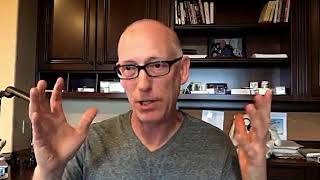
Scott Adams proposes framing border wall upgrades as 'the wall' so both sides claim victory, discusses Netanyahu's Iran presentation as visually persuasive but technically thin, and suggests expanding Iran talks into a multi-variable Middle East bargain including trade and Israel/Palestine issues.
Chapters
Hey, everybody, gather round. I figured out how to pay for the wall. I've got an idea. Come on in here and hear it. But before you do that, do you know what time it is? I think you do. It's time four. Coffee with Scott Adams. Mmm. Ah, that's the good stuff. That's the morning stuff. All right. Now, I've been watching Mike Pence. He's touring the border. Everybody's talking about the. The caravan. Everybody's talking about the. The folks who want to get in. And in this story that seemed to be about the caravan, we have a accidental solution for funding the wall. I might have to draw this on a whiteboard, but maybe I can do it without it. Here's the idea. So Mike Pence goes down there and he says, we are building the wall. Look at it. See my wall? And sure enough, you see them putting up the prototype wall that President Trump selected. So you say to yourself, there it is. They're putting up the wall. Now, CNN's correspondents will then talk about the project, but here's what they'll say. Will they say President Trump is building the wall? No, they do not. Because they don't want to say that. So instead they say, ha, ha ha. Let's bring in Dale to play the part of the CNN correspondent, Generically speaking. Yes. Well, Mike Pence says they're building the wall. They're not building the wall. That's not what was happening. That is not the wall. What that is, is something that was funded last year, in 2017, approved years ago, and is an upgrade. It's an upgrade to an existing fence. That, my friends, is not a wall. It's not a wall. The president loses. He gets nothing. He. He gets nothing seen. Now, do you see the opportunity yet? I spelled this out. I don't know, a year ago. I saw this coming. And I'm not sure if you see it yet, but here's the deal. As long as the administration is willing to call these upgrades the wall, they're building the wall. As long as the opposition team to the administration is willing to call them upgrades to existing fence, they're now funding the wall. So both sides can get exactly what they want for at least a few years. But here's the important part. So that alone isn't enough. You need one more concept layered on top of this. If you were going to upgrade your border security, where do you start? Do you start where there's already stuff, or do you start where there's not much of anything at all? Well, here's the thing, you probably start where there already is something. Why would that be? Why would you start where there already is some kind of barrier instead of starting where there's not much of anything? Does everybody know why you'd start where there already is something? It's because you already put something where you knew you needed it the most. So wherever it's easiest to get to, wherever people are just naturally because of population, transportation, just location, there are going to be some places that are a little more attractive for immigrants to try to get over there. Those places should already have some kind of a fence because it was a problem. So it's entirely possible that you could do a year or two of wall building and never get out of the upgrade zone because you do need a better wall where the bad walls are. So it seems to me that both sides could claim that they're successful. But here, and here's the fun part, you're going to have two forms of persuasion going here. So in theory, you could have the Trump administration saying, here's my wall. Look, I'm building it. It's right in front of you. Here's a picture of it. Here's a video of my wall. You can obviously see I am building the wall. Compare that to. His enemies will say, no, no you're not. You are simply upgrading and doing maintenance to an existing stretch of the border that was already, already fenced. But their persuasion is going to be a concept. So the people who are saying, that's no wall funding, that's just an upgrade to an existing wall. That's. There's no picture there, there's no visual that goes with that. So on one side you'll have a concept. People don't process concepts, you know, much. But on the other side, on the Trump side, you can have a picture of the actual frickin wall. Like you're gonna, you're gonna show the video. Look, there's the wall. So those two, those two forms of persuasion are not even close to equal. You know, the one with the visual is just the better one. Even though the other one is technically correct, it might be an upgrade. Anyway, you saw the news that Snoop Dogg's inebriated cousin did a little video in which he looked like he was trying to put down a hit using the grips on Kanye. Now I'm no expert on crypts or anything close to this topic. I don't know how much to worry about that. Do you, do you think that Kanye is literally in trouble? Now here's the other interesting thing you've got all these. Stick with me here for a moment. So you have these folks who don't like what Kanye is doing. And let's say they threaten him to the point where his. I assume he has bodyguards. So they threaten him to the point where he has to beef up his bodyguards. Do you know what somebody starts asking after Kanye beefs up his personal security? They could ask, are they armed? So the left is going to take the guy that they don't want to leave the left. It's like, Kanye, don't leave the left. Stay on the left. And they're going to force him to use guns to protect himself. He won't really have any choice. If you literally get threatened your life and it's, you know, it's a credible threat, you probably beef up your personal security a little bit. And they're not carrying nunchucks, they're carrying guns. So I assume. I mean, I'm just making an assumption that they would be. Let's talk about Iran and let's talk about Netanyahu's presentation. Many of you saw my periscope yesterday in which I talked about Netanyahu's persuasiveness for his presentation. I ranked it very high. I said it was an excellent presentation and very persuasive. It had visual, it had fear, it had repetition. It had all the points. It was very good. But do you remember what I said about it? And I said that he had sort of conflated two things. He had conflated what Iran had already done in the past with today. And even as I was describing it, I was starting to get confused about what is it that Iran is doing versus what is it that Iran did do but lied about it. Now, that's not trivial, that it's in the past. In this case, it's relevant because they had promised that they hadn't done it, and they did. So it was a sort of evidence of character, if you will. In this case, the past does matter because it's evidence of character. So it doesn't matter in the sense that the future would exactly match the past, but it tells you who you're dealing with a little bit. So that was an important confirmation of what we widely thought to be true. Now, if you're me, you probably thought, didn't we already know all of that? If you saw Netanyahu's presentation, were you surprised that Iran had a nuclear program and lied about it and said, we don't have anything like that? Well, I don't think so. I think we all knew that, right? The part that was new ish is that some of the individuals had been repurposed into dual purpose research sort of jobs where they could just keep going with their nuclear work. Again, how could I be surprised about that? Because they there probably does exist something close to legitimate nuclear research that isn't for weapons. And what else are those people going to do? If you lose your job as the boss of the secret nuclear weapons program, where do you take your skills? Well you're going to have to get a job doing something that uses those same skills. So you're going to be doing some non military research that's kind of similar to the military stuff. So nothing we heard was. And then the other thing we heard is that they kept all of their scientific data and records so that they could easily reconstitute. Is there anybody who didn't expect them to keep a file? I say a file. There were tons of files but they could be digitized and put on some kind of medium. Is there anybody who really thought that they would just sort of delete their data? Come on. There's nothing we saw about the Iranians reaction that should have been new really except that we saw it with a guaranteed, gave it an immediacy, gave it a visual, etc. So it changes how we think about it. But I can't say there was anything that surprised me exactly. Now the argument on I saw ex President Obama tweeted link to an article that said that it would be impossible to start up their nuclear program without getting caught because our ability to detect even the tiniest, tiniest trace of any nuclear activity is really good. They could clean out a facility weeks before we arrived to test it and we'd still know it was there because you just use this clean rag and you just wipe the surfaces and there's just nothing they can do to clean it all. So there doesn't seem to be much of a risk if we were to visit the right place. I don't know how big a risk it is that we wouldn't know what place to visit. But there wouldn't be much risk if they had gotten to the point of actually making a nuclear anything that we wouldn't know. But that doesn't change the fact that you could bring yourself up to that point. You can get all ready, you could be testing your rockets which were not covered in the deal. And that was another big point that Netanyahu made is that the rockets are still being tested. The ability to refine nuclear fuel, is that the right Word that sunsets in several years. So they could be right back online with nukes. But I don't know that. I just don't know how much of that is new. But it does change how we think about it. To see it so unambiguously, visually, so to have it all confirmed, it does feel different. All right, so what is it that would get us to a good solution there? Somebody says Mullows won't be there in two years. Yeah, I don't know if it's two years. So you've heard my at least preliminary idea of how to approach all this. And the preliminary idea, I have to give this a lot more thought because I don't know much about the area. But the preliminary idea is Iran is going to change no matter what we do because of the population bubble of young people who are pro Western. They're not so much pro their own government at the moment. And the current leaders are very old and can't be that healthy at this point. So something's going to change. And at the same time that something has to change in Iran no matter what, you know, there's going to be a big change ahead. They might as well change in a way that's productive, and maybe we can help make that productive. So I think we should work. We should be talking, talking past the sale. The sale is do they get to keep their current form of government? And I think we should just take that off the table, really. We're just talking about when either they change it quickly, they change it because of an internal coup, they change it because of demographics. It's going to change. So let's make it a productive change. Now, the big claim that. I don't know if it's the big one, but a big claim by Israel and the United States is that Iran is the biggest sponsor of terror. Can you name anything specifically? This is a trick question. So don't assume you know where this is going. Right. So let me just do a little poll for you. How many of you can name something that Iran did in the past five years that would qualify as terror, something that they sponsored? Now, you're going to give generic answers, right? Hamas. But is that the answer, that they're just sort of generically funding people we don't like? And those people being, let's say, Hezbollah, Hamas being anti Israel. So are they funding the organizations or are they funding the actual terrorist who fired blew something up? So don't. Chemical weapons. Yeah, they give weapons. We know they give weapons to Hezbollah. But is that what we're talking about when we say Iran is the biggest sponsor of terror. So to Netanyahu and to anybody in the United States government who wants to describe to the public what the problem is, the public has a gap. What exactly do you mean when you say they're the biggest state sponsor of terrorism? Because remember, we're talking about war, right? War is such a little word. I feel like I want that word to be like a longer word, because when you say it, it goes by too quickly. It doesn't give it enough power. We're talking about war, right? The highest of stakes war. And what does the public of the United States understand about the situation? Not a lot. We're not terribly educated on what's going on over there. So the gap I'd like to have filled in for me is what does it mean exactly to be the biggest sponsor of state terrorism? Does it mean funding organizations that themselves are attacking Israel? Is that the only thing it means? Does it mean things on the battlefield? Does it mean they're funding isis? Does it mean they're funding Al Qaeda? Because I think those guys are the enemies, right? I'm a little confused over there, because who knows who's fighting who at any moment. But I thought our traditional terrorists, ISIS and Al Qaeda, I thought Iran was opposed to them. Unless I'm wrong about that. But it could be. I could be wrong about that. Actually, you never know whose friend over there on any given day. How would you think he'd change if you knew exactly what was meant? Well, then I'd probably go to the next level. It probably isn't fair to speculate on that, but I'll do it anyway. If it was a question of funding in organizations, let's say Hezbollah, then you have something you can work with, because Hezbollah is an organization that. Because it's an organization, it has leadership and stuff. So you can deal with some entities. You know, you can negotiate with big organized entities. It's harder to negotiate with, say, onesie2z terrorists. It's hard to negotiate with. Let's say the accusation was Iran keeps funding little projects, little terrorism projects that are one off. It would be hard to do something with that. Like, how do you negotiate that? Because they just say, no, we didn't do that one, no, no, that wasn't us. So there's nobody to talk to. But if you have a big organization, Hamas, Hamas, Hezbollah, at least there's somebody to talk to. So it changes a little bit. Where's the problem? Knowing who to talk to is part of the Solution. Do I believe Prince Salman. How do you pronounce his name? Salman? Salman. Salman is the great reformer. Well, he's clearly a change agent and he is clearly intent on reforming. So how far that goes and whether all those reforms are in our favor remains to be seen. How far away are we from. I don't want to reveal my ignorance here. How many countries in the Middle east have recognized Israel? Help me out here on the fact checking. How many of the Middle east countries, if any, have recognized Israel? Yeah, I was thinking Jordan and Egypt were the only ones I could think of. Oh, all Ba'. Iran. Saudi Arabia has officially recognized Israel. That was the part I was wondering about, whether Saudi Arabia has. All right, so what I was wondering is, does Saudi Arabia have any large symbolic gestures left? If Saudi Arabia still has some large, let's say, peace gestures left, whether it's some kind of recognition situation or embassy situation with Israel, there might be a big surprise coming. You never know. So maybe Saudi. So we don't know the details whether Saudi Arabia, what their recognition situation is with Israel. This is the worst periscope ever because we don't know that fact. Somebody said Saudi will not recognize for religious reasons. I just don't know if we know the know the facts on here. I am next to a computer. All right, Par for the course on your scopes. So Saudi just opened direct flights, but it seems like there's probably more to go. I think there may be room, there might be room for a good solution in the Middle east when there never was before, but we'll see. Let me tell you what made. I think, Let me tie a couple concepts together. You know, I'm always talking about how you should not be a prisoner of the past because what happened in the past is rarely a perfect model for what you're dealing with in the present. We just think they look similar. So a lot of people are saying, hey, is North Korea going to look at the example of Libya and say we don't want to give our nuclear weapons away after all because we might get conquered? But here's what's different. North and South Korea are talking about unification. Libya wasn't talking about unification. So in North Korea's unique situation, if you combine denuclearizing with unification, then you probably have a verifiable endpoint because it's the unification itself that gives you all the access you need to the nuclear sites. That's completely different. Here's the important point. I believe the breakthrough thinking in North Korea probably went like this. If the Only thing you're talking about is denuclearization. You don't have enough variables. You just can't get there. If you add to denuclearization, unification. Now you've got all kinds of variables in play, and suddenly you can make something work. Because those two things work together so well. That's the key. The key is not that they wanted to denuke. The key is that they also wanted to work on reunification. Those two things work really well together. For confidence that you can get to an end point where everybody says, yeah, there's definitely no nukes here. You could walk over here and take a look. There's no fence. Just walk over here, take a look. No nukes over here. Now, that's different than a country that has borders and nobody can get in and the government can control who's where and all that stuff that's harder to control. Now take that thinking to the Middle East. If you say to yourself, this is important concept coming here. If we say to ourselves, the Iran nuclear question is just. The Iran nuclear question might be unsolvable because you don't have many variables to work with. You know, it's like, we want them not to be doing their missiles. Missiles are probably going to be the biggest issue. We want them not to be developing missiles. They want to develop missiles. There's just not enough variables. They want something, we don't want it. That's it. Now, maybe we could squeeze them enough, but that's a long, hard, risky process. But suppose instead of saying it's just about that one thing or two things, you know, missiles and nukes. Let's. Let's say we say it's about the Middle east, it's about Israel, it's about Hamas, it's about who's doing what in Syria. It's about all of it. It's about trade. What if we just keep adding variables, say it's not about the nukes, it's not about the missiles, it's about Israel, it's about Hamas, it's about the Palestinian situation. Then you throw enough variables in there. Suddenly there's a way to move things around. You've got options. Suddenly, and now you've got something you can deal with. So let me throw just that general concept into the mix that if all we're talking about is missiles and nukes in Iran, there are not many variables, and that's a tough sell. But if we broaden that to say, look, let's have a comprehensive something, we've got great partners in Jordan, Saudi Arabia, Israel, we have strong partners. If Russia gets on board, if maybe a couple other countries, maybe something big could happen. Maybe. The problem in the Middle east has always been we didn't think big enough. If you think about it, we always think there's some kind of peace plan in the Middle east is just so big we can't get there. But maybe the problem is we weren't thinking big enough. That was the problem in North Korea, wasn't it? If you think about it, and you don't have to go back far, you go back just a few months and you realize that the obstacle with North Korea. Wait for it. Is that we didn't think big enough. Because it's the thinking big enough that was the solution. If you're here and you're trying to get to here and all the really hard solutions are in the middle, just get rid of nukes, but stay un unified. The real solution was throw more variables in, go big in the Middle East. Who has ever made the offer of going big, of just going big, just doing something like that just changes the world. Who has that plan? I haven't seen it, and I'm not sure it's possible, but it would be. At least in our thinking. We should say that there might be a small solution that's just nukes and missiles in Iran, but maybe. But maybe there's a big one. A real big one. All right, that's enough for now. Traffic's going down and I'm going to take off and do something else right now. And all of you. Oh, somebody said, can you describe the golden age? Yes, I will. I do this often, but I'm going to do it as many times as people won't. The golden age, in my opinion, is when all the big stuff starts trending in the right direction. North Korea, Middle east, economy, immigration, everything. But the defining characteristic is that we'll realize our biggest problems were psychological. Just as North Korea was a problem that looks like we're going to solve just by thinking about it differently, the way we think about it might be the only thing that had to be changed. I think the Middle east is a psychology problem. The economy is a psychology problem. Even immigration is a psychology problem. To some extent. There are real people who have real problems, but whether they come here or whether they stay is partly economics, partly, but partly psychology. So you have the best psychology engineer that the world has ever seen. Perhaps I haven't been around that long in the world, but in my lifetime, the best psychology engineer, the best persuader, is Trump, and he's coming into a world where those are the biggest problems. Psychology. Once we realize that, a lot of things that seemed like barriers might start to fall. I think Kanye is, weirdly enough, an important part of how that thinking is changing. Because if you see enough things you didn't think possible happen, then your thought about the next thing being possible just changes. So it's like, well, I didn't think those other things were possible. And they happened. Yeah. I didn't see North Korea coming. I didn't see Kanye coming. Maybe Iran's possible. Maybe we can make something happen. So the golden age is that. And I will leave you with that thought, and I will talk to you later.
More from Scott

The Scott Adams School - 10/14/26 The Chicks and Joel Pollack Stops By. Scott & Persuasion


The Scott Adams School - 10/09/26 AKIRA.. TAKE TWO! Fri Yay! With the Home Team



The Scott Adams School - 10/06/26 Erica & Marcela Talk France. Venezuela. Scott Adams. and More


The Scott Adams School - 10/02/26 Fri-Yay!! The Home Team closes out another amazing week.


The Scott Adams School - 09/30/26 WHITEBOARD! AI Luncheon. FRAUD. MIKE ROWE, Happiness!