Episode 81 - How to Spot Cognitive Dissonance
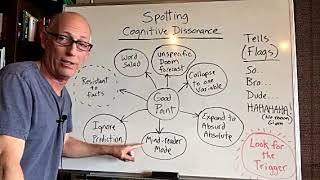
Scott Adams (Episode 81, June 14, 2018) gives a live whiteboard talk defining cognitive dissonance and teaching heuristics to spot it in oneself and others. He lists observable 'tells'—single-variable explanations, expanding reasonable points into absurd extremes, mind-reading attributions, ignoring failed predictions, word-salad responses, vague doom forecasts, rhetorical starts like 'so...', and dismissive 'ahah' replies—and ties these to examples involving public figures (e.g., Kanye West, Donald Trump) and major events (2016 election). He emphasizes the role of triggers (being proven wrong) and recommends using predictive success as a practical way to judge which ‘movie’ better models reality.
Chapters
Hey, everybody, get in here. It's time for a whiteboard talk in which I will teach you the secret master persuader techniques for discovering cognitive distance. Identifying it, spotting it, knowing when it's happening, knowing when it's happening to you, and better yet, knowing when it's happening to other people. So as soon as we hit a thousand, I'm going to launch into it. Now it looks like we'll be there in a minute. So if you're not familiar with what cognitive dissonance is, it's what happens to a human. And I'm talking about all humans. You, me, everybody normal. When there's something that they were sure was true, either about the world or about themselves, that is shown to be absolutely, completely not true. So when you think something's true and then you find out you're totally wrong, people tend not to say, oh, I must be stupid, and I just didn't realize it until now. People don't do that. Instead, they rewrite the movie to make the facts that just disprove their old thinking. They rewrite those facts in their minds to not be true, or to come from a source that is incredible, or to not really mean what you think they mean, or to be part of a different context. So cognitive dissonance is when somebody goes from relatively rational thinking. We humans don't get there very well, but relatively to flat out just scrambled. And it can last a little while or a long time, and it can happen to everybody. But here's the hard part. If you're the one who's experiencing it, you can't tell. And if you're trying to identify it in somebody else, lots of times you can't tell that either because it might be you. So the fact that you and another person are having incredibly different movies while looking at the same facts doesn't mean the other person's experiencing cognitive dissonance. And you can't even put a best bet on it because it might be you. And the odds are just as good if you don't know anything else about the situation. So I'm going to take you to the next level. Your awareness of your reality will likely change in the next 20 minutes. Not a lot, but a little bit. All right, I'm going to show you how easy it is to spot cognitive dissonance. Not every time, not 100% of the time. It's not that sort of thing, but I can get you pretty close, maybe 80% if you're good, maybe better. It's impossible to measure, but it feels like it feels like you can get pretty close. So now you know what cognitive dissonance is. Let me show you what clues to look for, both in yourself as well as in other people. So these are clues that you can identify in yourself to know if you're the one experiencing essentially an illusion or is it the other person. So let's say just for the thought experiment, that a good point is made. Now, I know everybody has a different opinion of what a good point is, but for this discussion, let's just accept that the point is good. All right, so somebody makes a good point. Let me use an example. Let's say Kanye west says, gee, maybe we should, you know, free our thinking, you know, think out of the box. That's about as good a point as anybody could make about anything. It's so unambiguously a good idea that it's hard to imagine who could complain. But you saw people doing this, they would collapse it to one variable. And you heard this, they would say, ah, Kanye, he's just crazy. Just one variable, he's just crazy. That explains it all. Or they might say, he's just trying to sell records, one variable. But what you did not often hear is somebody saying, you know, I think Kanye's a little crazy. It is a good way to sell records too. But he has a good point and I think maybe he's trying to make the world better. If you hear somebody go through all the variables, they're probably not in cognitive dissonance, but if somebody fixates on one that doesn't tell you they're in cognitive dissonance, it's just your first flag, it's a little clue. And you should say, huh, I wonder if it really is a one variable situation. Because there are one variable situations that can happen, but it's a clue. So you see that your radar should turn on. Likewise, if you see somebody expand your perfectly good point to an absurd absolute, that's almost always a tell for cognitive dissonance. Let me give you an example. Suppose you say, you know, I think, suppose Kanye says, I think we should be more open in our thinking. Let's try to think in new ways to maybe find new solutions. Perfectly reasonable thing to say again about anything. And imagine somebody listens to that and they go, yeah, now you're going to let children drive cars. Yeah, that's free thinking. Why don't we let a three year old drive a car, Kanye. So if somebody takes a perfectly reasonable suggestion to be creative in your thinking and it turns into, yeah, sure, three year olds Driving cars. That's some free thinking right there. That's a tell for cognitive distance. This one's pretty solid. You see this one? You usually don't have to look much further, but it helps. So the more clues that you find, the more likely you are correctly identifying cognitive dissonance. Again, it's not a hundred percent situation. I was tweeting about this today, what I call the mind reader hallucination. When somebody takes your point and then says, yeah, what you're really thinking is, or the real reason you're doing that is I know your secret intentions. Sometimes they're right. Sometimes. But this one should be a big flag. A big flag. And the reason is that we think we're good at knowing people's intentions, but we're terrible at it. Have you ever been in a relationship? You know what I'm talking about, right? Your biggest fights with whoever you're in a relationship with about misunderstanding what they were thinking. It's the biggest, most common hallucination we have, is that we can read somebody's mind. We're terrible at it. Terrible. So if you see it happening, somebody has left rational thought. That doesn't mean they're wrong. Sometimes you do know what people are thinking. And if. And if you're judging it by their actions, then you're probably pretty close. So, for example, if somebody takes a knife and stabs somebody else a thousand times and you say, I think he meant to kill the person, well, you know, that's not really mind reading, because that's more like a description of what just happened. So we're all doing a little mind reading. It's not an absolute thing. But if you see somebody doing some just pure mind reading, that doesn't seem connected to the actions that are being observed, that's a tell. Here's my favorite one, which is ignoring prediction. So you remember that early on in 2015, people were saying that Trump fella, he's a big old Hitler, and if he gets elected, he's going to create concentration camps and put all the gay people in there or whatever people were saying. I was saying, no, he's just really persuasive, and I think he'll make the economy hum and he'll do a good job with things like North Korea. So my prediction came exactly true. Other people's predictions were completely wrong. If that doesn't give you pause to at least question your filter on life, you might be in cognitive dissonance. All right, if my predictions suddenly stop working and you see me stick with my same Explanation of reality. You know, I've been predicting now in public for two years better than anybody probably has ever predicted anything. That's a big statement, but I can't think of anybody who's predicted better than I have for the past two years. They might exist. I just can't think of any. All right, here's another tell for cognitive dissonance, the word salad. The word salad are arguments that have a lot of words. They're often bigger words than you need. They seem to be too many of them. They're kind of conceptual. And when you're done reading it, you say, okay, okay, okay, what? I'm not even sure what that meant. You have to reread it. It's like all these words make sense in the sense that the sentence makes sense, but I don't know what this is saying. So you see that. And of course, again, this is a bit of a judgment call. You might be the one experiencing the cognitive dissonance, and your cognitive dissonance might be what's preventing you from seeing a perfectly good argument. So this one is not a confirmation by itself. But if you see it, it's another reason to suspect there's something going on. All right, now, you might want to check your own argument to see how many words you're using and how big they are and whether you got real conceptual. That might be a clue, too. Then there's the unspecific doom forecast. The person who says, well, if this. Whatever we're talking about, whatever the topic is, if this keeps going the way it's going, it could tear apart the fabric of civilization and we'll be living in a more coarsened world. What? But does it hurt? You know, I sort of understand what you're saying, but did that make me lose money? Did it hurt? Could I not find love in this world? I don't exactly know what the problem is, even though I understand all the words. So when you see these unspecific, generic, conceptual doom forecasts, that might be cognitive dissonance. For example, Donald Trump talking the way he does might turn us all into more coarse individuals. I don't know. Maybe. What's that look like? How could individuals be more coarse than they were before we were ever talking about a President Trump? In what world did people start out being pretty nice, and then suddenly Trump came on board and, well, everything went to hell after that. We started being mean on social media just the day he announced the. That didn't happen. All right, so in addition to these, look for these verbal tells when you see a sentence from your debating opponent that starts with the word so, so you're saying, chances are that whatever comes at the end of that sentence is not what you're saying. It's probably one of these, these absurd absolutes. So people will broadcast their cognitive dissonance with this word. So what you're saying is babies should be able to drive cars. So that's a tell. You see also bro and dude, where some people say, you know, clearly you're not thinking bro or something dude. And here's the thing, it's not that people don't use these anyway. So, you know, you could get lots of false positives with bro and dude, but if there's nothing else and the bro or the dude seem to be the active part of the sentence, you know, if the entire sentence seems to be crafted around the importance of the word bro or dude, as opposed to, say, pointing out a mistake you made or mentioning a fact that might make you think differently. But if bro or dude are sort of the focus of the point or the tweet or the sentence that might be telling you something, here's the other one. You know, somebody will say something reasonable, let's call that the good point, and you'll see a tweet that goes, ha, Hahaha. And. No reason. You left out the reason. You'll see me tweet. Quite often to that sort of thing, I go, you left out the reason. Even in the constraints of a tweet, you could certainly say essentially what the reason is. Even if you're wrong, you might say, well, I think you got your facts wrong. Or you might say you're lying. Or maybe you should study this or consider this context. You know, it doesn't take much space to put. Put a little meat on your objections. But if somebody comes at you with the ahah, that's a really strong tell for cognitive dissonance. But let's say you've looked at all this and you're saying to yourself, you know, still, I'm not totally sure if it's the other person or me. I know we're living in different movies, but I can't tell which one's the real one, or at least the one that does the best job of predicting. If you've seen my other work, you know that I don't think in terms of a true reality, although such a thing must exist. Otherwise, if there were not a base reality, I couldn't exist to ask the question, but my filter on life so says that we're all sort of creating our own subjective experience around that base reality that we don't have access to. Our brains did not evolve to the point where we even really needed to understand it. A clam survives, a dog survives. They don't know too much about the reality. It's very unlikely that we humans happen to be alive at exactly the time after 15 billion years, that we finally figured out the true meaning of reality. Well, maybe it's not impossible, but it's pretty unlikely, given that every generation before us thought they understood the nature of what was happening here. And they were pretty wrong. Chances are we're wrong, too, in a different but similar way. All right, so my point is that we don't know what's true, but we can tell what predicts better. I've been saying that the master persuader, or the persuasion filter, as I call it, looking at the world as irrational actors who are moved by persuasion as opposed to being moved by reason. In fact, I'm saying that that filter on life, the persuasion filter, is the most predictive. Not saying. I'm not saying that it is base reality, because I don't think I can see that. But I also don't think you can see it. All right, so the best you can do to figure out who's in the bigger hallucination, the one that doesn't predict, is to look for the trigger. You don't really get cognitive dissonance unless there was something you believe to be true that has been shown for sure to be untrue. So you look to see, who did that happen to? Here's an example. The day after elections, November 9, 2016, my world was completely consistent. I predicted exactly what happened. President Trump would win. And then I went on to predict that the economy would do well, ISIS would be defeated, we'd be talking to North Korea productively. So my world has no triggers in it. Everything I thought to be true and said publicly and often has happened. So it would be very unlikely that I got triggered because there was no trigger that I can identify. But for those people who are talking crazy talk on social media, you know who they are, they had a trigger. Everything they thought they understood about their own intelligence, they. Their own ability to see what's happening, their own capability to predict. All destroyed, just obliterated. That's a trigger. That's a big trigger. It's the biggest trigger we've ever seen. We have another one coming. If North Korea goes well, you're going to see the second biggest trigger for cognitive dissonance, probably that this country has ever seen. And I also predicted, and I think some of you have been with me from the start, you know, that I predicted on election night 2016 that it was going to trigger a sort of mass insanity. By the way, can somebody confirm that? Is there anybody here who was following me? Yeah. Okay, we have some confirmation. So I said that clearly and a number of times and publicly, this is going to trigger a type of insanity. And I told you it would be bigger than any you'd seen before. Both true. Right. What we're experiencing now is a bigger form of mass insanity than we've ever seen before. Nothing like it, really. We've got another one maybe coming. We can't predict for sure that North Korea will go well, but I think it will. And when that happens, it's going to happen again. People's minds are going to be just splattered. I also predicted that President Trump would open a tear in the fabric of reality so that you could see through, through that little, you know, through the curtain and you could see what's a more predictive reality. And here it is. This is what I've been waiting for years to tell you, but until you lived through this last few years, you weren't ready. You weren't ready for this. You had to live it right. Once you've lived it, now you can hear it. So this is the sort of stuff that was just trapped in my head because I could tell you this all day long. Three years ago, you wouldn't be on this periscope. You would have bailed down a long time ago with what? What's all that? I don't know. All right, so that is all I needed to say on this topic. How was this? Give me some feedback and let me know if this was useful to you, and I'll stay and just read your comments for a moment and see how this looks. Yeah. Somebody else is saying, if Mueller doesn't indict, and I assume you're talking about President Trump, will that be another big trigger? And the answer is yes, and people will explain that away with things. Such as, well, he probably was guilty, but people didn't want to catch him for whatever reason, or he probably is guilty, but they just didn't get the right, you know, didn't get the right information on him or, you know, he bought somebody off or, you know, you'll see that. Oh, somebody said, what is a major cognitive dissonance coming for Trump supporters? I have to think about that. You know, it is less likely that Trump, That Trump supporters will be the recipients of a big trigger like that simply because you don't have many characters who can change reality so effectively as President Trump. So if you're, if you were pro Trump, you're watching him change reality the way you expected him, creating lots of triggers on the other side because they don't expect it. I can't think of an example where there's somebody on, you know, say, on the left who is actively changing reality right in front of us. If I could think of an example of that, then I could predict that we might get triggered. Does reading your latest book teach any of this? Yes, actually, most of this is described in my book, Win Bigley, but I don't have a chart like this. So this is the part that I thought I could bring to it is actually charting it. And I think I have a little less detail in the book about some of the circles. But I do talk about the tells. I talk about the trigger. I talk about cognitive dissonance. That's actually the, the main lesson of the book is, is this stuff. But I, I think I did a better job of compressing it for the periscope than I. All right. I think I've seen all the comments I need, so thanks for tuning in, and I hope this was useful.
More from Scott

The Scott Adams School - 10/14/26 The Chicks and Joel Pollack Stops By. Scott & Persuasion


The Scott Adams School - 10/09/26 AKIRA.. TAKE TWO! Fri Yay! With the Home Team



The Scott Adams School - 10/06/26 Erica & Marcela Talk France. Venezuela. Scott Adams. and More


The Scott Adams School - 10/02/26 Fri-Yay!! The Home Team closes out another amazing week.


The Scott Adams School - 09/30/26 WHITEBOARD! AI Luncheon. FRAUD. MIKE ROWE, Happiness!