Episode 88 - Donovan Loomis in South Korea
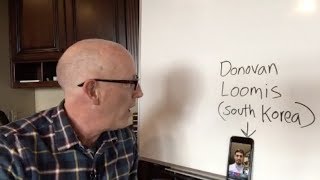
A June 14, 2018 YouTube interview where Scott Adams talks with Donovan Loomis, an American who has lived in South Korea about 10 years and coaches English to business professionals. Loomis describes high nationwide internet connectivity, low personal healthcare costs (reports paying about $75/month), some tax details (mentions ~3.3% base bracket and a flat 17% foreigner option past a threshold), higher housing costs, and that foreigners represent roughly 2.5% of the population. He reports broad optimism about denuclearization and possible reunification (liberal segments optimistic; conservatives skeptical), concerns among young people about unemployment and the cost of reunification, cultural/language differences (Konglish vs. North Korean terminology), measurable height/nutrition gaps, and that Otto Warmbier’s case—while tragic—is not a persistent major public story in South Korea. The interview captures pragmatic South Korean views of President Trump (criticized on trade but credited for progress on Korean issues) and notes that political prisoners are viewed as bargaining chips by the North.
Questions this video answers
June 14, 2018
About 10 years
Approximately $75 per month
Base bracket mentioned about 3.3%; foreigners can opt to stop at a flat 17% once over a certain amount
About 2.5% of the total population
Chapters
Hey, everybody, come on in here. Today we've got a very special periscope. I'll tell you about it in a minute as soon as we get some. Some folks in here. Let's try to not talk about Roseanne Barr today if we can. Today we're going to be talking about South Korea. Primarily, we're using the OneHub Interface app. And over my left shoulder is Donovan Loomis, who's in South Korea and has been in South Korea for about 10 years and is coaching English to business folks. We're going to talk to Donovan about what the mood is. What's the feeling in South Korea here, Learn what we can on the ground. And so as soon as we hit 1000, which is going to happen right about now. Close enough. I would like to introduce Donovan Loomis in South Korea right now for the past 10 years. And Donovan, say hi.
Hey, Scott. Hey, everyone. Welcome to South Korea via interface.
Yeah, so we've got a super connection now. Is it true that the WI fi in or just the Internet speed in South Korea is just amazing compared to the United States? Is that true?
It is torture going home for Christmas torture. How do you guys survive over there?
Yes. So it's hard to believe. It's hard.
It's amazing. Everywhere you go, even on some remote mountain, you can get great WI fi. You can get free WI fi pretty much almost anywhere you go. Korea is a very connected nation. I mean, we probably have the most smartphone ownership per capita in the world. We're just a tech place.
And more generally, would you say that living in South Korea is a higher end experience beyond just the technology? There are people experiencing just a higher quality of life or no America.
Well, let me give you a personal example from my life 10 years ago, before I came to Korea, I was diagnosed with Lyme disease and I received treatment while I was working and studying in South Korea. I could not have afforded that treatment in America. My family would have gone broke. But with my meager student salary and the little earnings I have from teaching English and the amazing health care that is offered here for Koreans as well as for foreigners like myself who have a visa is great.
And you pay nothing for the healthcare or just it's low cost?
Pretty low cost. So to kind of give you an idea, I pay about $75 a month for healthcare. That means I pay significantly reduced hospital costs, almost nothing for medical fees and surgeries and. Or medicine. To give you an example, one medicine in the state.
Yeah. Okay. I was just gonna. Before we go, too Far on medicine. I wanted to ask you, what are the tax rates like? So the average taxes, are they more or less than in the US or comparable?
You're going to have less taxes? My tax bracket is about 3.3%. And then based on the income, it'll go up and ramp up. Foreigners have a chance to stop at a flat 17. Once you get over a certain amount, that's it.
So you're living in a country with better technology than the US Better health care, and substantially lower taxes. Is that true? That's all true, right?
Yes. Wow. I would say, though, that we do have higher housing costs than you do have in the state.
Housing costs are higher. Okay. There's always something, right?
Yeah.
All right, so let's talk. Let's. Let's talk about the mood over there. I'm sure you're interacting, especially because your job, you interact with quite a few South Koreans in a casual way. What do they say about what's going on right now with North Korea, South Korea talking? What's the mood?
I think overall, there's quite a positive mood in Korea, something that honestly I haven't seen in the 10 years that I've been here. Of course, conservative liberal groups over here have a slightly different perspective on that. But I think the general consensus is we're moving to peace, we're moving to denuclearization, we're moving to reunification. You know, there's a lot of progress, and people, you know, have quite high hopes that this year or within the next year, Moon and Trump and Kim can resolve things.
Now, do the South Koreans believe that North Korea is serious and genuine about denuclearizing? Do they think it's a trick or do they think, no, everything we've seen looks like it's real? Which of those do they generally feel?
Okay, if you're looking at the conservative media, their coverage and their perspective is a good reflection of what's happening in America. At the same time, you know, don't trust him. He's not going to give up his nukes. This isn't legit. He's just going to trick us. There's kind of a little bit of a negative perspective on what's going on. But then again, the conservative party does. Their main role is kind of being that whole war that goes on, the whole North Korea thing. So that's kind of their perspective. On the liberal side, they're very positive about what's happening. They truly believe that reunification will be happening. I will say that generally, the overall mood is this is Legitimate. We just need to figure things out. Trump and Kim just need to sit down, talk things out, and we'll get to where we need to go.
I'm seeing a question go by about the diversity in South Korea. Is it. Is South Korea, with the exception of you and a few foreigners there who are there? Not as citizens, I assume. Is it mostly South Korea? Is it just mostly South Koreans?
Yeah, foreigners, including myself and a variety of different expats. We only make up about two and a half percent of the total population in South Korea.
Okay, and what is the. Are there any prejudices against North Koreans by the South Koreans now, given they have very little contact? Of course. But do they have a negative feeling about the fact that they may be opening up a border and they're going to be dealing with a lot of North Koreans pretty soon? Maybe, if things go well.
Well, let me kind of start from the easy answer. Generally speaking, young people kind of have a little bit of a negative feeling about reunification because there's the assumption that South Korea is going to have to foot the bill. And right now, unemployment among young people is at a very critical high. So you have a lot of young people who aren't able to get opportunity, and they're kind of like, hey, why should we pay, you know, for them?
All right, let me stop here. Why can't young people get opportunity? The economy is terrific. Right.
The economy may be appearing to do well, but for, I'd say the last five years, unemployment, especially for young people, has continued to rise. People have tried to explain it, but so far no one has really found a solution for it or really can't explain why young people have a hard time getting work.
That's interesting. All right, so getting back to how they feel about.
If we're talking in that kind of reunification complex, I think people are kind of concerned about how that's going to work out. If we're talking about North Korean refugees from the government, they get quite a bit of assistance and support, but they do face some discrimination in employment and in general, life living in South Korea.
Okay. Is the thought in South Korea, we don't know how any kind of a deal will turn out, but is the thought that this thing called reunification is something that could happen, at least in historical terms, relatively quickly, or something that might have to be spread out over a long period to make sure there's not too much shock to the system?
Yeah. I think as a nation, Korea really is looking forward to reunification. I think people, generally speaking, want a little bit of a slower transition to that, because, honestly, no one really knows what that's going to look like, how they're going to achieve it, and how much it's going to cost. But overall, people want it.
And are there people in South Korea saying, gosh, I can't wait to visit North Korea, either for tourist reasons or just interest?
Oh, yeah, oh, yeah. Me and my girl were just talking about we can't wait to go to the capital to have Pyongyang noodles.
But there's mostly sort of a curiosity, travel element to it. Right?
It's.
But people have a positive feeling about going to visit.
Well, curiosity, but I think there's also this kind of sense of loss, of grief, of kind of being divorced or separated from your sister nation pretty much by ideology for a long time. So there's a lot of people who are kind of, I think, not quite coming back home, but kind of creating a home together. There's this nostalgia, this kind of very kind of emotional mood around, you know, not only for curiosity, but just kind of like we're back together.
Somebody just asked an interesting question that went by the the two Koreas have been separated for so long. Is there a language difference that's starting to express itself, or wouldn't you know yet? Is it too early?
Yes. South Koreans are very quick to pick up on North Korean accents. What's really different is Korea has adopted a lot of loan words from English Konglish. It's, you know, words like, you know, computer becomes computer. You know, there's a lot of English Korean words that have crept into the South Korean language. Whereas North Korea has created unique Korean words for computer. It has some other different name. So there are some language differences, but, you know, and I think that little cultural differences as well that have been created by that gap.
Now, I've also heard some speculation that there might be a substantial height difference that is developed because of nutritional differences. Is that real?
Yes, that is real.
Wow.
Even South Koreans before, after the famine, very low height, after progress, incredible advances in height and health since then.
And do you think that the South Koreans are going to have something like just a prejudice or discrimination problem with the North Koreans, or are they going to say, thank goodness we're all together again and that's the end of it?
That's a pretty loaded question, honestly. I think it will depend on how reunification occurs. If South Koreans have to foot the bill, then we're probably going to see some negative perspectives if they don't have to foot the bill and they benefit as well from investment, from the world, then I think you're going to see mostly positive interactions between the two Koreas.
Now you deal with mostly business people. Is that true?
Yes. I'd say about 80% of my business is CEOs, entrepreneurs, office workers, and the rest are college students or parents of children who attend international school.
Would you say that the business people are showing interest in maybe investing in North Korea? Or do they think. Because I worry that that's just something that the politicians are talking about and the business people are like, I wouldn't touch it, or are they saying, yeah, let me in there.
I think right now the pharmaceutical companies would be. That's something easy for them to invest in because they don't actually have to have a plant over there. They can just ship their product. Other companies that do manufacturing, I've talked with them and they said we're not actually sure what opportunities exist for us over there yet. We wouldn't really know until peace and denuclearization and all of that's really sorted how we could really benefit from that. So certain industries like construction and transportation stand a chance to gain. But your average business person, from my perspective, is kind of like, oh, there's an opportunity, but I'm not really sure what that's going to be.
In terms of reunification, is this the first time that the folks you talk to have ever thought it could happen in their lifetime? Or have they, or have they been teased before not just about denuclearization, but about reunification? How unique is that conversation?
You know, honestly, this is the first time in 10 years that I've heard people talk about it as if it could be reality. You know, the illusion of unification, the illusion of peace has just been floated by so many times that there's quite a healthy amount of skepticism. But something about the Trump, Moon, Kim mix is unlike anything anybody has ever seen and probably will ever see. Yeah, so actually a lot of the people I've talked to, they kind of attribute this once in a lifetime opportunity to the immersion of Trump, Moon and Kim at this kind of unique point in time.
That's a perfect question. I'm seeing some the commenters prompting me to ask that question. So first tell me the South Korean feeling about President Trump and then I'll expand on that a little bit. What's the general feeling about him?
Okay, if we're talking about trade, South Koreans in general kind of feeling like he's being a little bit unfair and kind of just pushing them too much, especially when they're trying to do the whole north and South Korean piece. At the same time, if we're talking only about north and South Korea, generally speaking, my clients, people I've talked to, have been very supportive and very kind of, how should I say? He's doing good stuff. We kind of think he's a little bit over the top in some ways, but he's getting the job done, a job that has never been able to be done. So, you know, hat off to him, kind of.
So they. Do they interpret this as something he is uniquely qualified for, or do they think it's just sort of the right time and he's not breaking anything? Do they think he's making it happen, or he just happened to be there and he hasn't ruined it yet?
He's making it happen. Yeah. Okay, that's. Let me give you a good view of how people understand it here as opposed to in the US So, remember when Trump walked away and the whole world was like, oh, my God, that same day, you know, I'm talking with my clients, they're like, you know, did they say that? This is exact words. He wrote the book the Art of the Deal. He is doing exactly what he said he would do. He's doing what's in his book. You know, like, this is business. You know, this is exactly what would happen in a normal business setting. So why would I be worried?
Right? So the people who have a business filter on the world saw it for exactly what it was, and people who maybe are less experienced in negotiating for a living saw it as a little bit more of a risk. I think that would be true here as well. Now, you've been there for a long time, so you may not. I know you're following American politics to some degree. Well, let me ask that question. To what degree do you follow American politics while you're over there?
Let's just say until Trump came along, nothing was interesting.
Yeah, that's true. All right.
Korea's my home. We have enough political intrigue. I mean, we've had some amazing mind blowing political stuff happen in the last couple years that is entertaining, but honestly, us stuff. This is my home. Nothing was interesting until Trump came along and kind of turned the world upside down. But I think specifically because this is the first time in 10 years that I've seen a legitimate opportunity for peace.
Now, over here, the reason I asked that setup question is that over here, probably 50%, modestly, 50% of all the news about President Trump, is one side accusing him of being a racist. Does that accusation mean anything in South Korea or do they just ignore it or do they say, well, I don't care if he is or not, it doesn't affect us. How do they process that accusation?
I've seen 10 times more articles talking about Trump on trade than I've seen on race. Like I can maybe count them on one hand. How many times that's come up and like, as like a big headline story, not as some kind of like sideline note, you know, hidden in the back. It's not really on people's radar.
Okay, so they're, they're not in South Korea, presumably. They're not consuming a non stop diet of anti Trump media. Or are they?
You've talked about how the US Is having two movies playing, right?
Yes.
So I'm going to extend that metaphor. South Korea and us are in completely different movies. What's important to you? What's important to us? How we're seeing the world. How you're seeing the world. We're on completely different movie sets here. So what's important to us? North Korea. Safety, security. Not getting wiped off the face of the map. Healthy trade between us and Korea. Job, employment. This is what matters to us. What matters to you guys over there is important, but it's very different than what matters to us over here.
All right, how was the mood when the conversation between Trump and Kim was more bellicose and they were insulting each other? There was real fear in South Korea, was there not?
I would say that that was the only time in 10 years that I was worried about being in South Korea. And that was, I think, the only time that I could feel, you know, because here's the thing. For the last 10 years, every month we heard from North Korea that we're going to be destroyed in a great lake of fire. Every month. That's not new. Until Trump borrowing that. And then it's like, okay, stuff could get real really quick here. So I would say briefly during that time, there was kind of like, okay, Trump. Okay, well, we're pretty close to the border here. You can back off a little. But that was for a very short amount of time.
Yeah. You didn't mind the continuous reminders that you were going to be destroyed in a lake of fire. But as soon as they said dotard, things got real. I hear what you're saying. I understand what you're saying.
California always has a newspaper article every year about how Bakersfield is going to be beachfront property after the next big earthquake. Okay. We get that article every week. You ignore it, it's nothing. It's not important.
Now, let me ask you about the rhetoric. So Kim Jong Un speaks in a way that we're used to only seeing from a President Trump, frankly. It's a style of over the top rhetoric that is not common. Does his rhetoric sound. I'm talking about Kim Jong Un. Does his rhetoric sound over the top to South Koreans? Or is there a style in which that's normal for at least politicians? Is it normal for anybody?
Okay, big difference between North Korean politician and South Korean politician. You know, American media freaks out whenever North Korean politicians say something, but they've been saying the exact same phrases, the exact same words, the exact same threats for the last 60 years in the exact same way. Nothing has changed. It's a cycle. It's beautiful. I mean, works, you know, it's just the way it is.
And the North Koreans, we presume, you know, if reunification happened, would you expect the average North Korean who is not a political person to speak with hyperbole? Or do you think it's probably just limited to the Kims and how they talk and how they have talked for generations?
Oh, there's no possible way I can comment on that. I mean, without having really. I've only met one North Korean refugee in my 10 years here, and even then that conversation was very short. So I couldn't tell you what a normal North Korean would speak like in your.
In your normal. Your short conversation with the North Korean defector. I assume that he's got to be a defector, right?
Yeah.
Did you say, the weather looks warm today? And he said, I think we're going to die in a ball of fire. Nothing like that happened.
Right.
So I think I answered that question. So you see general optimism, but the people on the right are saying, well, don't trust them. You've seen the actual Korean language statements coming out of North Korea. And one of the things that I keep being concerned about, as I think plenty of people are concerned about, is that Kim has said things like, I totally want to get rid of my nuclear weapons, and everybody goes, yay. And then he adds sort of in an afterthought, yeah, when the rest of the world gets rid of nuclear weapons, I'm on. I'm on board. So in other words, he says it and then he takes it away in the second part of the sentence. When you read the actual Korean language statements from Kim Jong Un, is he taking it away in the second part of the statement, or is he saying in very clear language, I do want to get rid of these and the rest of you don't have to get rid of yours. Do you have a take on that?
Okay, first of all, there really is not that many direct quotes from him. The majority of what you're hearing is third party information, such as this is what President Moon told this person who told this person who released it to the media. So who knows how many variations we're getting from the. Like his own words that I heard from that Panjimun announcement, when you look at it in Korean, it says committed to denuclearization of the Korean of the two Koreas. So it's specifically talking about denuclearization of the two Koreas. There is no way that this could refer to the world, the US or China or anywhere else like that. I do not know if he has said that privately with President Moon or with representatives or to a US Representative, but I even had my girlfriend check news for me to confirm. There has not been that quote of the whole world. But one thing to think about is US has bases here. And some of those bases may house ships or aircraft that can carry nuclear weapons. You know, Korea also has nuclear power plants here. So this may be Kim's way of assuring that there is nothing nuclear that comes close to Korean Peninsula for his and regime's safety act. That is just me. I can't get into his head. That's just my personal opinion. But yeah, it refers to the Korea's denuclearization, not the world. At least what I read and heard.
Okay, and is there a feeling that in South Korea, do people think that Kim Jong Un. Well, I guess you answered this question. The people on the right don't trust him. The people on the left are optimistic. What else do you think we should know about the mood there in South Korea? Have I hit the high points?
I think one thing I kind of wish Americans would know about north and South Korea is just kind of like, chill about this. The rhetoric, the threats, what could happen. This is something that we live with every day. It has the potential to be serious. But, you know, like, you've noticed, like up until you started periscoping about Kim Jong Un, every single American believed that Kim Jong Un was crazy, that he was insane. But the truth is, you know, this is a guy trying to not die. This is a guy trying to keep what he has together and not fall apart. And, you know, his methods, you know, are, you know, someone else can judge that, but he's not crazy. He's not insane. He is, you know, a dictator who wants to hold on to what he has and not process. So I think if Americans can kind of see that he's trying, that this is a kind of rational approach to survival as to some, you know, crazy, insane guy who's going to start World War 3, I think that would be better. I think also I think it'd be good for America to stop kind of beating him down and saying he's brought to his knees, he's been beaten like a whip dog or something like that. That's not helpful. That's not helpful at all.
Yeah, I'm going to reinforce what you just said. So I've been saying the same thing, that in the age of the Internet, the public is very much part of the process, even if they don't want to be and they don't think they are. Because in our system of government, everybody observing knows that the leaders are going to be greatly influenced to the point of having to do what the majority of the public wants them to do. In other words, can't get elected unless they do. So our public opinion, to the extent that we keep up our bad rhetoric as just citizens who think we're just talking, ah, I'm just talking to my friend here on the Internet. That has to have an impact on the process. And we observe that President Trump is leading by modeling in this case from his normal bellicose language to hey, can we be friends? I think this could work out. He's completely modified his own presentation and I have tweeted that if we're smart, we the public and we want a good result, we should follow the leader in this case and modify just get out of the who won who lost frame because frankly, I don't see that as being the right frame here. I see two groups who have a bad situation and have an opportunity for both of them to come out way ahead. This is the biggest win, win, win, win opportunity that has ever existed since I suppose Japan decided to take to accept aid to rebuild after World War II. This is potentially for even and people will hate me for saying this, but Kim Jong Un has an opportunity to be one of the most consequential and important figures in the history of the planet Earth. And he's well on his way to making that happen. Now, you can judge for whatever else he has done and that's separate, but for this thing we should, for our own benefit, for our own selfish and as well as the good of the world, we should be treating these actions by Kim as heroic, probably brave, future forward, good for his people, probably a terribly hard thing to do on Many levels. But there is something very, very respectful about what's happening right now, and we should be part of the process and get on board with that. I think so. Thank you for saying that, because I think that's an important message.
I think I got two points to add to that. I think right away, after Trump's letter was made public, the North Korean and South Koreans got together for an ad hoc second summit. And, you know, I think if the North Korean government did not believe that Trump was sincere, you know, it probably was something like, okay, so what's going on? Why is he canceling? What can we do here to get back to the table? Is this letter sincere? And apparently it is, because, you know, both parties are hoping to meet on June 12th. I think the second point, it goes back to that native approach that a lot of people are taking to North Korea is I'm going to be selfish here. I cannot understand how people can wish for Trump and Kim Jong Un to fail, asking a war and risk the lives of. I got friends who just had a baby, and my friend, if war breaks out, is going to be on the front lines. He is still young enough to be called back into the military, not just one. A lot of my friends could die. My family that I have made here, the people I love, Hundreds of thousands of people could lose their lives. And here people are being petty and saying, I hope you fail. I hope that this blows back in your face. And I cannot understand that hate to justify the death of hundreds of thousands of children and women and my people that I love.
Yeah, I would say my filter on this is that the. What you. What appears to us as being hatred of President Trump and anything that might be a success is a form of cognitive dissonance, because there are people who have bet their entire personality and reputation on the fact that President Trump can't do things, can't make anything work. So if he makes this work, it's going to be a huge blow to who they are as a person. And I think it's expressing itself. It's expressing itself in this bizarre way, as cognitive dissonance will do. So that what you see as it seems almost hoping for failure in war, it does look exactly like that. But I think where it's coming from is not a place of stupidity. It's not a place of evil. It's not a place of wanting anybody to die. It's a place of can't integrate who they know they are with what they're observing. There's such a disconnect between their worldview and what they see as obviously happening in front of their eyes, that they have to redefine it as. Yeah, I've always been right, and you're going to see that I was right because in their view, I think whatever war or bad things were going to happen anyway, so they're not rooting for them. They're just sort of predicting them based on their rightness. But I totally get how if you're in the front line, that's, you know, you're not thinking about, oh, your psychology is not working. You're thinking, stop saying that you're going to get me killed. You know, you're just not on that. You're not on the side of the angels here. So I think we all see that. All right, I have one more question, only because so many people have asked it in the comments. I was going to ignore this, but I'll just get your take. So over in the United States, we have a large, let's say, emotional investment in the Otto Warmbier situation, and people feel like it's this unsettled, hard to get past it situation in South Korea. Is it even much of a story?
No.
Yeah, because he was American, so that would make sense now.
So let me kind of explain. Over here, we kind of have a. It really is a tragedy. But over here, we also have seen many Americans and even Koreans go over and by mistake or some way run afoul of the law and become a political tool. And usually it leads to the death and, or permanent damage of the individual who goes through that unspeakable event. For us over here, you know, during that time, I think it was, it was emotional and some people could kind of, kind of feel sorry for that. But, you know, that quickly got replaced by our own sorrows, our own tragedy, our difficulties that we have based over here. I, I think this kind of gets back to the whole, like, people want the North Korean government to be judged. They want justice. They want some sort of retribution or something for what has happened to their own people as well as to people who have been there. I think that putting that is something that does need to be taken care of at some point in time. How you get there, I don't really have a good answer for that because I know there's a lot of people are grieving, a lot of people who are hurt, a lot of people who want to see justice. But I think that justice question, maybe peace and denuclearization, and, you know, those might have to happen at different times. I'm not sure how that would happen, though.
Let me ask you a highly speculative question with the understanding that none of us can actually know the answer to this, but I want to get a sense of your. Just in a general sense, what do you think is the most likely explanation for why Otto Wambier was beaten to. Essentially to death, while he was beaten to death? Do you believe that Kim Jong Un is likely to have personally made that decision? Or do you think it is something that maybe happened at the local level because all of their. All of their jails are brutal and stuff happens? Or do you think it's part of a system that Kim Jong Un didn't need to tell anybody. They just knew, oh, it's an American. We'll brutalize this guy. Now, I know this is a totally unfair question. You can't get in the head of a dictator, etc. But if you're just looking at it from the outside, putting sort of the, you know, as best you can, the Korean culture on this, do you think it was likely an intentional act from the top and. Or more likely, he was in a bad situation where bad things are more likely to happen to you?
I think I'm going to abstain from that one.
Okay, that's fair. Totally fair. All right. I think I'm good.
The only thing I think Americans should know is that political prisoners that are taken for whatever reason are used as chips, if you will. So, hey, we'll release this prisoner, Give me this aid. Release this prisoner. We'll do this. So historically, political prisoners have been used as bargaining chips. That is the only information that I know I cannot comment on, you know, the justice system in North Korea, back thereof, and how that manifests itself and how, like, see that thing is, North Korea is really a dark hole. And it's just a lot of guessing, right, when it comes to that kind of stuff.
So let's leave that as a guess. And here's the caution that I've said before. Don't let our emotion about this one tragic situation that we frankly don't know all the details of how it happened or why prevent Donovan from having a happy life in South Korea and the South Koreans from getting.
I still want to get married, start a family. I'd rather not die in the lake of fire.
So let's keep the big picture. The big picture is as much as we care about any individual situation, there's a greater good here and we need to keep our eye on. All right, so Donovan, thank you very much. I'm watching the comments Go by. You can't see them from where you are, but they're all very positive in terms of. People really have enjoyed this conversation. I've learned a lot. This was totally perfect for me. I'll mention that Donovan is coming in through the wenhub interface app. That's my startup, so I'm actually paying him. I'm sure he would have done this for free, but we're just using the app, so he's actually making wenhub tokens, which we hope to have listed on an exchange so we can cash them out someday soon.
Can I give a plug for your app?
Yes, please.
Okay. So I jumped on wenhub when it first started, and right when there was only like a couple, 2000, 3000 experts or something like that. For whatever reason, both of my devices profile wouldn't load. I couldn't be an expert. The CEO Quinn happened to be on interface. I didn't know he was CEO. I talked to him and I said, hey, I'm having this problem. He got on. It was very communicative with me. Within a couple days, by profile was back up on, I could be an expert again. Everything worked. Just your team. I just really want to say thank you to you. Your team has been very helpful and supportive, and I appreciate that. Thank you. And if listeners want to hear more about Korea, usually early morning or their late evenings, I can be available on interveis for more detailed questions about South Korea.
So if you don't have the wenhub interface app, you would just go to either of the app stores and download it. It's free. Just search for Interface by wenhub and then search the keyword search for Korea. And if Donovan is on, he'll come up. He's got a price in terms of tokens. If you sign up for the app, you get free tokens. So the call is free to the person calling. He'll get tokens, which when we're on the exchange, he can turn into money. We hope that'll be soon and everybody wins. All right, I think we've done it. I think we've covered it.
Okay, great. All right, thank you, Scott, for having me. Appreciate it.
All right, thank you. I'm gonna sign off them first, and then I'm gonna say goodbye to you, everybody. I hope this was useful, and I'll talk to you later.
More from Scott

The Scott Adams School - 10/14/26 The Chicks and Joel Pollack Stops By. Scott & Persuasion


The Scott Adams School - 10/09/26 AKIRA.. TAKE TWO! Fri Yay! With the Home Team



The Scott Adams School - 10/06/26 Erica & Marcela Talk France. Venezuela. Scott Adams. and More


The Scott Adams School - 10/02/26 Fri-Yay!! The Home Team closes out another amazing week.


The Scott Adams School - 09/30/26 WHITEBOARD! AI Luncheon. FRAUD. MIKE ROWE, Happiness!