Episode 969 Scott Adams: I'm Here. Where Are You?
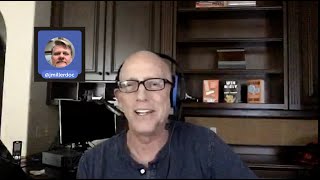
A May 12, 2020 YouTube episode by Scott Adams mixing personal anecdotes and commentary on the COVID-19 pandemic. Adams recounts stories (mini bike), scores his early pandemic opinions (travel bans, masks, vitamin D, hydroxychloroquine), and debates origins of SARS-CoV-2 (lab accident vs. wet market). The episode includes a live call with a physician identified as Jeff from southwest Oklahoma who describes treating roughly two dozen COVID-19 patients (in-person and telemedicine), reports one COVID death in his experience, recommends early use of hydroxychloroquine anecdotally, endorses vitamin D supplementation (about 10,000 IU/day), and describes evolving clinical practice: delaying intubation, using high-flow nasal cannula (nasal prongs) and proning patients while not on ventilators.
Questions this video answers
May 12, 2020.
Southwest Oklahoma.
About two dozen (roughly a dozen hospitalized primary patients and about a dozen via telemedicine/consults).
One patient.
About 10,000 IU (units) per day.
Chapters
Well, I saw the most fascinating thing today. Want to hear about it? Yeah. I know you do. That's why you're here. You're going to wind down. Get ready for a great night of sleep. It's going to be a good one. Not for everybody, but for many of you. Yep. Well, we got stories. Let me tell you the story about my mini bike. Yes. When I was 13 and for years before that, all I wanted was to own a little mini bike. Tiny, little, tiny little bike that was motor the size of a lawnmower, but, man, I wanted one. I. I mowed lawns and I shoveled snow and I worked on my uncle's farm, and finally I'd saved enough to buy a mini bike. It was one of the best days of my life. Except my minibike's chain fell off. But no problem. I'd own bicycles before. How hard could it be? So I put it back on, went a little longer, chain fell off again, and I could go up to 100 yards before that chain would fall off again. And for the entire time I owned that minibike, I never actually got it to work more than a minute or so. And so I remind you of the story I told you that forms one of the stories of my personality. And one of the stories of my personality that I talked about in a prior period periscope, was that if you dropped me on the island of Prisoners, I'd have a tough first week. But eventually, if you came back in a year, I would be running the island of Prisoners. So because that sort of fantasy movie script that I wrote in my head is so baked into my personality intentionally, I intentionally make that part of my code that when I saw a picture, I was just randomly looking through something. I saw a picture of myself at 13 on that mini bike, and I realized I've been telling Christina for a while that I want a mini bike. And I'm pretty sure she doesn't. She doesn't think that I mean it. Now, I don't have really the situation where it would make sense to have one, but I'm going to get a mini bike. I might be 75 when it happens, might be 95, but when you come back to the island in a year, I'm going to be on that minibike because I don't even know if I could stop myself from getting it eventually. It's like just built into my code. I'm going to have to make that happen someday. I would like to compare my medical recommendations to the medical community. I think this is fair, don't you? Because my qualifications for medical advice are nothing. And of course, the medical community is highly competent. So there was me calling for an immediate end to flights from China. That was on January 24, a week before the President called for it and before any of the medical experts called for it. So let's score that one for Scott, because turns out my medical advice on virus transmission was pretty good. Now, again, I'm not saying that that makes me qualified. Nothing like that. I'm still an idiot. I don't know anything about these medical, scientific things. But that's why we're scoring it. Okay, I got lucky on one. All right? So, all right, I got lucky on one. Then it was when I was calling for masks, when all of the medical community were saying, no, they'll just make it worse. You don't need no masks. And I'm pretty sure I was the first public person to say, bullshit, bullshit. I'm sorry, that can't possibly be true. I based that on my large reservoir of no medical knowledge whatsoever, on top of my gigantic foundation of no scientific knowledge whatsoever. Okay, I got lucky on that one. Everybody now agrees masks are pretty important. So, all right, so I was, you know, it's two. Two for me, zero for the. The experts. But there's some things that were sort of a tie, meaning that they said them, but I did probably say them first. For example, when the. When the virus stuff was first emerging. Those of you who've been watching me on Periscope, you know, I was probably the first person in the country, at least, you know, sort of in the public view, who said, make sure you get outside and get some sun. Vitamin D will be good for you. Now, I'm not saying that I invented that idea. Indeed, it came from the experts. But have you ever heard so many people tell you to get outside and get in the sun? Since then, I'm not saying I started it. I'm saying it's a tie. Because the experts say it's a good idea. I say it's a good idea. I said it first. I'm pretty sure I beat almost everybody there, which doesn't make me smarter. Clearly, I'm not, but I, you know, am. Three for three. Then there's a question of the hydroxychloroquine. And here, you know, here it's no fair at all, because I think you really have to have some serious medical knowledge to make a good recommendation about hydroxychloroquine. But I made one anyway, which was that, given that we all knew it had been prescribed for many years for several different causes was well understood. The risk of getting this Covid thing, especially for some types of people, was devastating. So from a risk management perspective, given that we had some anecdotal information, I said we should at least make it an option. Should be a good thing to try. Just from a risk management perspective, not from a medical perspective. Because it's really the medical is just part of the larger question. Because remember, you could have been saving the economy as well. So you had two upsides. Saving people, but also saving the entire economy, which would save more people. So since there was an enormous potential gain if it worked, or even if it worked some of the time because the stakes were so high, it would be worth the risk. There was a known risk somewhere in the. Well, you know, you can have this if you've got some arthritis or we'll give this to you for lupus. So what did the experts say? Well, early on they said it's going to kill you. Stuff will just kill you. Now you could argue that if someone else were scoring this one, they might give it to the experts. They might say, Scott, the experts are right. They do not have reliable, double blind, large scale studies that would show that this is both safe and efficacious. Scott, don't you know how science works? To which I would say I don't think you know how decision making works because I know all that stuff. All that stuff you told me I knew all that. Do you know how decisions are made? Because decisions are made, taking all that and combining it with all the other stuff and then you weigh the odds and make your decision. So I'm going to score that one for me, not from a medical perspective because of course, what do I know about anything medical, but from a risk management perspective and from the fact that we can see a number of other countries are obviously doing exactly this. So we don't know if it works great yet. That's a separate question. I'll never be the one that tells you it works great. How would I know? I don't believe any of the studies, but there's certainly enough to make you think you might that certainly a number of other countries are going at it hard. So I'm four for four. Then you've got the ventilator situation. All right. Now my understanding of the ventilator situation is there's a little bit of a question here. A little bit of a question. Oh, yeah, I've got one more after this. Whether the ventilators Are helping people or killing them. In the specific case of the COVID patients. Now you've probably seen on the Internet, at least if not in the news. I'm not even sure if the mainstream news has covered these stories, but maybe they have that maybe the ventilators are making things worse, not better. You've seen that, right? What was my recommendation about ventilators? Well, I didn't know anything about ventilators until I started seeing these reports of, you know, maybe the ventilators are worse. But do you think that people stopped using ventilators the moment people started raising the alarm? Possibly. What I saw was that people were getting better results maybe with these nose cannulas or whatever. They are basically just regular oxygen in a more less aggressive way. So I've seen those reports. I don't know what's true. How would I know? How would I know if a nose cannula is better than a ventilator and in what situations? But if it's true, and I would need a fact check on this, that hospitals can bill insurance companies a God awful amount if that ventilator goes down the throat and far, far less if it doesn't. And hospitals are hurting for money right now, if all of those things are true, what does that create? A situation which you've heard me describe before. There's a huge upside potential if somebody wanted to act badly. Huge upside potential, low opportunity to be caught. Why? Because my understanding is that they only use the ventilator in very prescriptive situations. I need a fact check on that too. So you should ignore everything I'm saying in this segment because I'm probably just spreading spreading conspiracy theories. But my understanding is that they use it in a very specific case so that they don't get sued. So that if I'm just guessing, it's something like your oxygen levels plus something else. So if you hit the checklist, the ventilator goes down. Now even if they were suspected that the ventilator was killing people in the specific situation of COVID and I don't know that that's true, but if they did suspect that, would they be influenced by the fact that there would be a gigantic financial incentive as well as probably lower risk to follow the checklist to do what you do when the oxygen is this and the other signs are this, Even if you thought it was killing them, because you don't know. I mean, you don't know, but you know, one pays you a lot so they might die either way. You don't really know. Do you, you don't know, because that's the whole point. I think if the doctors knew it was killing people, like, if they actually knew, I can't imagine, you know, except in the rarest case, I can't imagine a doctor actually killing somebody intentionally if they knew it was going to kill them. But what if they just thought it was a toss up? What if they thought to themselves, I don't really know. But I do know that the checklist says I should be doing it. And that's the checklist that keeps me from getting sued because at least I'll say, well, I had a suspicion. But, like, I didn't have any proof that it was killing people. Because to do that I would have to have some kind of a study. And I'm not in a study, I'm in a hospital. So it would be easy for me to imagine that the ventilators may be a little overused. I'm just saying that's something we ought to look at. But I wouldn't want to. I don't want to suggest that that's true because this is. This is so much the kind of situation where it turns out the whole thing is just bs. Meaning that maybe hospitals don't make more if the ventilator is used. You know, some basic part of the story is just untrue. So be on guard that there might be like a basic part of that story that just isn't true. So that's what happens when you put together everything you've heard on the Internet. All right, so all I'm saying is you should always listen to the experts. I think I made my case. All right, here are some weird things that are happening because the simulation is speaking to us. Have you noticed now that you're starting to see the world more clearly? Does it feel like 2020 is a year when there's some kind of veil that's being lifted on reality, or at least on what you understood about how civilization was put together. A lot of assumptions are falling away, right? And isn't it weird that the simulation would pick this year to make us see things clearly? What year is this? 2020. The simulation is letting us see clearly in 2020. 2020. Eyesight. How cool is that? And I tweeted, I found a picture I had. I tweeted this a long time ago, but it got funnier over time. I had purchased for gardening, there's a little thing called a TDS meter. Now it just says actually TDS meter on it, which was funny. Which is why I tweeted it, but I didn't realize the first time I tweeted it how much more meaningful it would be because right next to it it said made in China. So it was a TDS meter made in China that I just happened to run into today. What are the odds the simulation delivers? Here is the weirdest thing about the tragic situation of Amud Arbery, who was slain by the two guys who recklessly brought that gun to confront him. Here's the weird thing about this story. Are you ready for it? I'm going to give you the, the take on the story that nobody's given you. Do you think that's possible? Is there any way? Because you're probably sick of the freaking story by now, right? It's a tragedy. What can you do? You know, you can talk about it all day long, but it's not going to help the family. But here's my take on it. Nobody disagrees. It's the weirdest kind of, kind of a conversation because nobody really disagrees. If you actually. And people are acting like they're arguing without disagreeing. Have you noticed that? Because have you seen or heard one person who said, yeah, it was a good shoot, you know, that's, that's exactly what they should have been out there doing? No. Have you seen one person who thought that the guys who, who were, you know, chasing the, what was his name? Amud? The guys. Does anybody think that the guys who chased him were using good judgment? Nobody, literally nobody thinks they were using good judgment all the way through. Does anybody think that walking around in somebody's house is going to raise suspicion? Does anybody think it's the worst thing in the world if you went right down the line? Nobody disagrees on any part of. Was people who made what turned out to be bad decisions at the time. And what really the big problem was that all the bad decisions happened in the same place. If you take three people who make bad decisions once in a while, we don't know that they, they only made bad decisions, right? I wouldn't allege that. But if you take somebody who sometimes makes bad decisions and you put them in a field all by themselves, probably no problem. If you take two people who sometimes make decisions that are bad and put them in the field next to each other, well, a little more opportunity for something to go wrong. But if you add that third person who has a tendency to make bad decisions, you arm two of them, you've got a bad situation. Now, is it racism? That's what everybody wants to talk about, but if you have a situation where you could easily imagine it happened, no matter which races any of them were, where do you get that information unless you are yourself a racist? So this is where the parody begins. What would make people think that the two white guys were racist? What would be the. What would be the interpretation that says, yeah, this is obviously, it's because they were racist. It's not because they're white. Is it? Because that's the only evidence I see, I don't see. Now, if it turns out they have some body of work in which they've said things that would be appalling, I will immediately change my opinion. But as far as I know, as far as I know, it's just who they are that makes you assume that they're racist, is that not true? And if you're assuming somebody's a racist because of who they are, not what they did, because again, it would be easy to imagine that situation where you could just mix up all the ethnicities, ages and genders of everybody involved, still get something like that, same outcome. It'd just be easy. You could recast that a million times. And you put three people who made bad decisions in the past, I'm guessing, and maybe they made them that night, they just happened to happen at the same time. So it was, you know, a terrible tragedy. But to imagine, therefore, that you can read minds or that they're, that they were racist because they're white, I would say is not in evidence. Should it become in evidence later, I would reconsider. So that's my take on it. People are acting like they're disagreeing, but I don't think they are. I don't think there's a thing I just said that anybody would disagree with. If you actually, you know, could talk to them one on one. There's not one thing I just said that anybody would disagree with, I don't think. Right. Just a tragedy. Here's three interesting. Well, you can decide if it's interesting takes on what's going to happen after the coronavirus situation is passed. Now, Balaji Srinivasan, you might think of him as more of a. And this is the fun part because it's from three different personalities. So you might think of him as a tech, you know, very. He's hard to describe. He's such a renaissance kind of personality, but somebody who's future minded, technology minded, you know, science and technology, kind of a brain. And so he says one possible good future after the coronavirus stuff is that people would move out to Rural areas work remotely, change jobs more easily in a truly global labor market. Fewer but longer drives with autonomous cars 24,7 delivery drones socialize online and in virtual reality. Physical social distancing with digital social networking. Question mark. So those are just sort of some, you know, thoughts about how things might be different. Now those come from a, remember technology futurist kind of a personality. And then retweeting that with his own comment is Nate Silver. Now Nate would be most famous for his statistical analytical abilities. So, so his take on it goes. Another possible future. There's a vaccine in 12 to 18 months. People mostly go back to how they were living before, but with greater awareness of pandemic risk. In other words, everything just reverts to the mean. Yeah, it'll be just like before because things revert to the mean. So the technologist is seeing all these technology opportunities and the market, you know, the market meeting those opportunities and sort of building the future. The guy who knows the most about statistics says, quite reasonably, by the way, I'm not giving you an opinion which is the, you know, the more likely one. It's just going from two different personalities. So from Nate's filter we get a vaccine, go back to the way we were mostly. And then the last one, the last assumption or the last prediction is for me. So I thought, well, now we've heard from two different personalities, let's see what I can add to this. So I said, yet another possible future. The flaws of our ancient assumptions and rusted systems have now been cruelly revealed, making them easy prey for our geniuses and engineers who will lead civilization to the golden age. That's my bet. So nobody of course knows what's going to happen. I would say that this is bigger than all of us. So anybody who says they can predict what's going to happen after the coronavirus, I think that's, that's a stretch, you know. You know, I've had some good predictions, but they were in narrow little areas, you know, but predicting how everything goes, that's a lot to ask. But there are some things that I could say with some confidence. One is that, and see if you agree with me in the comments here. One is that this has caused us to completely rethink everything. All of our assumptions, all of our systems. Why do we drive to work? You know, why are some things physical? Our entire civilization, if you think about it, well, not entire, but let's say 90% of our civilization is a pre Internet design. Think about that. I mean that's sort of the Kill shot right there. I don't have to go on. 90% of civilization is pre Internet design. I'm just making up that number. But something like that. What happened with the coronavirus situation? Everybody just took a step back and said, okay, should I just continue running as hard as I can in the same direction forever? You know, now that I've got a. I got a pullback, what do I see? You know, what. What has been revealed? What do I know now because of this, the lockdown and everything else? What do I know now that I didn't know before? And the answer is a lot, A lot. We really found out a lot about where all the weaknesses are in our systems. We know where our food systems are bad. We know what kind of people are going to need help and what kind. We'll probably learn something about printing trillions of dollars. Weirdly, it looks like we can just print money if we want to. I don't know if there's going to be a penalty for this, but it looks like there might not be in this weird situation where inflation is largely impossible. So almost everything from, you know, you might not have a post office. I think all the newspapers are likely to disappear. So the nature of news itself is going to change because an entire industry is just going to, you know, likely going to disappear along with my job. And, you know, that's just a fraction. And I think even stuff like health care, there are likely to be gigantic lasting changes. For example, one of the things that happened during the lockdown was that I was part of this process. I suggested to the task force through some excellent help. Thank you, Jonah Shumate. I suggested the task force, the idea of letting doctors who are doing telehealth practice across state lines because of the emergency. You couldn't do that before. I think that'll probably last. What kind of a permanent change would that have on the cost structure and just the very assumptions about how you do healthcare? Now add that to the fact that we learned how to rapidly build all of these testing devices. So manufacturing is gonna come back to the United States. So now add the fact that we're going to start manufacturing tons of, you know, medical devices, probably around more locally. Add to the fact that you'll be able to get your doctor on the phone. How hard will it be to get a test from any place locally? It could be your cvs, your Walmart, because they will be doing this stuff. You go in, you get a test, you know, send it on your app to your telehealth doctor. I mean, you could see universal healthcare happening at a lower cost than current healthcare very easily. And it could be a direct outcome of the coronavirus stuff. So that's just one example. But I think everything from education to the way we commute live, recreate everything, I think it's just going to all be rethought from scratch and the result will be little thing we call the golden age. You're in the middle of Act 3. Act 3 is when you get really whacked hard and it doesn't look like you could come back. That's just about where we're at. But we humans don't really lose in the end. If you noticed, we do have a hundred thousand year unbroken record of kicking the ass of every micro virus, mammal, bird and fish that gets in our way. So we are going to climb on top of this. We're just about at the top of the hump, heading over, feeling good about it. So a weird thing happened on the Internet today. I don't know if you've ever seen this happen. I swear I'm not making this up. This is a real thing that happened to me, I promise, cross my heart, not making this up. I changed my mind on something. I know, I know you don't believe it because you've never seen it, right? Nobody's ever changed their mind about anything in politics or on the Internet. But dam Ann Coulter wrote an opinion piece about the virus and whether it came from the lab or it came from the web markets. Didn't you kind of expect that Ann Coulter would write that it came from the lab? Wouldn't you, wouldn't you have expected that? Well, what I wouldn't have seen coming is that, you know, she's anti neocon, anti war for no reason. And why not? Nothing wrong with that. And she makes a compelling lawyerly argument, but not like a lawyer. She's one of the best writers in the country. She makes a compelling argument that it probably came from the web market. And I thought to myself, damn it, damn it, Ann Coulter. I'll try to give you her argument quickly. And there was a, a fact that I kind of knew, but somehow I hadn't put it in place the way she had. And I thought, oh, it all makes sense now. And here's the way she puts it in context. First of all, who would like the United States to get into some kind of a military confrontation with anybody? It would be the neocons. So if you believe there are these people called neocons, you know, these ultra, you know, right wing, People in the government and the wheels of industry in the military industrial complex. And that these neocons are always itching for a war or at the very least, a buildup of military equipment, because presumably they all make money on the military industrial complex. So it would behoove them to make us think that we need to build up our military because China is a threat. So if you were to ask yourself, is there anybody who would be capable of. This is my spin, not Ann's. Is there anybody who would be capable of creating a rumor that it came from the lab, which would be the worst case scenario, who would be capable and who have the motive? And if there are such things as neocons, well, okay, there you have the motive and you have the opportunity, because the opportunity part is easy, right? It's pretty easy to start a rumor. Who can't do that? And so there's a huge potential upside, right? Odds of getting caught and going to jail for starting a rumor, zero potential upside if it causes a military buildup, because it's part of what makes us get antagonistic toward China. Profit incalculable. Gigantic. So in a situation like that, could you expect people to start a rumor that would benefit them in incalculable ways and they couldn't get caught? Not in any serious way? Yeah, yeah. We live in a world where that's a ripe situation for that doesn't mean it happened, but it's the ripest of situations. And then Ann makes this case. You know, I guess a lot was made of the fact that it was a bat virus, but there were no bats in the wet market. You all heard that, right? So it couldn't have come from bats because they didn't have any bats in the wet markets anywhere near there. But as Ann explains, and I kind of knew this, but somehow I missed the significance because I'm an idiot. We know that the virus didn't go from bat to human. It went through some middle species, which this Panaguin or whatever the hell it is, some kind of animal or bird. Yeah, Pangolin, I don't even know what that is. But some kind of a creature, which apparently they are at the markets. So the argument that it couldn't have been at the wet market doesn't make sense because of course it could. So once you throw in the fact that there's somebody who has a motive to tell you the wrong story, and it's easy to do, and you throw in the fact that the most ordinary way this happens is through the wet markets, and then you Throw in the fact that any virus lab in the world would probably have safety violations, which is what Ann also said. I thought to myself, oh, that's a good point. I'll bet you could randomly pick any top level secret facility and say, all right, we're going to do an audit. What are they going to find? Well, they don't find nothing because the people who do the audit are paid to find stuff. If you pay somebody to do an audit and look for safety violations, they'll find them 100% of the time. Otherwise, why are you going to buy them the next time? So. So here's the thing. Before I read Ann's argument, I would have said 80% chance it came from the lab, just like our intelligence agencies are saying. Our intelligence agencies. Right. Just like what they're saying. And that, you know, China's lying about that and everything else. And I want to say 80% chance it was the lab, not intentional, because that just never made sense to me. But maybe an accident. I would now revise that to 50. 50. I want to go 60, 40 web market. I'm going to go 55% likely that the Ann Coulter argument is right. 55% that it was the wet market. Darn it. Somebody says that pangolins are fake news, I'm willing to be persuaded. You saw me be persuaded once. Anyway, the point is, this is the kind of news that you just can't be sure of anything anymore. Right? You just can't be sure of anything. I don't think you'd rule out the fact that it was engineered. I do not think you can rule out engineered. No, not, not even a little bit. But you also can't rule out the wet market. And I thought it was a little bit easier to rule out the wet market. But if you can't rule it out, and it is the most common way that other viruses have started, you kind of have to play the odds, don't you? If it usually starts in this way and this way is the same way it's always been, and it usually starts that way, what makes this the one time it started the other way? Good. Good. Or as Jack Posavig said on Twitter, he goes, where do you think the guys from the lab go to eat? Where do you think they go to lunch? And I don't know, how would you score that? You know, what would the score be if the guy from the lab went over and got it on his shoe and then he brought the deadly virus into the lab? Would you score that as a lab Accident. If it then got out of the lab, I don't know. All right, that's probably all I wanted to say on that. Anybody want to ask me a question? I'm going to take some questions. I'm going to catch somebody off guard. Get ready, get on your game. The question answering will begin. Will begin. All right, let's see if Jeff is awake. Jeff, are you awake? Hey, do you have a question for me?
I knew beyond a shadow of a doubt that tonight you'd ask me to come online. Tonight. It's one weird. I'm a physician, I'm a hospitalist. I work in critical care medicine. I've had the unfortunate pleasure of treating this virus and yeah, it's kind of a scary virus.
And can you, can you tell us what part of the country or you want to keep that?
No, I'll tell you. I'm in Oklahoma, southwest Oklahoma. I'm in a fairly rural area, medium sized hospital. Most of my patients have come out of a federal prison, actually.
Wow.
Yeah.
So let me ask you this, of the. So this is anecdotal. How many, how many patients have you seen roughly? A lot.
A few, I would say in the hospital. In, as a primary, as a hospital is probably a dozen. And then I've consulted with a lot of people all across the United States that couldn't get hydroxychloroquine, friends of friends that would call me and I did some telemedicine with them. Maybe another dozen. So two dozen, maybe.
So, you know, I know that it's impossible to do a controlled study or anything, but is there any observation, just anecdotally that you would say people need to know x, that something works or something doesn't work. Is there any. Is anything that is in your mind as. My God, I think we're looking at this wrong. Anything stick out?
No, I think in general we're looking at this correctly. I think the social distancing, the flatten the curve has helped, at least it has in my part of the country so far.
But what about the meds?
Yeah. So hydroxychloroquine, anecdotally, I've talked to many doctors that have used it. We're kind of in the red belt here. And so, you know, this drug's been politicized, obviously, but a lot of us are using it and we seem to be having good effects. If it's used early, if you wait until you're on the ventilator, forget it. You know, you're in a different, different part or phase of the disease where not much is going to help, I think so.
Have you seen anybody yourself who got on hydroxychloroquine early, who did not have, let's say, well, whether or not they had other comorbidities or not, who went on to not make it?
No, I have not. But I've only had one patient die of this. And. And he was in very poor health. And quite frankly, we didn't put him on the drug because at first we didn't think he had it. He presented differently. He didn't appear to be a coronavirus patient. So, no. I wanted to address one thing that you said earlier, or you're talking about when it comes to putting patients on ventilators and reimbursement. So there's two areas of reimbursement that occur in a hospitalized patient. You have what they call EM coding, which is the physician's fee, and that is a very small variance, and it absolutely has nothing to do with whether or not we intubate a patient. What you're addressing is the hospital fee, which is based on what they call a DRG or ICD9 coding or tin coding. Now. And yes, that fee goes up dramatically, but the physician does not participate in that reimbursement, at least not in most areas. There may be some models where doctors get a kickback, but in most places that's illegal. So. And when you put a patient on a ventilator, it probably costs the hospital more money than they're getting reimbursed had they avoided it to begin with. So, yes, there is what I think it's about three times the dollar amount that the hospital gets, but you're probably spending more than three times that.
Let me ask you this. Do you have a sort of a checklist that says when you can and cannot use a ventilator to keep you out of trouble? In other words, if you do it, if you do it according to these criteria, you're always going to be okay, even if things go wrong?
Yeah.
Anything like that.
Yeah, I would say. I mean, it's not an exact checklist, but yes, the idea, the way you're thinking about it, is correct.
So. Well, hold on, let me finish the thought then.
Sure.
So if that's correct, then a doctor who suspected that maybe the ventilator might not be helping as much as it's hurting would still be. It would be an easier path for them to follow the checklist if it's a close call, wouldn't you say?
Yeah, I think so. But this is evolving so rapidly. There's a guy by the name of Scott Weingart at Stony Brook Hospital that's really on the cutting edge of this. And what we're finding out is what you were saying earlier, that it appears that when we put people on ventilators, it tends to accelerate the process. You want to delay that as long as possible. And that knowledge is just now kind of getting to circulate around, you know, most of what guys like me in rural communities, you know, the old way of thinking was if you come in, your sats are low, you look like crap, you put them on the tube.
Have you tried the nose cannulas for the oxygen?
Yes. Yeah, we call it high flow oxygen. And that's what we use primarily now. In fact, we. I've actually proned patients without being on a ventilator. We used to only prone patients once.
They went on tell, tell people. Tell people what that means to prone.
Them, to put them on their stomach. So most of the volume of your lung is on the backside of your lung. And if you're laying on your back, that part fills up with fluid and you don't get good oxygen transfer. By flipping you over, the dynamics of the lung become such that you get better oxygenation. And we only used to do that when a patient was like far gone on the tube. Last ditch effort. We turned them over in the bed. It's a real pain in the butt. Now we're literally proning people when they're not on the ventilator. They're just on nasal prong cannula and we're having dramatic responses to that. They actually improve quickly. It's a weird thing to see a patient laying on their belly in the ICU without a tube down their throat, but we're seeing that more and more.
Do you think that maybe. Because it does seem that the death rate is dropping quite nicely. At least I think it was. Maybe it's going to go up again because the lockdown slowly ending. But do you think there was anything that the doctors were collectively doing better that made the death rate go down? In other words, did they change a procedure, medication, learn something they didn't know? Because this, this whole prone thing turned was a pretty big deal. I understand, but I'm wondering if you think there was any one thing or things.
Yes.
Which like, dramatically changed the death rate.
Well, I. It may be early to say, but if I had to surmise. Yes. And it would be that delaying intubation and putting a person on a ventilator seems to be the the best choice and is probably saving more lives. So, meaning. And we've always known that putting a person on a ventilator across the board increases mortality, but in this particular.
Wait, wait, wait. But it can't increase mortality in general, or it wouldn't be used.
Well, it depends on how you compare the patient. So, you know, you know how statistics are.
But wait, wait, wait. Is this a cause and effect thing? Because you were. You only put the ventilator in the people who are. You know, it's just a long shot anyway. Right?
You're correct. But there's some studies out there that suggest that if you can minimize the time on a ventilator or delay going on to it, in some cases, mortality decreases.
Got it.
Okay. But with this virus, it seems to be that, you know, you only want to put somebody on the ventilator when you have absolutely no other option. And even those patients do pretty poorly, but it seems to accelerate death. What we're seeing, if you put them on early like we used to for other conditions, you might actually make things worse. And so I think that may be saving lives.
The.
The knowledge that's getting out there now a lot for what Scott Weingart's doing in Stony Brook is really getting around the nation, and we're starting to follow it.
So, so. So I've got to ask you about vitamin D. We. We know, for example, they're. They're all. Yeah, I have to watch out for confirmation versus, you know, some. Something that actually makes sense. So my confirmation bias. I'll just put it in terms. Looks like this, that we know vitamin D is good for your immune system, so it makes sense. It could have some effect. And if we observe that old people are having a bad time, well, that makes sense because they're old, but they also don't get out as much, probably don't get as much sun. We've heard that the African American community is getting hit hard. They have more trouble processing vitamin D. As I. I understand that kids are doing well. They get. They probably get more sun than anybody and wear less sunscreen, even though they shouldn't. Maybe. So there seems to be this almost perfect correlation. And then the places that you think wouldn't be getting much, such as the Scandinavian countries, they know they don't get enough. So they're eating cod oil and fish and stuff. So there's an almost. It's alleged. There's an almost perfect correlation between how much vitamin D you're getting and how much trouble you're getting. But confirmation bias would get you to the same place. Right. So it doesn't mean it's true, it just means that's the way it looks. Tell me what you think.
Well, I think it's very important to understand from the onset that correlation does not equal causation. And so you can't say with any certainty from what we're seeing with this type of studies that are out there now that having a good vitamin D level is protective versus, you know, the opposite. For precisely that is it's just a correlation. There could be a thousand other factors involved.
All right, so I agree on that. But could you make use of it this way? If you found that the correlation held and you wouldn't know which way it went, could be the low. Vitamin D is a marker for having a bad immunity to begin with. So suppose you could easily test for vitamin D. Could you then say, look, you folks who have boosted your vitamin D, you're probably going to be in better shape? No, if you couldn't, if you couldn't boost your vitamin D would mean you're probably in such bad shape that you shouldn't go anywhere.
Well, let me just tell you what I'm doing and maybe this will answer your question. I am recommending people get on a, a reasonable dose of vitamin D if they're not taking it, whether or not they know their levels are high or low because it's harmless to begin with, it's cheap, and a lot of people are deficient anyways. And it's been proven that there's a multitude of other conditions that, that you improve with improving your vitamin D level. So I think, you know, it's one of these. It may not be a study, but like you alluded to earlier, it's a decision making process and it just makes sense to take vitamin D. So that's where I'm at with it. Maybe I'm wrong, maybe people criticize me for that, but I'm telling people to take about 10,000 units a day and, and you know, go on with life if they can. So.
All right, that sounds like a good risk reward. It is possible to overdose though on vitamin D, right?
Absolutely, yeah. Don't eat polar bear liver.
That's the best advice I've had today. No polar bear liver. And when you talk to your doctor friends and you know nobody's watching, so you can say anything you want, what meds do they think are the killers? If they all got together, the doctors you talked to and made a bet and they could only pick one therapeutic or it could Be a vaccine. If you know something there, which one would they bet on? Doesn't mean they're right. But what do you think they would bet on?
Current medicine that has nothing to do with coronavirus.
No, the question is, what medicine would they bet on that would be the most effective, if anything, against coronavirus? In other words, would they go with hydrochloxquine, remesavir or whatever?
Yeah, I understand. Well, so I think hydroxychloroquine, to be honest with you, and Remdesivir, I think, as you're aware, the way they powered that study didn't really look at mortality. It looked at time to cure. So it, the cure is way out on that.
Yeah, way out. So what about the monoclonals?
Interesting. I understand DARPA is going to be doing some work with it and, you know, we're all excited to hear what's going to happen with that, but there's just, we have no, you know, the average guy on the, on the, the street like me, all we do is read about it. We have no experience with it. So we're excited to hear about it, though.
So here's the question that I don't know that you would know to answer this, but just for the audience. It seems to me that if you can find somebody who's, you know, already got the antibodies, that the hard way to get enough of them is to take them from each individual who can give you a pint of blood. That seems like hard to scale that up, but if you could clone it, you could scale it faster. Except I don't think we have enough cloning resources. We know how to clone, but it's not something that scales that easily. So the question I have is who makes those cloning devices? Who makes the lab equipment that could. If the federal government said, look, guys, there's one thing that we're pretty sure is going to work because. Would you back me on this following statement? But tell me if this is too strong, it can't be wrong to put antibodies into people. Is that too strong?
I don't think it's too terribly strong. I mean, there's going to be a couple cases, obviously outliers, but I think in general it's probably a good idea.
So if we could just put a, let's say Manhattan Project on whatever this lab equipment is so we can scale up enough, just take the hardiest antibodies we can, just started making this stuff. Now, would it have to be injected or would it be a pill, intravenous?
IVIG is the.
It would have to be.
Yeah.
Okay, so it can't. It can't. So that doesn't scale that well either. You can't just inoculate everybody or use it prophylactically.
The doctors with infusion centers would be making a killing.
Yeah, well, you could. But, you know, that's another thing you could scale up. Right. There must be all you need is a nurse or a phlebotomist. Right.
I've been looking for a reason to get in that business.
There you go. All right, well, this. This was a great call. Thank you so much. I'm watching the audience comments, and they're really happy, so thanks for that.
And I wanted to say briefly, you are one of my heroes. And the reason I say that is, is that I know that what you do has come to a purpose. Personal cost to you, and I think that you're doing it for the betterment of humanity. I believe that. And I believe you've taken a personal cost. And kudos to you for that. I really appreciate that.
Thank you. I appreciate that very much. And, yeah, I do take it personally. All right, thank you.
Thank you, Scott.
Bye. All right, I believe that's enough for today, and I will talk to you in the morning.
More from Scott

The Scott Adams School - 10/14/26 The Chicks and Joel Pollack Stops By. Scott & Persuasion


The Scott Adams School - 10/09/26 AKIRA.. TAKE TWO! Fri Yay! With the Home Team



The Scott Adams School - 10/06/26 Erica & Marcela Talk France. Venezuela. Scott Adams. and More


The Scott Adams School - 10/02/26 Fri-Yay!! The Home Team closes out another amazing week.


The Scott Adams School - 09/30/26 WHITEBOARD! AI Luncheon. FRAUD. MIKE ROWE, Happiness!