The Scott Adams School - Pollster, Mark Mitchell returns. Let's talk Midterms
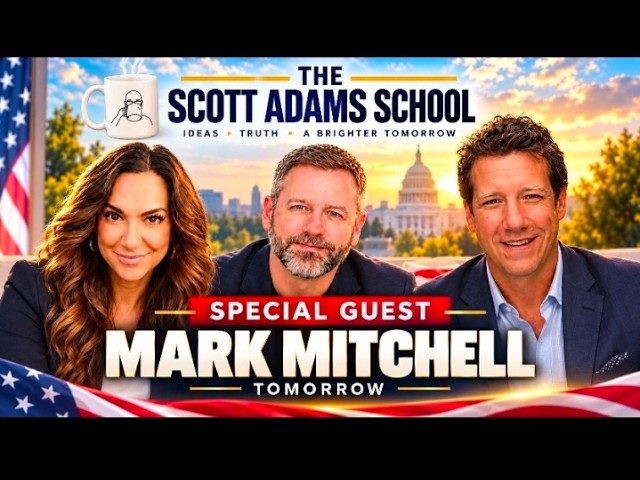
Mark Mitchell, who left Rasmussen Reports over undisclosed sponsorship, founded The Honest Poll to provide transparent, non-partisan polling. The group discusses voter disillusionment ahead of the midterms, economic anxiety, and Republican primary dynamics between J.D. Vance and Marco Rubio, analyzing how messaging on inflation and wages could re-engage voters.
Chapters
Hey, I think we are live and I have Locals. Yes, Locals is here and we're just going to wait for YouTube, Rumble, Spotify, and X. Good morning, everybody. Good morning, Locals. Look who's back. It's Mark Mitchell. I wanted to sing like, oh, I can't sing. I'll, we'll get in trouble.
Uh-oh.
Copyright.
Yeah.
I mean, my gosh, it's so restrictive. But Marcella says we can sing Happy Birthday because it's such an old song. But anyway, you guys, Marcella's off today. Okay, so she got called into court. She, uh, messaged us last night. She says she has to cover court, so we don't have her today. But we have Mark and we have Owen, and we have a good conversation planned for you. And, um, we'll just give you guys a couple minutes to come in, and then we're gonna take a sip of whatever you wanna sip. Uh, Mark, have you been since we saw you?
Doing great. Company is off to a roaring start. Got the website up, got the first couple polls out, and got added to Decision Desk and New York Times aggregator. So really great start.
I saw that. All right, good. So, all right, Locals still doesn't have video yet. Let's just give them another second. I think they can hear us. Let me see, what are they saying? Da da dum. Okay, I'm gonna say, can you guys see us? I mean, can you hear us and not see us on locals? We just want to make sure you have. And at least we have memes back today. Let's go! Come on! Okay, we have YouTube going, Rumble's going. All right, so good. The stream is live on X. But not locals. Hmm. You can't hear. I think that's just you, Dr. Von Hardy. Can't see or hear. Let's see if I can do something here. Makes me nervous, but let's try.
Hmm.
They say they're connected. I'm going to try something. Ready? Hold on, everyone. Okay, let's see if that does anything. I hit that, like, I unplugged it and plugged it back in.
It helps.
It's always something with, um, Rumble Studio. We want to just love you, but you make it hard, right? If for some reason it doesn't kick in, please, um, go to YouTube or Rumble or X. Okay, let's see if it kicks in. Let me just type to them, trying. All right, I'm gonna, I'm gonna say go to YouTube or X. Erica doesn't love us. I love them, you guys. I love them. Okay, so we're gonna keep going and they, they can't— they have plenty other options to go to. So let's do it. And you guys, before we Do anything. Look at those comments. I know they don't want to miss the sip, so I know they're running over, but we got to do it. We got to do it. Scott appreciates nothing more than technical difficulties, and you know what? So do I. Okay, good. There are a lot of them on our are on YouTube. I love it. We'll watch over there. Okay, let's do it, guys.
And it's not just watching; it's participating. And in order to participate in exactly the right way. Which is the only way you want to do it. All you need is a cup or mug or a glass of tank or chalice or stein, a canteen jug or flask, a vessel of any kind. Fill it with your favorite liquid. I like coffee. And join me now for the unparalleled pleasure, the dopamine hit of the day, the thing that makes everything better. It's called the simultaneous sip, and it happens now.
Go!
Yep, just as good as I thought it would be. I know yours was good too.
It was good. It was good.
I like the ones where Scott had, had like needed a haircut and he kind of looks like, you know, I don't know if it's like Beavis or Butt-Head or something, but it just had this like comical sort of look to it that fit his cartoonist image.
Yeah, we used to call him Trey Gowdy in those days, and I think this whole week he has Trey Gowdy hair. So let's start over. Mark Mitchell, welcome back to the Scott Adams School. And you know what? Share that news again about your— like, give, give the people a little flavor of who you are, why we know you, and where you just got pulled into.
Yeah, I was the head of polling for Rasmussen Reports for 5 years. Did a pretty good job there. Actually grew their media audience to be really big as well. Rasmussen is supposed to be an independent public opinion pollster, which means that they represent the American people and aren't affiliated with the Republican Party. Long story short, over the last couple months, there's an issue where, in my opinion, they have behind the scenes taken money from a politically oriented organization that's now sponsoring polls that they're putting out as unsponsored and public, which is a big no-no.
Yeah.
And I had to leave and start my own company in order to get away from that. So I'm the Honest Poll now. And the whole point is that somebody should out— be out there not shilling for Republicans or Democrats, but shilling for the American people who do not have a lobbyist in the halls of Congress. They don't, and they should. The whole point is that you elect people and they go to DC and represent you. And we're seeing that quite often that that doesn't happen. In fact, it's worse than it's ever been.
When you're an independent pollster, does— I assume you still need to get funding for your polls from somebody. Like, isn't usually someone sponsoring a poll? They ask you to do it and then they pay for it.
Well, that's why the media aspect of my business, and Rich Barris does this and believes this as well. I mean, people back 100 years ago when political polling was getting off with Charles, you know, George Gallup, Mm-hmm. they actually paid to find out what Americans think. But that's not good if you're a pharmaceutical company or you're big ag and you want a subsidy. And so what happens is, you know, again, this voice of the American people has been lost. And then you have basically me and Rich Barris who have come out and said, well, we have a different model. We can go directly to the people. I can get funded by YouTube subscriptions and ad revenue. I can pay, you know, I have the paywall on my site for some of the content. I would love for people to support me. And that pays for my monthly tracker. And yeah, I will take sponsored work if there's a nonpolitical organization, a 501 or that wants to come and sponsor like new research. I'll do that polling. We just did it for Veteran Action, but we disclose it, right? Like, that's the whole point.
Yeah.
So people know who paid for it. And I'll do private polling as well. Like, I'll still poll for campaigns, but when people, you know, the idea that I have this persona, I back my numbers, I explain what's going on, I put my personal face on this business so they know even if they're coming for private campaign polling, they're gonna get the real numbers and not some kind of like fairy tale so they can go get fundraising. Like, that happens a lot. So the entire industry is unfortunately corrupt. And being able to have a public face, a voice, a social media reach is my proof to people that I'm not corrupt.
I love that. Yeah, it's like, why do you want to fudge the numbers? But then when you said people do it for campaigning to fundraise, okay, again, it's always follow the money, isn't it? And I was saying yesterday, I played the 6-minute or 7-minute spot you had on War Room with Steve Bannon yesterday, because I think it's really important to kind of prime everybody to understand that You know, I was saying people that are going to vote Republican are going to vote Republican. Like, you're not the people that we're worried about for the midterms. Like, we already know what we're doing. We don't want socialism. You know, we know the options. And, you know, my concern are the people who are either disenfranchised and are just going to sit it out, or the people who, as you said yesterday when we were watching that, you know, you said a lot of Socialists voted for Trump. A lot of Democrats had voted for Trump, and a lot of independents have voted for Trump. And now those people who are maybe, I'm assuming, feeling it economically are just like, it doesn't really matter, like the down the road.
Yeah.
They're like, right now it's rough. And the thing I wanted to, I just have one clip I wanna show today because I was trying to say to everybody, it's like, we are like really well-informed. The people that watch Scott, And the people that come to the Scott Adams School, they're curious by nature. So we are definitely way more informed than the average voter, and good for us. But, you know, it's funny because if you are so taught to just follow your party, only watch your party's news, you have no idea the reality of what's going on. And so I feel like it's gonna be up to us to get the message out. It's gonna have to be grassroots. Now, this is really funny to me because as Owen and I were talking yesterday, we were saying, you know, Jessica Tarlov, I was saying that she's been going around on lots of media lately. And although she's articulate, she works for a Republican news site, Fox News. She was so uninformed about the border, actually believing the Democrats even while working at Fox News. So you guys, this is what I'm saying. People just don't know. So just watch this little clip and then we're going to chat. And I've gotten really important insight and a different perspective on it from working in a conservative media environment. You know, while the Biden administration was saying nothing's wrong on the border, the border is effectively closed, Fox had a drone flying over the border that was showing, you know, tens of thousands of people and at peak a couple hundred thousand people streaming across the border. In a month. And I was gobsmacked, not only by the reality of what was going on and how unfair it was that I was sitting here in an air-conditioned studio in New York City telling people in Eagle Pass to suck it up, but that the administration had no answer for it. And they got it together in the last year, I think, because elections frankly were coming and they thought we need to do something about this. So that's just stunning to me. I mean, she was gobsmacked. It's just so crazy. And that was even while working at Fox News, Mark. So what the heck? What are we dealing with here?
Cognitive dissonance is really rough to see, right? Like, that's really what's happening there. And there's a lot of— there's gonna be a lot of cognitive dissonance. So there's a lot of like mega big trends going on right now as far as politics and information consumption. And we're only really starting to see the extent to which it's gonna ripple through the entire political establishment. I mean, we had like red team, blue team, my team's right and holy and yours is not kabuki theater for a very long time. And Americans are waking up. They hate both parties now. They're increasingly independent and more people are getting politically engaged. And I really hate to say this, but like you said about your audience, like not everybody is cut out for the political news consumption. Let's just put it that way. Like there are people are, there are a lot of soft and squishy and very manipulative manipulatable, whatever the word is, right? People who the propaganda works on, their psychological operations work on. And quite frankly, that's what, in my opinion, mainstream media news is. She's not like out there doing research. She shows up on Fox News every day to play a role, and being informed on stuff is not actually her role. You know that. And I think what we're seeing is like, I like to talk about this a lot because not a lot of people do, right? Western Christian and Western society gave the world 2 really important gifts. And we all know about this idea of liberal philosophers who gave us natural law, right? Like the Magna Carta and God has granted you human rights and all of these things, right? But we don't often talk about Greek logos, this idea that, yeah, you should be intellectually honest and the point of discourse is to arrive at common ground, and it all is based on the merit of your facts, your logic, and not necessarily manipulative logical fallacies. That's what we have now is we have debate and lies, and people want to win with lies. That's very anti-West. Anti-West is like, hey, I don't care about your credentials. Let's talk and find common ground, and we'll both come away from this smarter and with a better understanding of reality. And I think when we have people tuning out of mainstream news, like mainstream news is propaganda and lies on both the right and the left, as we're starting to see, right? People are finding actual discussions on the internet and they're, they're seeing new sides of the other side and also their own side. And I think that it's gonna be actually, people are like, oh, Mark, you're a doomer. I'm very optimistic. That eventually, like, people will say, you know what, I'm done with the lies. This isn't good for society. We need to arrive at the truth. And I shouldn't be demonizing my opponents. I should be finding common ground with them because we all share this contractual obligation called the US Constitution, right? And when you look at it from that frame, and again, I represent the voter and not a political party, the Republican Party is just as cooked as the Democrats are. So the Republicans were just given a massive mandate to come in and fix the country. And we can go deep into what exactly that means. It means a lot more than what Trump has been doing over the last 2 years. And the numbers show that Americans think that the Americans that matter, that are going to be the swing electorate, do not think that Trump understood the assignment essentially. Right. And so what do you see the Republican establishment all of a sudden saying? Well, all the Democrats are socialists and they're evil and they want to put you in a ditch and shoot you. And we have to deport every single Muslim. In America because Islam isn't like— this country was founded on freedom of religion, you know, like, let's, like, let's be real. Like, that doesn't mean that Sharia law should, you know, circumvent the Constitution. Like, but we have law enforcement for that, right? And so every— oh, like, Islamic fundamentalism is our number one problem in America. No, it's not. Like, economic wealth concentration and oligarchic power is by far our number one issue. As all of the polling says, people don't trust the corporations. They think the economic system is broken. People can't afford to live. That's going to cause an uprising. That is—
Yeah. Talk about that more because we hear the oligarchy words and the this and the that. So what does that mean if you break it down for the everyday person? Because it comes down to the economy, stupid, right? So is that what we're talking about?
So if I want to— so again, I'm an outsider to DC, and I think that helps me do my job better. And I spend all day thinking about politics and how to explain it to people. And if I were to come down to what I think my fundamental operating theory of the way our government has been captured, and I think it really has, is that if you look at the legislature, it is primarily concerned with how our money gets spent. And that means that if you are somebody that wants to make a lot of money, you're incentivized to build a relationship with these people, like lobbying or donating to their political campaigns. And if you're a big corporation, what you want is subsidization. You want contracts, you want carve-outs, like, hey, we're not going to be held accountable for vaccine injuries. You want business stability. You want lower corporate taxes. And all of these things are things that both Republican and Democrat legislators can provide, right? And so if you look at the Democrats, they're just as pro-corporate. And obviously the right and the left have their own pet interests. Like under Obama, like the Democrats had big tech, right? And they had clean energy. The Republicans have the military-industrial complex. And this is broad brushes, right? Because there's a lot of Democrat neocons and whatever. But the point is, is that if you look at the way Congress operates, that dynamic very easily explains what's going on, which is the Democrats— the Republicans get in, there's a big spending bill, and all of their lobbyist friends get basically paid off, right? The Democrats get in, the same thing happens. And on the really important issues for big corporations, like lower corporate taxes or like offshoring or expansion of our, you know, temporary work visa programs, Both the Democrats and Republicans will get those things through. You know, subject to a whole lot of other caveats right now. The executive branch works a little bit different, so the president doesn't really have a lot of control over Congress because lobbyists really write those bills. I mean, Trump was really lucky to get anything in the one big beautiful bill, in my opinion, right? So what they have supreme control over is that they can just declare wars or bomb people. Completely free of any ramifications. We had Obama drone striking US citizens in foreign countries and nothing ever happened. And the war power votes I think are largely symbolic. And so what happens there is that the executive gets co-opted largely by foreign interests or by corporations that have foreign interests. And so that really explains this pendulum swing When the Democrats are in power, they're largely Bolshevik neocons and they want to take revenge against Stalinist Russia. And so we're going to get in a proxy war with Russia. You know, we're going to have NATO expansionism, right? And when the Republicans get in charge, we're going to be bombing people in the Middle East. Like, that's basically what it comes down to. And so that really describes everything. And it's like that system has been operating for a pretty long time and Americans are waking up to it. They certainly hate both political parties more than they ever have. And Equally, right? Everybody focuses on the low—
And rightfully so. Yeah.
Yeah.
But we're, we're getting to the point where that's not sustainable.
Yeah.
And we're getting to the point where people understand it more. And we're getting to the point where if these establishment components of both the right and the left wanna maintain control, they're gonna have to do some pretty evasive actions. And just to give you an example, that's gonna play out on the right in a very extreme way. And, and, and the reason I'll explain that is that J.D. Vance, is the heir apparent to Trump according to the polling. So he's just been above everybody else by leaps and bounds. And so he should be the 2028 nominee for the Republican ticket. But the thing is, is that there's a neocon Zionist component of the Republican Party that really doesn't like J.D. Vance, and they really don't want somebody focused on economic populism in there. They would rather have somebody focused on neoconservative foreign interventionalism. I.e., Rubio. And so what you see is this dynamic where the people want Vance and the establishment in Washington, D.C. wants Rubio, and they're going to have to work out how that happens because Vance needs the money that the people who back Rubio would supply. Right. And Rubio obviously needs the political support of the American people who really don't want more foreign interventionalism. Right. They really want what J.D. Vance is selling.
I mean, I'm not, I'm not convinced that that's even going to be a choice. For these people though, because I mean, for these, you know, lobbyists or whatever, because to your point, he is kind of anointed by Trump as the next candidate. And I think Rubio has at least stated, not that it couldn't change, but at least stated he's not going to run if Vance is running. So, you know, it may not really even be an option unless there is some sort of internal uprising that changes that dynamic to say Rubio is actually a candidate.
So I can't predict how it's gonna play out. And I think it's gonna be a hilarious mess to watch on both the right and the left because the Democrats have their own peculiar primary nomination mechanics.
Yeah.
Like they'll make a backroom deal and then all of a sudden the Democrats will be told to vote for somebody and then you'll be like, what happened there? As far as the Trump thing, I don't think he's actually, he said he supported Vance. I don't think he's actually come out and explicitly given him his nomination and no, his endorsement. And knowing Trump and how important that is, he's probably going to sit on it. And, you know, some of that is Trump being Trump. Some of that is it makes sense because a lot could happen and JD could, like, you know, shoot his foot or whatever.
Right. That, that may be true. But I would say unless there's some, you know, like if JD does have some massive screw up, okay. But he's a pretty smart guy. I don't think that's likely. And I, you know, I think To me, Vance is much more Trump-ish in the sense of being more populist, being more aligned with his agenda. Now, Rubio has come a long way. He certainly talks a lot like a MAGA Trump person at this point, but I see that as like, can I really trust that? Can I really believe that?
Yeah.
Do I really think that he's not just going to revert back to how he used to be? And I used to perceive him as this big deep stater, traditional Republican, swampy sort of guy. And You know, he may be just sort of playing the act to get along with Trump, and then after Trump's out, he changes into whatever else, you know, serves his interests. And yeah, so I, I don't really trust Rubio to be the next candidate as much as I trust Vance to be, at least to be what he appears to be.
Well, and yeah, that's what Americans are saying right now. And so you have 2 things going on. It's like all the DC dynamics that we can't really see, and you have the American people. And having— I talked to both Rubio and Vance, and personally, like, my opinion of Vance is he's more of an economic populist than really Trump is right now. In fact, he's the only elected nationwide, like, Republican leader who is, right? Like, that's really what it comes down to. And from Rubio, that perspective, I think he could be also. And, um, you know, like, from an electoral standpoint, the question is, is that some people will connect him to sort of like this establishment baggage. But the other thing that, like, the dynamic that I know is happening that a lot of people aren't seeing is that, like, in the White House, the dynamic very much is, is that this— and I don't want to use the word Susie Wiles administration, but Susie Wiles is running the White House. And, you know, Rubio's from Florida. They know a lot of the same people. They are sort of ex-Bushy people, right? Like, and so there is this aspect of, like, Trump is surrounded by people who Rubio is part of that. sort of network right now. Again, this could all play out in a million different ways. The only thing I'm saying that we're seeing right now is that like JD should be preparing for 2028 and he's starting to get out there more. And one of the first things he did was to go give a speech to the Republican Jewish Coalition. The whole point of that speech was, hey, I'm on the world stage now. I'm going to go run for president. Are you going to give me money or not? And the the reviews were mixed, right? And this is like one of the first wickets that he would go through. And unfortunately, again, I hate to say it, but it's the reality is that the pro-Israel source of capital for the Republican Party—it isn't the biggest, like a lot of people say it is; it's the easiest to get. And so it's the first place you would go, and you could get a two or three hundred million dollar check maybe. And that's a lot easier than appealing to the people. And so that, again, I don't know what happened behind the scenes. I'm just saying we're watching that play out and this could all shift. Maybe people look behind the scenes and JD's not going to get this money or he's not—
Rubio could.
Yeah. And again, this is all a proxy for this huge deep state neocon component of DC that still very much exists because again, we are bombing the Middle East, right? Like, that's just the end state.
I, I want to go back to Trump though because I, you know, I agree with you that the perception at least is that he's not doing enough, but I, I do think he's doing a lot. You know, like recently he's been really cracking down on H-1Bs. He's obviously been doing as much as he can on deporting people, which should, you know, make more jobs available to Americans and probably drive wages up. He's been working on energy prices. Obviously the Iran war is a counterexample to that. But I just think, like, in general, he's doing everything he can to increase energy production. Obviously, all the Venezuela stuff and other things are tied into that. He's been trying to get grocers and everyone else to lower their prices. And so it does seem like he's, he's, he knows about the issue, he knows it's important, and he is doing a lot. He even offered everybody a $5,000 check. So, like, yeah, it does seem like he's trying to do everything he can. At least that's achievable in a short timeframe to do this. Now, could he have done more? Yeah, of course. Like, the biggest example I can think of is healthcare. Like, we should probably have a completely new healthcare system. And to me, that was a failure in his first term, and it was a failure this time because there's no plan. There's not even an attempt. But I know that's tied into Congress a lot more than Trump.
Yeah.
So, you know, I don't know if I want to blame Trump for that as much as Congress, but I think, you know, to me, at least the Trump administration seems to be doing a lot to appeal to the people and to try and get them to, you know, vote the right way in the midterms. But I see the exact opposite messaging all over the media. Everybody's saying things aren't affordable. Everybody— so my question is, like, how much of this is the way the media is portraying the economy versus what Trump and others are actually doing?
Uh, you asked the right person, and I have exactly the answer for you, including in my opinion, the most important chart. Now let me see if I could put this up. Start to share screen. Screen share. I think it's— yep. Okay. So did you see that hop up? Yeah. Okay.
There we go.
So this is a very, very important chart, but the most important fundamental aspect here is that actually Americans are pretty smart in many, many things. And one of the things they're best at is understanding their ability to afford stuff. Right. And so again, things like, don't talk to me about affordability. It's like you're asserting something and the American people will agree with you as the leader of the free world or not. Right. And unfortunately, the truth is, is that they don't agree with Trump on that. So now, like, let me rewind a little bit and say, personally, big Trump supporter for almost a decade. But for the people, I wanted to see this president succeed because the people were very supportive of every component of his agenda. And what Americans needed was, out of desperation, systemic fixes. Okay, so now the homework assignment was Trump won with only about 65% of his vote coming from Republicans. The rest of the electorate that elected Trump was independents and crossover Democrats. And like I said on this Steve Bannon clip, actual socialists and working-class people and union people and police and minorities and Muslims, even like a lot of people came together to elect Trump, right? The homework assignment was always to come in and provide systematic fixes, not just for the economy, but for the swamp, like the broken federal agencies that have been corrupted. Because remember, like, looking back at Biden, a lot of stuff happened, not just inflation, right? To work with Republicans to show the ability to govern responsibly and fix America. Including the economic system. That was the homework assignment. Now, that's hard, right? And it's not all going to be done at once. And Americans, I think, understand that. But the idea was to maintain single-threaded focus on these things and an aspect of proportionality. Because remember, the Democrats wanted to put unvaccinated people in prison camps. So again, this idea of proportionality, we ran— like, he ran on words like retribution.
Yeah.
You know, like, this was not a thing that we Like to forget. But this— what this chart shows is that the American people gave Trump a, you know, honeymoon where they came in and said, all right, let's, let's let this guy cook. And even before the polling turned on Trump approval, even before the polling turned on generic ballot, the economy polling turned. So what you're looking at is a really great time series out of YouGov. And they asked the question, is the U.S. economy getting better or worse? And better is purple, worse is red. And you can see that during the first Trump administration, which is on the left side of the chart, it's about parity between better and worse. And in fact, in the tail end of 2019, the beginning of 2020, more people were saying the economy was getting better than were getting worse. Now, there were economic signals that corroborated this. Like, we had the lowest Black unemployment rating of all time. We had new job formations were up, right? So the economy was getting on the right track. And a lot of this was Trumpism, right? Like the way he came in and, you know, things were working. Then COVID hit and immediately everybody's like, oh my God, the economy's getting worse. And it spiked up to 60%. So there was a lot of chaos, you know, a lot of stuff happening. Small businesses were shut down. You know, everybody was shopping at Walmart. You know, we suppressed the economy. There were, there was a big bipartisan, you know, bailout bill there. But what happened is this red line spiked to 60 and then went back down to 30. And if you look at the timing, it lines up with Biden getting elected. So people were desperate. It was a mess, a lot of chaos. People were trying to turn a page back into normalcy. And that they were convinced in the 2020 election that that was Biden. And then immediately within 6 months, you know, all bets were off. People completely turned on Biden. They're like, this guy has no idea what he's doing. Prices are going through the roof. We're abandoning military equipment in Afghanistan. Like, it's just an utter nightmare. And so it got all the way up to almost 70% by the middle of 2022.
Mm-hmm.
So it, it kicked around at 50 during the tail end of Biden's term. Then Trump got elected and again, the same thing happened. We got a new guy in, he's gonna fix things. I'm optimistic about this platform. And they gave Trump a honeymoon. So this area where the, you know, red and the green lines touch, that's when Trump got inaugurated. And you see about like 5 or 6, it, it, it's actually between the election and inauguration. So like November of 2024 to really about like May or June. So now what happened in that time period? Trump got elected on an economic populist platform, on a platform of retribution and draining the swamp and fixing America systemically. Okay? He got into office, he signed a bunch of really great executive orders. Doge was hacking apart the government. People thought that the deficit was going to get cut in half and that all this waste, fraud, and abuse was going to get exposed and that tariffs were going to come in and magically fix all of our, you know, foreign trade problems and be used as a hammer. And then it's like by May or June, people gave up. They're like, nope, it's not, it's not fixing it. And incidentally, by June we were bombing Iran. By July, the one big beautiful bill had passed. And so the number shoots back up to 55. People are like, nope, the economy's getting worse. So this is right after, you know, uh, no, you know, no tax on tips, no tax on overtime, immediately after all that stuff passed. People are like, nope, the economy's falling apart again. Like, it's abs— it's getting worse. This is terrible. We elected this guy, but the economy is getting worse. And now where you're at is the number is almost as high as the absolute highest it was under Biden inflation. Obviously, some of that's because of the Iran conflict, right? But not all of it. The number is elevated. It's 55 to 60%. So this is like the fundamental thing again that Republicans don't understand or willfully neglect is that— and you can take it down, I'm done talking about it, but is that you can't force public opinion. And Americans are smarter than you are when it comes to their wallet. And so you could say we got 5% GDP, or you could say that we got rid of 100,000 H-1Bs, but until their wages go up or until their healthcare premium gets cut in half, you could talk till you're blue in the face about prescription drug prices coming down. It does not matter at all.
Mm-hmm.
And that's— I, I've been screaming about it for a year and the messaging has been so bad. The only messaging that would have worked is to come in and say, okay, yes, this economic system is cooked. Yes, sorry, under 50 people, you've been shut out. Yes, all the jobs are going to over— people from overseas. It's gonna take us time, but here's our very detailed plan. We're gonna get 1 through 3 passed, and then you gotta keep voting for us to get the rest cuz it's gonna take time. And I said that to Trump last November, and then they bombed Iran. So like again, this administration started with the right level of proportionality, a very clear understanding of the homework assignment, and by March it was gone. Like it was just gone. Doge was gone. Doge was the best thing Republicans ever did. Oh, it's great. Republican Party and Republicans shut it down, and it wasn't people screaming about. It wasn't people screaming about. Federal workers getting fired on MSNBC. That is not why Doge went like it. It went because they didn't want spending cuts in the one big beautiful bill because that's bad for business. You can't cut spending. You know, deflation is bad. We can't have wages going up. That would compress corporate profits. And so we have, and so here we are, you know, a year and a half into the Trump administration with corporate profits at historic record highs. And with US workers' share of national income at record lows. So the idea that—
I guess I just, I think I look at all the accomplishments that Trump has had and a lot of them are along the lines of the types of issues you're talking about. I mean, he had Trump accounts, he had bringing manufacturing back to the US. He has all these different things that he's done that are at least aligned with the agenda you're talking about. And there are some real accomplishments there, some really fundamental systemic changes that he has put in place. And I agree that it may not have had the bottom line impact yet, and maybe they haven't messaged it properly, but I just wonder how much of it is the way the media is portraying the economy versus the reality of the economy. And I'm not saying like these people think they're struggling, but they're not. Not at all. I understand there are a lot of people that are having trouble paying rent and groceries and all that stuff.
Yeah.
And again, I also understand that you could probably put a lot of the blame on Biden, but nobody cares. Like, you know, you can say all day long, well, the inflation came from Biden, but that does seem like something that does have some message you could use to say, look, if you put the socialists back in power, it's gonna be back to Biden. You're gonna have another 17% inflation. It's gonna be much worse than everything that you're seeing today. 'Cause legitimately, you can say he brought inflation back down to 3%.
Yeah.
It might not be the 2% what the Fed wants, but it's at least a lot lower than it was. And yeah.
You're talking as an informed person. Okay, so that's— this is what we're saying. Like, you, you know, I know, we all know the amazing accomplishments this administration has had. It doesn't matter because we're all voting Republican. So the people that it matters to are the ones that are not paying attention. And it's like just that simple. Like, we could list all of the great things he does, or he's done, or he still will do, but when they go to the grocery store or they go to pay their utility bills and they don't have money, that's what matters to them. So—
I get it. But number one, I don't know what Trump could feasibly do to say, I'm going to reduce your grocery prices by 30%.
He could say, I'm going to get your wages up. I'm a pro-worker. Something. We're going to look at those corporations. There's too much concentrated power. They're offshoring things. We're going to hold those people accountable. We're going to tax offshoring. We're going to tax remittances. We're going to get rid of— Every single illegal alien in here because they're driving your wages down. And that's not what Trump's saying.
But Trump is doing almost all of that.
Okay. Not according to this chart, right? Like, that's the thing.
Well, I get that the message is not getting there. My point was just that I think some of it is that Trump actually is cracking down on H-1B fraud. He's, he's cracking down on a lot of the things that you're talking about.
A lot of this is a messaging thing. If you cornered Trump today in a press conference and asked him what he thought about H-1Bs, you know what he's gonna say? He's going to say that Americans, American corporations need that talent because we don't have enough talent in the United States, because that's what he said on Laura Ingraham. So he doesn't even understand that this H-1B thing is a major issue with under-40 people because he's surrounded by people who benefit from H-1Bs. Now, again, his administration is doing more than I ever thought would be possible under H-1Bs. But this comes back to this. Let me, let me step back. And I said a thing about proportionality as well. Right. So Let's remember what happened under the Biden administration. We abandoned our best anti-China airbase and gave the Taliban billions of dollars of weapons. We politically persecuted J6 people. We completely threw the First Amendment out the window and did mass censorship of opposing political viewpoints. We shut down small businesses. We Passed the biggest spending bill that we basically ever passed. Like, I could go on and on and on. We politically weaponized the FBI and convicted a former president. And so when you look at this Trump administration and it's like, well, he got egg prices down 30%, it's like, bro, the Democrats crossed the Rubicon and you got shot. And Americans come in and say, this is our avatar for systemic change in Washington, DC. And we're seeing it. We're seeing Doge. They're going to audit the Department of Defense. We might get like we might even get rid of the Fed. Like we're not going to have a deficit anymore. And then it's like, well, you have to elect us or inflation is going to go up four percent again. It's like that's so when you look at the electoral dynamic, this might help people. When you look at the electoral dynamics of exactly what happens is happening here. Again, it's not Republicans necessarily all turning on Trump. Some of them are, some of them are single-issue voters, some of them are pissed about Epstein. So he is going to lose some of his own voting base, 100%. But that's not what's driving this dynamic here. So over the last couple of decades, there's been an increasing component of the electorate that identifies as independent. And so Gallup tracks this very closely, and there's charts that show exactly what is going on here. And they ask the question, do you identify as a Republican Or a Democrat or something else. And the share of something else has gone up to like 40% now. So when you look at party ID, Republicans are down to only 30% of the electorate. Democrats are at 35. So they're 5 points apart, right? But then they ask a follow-on question. Well, if you had to pick one, which one would you pick? And so a lot of those independents will say, oh, I guess I'll vote for the Democrats. I hate them all, but I guess I'll vote for the Democrats. Or some of them will say, I guess I vote for the Republicans. The Democrat number has gotten higher and higher and higher because a lot of those independents will just vote for Democrats for social reasons or for media, like whatever, right? The Republicans really need those independents to win. And with Trump, they did. So now those people have absolutely no allegiance to the Republican Party. And a lot of them don't even think the Democrats are necessarily insane. Because not to them, not everything's driven by the national picture. And it's like, well, I know my Democrat state assemblyman and he's fine. And you know what I mean? It's like a lot of this is all BS. Like, I don't agree with AOC that we should defund the police, but I still have a police department, right? And so this idea that like universally you can apply the things the Republican Party says and shame these people or what, like, whatever, like it doesn't work. They're this fluffy mass. And if you piss them off, They are not going to turn out. And that's exactly what Gallup found, is that when you force those people now, the Democrats have a 10-point advantage. So that means 5-point to 10-point. Like, that's because all these independents are now, that's it, I'm Democrat. I'm going to vote Democrat this time. And a lot of them probably won't vote. And a lot of the Republicans who say they're going to still vote for Republicans will not turn out. But this is it.
Yeah. And I don't know, I get too much into inside baseball, but I don't think this is necessarily, but like, When I see that 10-point advantage, I, I feel like the next step is you have to map that to where there are actually swing elections. Sure. Like, it doesn't matter if they're 10 points up if it's in a really blue or really red area. They might win by a less margin, but it really only matters where it's on the margins.
And there's cheating, so we have to remember that too. So yeah, yeah, it's all a problem.
So what we've been talking about is strategic Like political trends that inform on what's going to happen with the election.
Yeah.
But as far as the election and exactly what's going to happen, like, we can sharpen the pencil. Last time I was on, I think I said that I had Democrats up 11 points and everybody freaked out. And I— and then— and that's because that was the first time a lot of those people were hearing that. Well, now you have YouGov with Democrats up 14. You have Tony Fabrizio, Trump's own political pollster, showing Democrats up 11. You have, uh, like Rich Barris with Democrats up 11. You have Axios like reporting about how Republicans are just checked out and think they're gonna lose. You have leaks saying that Trump is like acknowledging defeat. You have Ted Cruz out there begging on his hands and knees for people not to vote for socialists. So like, I was right and I was on the leading edge of this. The national elector electorate looks really bad for Republicans right now. It's probably about a Democrat plus 9 race. That's the last thing I got, which would represent an 11-point shift to the left. Now, you're— what you said is exactly right. That's not going to be uniform across every single state. And not only that, you can't even poll every single individual congressional district. It's prohibitively expensive. Some of them are too small. And so a lot of this comes down to like what actually happens on the ground. And this is kind of at the limit of polling. Like, I could say that this is what the polling says the election will be if it were held today. And people say, oh, the polling's wrong and there's been polling misses. It's like if Republicans somehow kept the House, this would be the biggest national House popular vote polling miss, like, in the history ever, right? So, but you have to understand, like, how many data points actually align now. So this isn't like, well, the polling could be off and There could be some hidden success path for Republicans. It's like the House generic popular vote agrees with the state Senate polling, which agrees with the betting market, which agrees with how Republicans are picking which states to spend money in, which agrees with leaks coming outta the White House, which agree— like all of these things agree that it's going to be a very bad election for Republicans. Now, what does that mean electorally? Nobody knows. So like you still see Cook Political putting out maps that show all of the middle states as being toss-ups, like 21 toss-ups. We just have no idea. And it's because Democrats are going to count and count and count. It's because, it's because some of these districts are going to have a massively disproportionate amount of money spent on them. It's because there's going to be a lot of mail-in ballot stuffing. It's all of these things, right? So now, and the Republican gerrymandering. So I think it's very plausible to say that even though in 2006 we might have seen a similar Democrat polling lead and the Democrats won 30 houses, we could see something more like 15 or 20, and it would be a very thin congressional lead. And I think there is a better case to be made that there's going to be a bigger miss in the Senate polling. It could underestimate Republican turnout. But again, Republican turnout's been like super suppressed in all of the primary elections. And, you know, like, there's just intangibles, right?
So my concern, I want to make sure we pivot toward this at some point that, you know, time is ticking. And it seems to me that it's going to take the undecideds, that huge group of people of undecideds, to feel something in their life change, not just words, right? So the messaging is Definitely off. Like, I agree. So what say— so if you say like, you know, wages have to go up, I mean, it's like time's running out. Wages are not going to go up right now. What do you feel like if President Trump is listening, Susie Wiles, if you're listening, anyone's listening, what is the messaging needed to make those undecideds give the Republicans more time?
So, I mean, this is the, this is the problem I face is that I've been given advice for the last 14 months solid, and I've just been called a panicking and attacked and they try to literally, Laura Loomer wants me deported. You know what I mean? That's where we're at right now because I—
We will amplify. We will amplify. Yeah.
Well, what it comes down to is now you see Newt Gingrich come out of the woodwork with a month and a half to go to election when the polling looks ridiculously bad. And he is like, well, this is how Republicans can win. And as a pollster, I'm sorry, it's like between now and November, there's very little that could happen at this point that would really help Republicans. And the problem is Trump. And the reason I say that is because if you look back at Republican Party polling of party favorables, like this has been a trend everybody's talking about. Look, Quinnipiac put out a 19% Democrat favorability rate. No, that number was a lie, but both parties are probably in the high 30s right now and they've been low the entire time. Like people didn't all of a sudden decide to love the Republican Party in 2024, right? What people loved was Trump. He came into office and got up to a 55% approval rating, which is pretty crazy for the politically polarized environment we're at, right? So now what you have is that Trump's underwater about 15 points. Democrats are up about 11 points. Like, all the state Senate polling has shifted to the left about 12 or 13 points. And so what's different between 2024 and today is that people do not approve of Trump. And this is new because They approved of him a lot in the first term. He exited— after January 6th, he exited office with 49% approval number. Like, that's wild. People thought— the other side thought he was basically going to steal democracy. But the people that supported Trump stuck with him through all of that. And so this, in my opinion, if they really want to see some kind of change, he's got to get it together. Like, there needs to be some kind of uniformity and understanding that Trump, as the leader of the Republican Party, is again going to fix these systemic issues that have been affecting America. And I just think it's too late at this hour. They're out there now. I was on the segment before me on Steve Bannon's War Room was talking, it was Mike Davis talking about what they could do about the leftist judges that are blocking Trump's— remember proportionality. Trump was arrested. They wanted to throw him in jail. He got shot.
Yeah.
They wanted to put unvaccinated in camps. And we got in on a retribution platform. And I did the poll. I was there every step of the way to do the polling, to give them cover to do this stuff. I had the FBI is Joe Biden's personal Gestapo. I had the media is the enemy of the people. I had in February that by a 2-to-1 margin, people wanted to see all these leftist judges impeached. I even had people agreeing with Trump's quote that he who saves his country violates no laws. And so people were very much looking at a— the Rubicon was crossed. What is our solution to this? And it's like a month and a half from the election. Now we're saying, well, like, like, how do we save it? And the answer is, is like, what does the Republican Party led by Trump stand with? And what is it going to do for people? If they maintain control of the Congress and the Senate, and I just don't think they have the authority or believability to really say like much of anything because again the stuff that Trump's doing, it's it's great. It's not proportional. It is not moving the needle. It is not like and people like might watching this might be like well you know my life's good. I make enough income. I got a family. You know I'm not going to get sent to war, and so things aren't that bad for me. Right. But I have 43%, the last time I asked it, of Americans think a civil war is likely in the next few years. I have domestic political violence is like the number one concern, like as high as inflation in America. I have what are America's biggest enemies stack ranked, and China's number one, but then the Democrat Party's number 2 and the Republican Party's number 3, and like Iran is a distant 4th place, right? So it's like all of the administration has been focused not on the things that fundamentally address the concerns. I had 72% of America was concerned under Biden that we were living in a police state.
Mm-hmm.
But it was like, what happened, Kash Patel? You were gonna like knock down the FBI and make a museum of the deep state. And so on almost every single one of these levels, and, and okay, like I was tracking these things very closely. I was picking what to poll on. Like you said, Americans aren't informed, but they, for instance, very quickly through osmosis determined that their economic situation is not improving or would not improve under the Trump administration even before Trump's approval rating started going down. So they are smart. And unfortunately, like, again, at this point we've moved past these things like the Democrats are all socialists. That's just not going to work anymore.
Yeah.
And it's like, it might be the best you have, And it comes down to like, okay, they have a financial advantage. The Republicans do. They have a lot of money they can spend.
Huge. Yeah. But we need to convince people, as bad as things might feel for you or be for you, you still have to go vote. Nobody can sit this one out, even if you feel like you want to. Go ahead, Ellen.
Well, and I do Agree that it's probably too late for midterms at this point. I don't know that they could really do much of anything other than spend a lot of money on ads. But yeah, I think, you know, to me, I wonder if something like Newt Gingrich's Contract with America—
Yes.
Would be what we need, because, you know, that was very effective. And I, I think that's— I think what you're kind of talking about in terms of like getting Congress in the game, like they're not really Trying, as far as I can tell. And I, I do understand that, like, we don't have, you know, supermajorities, so, like, we can't necessarily always push stuff through Congress. But at least if you said, this is our plan, this is our agenda, this is what we're trying to do for you, here's what we're trying to get done, and frame it in a very populist sort of way that resonates with people, then you'd at least put a lot of pressure on those margin Democrats that are at risk to say, maybe I'll vote for some of this stuff.
Something, say something.
You're 100% right. I've been saying that stuff for a year and a half. This isn't hard. Like, this is, this is willful negligence is what is really going on. So I told Trump to his face, stop with the Golden Age stuff. We are not in a golden age. Nobody's going to believe you. But show people a path to the Golden Age. And that path, lay it out and say that Congress is going to do it. Call it, you know, just like I said, like the Contract for America. And I've been saying that on social media, at least since like June of last year. But you have a very valid point, which is like, yep, seriously, we should have fired the Senate parliamentarian on day one. I don't know why we didn't do that. That is really easy. Nobody cares. And that shows you what the Republican Senate's job is, which is just to, for its constituents, the big corporations, weather the economic populist president so that they can get out on the other side and be big business Republicans again. Because they could have just fired the Senate parliamentarian, and then almost anything we wanted could have gone into reconciliation, right? And then we wouldn't have had to nuke the filibuster. But if that was the case, that nothing was going to get through Congress in the Senate, imagine how different things would have been if starting in March— well, we kept Doge, right? But like starting in March of 2025, Republicans brought to the floor one single-page bill that was a super popular 70-80% position in America. Today we're going to vote on English as an official language. Today we're going to mandate E-Verify. Today we're going to like, like just day after day. Today we're going to tax remittances to India 100% and just vote on it and show the Democrats voting no over and over and over again. And not only that, get this one. Every day have an FBI firing cam and somebody gets frog marched outta the FBI. And then every day a Democrat scumbag, you know, deep state swampist gets arrested. And you can say, well, Mark, they're never gonna get convicted. Okay, at least you're showing people that Democrat justice doesn't work, right? Imagine if we had done that every day between March 2025. I think it would've been proportional. We certainly have enough on these people to indict them.
Oh yeah.
You know what I mean? Why is Stacey Abrams just like walking around out there? Right. And it's like the Democrats know that the process is the punishment. Trump didn't go to jail. So again, this aspect of proportionality, you know, people thought we were losing our country. We almost got into civil war over a stolen election. And it's like Trump gives one speech on election integrity and nobody cares. That shows you it's a Trump issue. Right? Like, this has not been a priority of the second administration. You could say, well, they got this, they got this guy Kurt Olson, or Todd Blanch is doing something behind the scenes. But they don't, they are not getting credit for any of that. And so the problem is, is we're going into another election that everybody's probably going to yell at each other that it was stolen, because some of these races are going to surprise, right? And some of these races are absolutely going to be stolen.
Yeah.
And it's like, Oh, well, there's a, there's a Georgia grand jury where they're doing something with the Postal Service. It's like, okay, you're gonna drop an executive order a month and a half before an election and change all this untransparent stuff with the Postal Service?
Well, then you have Thune, right, who wouldn't go with the SAVE Act to push that through. I mean, what are we doing? Our own side, let's call it, you know, the Republicans fighting the Republicans. Why?
So the Republican Senate couldn't even get that to a vote.
Right.
So it's not that it didn't pass because of Democrats. It's that Republicans couldn't get it to a vote or refused to. Right. So like, this is the problem. And again, I'm not— I'm just trying to explain to people why what's going to happen is going to happen. Again, if you're a Republican Party guy and you're okay with being like, you know, voters didn't get everything that they wanted, but we have to keep the Democrats out, fine. Like, I'm not like, go ahead, but you're going to probably have to tell some lies. You know what I mean? Like, that's just what it is. And I'm not, I'm not going to do that. Like, because the American people needed this. They really needed this. And yeah, Democrats are going to be worse, but I will say this, 2028 is still a potential win. I'm very optimistic about 2028 because the Democrat national leaders are like retarded. And this is going to, like, this is, Really possible. Now, Trump might be messing it up, but if you look at like this election, it's just going to give us more gridlock. You know what I mean? Like it will, it will be bad for members of the Trump administration when the Democrats weaponize congressional investigative power against them. But at the end of the day, nothing important is going to come to a floor vote, in my opinion. And we still got a shot at 2028. So I'm moving ahead and focusing on what's the message for 2028. And it's like it needs to be economic populism and brutal visible reform of the federal government. And it needs you know all like what they need to do is screenshot everything that Ted Cruz is talking about now and come up with a fix for that. Like actually do that, right? You know you know what I mean? Like except for the Israel stuff. Like we should we need to get the hell out of there. Like that was that was a self-inflicted gunshot because this would have been a lot closer if they had not done Iran as everybody in the polling industry was saying. They had the polling to know that this was a bad idea and they did it in opposition of public opinion. And they are like, this could be a Democrat plus 5 race right now. Yeah. Which would put Republicans in striking distance of keeping the House.
And that's just the facts, you guys, whether you think the war was justified or not, it's now coming down to the midterms and elections. So it's not what the majority wanted. Maybe you did and maybe you have a good reason for it, but it just, at the end of the day, when it comes down to now, Voting a lot. There's a lot of disenfranchised people, and I get it. And you have to remember, a lot of people that pushed Trump into the White House are undecided voters and people that don't typically vote for Republicans. But Biden was so bad, and Kamala was so horrific that they helped. They literally had to hold their nose and vote for Trump. Now they're like, okay, well now look at where this got us. And although some of us are perfectly fine with what he's doing, and a lot of us. Do know all the great things he's achieved, and I'm so happy about those things. But if and when the Democrats come back in, they're going to undo all of it. They're going to just start trying to impeach Trump and undo every great thing he did. So this election, although it is so freaking important, unfortunately, it appears by conversation we're having in the polling that Trump has made some major. Faux pas, and a lot of them are in messaging. And, you know, it's going to be hard to tell people who are hurting right now, like, no, just keep voting for the same thing, when the other side is like, no, everything will be free and you'll get free rent and free grocery stores. And, you know, of course it's not going to be free, but, you know, they're just giving a good message. So it's tough. It's a really— and it's tough to listen to Mark too if you don't want to hear what he has to say. And So easy to agree with Owen because I agree with Owen too. But at the end of the day with voting, it doesn't matter that Owen's right. It's the people who don't pay attention. That's the problem.
All right. Well, I need to drop. It's been a great conversation. Thanks so much for joining us, Marc.
Thanks, O.
All right. Bye. Yeah, it's a pleasure.
Good meeting you.
So yeah, Owen has a meeting. So I mean, the other thing I wanted to ask you, if you still have a minute, Marc, is how Andy wanted to know how the gerrymandering by the GOP is going to affect polling or, or elections, do you think?
You know, that's really more of like a modeling thing and less of a polling thing. And I've seen so many just disparate answers, but basically it's like if you were gonna gerrymander a state, right, you would look at the districts where you're down like less than 10 points, right? So on average, those states are gonna be places where you lost by 5, just, you know, Rough, rough math, right? Well, the electorate has shifted left 12 points since 2024.
Mm-hmm.
And so that means that everything you gerrymandered to be a toss-up or to be a lean R is now probably a toss-up or a lean D, right? So that there's like this idea that, well, we just picked up 15 seats. No, you've shifted 15 seats to the right. But the competing national electorate has shifted to the left. Now, again, there's a whole— like, this is why it's a modeling exercise, because all of those seats in the middle are going to be disproportionately where all of the money is spent. And so they're not going to move as much, but nobody knows because it all really comes down to, well, what did they put in that ad? Or did somebody come up with dirt? Like, we haven't really even seen October surprise season. So again, I, like, I'm not looking at a Democrat plus 40 House pickup. Like, it's not going to be like that, but it's probably going to be a Democrat win. Statistically, it's like a 90% chance at this point. And then everybody looks at the Senate and it's like, really, with like Collins and Murkowski and all these characters, like, do the Republicans even control the Senate now? Like, not really. So I don't think the Senate matters as much unless you're just looking at, well, this is a good Republican map year and we have to do well in order to maintain Republican control of the Senate in 2 years from now. Like, that's a valid point. But again, there's so many intangibles. So like Paxton will probably go into Election Day with trailing Tallarico down in Texas, but he might win because Texas is full of Republicans and that matters when they control electoral. Like, you know, I'm just saying there's these things that we can't predict. So I'm not like, again, I'm not dooming.
Yeah.
I'm just trying to show people exactly like what's really going on. Because I want to see Republicans actually be the party that can outcompete Democrats electorally. And the way that I think that they should, they need to do that. And what you just brought up, Erica, is they need to be a lot more transactional with the voters. What they've been is they've been using like the, the, the dying fumes of moral authority that have been wafting off of Reaganomics and stuff, right? Where it's like, well, you know, the Democrats are going to give you free stuff, but that's evil. So vote for us. And it's like, well, Like when people can't fill their fridge with food, that's not going to work anymore, right? So they need to be more transactional. People like— here's the important thing— even people in the country that say they're socialists don't really want to live under socialism. They don't want like lack of economic freedom. They just don't want to have to worry about how to live. Like they want to have the 1950s and '60s economic situation under the Great Depression, right? Those are things that Republicans could offer, right? Like they could offer Justice and accountability. They can offer a federal government that isn't wasteful. They could offer higher wages for workers. They could offer a lot of things that would be absolutely more appealing than actually true socialism. But that, like, they're not— like, you don't hear that messaging anywhere. In fact, if you say anything even remotely economic progressive in a Republican room, they're going to call you a socialist.
Right.
And again, that's because they're still at a point where It's really the big business status quo is what is the apple of these people's eyes. But that's not what America First is. That's not what MAGA was supposed to be. And these people are losing control. Like, they are to the point where they can be beaten into submission. And that's what I'm excited about, because the silver lining to a Republican wipeout would be that a lot of these people who are RINOs, like, you know, we're going to get new blood in, and it would be an excoriation of neoconservatism. To the point where it should be a laughingstock as part of the right. Like, again, the idea that we're in another hemisphere when healthcare costs a rent check, like, it's just absolutely insane.
And now I, you know, I voted for Trump 3 times, you guys.
Me too.
Yeah. And I wanted him— I've told this story 100 times— I've wanted him to be our president since 1997 when I found it written in my journal. And I remember the day feeling that way. You know, Mark and I are here on the East Coast. We grew up with Trump. We're very— we're probably more aware of him than like the rest of the country because he was like everything over here in New Jersey, New York. And, you know, it's just what I see now is Trump the politician who is starting to feel like everybody else. He's still trying to do his same messaging. And yes, he's entertaining and funny and pokes the bear all the time, and that's all fun. But I feel like his actions have become pretty establishment if I'm thinking of the big things he's doing, like the wars. And, you know, I'm like, wait, what happened to us over here? And I had never felt so lost in this country as I did when Obama was president. I felt completely left out, like nonexistent. I was a, you know, a business owner. I was employing people. paying people, paying my taxes, paying out the ass for everything when you own a business in New Jersey, let me just tell you. And it was like, oh, and now if you make any more money, we're gonna tax you even more. And I'm like, but wait, I'm creating jobs. Like what? Like it was, I just felt like I can't, I can't make it like this. And then, you know, then when we got Trump, I was like, oh my God, finally. I was like paying off debt, you know, like things were amazing and COVID hit. But I was like, you know, give us Trump back. Like, you know, Like things were just sailing beautifully when COVID hit. It's like hard to remember that, but I have never felt it. I was like, oh my God, this is the American dream right now. When Trump was first in office, that first couple years.
Yeah, it was working.
It was amazing. And now I'm just like, oh, like, yeah, he is doing different things that are great, but I kind of feel like, but he's like just this guy now who's doing what the people are telling him to do. So I don't know what happens when you get elected as president. I don't know what, like Scott would always say, like, you know, they come to you and they present to you like, I don't know, maybe a picture of your family with targets on them, and we're going to kill every single one of them if you don't do what we say. That's a possibility. Because I— the about-face is crazy to me.
That's— that sounds so conspiracy hat, like tinfoil. But I find myself having that conversation almost every time I talk to smart political insiders. And they all just don't understand Because it was like a light switch. Like, the 2024 campaign was good. It was all the right things. And in interviews, he said all the right things. And it really was really about March of 2025 where a light switch was flipped. And I've had other people tell me that, you know, something happened, right? And it's like this administration was setting America on a different course. And I don't even— like, it was the right course. Like, we know that, right?
Yeah.
But it was going to be rocky for a lot of people. It was going to upset a lot of power dynamics. It was going to make some companies go bust. Like, you can't hold people accountable for the vaccines without major change in the pharmaceutical industry, for instance. Right. And all of that went away. So I like— yeah, it's reasonably practicable that something happened behind the scenes. And, you know, I've heard people say, well, it must have been the silver or lead talk. And maybe. Yeah.
Maybe.
Yeah.
I, I know. And, you know, I guess we'll never know. I wish, I wish we could. Like, I wish he could just spill the freaking beans on everything. Like, I wish he could just come out and on his, like, last week in office just say, like, eff it, I'm taking one for the team. And here's what happens when you get in, and here's who killed Kennedy, and here's who Martin Luther King was, and here's the thing about the UFOs, and this is who threatened me, and this is who threatened to kill my kids. Like, just tell us the thing. Burn it all freaking down at some point. Yeah, burn it down.
I gotta plug my friend Rich's book. He just literally today— yeah, it's out for sale. It's called Burn It Down. Oh, and I agree with the idea, but it's like, listen, this idea of maintaining the establishment status quo is over because the younger generation does not think like you and will not tolerate— the young people have this phrase, I think I can say it, but they say everything is fake and gay.
Right. We say it too. Yeah.
Everything is still fake and gay. And, you know, like, that's going to end and it's going to be brutal for a lot of people. And I'll give you an example. It's like we're never going to know, like you said, what happened behind the scenes in the Trump administration. And maybe there's a completely innocent and simple explanation. But in the absence of any explanation, you know who they're going to blame? They're going to blame Benjamin Netanyahu in Israel. And that's just because Israel Public approval is terrible right now. Benjamin Netanyahu's public opinion is terrible, and there were enough outward optics. And then here we are in Iran. And so that is what history is probably going to say, at least among grassroots conservative people, is like that's what happened. And it's like that's what I look. That's what we're going to be stuck with, which is like Trump had a mandate to cross the Rubicon in response to the Democrats. And we bombed Israel or bombed Iran. Excuse me. That was a Freudian slip.
And we had Elon Musk working with him. It was like, oh my God, what is this dream put before me? Like, I just couldn't even believe it.
We had Project 2025. I mean, well, did we? Well, no, I was told that that's where a lot of the early executive orders came from and that it was shut down internally.
And the words I was told by the Susie Wiles administration, Okay, well, yeah, but I mean, it's just he had 2 good starts, uh, the 2 times he, you know, I guess officially won, um, because I believe 2020 was stolen. Sorry if that's a shocker for anyone, but yes.
I believe.
Yeah, um, so, you know, so please understand, I mean, it's not like I need to make this case. I love President Trump. Like, I have a lot of affection for him, and I look at him, um, I look at him and I like have feelings with my heart. Like, this man really did put it all out on the line, didn't have to. I mean, he— I think part of him kind of always wanted to, and it made sense that he would run and be a great president. And unfortunately, it is such a swamp and people change. And I mean, I always say to Mark, you know, it's like the only career I have ever seen where people get into service And then they never fricking leave until they're dead. Like, where's Mitch McConnell? Right? So something happened.
You bring up an important point. Like, this is a hard job and it is not fair to lay all the blame at Trump's feet. In fact, the real problem is that DC is occupied by scumbags on both the right and the left, and they deserve the blame 100%. Being the president should not be this hard. It really shouldn't be. He didn't, you know, he wanted the job. Like, I guess that's the easiest way to say it, right? And so there is a certain amount of buck stops here, and he could have done things better. So it's like he could have systematically dismantled the establishment Republican leadership of the Republican Party, and that's objectively not what happened over the last 10 years. But it's like, is that what it means to be a Republican president now, that you have to— if you're going to be an outsider and come in And, and be like Mr. Smith Goes to Washington and try and fix the Republican Party, that you have to have some 20-year Machiavellian plan to overthrow all these criminals. You know what I mean? Like, that's— it's— we're starting to get to an inflection point where things are going to change rapidly, is I guess what I'm saying. And I think the youth will be involved in it because they want fairness and they're very value-oriented and they want justice and accountability.
Right.
More so than any other generation. And we're going to see rapid change because roughly about every year we lose about 2 million boomers and we gain about 4 million zoomers. And so a 6 million electoral shift every year. By 2028, it's going to be very different. By 2032, it's going to be wild because we got 65% of the Senate is boomers and silent generation. There's more silent generation people than there are millennials. There are zero zoomers in the Senate. That's gonna flip. That is definitely gonna flip. And these people, again, they are not gonna be running on Reaganomics. They're probably not gonna be running on socialism is evil. They're gonna be economic populists. They're gonna be nationalists. The Republican Party is like, we assume everybody's a nationalist, but we're gonna run on conservatism, right? And these people don't even know what that word means, but they're gonna be like, well, I wanna save America. Right. And if that means Blowing up some narco boats and deporting a judge. And like, you know, we might have to do that. We might have to break the Constitution to fix it. Like, that's the way these people think.
Yeah. Oh man, it's so interesting. So you guys, I hope you found this helpful. I mean, the midterms are coming. This is just, you know, what we're gonna say is reality. You know, the polling, the people on the street, the people I'm running into. And I have, you know, friends and I get to talk to people of all sorts of different demographics and ages, everything, jobs, And, uh, people are feeling it. So we are lucky to be so smart, but I think sometimes it's a disadvantage because we don't understand that nobody— you know, there's not that many people. There's really like not many people in my life around me personally that I could have a conversation like this with because they really, they really just don't know. They just know like this much, and I'm like, oh my God, it's so frustrating.
So, um, yeah, we should dream of an America with a 20% turnout. rate, because that means everybody's happy, right? If they're not voting, it doesn't affect their lives because everything's great.
Yes. Yes. So, Mark, thanks. I mean, plug your, plug your channels and what you're doing. Let everyone know where to find you.
So I hope I've established that I'm willing to go against Republican and Democrat orthodoxies. And I think that that's proof of my bona fides, that I am representing the American people and want them to get what they need. I'm really the only one out there doing it. So it's thehonestpoll.com is my website. We have a Substack you could sign up. Really appreciate if people sign up for free notifications. You're not going to get spammed. The Honest Poll, and I'm on Twitter @honestpollster.
Yes. Okay. And I'll drop your handles also. And they're, they're on my X right now in my last post for the Scott Adams School. So Mark will join us again and again and again, you guys. Okay. So isn't it so nice that we have a pollster who's honest that we can actually talk to? I mean, most people don't have that. So I think it's, I think it's a great advantage to keep us getting smarter and smarter. So, Mark, thank you so, so much for being here. We always give a closing sip to Scott and Shelley for allowing the show to go on. And this is why we're all here together. And I want to thank everybody for being here today. And sorry, I don't know what happened to the locals. Feed you guys, but you guys are amazing. I see you all chatting on the local stream and a lot of you watching on YouTube and on Rumble. And we will try to get the the video up on locals after the show. Okay, so you guys are the best, Mark. Thank you so much. And let's have a closing sip to our beloved Scott Adams, who I had the most amazing dream about last night. I got to ask him a lot of questions and get a lot of resolution to things. It was so great. So as always, a closing sip. To Scott, to Scott. Thanks, Mark. I'll kick you out for you. All right, and we'll talk soon. Thank you.
See ya.
Okay, I really appreciate him coming in. He's um he's a good guy, you guys. He's a good guy. So let's see. I don't know what happened to locals, but how about we do a song? We'll do like a video, and then I'll put the chat on the. Screen so everybody can see each other. And I can't wait to tell you guys my announcement for you on Thursday. Okay, so let's move this over. Okay, and let's do— you guys, I have more Jessica Tarlov clips from the other day I didn't get to. I was like, good Lord, Jessica, talk about now. Is Beverly here? You guys, is Beverly here? That's what I need to know. Let's see. I'll wait for your answers. Beverly, you were be good. Oh, I'm glad. I'm glad you were riveted. She's on X. Oh, okay. Beverly, if you can see and hear this, this is this is coming in from Akira the Dawn, and this goes out to Beverly, known as the Beaver, and this is called. What you think about the most, featuring the cool smooth words of Scott Adams.
All right, I saw a story in the South China Morning Post. It asks the question: Can you train your mind to be happy? And it says yes. Expert says. Would you like to know how? Would you like me to train you with my hypnosis experience into into how to Be happier? All right, well, I won't hypnotize you. I'll just tell you how to do it. Number 1, whatever you think about the most is who you are. It's who you are. It's who you are. Whatever you think about the most is who you are. Who you are. Who you are. It's who you are. It's who you are. And you can change what you think about the most. It's easy. Watch. Think about your favorite animal. Could you do it? Of course you could. You all had a different favorite animal. But when I said, think about your favorite animal, you could do it. You could do it. You could do it. You could do it. So that was when your brain was focusing on a cool thing that you liked. Favorite animal. Probably made you a little bit happy. I mean, just a little bit. But during that time you were thinking about your favorite animal, you weren't thinking about some bad thing that could have potentially put you in a bad mood or affect your energy. or make you anxious or anything. Whatever you think about the most is who you are. It's who you are, it's who you are, what you think about the most, it's who you are, who you are, who you are. It's who you are, it's who you are, what you think about the most, it's who you are, who you are, who you are. So I just proved to you that if you just remember as a habit to change your thinking from whatever negative stuff to positive stuff, it's really that easy. Just think about stuff you like. Everybody likes something. Think about a person you like, experience you had, a walk on the beach if that's your thing. That's your thing. Just think about And reduce the shelf time that you give to the bad thoughts, because how much you think about something is what creates the structure in your brain that becomes semi-permanent. You can usually change it, but something becomes a little semi-permanent. So the more you think about positive things, the happier you. Good to be.
Amazing. Yes, love. Good choice, Bev. Good choice. What am I having a baby? Absolutely not. Love the eye rock, you guys. The animal pictures were the best. I love it, love it, love it, love it. Um, thank you, you guys, so, so much. What time is it? 11:24. I'm gonna skedaddle. That was a nice song, wasn't it? Akira the Don, you guys. Akira the Don and his, um, YouTube and his website, I believe, are both meaningwave.com. So go say hello to him. Uh, he's on X as Akira the Don, A-K-I-R-A. And thanks, Kitty. And say hi to him, okay? He's a he's a great guy, a lot of fun, sweetheart of a guy. All right, you guys love you so much. So the home team will be back tomorrow, and we'll do some news, okay? We'll do some news. All right, love you guys. Say goodbye. Sorry about the glitch on on locals, you guys. Who who the heck knows what's going on? Okay, bye guys. Oh, my big announcement? No, not at all. All right, bye.
Oh Lord.
More from Scott

The Scott Adams School - 10/14/26 The Chicks and Joel Pollack Stops By. Scott & Persuasion


The Scott Adams School - 10/09/26 AKIRA.. TAKE TWO! Fri Yay! With the Home Team



The Scott Adams School - 10/06/26 Erica & Marcela Talk France. Venezuela. Scott Adams. and More


The Scott Adams School - 10/02/26 Fri-Yay!! The Home Team closes out another amazing week.


The Scott Adams School - 09/30/26 WHITEBOARD! AI Luncheon. FRAUD. MIKE ROWE, Happiness!