Boosting College Readiness: Parental Engagement, Respect, and Resilience with David Samore
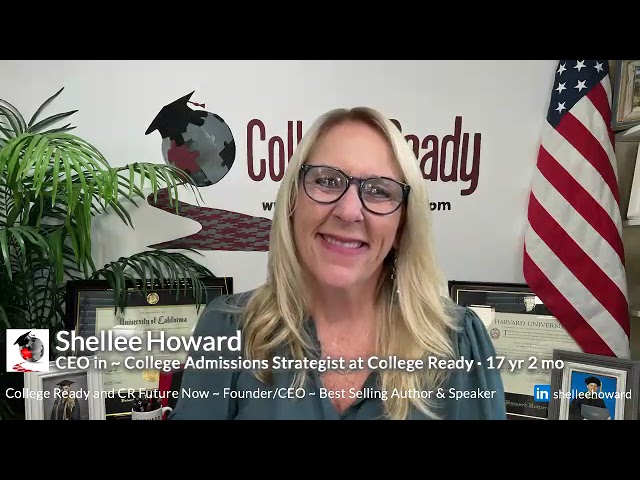
In this interview, Shellee Howard, founder and CEO of College Ready, talks with veteran educator Dr. David Samore about how parents can effectively prepare their teens for college. Samore shares his 35‑year background in K‑12 education, including experience as a principal of International Baccalaureate schools and fluency in five languages. He introduces the "3 Rs" framework—Respect, Responsibility, Relationships—as universal values that shape student behavior and school culture. The conversation then moves to concrete parental engagement strategies for middle school, emphasizing early involvement, building ongoing relationships with teachers and administrators, and fostering responsibility through age‑appropriate chores and challenges. Samore advises parents on balancing advocacy with encouraging teen self‑advocacy, normalizing failure as a growth tool, and practicing patience. Practical tips for the middle‑to‑high‑school transition are offered, such as touring the new campus, scouting bathrooms, cafeterias, and class distances, and reviewing schedules before school starts. For students with learning disabilities or anxiety, Samore outlines the legal requirement for transition meetings and the importance of a documented IEP. He also addresses parents who feel unwelcome at schools, recommending direct, concise communication with principals to assert partnership. The interview concludes with Samore’s contact information—his website, two bestselling books, and presence on YouTube, LinkedIn, Facebook, Instagram, and X—providing resources for parents seeking further guidance.
Chapters
Welcome parents to Parents, Is Your Teen College Ready? My name is Shellee Howard and I'm the founder and CEO of College Ready. And today I have a fantastic guest I can't wait to introduce to you. Dr. David Samore is with us. Welcome.
Thanks, Shellee. It's so exciting to be here because we get to talk about really important stuff, which is how best to present opportunities to kids. So I'm really glad to be here.
Outstanding. So can you share with our listeners a little bit about your background, maybe why they would even be listening to us? What do you bring to the table?
Well, I finished a career, 35-year career actually, in secondary, elementary, middle school education. So K-12 in the public school sector. Did some private school work, but mostly public school. Principal for 20 years at high school and middle school. I speak 5 languages. I've traveled pretty extensively. My mother and father are immigrants from 2 different countries, and funnily enough, they didn't teach me their languages. The 5 languages I speak were not theirs. I have been the principal of 2 International Baccalaureate schools. I have an IB diploma that I earned myself. I know what it's like to navigate getting into college. Whether it's undergraduate or graduate work. I have to say that I came from a family where college was expected, but my parents really didn't know much about how to go about doing it, even though they themselves had gone to college. Because back then, and I'm talking about the early '70s, parents didn't have the resources like Shellee Howard to hear and all the stuff on the internet, but still. Um, I learned how to navigate that, was successful with that, and so I made a career because it was important to me to help other families find success at school too.
Wow. Yeah, I mean, you would have to love what you do to be with middle and high schoolers. I mean, I, I love my career. I chose to be with them. I'm not a toddler kind of person, so we both are speaking the same language. I adore them. People think, you like that? I'm like, I would be nowhere else, right? You made your career doing it. I'm making my career doing it. But I always start with the simple question of, when you were in high school, did you know that this would be your path?
You mean when I was a student myself?
Yeah. Take yourself back.
You know, I kind of, you know, I kind of, Shellee, I kind of think I did. And I'll tell you why. I went, my last, I had a very weird sort of high school career because up until 10th grade and including 10th grade, I went to what might be called the typical high school. I grew up in Sioux City, Iowa. Of all places. But then in 11th, 12th grade, I got a scholarship to go over overseas to Britain to go to the— literally the very first International Baccalaureate school in the world. I'm not lying. And I didn't really know what I was getting into. To me, it was going overseas, and it was an outward-bound kind of school called the United World College of the Atlantic. To me, it would look like it was going to be a lot of fun. Turned out it was a whole lot of fun and a whole lot of hard work.
Okay.
And I think about halfway through that, when I realized I was facing these challenges— my European classmates, most of them were brainiacs compared to me. I had to really come from a long way. I thought to myself, you know what, people shouldn't have to do what I did. Maybe I someday can be part of helping people find, connect the dots so that their task and their path is a little easier to follow. So I think it kind of occurred to me when I was 17 or 18, I think.
That's fantastic. You know, I have 4 kids, and my firstborn knew in 8th grade exactly what he wanted to do, and he stayed the path, and he's still doing it. My second, she knew about 9th grade. My third, my stepson, He kind of didn't know and kind of just went with the flow, and he's still going with the flow. That's the third child. And my fourth, interesting enough, is studying in AAU, the Czech Republic, Prague. And so she's going for an international business degree. So I have a little perspective of what you're talking about just because they all put me through it differently. But let's talk a little bit about middle school. Let's start with, you know, when should we be— there's many different parenting philosophies. Let your kid just raise themself, be their best friend. I mean, there's a zillion ways, and I'm not a parenting teacher. I'm a college admissions specialist. But you worked in the trenches, right? You were in middle school, in high school. What does that look like from a parent's perspective? How much should they be engaged and really be part of that process?
You know, uh, there is no harder or more rewarding job, I think you and I both know, than that of being a parent, and certainly no more important job. And my wife and I, we have two kids and they're both grown men now, but I will say that being a parent is never easy, never will be. I think I was fortunate in the sense that I grew up, I was fourth of five sons, no sisters, all boys. And I think by the time I, I, I started kind of coming of age as the fourth of five sons, I was kind of left to my own devices. But I, I learned a lot in the process. And one of the things I learned, which has stayed with me,, and I think has been the basis of my parenting and my working as a school, as an educator and, and a principal, is that people really respond to 3 things. And by the way, I've discovered that the research of this actually bears out what I'm about to tell you is, is actually, uh, true as fundamental values all humans need, no matter the culture. It's transcultural. Globally, a primitive culture or a highly sophisticated high-tech culture, it's all the same. And these 3 things are, and I learned them and they were part of the fabric of my schools. Number 1, respect. People want to be respected, but you also have to respect everyone if you want to be respected. So that's one. Mm-hmm. Two, responsibility. Believe it or not, people really want to be responsible for themselves. I think we should not demand that they be responsible for other people. In other words, you be responsible for yourself. Self-responsibility. Take responsibility for your actions, and I'll take responsibility for mine. But don't pretend you didn't own it if you enacted that action. So responsibility is fundamental.. And the third thing, which a lot of schools and people kind of forget, is the relationships. In other words, everything Shellee does or everything David does impacts people around Shellee and David. And, and we can't pretend it doesn't. It just does. It impacts other people. So when you start to kind of put that in a family and then expand that to a school environment, again, these are fundamental human needs, the human values. I call them the 3 Rs: respect, responsibility, relationships. No man is an island, that stuff. That's the third one. Um, all of a sudden, things start to fall into place. In other words, there's nothing wrong with having a 3-year-old kid help you stack the dishwasher at the lowest level. Now, they may not do much, but innately All human beings want to contribute to a larger order. It gives them a sense of satisfaction and accomplishment. So for parents, if you think, you know what, I'll pay my, my son or my daughter $5 or $10 to mow the lawn, you're not doing them a favor. That's part of being a member of a working, functioning organism called a family, is that everybody contributes, and it doesn't— you don't get paid for it. Just like when Mom does, cooks a meal or takes the family out to eat or puts gas in the tank, she doesn't get paid for that. She has, she has to be, be paid. And I find that kids, they really do respond well to this at all ages, especially secondary kids, but, but elementary kids too. So, um, those sorts of lessons I I've, I implemented and, and I, uh, enforced really, but it was very easy because everybody agreed with it. When you tell parents and community and teachers and kids, guys, we're all going to do this, 3 things, it's like magic. They do not— no one disagrees because they all go, you know what, yeah, that makes sense. We, when we started to implement that in a formal way we saw discipline issues, parental stress just decline very quickly. Yeah, it was like magic.
I, I, uh, I, I, you know, I love teenagers and the more that I'm with them, I love them even more. And so listening to that, I do give them a lot of those three things with just without even thinking about it. And they do respond really well. Let's talk about as they prepare to launch. So now we're into high school and people are in, and teenagers are trying to navigate their way. I'm good at this. I'm better at that. What advice can you share with parents on how much they should advocate for their child or how much they should let their child advocate for themself?
You know, um, my experience again was, was largely secondary, but my feeling is that there's a couple of things we have to acknowledge. One is that we and kids, young people, are more capable than we think sometimes. They truly are. You know, middle school kids and a lot of the groundwork For high school success begins and is laid by middle school.
For sure.
Um, it's okay for your child to fall, even if it's figuratively, and scrape their knee. Because as John Maxwell says, many of us have heard of him, like he wrote a book on it called Failing Forward. In other words, failure teaches us something. Failure isn't a bad thing necessarily. Failure can be a great tool for us to kind of do things differently or better next time. So as a parent, A, expect failure, because in a very real way, if your kid never seems to fail, then maybe they really aren't trying hard enough. It's okay to fail if you're trying, and you can expect it. But then as a parent, it's a good idea to, to kind of recapitulate with your child at an opportune time. When you have some moments together, cell phones are pushed to the side, turned off, and you have to talk about that. You know, what happened? How did it come to that? Because that's where growth comes. So as we look into high school and we parents are, do I scaffold my child or, you know, stop them from this or that? It is a slow release. And every child's different. The question of when do I give my child a cell phone The answer is really depends on the child.
Sure.
Depends on how they start to show responsibility, how they start to show that they're using things that could be dangerous safely. So, um, the same thing when it comes to parents kind of nudging their child into some things. Now, I will say, and we haven't talked about this, but we do need to talk about the fact that not everybody's brain works the same. So we have some people, some kids that really kind of have their own rhythm and they may not fit in with a large number of other kids. And parents know this. Parents can tell. So that's where the parent has to come in. And again, it's kid by kid. You have 4, I have 2. You really kind of have to— they're different. So it can't be a one-size-fits-all in, in, in this issue. Because you might have one child that's ready to try out for everything and be— never make it on an athletic team but keeps on going to the tryouts no matter what. Okay, that's a choice they make. Encourage them. And another child who simply doesn't want to get involved and wants to sit on the sideline. Knowing your child is job one, and, and determining when they can stretch. Last thing I'll say Be prepared for their failure because it could happen, probably will. It's okay because success comes from failure. But also be prepared to stop talking. Just be there because a lot of times, and especially dads, men, and being a man, I know this, you know, we tend to get in trouble with the women in our lives because we think we want to fix everything. And lots of times, especially if it's a daughter you have, she doesn't want you to fix anything. She just wants to talk. Like, just be quiet and listen. You know, it may not require a fix. Um, and that's hard for parents is being patient and allowing that to happen. So the last thing I'll say on this is practice patience, which is so hard for parents. The good news is you get lots of opportunities to practice it.
Yeah, no doubt about it. There were so many things I'm thinking of as you're speaking, because each child is uniquely different and we have to treat them as such. And so when you're looking at when is the best time to start college, it really depends on is your child mature enough to have a conversation about their future? Some are ready much sooner than others, but the best time is like when you would go to a museum or when you would go to a library, you, you you introduce these, these things gently, and then you start to have conversation and it becomes a lot more comfortable. So what you're saying absolutely has shown true as I watch these kids launch, because we start students as young as 7th grade, but we have to make sure they're mature enough to be able to understand what a core value is and why is that important and what can they do with that core value and So let's talk a little bit about— this comes up often when a parent— so a student, let's start there. A high school student starts in the fall, finds out that they did not get their list of classes like they had requested, and they are a student who wants to go up to a top-tier school, and this adjustment may not help them get there. At what point do you— what is the path you would encourage the student to try, and at what point would the parent be welcomed or need to step in?
Well, again, as we both said, I think it takes knowing each child a little differently. Um, the willingness to accept challenge to test oneself, to try something that might be a little harder than it was last time. That actually is something that parents can start to build in their child from a very young age. You know, let's give it a shot.
Hmm.
For example, um, when people are unwilling to try something just because it doesn't look right or they heard something about it, the parent's attitude, I think, is best if Let's, you mentioned a museum, let's try this. You might find something interesting, but then the child may also say, well, great. You know, how about if I get you to try something? And, and I think a parent can show a willingness to learn and be exposed to something new, skateboarding, uh, gaming, something. It's not just a one-way street. And I think when kids see that this is a two-way street, then everybody grows. Now, When you look at the classes you get and you say, wait a minute, and again, some parents are so in tune with this particular class has this particular weighted GPA. And I want to bring up at this point, every child has what I call a different sort of— and I call it the other GPA. Now, we all know GPA means grade point average. The other GPA is the great propensity to achieve. Now, every kid's other GPA is a little different, right? Some kids, you could throw anything at them and they'll say, give me more, that's not enough, I need more. And other kids, the first challenge that comes their way crushes them.
Hmm.
Underlying all of this is accepting and seeking challenge that stretches you, even if it's not that much. Look for those things. Now, if those classes are not what you'd hoped for, this is where a parent's ongoing relationship with the school is key. It is imperative, in my opinion, having been both a dad and a school administrator and teacher, that parents become known at their school. That doesn't mean you stamp and shout. That means you attend meetings when you can. You might even call up a principal and say, or assistant principal if it's a large school, and say, you know, I'm Mrs. Gomez, or whatever your name is, um, I just like to spend 15 minutes of your precious time. I know you're a busy person. Rarely, if ever, would an administrator say, no, I'm not meeting with you. And a lot of parents don't even bother to do that. They, you know, they just think, oh yeah, he or she's not going to do it. They want to know their constituents too, their stakeholders. And I think having that kind of ongoing relationship where you might be seen at basketball games or special parent events or in the media center for early morning, whatever— all schools do these things. The more known you are so that when the time comes, you need to say, can we review my daughter's classes that she's got scheduled? Is that okay, please? Because then you're not seen as an interloper, you're seen as a partner.
Wow.
And I think you go ahead and advocate for your child and then see what happens.
Absolutely. I've seen that play out many times, and it seems to always follow that same direction, because if they know, like, and trust you, now you're just what's best for the child versus one trying to put pressure on another. So that is spot on. I love it.
Remember what I said about the 3 Rs?
Yes.
Respect, Responsibility, Relationships. It ties into that. The relationship piece, oftentimes we tend to forget about that. And as a result, then we start to— when we do need to call in and make a request, and then sometimes in our excitement as parents, you know, we get anxious, and then that comes across as— in our frustration, it comes across as angry. Then we start to have other reactions. So yeah, building the relationship ongoing is always a good thing.
I love that. So as students are now coming off of summer and they're going to transition right back to the, the next, uh, school year, what do you recommend for the transition between middle school and high school, especially if they're moving buildings, like physical, from middle school to high school? What can parents do to help their child make that transition?
Well, I, I can tell you, and this continues to happen even though I became a consultant a couple years ago, um, some of these things are simply perennial, like freshman or a new kid at high school, from middle school to high school, and it's always going to be that challenge. I think a lot of conversation to prepare the child. There's a number of ways you can do that. One is every high school that I know, every high school has a welcoming opportunity before classes begin where the new students get to come see, walk around, feel, touch, see the cafeteria, get a sense of the hallways. Oh my gosh, it's big. They get that shock, that sense of awe before the first day of school. That's job one. Two, have conversations with your kid going into high school. Preparing them for the 3 typical issues that will always occur. Number 1, where's the bathroom when you need it? That sounds stupid, I know. But when you're a kid and there's hundreds of kids, most of whom you don't know, and you think, I've got 4 minutes, or whatever the transition time is, panic sets in. So you scout it out. That's one. 2, see the cafeteria. Talk to your child, and your child can expect for the first few days, uh, maybe feeling kind of lonely in the cafeteria. They may not see a face they recognize right away, even though they're probably there because they have two different lunches and then it's a bigger place. Cafeteria, that's number 2. And the third thing is the distance. That the kids have to walk from one class to the next, maybe more than what they're used to. Now, they may get lucky and it may be very close, but that causes an anxiety among the kids. And, and the last thing I'll say, and most high schools do this, most high schools give the kids their schedules prior to first day.
Yeah.
And typically, many, if not most high schools, will actually have their orientation for the new kids before school begins.
Sure.
Where they get those schedules.
Mm-hmm.
So take the time, walk with your kid from hall to hall. You'll see other parents. Hey, you'll see friends. And that first day of school seems a lot less. Now, I will say that if you have a daughter, this is a pragmatic preparation point. PPP. Uh, if you have a daughter, she can expect older boy students. To pay attention to her possibly, which could make her feel very uncomfortable. Um, so especially moms get this, you know, dads get it differently. Uh, they, they, they get it, you know, don't ever talk to boys. I mean, sometimes you get that thing. I know what they're thinking. Dads kind of go off the deep end and that's impossible. You, you got to talk to boys. But you'll see, this is a tradition in, in most schools anywhere on the face of the earth. Older male students will focus on some of the younger female students who are new there, and they may talk to them, they may say things that may embarrass them, um, because administration can't hear everything. So prepare your daughter, especially daughters. Um, boys will feel as though they're intimidated by the kids that are 6 inches taller with beards. They're there. It's a different kind of intimidation. I, my heart goes out to my girl students because A lot of this is done very subtly. It's really hard to spot from an adult's perspective, but they can pretty much expect that to happen. So therefore, prepare them and just say, look, just keep walking. You turn around and ignore them so that they actually have an action prepared for that.
So helpful. The last question that I'm thinking is accommodations for those students who may have, right, either learning disabilities or anxiety or whatever. What is the best way to handle that integration from middle school to high school, and who should they talk to, and what would that conversation look like?
You know, it's a federal law. Um, a lot of what governs what you've just asked is really guided to us and for us by federal law, um, which is the following transition. There's always— there's meant to be, because otherwise it's actually illegal. If you've got a child who's already had a, an identified handicap of some kind, learning disability, dyslexia, whatever it may be, it could be any number of things, it is your legal right to have a meeting with— that has got teacher representatives, an ESC specialist, or a special education specialist and an administrator as kind of an exit meeting so that you have those questions kind of prepared so that when your child gets to that high school, there is a plan in place. And, you know, we all know that as, you know, the, the, uh, their learning plan. Um, so, uh, this educational plan, the LEP, is something that helps guide the answers to those questions. One thing I will say again, being known helps things happen more quickly. Okay. Um, this is where a parent really does need to— Shellee Howard, did you— to kind of be part of it, because kids, it's tough for kids to talk to adults and say, wait a minute, aren't I supposed to have an iPad that I get to take from class to class? Human error, they might forget it. So that's why a quick call or a quick email or a quick text from the parent to the key person at the school. Hey, it's, uh, Mrs. Gomez again. Did my son Jose, did he get, did he get that iPad? Just checking. Thanks very much. Have a wonderful day. Uh, again, that's the communication relationships piece.
Wow, communication is key. I mean, it's come up all the way through this. The beauty is you welcomed it, right? And not every parent feels that they are welcome at the school. So I said that was the last question, but I've got one more. For the parent who doesn't feel that they are welcome to have communication at that school, what do you recommend for them?
Unfortunately, this does happen, and a lot of it's because, um, educators tend to have their own vocabulary, just like a lot of professions— doctors, lawyers, police. You know, they have, you know, what's a 1036? I don't know, but the cops know. Um, well, that happens at schools too, and it's almost always inadvertent, but it takes someone who listens to hear those concerns. So, um, what I would suggest to all those parents that feel this way: A, it's almost always inadvertent, it's accidental, even though it feels like it isn't. Okay. 2 is really important that this is where I would say don't feel bad at all to literally call the principal up and all you gotta say these words. Okay, I think it's 4 words. I have some concerns. No principal wants to hear that.
Okay.
If they hear it, they're, they're not going to say, well, I don't want to hear your concerns, lady. It's, it's, it's one of, to me, it's, it's as predictable as this question to all male students that I've ever dealt with, the tens of thousands. If I have a boy that's, it works with some girls, often it does, but girls have all this talent and sometimes underestimate themselves, which is, you know, something we work with. And boys, on the other hand, tend to think they have more talent than they do sometimes. But if you ask a boy, look, I need you to do— you give them a challenge— I need you to sit here in this chair without actually saying anything disruptive for the next 10 minutes. And if you ask this question, do you think you can handle that? The answer is always one word: yes. Boys will never say no because you put a challenge to them. And when they ever get a challenge, their answer is always, yeah, I can do it. I'm up to it. Okay. And so when principals hear the words, I have some concerns, their answer is never go away and stop talking to me. Just doesn't, it doesn't work like that. I know principals. I am one, you know, their answer is, well, tell me about it. Well, let's talk about it. And then that's your opening, and that's where you get to come in and say— and again, parents, I would suggest, who are listening to this, if you think that you're ignored or marginalized or you're— whatever you got to say, no one wants to hear— it's okay to say that to the principal, just like I said it. You know, I get the feeling nobody really wants me to say anything or be part of it. I thought I was a partner. Aren't I a partner in my child's education? And that's another one. The answer is going to be yes. If you ask a principal that, aren't I a partner to my child's education? They're never going to say nah. They're always going to say, of course you are. And see, that's a starting point to really have something. So I would encourage all parents. Sometimes we're afraid to do those things.
Wow.
So I would say courage. You don't need to be afraid.
All right, parents, put on your armor. No, I'm just kidding. Let's, let's do this. We're going into the new school year. Thank you so much, Dr. David Samore. I am so grateful for your time. If a parent who is listening wanted to reach out to you, what would be the best way for them to contact you?
Easy to find me on my website, my first and last name, one word, davidsamore.com.
Okay.
If you go on Amazon, I've got two books. One of them is a bestseller. Again, David Samore, put my name in. It should come up with my books and there's a lot, there's a really couple of good things here for parents really to look at resources, I think. But I'm also on social media. So I'm on 5 streams. I'm on YouTube, LinkedIn, Facebook, Instagram, and I forgot one. Um, TikTok, Twitter, no, X, Twitter. Now it's called X. And, uh, 5 is enough for me. But if you put my name in on any of those streams, because I post It's always about what I— we just talked about. You'll find a lot of resources there too.
Outstanding. Well, thank you so much for your time. We do appreciate it. And parents, is your teen college ready? Because we want them to be there. And hopefully this got you a little bit closer. Have a wonderful afternoon.
More from Shellee




The 3 Questions Every Parent Should Help Their Teen Answer Before College | Featuring James McLamb

Helping Your Teen Stand Out for College Through Purpose & Impact | Featuring Aishani Sheth


From Robotics to Cornell: A Father-Son Blueprint for College Success with Aarav & Ritesh Kumar

The Hidden College Credit Strategy That Could Save Your Family Thousands with Josh See

The Truth About Financial Aid: Why Some Families Pay Less for College Than You Think with Jack Wang

Human Skills Every Teen Needs for College, Careers & an AI Future with Rob Heller
