Confident Connections: Mentoring Moms of Teen Girls with Jeannie Baldomero
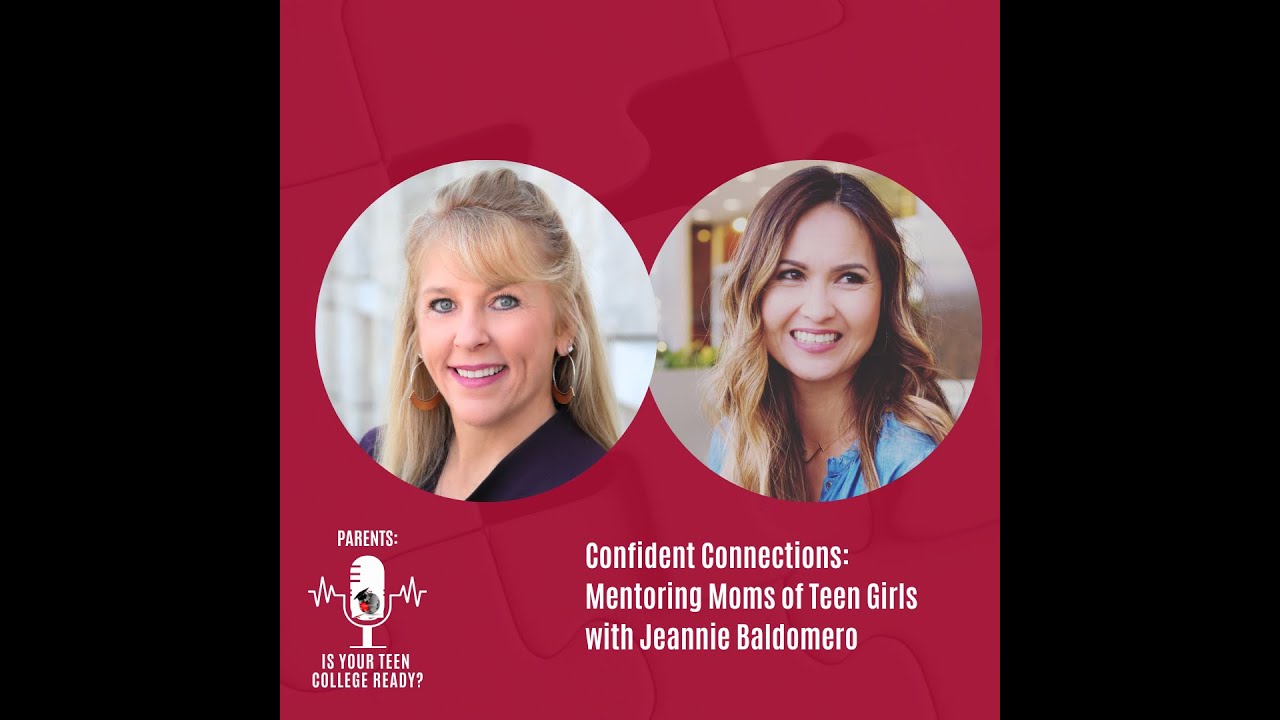
In this episode of the "Parents, Is Your Teen College Ready?" podcast, host Shellee Howard interviews Jeannie Baldomero, a former educator, mother of three, and founder of the Raising Her Confidently podcast and coaching program. Jeannie shares her personal journey—from growing up in a military family, homeschooling, and navigating her own teenage years—to explain why she focuses exclusively on mother‑daughter relationships during the tween and teen years. She explains that her coaching targets mothers, not the teens themselves, helping them shift from a directive, authoritarian style to a collaborative, relationship‑based approach. Central to her method is the "Talk to Your Teen Girl Framework," which teaches parents how to create open communication, set guardrails (boundaries with choice), and foster empathy so daughters feel heard and empowered. The conversation covers practical challenges such as eye‑rolling, indecision about future careers, and disagreements over community‑service choices, illustrating how Jeannie’s strategies can turn friction into constructive dialogue. She also discusses the emotional transition when daughters leave for college, emphasizing consistent love, grace, and maintaining connection. Throughout, Jeannie promotes free resources—a two‑day Teen Talk workshop, a free community group, and her website raisingherconfidently.com—inviting listeners to join her workshops or coaching. Shellee reinforces the need for a supportive “village” for parents raising teen girls.
Chapters
Hello, this is Shellee Howard with Parents, Is Your Teen College Ready? And today I have an amazing guest, Miss Jeannie. Welcome to the show.
Hi, Shellee. Thanks for having me on here. I'm super excited to be chatting with you today.
Well, parents, you're in for a treat if you have children, which I'm guessing you do. Jeannie is an expert, and I'm not going to steal her thunder. So, Jeannie, can you share with our guests a little bit about who you are and what you do.
Awesome. Yes, of course. My name is Jeanne Boldamero. I actually live in sunny San Diego, California, where I have been married to my husband for 24 years. We actually dated for over 30, so I know him really well. He knows me really well, and we tag-teamed for many years, 18+ years, uh, raising our kids. We have 3 kids, 2 boys and a girl, uh, 23, 21, and then our youngest, who's our daughter, 18. Uh, I am a host of my own podcast called Raising Her Confidently, and I mentor moms specifically raising tween and teenage girls. And prior to that, I was an educator. I come from a background of education. I taught younger kids in the primary grades. I specifically enjoyed primary because I was so I'm so intimidated with middle schoolers and high schoolers, and funny that I actually teach moms how to raise their teenage daughters these days. And the reason why I decided to do that, after homeschooling my kids for about 6 years and being involved in my daughter's, uh, ministry, I decided I wanted to, you know, start girls group. And I realized that moms in this age, from 5th grade to even sophomore year, were coming to me trying to figure out how to deal with their daughters. To me, they were fine, right? You know how it is, like teachers come to you and they're like, your child is an angel, and you're like, are you talking about my child? Because at home, right, they're completely different. And that was what was happening during this time. And I actually did a personal study with a group of women. You know, we, we talk about raising our kids with a village. It's also feeding ourselves in community, right, in order to be able to pour out into our children and be the mom that we're meant to be, we need to also fill ourselves. So I did a personal identity study during this time, and it really unpacked a lot of struggles that I was struggling during that time. And one of them was pinpointed towards my 13-year-old self. Everything pointed there, and I'm almost like— I was mid-40s at the time, and I was thinking, why am I being pointed and directed to my 13-year-old self. Why couldn't I get over that? Well, it was a time where my mom said, "I don't even know who you are anymore." I grew up in a military family, uh, migrant family as well. My parents did the best raising us. I tried to be the, the good little girl that was obedient. My brother was opposite. He was ADHD and off the wall, but I tried to be the opposite. I was the oldest. I tried to do everything that my parents asked. And for some reason, at 13, it was either pent-up frustrations or the lack of having my dad around. I love him to death. He's in my life now, but the military calls him off. And so I didn't have him. And I think it, it was a perfect storm of hormones, trying to be that perfect person, not having my dad in my life, that 13 just blew up in, in my parents' face. I was pretty rebellious. It was a hard, hard year, and it took years of recovery from there. So that is why I have this passion of mentoring moms, specifically raising tween and teen girls, because I want to speak to the person that's my mom. My mom that needed somebody, that needed community, that needed tools, that needed information on how to raise a daughter who suddenly she didn't know anymore. So that's where we are now.
That's so powerful. I have 2 sons, 2 daughters, and an Italian exchange daughter. So I'm surrounded by— and of course, all my clients are teens. So I deal all day long with who these parents are wondering, who is that? Like, they were this wonderful child, and now they're like, And I love all teenagers, and people think I'm, I'm crazy, but I love them all, and that's why I do what I do. So the fact that you're doing this is so powerful because parents, when we're really close to our own children, sometimes it's hard to see what's going on because it's just right there, right? Before we dive any deeper, I have to ask you, why did you pick girls Specifically and not girls and boys?
I know you would think so. I've gotten this question, uh, quite a few times because I do raise— I've raised boys. I've had two boys and a girl. Actually, it's outnumbered by boys. But I, I specifically chose mother-daughter relationships because of my own personal story and because I'm raising my own daughter. I knew this was my calling to change the dynamics of what I know my mom wanted with me that I can pass on and have this relationship with my own daughter. Mother-daughter relationships are unique. I love my boys. Believe me, I love them. There's this book called I Love You the Purpliest that describes how we love our children just the same but in different shades. So, right? And so my daughter, we just understand each other. There's this unique bond. She said this. I said, hey, describe our relationship together. And she's like— and I said in one word. She said, oh, dynamic. I was like, that is perfect. Dynamic because it ebbs and flows. Because we are so emotionally bonded, it can cut us but yet warm our hearts at the same time. And mother-daughters, you think of villages, it's the women that gather together. It's the women that surround raising other people's children that do, you know, that help with the house, that make the money, that contribute to our community. It's the women that do that together. So that is why I specifically chose mother-daughter relationships, because I know that in the tween and teen stage, it's very fickle and it's very emotional on both ends, both mom and daughter. When you think about the stage of midlife, uh, this might be TMI, but our daughters are going through hormonal changes during this time as they develop into a young woman, and we are also at that same stage where we're also changing hormonally, transitioning into menopause. And so you see this heightened variation in emotions that affect both of them. But if I could speak to the mom, knowing that you have gone through what she's gone through as a teenager, then it shifts our perspective a little bit bigger, a big picture, because our ultimate goal, and I know moms' desires, are to have a healthy relationship where they don't need to do the repair as adults, right?
Yeah. And that brought up a, a really important point is, who do you help? Do you help the parent? Do you help the teen? Do you— what, what does this look like? You know, I, I'm listening to you as a mom of 2 daughters, very different daughters.
Yes.
And I'm thinking, would you coach me or would you tell them to stop that behavior? No, I'm kidding. Or would you coach them?
You know, I've been asked, do I coach— can I coach their daughter? And my, my answer is no, because my ultimate goal is to be able to shape their daughters to embrace who they are, who their true identity is, to instill confidence, which is why it's called Raising Her Confidently. And so confidence in her to know how to, you know, put up personal boundaries and even know what boundaries are, to know her own value and worth and not to have to struggle with that. Really, it becomes— it's the relationship that you have with your mom that, that happens. I do not want to get in the way of a relationship opportunity that can connect them between a mom and daughter. Which is why I coach the mom to connect with their daughter in a different way. I think sometimes we imagine our daughters still like— think of those, those boxes that you just— old school toys that you would put like a circle cylinder into a circle hole or a square into a square hole. And most times moms are still trying to fit a square into a circle hole because now she's a circle. She's changing. And so this is where we have to shave those sides to round it out a little bit into this next phase where relating, connecting, communicating with your daughter is just going to look different and it's going to require a lot of patience, a lot of trial, and a lot of grace for both of you. You know, it's so easy for moms to shame, blame either the daughter or themselves for not having the relationship they want when they don't necessarily understand what's going on.
I think it goes back to knowledge, right? And there's no book— well, there's lots of books, but there's not one specific for your daughter, I think is the best way to say it, right? When we were little or when we were pregnant, we had this big book we could follow and figure out the stages. And then yes, young, we had lots of parenting books, and now we have the teenage stage, which gets a bad rap. And I, I, I have, I have my own struggle with that. But let's talk about for a minute, I'm listening and I'm wondering, um, do you help, uh, moms that have a good relationship and want it to be better, or do you mainly focus on the ones that Somehow they're just not communicating, they're not connecting, and the relationship is bad. What does that mean?
Yes, I focus on, uh, the spectrum.
Okay.
Right. And then of course the, the ultimate is really the ones that just cannot connect with their daughters. But I do do a spectrum of them because I think in there, in any relationship, there are, there are ways we can improve. Uh, what I teach is creating open communication and ways of creating space having them feel understood, empathy, when to let go, creating a village. And I think in any relationship, no matter how healthy or unhealthy it is at the time, they can value from any of these elements of continually to even just let go a little. You know, from a mom's perspective, you know, feeling like your daughter is— and this is, this is mine and my mom's perspective. Is, oh, my daughter's doing everything I think she needed to do. She's doing everything I've said she should do, and she's being obedient. But there's a difference between being obedient and being real and honest and having a safe space to really be imperfect, right? And I felt like— and I love my mom, if you're listening, I love you, Mama. And we have a great relationship right now, but I wasn't able to do that. I wasn't able to say, I can't do that, or I messed up, because she's felt like, because I was so obedient, like, it would be a surprise and I would feel like I'd let her down. So there are those aspects in a relationship that needs to be unraveled, you know. It's just, we want honesty. We want honesty and health in our relationships. And when things go really, really, really bad will she come to you?
Right. So question, I obviously deal with a lot of parents and their teenagers, and I'll be on a, um, a call, initial call, and a, uh, parent says something, teenager rolls her eyes. Boys don't do this. She rolls her eyes and the dynamic starts. Right. So I'm seeing this. I'm in— I'm visually seeing this.
Yes. Yes.
Is this something that you could work with a mom to help stop that behavior?
Oh, definitely. And this is exactly what I do is how does a mom help with daughters rolling their eyes? How can they have empathy with that and how because you cannot control what you cannot control. You can only control what you can. And so that is what I, I help moms through. I actually have a course called Talk to Your Teen Girl Framework where I teach you how to actually talk to your girl so that she can talk to you, not you talking to her, because I think we're pretty good at talking at our girls. But what we're having issues with or challenges with, and I noticed that a lot of moms who I've worked with have said, is the struggle is for her to come back and talk to me without just nodding her head, a one-word answer, or just telling me what I want to hear.
And that is so important right there, right? I'm gonna pause on that because the number one thing that when I'm working with new families, the struggle is my daughter has no idea what she wants to do. That's— I mean, 9 out of 10 times that, that will come up in somewhere. They may know they want to be an engineer, but not what kind of engineer. They may know law, Whatever. So I think it would be a wonderful gift if the parents, the mom and the, the daughter, could have that communication. Because when I help them, they're more than happy to tell me everything that I need to know. So what is that dynamic about that is the struggle between— is it the expectations of the daughter? Is— where's that dynamic? Because they tell me everything and then the parents like I said the same thing and they don't even listen to me.
Oh, yes. And that is like the perfect thing. Like, I just said the same exact thing. But for some reason, when you said it, they heard it. But when I say it, it's just nagging, right?
For sure.
So, well, when we think about the teen stage, we think about the hormone changes and why— why do we even have puberty? Well, it's for our children to leave the family unit to go and procreate and start their own, right? And then it can start as early as, for girls, 8 years old. I mean, it's crazy. I know, I know. And you're probably thinking, mom, with her jaw dropped, just like you're a Shellee Howard, like, they're not ready to be a mom yet. No, they're not. Developmentally, they are not. There's so many things that they still need to experience and learn in order to, to even get there. But that's biology, biologically where they're at. And Mentally, they're already thinking, I can do this on my own. They're trying to discover who they are, what their identity is. And then, you know, the storm of having to be put in the corner with mom saying, hey, we're about to have this meeting with Shellee Howard. You better know what you want to talk about or what you're going to do because we're about to talk to her. And it's like that pressure from mom and dad, even if you don't mean to pressure them. It's the unspoken word because you're mom and dad and she wants to be independent that maybe she just doesn't want to answer that question because it's her answer. It's hers. And mom and dad, you right now, you don't have any say in it, right? You don't. This is what they're thinking. Does that validate that they're right? No, it doesn't, because they're still a minor, right? I mean, like, you're responsible for them, but This is what they're thinking. It's my decision. I get to discover it on my own. I don't want you to put any input in it. So if we are communicating with our daughters and always putting our input, trying to say, hey, I think you should do this instead, or maybe have you thought about this, then it starts to depreciate her own value of what she's thinking, even if it sounds crazy. Even if it sounds crazy, because it is crazy. I mean, as she matures, she'll probably think, oh my gosh, that was crazy, but I'm so glad my mom and dad gave me the space to listen, right? So if moms and dads would love to hear what their daughters want and be able to freely share it like they do with you, then give the space where she feels like she's not going to be judged for And that takes some training. And that's what I teach in Talk to Your Teen Girl Framework, is to be able to keep yourself from putting your input. It's almost like having coffee with your girlfriend. It's listening more than giving your own opinion, empathizing more than you should do this, right? And leaving a coffee chat with your girlfriends like full. And that's what we want our daughters and our, our sons to feel, is that when they leave your conversation with you, they feel full instead of depleted, right?
Yeah. Where I see this come out a lot is community service. So we're very, um, our mission is to help a million families, um, get into college and graduate debt-free. And part of that is, it's my belief that if every child did community service in an area they would enjoy that's the big point right there, exclamation, that our world would be a better place, right? If everybody leaned into that. So where I see a lot of the, the friction, if you will, is the mom will say, well, why don't we go and feed the homeless? And the daughter's like, I'm terrified of the homeless. No, thank you. That sounds awful. And the mom's like, but I think it would be great. And then you start to see this struggle. Is that the kind of communication you can help these families navigate so it is a positive? And listening to what that young lady is passionate about and wants to serve in her community, is that something you can help with?
Oh, of course, definitely. Uh, we talk about giving choices and widening boundaries. I think sometimes we forget as parents that the boundaries we've set with them as elementary school-aged kids, we keep those boundaries or even tighten them a little bit more because you start to sense a little, I put in quotes, rebellion, when in actuality it's their way of expressing how to be independent, right? That we start to tighten these boundaries a little bit tighter, which causes more friction between our teenagers. And if we allow them, still have boundaries, I call them guardrails, widen them, but allow them choices, I think they'll start to flourish a little bit more. And we can control less, but still guiding them to what we want to do. For example, you talk about the community service aspect. It's, hey, we're gonna do a community service this week, but guess what? You get to choose which one. Instead of me choosing this month, you get to choose this month. It gives them a sense of ownership. It gives them a sense of responsibility, and it gives them confidence to know that this is what I want to do. I get to decide for the family, and you're giving me that choice, and you guys are for it.
You're for it.
And at the same time, moms feel like they're still in control because they're giving them this boundary of community service is going to happen, but you get to choose. So it's communication like that, and being able to help moms shift their roles in the parenting stage is what I teach too. It's like, hey, if you're gonna continue to, to coach with the shades of looking at your child like she's still 9, then you're gonna have a very hard time. We need to change those shades and start looking at your daughter, your son, as a growing individual who wants to become his own or her own.
And isn't that ultimately what we want as a parent? Right?
Yes.
So I love— I tell this story when I dropped off my son at Harvard and we were in the dorms and we were unpacking. All the parents were there and the moms were in tears. They were crying. And my son looks at me and he says, Mom, why aren't you crying? Why aren't you sad? And I'm like, are you kidding me? I just won the lottery.
We're at Harvard.
Hello? Yes. So I think, um, sometimes, um, it, it is hard to almost see ourself in that way.
Yeah.
So what would be the first thing, or the— if I'm a parent listening and I'm going, I wonder if, if this would be helpful to me, is there like a quiz they can take, or how would one know that they need somebody like you to step in and guide them?
You know what, uh, perfect timing. First, it's listen to Raising Her Confidently and gather the information and see like, oh my gosh, I've tried some— because I— what I do is I really give you practical steps. But I also have a free, uh, 2-day Teen Talk workshop that is happening beginning of November that they can go and get educated, learn how to learn about the teenage stage and how your girl is just changing, so that it gives you a sense of understanding. Because that's really what girls and teenagers really want is a sense that they're understood and that they're seen, right? And then we're also going to cover, you know, shifting your role as a parent. Like I was just talking about earlier, it's no longer trying to fit the square into a circle peg. We need to be that circle that fits into the circle peg so that we can continue to parent, guide, help our daughters through this teen stage while developing a budding friendship that happens. Because, you know, I've seen so many times where girls have been obedient. Moms are like, oh, she's just so great, straight-A student, doing all the things, never in trouble. And then all of a sudden, turn college, completely different person, doesn't want to talk to parent because it was all this pent-up aggravation. Like, I can't wait until I'm an adult so I can get out of here. We don't want that from our kids. We don't want our kids to say, I can't wait to get out of here because I don't want to have anything to do with my parents. Really? We want them to leave and be independent, but we also want to have a relationship with them. So it's really shifting that role and then creating communication pathways in this stage. I'm going to teach you what your daughter needs in this stage so that you can openly communicate together so that she's coming to you when she's scared, when it's hard, all the things, not just the surfacey stuff, but even the hard things that I know moms truly want to know about. So that's what's going to happen. And if, if you guys are interested in that, you just go ahead and go to jeanniebaldemero.com/teentalkworkshop, totally free. And it's for a way for you to learn and see if this is something you want to move forward with and jump into my course or in my coaching.
I love that. You know, it's, it's good to— we don't know what we don't know. And that's why I love having you as a guest, because I didn't even know you were— there was somebody like you out there. Um, with my first daughter, it was super simple. Um, we had great communication. She's an awesome communicator. And with my second daughter, totally different person. So I, I know it wasn't a me thing, but it was a how do I communicate to that child?
Yes.
Or that young adult. So let's talk for a moment about, um, they are now in high school, they're making choices, and they're going to be leaving for college. And right, as a parent, we want them to come home, um, hopefully, and be nice and loving and wonderful. And that dynamic changes once they live on their own. There is no changing back.
Right.
What advice or words of encouragement can you give to a mom so that her daughter will want to come back and want to spend time when it's a choice? It's not something they have to do anymore.
That's very true. Actually, I sent off my daughter. She's a ballet dancer, so she trained early. I sent my daughter off at 17 last year to go and train in a different state, and this year Now she's 18. I, I honestly see the difference between 17 and 18. It's like this little switch that automatically gives her permission to be her own. And she now is in a different state. But we communicate every single day. And it was her choice to do that, her choice to call me while she's brushing her teeth at night and washing her face to do have a connection point. And I think one thing that we've done is maintain that open communication. That we've said to all our kids, even if you think that we won't want to hear it, we would rather have you share it with us because we will still love you. Will it be hard for us to hear it? Yes. But will we shun you or not love you for it? No, because you are our child. You will always be our child, even when you're an adult. But we value what you have to say. Because we want to be your friend. We want you to come to us for wisdom. And it's not a one-time thing that we said, hey, we want— and then it's like, oh, okay, let's do that. It's a chain of reactions, a chain of actions that we have done since the beginning. Okay, were we perfect at it? Was I perfect at it? No, I was not perfect at it. Okay, talk about like going through the transition of menopause. I was raising my teens during that stage. So no, I was not perfect at it. But I have learned a lot. My kids have taught me a lot. And one thing is to know that they— that no matter what they do, that you will still love them, right? It takes a lot of grace. It takes a lot of patience. And words can only say so much. It's your consistent actions that will say that over time. It's your consistent actions that will say it over time. And if you mess up like I have, Are you quick to apologize?
Right.
Because you are human too.
Right.
So that would be my advice, is to know that. Do you know that we love you no matter what?
That's beautiful. So one final thought is there's two sides of thought. We don't want to be our child's friend. And the other is my house, my rules, da da da da da, you know.
So there's—
okay, so, um, I'm not, uh, telling people what is right and what is wrong. That is for you to choose in your own family. Um, are you able to help both of those mindsets and without, without having that parent feel, uh, uncomfortable in how they want to raise their child? Because there are some people who are like, but they're not my friends. They— they're— this is my way or the highway. So how can you speak to that?
Oh, my husband's that way. We have different parenting styles. I mean, there's an episode in Raising Her Confidently where I have my husband on and we talk about how important it is to communicate and still value our different parenting styles. Right? So, and, and what our boundaries are when communicating with our kids, and to also respect each other's parenting styles. Um, there's this great quote by Mark Grigston. Uh, he's the author of Tough Guys and Drama Queens, and he has a ranch that helps troubled teens, and they live there and they work there, and he works with them. And this is one of my favorite quotes. It's actually on my website. Um, truth With judgment pushes kids away. Truth with relationship draws them to you. So we can think truth and equate it to authority, authoritative. And then we think relationship as grace, friendship, right? And the beauty of this stage of tween and teen stage is we have this crossroads where I think raising our kids— and I explain this in our workshop if you attend, uh, about our roles during the early years, how it could— it's pretty much authoritative, you know, we have to set the ground rules, we can't let a 3-year-old do whatever he wants. I mean, he might die. And but there comes a time, right, where naturally our teenagers want to explore being independent and rightfully need to come into their own identity. And this is where relationship and how we relate to our, our daughters matter. Now, do we become their bestie? No, because you will gain zero respect, lots of confusion, and when you really need them to do something, they will not listen. Now, do we remain that disciplinary and authoritative mom of a 3-year-old? No, because we cannot treat our teenagers like a 3-year-old. So there's this happy medium that I teach about, and That's really becoming a coach. And I teach— if you join me on this workshop, I teach you what that looks like because there's this happy balance of authority and relationship. You cannot have authority without relationship, and you cannot just have relationship without authority. So it's a good mixture of both. But I know the how is very hard, which is why I teach it, because I think it's so important. I do. I have a spectrum of moms., that come with trauma and are deathly scared to give consequences to their child. But helping them realize that your definition of what a consequence is might not be a healthy definition of consequence. And let's unpack that. Sometimes it's there. I'm not a therapist. I'm going to tell everybody I'm not a therapist. But sometimes unpacking that helps reveal why we think the way we think. And if we can take that lie that is no longer true in our lives and replace it with something healthy, I think it matters. I think authority and relationship can be healthy together. It's just how we see it.
For sure. Yeah, I love that. Well, if, if a parent is listening and they're like, I need this, how can they reach out to you?
Sure. You can find me at raisingherconfidently.com. That's where I have all my information. I have a free group you can be a part of. I believe moms need to be a part of a community. This can be a very, very lonely place raising a teen girl, especially if you have friends who teen girls might be thriving. It's very hard to share that, so I get it. I also have my podcast in there with lots of information that I give through the podcast, as well as information for the upcoming Teen Talk Workshop that I would love to invite you to be a part of.
Outstanding. Well, thank you so very much for all of your time, your wisdom, and just, you know, your, your ability to say it's going to be okay and we're here to support you. So thank you for being on the show. And parents, I encourage you to take advantage of these resources because it is a village. We can no longer do this alone. So thank you so much. Until next time, well, have a good day.
Thank you, Shellee Howard.
More from Shellee




The 3 Questions Every Parent Should Help Their Teen Answer Before College | Featuring James McLamb

Helping Your Teen Stand Out for College Through Purpose & Impact | Featuring Aishani Sheth


From Robotics to Cornell: A Father-Son Blueprint for College Success with Aarav & Ritesh Kumar

The Hidden College Credit Strategy That Could Save Your Family Thousands with Josh See

The Truth About Financial Aid: Why Some Families Pay Less for College Than You Think with Jack Wang

Human Skills Every Teen Needs for College, Careers & an AI Future with Rob Heller
