Do you have a passion for The Brain? Cognitive Neuroscience? Check out this interview.
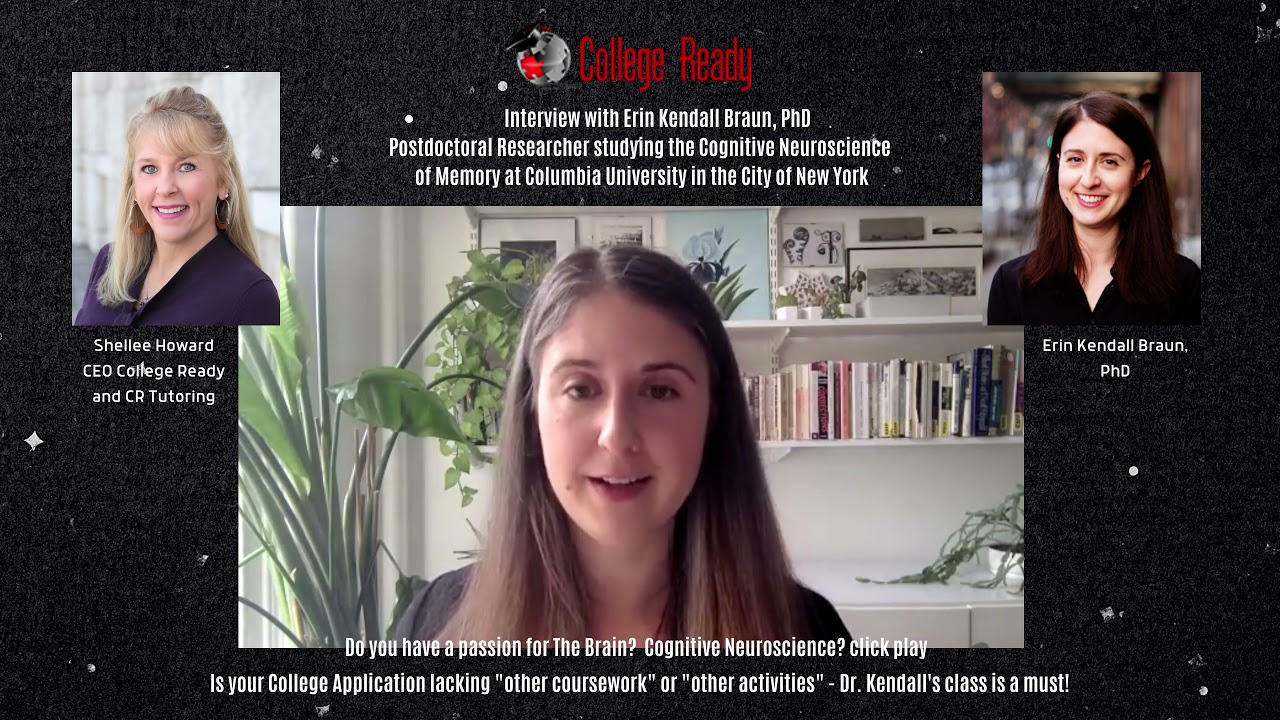
Dr. Erin Kendall-Brown, a cognitive neuroscientist from Columbia, designed a 6-week course teaching high schoolers how to study using brain science. Weekly lectures cover learning principles backed by neuroscience, with experiments and journaling to build metacognition. Students who master these techniques improve grades, sleep more, and strengthen college applications.
Chapters
Good afternoon. My name is Shellee Howard, and I'm the founder and owner of College Ready, and I'm so excited to share a huge find that I have found for you, my family and students. Today, I'd like to introduce to you Dr. Kendall, who has so many impressive accolades. I'd like to have her share them. So, Dr. Kendall, welcome, and can you please share with our students who you are and how you ended up in this world.
Hi, Shellee Howard. Thank you so much for having me. My name is Dr. Erin Kendall-Brown, but everybody calls me by my middle name, so Dr. Kendall is good. I was— am a cognitive neuroscientist, which is to say that I studied psychology and the brain and the intersection between those two things. I have a PhD from Columbia University, and now what I do is I take what we know about things like learning, memory, decision-making, which is where my research was, And I help students use that information so that they can learn how to study more effectively and efficiently so that they can get top grades without feeling so burnt out and scattered and just stressed out all the time.
Oh gosh, I wish I would have known you. Do you hear that often?
Yes, yes, sometimes it comes up.
So I mean, how is it that nobody else has taught our students to do this? And how did you get involved in this area?
Yeah, so I graduated summa cum laude from Columbia University as an undergrad, and I managed to do so while working in a top-tier research lab, getting, you know, tip-top grades, having fun with my friends regularly, and getting a full night's sleep almost every night. And the way that I did that was not because I was necessarily so much smarter than everybody else, but because I learned how to study really, really efficiently. And I just kind of figured it out, like, sort of like the secret unlocking of how to get great grades without, you know, making my entire life miserable. And so when I then went on to grad school, also at Columbia, I got a PhD and I studied learning, memory, and decision-making. I was just really surprised over and over where these tricks that I thought were entirely like something that I had come up with, that they were really rooted in like what we know about how the brain works. And so now what I do essentially is help students learn how to study more effectively, which is say usually much more strategically, not so haphazard, not just like rushing to deal with whatever the next crisis is. I feel like a lot of the advice out on the internet tends to fall into one of two camps. It tends to either be done by some academic who hasn't themselves been immersed deep into a classroom in a long time, so the advice that they tend to give tends to be way too complicated, and while it works really well, it's unrealistic to actually implement in the world. Other advice tends to just be kind of flimsy and useless. So what I really think I offer is an understanding of sort of creating a toolkit that students can use to figure out what works best for them, guided by the information and science and the scientific rigor, but with a heavy dose of let's be realistic about how many hours in the week and let's try to sleep for as many of them as possible.
Wow. I think sleep is something that all students can tell me that they would like more of, not less of. So as you think about studying more effectively, it gives you more time to do other things that you would like to be doing. So does that mean that I would have to study less hours if I followed your recommendations?
So I think when I talk about what does it mean to study more effectively, I think it's usually operating on two different dimensions. The first dimension is just do things in less time. The second dimension, though, is to have the time, the space, and the energy to actually go more in depth on things that you really care about.. So for me, when I was in undergrad, it really was digging into the psychology and the neuroscience classes. So for some classes, I think, you know, Music Hum was one of them, you know, it was just about how do I get an A in this class in as little time as possible. I'm not such a musical person, I just had to do it. Other classes though, for example, one was a seminar on learning and memory. I loved the topic, I wanted to do all the extra readings, and because I studied more effectively, It gave me the time and space in my schedule to do that. Now, some people are like, well, why would I want to do that? I actually, because of that, I got a volunteership in a lab, which is a research assistant position that I also got to have time and energy to invest in, learn a ton of practical hands-on scientific skills, which then went, and when I graduated, the professor in the lab actually just offered me a job, which is the kind of the gateway job to getting into grad school. So because I was able to study effectively, it gave me the opportunity to really show off in classes that really sparked my interest, and that is how doors get opened. And having the opportunity to, you know, invest your time in an internship and really show up there, or, you know, do research in a lab where you are networking with real scientists or real doctors, or, you know, whatever your passions and interests are, having that extra space in your schedule where you feel like you're in control of your schedule is really the, I think, the key to getting the most out of your college years.
Wow. I mean, if I only would have known, it would have saved me so much heartache. So I love that you're, you're willing to do that. Now, if we have students that would love to learn from you and to, you know, before they leave for college, figure this out, I, I, I am blown away to think they don't offer this, but they don't. So if a student wanted to learn this and the cognitive neuroscience portion, ultimately, are you saying that these students would be better prepared for college?
Absolutely. I actually— I think this is the course that I— to be very honest, I was a student who didn't struggle so much in high school. And I didn't really need much of a plan. I just sort of did whatever was like the next most urgent thing. And I was just fine. It worked. It was a not a great plan, but it turned out okay. Um, but the problem is, is that all of a sudden I showed up to my first day of my freshman year and I did not have the study skills, um, that a lot of other students had developed. In college, there's a lot more reading, there is a lot less structure in the day, you're taking fewer classes, but at the same time that leaves hours and expansive times open. There's like not so much direction on exactly the steps that need to happen to get the grade that you want. And so this— let's just say that there was a crash course in figuring out how to study. Really was not the most pleasant way to spend my first semester of freshman year. And this course is really sort of like a love letter to my senior— my high school self. It's basically the class that I wish I had been able to take before I started college. So whether you're struggling right now or not, I think a lot of students could really, really benefit from having the skill set down pat.
Yeah, so when we talked about what it is that you do, and I, I was thrilled. I mean, I'm like, not only do I wish I would have had this, I wish my own kids would have had this. Now you're willing to offer it to our students, and we are so grateful. So can you go a little bit deeper into the class itself? Now, before you do, So I don't mean to cut you off. I want to help students understand why they want to do this other than make themselves a better learner and make college easier. Because from my perspective, everything's about the college application. Now on the college application, there is a section— and I have to use my little notes here— on the AP app, it's called Other Coursework. On the Common App, it's called the Activity Section. The class you offer fits brilliantly into both of these sections, which are really hard to find. And that's why I found you, and I want to share you. So can you tell students if not only would they make their application better for college, what else could they get from this class?
Yeah, so my goal for this class is that students understand— basically have the toolbox that they need to begin college. That's things like, I think one of the big and most important skills is we talk a lot about what's called metacognition or meta-learning. It is an executive function that is basically a very fancy way that scientists say your ability to think about your own thinking. So meta-learning is essentially how well have I learned this information or what information do I know, what information do I not know, and using that information, it's basically learning how to be hyper-strategic in what you're learning and sort of guiding your own learning process, not being sort of a passive student. So what I find is that a lot of high schoolers, which I think is still a process of just regular development, is that they feel very passive in their lives in a lot of ways. It's like, well, my mom, dad said this. This is what my homework assignment is. This is like I'm just responding to what people are telling me to do. But in actuality, by the time that you're in college, you kind of get to be the captain of your own ship. But that means that you have to be aware of kind of what's going on in your head or your metaphorical ship so that you can be making the most of that. And really, that's a huge aspect of what we cover in the course.
Wow. It sounds fascinating. So, you know, the logistics of the course, is this a one-on-one? Is this a group class? Can you give a little bit more wrapped around that?
Yeah, so, uh, the course is 6 weeks long. Um, I could download it all in like a 2-hour spiel, um, but I have found over and over that while students can take all that information in, it usually takes at least 6 weeks or so for students really to begin to implement those, um, things that we're talking about and make them habits. So students must be in school of some sort, or at least taking some class when they take this course, because what we're going to do is at Every week there is a lecture/discussion. And in the lecture/discussion, what we do is I talk about neuroscience and psychology. So we're just trying to understand where— what our psychological processes are as they relate to cognition and also how the brain supports those. Then what I do is from those things that we learn, we extract principles that you can use to guide your own studying. And then what I usually do is after that, there's oftentimes another section where we just kind of teach a little bit more about the brain, and that allows you to then practice and implementing what we just learned. So there's sort of this kind of cycle of learning something about the brain and then thinking about how we can apply that. Additionally, there's always time for calm discussion. I really think that critical thinking is a skill that is so important, and so what we can do is use both students' personal experiences and also what we've talked about in class just to practice having a high-level critical thinking discussion. And that's something that we practice. We start off kind of easier critical thinking in the beginning of the course, and we gradually make that more difficult. So that's a skill that, you know, is learnable. So that's what we aim to do. Now, in addition to the time actually spent in class each week, there's a little bit of an assignment or a homework project, or sometimes they call them experiments. And for each of those, What I do is I try to take usually some aspect of metacognition or something that's going to help you improve your metacognition, and I just want you to try to implement that throughout the course of your normal studying. So you— it doesn't really take very much more time. It's just kind of pausing to think, okay, what am I doing right now? Was that effective? Was that not effective? Where did I do too much? Where did I do too little? And then we— I have you write that down, and when we come back to the next lecture or next class, what we do is we sort of sit down and we workshop about everybody's different experiences and talk about what worked really well for one student, what worked well for a different student, and try to develop again a toolkit that students work for them and their personal style. There's a lot of times where it's like, oh, this technique was really great that I know that I'm having this problem, but oftentimes what we can do is come up with multiple techniques for dealing with it. The last component is a journaling component, and journaling is a great low-cost, easy, you can do it anytime opportunity that students can just kind of pause and think about what they're thinking and feeling. And that there's something magical about putting your thoughts and your feelings and where you're stuck and what you've tried so far and why it's not working. You can also be really angry and nobody's gonna know and you can kind of like get out your feelings. But once they're on the page, it makes it really much easier, I think, to see what you're thinking and kind of think about it like, how would you recommend a friend deal with this? And kind of as soon as it's out of you, it, it's really helpful for thinking about your problems in a different way. So I think it's a great habit to employ, especially while you're learning how to think about your own feelings and your own thoughts. So those are the main components.
Wow, I'm just so blown away. You know, as I am listening and I'm matching students in my mind with who would be a perfect fit for this class, is there any certain student that wouldn't be a good fit, or are there students that typically do better than others, or is everybody going to benefit?
I think any student who's really motivated and wants to learn the material and actually employ the techniques and at least experiment with them— I'm not saying everything's probably going to work for you, but at least give it a, you know, a good try and see how it works and be open to receiving information and getting feedback. Any student who's really motivated, I think, is really going to get a ton out of the course.
Outstanding. Now, you know, students are feeling a little down or disappointed about the pandemic. And I tell them to take lemons and make lemonade. That's just my constant mantra. Are there any top tips you can give students who are struggling with this pandemic?
Yeah, so the main complaints that I've heard from my students is that they're just feeling a lot more distracted and less motivated than usual. And so before I, you know, go into actual tips, I just want to highlight that those are two symptoms of depression and other mood disorders. I know that teenagers are just extra susceptible to kind of having a first diagnosis of a mood disorder, and the stress of a year-long pandemic is also likely to have sort of create a situation where incidences of mental health problems and troubles are higher than they are usually. So my first thought is that if you— if students are really experiencing a lack of motivation, sort of the difficulty getting going, sort of feeling kind of brain foggy, that might be something to definitely check in with a parent, another trusted adult, or a doctor. Just because if you're not in a mentally healthy place, nothing else is going to help, right? So take care of your mental health first and foremost. The second thing is, I— okay, so usually what happens in school, right, is that you have a class Let's say you go to your math class first. And then you get up and you have a 5-minute break where you go chit-chat with your friends. You talk about what just happened. You have a little bit of gossip. You go to your locker. You pick up some stuff. And then you go to another room and you sit there. It turns out that the context we're in are really, really important for binding memories into like a basket. So the fact that you're in a math room where you always study math, that actually is going to help you take all of your math memories and study and sort of compact them into one memory. Now then you move on to your next class, let's call it your social studies or what have you. Again, you're going to be in a social studies room. There's all the social studies imagery on the wall. And that is actually going to help you take all of your, the memories that are associated with that class and like put them all together. So one thing, this is basically called something like context-dependent memory or context-dependent learning. You're not, most students who are sitting in front of a Zoom screen all day are not experiencing those context shifts And both the break, the chit-chatting with your friends, and the context shift are all really, really helpful for helping you remember that information. So that is something that you can kind of artificially reconstruct. And so especially for classes that you're finding it hard to study for or you struggle with a bit, if you have another space in your home or even in your room, you can like shift around somewhere else, is that give each class or at least the classes that you struggle with their own space. And that's just going to let your memory take care— take this idea of context-dependent learning and let it do what it's good at. So that is one kind of simple, easy technique. Another thing, though, is that you have hopefully 5 minutes or so between classes. This is not a moment that I would recommend checking your email or sitting at your computer or staring at a screen anymore. If you can get even just a little bit of exercise moving around your house or your apartment, that is really, really good for just creating a break and letting your mind actually replay without you thinking about what it's thinking about, what just happened, and help it consolidate all that information. Tip number 3 is that we're used to having a lot more social interaction when we are in school. And that can be really, really important even for the introverts amongst us. So one thing you might consider is if your school is all on the same schedule, is just take those 5 minutes Get on a group phone call, throw it all up and have your gossip. Talk with your friends, clarify if you had any questions that came up in the past class and be like, eh, did anybody catch that? I was confused. And oh, did you see so-and-so's hair? Did you? Like whatever it is, like that sort of social interaction is really, really important, but students aren't getting it. And there's no reason for you not to just, you know, go old school, put everybody, 3 friends on speakerphone and like have a good bit of a walk around in the chat. So that's kind of one set of information, one set of techniques. Another thing is with the focus and the distraction aspect. I think students overestimate their abilities— correction, I think all people overestimate their abilities to pay attention when there's distractions. And so we all know what our good distractions are and sometimes we can convince ourselves that they're like helpful. So for me, my big distraction is usually my inbox and my email and I'm like, well, I have to check my inbox because of, you know, work. But in actuality, I probably don't need to be checking my inbox every 7 minutes. Likewise, your phone is probably a big source of distraction. You probably whatever. So what I really, really recommend is doing an audit of the things that distract you when you're studying and then come up with a very concrete plan to deal with all of them. If you're still dealing with distractions, it's actually a skill. Your ability to pay attention for periods of time is a skill that does increase with practice.. And so if, for example, you're studying and you have control of your time and you can't really, you know, encourage your teacher to abide by this, but be like, all right, I just focused for 8 minutes straight today. I'm just going to focus in 8-minute units. That's just where we're at. So I'm going to do 8 minutes on, a couple minutes off, 8 minutes on, Harry Styles dance break, you know, a couple minutes on, you know, a little Lizzo, whatever it is, pick your thing. But just like basically get into a habit of like taking these micro-breaks every you know, after 8 minutes. The next day, be like, all right, I'm going to put a timer on. Now I'm going to do 9 minutes. And then slowly let it— don't rush yourself. This is one of those things where you— it's a pandemic year, you're gonna have to be patient with yourself. Slowly increase it up to somewhere probably between 25 and 35 minutes, at which point you probably want to take another break, just because you'll be able to study longer if you take short breaks more frequently.
Wow, that— I mean, I already feel like I need to make some changes. So thank you so much. I am so grateful that our paths crossed and that I have brought you into the world of helping our students get into the best colleges. What a role model you are for all you've accomplished. So thank you for joining us, and I will post for the students, uh, the day, the time and the details. I just want to thank you again for sharing all that great information.
Well, thank you again for having me, Shellee Howard. I cannot wait to meet your students. I really do love teaching, and I love watching students grow and transform and learn and watching their executive function skills that, you know, sometimes adults like to, you know, remind their teenagers that they don't have. That is a skill that can be grown and developed, and that is something that I really, really love doing with students.
Fantastic. Thank you so much.
Take care. Bye-bye.
More from Shellee




The 3 Questions Every Parent Should Help Their Teen Answer Before College | Featuring James McLamb

Helping Your Teen Stand Out for College Through Purpose & Impact | Featuring Aishani Sheth


From Robotics to Cornell: A Father-Son Blueprint for College Success with Aarav & Ritesh Kumar

The Hidden College Credit Strategy That Could Save Your Family Thousands with Josh See

The Truth About Financial Aid: Why Some Families Pay Less for College Than You Think with Jack Wang

Human Skills Every Teen Needs for College, Careers & an AI Future with Rob Heller
