Helping Your Teen Choose College with Purpose, Not Pressure : Insights from a College Strategist
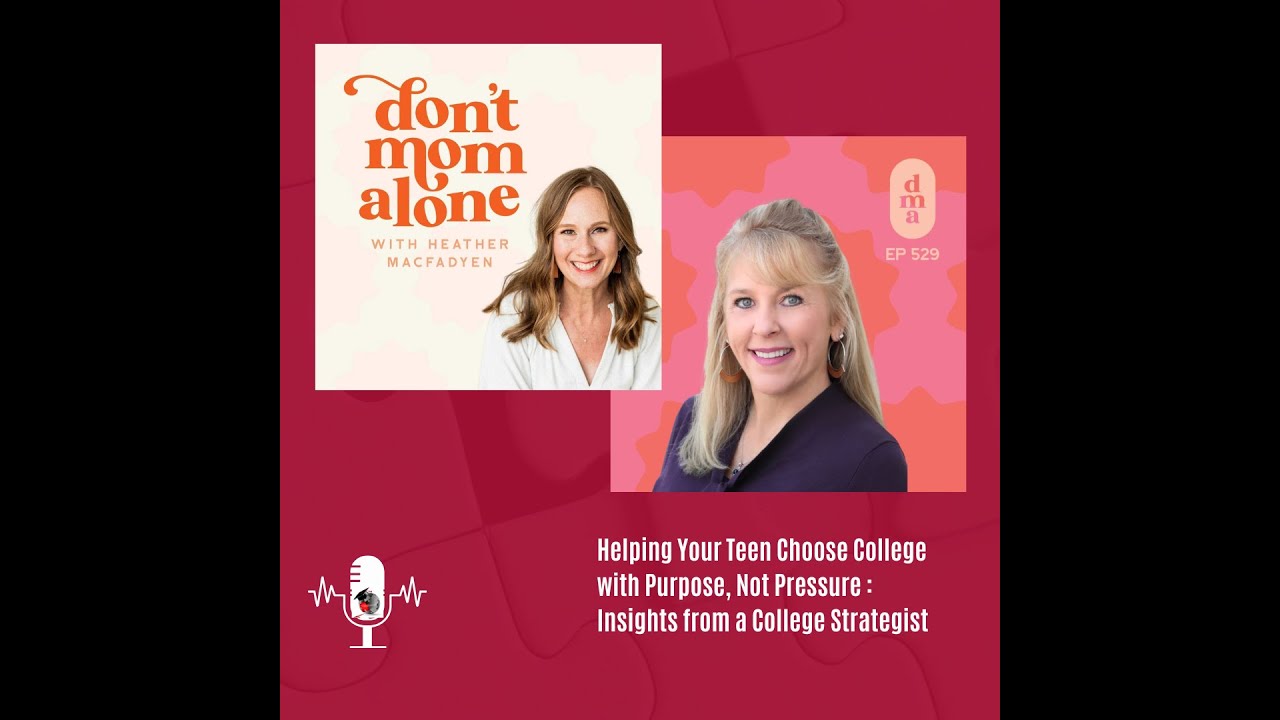
In this episode of the Don't Mom Alone podcast, host Heather McFadyen interviews Shellee Howard, founder and CEO of College Ready, a college‑counseling service that aims to help families navigate the college‑selection process and graduate debt‑free. Shellee shares how her own experience helping her firstborn become an orthopedic surgeon sparked a 17‑year career in college strategy. She emphasizes the importance of early self‑discovery through core‑values assessments and high‑school assessments that identify top career and major matches, even projecting future earnings and automation risk. The conversation covers how to evaluate college fit versus prestige, the role of campus visits, and the need to start planning in middle school rather than waiting until junior year. Shellee outlines financial‑aid strategies, including understanding the student‑aid index, negotiating scholarship offers, and treating college admissions like a real‑estate transaction. She explains how the modern application is a “marketing story” that must align essays, extracurriculars, leadership, and service with a student’s values. Common pitfalls are highlighted: procrastinating, over‑loading activities, neglecting essay editing, and misuse of AI. Shellee also points to lesser‑known schools that may be a perfect fit, and stresses the parent’s role as an advocate and negotiator. Throughout, she balances practical advice with encouragement to keep the process purposeful rather than pressure‑filled, and provides resources such as a free 30‑minute consultation, her books, and online assessments.
Chapters
Hey y'all, welcome back to the Don't Mom Alone podcast. I'm your host Heather McFadyen, and this is the place where I get to walk alongside you and connect you with people and resources so you know that you don't mom alone. And in this episode number 529, I'm welcoming to the show Shellee Howard.
The questions that they're going to have to answer are digging into who they are, what matters to them, and are they advocating. Well, if a child doesn't even know who they are, one, that's going to be really hard, but two, how will they know what career, what major, what is their long-term and short-term path? So we start all of our students with a series of high school assessments to help them figure this out. We can get them to their top 3 careers, their top 3 We can even tell them how much money they'll make 5 years out of the— out of college, and if a robot will be doing their job when they graduate.
Shellee Howard is the founder and CEO of College Ready, where they offer college counseling services so your student can graduate debt-free and have the expert guidance you may need, especially if this is your first child going off to college. Shellee has got into this industry because of her own experience with her kids, and she's here to help us not just know how to fill out an application, but really focus in on your child and their core values and helping them know what they want in a college, and then also recognizing the business of college. And she's going to give us lots of tips and helpful advice, and there's so many great links in the show notes that you need to check out. I love her personal values assessment link that she shared with us, and there's even a college-ready questionnaire that she offers. So go check out those links in the show notes. Let's get right to it. Here we go. Shellee, welcome to the Don't Mom Alone podcast. It's so good to get to chat with you today.
Thank you so much for having me. I'm anxious to share what I can to support your mamas.
Yeah, it's been so interesting. We've been doing the show for, I don't know, almost 12 years, and there are some moms who have grown alongside me. And while I used to talk about potty training, now we're talking about college. And I told you we've done an episode on FAFSA, we've done an episode on how to get through your senior year. And I know as a mom of a current junior that the summer before senior year is when a lot goes down when it comes to college applying and deciding where to apply. And so I'm thrilled to get to pick your brain for free, y'all. I get to ask my questions selfishly. Um, but tell us a little bit about yourself and how you even got into becoming a college strategist, which is a cool title.
I'm happy to share. I'll give you the condensed version because that could be a podcast in itself.
Yeah, right.
Um, it actually all started when my firstborn came home from 8th grade this time of year in spring. And he's like, "Mom, I know exactly what I want to do when I grow up. And I want to go to one of those Ivy things and I want to be a brain surgeon. Can you help me?" And it was quiet. And I'm like, any good parent, "Sure, honey. I will absolutely help you get that done. No problem." And he walks away. And that's what started this whole process. That young man's journey is why I've been doing this for the last 17 years. He turned 31 yesterday and he's an orthopedic surgeon. Oh, it is crazy, moms, how fast this time goes.
But here's the deal, the 8th grade boys now, have you heard of brain rot?
No, is that a phone thing?
It's like their own little language and they just like are quoting TikToks and YouTube Shorts. And I can't even imagine if, if I had an 8th grader come home and say anything about wanting to be anything besides a YouTuber, or you know what I mean? Like, I love that the age that your son was, he had these big, you know, I don't even know the right word, great goals, and then you helped him achieve them. That is very exciting. I love that.
Yeah, so the story goes, I panicked just like any other good parent, right? And I, I started doing my research. Now keep in mind, this was 17 years ago.
Yeah.
And it wasn't, uh, you know, uh, so much information on Google. It wasn't as accessible. It was very frustrating, honestly.
Yeah.
And so the more I dug, the more frustrated I become. And I went to his high school counselor, and this is not a bash on her at all, is she said, why would you waste your time or money being a doctor? They don't make money anymore.
Oh gosh.
And I knew this mom had to advocate for her child So I went back to school and I got my master's degree. Then I went back to school and I became an independent certified college consultant, started touring 25 colleges a semester. He had 7 full-ride offers and went to Harvard for free. So you look shocked.
I'm— my mouth is— yeah, my mouth has opened up quite a bit, y'all. If you can't, you can't see, but And some of you are like, wait, I have to do that? No, she's not saying you have to do that. And then she's not saying— yes, but that's amazing. That is— you're a go-getter.
Well, you know, I am an entrepreneur. This is the 7th business I've successfully started. And College Ready, all of my businesses have come to me. They just landed right in front of me and I just chose to pick them up and go. And like you said, parents, you don't need to do that craziness. I spent 30 hours a week on top of my full-time career figuring this out for 4 years. And yes, did he have lots of opportunity? And yes, he did what I asked. Let's be clear, I have 4 kids. I know that that's not a normal thing for every child out there. So there's a lot of caveats to what happened.
Yeah, no, I get that. And, and firstborns, very unique individuals in themselves. Yeah. And like you said, the timing of it versus now, and it's the challenge.
It—
you're in the industry, you've been in it 17 years. Can you talk to the mom about the changes in the competitiveness and just this intensity around applying that I— that all my, all my mom friends are like, it wasn't like this when we went to college. We just picked a place and applied and went, you know.
Right. And so we could look at it two ways. We could look at it, it's, it's harder, it's more competitive, it's more expensive. I like to kind of flip that on its head and look at, there's so much opportunity for these young people to do great things. My son and I got to travel to Kenya together to do a, a service project to help him figure out why he wanted to be a doctor. Like back when I was in high school, a long time ago, I didn't even remember applying to colleges. It was that easy. I think I picked 2 schools and put a stamp on it and it was about it. And I got into both and I'm like, I remember my dad going, that's really expensive. And I think it was like $2,000 a semester, like ridiculous, right? And so I look at it this way, parents, is our students have a wonderful opportunity of resources. It's helping them figure out who they are, what matters to them, their core values, their advocacy, and then leaning into that and helping them be great on their own. It doesn't really matter, college or no college, you still want to do this for your child. So I look at a little unique versus you're good at math, go to MIT and go in debt. That's not our strategy.
Yeah, I love, I love that you pair finding a good fit but also a lot of information that you have to offer parents on scholarships and not going into debt over college, which is huge, huge, huge. Let's talk about, because I am in this season of having a junior and we've did some college visits and not everybody even gets to do that, right? Like, that's expensive. That was his spring break. I mean, lucky dog. But you might have a kid who knows exactly what they want to be when they grow up. You may not. And then again, with the influence of social media, they may have seen a TikTok and that college looks really fun. They have— SEC is so popular because of how much fun they're having. How do you kind of guide a junior in high school, a 17-year-old, kind of narrow in on a good college fit, if they even want to go to college.
For sure.
We're talking to those kids right now. But yeah.
Right, right. And I help students who want to go to a trade school.
Great.
I help a student who wants to be an influencer but needs a business plan. These teenagers need support, period.
Yeah.
College ready came about because nobody understand life ready. So when I was trying to help people understand that our teenagers need to be ready for adulting, they didn't get what I was trying to do. So now I call it college-ready because people kind of understand we're moving forward.
Yeah.
And so to, you know, to answer your question, I'll share. I have 4 children. My firstborn, he knew exactly what he wanted from 8th grade, stayed the course, living the life. My second, she wasn't as clear. She knew that she had a really big heart to serve her community. She was compassionate. And just really what brought her joy was caring for others. So, I took her to Peru and we worked in an orphanage in Peru. And I watched her clean faces and stuff. And I couldn't even come close to it. It was, ugh. And she's like, "Mom, we need lotion and Band-Aids." And I'm like, "Oh, you're a nurse. Whoa." And so, it was— giving those opportunities for that teenager to dip their toe in the water. If you have a child who loves money and is thinking, I want to be rich, they need to be thinking, I need to start a business now and see how hard or easy that may be, because that's going to give them an aha of, okay, so you just don't show up and get rich. Like, there's some stuff you got to do. So to answer your question, it really comes down when they're a junior. One, they need to know their core values. If not, I'll give you a link and I will— it's free and you can learn their core values because if they don't know their top 5 core values, applying to college is going to be insanely difficult because the questions that they're going to have to answer are digging into who they are. What matters to them and are they advocating? Well, if a child doesn't even know who they are, one, that's gonna be really hard, but two, how will they know what career, what major, what is their long-term and short-term path? So we start all of our students with a series of high school assessments to help them figure this out. We can get them to their top 3 careers, their top 3 majors. We can even tell them how much money they'll make 5 years out of college and if a robot will be doing their job when they graduate.
Which is something to think about for sure.
This is all, see how different this is, parents? But I like to tell parents, think of this. Remember the cell phone that was the big brick and people were walking around, we're like, that's never gonna catch on. Why would you wanna carry around a phone? Right? And now look at us.
We freak out if we don't know where it is. Yeah. Yeah.
So this technology and, and having to pick a major at 16, 17, or 18. Wow. But here's the thing. These kids don't hold a job longer than 2 or 3 years. It's a very different situation. So what we're trying to help them do is get to know themself so they can explore that, which will lead them to a great opportunity for their future. So it's hard, but you have to kind of take the college piece out for a moment and help them figure out, because it's really hard for a teenager when a well-meaning adult says, "So what do you want to do after high school?" And they're like, "I don't know," and they kind of shrink and they feel bad. And I tell them, "Don't feel bad. Let's go figure it out." Yeah. So it's an empowerment. And parents, you can do it if they listen to you.
This is the key. And again, which kid are we talking about?
Yeah, for sure.
Two days before Christmas, Clayton Green's 6-year-old daughter said, Daddy, you say Christmas is about Jesus, but I feel like it's all about presents. As a church planning director, it was a punch straight to the gut. Her honest comment sent Clayton on a quest to find congruence. Using habit science, like you find in the popular book Atomic Habits, and biblical wisdom, they wrote the book Building Spiritual Habits in the Home. Authors Clayton and Chris will help you turn your good intentions into spiritual intentionality through 6 small and practical steps. And if you want to hear more about those steps, you could listen to an interview I did with them back in March of this year. It's episode 512. You can build a home marked by love for Jesus in everyday practices. Don't take my word for it, but there's some great people. Uh, Justin Whitmill Early, he wrote the popular book Habits of the Household. He said, this book is not just refreshingly practical, it's ridiculously practical. Whenever I talk about habits of the household, I get asked, but how do I start? This book is going to be my new answer. Order Building Spiritual Habits in the Home from Moody Publishers or wherever you get good books. You start with the values. That helps narrow in on the long-term view and the the major, because from my experience, even touring like some big schools like Duke—
I was just there.
Yeah, okay. So they asked on the tour, what do you want to major in? So many kids, business, business. Well, you know, we don't have a business major here.
I love that.
And it's like, what? At Duke you don't have a business major? And you know, you can go, you do econ, right? That's what it is.
You can, but it's not the right fit.
Yeah, exactly. So I do think that starting at the values instead of, oh, I just want to go to this place because it looks cool on the brochure or on the TikTok. What are some other discerning questions like related to values or maybe even experience that kids should and parents should consider?
So I encourage people to start as soon as your child is curious. Not hammering on them, what do you want to major in, what career, or what school, like not gentle. So even when your child is in elementary school and they're curious about, did you go to college? What was it like? Why, why do we go? So at about 5th grade, I started on our family vacations doing a college tour as we were on vacation. You go see a museum, you see an art gallery. Seeing a college tour is the same, same type of education, and it allows you to have those G-rated memories to share with your child about— this is not high school, this is not anything like you've ever experienced. You get to pick where, when you go to school, what you're going to study, how often you study, how far away from home. Like, all these really cool self-analysis that they're going to want to do. You can take your child to a very large public school and they'd be like, whoa. And I always encourage families, sit and have a meal with all of the students. Have your child look around. Are they all on their computer or cell phone, or are they socializing, having a great time? What does that experience look like? So I, I say explore early. Without pressure. And then from there, help them to get clarity with their words. Why did they like this about this school? Why did they not? And now it's not a yes or a no. They have to articulate how they're feeling. They can't say yes or no, right? How did that make you feel? You know, I remember when my son was at Harvard and he had his sister fly out for Thanksgiving break and she lands, he picks her up, goes on campus. She goes, "Mom, get me out of here." I'm like, "What? What's wrong?" She goes, "They're all weird." And I'm like, "But your brother's there." She's like, "I don't understand, Mom. They're so smart. Like, I feel so stupid." So it is an honest reflection for them on is this a real feeling? Do they want to fight for every A? Do they want to be the big fish in the small sea or the small fish in the big sea? When we talk to students, we don't talk in yes or no. We help them to verbalize what is it. Why do you want to go to UC Santa Barbara? And the view is what I hear most of the time from the dorms. And I say, no, no, no. Why do you want to go to Santa Barbara? And they're like, yeah, yeah, I told you, the dorm, right? The, the view, it's the ocean. They don't even know what major. They have no idea if it's a good fit. So we start with the student first because the chances of them completely changing at this age, probably not huge, unless they truly haven't done any of the self-reflection.
What's a college that you visited in your like 30th semester you're like, nobody talks about this college. This is an amazing university with so many great opportunities. Do you have like that list, like the ones no one's talking about?
And, and that's kind of tough because it's based on location. When you're on the West Coast, it's UC and Stanford. When you're on the East Coast, it's more of the, the Ivies. In the center, you might find, you know, Rice. You might find some other names. So it's— I have to kind of do it by geography.
Yeah.
But I was just visiting South Carolina and I visited Coastal Carolinas. Never even heard of it, but I was on my way to toward Duke and Chapel Hill. And I'm like, you know, I have a lot of students who want to do marine biology and it's not an easy specialty to find. And when I was doing my research, I'm like, I need to go.. And when I did, I was in awe. And they're not paying me, like they don't even know that I'm talking about this, but it has to be the right fit, right? Here's a student who wants to be, work for SeaWorld or do something very unique. What an amazing opportunity this, this school had. And again, I've been doing this for so long now. It's very rare that I get something new on my radar. But here was a great opportunity that I just happened to need to fill a gap of time. And I'm like, what can I see? And that was it. So I always recommend to families, when you're starting to explore, don't go on a college tour before you're a junior. A, a, a not legal— how do I say— a, a planned. What I recommend is downloading the college tour to your phone, put your earbud in, have your child do the same, and walk around the campus and do a self-guided tour. There's no pressure. There's no sales pitch. There's no— there's nothing where your child's going to be like, oh my gosh, oh my gosh. It is fun. It's just like going on a scavenger hunt with you and your child. And it's really a great bonding experience because you could talk about what it's like to live in a dorm. Or maybe if you don't know, then you can ask somebody. I remember stopping students on these college tours with my kids and say, I'm sorry, I don't mean to be weird, but can you tell my child why you went here? And they're like, lalalalala, and that's genuine.
Yeah. Yeah.
That's an easy way to get started without any pressure at all. Then when you're hitting your junior year and it gets real and they're mature enough to have that kind of tour, for sure you want to do that to your top schools. But just getting a feel for it, you don't have to fly. Every state has schools very close to them, and that's where I would get started.
And then, I mean, having just gone on a bunch of tours, there seems to be stats that they're throwing out there. I'm curious which stats you think— like, do all stats— you know what I mean? Some stats feel like You know, the, the teacher to student ratio, the number of teacher assistants that teach a class. They talk about meal plans like nobody's business. So much information about meal plans, like how you get your roommate, like how much of that. It just felt like they all wanted to talk about that. And I didn't know how much it really mattered to the experience. Yeah.
I love that question because I want your listeners to know college is a business. Okay, just for a moment. I know it feels really heavy and really emotional, but they need your money to stay in business. This is true, bottom line. So when you go on a college tour, they are selling you why your money should come to this school. Okay, so it's really kind of hard to wrap your mind around, but all of those statistics are the ones they want to share. When you sell a house You talk about the neighborhood, the school system, da da da da da. When you talk about selling a university, you speak to what the concerns are, right? And so the U.S. News and World Report has turned into quite the advertising machine. And that is not real statistics, because what happens when your child is a junior and they take the PSAT and it goes out to every college and every college says, oh, apply here, apply here, we want you. Now they're messing with the ratios. Your child, if they have a 2.5, should never be applying to Yale. No way. But if they apply and don't get in, boom, now their statistics go up. Shocker, right?
Which, which statistic would go up? Like, they're, they're like selectivity.
Who gets in? Yeah, like, they look like 3% of our, of our class, right? Only 3% of those who applied got in. Well, some kids should never have even applied.
Yeah, yeah.
So it's really not fair to the family. And picking a school based on those statistics, I caution you, it's like picking a house based on, you know, the local elementary school has a high ranking. That doesn't mean it's a great fit for your child.
Yeah, or the home is a good—
or the home. Yeah, yeah. Resale, we can go all day long on that, but It's, it's the same mindset. If you put on your mindset of it's a business, we do financial negotiations for our family reconsiderations. We help drive down the student aid index to increase scholarships. Last year, our students got $10.2 million in scholarships. The money is there, families. It's just knowing where to get it.
So you said it really quickly, and I know my guest before, if you all haven't listened to that, talked a little bit about this. Negotiation. Yeah, like that's brand new information. So tell us now because they may not have heard that before.
So again, put on your, your mindset you're buying a home, right? You rarely will go pull the flyer, call someone and go, yes, I will pay that price, unless you live in like California or Boston or something and you're moving to Texas and you're taking all our homes. It's fine. Yeah, exactly. Um, so Think about it this way. You would have the realtor talk to the other realtor and have a negotiation about— it's a business decision here. Why would you not do it? You do it for a car, right? You do it for so many things in life, but nobody thinks about doing it for college. And it is amazing how much money is available if you ask.
Well, it— I think to me, like, if I'm putting my parent hat on for our Tennessee experience, it's a challenging school to get into for an out-of-state kid. They did give us scholarship money, and so I'm kind of like— you kind of are like, oh, thank you, mighty people at the Tennessee admissions. Don't look over here, we'll just graciously come to your school. I— it's not like I feel like I'm in the negotiation chair because thank you for giving us a spot. That's what it feels like for a lot of parents, like they're lucky.
Yeah, unfortunately. And that, that's the beauty of having a college strategist is we educate you on what you don't even know is possible. And then for, for my clients, I even get the— give them every step of the process, so all they have to do is put in their name and their information and, and the who to talk to and the how to talk. They cannot rescind admission if you ask for more money.
Oh, good to know.
They can't.
So you are going to— you're going to the financial aid office or you're calling the financial aid office and you're saying—
some schools it's financial aid, some schools call it something else. So just know it's whoever sent you the letter of Scholarships or Loans. That's the department that you're calling. But parents, don't even wait till that point. Right now, if you want, I can help you understand what your student aid index is. I know that's a very weird name, but basically what it says, you put in 3 or 4 things about your finances, a number comes up, and you panic. You're like, what? We are never going to be able to afford it. La la la la. Okay, it's just a barometer. It's a place to start. But the FAFSA looks at some assets and they don't look at others.
They don't look at the fact that we're paying for private school for the other 3 kids. Yeah, right.
So get your financial house in order so you can have a very strong case when they don't give you what you think you deserve. The other thing is we have a database that shows what the average student scholarship at that school is. So if they, if they've never given a child a penny, you're, you're done at that school. But if that school often gives 50% off, 75% off, guess what, parents? I want you to know that you have a lot of opportunity to go and get that scholarship.
And I think that's an important thing. I think I've, I've said this somewhere, but If your child has a dream school and it's maybe even in-state, but it's a private school and you're like, we could never afford that because you're looking at the sticker price. I think it's important for parents to even hear, like, don't completely shut that opportunity down because I know plenty of people who are doing what— who've done what you're talking about and have gotten it, a lot of it paid for, and it's cheaper than the state school in-state.
Absolutely. And the other thing is opportunity cost. A lot of state schools are overcrowded, which means they're going to take 5 or 6 years to get a 4-year degree. Truth. Now how much cheaper is it?
Yeah. Or, or they don't have enough— this is what I think people don't look into too, is the housing situation. So like for my Tennessee guy, now sophomore, junior, senior year, we're going to be paying for apartments. That are very expensive because they're all jacked in price, gouging because of, you know, they can make a lot of money because what are you gonna do? It's a small town and there's— anyway, so it's something to consider when you're looking at it. It's like, okay, do students live in dorms through junior year or are they out after freshman year? And can we afford that increase? I don't know, these are questions you don't know to ask until you're already in the situation.
NYU right now is $98,000 a year.
What?
Okay, and so parents, on top of that, one year you get to live— well, have you ever priced how much a closet costs to rent in New York? Uh, like $3,000. So just be—
that's how much it is in Knoxville too.
Yeah, for a closet, basically.
Yeah, it's crazy.
That's what we call the total cost, right? And so getting in, yes, that's, that's tough, but not if your child is spending time getting really clear on who they are, what matters to them, what they advocate for. Writing an essay is so simple when you really can articulate what's important to you. So the getting in part Here's the difference, going back to your very first question. Back in the day, it was a GPA and a test score.
Now it's a GPA, test score, community service, leadership, extracurriculars, letters of recommendation, and an essay that all fit together to tell a marketing story that you're the best fit for their school.
You got it.
Yeah, that's what I learned, you know, later, starting freshman year. You're like writing a marketing story. For your child. So don't sign up for all the things. Sign up for the things that fit in that story, which is also a relief. Yeah, you don't— it's not quantity, it's quality that fit the marketing story. Yes, but it's exhausting. Like, I'm just exhausted because I know it's all starting again. I'm very thankful that it's every other year for me, but the whole journey of even like You know, filling out the Common App. I'm glad there's a Common App, but that whole process— you mentioned, you know, when I was talking to you about coming on the show, that a lot of parents, there's some common mistakes we make in this whole process. And I'm guessing with the overwhelm or the unfamiliarity, what are some of those mistakes that they make and how can they not do it?
So the first mistake is they think they can wait until their junior year to get started because that's when they did that. That's the first mistake.
Based on their own experience.
Yeah, just thinking, oh, I did it for myself, you know, I could totally do this. The thing is, the shorter the runway, the more stressful it is for your family. Think about retirement. It's like if you started saving for retirement at 75, how stressful that would be. And some people do, but it would be stressful. So we start students in our program in 7th, 8th grade in middle school because we gently bring them along, helping them figure out community service with leadership, helping them understand that the Common App asks for 10 activities, honors, and awards. The University of California app, UCLA, 20.
And the University of Texas wants an expanded resume, like 5 pages.
It's quite something. Yeah, so starting sooner, you can start counting everything for college the day your child promotes from 8th grade. You could start with scholarships, you could start with essays, you could start with experience. You can start this plan and enjoy the process and watch them grow and, and, and really be ready for college. Or you can kind of put your head in the sand and hopefully, you know, it all works out. The challenge there is it's stressful for you and your child, and now you're fighting.
Yeah.
And when you're fighting, they don't want to come home for Thanksgiving or Christmas, right? We want them to come home, moms. It's really a quite— when they choose to come home, it just feels good. And I remember my second, we had some battles because she wanted to go to a school that I just didn't think was a good fit. And so she figured out how to go for free, and so I let her go. And then she figured out it wasn't a good fit, and then she did it my way. But life lessons.
This is the thing, there are— I just heard it from someone the other day. It's like, when you go to college, you're not getting married and signing a marriage contract. You can't switch colleges. Yeah, this does happen a lot.
It's just expensive and emotionally trying, right? Every time you switch colleges, add an extra $100,000. So money-wise, I don't recommend it. I do recommend doing it right the first time. But to your point, she did transfer and, and we did okay because where she transferred, she also got a full ride, so we didn't get punished there. But if you are feeling like your teenager battles, you know, doing the dishes or picking up their room, these essays coming up, parents, hang on, because they want to go out on Friday night and you know that that is not a good idea. Those are the challenges.
Yeah, and, and I really— I mean, some of mine, totally motivated Yeah, and others I can't— I can see that 10-item list, and I mentioned this in the episode a month ago, and he's got zero items on that list for freshman year. Zero. Because despite any suggestion, I can't make him, right? I cannot make him. So you make your bed. I don't know if it's all the sunshine or the slower pace, but I am a big fan of summer. And if you have older kids, you know that it changes from when they were little and you're having to keep them occupied. Well, one thing that makes my summer even better, and especially since this summer I'm really focusing in on clean eating, is using Green Chef. I don't know if you guys have tried them yet, but let me tell you a little bit more. They allow you to eat really clean without spending a lot of time in the kitchen, or, and this is the part I hate the most, all the planning. Y'all feel that way when I'm having to look at like, how many dinners do we have and who's gonna be here? And oh, that person doesn't like this and this person doesn't like that. It can make me go crazy and I spend so much time just planning our meals, not let alone shopping for them. But when you have Green Chef, the, the ingredients come to your door. The recipes have fresh, organic, seasonal produce. They're 100% responsibly sourced protein. And it's just like, if you've never used a meal plan, I'm a big, I'm a big fan of those because they come, they have the recipe right there, they have everything you need. And even if you, the parent, aren't able to cook it, I've had teenagers who are able to follow those recipes. So the recipes change every week, week-to-week flexibility. You can adjust to match your mood, your schedule. I think everything I've served my boys from Green Chef, they have absolutely loved. But if— here are some of the lifestyle options you can pick. Mediterranean, big fan of Mediterranean. If you're gluten-free, they have that. Plant-based, protein-heavy, which I know is a big trend right now for perimenopause. They even have gut and brain health and some calorie-smart choices. So if you wanna check them out, I have a great deal for you. Make this summer your healthiest yet with Green Chef. Go to greenchef.com/50alone. Use the code 50alone, and that's like put the actual numbers in there, 5 and 0, 50alone, to get 50% off your first month, then 20% off 2 months with free shipping. That's code 50alone at greenchef.com/50alone. This podcast is sponsored by Active Skin Repair, a skin health company helping people heal with natural, non-toxic, medical-grade ingredients. And as a mom of 4 teenage boys and a husband where lots of accidents do happen, I have been pulling out the Active Skin Repair more than you can believe with various scrapes and scratches. Even the other night, my husband— we were lying on the couch watching a movie and the cat jumped from the fireplace onto my husband's leg, then to the coffee table, completely scratching him in 4 different places. And I said, okay, let's get out the Active Skin Repair. And he said, oh, is it gonna burn? And I said, no, it has this molecule called hypochlorous acid. Maybe I didn't remember the name of that in the moment, but that's what it is. That when it is applied to your skin, the molecule actually works to mimic the natural immune response to cleanse to soothe the irritation, to reduce the inflammation, and to support healing. And it can be used for so many different things, whether it's a burn, a sunburn, diaper rash, any other skin damage. Because it's safe and non-toxic, it is suitable for so many different skin types in different parts of the body, even rosacea, eczema, acne-prone skin. With over 500,000 happy customers, thousands of 5-star reviews, and ingredients so safe and clean that can be used from the youngest member of your family to the oldest. Now you can have one simple solution for all your family's skin health needs. I love that they have two different ways that you can apply it. Even there's a gel option and then there's a spray bottle option, which I think is super, super handy. Visit activeskinrepair.com to learn more about Active Skin Repair and to get 20% off your order. Use the code D D-M-A. So that's activeskinrepair.com and use the code DMA to get 20% off of your order. I've heard you say full ride for your kids, and I know I was talking about mistakes parents make, but I can't not ask because I know the person listening is thinking it.
Full—
how do you get a full ride? Like, yeah, so are you just a really impressive student? Or is there a special backdoor?
It's, it's a lot. And that's why you don't hear about it often, but I was a single mom going through it with my firstborn. And I knew that even if he got into his dream school, which was $63,000 a year, that I couldn't do that on my own. So I had a different motivation than maybe some other families. And so I dug a little deeper, stayed up a little later and really, and really figured it out. And I've done it with other people's children, so it's not just my firstborn, and he was an anomaly. But, um, here's what you want to be thinking if you do want scholarships. And I tell parents, even if you want to write the check, like, you can. It feels really good when a student is recognized and receives money for their effort. And so even if you can afford it, parents, you know, save your money, put a down payment on their first home. If they can get some good scholarships So here's the thing. Number 1 is they need to take the most rigorous class schedule that they can do well in. Rigor is everything. Challenging classes equal scholarships. If your student gets a 3, 4, or 5 on 3 AP tests, they are a National Merit Scholar. Ching, ching, ching, ching, ching.
Wait, if they get a 3, 4, or 5 on— 3 AP tests?
Yes, that's it. That's it.
I need to tell my— I don't think he knew that. Um, so they're a National Merit Scholar? Yes, automatically.
Yes.
I thought the National Merit Scholar was related to the PSAT. No.
So the, the PSAT— hold on, sorry, AP Scholar. Okay, my bad. I was like, yeah, the PSAT is connected to the National Merit Scholar AP Scholar is connected to the 3, 3, 4, or 5.
And they'll just automatically tell you you got it? You don't apply for anything?
Nope, it's automatic.
Okay, so great.
We're going to be encouraged for that. The second thing is the National Merit Scholar. So you definitely want to have your child take the PSAT their freshman year, their sophomore year, and the junior year's the money round. If they score well their junior year, they could be a National Merit Scholar. Ching, ching, ching, ching. So those are the two really great easy ways to bring home the money. Then from there, a student who does an international service project will be recognized for their efforts. Our students have the opportunity to earn 10 national awards and 4 leadership certifications. That means there's money attached to both of those. From there, it's their extracurriculars. So if they are a 4-year varsity athlete, there's going to be money attached to that. There's going to be— if they're first chair music, there's money attached to that. So it's whatever their greatness is, how great they are, there's money attached to that, right? And then the essay. The essay is so incredibly valuable, parents. Do not edit it. For them. Do not do that. Back in the day, we did period double space. It is now period single space. So I can't tell you how many I review that is obvious that a child did not do this. The other thing is we have an AI checker. This year, I had to talk to 25 of my students that came up as utilizing AI. If we don't catch it and it goes on and they do, they're done. Yeah, there's just these roadblocks that these students don't know. So speaking to that, my firstborn didn't have a perfect GPA, but he had a— he graduated second in his class, didn't have a perfect test score, but he had a good one. He had well over, I think, were like 900 service hours that he led. And his trip to Kenya, Africa was written about in 2 books. His essay was published. It was an amazing story. And then his extracurriculars, he was a 4-year varsity athlete, ASB for 4 years. Are you starting to see like there's lots of money.
It feels like too much pressure.
He loved every second.
That's what I think we need to make sure the parents hear. Yeah, because otherwise they're going to be like, you better this and you better that so that I get money. And I don't want to add more pressure to y'all because there's enough pressure to just make them be good people of character.
Totally. Parents, just, just so you understand, when my son was, um, standing up at graduation He was ASB president because he wanted to be.
Right.
He was giving his presentation and the young man sitting next to me says, dude, I didn't even know that kid was smart. And he was talking about my son because my son was playing soccer with him and he wasn't in the books 24/7. So it was his decision, not mine. I had to tell him, pull back, pull back, pull back. Where my second, she wasn't that. My third, I couldn't get him to do anything. And my fourth is like, yeah, let's go, but I want to do it in Europe. So all of them did it so differently that it is really about the student. If you have a student who wants to go get it, it's just like when you go to work, you can either do the minimum and get minimum wage, or you can stay late and work hard and get more money. It's the same strategy.
But these full rides, because that was my question that led to that, that is attached to a child that's wanting to— yep, do all the things.
Yep. And it's not for everyone, and that's not for everybody.
That's okay.
It wasn't for me.
I for sure did not get that in my situation. Okay, well, we're— we have to wrap up soon, which is super sad. So I want everybody to know where to find you because you have your own podcast, which is great. You're constantly putting good information. And you have a book— books, multiple books, but one called Parents, Is Your Teen College Ready? And your services through College Ready. So tell everyone, and we're going to put links in the show notes.
Yes. So the best way to get started is I'm going to gift your listeners 30 minutes where I can help them see if they are college ready. If not, I'll give them recommendations. So that 30 minutes, to take advantage of that, go to college-ready-plan.info. My website is college-ready-plan.com, so you could get there the back way. But for your listeners to get the free 30 minutes, that is college-ready-plan.info. Both of my books are bestsellers on Amazon. You can search them by the title or by my name, Shellee, S-H-E-L-L-E-E, last name Howard. And the books are foundations. You can read a chapter, put it down, or you can read the whole book in a weekend. It's not an intensive novel. It's practical. Do this, do this, do this, do this, or choose not to. But at least you know it's available. Yeah. So hopefully you'll take advantage of those. Also on my website, I have free resources where your families can log in and I send them out constantly.
So good. Well, appreciate you. I'm gonna go check out that core values link because I think that's where I gotta start next with, with my junior. And thank you, thank you for joining me and sharing all your wisdom. Um, honored to get to chat with you today.
It's been my pleasure. Thank you so much for having me.
Maybe you're hearing some of that and you in your mid-age are wondering, man, do I even know my own values? And maybe you're curious, I think go click the link and discover what's going on in you and maybe your own next steps. But I do hope you connect with Shellee or someone similarly. And more than anything, I just want to communicate peace and grace. And I feel like this stage of launching has become so much more stressful than those of us especially who are kingdom-minded, who believe that God is sovereign, who believe that there's so much more going on than just getting into the right school so you can get the right spouse and the right job, that God has a bigger plan at play. And while it feels monumental because a lot of those big life, uh, moments happen in college, I just want to pray over us and remind us of God's hand over our children and over our own lives. So Here we go. Lord, we know you already know how the whole story ends, and you see our child's entire timeline, and you know what they will encounter in the next 5, 10, 20, the rest of their life years. And I pray in this process of helping them move into the next stage of their adventure with you that we would do what needs to be done to be the most, the best stewards of our money and of our time and of our resources, and that we wouldn't be swayed by peer pressure or what everyone's doing around us, but that we would trust that you have big plans and you don't make mistakes. And even if there's a college choice and there's a change after freshman year, that that's not like they stepped out of your ability to move in their lives. And I pray, Lord, um, that we would lean on you, that we would reach out to others for help and support, but ultimately that the peace in the process would come from us trusting you. That when we start to feel anxious and overwhelmed, that we would bring that to you, God. And I pray for each person listening, whether they're even in this stage or not, that you would right in this moment, just surround them with your presence, your love, that you would remind them that you ultimately are parenting their child and you love them more than we could even imagine. In Jesus' name, amen. Okay, thanks y'all for being with me. I know that's for the older kids, and again, I told you I'm selfish in this podcast. Um, Next week I have a new friend I made when I went to film the podcast for Compassion International, the Nuance Podcast. His name is Zach Wendall, and he has just— he's amazing. He's done so much to help people get into God's word, and he has a new resource out that I think would be fantastic to work through, um, either with your kids or on your own to give you an overview of the Bible, especially if you're unfamiliar. It's called the Bible Simplified, and we'll talk more about it. I love his story and his mom's role in his journey of faith, uh, and her amazing survival through cancer. Anyway, lots to that story. I'll meet you back here next week. Have a good one. Bye. I hope you enjoyed this episode of the Don't Mom Alone podcast. If you're wanting to connect with more people and more resources to help remind you that you're not alone head over to dontmomalone.com. That's where you'll also find show notes with any links mentioned by our guests. Most importantly, I want you to know the good news, the great news, that you're not alone because God has promised to always be with you. With faith in Jesus Christ, the one who died for you and rose again, Jesus said when he left, he was going to leave a helper, a comforter, to be with us, God in us. Yes, moms, that's superpower. So while you're washing dishes at your kitchen sink, while you're driving to and from work, while you're feeding that baby late into the night, while you're cleaning sticky floors, God promises to be just as present with you as when you're worshiping in a church pew. As it says in Zephaniah 3:17, "The Lord your God is with you. He is mighty to save. He takes great delight in you." He will quiet you with his love, and he will rejoice over you with singing. Now that's good news. Have a great day.
More from Shellee




The 3 Questions Every Parent Should Help Their Teen Answer Before College | Featuring James McLamb

Helping Your Teen Stand Out for College Through Purpose & Impact | Featuring Aishani Sheth


From Robotics to Cornell: A Father-Son Blueprint for College Success with Aarav & Ritesh Kumar

The Hidden College Credit Strategy That Could Save Your Family Thousands with Josh See

The Truth About Financial Aid: Why Some Families Pay Less for College Than You Think with Jack Wang

Human Skills Every Teen Needs for College, Careers & an AI Future with Rob Heller
