How Larry Hagner Builds Legendary Fatherhood: Lessons on Parenting, Marriage & Raising Boys
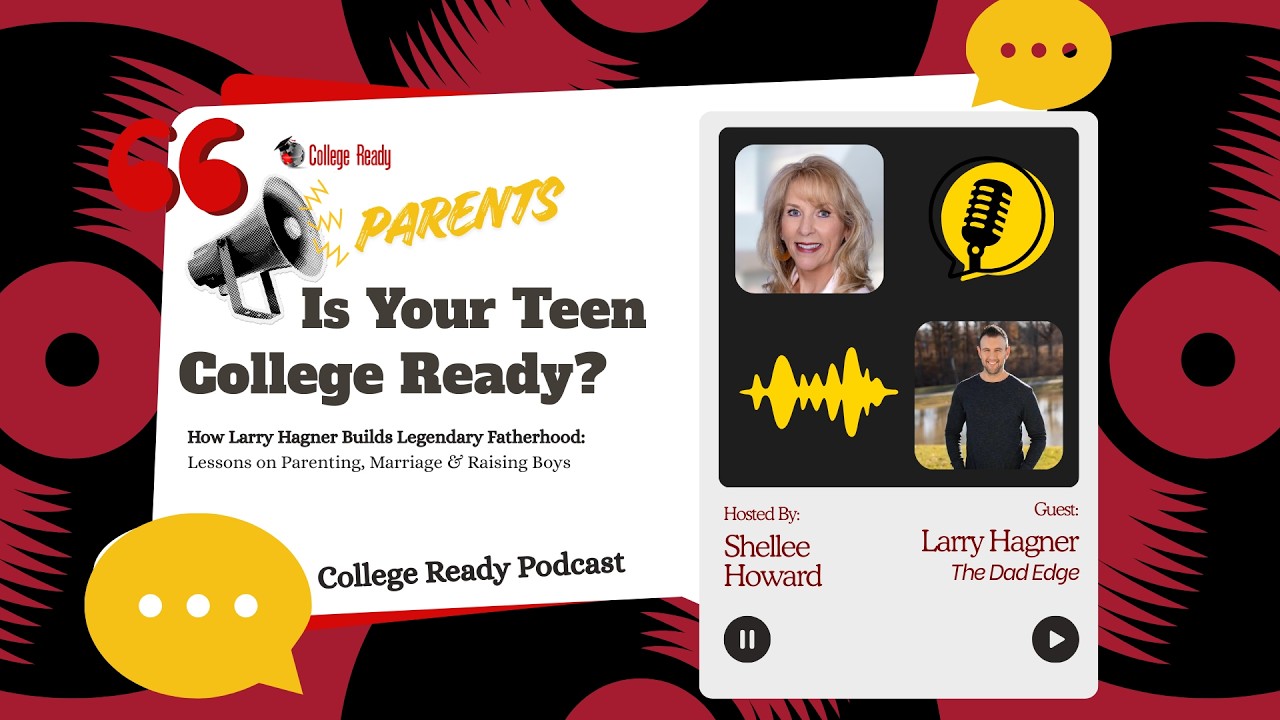
In this episode of the College Ready podcast, host Shellee Howard interviews Larry Hagner, a father of four, bestselling author, and founder of the Dad Edge podcast and movement. The conversation weaves through Larry’s unconventional career journey—from psychology studies to health‑management, medical sales, and finally full‑time podcasting—highlighting how his early missteps taught him the value of relationships over transactions. Larry shares the personal trauma of his own fragmented father figure and the three promises he made to himself before becoming a husband and dad, including a pivotal moment when he spanked his son too hard and resolved to change his parenting style. The core of the interview centers on his "Team Hagener" philosophy, a TEAM acronym (Take responsibility, Everyone, Action, Manage, Sacrifice) that guides family dynamics, discipline, and communication. He describes how he uses curiosity‑driven, collaborative conversations with his teens, tailoring approaches to each child’s interests—from a volunteer firefighter to a future finance student—while also offering concrete tactics for parents of gaming‑obsessed youths. Larry promotes his latest book, The Pursuit of Legendary Fatherhood, explains its rapid development, and bundles it with free courses on patience and marriage. He also highlights the CAPS (Career Advancement Professional Services) program that provides high‑school students with entrepreneurship training. Throughout, Larry emphasizes that parenting, marriage, and college readiness are skills that can be learned rather than guessed, urging families to seek resources and adopt intentional, skill‑based practices.
Chapters
Parents, is your teen college ready? Are you feeling overwhelmed, stressed out, or excited about your teen applying to college? Do you know what colleges are looking for? And if your kid gets in, do you know what you'll pay for it? College admission has never been so competitive or expensive. Shellee Howard will take you on a journey to help you and your teen get college ready. Now here's your host, Shellee.
Hello parents, is your teen college ready? This is Shellee Howard, the founder and CEO of College Ready, and I have a wonderful guest today on our podcast. I'd like to welcome Larry Hagner to the show. Welcome, Larry.
Hey, Shellee Howard, how you doing? It's great to be here. Thank you.
Outstanding. So you are in for a treat, parents. If you have any thoughts, questions, concerns about fatherhood, marriage, communication, having 4 boys out alone, I think a lot of people would be, hey, how'd you do that? He's a bestselling author, and I'm not going to steal his thunder. So Larry, why don't you go ahead and introduce yourself to our listeners?
So my name is Larry Hagner. I've been married for 22 years. I've known my wife for almost 30. I'm the father of 4 boys. I have a 19-year-old, I have an 18-year-old, a 12-year-old, and a 9-year-old. And I'm the founder of the Dad Edge podcast, the Dad Edge movement that's been around for 10 Actually, it's been around for 13 years, been podcasting for 10 years. Podcast has 1,425 episodes, give or take, 3 shows per week. I've written 6 books, 3 kids' books and 3 books for dads. And my latest book just came out September 16th, which is called Pursuit of Legendary Fatherhood. And the last thing I'll say is, yes, I'm behind this mic and I coach men and write books. But man, I'm still just trying to get this thing right. That's why I continue to do it, because if I don't, I'll get it wrong. So I got to stay sharp.
Lifelong learner we are.
Yes.
So parents, this is going to be so helpful because we're going to be talking about real concerns, right? We talk about— bring guests on to this because we want to support you as a village. We know that being alone with teenagers can sometimes be a little overwhelming or daunting. And so we hope that you get massive value. So let's go ahead and dive in. So Larry, let's talk about the first question I ask every one of my guests, and that is, when you were in high school, did you know that you were going to be a podcaster?
Well, when I was in high school, there was no such thing. So absolutely not. Back when I was in high school, there was just AM/FM radio. There wasn't even Sirius. Sirius Radio or XM or whatever it is. And yeah, I never thought I'd be on a microphone making a living this way. So no, it's such a great—
you know, many parents get overwhelmed because their child doesn't know what they want to do and they haven't got it all figured out. And I love for my guests who are very successful in their own right to say, I didn't know when I was 18 and I'm doing okay. So what did you think you were gonna do when you were 18 and just getting out of high school?
I actually thought I was going to get a degree in psychology.
Okay.
I was gonna actually— my very first, you know, to call or out of high school, that's really what I wanted to do. And, um, some classes, you know, went away to school for one year and then switched schools after that. Just realized that's not the direction I want to go in. And then I pursued a degree in health management with a minor in nutrition. So it was more of a sports medicine degree. I was going to go on to be a PT. And at the time, physical therapy was— when I graduated college in '99, it was saturated. There wasn't a job to be had. So, um, went into sales. I actually went into medical sales. So I went into pharmaceuticals and then I went into medical device sales. And that was— none of that was planned, like, none of it. So it was a funny thing. After I found out that I was not going to go on to get my master's in physical therapy, because that's really what I was getting my undergrad in, I was like, well, I guess I'll go either do corporate wellness, because that was really popular back then, like go work for Monsanto or something like that, do corporate wellness. Or I wanted to be a trainer for a professional team. The second one was really hard to get into, really competitive. And the other one, the internet really wasn't around that much yet when I was in college. And I'll never forget being a senior, 3 months away from graduating, and my advisor, my college professor, was like, all right, we're going to get you guys ready for internships. Well, you guys are going to corporate wellness. You want to make sure you show up early, you stay late, all this stuff. And then maybe after 3 months, they'll offer you a job for $28,000 to $30,000 a year. And I was like, What? $28,000 a year? I owe $60,000 in college loans alone. So I was like, I think I'll just go do sales. And that's what I did. So literally none of it was planned.
And I think that's such an important thing as you have your own young men now navigating this path. Let's take it one step back. I heard you say you started at one school and transferred to another school. Since we're talking about being college ready, how did you prepare to go to college, and what made you switch schools?
I—
well, so I switched schools because, um, college that I went to my very first year, I commuted there. So it kind of like more of a— it wasn't a community college, it was a university, but it was close to my house. And I went there and I was just like, this really doesn't feel like the college experience. And plus, like, knew after the first semester, I was like, I don't know if I want to do this. So I started looking at other colleges and I was like, what do I really love? I really love the health field.. And so I started looking at colleges that did well with that, and then that's why I chose my next 4 years.
Gotcha. And so interesting enough, starting as psychology, which is really, I don't know about you, but podcasting, a lot of times I do feel a little bit like a therapist, um, talking to different guests, right? So, uh, she was a psych major for one of my majors. It wasn't my final one, but I have a lot of students, and this fun fact may be interesting for you. The number one most unemployed major, psychology.
Really?
Yes. Hey, I know. And why is that? Many students don't realize if you want to use the degree, you have to continue your education. You don't just graduate after 4 years and look in the newspaper and find a psychology, right? It's not like looking for a sales job. And so many students choose psychology because it's fascinating, interesting to learn how people think and act, but they don't often think about what is the career that will be attached to that. Yeah, it is interesting. Both you and I navigated that. I also did sales for a bit. Now what We're going through this process of sales. What did you learn most about yourself and why aren't you still doing it?
Learned how much I love people. So, um, solving problems, love people, love interacting with people, love talking to people. I'm not afraid to do that whatsoever. So the thing that I really loved about sales was just how often you're communicating with people and how you can bring solutions for problems that they have. So, um, the thing I learned about myself is I love relationships and I really, um, relationships and I don't believe in transactional relationships. I like deep human connection. So like really did well for me in sales because like, I think my customers definitely got the— surgeons that I called on that I worked with almost every day. You know, I think that they knew that I was part of their team, you know, I was there to help them. I wasn't there to just sell them something else.
Right.
I was there to help. This patient have a good outcome, for him to have a good outcome, or her to have a good outcome. And, um, that— those are definitely a couple things that I learned. And, um, also learned very quickly because I got put into management, because, you know, a really successful sales rep, you're automatically going to be a great leader, which is— I learned really quickly that those skills are totally different. And I was a great sales rep, but it took me a while to be a good leader because I had to learn that one. My learning curve was pretty steep on that one.
Okay, true. And I love to bring this up. So as listeners are thinking of their own children, their own story, how this comes full circle. So let's talk for a moment about your 4 boys. Are they all identical or do they have different interests?
Oh, they're totally— all of them are totally different, right? Completely different. Yeah.
So as a father of 4 very unique individual children, um, have you found navigating that. And I know you have written books and you podcast about fatherhood, and maybe you can help our listeners, um, a little bit about what you do and how that all came to fruition.
I wish I could say it was like really beautiful story, you know, like I had like great epiphany or something. I didn't. Um, childhood, I had a really crazy childhood as it related to fathers, which I knew at 12 years old that I wanted to be a good dad. Like, I remember actually saying that to myself, and I'll give you briefly the story of the 30,000-foot view. My mom and biological father were married pretty young, about 21. They were married in '71. I was born in '75, and about 9 months after I was born, they got divorced and never saw my dad ever. Didn't even know who he was. And my mom got remarried when I was 4. That guy adopted me. I knew him as dad, didn't know any different. They got divorced when I was 10, and it was a horrific 6 years that they were together. Very abusive, really crazy childhood. Started asking a lot of questions when I was 10. Like, what's second? Like, I came along when I was 4. Where did I come from? My mom told me she had been married before. And, uh, 2 years later I had a chance to meet my dad. Had no idea who he was, where he was, but I had a chance to meet him. We ended up having a 6-month relationship after that. And then after that 6 months, he told me, it's complicated. I don't think I can really do this anymore. That's when I made a decision at 12. I was like, okay, guy left me not once, but twice now. Not only that, but like my stepdad was gone. I haven't seen him since I was 10. Went on to high school, college, all that good stuff. 30 years old, 20 years ago, in a coffee shop, hadn't seen my dad since I was 12. Who came walking in for his morning coffee while I'm there for a meeting? My dad. So, um, past 20 years we've had a good relationship. Uh, I have two younger half-brothers. He's been married for 45 years to the same woman. Everything's great. I know it sounds like a really unique story. There's a lot of detail in there, but I knew then that I wanted to be a good dad, but it took me like 6 years. My son, my oldest son was 6 and my youngest was 4 at the time. I made 3 promises to myself before I became a dad, before I got married. I was like, if I'm gonna get married, it's gonna be one time and I'm gonna be a good husband. I'm gonna be, um, I'm gonna be a good husband. That's one. I'm gonna be a good dad. That's another promise. I'm never gonna hit my children out of anger. And I broke all 3 of those promises. I started, uh, that edge the night that— so my son was 4 At the time, he's 17 now. I'm sorry, he's 18 now. He just turned 18. And he stepped out of line as any kid would at 4 years old. And I reacted and I spanked him. And unfortunately, I spanked him so hard he hit the ground. And I was devastated that I did that. It got worse though. When I went to go help him up off the ground, he saw me like help pick him up and he thought I was coming to hurt him again. And he like closed his eyes and like hurt me. After that, that's when I knew things had to change. So yeah, vice sales and all that good stuff, great money, you know, good stuff, but there's more important things in life and that's the relationship with your family. And in 2012, I made that decision. I was like, I'm going to do this. I started podcasting and then 6 years ago I went full-time and I have not looked back since. And I will tell you, it's one of the hardest things ever. Um, It was greatest gift I could ever ask for was this education that I've gotten over the past 10 years. But yeah, to answer your question, like, kids are all so different. And the way I go about operating with them is I don't do a lot of telling, I do a lot of asking. So I get really curious with them, like, hey, what do you like to do that brings you to life? You know, what are the things that bring you joy? What are the things you want to do? You know, oldest son right now, he's a volunteer firefighter, he's going through a fire academy right now. So that's what he really wants to do. My younger son, he's going to go to University of Arkansas, totally different path. He's going to get his degree in finance. He wants to be a financial planner. That's what he wants to do. My 12-year-old, 9-year-old have no idea. They want to be superheroes, I think, at this point. But like, will never be the dad that tells them what they should go do. I actually ask a lot of questions to get them get clear, and then they lead me down their life. And I obviously I help them make the bumpers. I'm like the guardrails, but like want them to do the leading, right, when it comes to that. So that's something that has really worked for us, is just to know our kids really, really well and just stay really curious with them.
So important. We talk about it all the time because, um, teens think we're always judging them, we always have an ulterior motive. So if you ask them, what do you want to major in, they're already thinking something negative, like not going to buy into it or something. So we talk about it as intellectual curiosity. So, wow, you're really good at that. Does it bring you happiness? And it's this gentle way of reinforcing that they are really good at a thing. So maybe you can talk about, the podcast is about giving resources to families. So when they find themselves in these situations that they have a way of dealing with it. Let's just kind of advise, somebody has a son who really just likes gaming, really doesn't really want to do anything else, and they're very content and they don't want to go to college, don't want to move out. They just want to be there. And the parent's concerned. And can you give some, some thoughts, some work suggestions for a parent who might be in that situation?
Sure. So are we talking about an older kid?
Old enough to know.
So I'll tell you what I think my first approach would be, and then my second. Um, I'll say this, that, um, I would say we're probably a good mixture of gentle parenting and also rigid, hard, a little bit, right? Discipline. A little bit of old school, a little bit of new school, right? Kind of this little Goldilocks thing, I guess you could say. So if I had a kid that was doing that, at first I would get really, really curious. I'd ask a lot of questions. Hey, what do you like most about playing games? Like, what is it about this that you enjoy so much? Right? And get us to understand it really first, just completely and totally understand it. Because I think when we go in with judgment and we don't go in seeking to understand, it's like Stephen Covey's old stuff, right? Which is like, first understand, like, let me understand what it is about this that you enjoy so much. Because if I don't understand that, how in the world are we— am I going to have a conversation around it if I'm only telling you my perspective? I'm a really big fan of asking questions that I want them to do 80, 90% of the talking. So I understand what it is that they like. I'll also ask questions about like, "Hey, is there any part that you think that this could be failing you? Could this be hurting your future in some way, shape, or form? What do you think is an appropriate amount of time to be spending on gaming?" And that kind of thing. And then just really understand that. I like to take a more collaborative approach and just say, "Hey," I had to do this with my oldest son, Okay. Who is going through the fire academy.
Shit.
It was like constant, like conversations, these like, like nudges, but they were also like reflective. So, but also I've had very direct conversations with him. So it's been a mixture of both. So I'll go in and I'll ask questions. Like, I'll give you an example. He graduated high school, he had all summer and he, uh, taking classes right away for EMT. And he only had one class a week. That was it. One day a week. And he was also at a part-time job and he was spending an enormous amount of time in his room on his phone. So I just went in and I started asking questions and just like, hey, you know, you feel when you're in your room, you know, 5 hours with the door closed, you know, you feel when you haven't showered and it's noon, you know, going on. Like, how do you feel when you start your day, you know, 9 o'clock in the morning, showered, teeth brushed, you know, the gym, you work out. Like, how do you feel that compared to this? You know, I get really curious when we get collaborative and we make a plan of like, hey, I saw him be like, you know what? Yeah, I'm going to get up at 8. You know, up at 8 o'clock every day, um, is what I'm gonna do. I'm gonna be in the gym by 9, you know, is what sets me up for, you know, success. And this is real examples, and he'll do that for a few weeks, and then I'll have a more direct conversation. And thing is that I missed, that I didn't share, is that I want to get— I want agreement, right? So like, when I'm asking questions of— and we're being collaborative, I want agreement. I don't want to be like, hey, this is my way and this is the way you should do things. And I also want to be like, this is my way and this is the way I'm going to do things. I want this to be collaborative and I want him to have some ownership, but I want us to agree on something so that way it's not my word against yours. This is what we agreed upon.
Okay.
So I'm like, okay, so I'm understanding you. It sounds like what you want to do is you want to be up by 8, you want to be in the gym by 9, you're gonna be doing this, you'll be, be at work by 3, you'll be studying, doing this. So if I'm hearing you right, are we agreeing that this is the way you want to run your day? And if I get, yeah, this is the way I want to run my day. Okay, so when do you want to start? Well, let's start tomorrow. That goes for about 2 or 3 weeks. Then I have a different conversation with him. You're knocking on his door and this is a real conversation. I'm knocking on his door at 10 o'clock. Hey, it's 10 o'clock. 8 o'clock was 2 hours ago. This is not what we agreed on. What's going on? So then I'll be a little bit more challenging, you know, stand a little bit more toe to toe and challenge, you know, thinking and make sure I'm holding that standard and hold them accountable to what we agreed upon. Um, being like, no, you were doing this because I said so. I want the agreement to hold the weight and not me.
Mm. Good. Yes. I hear a lot of, um, challenges. And so for me, it's wonderful. I got fortunate. My firstborn was super easy. My secondborn was very challenging. Third was easy. Fourth was very challenging. So I have followed in your footsteps for sure. Now let's talk about your second son. Little bit different, looking to go to college. His plan or what is his plan? What is he thinking?
So he always— my second son has been— so he's quiet and very boring. I say that with a smile because like he really does— the kid never does anything wrong. Like straight-A student. He's the starting center on his varsity football team. If you're not finding him at football practice, you'll find him in the gym. And if you don't find him in the gym or the football practice, you'll find him here at home hanging out with us. Like he is, uh, he's got a great girlfriend. He's got his offensive line because he's the center. They're all boring kids. None of them get in trouble. None of them drink. None of them do drugs. I'm like, gosh, like not even a challenge. But like, the whole thing was like, he's like, well, the son is like, I don't want anything to do with college. I want to be a first responder. I want to be a firefighter. Like known that for a while. And my other son was like, I don't want any part of that. I want to go experience college and I want to get a degree in finance and I want to go to University of Arkansas. So like, he was diehard about that, and that's exactly what he's doing. And now he's in this program too, which I think— and here's a side note— I think parents should always look for opportunities to expand their kids' education and life experience. Luckily, in our area, we have this great program that works with our high schools called CAPS, and it stands for Career Advancement Professional Services. And they've got 3 different, or 3 different, um, in there. So it's Entrepreneurship. And, uh, so he did the business and entrepreneurship. So like, he leaves high school every single day, half a day of high school, and then he goes and he learns everything about business. I'm incredible. The life skills that they teach these kids— they teach you how to interview, they teach you resumes, they teach you profit loss economics, like how to run a business. It is awesome. And so like You know, I knew about this program and I'm like, you should really apply for this. They only take 100 kids. This will tremendously help you if you really want to do business, if you want to do something like this. And he's like, yeah, I do. I was like, well, this might be something great for you. And I have seen him just blossom these past 4 months, like come into his own. And I think him like in with that type of attitude and that type of experience. And for now, I just see him like ready for college than he was a while ago.
I love that. I wish every high school had that. Unfortunately, they do not. Uh, the first thing we do in our college-ready program is we help the child get to know themself. It's such an ironic thing, but they spend so much time on their phone and in their computer that I will ask a young person, you know, you— and they look at me like I've lost my mind. Yeah, they're like, I'm so-and-so, like give me their name. And I'm like, well, no, really, who are you? What's What do you need? What do you want? And they're lost. And the fact that that gave him that extra umph— what we do. So the first thing we do is getting them clarity, who they are, what matters, their gifts, their talents, what they advocate for. And then we have them prove it. So very similar to what you're talking about. And it gives them this confidence that they can then go in and make some choices. So let's talk about family dynamics. You have 4 boys, you've been married, happily married, and do you go in with the team effort? Do you do bad cop, good cop? Like, does that look like in the house?
Team isn't just me and my wife or the whole family?
Uh, is united your, your wife, um, heads of the household? Team as in whole family would be awesome as well. Obviously, you know, 4 different personalities and 6 people in the house, you have to start with kind of leader. So let's talk about what that role looks like and how the team is formed.
So we call ourselves Team Hagener, the whole family. So we're Team Hagener. We even have a text group, Team Hagener. That's our, you know, everything is about team, right? And team morale, culture, all that good stuff. My wife and I, I'll tell you, we, I'm very blessed. I kicked my covers with my wife. She's phenomenal. She is definitely wired and made for 4 boys, like, and I don't think everyone can say that, but she handles it very well. But as far as like how we— alignment is, um, first of all, like, even the acronym TEAM, right? So the T stands for we take responsibility. Every person here takes responsibility. You have a job, you have responsibility, and by the way, when you screw up, take responsibility, right? So that's the E. I'm sorry, that's T. The E is everyone. So we always have to remember that this is about everyone, that this is not just about one person. Is action, right? So we take action. We don't wait for motivation. We take action, right? And is manage your job. So everyone in here, we all have jobs, we all have roles, we all have strengths, we all have good things. You need to manage your job. Right? And then the S is sacrifice. That's the essence in teams— sacrifice. So we sacrifice each other and we help each other. As far as my wife and I go, um, great team. I really, really— I can't always say that, but I can now. As far as how we operate, you know, wife really looks to me to lead. She, she really does well with that. Like, she's like, your dad leads the family, right? She's like, he provides and I make our house a home. So she does awesome with that. The other thing, my wife has this beautiful combination of compassion, empathy, and tough love, which I think a boy really, really needs. Like, she's always there to hug them, you know, and be empathetic, but also be like, you're growing up, you know, come on, right? So she'll do that. One other thing that we do too is we never disagree with each other in front of the kids. And what I mean by that is we'll have disagreements with each other, but if she lays down something like, you just did that thing, you need to go in timeout, or your phone's mine for 48 hours, right? Whether I agree with that or not, I agree with it. I agree with it in front of the kids. I have her back, even if I think it was too harsh or whatever. And the kids will look at me and be like, is that fair? Well, she said it, so yeah. Looked at me like, I'm not going to help you. She said— and guess what? When I lay down something, she has my back. You ain't gonna divide us. So what we'll do is we'll handle any disagreement on kids' discipline or decisions like that in private. So she'll be like, you know, pull me aside, or I'll pull her. She'll be like, you know, like, I thought that was harsh. I think we should talk about it. And then if we do decide to make a different decision, we both go in and talk to the kid. Hey, we've talked about this and we're aligned on this decision and we thought that was harsh or we didn't think it was harsh enough. Here's the new decision. And so we always want that alignment with the kids that we're not divided.
So important. Let's talk a minute, um, motivated you to write another book. I've written two bestselling books and each time I'm like, shit, I'm done. I'm not going to do another one. It is pouring out my soul onto pages. Here, I think you said this was your 6th book? 6th or 7th.
The joke is like the kids' books kind of count. I mean, I guess they do. You can write those in a day and just send it off to an illustrator and they'll get it ready for you. But yeah, the 3 other books are chapter books. So yeah.
The first 3 didn't count. Um, let's talk about the one you just released. What is the name of it? What inspired you to write it? What's it about?
It's a really funny journey. So like you writing books, you'll probably really appreciate this. So The Pursuit of Legendary Fatherhood was actually written in 2023. It actually had a launch date of September 20th, 2023. The publisher that I was going through, 6 weeks before the book was supposed to launch, he went bankrupt. So, so I hired a, an agent, agent who worked for HarperCollins for like 40 years. She was independent. And so she's like, send me your book. I was connected to her. She's like, send me your book if I like it. I'll shop it. And she's like, by the way, I've been doing this for 40 years, so if your book isn't good, I'll know. So she, she wrote back after a few days. She's like, I love the book, I'll rep it. And so we went and shopped it, uh, went to a bunch of the big publishers. Uh, Morehouse, the one that answered the call. We met with Morehouse here. I thought I was going to close a book deal and they get on a Zoom call with me and they're like, hey, we love your book, but we want you to write another one. And I'm like, what? Like, you want me to write another one? They're like, we want you to write a book, a Christian-based approach to fatherhood called Spirit of Fatherhood. And I'm like, I just laughed. I mean, I'm a very faith-based person, but I'm new to it. I've only been doing it for about 6 years, and I'm like, guys, I'm not qualified to write this book. Like, I'm like, I was raised Catholic, been involved with faith my whole life, but really deep in it for only like 6 years. And they looked at me and they're like, we know, we've been watching your podcast. That's why we think you're the perfect person to write this, because we think it's relatable. And I was like, okay, so we need this book by— I'm sitting here, they're like, well, we want to launch it 2024 Father's Day in like 9 months. I was like, great, so I have like 6 to 9 months. And they're like, no, you actually have 11 weeks. And I'm like, what, 11 weeks? And they're like, yeah, we need the first, you know, way before we launch, like, like before we launch. And I'm like, in 9 weeks? I was— and I did write it. And then in my contract, I couldn't release Pursuit of Legendary Fatherhood for at least a year after the launch of that book. So this book, I did add more to it, um, but it's been written technically like 80% for almost 3 years. So I, this summer, since it had been a year, I was like, it's time to launch it. So I went ahead and launched it. But I basically, what I did was in Pursuit of Legendary, I mean, I Fatherhood is a Faith-Based Approach book. This one, it's divided up into 4. So the first part is the drift. I can explain that if you want, but it's where men just tend to drift, right? Then there's husband, father, leader, and the book is 22 chapters long. 285 pages. And basically what I've done is I've poured every single skill that we teach to men, husbands, and fathers into that book, into those areas. So it really has an arsenal of everything that we've taught for the past decade.
Um, so how could our listeners get, get a copy of the book? What, what would be the best?
Um, this one on gangbusters, uh, people have really into this one. So if they go to thedaddedge.com/legendarybook And they buy it straight from me versus on Amazon for— you can buy it from me for $28. But I also am giving away free courses with that. So I have a few courses that are really popular. One is called Creating More Patience. I basically— it's to help men and fathers to be more patient with their kids. I basically made that course because I needed it so bad. So I really like studied patience and resilience and emotional regulations for 3 years. And then I made that course. And then I created another course called Creating a Strong Marriage where you learn 11 skills on how to communicate and connect with your wife better, how to build intimacy and attraction and all that. So anyway, those are each $500 apiece, but I'm giving away free if they buy the book for $28. So that's the best place to buy the book, in my opinion.
Sounds great. We will put that in the show notes for sure. And if you were going to leave families with one last thought, one thing that they could take away, what would that be?
It's your perspective of marriage and parenting. I think I'm preaching to the choir when I say this, but think about anything that we do in life and we do well. We, we learn skills, we train, you know, I want to do jiu-jitsu, you go to a dojo, right? If you want to learn how to be a cop, you go to the police academy. When you get married and you start having kids, people pat you on the back, they hug you, and they'd be like, oh, this would be the best time of your life, you'll figure it out. And I think that's a really poor way to go about it. Best way, like, go out, that sounds horrible to me. So the good news is this: you don't have to figure it out. There are so many resources now, there are so many ways to learn. If you want to create an incredible marriage, guess what, you can just by learning skills on how to do it. If you want to be a more calm, patient father, if you want your kids to tell you anything, you can really lean into skills like, like labeling and creating environments of psychological safety and conflict resolution using a skill set that we call the cube and things like that. Things that really help you not to guess and to actually do the things that move the needle. So if your perspective is, I just need to figure it out, you don't figure it out. You can actually just go learn and it's a much more enjoyable journey.
We talk about that all the time. You could fight your way to plan for college, or you can reach out and we can help you do it very gently.
Oh my gosh, right?
Enjoy the last few years of them at home. What a concept. Make sure they come home for Thanksgiving and Christmas. Those are all very important and valid. So Larry, thank you so much for being on this show. It has been a pleasure.
Thank you so much.
Until next time. Think about this. Is your child doing this on their own? Are they doing it with you? Are they doing it against you? They need you, and you've got this.
More from Shellee




The 3 Questions Every Parent Should Help Their Teen Answer Before College | Featuring James McLamb

Helping Your Teen Stand Out for College Through Purpose & Impact | Featuring Aishani Sheth


From Robotics to Cornell: A Father-Son Blueprint for College Success with Aarav & Ritesh Kumar

The Hidden College Credit Strategy That Could Save Your Family Thousands with Josh See

The Truth About Financial Aid: Why Some Families Pay Less for College Than You Think with Jack Wang

Human Skills Every Teen Needs for College, Careers & an AI Future with Rob Heller
