In this two‑hour live webinar, college admissions expert Shellee Howard and financial‑planning specialist Kevin Rourke walk parents and students through every stage of paying for college without incurring crippling debt. They begin by reviewing the FAFSA and CSS Profile timelines, highlighting the ten most common FAFSA errors that can cost families free aid. They then detail how to craft standout essays and market extracurricular achievements, and explain how to select a balanced list of reach, match, and safety schools while matching majors to each institution. The duo breaks down the three funding pillars—savings, borrowing, and aid—showing how traditional savings vehicles (529s, stocks, bonds) can hurt the Student Aid Index (SAI) and presenting alternative accounts that are invisible to aid calculations. They introduce a “Be Your Own Banker” model that leverages equity‑building accounts (e.g., cash‑value life insurance, annuities) to borrow against oneself while the principal continues to grow tax‑free, dramatically reducing out‑of‑pocket costs and boosting retirement savings. A case study of a family that saved $95,000 in interest and generated $350,000 tax‑free for retirement illustrates the impact. Kevin also covers loan options, interest implications, and the importance of professional advice for mortgages, taxes, retirement, and major life expenses. The presenters outline their 67‑step process, from a free discovery meeting and SAI analysis to a customized strategic design and ongoing workshops. Throughout, they stress the need to avoid denial, use experts, and maintain a positive mindset, ending with a call to action to book appointments, share the webinar, and spread the word.
Chapters
Welcome everyone. Thank you all for joining. Please take a moment and you'll see a poll quiz up on the screen while you're waiting for others to enter. We'd love you to take the quiz so we can make sure and give you the right information for tonight's workshop. Alright, as you enter the room, please complete the quiz so we know how to complete the workshop tonight. We want you to get massive value, and so by taking the time, we'll know who's in the room and we can speak directly to those people who are entering. We have a very full webinar tonight, so we will get started on time. As soon as we have a chance for everyone to complete the webinar or the quiz. Awesome. Thank you for showing it's working well.
Also, if you could just put a thumbs up in the chat box if you can hear us okay, you can see everything, the way we know we're, we're all ready to go.
People are still entering, so you have time to complete the quiz. I promise it's not a hard one.
Not getting any thumbs up. Can everyone hear us okay? If you can hear us, go ahead and put a just okay or yes or a thumbs up in the chat box. That way we know we can hear— you can hear us.
I see two hands up.
Okay. There we go. Chat is disabled, someone is saying.
Oh, yeah, okay. So chat is disabled. Okay, great. They can hear us. That's a good sign.
We put in the Q&A section instead.
We can hear you.
Yay!
Okay. Outstanding. So if you want to go ahead and finish, we see some of you are still in completion mode, and we don't want to rush you, but we do have a very full agenda tonight.
Okay, I think we enabled the chat there. Okay, I'm gonna go ahead and, uh, end the poll. Do you want to get started, Shellee?
Yeah, let's do this. Excellent. Well, welcome everyone. I am so happy you're here. We're so happy you're here. My name is Shellee Howard and I'm the founder and CEO of College Ready. And tonight, Kevin and I have a packed agenda, so I recommend putting away all distractions. I recommend having a notepad, and let's go ahead and jump in and get started. All right, so we started off with the quiz because it's really important to understand that a little thing could— a little mistake can turn into a very big mistake. So I'm going to briefly go through some of the quiz questions, but what I want you to know is tonight we're going to talk about all of these different categories. So not only will you have the answers, but you'll understand the why. So for question number 1, what is the term COA in college planning? It is cost of attendance. Number C, or letter C. How many pieces are there in college planning? How many pieces to the puzzle, right? It's a huge puzzle. There are 3 main pieces we're going to talk about tonight. Number 3 is B, false. We're going to explain a little bit more. Number 4, B, false. This one I hear all the time. Shellee, I just make too much money. There's no money for my family. And I'm here to tell you there's a ton of money for your family regardless of what you do or don't make. Number 5 is C, 10 to 12 colleges. All right, number 6 is D, student aid index. And this may be new for a lot of you because they— it changed from expected family contribution, and we'll dive deep into that because that's really important for you to understand. Number 7, it really depends on the college. We'll dive deeper into that. Number 8 is false. Interesting, a lot of people are kind of perplexed. Number 9 is C. I know it feels like D, but honestly it is C. And then number 10 is D. It is definitely possible, and 2 out of my 4, actually 3 out of my 4 went private, and all of them, it was cheaper for them than it would have been public. Quick disclaimer tonight, this presentation is educational. We want you to have the knowledge to make the right decisions, so we're not here to be your CPA, we're not here to tell you how IRS code We're simply here to educate you. And so we want you to know everybody has a different situation. And if you stay to the end, we have a really important opportunity for you to get your questions asked. So I am Shellee Howard, and like I mentioned, I am the founder of College Ready. I am going on my 16th application season, which seems a little crazy. And so I have so much opportunity and so much I want to share. Oh, and it went back. Kevin, can you take me back? There we go. Um, why is this important? Well, I've been featured on Fox. I've been, uh, I have a best-selling book. I am an international speaker, and I enjoy doing these webinars and workshops more than anything because it's you, the parents, I want to serve. So this is my background, but also what makes me a unique instructor is I have 4 kids of my own. You can read in my bio, my first went to Harvard, then UC San Diego Medical, and now he's an orthopedic surgeon at UCLA. Just a normal kid. My second is a registered nurse. My third is a junior in college, and my fourth is a sophomore in college. So I want you to know from a mother's heart to yours, that is what makes this so important to me. Kevin.
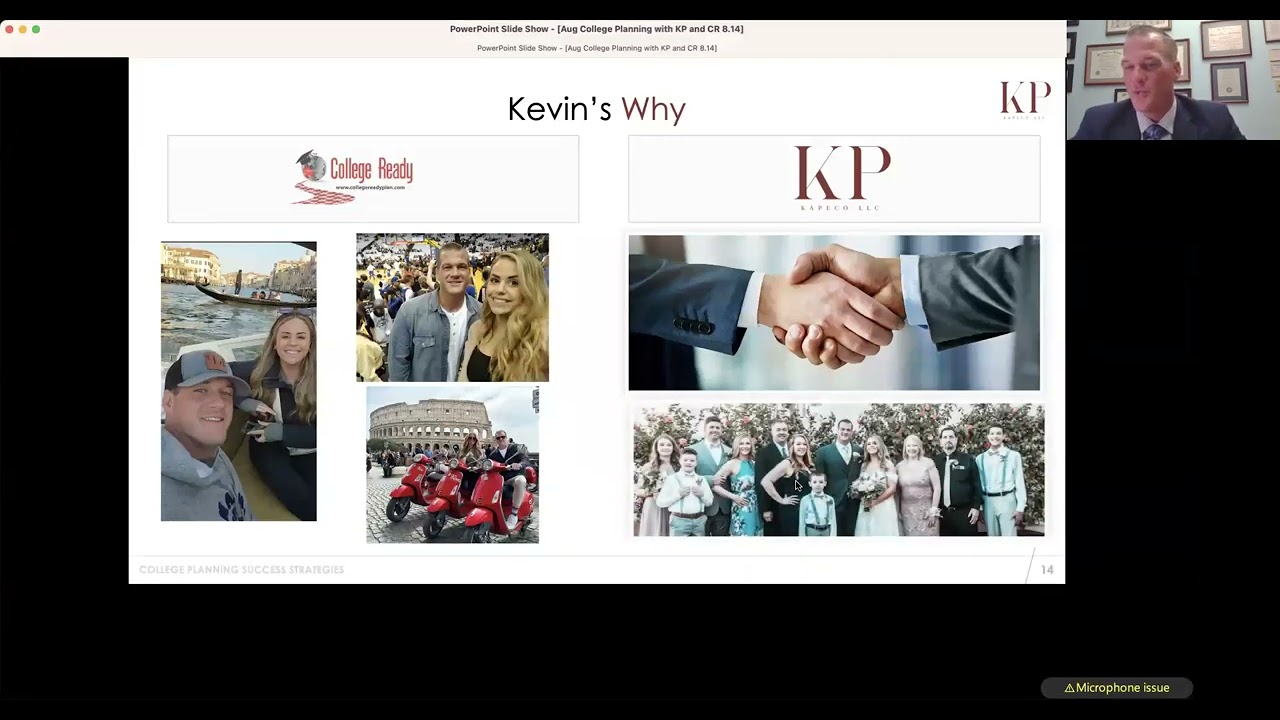
Yep. So my name is Kevin Rourke. I am the founder and CEO of CapeCo. We are a team of financial planners. Everybody on my team comprises all the credentials you see here in front of you. Chartered Financial Consultants. We do Certified Financial Planning, Social Security. We do estate planning. Everything around the sun. It's not just investments that we do, but today obviously we are going to be focused on college funding. What are the best ways to fund and how are we funding? Okay, so a little bit of housekeeping. Attendance is good, but participation is better. If we ask questions, I think I've enabled the chat this, uh, so far. If not, you can put it in the question and answers box. We'll get to those. Uh, understand that we're going to be giving you a lot of information but going very quickly. We only have about an hour and a half that we spend here. We could— Shellee, between Shellee and I, we could speak for 4 or 5 hours on this topic alone. But with that being said, I put in the chat box a link that you can book a one-on-one appointment. We'll make an offer towards the end. But again, if you have any questions, just type those in. We are going to send you an evaluation form at the end. This is free, but we just want to know if you can do us a favor at the end. Tell us, be critical. Is there anything that you wish that we taught that we didn't teach? Anything you wish that we maybe spent more time on? That way we can help and keep improving. That way we can help as many people as possible. So we do have one free scholarship offer at the end, but you do have to stay to the end to figure out what that is. Here's an example. The value is of $1,500. We are going to be giving it away to one family. There are specific instructions, though. So this was the last winter. We typically teach seminars all around the country. This is one of our first few webinars. So you can't take a picture like this unless you fly into our office, but that's okay. We love to see you guys over Zoom. So again, we're a financial planning company, myself and CapeCo. These are all the classes that we teach all over the country. Tax law, women and their finances, life settlements, My FedLife. But today we're going to be obviously teaching college planning strategies. We are currently teaching 3 other courses. Your Dream Retirement, Tax Reduction Strategy, and Estate Planning are the ones we're doing this year. If you have any interest in those topics whatsoever, please email us, please message us. We'll be more than happy to invite you to those as well. Okay. And again, it's not just investments. We have all kinds of different areas that we focus on with families. Today, once again, we will be focusing on college planning. So why am I doing this? Why are we sitting here? Why is a finance guy sitting in front of college planning parents and students? Simply, it's expensive, right? Certain private universities are as high as $75,000 per year. And for those of you who have multiple kids— and we took a poll at the beginning— you, you already know, otherwise you wouldn't be showing up to this, uh, this seminar. So I'm the founder of CapeCo. I've been in the financial planning business for roughly 8 years. I was sick of having our clients coming in for retirement planning who are 60, 65, 70, and they have a mountain of college student loan debt, right? And so I went on a mission, said, well, how can we solve that earlier? How can I reach people at an earlier stage and teach them the tricks of the trade so they don't have to go through all that debt? Then that's how I met Shellee Howard. Shellee Howard is one of the best college planners in the country. She really knows how to hone in the student skills and passions, and I'll let her explain that a little bit further. But we did a partnership, so Shellee Howard is going to teach you a lot about getting accepted, what colleges are looking for, how you can put yourself in the best position to be accepted. And then my job is to teach the financing, the funding, how are we actually paying if there's any out-of-pocket costs once we're getting those scholarships and getting accepted to the school. So also why I'm doing this is I made a lot of mistakes while I was going through this process. Okay, I'll give you a little background on myself. This is my— this is me and my wife Maggie. We're both from Indianapolis, Indiana, born and raised. We've known each other since we were 12. Okay, so I've been best friends for a really long time. Um, I got married to her. We, we had a COVID wedding, 2020. We just missed the pandemic by 2 weeks. Unfortunately, our honeymoon did not missed the pandemic. So we had to reschedule that one. And that's what you actually see in this far left picture, which is us in Italy. So we did that last year as kind of a little makeup there. But let me tell you a little bit about my family. This is my mom and my dad on the left. They've been separated since I was 6 years old. Okay, one of your quiz questions was what is SAI? SAI stands for Student Aid Index. Okay, and basically to sum it up, and we'll teach you a lot more, uh, later on in this presentation, but that's a number that the government's going to put on you as a family. They say this is how much you can afford per student per year for college. Okay, and it's made up of different assets. Where's your allocations at? Do you have 401? Are you contributing to 401? How much is in your checking account? What's your gross? What's your net? They want all that information Based on that information, they're going to give you a number. Okay, and that's how you can know if you're going to qualify for need-based aid or not. Well, there's some rules that most people don't know about, and I, I broke all the rules. So both me and my two sisters— I'm the youngest of three. I have one sister who's 5 years older than me and another sister who's 10 years older than me. We are all collegiate athletes and also great students, mostly straight A's between all three of us. My sisters played golf and softball at Indiana Wesleyan University, and I went on to college to play football. Unfortunately, I had 6 knee surgeries after my freshman year, so my scholarships were taken. Right. But when you're filling out the FAFSA— and for those of you who don't know what a FAFSA is, we'll get into that here in a little bit— but it's a financial aid form, so to speak. There's some things in a separated household, as I was. My parents were, like I said, were separated since I was 6. You do not need to claim both parents' income. The technical rule is the parent who provides the most financial support. That rule has changed over the years, but right now, whatever parent's providing the most financial support is the one that you have to claim. Other than that, you do not need to claim the other parent's income. Rule number 2, another mistake I made, was when they're asking where your assets are, you do not need to claim the equity in your primary household. Okay, so not only did I put both parents, but I put both equities in both primary households. I did not qualify for any financial aid. I made those two major mistakes. There's a couple more mistakes that we can teach you here. So I went on at Radford University. I started a clothing line with this guy here, and if you don't know who that is, that's Stephen Curry. He's a great basketball player, but a good family friend of mine. And when I was in college, I owned a business. And on the financial aid forms, they say, they ask you that, do you own a business? Okay. So if you have a business and it's less than 100 employees, you do not need to claim the value of your business as an asset. Okay. Not only did I put the value, I was proud of my business. I might have puffed it up a little bit. Yeah, I have this much in my business. Again, no, I did not qualify for any financial aid. And lastly, for any of you who have a 529 account, the college savings account, a MYGA, a lot of different ones out there, any assets in the student's name, up to 50% is going to be calculated into the SAI calculation. Any assets in mom or dad's name, only 5— up to 5%. Okay, so you really want to know who's the owner of the account. Is the student the owner of the account? Or is mom and dad the owner of the account? If you have any assets in the student's bank account, you might want to move those over. We'll teach you guys a lot of those. But again, I'm telling you all this because I made all of those mistakes. I qualified for no aid, and I don't want that to happen to you guys. So Shellee and I are teaming together to help all students. And here's a good example. The gentleman on the left looks like a 35-year-old, but that is my 16-year-old nephew Riley. He is one of the best baseball players in the country, right? He's a rising junior. He could go to a number of schools, right? But he cares very much so about academically. Why should he go to this school or that school? Not just for baseball. He's also a straight-A student. So our team, we have former academic advisors, admissions officers, strategic enrollment managers in our company that can help Riley decide what career path might be best for you. Let's say baseball failed. Football failed for me. Let's have a backup plan to the backup plan. So our team is helping him. He is a 2025 graduate. His cousin Anna is a 2027 graduate. Completely different situation. She has no athletic bone in her body. She has no idea where she wants to go to school. She doesn't know what she wants to study. Again, we have that full team to help her along the way. We've got her a little bit closer to that finish line. And then finally, the little one you see in the green shirt here, His name is Aiden. He is graduating in 2030. He plays a lot of video games, so we are going to just pray for him for the time being. But when the time comes, we will be there to help him. Shellee Howard is going to— you want to share a little bit about your story there?
Absolutely. So my WHY actually started with my oldest, my firstborn. He came home from 8th grade and he was so excited. He was like, Mom, I know exactly what I want to do when I grow up. And I am like, There's a lot of adults who still don't. I'm like, what do you want to do? And he says, Mom, I want to be a brain surgeon. I want to go to this Ivy thing. And that's exactly how he said it. And I panicked inside, but I was calm on the outside. And I said, yes, we will figure this out. Well, for about the next 4 years, we figured it out. I spent about 30, 20 to 30 hours a week for 4 years, helping this young man figure out how he was going to attain his dream. And that's what kicked off College Ready, because when he graduated he had 7 top-tier offers, a full ride to USC, which turned into a full ride at Harvard. And so he was my why. I never sought out to do this, but I ended up getting my master's degree, and then I got my Independent Certified College Consultant certification. I started touring 25 colleges a semester, and by the time I had finished with my oldest, his sister was coming 4 years later, and she looked at his 33 spreadsheets I had completed, and she's like, oh, heck no, Mom, I am so not going to do that process. So she had a different plan, and that's when college ready really became clear. Every student needs their own desire, their own passion, their own connection. And so I have absolutely embraced and love helping teenagers. I was a softball player for the USA, and then when I found out there is no softball team that makes money, I decided that that wasn't my long-term plan. And so what I've been very passionate about recently is I created an organization called, um, EmpowerEducation.World, and we are building schools in Africa, in Uganda, and in Oaxaca, Mexico. Our students— there's so far 32 of them who are leading the charge and have raised over $7,000 and have built 3 classrooms. We're changing lives, and these students get opportunities that they wouldn't have on their own. So my why is bigger than let's just find the name of a college. My why is how do we help these young people, adults, have a great career and understand how much it's going to cost them if they do it wrong versus if they do it right. That is why— my why. My experience goes deeper than that. I'm actually a bestselling author and international speaker. I'm part of 3 ethics organizations. I've been doing this a long time. Why I do this is because my mission is to help a million families be educated about making this decision. When my son graduated from Harvard in 4 years, 3 years, 3 men. His first job was $106,000 a year and he had no debt at 23. Can you imagine what life would be like? He will graduate medical school— actually, he has graduated medical school and now he's a third year as a resident for orthopedic surgery with a $30,000 total debt. He will have that wiped out in his first year. So My passion is helping families understand where there's the big money and everybody wants to know, how did you do it? Guess what we're going to share tonight? That's what we're going to share, how I did it. This is my family. It's made up of a lot of amazing people. I had an Italian exchange student for a year and I learned about European education. My fourth is actually going to school in the Czech Republic of Prague. She is getting a dual degree, international business, for $27,000 in total and traveling the world. These are the reason these people, the experience. And in February, I went to Uganda and I got to build a school. So this is why we're here tonight. It's not because we charged you a lot of money to be here. It's because we want you to be successful., and we're excited to share. So as I mentioned, my experience, I could go all into that. I was opposite of my firstborn. I changed my major 5 times. I had no help. I was the first gen to go to college. It was a disaster. You heard Kevin's, he has his own story. We made our mistakes. I don't want you to make those same mistakes. Our passion leads us to be here, and hopefully you'll see it come through as we go on. Briefly, I want to talk to you about a Harvard study. It talks about the things you don't know and the things you do know, and there's called known knows and unknown. So to me, what this all leads to is once you know something and you choose not to do it, that's called a regret. We don't want you to have regrets. We want to help you know so you don't have to regret, and that's what our goal is tonight. So here's what you're going to learn about: how to pay less for college so you can save more for retirement, the formula for planning for school so you can pay the least amount, how to avoid the biggest mistakes. This is where I truly have a heart to serve our community. The topics tonight are insider admission strategies. I'm actually gonna tell you things that most people don't know, so it— you— the value here is gonna be massive. How to maximize grants, how to attend a private college for less than a state college. Yes, it is true. And forms that need to be completed if you want the big money. So you may be saying, well, why college? Maybe college is not right for me or my child. We're not here to debate that issue. We're here to give you options so you can make those wise decisions and help your teenager not make mistakes. Kevin, you want to talk about our first poll?
Absolutely. So I'm sharing the results here. Uh, poll number 1 is what grade is your student in? When are we graduating? So for 2024, 7 out of 11 families had a 2024 graduate, 18% out of 2025, so 2 students. Looks like 1 in 2026, none in 2027, and we have some in middle school as well— I'm sorry, in community college as well. Okay, so it's good to know who we're talking to and who we're going to apply this to. And then poll number 2, we have a limited amount of time, we're going to be talking about strategies on getting accepted and affordability grants and grants, scholarships. So we wanted to know which side you really wanted to hone in on and learn more about. Looks like we are 90% how we can afford college and only 10% strategies on getting accepted. And I always find that funny because if we don't get accepted, doesn't really matter how we afford it, does it? So we are going to give you, whether you like it or not, some good strategies on getting accepted. But at least we know, okay, we really need to hone in on some grants, scholarships, and financial aid. At the end there.
Outstanding. I'm gonna hide the poll again.
Oops!
Can you take us back? Okay, excellent. The first thing I wanna let you know, maybe you've not heard this before, because when I talk about it, most people are mystified. The college is a business. I know as a family it feels like an emotional decision and you want what's best for your child. I totally get it, but college is a business. They want the most from you. You want to pay the least, and some schools have a boatload of money. So what does this all mean? There are colleges schools that I talk about in my bestselling book, that there's 10 of them that are tuition-free. All you have to do is work, but nobody wants to go to school there. Everybody wants to go where everybody— all the competition is. There's so many amazing schools that are hugely gifting students. We have students every year who get scholarships, and often Full rides. Tonight we're gonna talk about 3 major pieces. I wish I could talk about all 7. We just don't have enough time. We're gonna talk about getting accepted, getting the financial aid, and how will you pay for it. So when we talk about getting accepted to college, like Kevin said, if we don't get accepted, we don't have to worry about the rest. This is my specialty. This is where we shine. We create a standout strategy for your student because there's gonna be a student who has the same GPA, as yours or higher, the same test score as yours or higher. Why will they pick your student? That is what we do. So if you're really confused and overwhelmed, it's because this process is hard. Most people don't even know where to start. It's confusing, it's competitive, it's expensive. I, I wanna unpack that for you and let's get started. We also have forms that you need to complete. A lot of people, and it may be you, think, I make too much money, this will never apply to me. Remember I told you all of my son's opportunities for a full ride? I live in Southern California. I have students and consultants and friends and family who've done this all over the world, but I live in an area that you can't be need-based. And live here. It would be very challenging. So I'm going to teach you about how important the forms are. The FAFSA— the deadline has always been— or it opens in October and ends in June. This year it's not going to open until December. Oh my gosh, you need to know what that means for your child's future. You want to apply early. Everybody should complete the FAFSA unless You're happy to write a check and pay full price. 46 questions with a 91% error rate. It doesn't need to be that way, and we can help you navigate through it. There's also this weird form called a CSS profile, and when Harvard sent it to me, I almost choked. They wanted to know every detail about every piece of my finances. And if you don't complete it, you leave 70% of the grants on the table. These are the things we want you to know, because if you don't play the game, you will pay full price. It's that simple. There's a strategy for this. We want to help you go to these schools that offer the most money. It makes the student feel good, and it makes your pocketbook and your retirement feel better. Now keep in mind, there's these other forms that are making students crazy right now. My rising seniors have the Common App, the Coalition App, the private app, the state app, the school app. And if that doesn't blow your mind, there are different essays for each of them. It is a very competitive, overwhelming thing. Don't think for a second the high school is doing this, and don't think for a second your 17-year-old understands that an optional question is not optional. These things are what we specialize in, and we want to help support you. The other question I often get is, how many colleges should I apply to? Well, let me tell you, last year I had a student do 38. Way over the top. It was a disaster. I told the family early on, bad strategy. They worked it anyway. The average student does 12 for reach, for comfort, for safety. But finding out, is it a real reach, is it a real comfort, and is it a real safety? We have a proprietary program called The Vault with 16 years of information to help you know, is that school reach, comfort, or safety? But the other point is you want to have competing schools. Remember when I talked about USC getting the full ride and then Harvard knocking, going, well, we'll give you some of that Well, we'll give you that and a trip to come and, and check out Harvard. Very am— it's just such an experience to compete. All right, secrets colleges don't want you to know. Admissions officers do not make the final decision. As a matter of fact, they're only a small part in the process. Small schools have a small number of students. UCLA and the like, have massive amounts of students. We have the stats for you if you're interested. Why this is important is because your student will have about 4 minutes— 4 minutes— for this, the admissions person to read their application, their activities, honors and awards, and their essay. If it is not stellar and stand out, it will go in the wrong pile, and it is heartbreaking. But really, the person you need to be paying attention to is the strategic enrollment manager. And nobody wants to talk to you about this because this is their little secret. This is the person who has to balance the class of accountants, psychologists, artists. Every class has to have balance. And then, of course, we get to the U.S. News and World Report, right? This is a famous go-to for a lot of people. It is one of my least favorite, and Kevin just probably dying laughing at me. I don't like it because it's— I don't think it's— I'll be nice— it's not the end-all. So the big thing I want you to know about admissions and the, uh, the U.S. News and World Report is something called admissions yield. Okay, so after you take the PSAT You're going to get bombarded with a ton of schools, apply here, we want you, apply here. And you're like, yes, my kid's going to college, this is awesome. And then you realize, well, wait, why would Harvard be telling me to fill out an application when my child has a 3.1 GPA? That is not a good academic fit. That is because the more people who apply and the more people that are rejected, the more competitive they look. And who wants to go to an easy school? No one. Who wants to go to a competitive school? Everyone. What did I say? College is a business. There are so many applications to look at. You want to be mindful of putting the activities and honors in the proper ranking. We tell our students what ranking colleges look for— a 5, 4, 3, 2, 1. Every Every single thing has a ranking. Instead of somebody just hoping, this strategy needs to be played out. Be careful about what you read on the internet. A lot of times it's not true. So let's talk about getting accepted, right? Positioning. This is so important. We call it a standout strategy because that's truly what we're trying to do. We're trying to help your child be the best version of themself. Doesn't that make sense as a parent versus trying to force them into something? Anyway, so what we're trying to do is position. And here's an example of one of Kevin's most recent students. And Natalie, sweet Natalie, she wanted to go to Pepperdine. She was— or yeah, she was Hispanic, came from a Hispanic family, I believe in Texas, with a 3.7 GPA. A 1050 SAT. She wanted to go biology with a chemical engineering minor. Okay, I don't know how much you know about a few things here. Number one, Pepperdine is an incredible school in California, but it is a competitive school. It's a small religious school, and Natalie and her family were hoping that they would be considered a minority. Well, in California, being Hispanic is not a minority. And so that wasn't quite the positioning that we would have her go for. Then her GPN test scores, they were okay, but it was nothing that would like get them super excited. The other big struggle is biology is very much a female type major versus engineering. So when we looked at all of this and we considered what admissions officers were going to look at. We analyzed the algorithms at the university. We looked at who got in last year and what her chances would be. We optimally positioned the student for success. We didn't want her just to base everything on her diversity. So instead of biology as the major,, we went engineering as the major with biology as a minor because she really wasn't sure that's what she wanted to do in the first place. She really wanted to go to Pepperdine. Natalie got accepted, which is exciting, and we got her over $30,000 in scholarships. We'll share with you that scholarship in just a bit. So more about how to get accepted. Here's Marcus. So Marcus is a great example. He is a student that we got as a freshman in high school. We actually start students when they promote from 8th grade. Why? They haven't made any mistakes. So when people ask, when should I start? You should start now. That's, that's when you should start. His dream school was UCLA, and we have a ton of experience with the UCs. He had a 4.1 GPA, which wasn't bad, But he wanted to go engineering, and he was a guitar player. So as we looked at through the eyes of admissions, where were the holes? Remember, he's young, we have time to patch the holes, and we have time to help him stand out. We interviewed the music department. We found they have trouble finding a bassoon player. Guess what? Marcus decided he was going to try the bassoon. It makes sense, right? If that's truly where he wanted to go. Marcus got accepted. Marcus also received $24,000 in gift aid. Do you know how to help your students stand out? This is how we do it. We want them to have an academic strategy, a financial strategy. We want your student to understand return on investment for their decisions. We want them to be happy there socially, athletically, visual and performing arts. We can help every student find that fit. So what if— what affects the first piece of the puzzle? This is where you start taking copious notes. I'm going to tell you what everybody wants to know. What do colleges want? The first thing they want academic rigor. They want your student to challenge themselves. They want SAT, ACT, IB, dual enrollment, AP. Yes, they want tests. Is it optional? Is it blind? Not if they want scholarships, not if they want to stand out. They want passion with a purpose. Remember my project where my students are building a school in, in Kenya? In Uganda and living their passion in, in helping students in an international culture. We're certifiers for the Presidential and Congressional Award, which gives our students 8 national awards. That's hard to compete with. That's what colleges are looking for. Extracurricular activities— it's not about a bunch of busyness. It's about strategic alignment, leadership, Students are looking for leaders. Why? Because it's a business. Those leaders are going to make the school better, therefore the school is going to rise, and when they graduate, they will be somebody, somebody wants to emulate. Letters of recommendation— there is a strategy for that. Essays are critical. Our essay editors have got our students into every top-tier school. Actually, every school, they are phenomenal. Our lead editor has 3 degrees in college essay writing. We want your student to understand diversity and inclusion. We want them to understand activities, honors, and awards. Real brief here, had a student come to me, we went over everything, and I said, are you sure there's not more? And he says, nope, nothing else. And the parent looks and says, well, what about your Eagle Scout? And I shook my head, and I'm like, this is where the students make their biggest mistakes. They just don't value it the same as a university does. In college interviews, we prepare your student for that interview. So let's talk about the roadmap. I wanna lay it out for you. There's no mystery with us. We want you to be empowered with knowledge. Our strategic certified consultants analyze school algorithms. We can show you, not just tell you, and it's not on Google, what the GPA and the test score of the students were last year at any school in the world, what universities need and want, how to stand out from the crowd. Do not do what all their friends are doing. That is not going to help them at all. Design the student standout strategy. What does that mean? If they want to go into a certain area and everything else in their resume points a different direction, that only confuses the admissions person. We're going to market the student because you've raised them to be humble— don't brag, don't boast— and we're going to tell them brag like your life depends on it because they'll never meet them otherwise. So we help them with their verbiage. We help them to take what they've done and polish it and make it worthy of an admissions admittance. We want them to have a good social fit. If they're an athlete, we work with scholar athletes. It's important for students to know what that role looks like. If they make one mistake, one mistake, one miscontact, they can be disqualified. Our counselors and admissions officers put together a strategic college plan. We help them pick their top 3 majors, top 3 careers. We build them out a specific test strategy— when to test, where to test, how to test, how many times to test. We take all the mystery out of it. We put together their own Passion with Purpose project, and we bring students together from across the world. We help them navigate extracurriculars so they can lead them, not just participate. We help them to have an essay strategy, so instead of just rambling a bunch of things or talking about what's already been talked about in their application, it's a theory, it's a strategy, it's specific and measurable. We help them to pick out 10 to 12 specific colleges that will compete against each other. We help them understand what is a good fit school. Does it align with their core values? Will they graduate in 4 years or less? And how to rank those darn schools, because this is one of the hardest things students will have to figure out. Kevin?
All right. So we took the poll at the beginning of our class here today, how many wanted to know getting accepted or financial aid, and only one person said get accepted, which is everything Shellee just said. But now you can see the value there, right? It's so much involved. It's not just putting a good GPA and SAT. Colleges aren't like that anymore. They want to know who your student is. They want to know what are the student values, who's going to be wearing that logo for that university on their shirt and representing their school. Right, so that's very important. But we're going to switch gears to money. Uh, that's my realm, financial aid. I don't go anywhere without my financial calculator. It's always right here next to my desk. So let's dig into that. Scholarships, they're going to come from 3 major places. We have need-based aid, which is going to be based on the family and the student's income and assets. We have merit-based aid, which is GPA, SAT test scores. And then we have institutional aid. That is aid from the university. Shellee told you that Harvard has a $50— more— higher than $50 billion endowment fund. That is money that your student could have, something that they can entice your student to come to their school. But you need to know how to position yourself, and that's everything that Shellee was talking about— standout strategy to get the institutional aid. Okay, so let's go into it in detail. She took you through Natalie. Natalie was the student who wanted to go to Pepperdine, right? And we got her $30,000— is actually $31,526— and this is how it's broken down. Federal Pell Grant, that was need-based aid that we positioned her assets in such a way that qualified her for need-based aid. Federal Work-Study, uh, Shellee, do you want to explain Work-Study briefly?
Absolutely. My two oldest did work-study. I thought it was very important that they have a little bit of skin in the game. And so my firstborn, he was at Harvard and he chose to do— be a tour guide. So he got to walk around people just like you and tell them all about his school. And what that— what happened is they used the money that they would have paid somebody and they set it against his, um, admissions or his finances. My daughter, on the other hand, she went to University of Alabama and she thought she had a brilliant work study. She was checking in all the cute boys that came in and out of the gym and making new friends. So everybody can do it their own way. The nice part is they can be doing something fun and meaningful and enjoy their— the process and receive money. Now, Not everybody gets work-study. You have to apply for it.
So that is something awarded to you when you— and again, Shellee told you, if you want any financial aid, you need to fill that FAFSA out, and that's going to include the work-study as well. Okay. She also got institutional aid of $1,000 from the University Alumni Grant. She got the Siebert Trust Grant for $600 and the Pepperdine Grant. For $27,704. And again, that's institutional aid. Natalie had a standout strategy. We showed you that. That's what got her awarded that money. Okay, so what you need to know: the rules are created by Congress. Our government is constantly changing things. Last year, uh, the, the old rule— and I told you what parent needs to be put on the FAFSA in a separated household— it used to be the parent who had the majority of custody. Now it's the parent who provides the most financial support. That's because the government knows that whoever's providing more financial support has a higher SAI, and the student's going to qualify for less aid. Okay, they're always making it— what they want to tell you is easier on you, but it's always difficult. Another major change: families used to have a discount for having multiple students in college at one time. Congress said no more. We are not giving you that discount. You're going to have to pay the same per student, right? Because colleges did not make enough money. They wanted to give them a little bit more, right? But you need to know these rules. So the rules are in an 847-page, what's called the Higher Education Reauthorization Act. I don't know how many of you have read that other than Shellee Howard here, but it's long and it's not exciting and it's constantly being amended. Okay, we talked briefly about Student Aid Index, that calculation. The formula itself is 36 printed pages long, okay, and they don't always make sense, again, because Congress created the rules, right? Understanding how the rules apply to you is paramount. Making a little mistake can cost you a lot of money, and we will teach you some of those here. So it's expensive. Spoiler alert, it's expensive no matter where you go. I saw some of you taking the poll had multiple students going in at one time. So 4 years can cost you $80,000 to $300,000 depending on where you're going. Multiply that by the number of kids, and right now the cost is increasing 10 to 12% every single year. So let's talk about the cost of attendance. A common misconception is it's just the tuition cost, but that's not true. It's going to be room and board, it's going to be the books, the transportation, personal expenses, miscellaneous expenses. Here at my financial firm, we have a couple of interns who are currently going to the University of Houston. They have to pay $600 for a parking fee for a parking lot that's not even close to their building, but they still have to pay that. That's $600 for college students, not a little bit of money, right? So it's expensive. There's going to be expenses everywhere. And it's not just that. How much was the helmet? How much was the sweatshirt, the football tickets, the foam finger? These are things you need to calculate. It's not just going to be, hey, it's $20,000 a year, go pay that and that's it. No, there's a lot of added cost to it. So let's break down an example here. We have tuition being $36,428, room and board being $11,644. And I know a lot of the families we have coming in and say, no, Kev, it's okay, we're going to live— the student's going to live with me back at home. I don't know about your students, but I stayed at home over summertimes when I was going through college, and I ate more food. I used all the electricity. It's still going to cost my family money. It's still going to cost you money, right? Campus comprehensive fees, so just miscellaneous fees, transit fees, books and supplies, personal allowance, and average loan fee, all bottom-lined at $55,706. Right, so you're from the $36,000 tuition all the way up to $55,000, and the cost is just going to keep increasing. Uh, Biden tried to pass the $10,000 forgiveness. It didn't pass through, but even if it did pass through, I promise you that the colleges would just raise their tuition that much more. That's how the system works. And then also, that's going to cost taxpayers in the back end anyway. So someone has to pay for that. How is the family supposed to pay for that? Can we pay for it out of the savings? Are we going to borrow? Are we going to get a scholarship? If some moms— oh, we have a really bright student, he's going to get a full ride— we just showed you that's just merit-based aid. We have to attack it from 3 angles. Merit-based aid, GPA, SAT— yes, get high scores, do your homework. But we need institutional aid. We need you to have a standout strategy to get the institutional aid. Then you need to have financial planning to know what assets are going to count, what assets aren't, to get the need-based aid. Okay. Then we have go to a lesser school. We already told you, and we're going to teach you here coming up, you can go to a private university for cheaper than a state school. Okay. We'll teach you why that is. And not go at all. I'm not here to say college is for everybody. That's not true. There are a lot of financial certifications that just are a 2-year course, not a 4-year degree. My business partner here, he's been in the financial planning business for over 50 years. He says, Kev, my, my neighbor is a plumber. He makes $600,000 a year from his company. He smells real bad, but he makes it. He makes a lot of money. He did not go to a 4-year school to do that. Right. So it's not for everybody. And if you don't know if it's for you, that's a struggle a lot of families have. I'm putting in the chat box right now, we're going to offer at the end for you to come in one-on-one, but book an appointment. That's something we can help with. We can ask you a lot of questions, give you the expectations, give you some tools that you can do in the meantime to help figure that out. Okay, so 3 magic letters: SAI. We've named it a couple times— Student Aid Index. When you complete the FAFSA, based on your income, based on your asset allocation, The government's going to give you a number, how much you're going to have to pay for school, right? It's what the government thinks you can afford, and it's based on 74 factors. Here's a fun fact. The calculation itself is under the assumption that a family of 4 can live on $25,000 per year. Okay. I haven't met a family of 4 as a financial planner who can do that. Right. But that's what the calculation is based on. Now here's the top 5 factors. We have parents' income, parents' assets, student income, student assets, and how many people are in the household. Again, another factor that used to count is how many are attending college at one time, but no longer is there a discount, right? They took that away. So certain income, certain assets are hidden. And again, a mistake I made— any assets in mom and dad's name, only 5, up to 5%, sometimes even lower, is going to be calculated into that calculation, student aid index, any in the student's name up to 50%. So again, if you have the 529 accounts, if you have the UGMA, the UTMA, any sort of college savings account, student checking account, you may want to look at that owner being mom or dad, not the student. Again, book an appointment. We can help you there. Where should you have the assets? What's counted? What's not? We'll do that for you. So student aid index, continue. There's a lot of ways in reducing your student aid index legally, similar to tax planning. If you run a business, certain things are hit, you know, you mark off as an expense, certain things you can't. It's the same thing. There's certain assets that are hidden. If you have a checking account, that's going to count against you. If you have private investments, so you have your own brokerage account, that's going to count into that calculation. Things that do not count are your 401, IRA, any official retirement account that is not calculated in. Reason being is the government says, well, if you're not 59 and a half, you're going to have to pay a penalty on top of the tax to pay to take that out of your account. We're not going to expect you to do that. Right. But what they will count is how much are you contributing in an annual year to your IRA to your 401 because the government says, well, you can easily stop contributing and then point that money in the direction of the school, right? So you— there's a lot of rules. There's over 74 different factors. Those are just major ones that are very common, okay? SAI is unique to the college you are applying to. Different universities are going to consider the SAI differently. Right, you have to apply for every single year. That's the FAFSA and CSS Profile are going to come up with the Student Aid Index. You filling it out December, like Shellee Howard said, on your senior year of high school, then you have to fill it out every single year thereafter for the following year that you're going to need financial aid. Okay, and the SAI score is not given to you till halfway really 3/4 all the way through your senior year, because it used to be October that you fill the form. Now it's not till December. So the schools are going to have as much time to kick back that student aid index to you in the award letters, right? So I equate that to going to a car dealership, picking a real nice car just because you like the way it looks, driving it off the lot to your home, in your driveway, calling the dealership and saying, hey, How much do I owe for that? It's the same thing because you should have already applied to the schools that you want to apply to by the time that you're completing that FAFSA without knowing what the student, student aid index is and how that affects at the college you're applying to. So again, put in the chat box, I put link, book a meeting with us. That's the first thing we'll do for you, calculate your student aid index for you now. There's a simple form if you do book an appointment that you complete, then we'll tell you this is what your student aid index is, this is how you can lower it, and just educate you even further. I'm looking on my desk right now, I have 1, 2, 3, 4, 6 different books that I've read just applying strictly to how student aid index is and what's that mean for you as a family. Okay. So let's look at an example. How do they determine if I'm eligible? Cost of attendance, which we covered— it's not just tuition— books, fees, room and board, minus your student aid index, which is the number the government puts on you as a family, equals how much need, which is the aid that you're eligible for. So let's do an example. If the cost of attendance is $20,000, your student aid index is $16,000, you're only eligible for $4,000 worth of aid. But that's not guaranteed to be given to you. That's just what you qualify for. So between Shellee Howard's expertise and my expertise, it's our job to get that all to you. Okay, so Student Aid Index case study number 1. Uh, one of my students, Robert, his parents were separated. And remember, in a separate household, you only need to put one family— one parent's income. All right. So he wanted to study pre-law. He had a 1250 on the SAT. He looked at 11 colleges around the country. His family income was $55,000 a year. Originally, he put both parents, so it would have been $190,000, but we took that down. So we put it to $55,000, which is going to extremely reduce that student aid index. He had $23,500 in an AGMA. And if you're not familiar with an UGMA, it's a college savings account, much like the 529, except for the student's going to become the owner once they reach the age of majority of 18. So we took that out. In my financial firm, we will educate you. There are certain assets that you can put in investments that are hidden— legally hidden from the SAI. And by the way, if you have not heard SAI, it used to be called expected family contribution, EFC. But now they've changed again. They're constantly changing. But we have the investment that's hidden from the student aid index. It grows tax-free. You cannot lose money. Again, you cannot lose money. That's my favorite. You can't lose money. You can't do that very, very, very many places. 529 accounts. The government is in charge of where the assets are allocated and their goal— they're not very aggressive. They really want to be conservative because their goal is not to gain a lot of money, is to not lose a lot of money. Okay, but they're not very good at their job. The families that came in within the last 2 years are typically down 30-35%, right? So you're losing money. Why would you be punished? A, it's going to calculate in the student aid index and you can lose the money. Okay, and the third thing why we don't like 529s, we don't like UGMA, we don't like UTMA is because we're very good at our job. Shellee Howard's, like I said, one of the best in the country. If she's able to get a full-ride scholarship for your student and help you achieve that, uh, now you have all this money that you're going to have to pay tax and penalty on if you want to get that money out, or you have to gift it to another student. Okay, that's not the case where we're— what we would do for you guys. So we can teach you along the way. Well, let's go back to Robert here. He had 5 family members, only one in college. His initial student aid index was $16,211. Just maneuvering a couple things around, we got it down to $4,176. Only a quarter of what he would have had to pay. He received $42,177 total in financial aid, and he got accepted at the University of San Diego. Okay, so knowing the rules is paramount to you guys. We're just showing you some of the major mistakes, but like I said at the beginning, we could speak for 5 hours because this is very detail-oriented. All right, let's look at another case study. Uh, Kevin, one of my Texas students here, he had a business management major. He had an SAT of 1388. It's okay, it's pretty good. We can now qualify at some schools for merit-based aid. Some schools you won't though. Some schools you need a 1500. So again, that student positioning, that standout strategy, is really going to matter for him. You got to put him in the right school where he'll actually qualify for financial aid. He initially had one college pick, Baylor. So I don't need to apply anywhere else, I'm going to go to Baylor. My dad went to Baylor, my uncle went to Baylor, that's where I'm going. So I told him a true story. We'd done this presentation a number of times all around the country, and we had one student come for the one-on-one meeting. Brilliant student, amazing SAT score, Perfect GPA. He wanted to go to an Ivy League school. Okay, he had one school in mind. He apparently, he didn't want our help once he first came to us in the fall of his senior year. He calls us back in the winter of this, of the senior year and said, hey, I applied to that school, but I did not get accepted. I said, I know, it's a high risk. It's not just GPA, it's not just your test score. He did not spend enough time on a standout strategy. He didn't have a purpose. The school didn't see much what he cared about, where his passions were. And they don't want to take that liability, especially the top-tier schools. They want to know who the student is that's coming into their class. But Shellee taught you admission yield— how many offers were sent out, how many came back as accepted. That's a percentage. And we found a school, small school you probably never heard of before, that didn't have all the seats filled. Okay, it was Princeton. We got him accepted to Princeton, got him a full-ride scholarship, right? So I told Kevin here that story. You can just go to Baylor, but this happens sometimes and you need to have a backup to the backup plan. Uh, so he panicked and then he had 24 schools he came back with. We narrowed that down to 9. His, uh, family income was almost half a million a year. Okay, so again, one of the biggest myths: we make too much money, we're not going to qualify for aid. They had $360,000 in a taxable investment. Again, that counts against you in the EFC— sorry, the Student Aid Index calculation. We put those assets into our own account with my firm. That's hidden, again, hidden from the EFC legally, grows tax-free, and he had access to use that for any sort of cost. If you wanted to buy a car for his, uh, for Kevin to go to Texas, he can do that. By the way, you can't do that in a 529 account. It has to be for school, right? $250,000 in home equity. I've already said that. Do not claim the equity in your primary household and your assets and your net worth. He had 4 family members. Initial student aid index was $78,000. They expected that Kevin and his family to pay per year per, per student. We got that down to $11,298. Again, you need to know how the rules apply to you guys. He had $21,975 per year, $87,900 total, and we got him accepted. He— I say we— he got accepted. We helped guide him. He got accepted to Baylor University. Okay, okay, so that was need-based aid. Uh, we're going to talk briefly on institutional-based aid. Shellee Howard talked a lot about it because standout strategy is really going to put you in that position to get the institutional-based aid. But it's going to be broken into two categories here: gift aid, which is free money, and then self-help, which Shellee explained you have to apply on the FAFSA, but they can give you a job to do at the university. Shellee Howard's daughter worked at the gym there. Her son was doing tours around the campus. They can be teacher aide. They can work in the cafeteria, but that has to be awarded. Okay, so that's self-help or student loans. Okay, so money that you either have to work for or pay back, the two categories here. Keep that in mind. So three questions. If at the beginning we— Shellee Howard showed you what's the unknown unknowns, your blind spots. We want to teach you as much as possible today, and then we're going to leave it up to you. That's something that you can try to study further because I promise we can't get all the information out in one— in an hour and a half. It's going to take more. Uh, book a one-on-one appointment. But if you are going to do this on your own and you're not seeking help, 3 questions you need to ask every single school, okay? What percent of need do you meet? We talked cost of attendance minus your student aid index's need, but not every school is going to meet 100%. And this is how we can get into a private school for cheaper than a state school, because private schools are going to meet a much higher percentage than the state school. Question number 2: What percent of need that you do meet will be gift aid, free money, or self-help money? I have to work for money, I have to pay back. Okay, and then question number 3: How long does it take to graduate? That is a statistic. It's not because your student's not smart, uh, the way that they have the classes. Actually, Shellee Howard, do you want to explain a little bit about how long it takes to graduate and how that differs at most schools?
Absolutely. So the important thing to think about is if a school is somewhere that everybody wants to go, the classes are going to be very crowded. They're going to take as many students as possible. What this— what happens is that students can't get the required classes in undergrad to be able to get into the upper division, which slows them down. So they'll either go and take it at a community college or they'll take it online. But the problem is that extends their graduation time, and that takes them a year or more out of making income, a job, or retirement, or medical benefits, being them living out of the house. There's lots of things. So that's one of them. Schools are just overcrowded right now. The Cal State schools, a favorite, San Diego State, um, has capped the units at 16 units a semester, which means if you do the math, you can't get out in 4 years. Big pause. People are like, well, I only want a 4-year degree. I get it, but there are some schools that it just won't happen at, and it's important that you know before you apply because the students can be really frustrated when their friends are graduating with that 4-year degree in 4 years and it's not happening for them. Knowledge is everything in this world.
Thank you, Shellee Howard. And state— just on average, state schools can take 5 to 6 years for a 4-year degree. Private's going to be closer to that 4 to 4 and a half years. And if you're going to go to the community college route, know that a 2-year associate's could take 3 to 3 and a half years. So if your plan is, I want to go to a community college then transfer to a state school, Understand what opportunity cost is. Every year that you're in school longer is more money out of your pocket. Also, put a number on how much your student will be earning, or if you are a student, how much you will be earning when you graduate. So if you're taking 5 years now, it's— you're costing whatever the cost of attendance is plus whatever your salary would have been if you started working. So if you're doing the community college route, you very well could be pushing your graduation out 3, 4 years. That's not a little bit of money. It would have been cheaper, if you understand that, to go to the private school and not extend the stay, right? So let's look at a case study. I'm going to go back and forth between a state school and a private school. So in this example, the cost of attendance is $20,000 for the state school. The student aid index is calculated at $10,000. So the need is going to be the difference— cost of attendance minus your student aid index is your need. So the need is $10,000. For the private school, we're going to use a $40,000 cost, double the cost, same student aid index at $10,000. The difference is going to be $30,000, right? So that's your need. Need is $30,000 at the private school. State school is going to meet 60% of the need, and that's pretty typical. In fact, it actually is pretty much lower. It's usually 45%. Maybe even 50%, but we're going to give them the benefit of the doubt. This is a better state school. So they're going to meet 60% of the need, which is only $6,000, which means they're $4,000 short. And then half of that need— I told you, question number 2, how much will be gift aid, how much will be self-help? Gift aid is 50%, self-help is 50%. So that means that of that $6,000 they're giving you, only half of that's going to be free money. The other half is going to be loans or money that you have to work for, uh, for work-study. Let's go to the private school. They're going to meet 100% of the need, which is typical. Private schools meet a lot higher percentage. Gift aid is going to be 80%, and self-help will be 20%, right? And there's a lot of private schools who can give you 100% gift aid. We're just trying to put apples and apples here. So what does that mean you're actually paying? For the state school, student aid index is $10,000, your unmet need $4,000 short, plus a total student aid index of $14,000. The total gift aid is going to be 50% of that need at $3,000. Self-help, again, 50% of that need at $3,000. The total cost of college will be $17,000 per year, okay, totaling for Remember, state schools are going to take more of an average of 5 years to graduate. That's $85,000 total to graduate from the state school. Now let's go to the private school, what you're actually going to pay. Total Student Aid Index, again, is going to be the same here. Total self-help is $6,000, so that's 20% of the need. Total gift aid is 80% of that need at $24,000. So the total cost will be $64,000. In private schools, you're going to graduate closer to 4 years. So that's a total of $64,000. Even if you went for 5 years, you're still $1,000 cheaper at the private school than you would be the state school. Okay, so let's look at a real-life example here. Let's, uh, double the student aid index. Let's call it $20,000. The University of Texas, the cost of attendance is $32,124. The gift aid would be $5,800. The merit-based aid— if you have a genius student and they are in the top 4% at the University of Texas, University of Texas is going to give you $1,500. That's it, right? So the total aid is $7,300. The total out-of-pocket is $24,824. Let's go to Gonzaga. That's more than double the cost. It's $70,000. Total gift aid is $30,000. The merit-based aid is going to go to almost half of the students, 48%. That's $21,000. The total aid is $51,000. So the total out-of-pocket, $17,722. Okay, I'm not telling you to go to Gonzaga University. We have a lot of work, but this is just a typical apples-to-apples comparison, uh, what a private school look like neck and neck with the state school. Okay, so let's talk some myth versus reality. My income's too high, I will not qualify. That means you're not going to get need-based aid, maybe, but you still have merit and you still have institutional aid. Okay, so my grades are too low. Okay, we've sacrificed some merit-based aid there, but we still have need-based, we still have institutional aid. Okay, so I own a home with equity. Do not Claim the equity in your primary household. I think that's the 4th time we've told you today. It's the number 1 mistake that people make on the FAFSA. Do not claim the equity. Okay? Easy process for your high school counselors. Private, they're overworked. Guidance counselors are overworked. Don't say— I'm not saying don't go to them. They can be an excellent source. Maybe there's some local scholarships, some links, but they simply can't spend that one-on-one time that's actually required for this process. That's what people like Shellee Howard are here for. Okay, so private school high schools have 1 counselor for every 100 students on average, and the public schools can have 1 to every 500 to 600 students on average. Okay, largely, largely overworked. Okay, so let's look at an award letter here. Uh, when you are applying to schools, when you fill out the FAFSA, all the schools that accept you will send you what is called an award letter, which will look similar to this. This is the cost of attendance being $36,000. We got over half the cost covered at $20,000 for the fall and $20,000 for the spring. Okay, but number one way to get more money, we can appeal this award letter. It's not the final offer. There are certain reasons that we can come back and appeal this offer that they're sending to your student. Okay, so Some reasons we can appeal: medical bills exceeding a certain percentage in an annual year. Maybe you had a death of someone who makes a lot of the money for the family. Maybe you lost a job, okay? Or other unexpected life events. There are a lot that we've seen come over, over the years. There's a lot of reasons why we can go appeal. Maybe you didn't get a high enough, uh, need-based aid— or I'm sorry, merit-based aid. Based on your GPA, your grades. We can go back and Shellee said we had USC offer full ride. You can take that to the other school and say, hey, this is what they offered, what will you offer, right? So we coach you here. This isn't just you call the school and say, hey, we need more money, please. That's not how it works, okay? There's a process to these things. That's why people like Shellee and I are here for it. Oh, okay, there we go. Okay, roadmap to financial aid. So we want to pick the right colleges for the institutional aid, everything Shellee covered with you earlier. You pick the right schools, market the student to get the best opportunity, apply to the schools that align with your students' financial goals. We're not going to help families fail here, right? If you want to go to a $70,000 school and you don't have the grades to be in that top 50% of that school, we know that you're not going to qualify for the merit-based aid, as a financial planner, I'm not going to tell you that that's the school you should go to. So we have a lot of work to do to make sure that that's feasible. Uh, test score strategy— it's not just, uh, every school wants the SAT if you're an English major. It's not if you're doing math or engineering, you have to do the ACT. Every student's going to be better at one test versus the other, and we have a diagnostic test that's going to tell us which one's better, and then have a custom study session or study guide based on the questions you got incorrect, right? So there's a whole strategy behind the testing. We will advise you on the forms, CSS Profile and FAFSA. Can we reallocate our assets? Again, book an appointment with us, book a discovery meeting one-on-one, and we'll give you an offer here in a little bit. We'll calculate that for you and give you some extra tips and show you how we can continue to help you. After that meeting. Need-based aid. Again, if you're booking a discovery meeting, quick little questionnaire, I can calculate your student aid index for you. That way we can see up front how much are we paying for school so we don't have to guess at the school and then call, like I said, call the dealership, how much do I owe for that car again? Same thing. We want to calculate that now. We do full retirement analysis, just a part of what we do. Okay, we want to show you where you might be missing money, uh, that you're losing in other places unknowingly and unnecessarily, so we can put that towards the school. We want to hide assets that we can from the Student Aid Index. Okay, and we want to advise on the FAFSA. So the FAFSA is a financial form, right? We want to advise you there. SAT, ACT, uh, again, we covered that. Strategic school selection, we hammered that. Award letter analysis, we covered that. It's going to be specific to you. And then appeal recommendation, recommendations and winning examples. So we'll show you what our previous students have been successful with and apply that for you guys here. Shellee, you want to take them through a quick check?
Absolutely. So at this point, if you need to stand up, shake it out, move around. Because it's getting even better. We want to absolutely give you everything we can. So let's just do a quick check to see how everything is going for you. What are the opening and deadline dates for all forms that will qualify you for free money? Remember we talked about the FAFSA date has changed, so if a well-meaning aunt or cousin or somebody says, oh no, no, the FAFSA Just know it's changed. Happens all the time. What are the 10 most common FAFSA mistakes that will lose you free money? Because all of you are different, we can't tell you what those mistakes are for you in a general meeting, but when you book a call with us, we can tell you this, this, this, this, and this is going to cost you. That gives you time to make a change if you want. What are the 5 times you need to include— or, oh, 5 items you need to include in the student essay for the major they are seeking? This is massive. What students write in their essay can make or break a student. They did all the work for 3 and a half years, and some of the things they put— they write their essay about It just makes me shake my head because if it doesn't add to the application, why are they writing it? We can tell you what those items are, and we can even show you the essays they're going to be writing their senior year regardless of when they start with us. To get your student into the best schools, what are the 3 items to correctly market them in each area? Okay. Remember, your 16, 17, 18-year-old is not used to impressing colleges. And unless you are really good at it and they listen to you, this may be an issue. Because when I help students, we have a discussion and then I repeat back to them. So what you're telling me is you were part of National Honor Society. What most parents and, and students don't understand is that some schools, NHS, National Honor Society, is a pizza party. At some schools, it is an intensive, rigorous, uh, opportunity. And if a student just puts part of NHS, that is so not going to impress them. So little things that they are actually doing need to be said in the essay. All right, so what we focus on is the academic fit, the social fit, the financial fit. Do you know how to select the best 10 to 12 schools, make sure they're in competition, and how to select the right major at each school? First thing is, not every college has every major. Students are very shocked by that. The second thing is you don't have to apply to the same major to every school. Another shocker. Our goal is to give you knowledge so you can be competitive. 82% of all college applicants now have a college consultant like myself. If you go it alone, you're at a massive disadvantage. Kevin.
All right, so we talked about 2 of the 3 pieces so far: getting accepted, get financial aid. Now we're going to cover the third piece here. Funding. Okay, as long as I don't lose my voice here, maybe we can get through there. Okay, cost of college is rising. We know that in 2034, 2035, the projections for a private school are in the six figures per year. That's per student per year. So if you have four private school students and you're not addressing this correctly, that's a half a million dollars at the very least for one student. Multiply that by how many students you have. Right? So how are we going to pay? These are the 3 areas that we can pay. There's no other version out of anything here. Out of income, out of your assets, or borrow. Okay? But let's look at that. Savings. An average family has saved $10,000 to $15,000 total, not per student. I know some of you have saved more. Some haven't allocated anything specifically for school. That's okay. That's why we are here. Right. 529s, we've talked about that. They count against you in the student aid index calculation. So do other savings accounts. You're penalized for saving, right? So if you had a baby and you did what you thought was the right thing and you opened a 529 account, now that baby is 18 and you have $200,000— I've seen as high as $300,000 in a 529 account for a student that we got scholarships for. Now you're stuck with an account that you're going to be penalized in tax and it counts against the student aid index. Okay, big mistake. We can teach you another account to put it in that's hidden and has more flexibility and access. Okay, stocks, bonds, mutual funds, those count against you. Okay, well, we talked about Roth IRA, 401, any actual retirement account does not count against you. Life insurance doesn't count. Any cash value life insurance annuities don't count against you. Okay. There's a lot of different versions, but we can talk about that on a one-on-one basis to see if it's even worth— I can't just tell how many, you know, how we have a lot of people in here. I can't just tell you all, go get an annuity. I'm a fiduciary. I have to have a fiduciary responsibility. Rather, I have to have your best interests in mind legally, which, by the way, is not unanimous with all financial planners. If you ask your investment guy, Do you have a fiduciary responsibility? Most of them do not, okay, because they take fees from you and they say, that's not what I'm about. Borrowing, okay, there's a lot of options there. Are we going to do in mom or dad's name? Are we doing the student's name? Subsidized, unsubsidized, Stafford Loan, PLUS Loan. There's a lot of different— and it's not this right answer for everybody. Everybody has a specific need. And has a different way to address it. Okay, but let's talk briefly about interest. If you are going to a $20,000 per year school, 4 years will cost you $80,000, right? 20, 40, 60, 80. But what people don't always think about is the interest on top of that. So add the interest, that's $120,000, right? Scholarships and grants, need-based aid— we've covered all of these: need, merit, institutional. Those are the scholarships that we talked about earlier. That's the third option here. Okay, so our process, we have two steps. We have two steps. Step one, lower the cost. Before we, uh, do any sort of financial planning, we're going to start immediately. But we— how much can we get, let's call it a wholesale price, by choosing the right school, by getting good test grades, by doing a standout strategy with Shellee Howard. Okay, so we talked all about choosing and lowering the cost so far. Step 2, we have financial strategies that can give you a full refund for any money that you do have to come out of pocket for. Okay, we call it being your own banker, and we'll teach you a little bit more about that here shortly. But first, let's look at the impact of lowering the cost. So Shellee Howard's done a full standout strategy for your student. We picked the right school. We've got National Honor Awards and have it signed off. Uh, we are getting accepted to a top-tier school. Let's say the average cost there would have been $40,000 before all that help, but with some help— merit institutional need-based aid— let's say we got that down to $25,000. Okay, so you're saving $15,000 per year. Let's multiply that by 4 years. That's $60,000. But it doesn't stop there. If you put that $60,000 in an investment account— and there's a lot of different variations of that, but like I said, there's safe ones that are hidden from the student aid index, grow— grows tax-free, and you cannot lose money— that's $250,000 at least for your retirement. Okay? So making the right decisions here can make a huge impact on your standard of living when you're in retirement. Especially if you're the one who's footing the bill and you're taking the responsibility from your student, right? But we don't want to do that and sacrifice your lifestyle because who's going to have to take care of mom and dad if we're not financially ready to go in our retirement? It's the student anyway. So both ways you're hurting your student by not being prepared there. But let's look at step 2. We want to refund out-of-pocket money. Any dollar that you have to come out of pocket, we want that coming back to you for your retirement. Kevin, what are you talking about? Right. So you're financing everything you buy. If you are borrowing money for college, you're taking a loan. But they're not just giving you that loan for free. They're going to have interest on top of that. If you're borrowing money for a car, they're not just giving you that money. You have to pay them for letting you borrow that money. It's called interest. Right? So, or if you're paying cash, step 2, if you save, save, save, save, save for a car, you save $30,000, you give it to the dealership, that $30,000 is no longer working for you. So you are no longer able to gain interest on that cash. You save for college and you just pay cash for college, that money's not working for you anymore. If you put all your money in a 529 account, You pull it out, you give it to the school, that money is gone. There is a better way, and that's what we want to teach you. So there's 3 types of people in this world. There, there is spenders, there are savers, and then there are people create wealth for themselves. Let's assume that this black line for the spender, this black line for the saver, and this black line for the wealth creator, uh, represents $0 financially speaking. The spender is going to borrow for college and pay that back over time. They're going to borrow for a car and pay that back over time. They're just getting back to $0 financially. They're going negative and paying it back. The saver, who thinks they're so much better than the spender, is going to save, save, save, pay cash, go back to that $0 financially, save for a car, pay for cash. Save for college in a 529 account and a checking account. Pay, that money's gone, no longer working for you. What we want to do is the Be Your Own Banker strategy. We want to put your money into an account to where if you need to take the money out, you're going to borrow, but you're borrowing against yourself. Then you're paying that back, but the whole time that money has been gaining interest. So if you put $100,000 into one of these, you're borrowing $50,000, you pay that $50,000 back. That $100,000 is now grown to $130,000, $140,000, and it's tax-free. Think of it like a rental home. If you buy a rental property and you're paying the equity into that rental property and it's building up, building up, you can borrow out of that equity. That doesn't decrease the value of your home. You're able to borrow that cash out grow it back, and then that equity is still growing. It's the same thing here, except for we don't need to borrow or we don't need to buy a whole property to do so. It's very, it's very complicated, but very smart and easy to understand. But again, that's what we'll teach you. Book an appointment with us. We'll talk to you more about that. The best thing, again, this does not count in your student aid index calculation. Right. Okay. So let's look at a case study. Mom and Dad had 3 boys. They all went to state school. State schools do not give a whole lot of money. We've, we've coached you guys on that so far. They got $2,250 each per year. So that's $27,000 total all 4 years. Mom and Dad, however, decided to be their own banker. They did exactly what I just taught you. That saved them $95,000 in interest that they were going to borrow for school. Right. Just on $27,000, the interest add up. Some of these have hidden fees, hidden costs. 2016, there were a couple major schools that got in a lot of trouble. You went to their financial aid office, they sent you to a preferred lender, a preferred loan, and that preferred lender had a fee. Well, it turns out those big colleges were getting that fee on the back end. That's illegal. You can't do that. So not only are you borrowing, but they're, they're sneaky about it. So we saved $95,000 in interest for this family. We put it in a Be Your Own Banker strategy and we got $350,000 tax-free for mom and dad's retirement. I have countless examples of this. I see a few of you who I know the names in the, in the crowd here who are currently participating in this and they're shaking their head. Oh yeah, we saved a bunch of money with Kev. Thank you. Okay, so best way to describe what we do. Shellee focuses on what it takes to get into the best fit school, everything we covered with you so far, the academic fit, the social fit, the stand-out strategy. How do we stand out to get the most amount of aid? Then I come in with my team, the financial planners, comprehensive financial planning, and get your return on investment. Any money that you do have out of pocket, let's make sure that's not counting against you in that student aid index. Let's protect it. Don't pay cash for school. It is the worst possible way. So it's so frustrating when you understand opportunity cost. We will teach you. Please come in. Please book an appointment with us. I put in the chat box here one more time a link so you can book one of those with us. Let's look at 5 major areas of expense. We have mortgage payments. We have taxes. Some people come in after working their whole career, come into my office, hey, Kev, I have $1 million in my 401. I said, no, you don't. You might have $750,000. What are you forgetting? The taxes. Okay, then we have qualified plans. Again, 401s, IRAs. How are you funding those? Is your company giving you a match? Is it a 50% match? Is it 100% match? There are different ways that we can look at, is it better putting that money somewhere else? How much are we going to pay in taxes? Would it be better to put it somewhere else that grows tax-free for the rest of my career? And can we leverage any of those assets for school? Some people's college strategy is we're going to borrow out of our 401 and pay for school. Quiz question, if you're borrowing out of your retirement account and you lose your job, how long do you have to pay to pay that back. It's 30 days. You have 30 days. So if you're borrowing $30,000 for one school and you lose your job, where are you coming— you're going to have to pay those penalties and fees. Cost of college, we beat that up today. That's a major expense. And then major capital purchases, cars, weddings. For those of you who have daughters, you might want to teach them what elope means. There have been more and more and more, and I'm speaking from experience, These weddings are expensive today and then vacations, etc. So anywhere you're spending major money, but I want to pay note to one thing. You have a professional that's going to help you with the mortgage. You have a real estate agent and you have a professional lender that's going to work with you. Hopefully you have a tax professional, a CPA, someone who does that for you, or at least you're using a major company that you like, an app that you can use to help you along the way. Someone's running your 401, your qualified plans. Someone's doing those investments for you. Someone's going to plan that wedding— wedding planners. Some— there's vacation planners. Why would you go at the college by yourself? We've hammered opportunity cost over and over again. There's so many different ways you can make major mistakes that cost you so much money, and it's just not necessary. Right? Okay. 3 questions for those of you who have a mortgage. If you're paying over your monthly payment, just a quick example of how you might be losing money unknowingly or unnecessarily. If you're paying over your mortgage payment, does that increase the value of your home? No. Does that decrease your monthly payment moving forward? No. Is your money easily accessible? No, it's not bad. It's just not good. There's better ways to handle your money. Put it someplace else where you can really utilize your funds. So that's an example of what we do. Long-term effects. We want to figure out where you are for your retirement. If you go on past the first appointment with us, we'll give you a full retirement analysis. Okay. We want to know where all the money— where's your expenses? That's how we can help you the best to get a full 10,000-foot view. They can really get in there and show you all the ins and outs of what you could be doing best for your retirement. So let's look at the roadmap to funding. SAI analysis, quick, quick questionnaire. Let's calculate your Student Aid Index. College cost analytics. Do you want to go to a state school? Do you want to go to a private school? Where's your test grades and how will that qualify you for extra aid? We're going to look at that. Can we lower the cost for you? Is that possible? Are you already in school? We'll answer those questions for you one-on-one, and we'll give a full retirement, uh, analyze, uh, financial education. Again, if you have a 529, can we harvest that? Can we put that in another account that's going to be but more beneficial to the family? We look at tax-free strategies. Again, I have multiple books on my desk here about how we can have a completely tax-free retirement. Again, I don't just teach college funding. I teach retirement planning, Social Security, estate planning. One of those is tax-free retirement. It is possible, and I do it all the time with my clients. Okay, early retirement options. When do you want to retire? I know the answer is yesterday for most of you. Myself, I think I'll work to the day I die. I love what I do. But is early retirement an option for you? The mistakes or the decisions you're making in how we're funding college is going to drastically affect that, right? Then we're going to design a specific funding plan with you. If you already have someone who's running your investments, that's fine. I'm not here to replace them. I have a specific goal here, which is to create a college plan. And I promise 90, 95% of the financial planners out there who don't specialize are going to say, well, let's start a 529 account for you. Right, because they just don't know what the ins and outs are. Again, can we harvest the current plans? Let's create a college funding account and let's get retirement restoration. Let's put you back on the right track. Okay, Shellee Howard.
Okay, to recap, let's talk about a few things, but before we do, I want to remind you that if you stay till the end, we have a special gift for you. So hang in there. I know this is like drinking out of a fire hose because I do this all day long, but the hard part is, is if you don't know this, there's a lot of regret. People call me when their kids are young. I've got it, I've got it. They call me when they're seniors. Shellee Howard, I don't have it. Help! And now everybody is stressed out and frustrated. So let's just talk about a recap. We're almost done. Understand the financial aid rulebook and how it applies to you. Kevin alluded— I've actually read the FAFSA so many times I slept through several of them, but the ones I stayed awake, it was great until they changed the rules. So knowing the rules of the game, like anything else, gives you competitive advantage. Know which schools have money and which do not. Everybody wants this magic secret, and all you have to do is pick the right colleges. But I will be honest, what you Google is not the right information. You need to know who got in last year, and are you competitive? Fill out your forms accurately and on time. That means no procrastination, because the money will run out. Negotiate with the schools, and when appropriate, make sure you're doing it with wisdom. Do not go to them and say, but I really need more money or my child can't come here. Everybody wants more money. What we do is we help you with actual, uh, award-winning, um, letters and help you craft your story because it does matter. Be prepared for a last-minute ambush. What does this mean? This means, you know, those service hours that your child may have just kind of inflated a little bit— don't do that. Having a company certify them like we do, it just absolutely makes it that they will not be ambushed. It is being prepared. Figure out where you're at for retirement and avoid college ruining it. It breaks my heart every time I meet with a new family and I ask them, what, what's more important, the academic fit, the social fit, the financial fit? And of course the student says the social fit and the parents say the financial fit. And the reality is, if you don't do this right and don't have a plan, it's going to cost you in all areas. So here's some more tips. When's the best time to start? Now. We help students from 8th grade all the way through transfer students, PhD, law, medicine, the whole bit. Use professionals. Like Kevin said, you could do your own taxes, or you have a bookkeeper or a CPA. They will save you so much money. I learned that the hard way. Work with our former admissions officers. Right now I have the dean of students for the Claremont McKenna Schools. These are not kids. These are adults with a ton of experience. We have guidance counselors, strategic enrollment managers, educational consultants, test strategists, essay editors. It truly takes a village. We spend hours. If you were to do this, I can promise you it took me 20 to 30 hours a week on top of my full-time career. Would you like our assistance? I think this is really what it comes down to, because you could do this alone. We have opportunities that doing it on your own may seem like it's saving you a lot of money, but in the end, it always ends up costing you more because of the mistakes that are made. Do you want to maximize your grants and financial aid? That is a fact. In '22-'23, our students earned $22.3 million in scholarships. That's gift money. That's not need-based. We know where the money is. Let us help you find it. To find your SAI now, Kevin said when you book a call with us, that's part of the deal. You'll know exactly what your Student Aid Index is. Finding what is affecting your SAI negatively, right? You wouldn't just be okay if you had a bad credit score. You would want to investigate. That is what we need to do. Why are you expected to pay so much money? You don't need to. I didn't. I don't want you to. On investments that will lower your SAI, on education for alternative college savings accounts that are superior way superior. I could go all day long about how the 529 almost cost my son his full Harvard scholarship. Plan now to save you time, money, and costly mistakes. So Kevin, you want to go over the takeaways for funding?
To unmute myself again. How are we going to pay? Are we going to just pay as we go? I already told you the penalty for just paying cash, right? And then not being prepared. Are you going to borrow from your 401? We covered that. If you have a family member, grandparent, aunt, uncle who wants to assist with the cost, we still don't want them paying the retail cost. We want what we call wholesale. We want to make sure that we have that standout strategy and saving them as much money as possible as well. And again, loans, good ones, bad ones. There are so many options and those are also consistently changing. Fees. Uh, one point I did want to make is, if most people don't know this, but you can go to the IRS and they will file your taxes for you for free. Okay, but if they're doing that, do you think that they're going to do that in your favor, or do you think they're going to do it in their own favor? They're going to think— help save you as much money to pay them as possible. I equate that to going to a financial aid office at a university. Okay, they are a business. College is a business. They want the most money from you. You want to pay the least. Okay, so you want an outside non-biased opinion on how the financial aid system should be affecting you.
All right, this is my favorite slide because I, I face this every single day. People call me up, Shellee, I think we need to start planning. So are you in denial? I don't want them to leave. No, no, no, no, no. I don't want to deal with this. I'll deal with it later. Do you just put your head in the sand and go, you know what, let's just like pretend it's not here. I'm not going to even listen. I'm not going to pay attention. I just don't even want to participate. Do you want to do it yourself? I'm in a full remodel right now, and let me tell you, that is not the best option. Or do you want to use experts? We've been doing this for 15 years. Do you think we would know all of the techniques and strategies? Oh yes, we would. And because I had to personally do it for my own children, I know everything there is to know. This is an interesting thought. You could Google how to pay for college, and this is what you would find. Really, this is what you would find. You can do it. It's scary out there. Don't listen to Google. Now remember when we talked about blind spots, the known knowns and the unknowns? Well, I hope you now know. So now you get to choose. Now that you have the knowledge, what are you going to do with it? Are you going to pretend it's not there? Are you going to put your head in the sand? Are you going to ask for help? Are you going to do it yourself? Because your 17-year-old has no idea how much $300,000 in debt means. They don't even know how much rent costs. So please do not think this is a good time for your teenagers to stand up and learn a lesson because it will cost them for the rest of their life. Our college planning services guide the student on the Finding the right colleges and shuring they get accepted. Our students on average apply to 12 schools. Out of that, they get into 9. Why not all 12? Because we want them to dream a little bit big, and we want them to have a lot of opportunity. Get parents free money. Yes, free, not stuff that you have to pay back. Those are loans. That's not free money. And we want to show parents how to fund the cost without using your retirement. To me, that's part of the tragedy, is thinking short term, we'll just throw something at it and hopefully it all works out. These are the 67 steps that you'll need to go through. I promise you, after doing it myself, if I could have hired somebody, I would have hired somebody. Who do we work with? I will be honest, we don't take every student because of a student I get on a call with and they say, I don't want to go to college and I don't want to be here. My parents are making me. That is not success. We are 100% successful with our students. Our students get into every tier school. We're not just focused on the Ivies. We're not just focused on the state schools. What are we focused on? Your student. The goal is not getting them into a college, it's getting them out without debt and onto a great career that makes sense. We want families that are friendly, students and parents that are serious about college, students and parents that, that want advice, parents that are serious about not giving up their retirement, and parents and students who do not, you know, perhaps procrastination always catches up with you. We do not want that for your family.
All right, so what are we offering? We got— we're almost there, guys, I promise. So this is our process. Uh, for those of you, maybe you have some engineers in the room, someone who has their own career, you know, once you find a process, it works, you stick with it, right? So we're starting off here right now in the Enlightenment Experience. Maybe a light bulb has gone off for you. Right, what's next? We're going to make an offer for you to come in one-on-one. That's a discovery meeting. Again, here in the chat I've got it put a few times, but one more, there's a link for you. Then we're going to build a strategic design. Your student is unique. Mom and Dad's income and assets are unique. It's not the same for everybody, so we have to make a specific design for you. But then we're going to plug that into the 67 steps that we've created, our process that we know works. Then we got to implement that plan, right? Then at the very end, we're always going to keep educating. Even once your student's in there, Shellee Howard has multiple different workshops, essay workshops, a lot of things that are going to help your students along the way. I have multiple different financial workshops. There's not a point in my career where I've learned everything. I'm still learning, so I know I can still teach you guys quite a bit, and Shellee Howard would agree with me there. So we're going to offer a discovery meeting, a one-on-one analysis. I will say keep your questions and answers in the chat box. We're going to address a few of them here in a minute at the very end, real briefly. We have gone a little bit over our time, but to book a discovery meeting, we're going to calculate again your Student Aid Index. We're going to give you strategies on how you can lower the SAI or how your SAI is being affected negatively, or maybe it's a moot point. Maybe that's not something we focus on, but then we're also going to answer all your personal questions. We're going to meet your student, preferably. If you're not comfortable, that's okay, but we love to speak to students. Why? Having an outside perspective always makes a difference. I can't tell you how many times I've asked a student a question and the answer mom and dad are perplexed by. They said, that's not what they told us last night. It comes different from a third, a third party. So More than welcome for the students to attend. We'll answer all your questions. We'll give you additional strategies on getting accepted, getting financial aid and funding. Okay, then we're going to go over how our services could continue to help you. So the value in that discovery meeting is Student Aid Index initial impact. Maybe you need to work on this, maybe you need to work on this. And then we're going to offer— this is what we would implement for you if you wanted to keep going with us. Okay? Again, both parents and students are recommended to attend. We are hourly— at my financial firm, we're hourly advisors. Okay? We are $400 an hour. But because you guys attended this workshop and I don't have to spend that full appointment teaching you because we just taught you today, we're going to offer you that at a $97 cost. Okay? There's a lot of value in that. Just the student index alone, knowing how that will affect your— that could— that meeting alone could save you thousands of dollars. But also, we're going to give you a lot. I don't ever want money to be in the way between me and helping a student out. This is the lowest that I could honestly get it with our operation costs, but we'd love to meet your family, uh, and come in. We do have limited spots available, so please book within the next 2 weeks. We have 2 more educational workshops this week, so our schedule is going to get booked up pretty quickly. So book within the next 2 weeks and we'll give you some instructions there. At the end of the presentation, you should have a link in your email. Also, I put the link in the chat box here, so please click that, book your appointment. Don't keep us a secret. If you learn something today, which I hope you did, If we were live in person, I'd make you raise your hand and tell me you learned something, but I assume everybody did. If you know anybody who this would benefit and you have an opportunity, I know a lot of you have maybe a Girl Scout group or a basketball team or a church. If there's anywhere that you could put together that Shellee Howard and I could do the same presentation in front of, we will give you and your family a scholarship of the value of 100% of those $97 fees that come out of that. So I've had a principal— one of the parents of my students was actually a high school principal's student. That's how, uh, that's how challenging this process is, that even a high school principal did not know the right process to go to college. We presented to all the parents from the student body that were willing to attend. That student got over $5,000 worth of the $97 fee as a scholarship for their, for their tuition, right? So if you know of a group or anything that we could help benefit, it can be in person if it's in certain locations, but we— or virtual via Zoom, we'd be more than happy to schedule and do that for you and get you guys a little bit of extra money involved. But that's not the offer that we're sending out to everybody. We do still have one more offer for another family. We covered 3 sections for you guys today: get accepted, get financial aid, and how you will pay or funding, right? The how you will pay section is what I do. That's the complete funding, full retirement analysis, full education on, uh, how are we going to pay for school, the books, the videos. We're going to do a lot of one-on-one educating and analysis for financial planning. That itself is $1,500 in value or more, because a lot of times I don't just stop meeting with a family until we have that funding plan implemented. So it could be a value of $3,000, but minimum $1,500 value. The way that you can get that is book your discovery meeting. Again, there's a link in the chat and submit your SAI Fact Finder, which you will receive after booking. The discovery meeting. Okay, so what we're going to do is in sequential order, when you guys are booking your appointments, we're going to have Google do a random number of how many between 0 or between 1 and however many people booked. Whatever that number is, we'll contact you. These were our 2 previous winners, uh, live in Houston, but we might request a cheesy picture from you as well if you don't mind. But no, Book your appointment schedule within the next 2 days. I'm sorry, 2 weeks, and book it within 24 hours and we'll go ahead and reach out to you guys for that. Shellee, do you want to touch on some questions or do you have anything else for them real quick?
So the last slide I want to leave you with is positivity. You read social media, you, you hear people It's competitive, it's expensive, it's impossible. I don't want to go. I don't want to go into debt. And I just want you to know it doesn't have to be like that. I wanted to leave you with some positivity that my kids are no more special than your kids. And what I learned through this process is if you help them truly be the best version of them, they get into the best college for them. And it is possible. Everybody says it's not possible. And I'm telling you, I experienced it multiple times and I still do. I have a client right now, just got a full ride to Vanderbilt and their parents thanked me and I thank them for having the opportunity. So this is and should be an exciting and positive thing. And so I just want to honor that. And here, one last time, is the way to earn that $1,500 scholarship and to book your discovery meeting. So with that, Kevin, are there any questions that we wanted to answer?
I want to join on here and see what kind of questions. Looks like the first few were if you could hear us or not. Passion with a purpose. What if my 12th grade student does not know what she wants to major in? Shellee Howard.
So it's a beautiful thing that you bring that up because I have a lot of students who come— most students who come to us and they don't know because they spend so much time with their face into the screen. How would you know? Back in the day, we were the fastest on the street, or we could jump the highest, or We knew like we had these really cool gifts. These students unfortunately are not in that world. So what do we do? We help them to get there. And how we do that is we talk to them. We speak teenager. I love teenagers and they love me. Um, the neat thing about it is they'll tell me things that they may not share with family members because I am like their private secret weapon. My only job is to get them their dream. So they listen. I don't ask them to do chores. I don't ask them to do homework. Like, they really like me. Best job ever. That's how we start. We have to first get into their core values, their gifts, their talents, their passions, and then we help them to navigate what that looks like. That is how we do it. For some students, it takes 1 or 2 sessions to get through that. For others, it may take 6 sessions. It's important to know that you as the parent— because I'm a parent— will say, why don't we do this community service? And why don't we do that community service? And they're like, no, no, no, that's really stupid. And it's kind of hurtful because we're just trying to help. But when I give them brainstorming opportunities and we find it together and they find their why, they are on fire. And that's what our students are doing.
Good. And also start, start now. If you're a senior and we haven't gotten the planning, it's not too late, but let's go ahead and get that done. And if you're not a senior, you're— you have a freshman, sophomore, junior, take advantage of the time that you do have, because even if we can help a senior, there's a lot more that can be done earlier on, right? Uh, let's see, if the child has already started school in this process, is it too late, uh, for the next year's plan? This process too late? Child has already started school. We can help all students, right, Shellee? I mean, it's worth the— at least the discovery meeting to see if we can help you. All situations are different. Yep. And then that question should be if a student has a job. Looks like there was a comment somewhere along the way. I'm not sure where that was in there, but if a student has a job, remember that any assets or income coming from the student is going to be more weighted into the calculation for student aid index, but everybody's going to be unique. So again, please book the appointment. We'll calculate that. And I think one last question here. If a student had— or let's see. Yep. If a student has a kid and is contributing to a Roth IRA, does that count against them on their FAFSA? And I assume by FAFSA you mean the Student Aid Index. It's going to be school-specific, right? And so again, we have a quick questionnaire. Complete that if you want to book the discovery meeting, come one-on-one, and we'll, we'll break that down for you in that meeting. Okay, looks like that might be our last question, but thank you guys so much for, for watching, and we will be sending out a recording, so make sure you can share that tomorrow morning. You will have that. Make sure you share that with anybody who you think would have benefited from this information. And then also book that appointment. So we look forward to seeing you guys one-on-one.
Outstanding. Thank you all. Have a wonderful night, and we appreciate your time and look forward to meeting you.
More from Shellee




The 3 Questions Every Parent Should Help Their Teen Answer Before College | Featuring James McLamb

Helping Your Teen Stand Out for College Through Purpose & Impact | Featuring Aishani Sheth


From Robotics to Cornell: A Father-Son Blueprint for College Success with Aarav & Ritesh Kumar

The Hidden College Credit Strategy That Could Save Your Family Thousands with Josh See

The Truth About Financial Aid: Why Some Families Pay Less for College Than You Think with Jack Wang

Human Skills Every Teen Needs for College, Careers & an AI Future with Rob Heller
