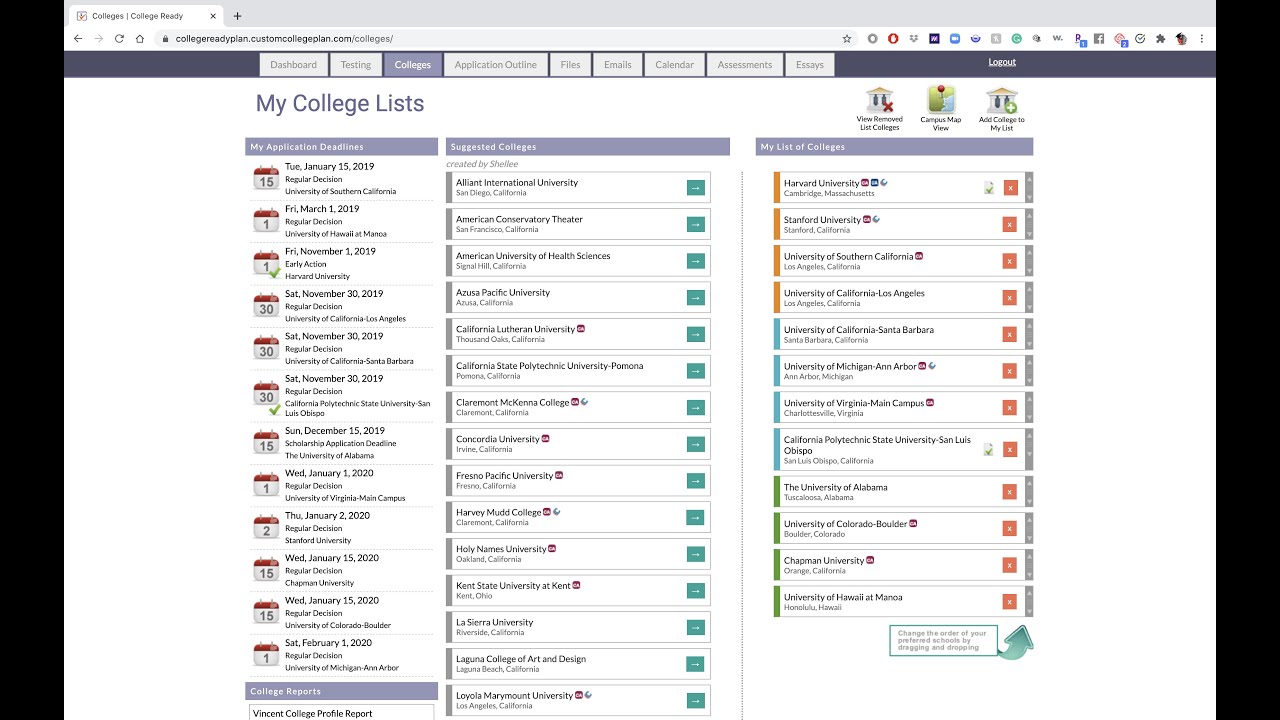
Shellee Howard of College Ready shows how to match a student's profile to colleges using reach, comfort, and safety categories. She walks through Vincent's application: 3.9 GPA, interests in engineering, biology, or film, and explains what schools need to see, from test scores to essays to FAFSA forms.
Chapters
Hello, this is Shellee Howard with College Ready, and I am really excited to help your student or yourself figure out which is the best school for your student. As we look at the different options and how to know which is a good fit—comfort, safety, reach—you want to be mindful, what does this look like and how will my student know? So when you think about how this all plays together, you want to be mindful of what does the student bring to the college, and how does that feel to the college, and how does it all come together. So today we want to start with some important things. We want to start with the student. So I have my sample student Vincent, He's a great student. He has a 3.9 GPA and a 4.25 weighted, and he's thinking engineering, biology, or, you know, film. So as the student starts to look at his entire profile, we can look at things that make sense for Vincent—his GPA, his test scores, his community service, leadership, his extracurricular activities, and essays. So all of that together is super important. Standing alone is not as critical. So the first thing that you want to ask yourself about Vincent is, is he going to go for a school that fits him financially? A school that fits him academically, a school that fits him socially, because the perfect fit school needs to have a perfect fit. And so prioritizing that for your family is super important. Once we have the GPA and the test scores inside of our proprietary program, you can then go into any school in the globe the world and look at how this school would be for the chances of Vincent getting in. Since Vincent has a 3.9 GPA and the average student who goes to Harvard has a over a 4.18, we want to be mindful that the student's a little bit weak on the GPA. Then you look at the test scores. Wow, the student's a pretty darn good test taker, but average in math, and if he's applying engineering, then there may be some questions. You look at, wow, English is really high, and, you know, composite's a pretty solid score. So those are just a few solid facts that we can look at. Then the next thing that we're going to look at is we're going to decide, does this make sense for the student to apply early action or regular decision. At some schools they have priority, um, they have early decision. So be mindful of all of the different ways your student can apply because they all have good, bad, and indifferent reasons about them. Then the next thing you're going to look at is what type of application will Vincent need to apply to, to this university. And for this university, he would need the Common App. He would also need the Common App supplements, his high school transcripts, mid-year grade report, SAT scores, SAT subject scores, ACT scores, letters of recommendation, and any secondary school report, the FAFSA, the CSS, CSS Profile, an interview, and potentially a creative supplement. Will be needed. For the essays, the student will be asked to do 4 application essays, 1 essay required supplement, and 2 essays called op— optional supplements, but they are not optional. So there is a lot that goes into this application process. It's not as simple as somebody saying, oh, you have a 4.0, you belong at the best of the best. This year we have students from 3.3 GPA all the way up to a 5.2. We have several students with a perfect 36 on their ACT, and we have students who are going test optional. So keep in mind, test optional is not test blind, and therefore be very careful. It could go against you if you do not offer your test scores. Test scores. If you want any kind of merit aid, you need to show your test scores. Very important. We can come on down to, you know, we've got some more reach schools. Let's take a look at maybe, you know, a comfort school. What does a comfort school look like for Vincent? So here you go. A comfort school is going to look like his GPA is going to be more in alignment, and he's going to be at least in the mid or above the mid-tier. The mid-tier is students who actually were accepted into this school last year. So, so many things to consider. It's really not as, uh, easy as it was back in the day. Then let's take a look at what does a safety school look like. A safety school is one in which a student is very much overqualified. Their GPA is absolutely higher. Their test scores are off the charts. Remember, the purple is the average, and you can look at the amount of work is much easier to get into that school. So this is a great safety option for Vincent, and he will most likely get a lot of money from that institution because he is overqualified. So there are so many pieces to this puzzle. A puzzle. If you have no idea where to start, we are happy to gift you a free strategy session in where we will help you to map out what your schools are and how your chances of getting accepted into those schools look. So hopefully you, uh, can see that with help, this is a doable process, and we really would love to see you and your students succeed, especially during this crazy time. Please reach out to us. The website is www.collegereadyplan.com, or you can call me personally. Again, that's 949-235-7350. We will guide you every step of the way and take the fear and anxiety out out of college. Have a wonderful afternoon.