Is It Ever Too Early to Start Preparing for College? | A Real Student’s College Ready Journey
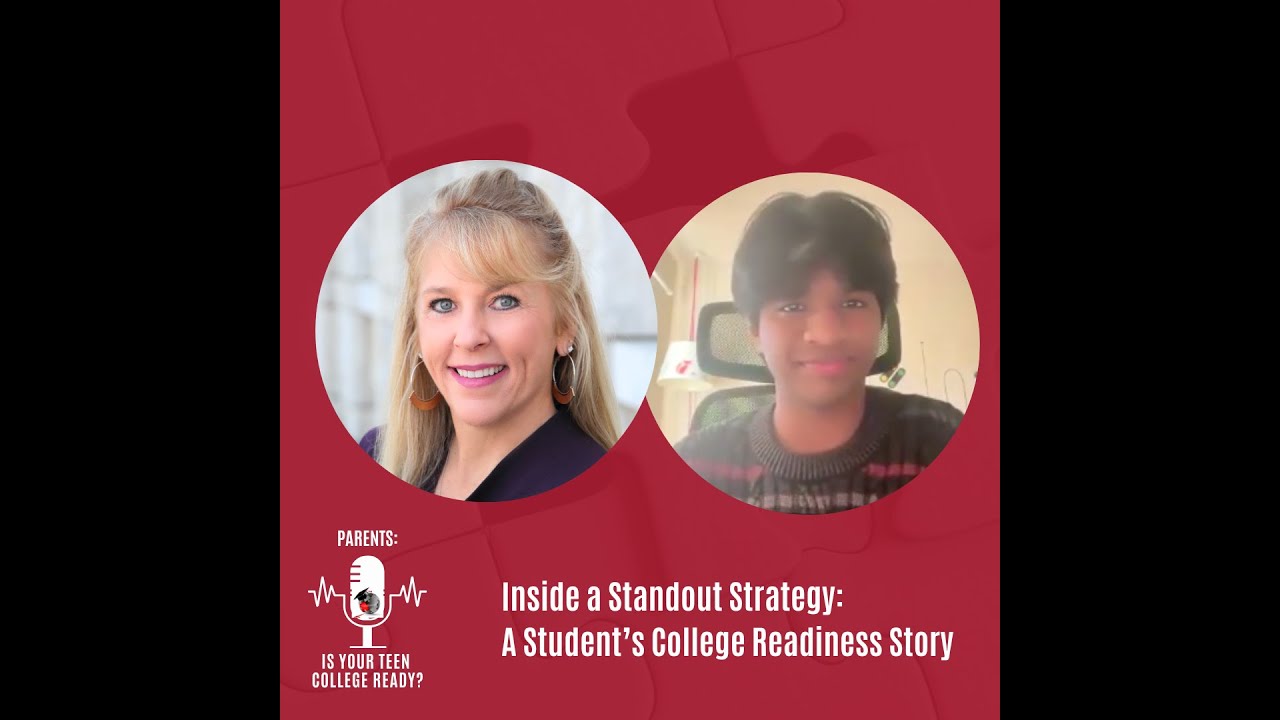
Shellee Howard interviews student Vidartha about starting college prep early. He began planning in middle school, pursued summer research in quantum cryptography, and balanced music and AP classes while preparing for engineering school. His counselor Deborah Carlson Wood helped him navigate the process.
Chapters
Hello, this is Shellee Howard, the founder and CEO of College Ready and Parents. Is your teen college ready? Today I have an incredible guest, one of our students, Vedarth. Welcome to the show.
Hi, Shellee. Thank you so much for having me on today.
Excellent. Can you tell our listeners a little bit about your story?
Yeah, sure, of course. So obviously, as Shellee Howard said, so my name is Vidartha Unbu. I'm from California, specifically the Bay Area. I'm in like the San Jose area, specifically like the Evergreen. So I go to Evergreen Valley High School. You know, I'm 17 years old and, you know, I'm a senior. So, you know, I think college apps for me is just wrapping up a little. So, you know, just a quick gist of what I do. So I love playing music. Music is one of my favorite things to do outside of school. Um, I love to do golf and, um, you know, I like learning about new subjects and I feel like it's a great way to get exposed to new and different kinds of things.
So he is so humble. Wait until you hear how amazing he is, families. But before we jump into that, let's talk for a moment. When did you start to really think about college?
Uh, I guess I started really going into doing all whatever I did, kind of like my 10th grade, about middle of that year. You know, I have an older sister. She's 2 years older than me. So when she was going through her college app preparation, you know, I was kind of looking and I was kind of observing about like, you know, maybe I should start this a little earlier. Maybe I should get a little exposed to this earlier. And I think the best time you could possibly start is your freshman year, which I felt maybe I missed out on. But, you know, it's not too late to start at any point. Like, you could start even in your 12th grade years. But like, I feel like the 10th grade was the point for me where I felt that I wanted to do more things. I wanted to learn the kind of things because I felt college admissions was going to be— this is going to be very important for college admissions.
Well said. So parents, the perfect time: 9th grade year. But any time is just okay. And then when you think about when did you start to get clarity around your major?
I mean, I kind of knew for a long time that I wanted to do something engineering related. My dad's a software engineer and my mother's an accountant, but like they both kind of instilled in me this belief that, you know, you know, if you— I don't want to obviously advertise engineering as like, you know, the greatest thing in the world or something. But, you know, you could do a lot of things with engineering. And like my parents told me, you have access to hundreds of things because it provides you with the thinking to do anything you want. And I felt like that was such an enticing offer cuz maybe down the line I'm not gonna do engineering, but like it was kind of throughout my entire life I kind of knew I wanted to do something engineering, but I didn't know what exactly to go into. I'm not gonna advertise engineering as like, oh, you gotta do it. But you know, that kind of belief just like made me realize maybe engineering was a possible goal for me.
So let's talk about, do you think it'll be in the direction that your dad is in or do you think it might go a different direction?
Yes and no. I mean, my My dad does software architecture, which is like kind of similar to what I want to do, but it's not exactly. I do a little different. I'm a little bit interested in quantum side and that's not really dependent on software. But, you know, I don't want to go too much into that because like, I don't want to confuse the audience and say, oh, do this, do that. But the point is that like, you know, I kind of like structured all my activities, my interests, what I would watch, what I would do. It was kind of structured around engineering, so I can kind of shape me to take, take forward that major.
Okay, that's what I was getting at. So you had this vision and then you started to— what, what can I do with that? Lots of possibilities. Then you started to formulate, right? Um, what grade did you start with College Ready?
Uh, I started in, uh, I believe 10th grade Just in spring, I believe.
Okay. And who's your consultant?
Deborah, Deborah Carlson Wood.
Perfect. She is your biggest fan. Let me tell you, I think she just thinks you can't do anything wrong. So as you're working through this, you and Deborah, you're formulating your strategy. You're coming up with what are we gonna do to really stand out? Then you get into, okay, application's gonna be real, right? How I spend my time is real. Can you take the listener through maybe how you spent your summers or your breaks?
Yeah. So last— so I can first start with maybe like my 10th and 11th grade summer because that was like a bit of a quick flash. So 10th and 11th grade, I mainly took— I took college courses. So I took one college course on CS in 10th grade and a college course in 11th grade on CS, on math. And, you know, I feel like getting the college courses was very helpful because my research was mainly math-based. So it was important that I gained those two understandings of like, you know, how to model, how to understand the math. And in kind of 10th grade, I was researching programs that I could do into my 11th grade year, something maybe I could possibly try, maybe get a little bit more experience. I was looking at— I think College Ready has an amazing tool where they have the files of past acceptances from like Stanford and Yale. And that was like really insightful for me, at least when I was able to go through and see, oh, this person had this, what is similar between this person and this? Maybe I could try to do that. And that's what I kind of did in my 10th and 11th grade, which is just a lot of research. And then in my 11th grade year, I got accepted into this place called the Knowledge Society. And it's basically like a 10-month program where they give you a real insight into how the real world looks like. So, you know, it's all about how companies execute ideas, solving real-world problems, and you present your ideas and your solutions to them, and then they would, you know, obviously look through it, and they provide you very detailed feedback. And I felt that was very, very good for me, at least, much when I didn't realize it. But presentation is so important, especially in the corporate world, and startups and all that world. And if you're very interested in like business, economics, or even, as I said, even engineering, the presentation is the most important part. And that kind of program helped me shape that understanding. And in my 11th grade summer, so the summer I had in 2025, I mainly just did research. So I enrolled in the Polygence program and I did research on quantum cryptography, And I don't want to get too into that. It sounds big, but it's really not. It's just, it's just like, you know, ciphers and how you use quantum mechanics to put the ciphers. It's not that sound as big, but like, you know, so I did finish the research paper and in the T-GaSE program, I also did research which got certified. So I felt like that kind of a lot of that work made me just realize work ethic and really just forced me to not really forced, but like made me enjoy the project more because I was learning a lot. And yeah. And then about my summer, I just did the research mainly. And then I was contacting professors and people I could work with and showed them my research on the paper. And then I worked with a professor from Berkeley who— on quantum position verification, which also sounds big, but it's really not. So, you know, You know, I don't want you guys to get too overwhelmed with what I'm saying, but like, you know, it's— yeah, so I just did research with him. I was like modeling, I was learning, and I felt like it kind of made me take my mind off college applications because, you know, obviously you shouldn't do something that you don't want to do and you're only doing it for the college apps because I'm pretty sure college admissions officers will see it. I don't want to say that— I don't want to make a presumptuous statement, but like, you know, you should do something you probably like to do. And I thought what all this made me do is take my mind off college applications because I realized, you know, I really like doing this and I shouldn't be doing it just for apps.
That's so good. So for those of you who are listening, this is true passion. When we talk about passion with a purpose or a standout strategy, it's not to get into a name of a school, right? It's to help you figure out what do you connect with. You're so big and so excited when you're talking about these really, for me, far-fetched, uh, quantum, uh, theories and such. I think of a TV show, but You have the gift of really connecting to that. So you did all this stuff, but what ultimately did you gain from it?
I, apart from all the, you know, obviously the knowledge I gained, I think that the, the best thing that could possibly happen was that I was able to realize I couldn't, I, I kind of doubted myself a lot throughout this process. Like, you know, especially when you're thinking, I think it's not limited to just engineering, right? If you're going through even like medical, even if you're going to law, if you're trying to ask all these big professors, it can be really daunting at first. I think a huge shout out to obviously Deborah. She told me back in 10th grade just to email professors. And I kind of was like getting, I was a little nervous first, but you know, I think that's like the excellent part is once you throw yourself into something, you realize maybe how good you really are, in air quotes. I think that kind of helps you a lot in realizing you're capable of more than what you think. So obviously that fear, that like little thing inside of you is telling you, oh dude, you're not going to get it. This is not going to work out. But you know, you're more than that. And I felt like that kind of opened me to taking a little bit more riskier shots, maybe going out for Stanford admissions. Obviously that didn't happen, but to get the guts to do that is what I kind of took away from it.
That's beautiful. So you grew as a human being.
I definitely think so as well.
That's the greatest gift right there. So now take me to, um, you were invited, and you haven't really delved into this yet, um, by a CMU professor to present to working professionals. Can you help the listeners understand what that experience was like, because this is where Deborah was singing your praises from the rooftop and just couldn't say enough about this experience. So maybe you can share that with the listeners.
Yeah. So I just like to give a quick story. So after I finished my paper with the help of Dr. Krishan Pukkar at the University of Washington, so I need— I wanted to look for presentation opportunities because that was As I said, outreach is the most important thing you could do. So I wanted to look for somewhere where I could show off my, what I had learned, what I had gained, what maybe this means for whatever. And, uh, it was a very frustrating process cuz I was, cuz I would be at school and I would be, I sent out, I think 130 emails to a bunch of places and you know, you only get responses from 10 places and those 10 places would be like, oh, contact this person. And then they'll send you to someone. It's just a back and forth of nonsense. But luckily one place, the SF Bay Association of Computer Machinery, I don't wanna say that this is all like, you know, like, you know, if you do it, you're gonna get it. It's all luck. Like this is literally a lottery system. They get so many emails. So, you know, you just have to the probability, right? You gotta increase your, your, your, your number of tries in order to maximize the most. So I think the best thing that I did was I just sent out a bunch of emails. Emails without looking at who the address was, and I just sent them out. So I got back from the SF Bay ACM and they told me they would love to have me as a presenter. So I was initially really excited, I was like amazed, and then there for some reason they kind of ghosted me for like a week or two, and the deadline for when the presentation was was coming closer, and I had to— I sent them like 5 emails and they didn't respond back. And then somehow they responded. They said they moved me to, uh, they said to contact this person at CMU and they said that you should contact her to present for this opportunity. And then she had sent me an email saying that, uh, they were recommended by the SFBA ACM and she wanted me to present to her. This is the CMU Silicon Valley, so the professor asked me to present at her software engineering management class. And obviously what my research is and what software engineering management is, two different things. So then I was initially really, really confused. I was like, so why do you want me? I mean, like, I'm a quantum computing guy. I have nothing. I don't know how much I can offer you. But then I did a little bit more research into the class itself, and I kind of modified the presentation to kept the same topics, but I learned a lot more about AI, its applications. So then when it came time for the presentation, they were really, really impressed and really, really happy because, you know, it was kind of what they were looking for. And, you know, the TA really, really told me what to do, at least that kind of helped a lot. So I think that there's no shortage of help out there. There's obviously— Google is an amazing tool. I'm not going to advertise that. You know, it's not, and, uh, you know, there's always gonna be help out there and I feel like maybe I was a little unreluctant to go and find it, but now that I've been a little bit into it, I'm a little bit more reluctant to send an email to send for some help. And yeah.
Again, so humble. I can totally appreciate that. What that has done for you in so many ways is give you the confidence when you go to apply for a job.
Right?
You now have this gift of tenacity that will serve you well for the rest of your life. So I'm so incredibly proud of you. It is an incredible accomplishment. So let's talk about your senior year. What has your senior year been like?
Uh, it's been pretty hectic. Uh, you know, uh, right out of the gate, I mean, like, you know, I took quite a bit of APs. You know, it's hard to kind of like think about all of this at the same time. And that's really stressful, I feel. But I think one way that I think kind of helped me out was— so I had music, so I play— I feel like this is a little bragging session and I don't want to make it a bragging session because I don't want to say, oh, do all these instruments. But like, you know, so I play many— I play 4 instruments. So I play the piano, I play a South Indian instrument. And then I play the French horn and I also sing. So, um, and I also DJ on the side, but like, you know, I don't want to go into that. But like, so I had music to kind of— when things got really, really stressful for me, at least I had music to kind of take me out of it. So, um, and I was preparing for a really huge concert in December. So then I had that on my mind all the way throughout senior year, but You know, I think if you have something that you really, really love to do, especially music, at least for me, it could be sports for you. It could be like reading. It could be anything you'd like. It could be writing. But if you have something that you— that is away from all of this, it's away from college apps. If you have something like that, I think that's really, really important for me at least, because that kind of, you know, even though I have to go to rehearsals at 5 PM and come back and study for tests, and do essays and do this and do all that. It's very, very nice because that 1 hour when you're at a rehearsal or that 1 hour where you're just practicing for yourself, that's really useful because your brain really needs a break.
So that's beautifully said. So music was kind of your escape from kind of the grind. And I think that's super healthy that you recognize that. You'll take that with you to college. And so are you now finished with all of your applications?
Uh, I'm mostly done. I still have 5 colleges left. Um, I, I finished all the essays. It's just that, you know, I set a meeting with Deborah, make, make sure to go over everything and then, um, talk with my parents, make sure this is the college I want to go to. And, uh, then I think I'll be done in like 2 days. Maybe I'll submit them today. So. Woo!
That's gotta feel so exciting.
Yeah.
So talking to a younger version of yourself, put yourself back in your freshman year. What advice would you give yourself?
I definitely think that in my freshman year, at least, so I mean, my freshman year, I thought that getting into a college was very, very simple. I did not think it was a very complicated process. There was a point in time when I thought, oh, UC Berkeley, electrical engineering.
Wow.
'cause like everyone got into it the year before when I was looking at people, they all got in. So I was like, "Oh, I don't have to try that much, you know, I can get into the UC Berkeley electrical engineering." But then once you really get into the year, you're like, "Oh my God, it's not easy. It is very difficult." So I think one thing that I especially wanna give myself advice is there's never too early to be locked in. I feel like the best point is your freshman year, obviously, and I felt like One thing that advice I would give is he could have started— Carter started his freshman year. I probably would have gone in a more bigger jump on some things. Maybe we never know. Obviously could have, could have turned out, could have turned out bad. But like, I felt like, you know, one advice I would probably definitely give myself is, you know, you shouldn't be afraid of going out and trying new things, going out and asking people for help and going out and looking towards people. 'cause you know, that stuff is really, really gonna change your life really. And I, I wouldn't, obviously I don't regret anything I've ever done, but the advice I would give is that, you know, don't be afraid to go out and just start now. 'Cause you know, you never know until you start.
So great advice. Yes. I, I would say 9 outta 10 students that I talked to would give that similar advice. So well done. And then as far as College Ready goes, you worked inside the Vault, you worked with Debra, what is the takeaway? What is the one or two things you felt like was really helpful?
I just think the amazing kind of opportunities that especially CollegeReady provides. I think it's such an amazing program that you fostered, and I, I think that's amazing props to you for, you know, fostering such a program. And, um, I think especially the Empower Education program, I did that last year during summer as well, which Last year was also like a lot of volunteering work that I did, but I felt that, you know, the College Ready program as a whole with the opportunities it provided with the Congressional Award, the Presidential, the Martin Luther, the Empower Education, all these separate things, all this help that they provide has just been like monumental in my journey. And I don't think that if I was— if I didn't have College Ready, I think a lot of things I wouldn't have done. And I don't regret doing College Ready at all because It's been amazing. And I think this is just a huge shout out to Deborah, at least, because like, she's like such an amazing person. She's always there supporting me. And it's really, really great to have someone out there, even when you don't believe in yourself. Deborah is always there. If you want to call, she's always there. So I think the program, the counselors that you have is just absolutely amazing. And it's very, very good for people like me, at least when you're, when you're really grinding and you're really, really like, oh my God, this is not gonna work out, there's someone there to say it's gonna work out. So, you know, I think that's really great what you fostered.
So beautiful. I'm glad we were there for you. Looking to your future, have you thought about the, the career or the, the next step?
Yeah. Uh, I mean, I'm, I'm, I'm a little, uh, I don't wanna see, I don't wanna brag too much also. So like, you know, I'm gonna be like as as low-key as possible. You know, I think I learned from my freshman year at least, and I guess I don't want to say advertising having an older sister is great. Having an older sister is absolutely amazing because like they're the example that you set, and you know, since they've already gone through it, you know what to expect going into it. And especially at least I did a lot of research because I was sure that I wanted to do my— I wanted to do a PhD. And I was sure that I want to do a career in something related to quantum. And I knew that going into it, especially in 10 years' time, the job market is going to get even worse. So I planned out what my next 4 years of college would be like and how I would prepare for a PhD program, because I know obviously PhD programs are especially competitive as well. So I knew going into this that I would need to prepare for the next 4 years. So I kind of have a plan for every single college. I knew if I got into that specific major, I would know what I needed to do to get into my— to get into the PhD I wanted to. So I kind of have a plan for my next 4 years. I know the career I want to go into. It's just like a matter of time of— I guess I'm in the most anxious part now where I'm like, where am I going? Which plan do I pick? So, you know, yeah, I kind of have that plan out, but I don't think it's really necessary to have that plan. I think I'm just anxious from all the college application results waiting. So I don't think it's necessary to do that, but I think it's like a good stress reliever, at least for me, at least when I can like think about my future and knowing.
I think it's wise you took your own advice, right? You started a little on the earlier side and now having a plan is just— it's a strategy for success. Not having a plan, as you learned, can be really difficult. So the College Ready program is all about that planning, and it sounds like it aligned perfectly with who you are and what you're going to accomplish. So please come back and be our mentor and help other students. We are so incredibly proud of you. Thank you for being a part of College Ready.
Thank you so much for having me. And I would just like to give a huge shout out, obviously, to my parents, my sister, and obviously Deborah, who's played such a huge role. She's been absolutely amazing. So I just wanted to put that final note out there. For her. Thank you.
More from Shellee




The 3 Questions Every Parent Should Help Their Teen Answer Before College | Featuring James McLamb

Helping Your Teen Stand Out for College Through Purpose & Impact | Featuring Aishani Sheth


From Robotics to Cornell: A Father-Son Blueprint for College Success with Aarav & Ritesh Kumar

The Hidden College Credit Strategy That Could Save Your Family Thousands with Josh See

The Truth About Financial Aid: Why Some Families Pay Less for College Than You Think with Jack Wang

Human Skills Every Teen Needs for College, Careers & an AI Future with Rob Heller
