Shellee Howard and Rachel Mead explain why standardized testing still matters for college admissions and scholarships, even at test-optional schools. They walk through a framework for building strong applications: finding your strengths, creating meaningful projects, writing standout essays, and planning finances. Test-optional schools still compare scores when submitted, and most merit aid requires them.
Chapters
joining us today for our Is Testing Really Optional? We're gonna let people fill in and then we'll get started in just a minute here. And before we do that, Shellee, I'm gonna let you go ahead and start with an introduction on you and your background for us.
Absolutely. Um, thank you so much. My name is Shellee Howard and I'm the founder and CEO of College Ready. I have the honor of helping families, not just the student. I embrace the whole family to help them navigate the college admissions process, and I have been doing it for 17 years. It all started with my firstborn. He came home from 8th grade and said, Mom, I know exactly what I want to do. Can you imagine? Like, I had no idea in 8th grade, and that's what started College Ready. That young man is now an orthopedic surgeon. Wow, time flies. So I am a 2-time bestselling author. I love to give resources free, tons and tons of free resources, and I'll share that at the end about going to my website. But what qualifies me to be here is, well, I'm a mom of 4, so I'm kind of qualified in that. My baby is graduating, the last one from college, so all 4 will graduate completely debt-free. And I didn't pay a dime. So I'm super excited to share both the getting in and the financial side. And then I also am a Certified Independent College Consultant. So I actually am part of an ethics organization, and I love to share what's going on so parents do not have to worry.
Excellent, thank you. And for those of you that don't know me, I'm Rachel Mead. I'm the co-founder of Enhanced Prep, um, and we specialize in academic tutoring and test prep tutoring. And I've been in the supplemental education space for, um, over 28 years now, really focusing in on anything and everything related to standardized testing. So in this space, that means SAT and ACT are my specialty that I'm bringing to the mix of what we've got going on in the world of in the world of college admissions. So, Shellee, I'm going to let you go ahead and jump in. You should be able to share screen if you'd like to and get us going in our work together today. As Luke did put in the comments there for us, please use that Q&A portion to ask questions. We do have people monitoring that. They'll certainly interrupt us if it's on point. We will make sure that it gets answered during some time at the end for you as well too if it doesn't fit in with what we're working on right now. Something's on your mind, drop it in there to make sure that you remember and we can come back to it.
Absolutely. One other thing that I would request is if you could put in where you're located and the age of your child. I think it's so important. I don't want to talk about middle schoolers if everybody in here is a junior or a senior. I want this to be super relevant to you. So if you can share that information, I can cater it to exactly what you're here to learn. So let's go ahead and I will jump in and I will monitor the chat as I'm going. Um, uh, let's see, what does it say?
So we've got a poll going on here that's going to help us identify if we've got a student, parent, counselor, or teacher, um, or other. Then we're also identifying grade level as well too, and we've got 2 responses so far, um, both for juniors coming in, one parent and one counselor or teacher in place. I did also see chat, I saw some California come up here. We've got a freshman that's participated now, so we're seeing that roll in. Another junior coming in. So yeah, it looks like we've got a lot of high schoolers that are coming into play, but I love the fact that you brought up location too, Shellee Howard, because we know that there's some states like Florida that are going to mandate testing as part of that admissions. We've got other places that, like California, that tend to be a little bit more test optional or test blind. And I know we're gonna spend some time talking about the fun of distinguishing between those two.
Awesome. That's so helpful. All right, let's dive right in. So my goal this evening is to help you, the parent, Maximize your child's potential. That's why you're here. What can you do to give them that competitive advantage? And I want to give you some insider secrets, right? Stuff that you cannot Google, or you definitely don't want to Google because it'll just freak you out. So sorry, I'm trying to move the little— oh, it took me right out.
Okay, we can see your screen full here, Shellee Howard. So everything looks good to us.
Okay, perfect. There we go. It's in the middle of my screen.
Okay, got it.
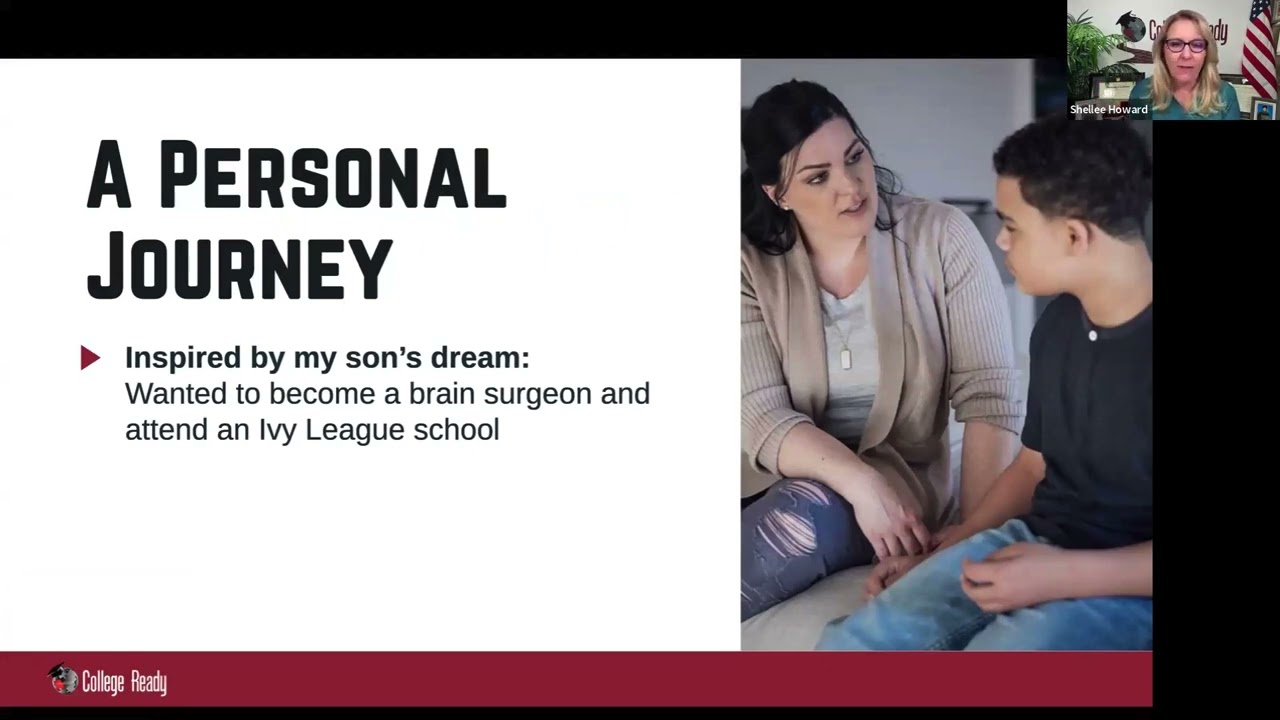
So a little bit more about myself very briefly. I am the founder and CEO, started 17 years ago, and we've helped well over— I mean, I've lost count, but, um, we really spend our time getting to know our students. In the last 3 years, our students have earned over $23 million in scholarships. Last year alone, we had 29 seniors earn over $9.2 million in scholarships. So not only are we focused on getting students into college, the best academic, social, and financial fit, we're looking to get them out without massive debt. We support families. Looking to go Ivy, looking to go state, anybody over community college, you don't need me if community college is on your radar. You may need some support when you transfer to a 4-year. So our mission is very clear. We are here to empower families and give you knowledge and strategies to maximize your child's potential and secure admission to the best fit college for your child. So my personal journey, I alluded to my son's dream when he came home from school. He says, Mom, I know exactly where I want to go and exactly what I want to do. And I am like, oh wow, because I changed my major 5 times. He's like, yeah, Mom, I want to be a brain surgeon. I want to go to one of those Ivy schools. I took a deep breath and I said, yes, we will get that done. So the challenge was I had no medicine in our family. I was the first to go to college, and I was panicking. Of course, I did not let him know that. And then what we figured out is he needed a strategy. So I became a certified college consultant, and I reverse engineered a successful strategy. But guess what? He actually did it, and I have 4 kids, so I know that that is not always the case, but it was for him. We built a comprehensive plan, or I did. I invested the time and the effort to secure his success, but it cost— it cost me 33 hours a week on top of my full-time job, and the results He got accepted to Harvard, graduated debt-free pre-med. He had multiple full-ride offers and he had a balanced high school life, right? Isn't that what we want? Show me the money and let's have some fun. Your child can succeed. No different than my own. A strategic plan makes the dreams of— that's what it is. It's not a let's wait and see. It's let's create the plan. It will relieve the financial strain, and it will make your child feel really good to earn some scholarships. What we're going to cover today is we're going to discover and showcase their unique strengths. How do we even find that? How do we help them develop a passion project with purpose? How do we help them navigate the admissions process with confidence? And how do we implement the whole financial strategy. That is what we want to do. We also want peace of mind. So I'm going to go through this pretty darn quick because there's a lot to cover, and then I'm going to open it up. If there are questions that come in, please go ahead and stop me, and I'm happy to answer. Otherwise, I'm just going to push on through because I want you to get all of this. All right, step 1, how do we discover their unique strengths, right? There are some children who are really outgoing and some who are really quiet and everything in between. So the first thing we need to do is find out what lights them up. And I have 2 strategies, parents, to help you figure this out. Number 1, think about what is that thing, that person, the event where they jump out of bed and they're excited to go, to do, to be. Or if they don't have one of those, and maybe it's in their hand called their cell phone or computer, maybe you need to play this game called the Millionaire Game that I love to play with my high school students and middle school students. This is how it goes, parents. There's two rules: you cannot roll your eyes and you cannot tell me it's a stupid idea. Other than that, free game. If I gave you $1 million cash, if your child is not smiling, you have a problem. Just kidding. I give you $1 million cash, you have 24 hours to spend it or you have to give it all back to me.
Go.
And if they look at you like, uh, I'm— I got nothing, we need to go a little bit deeper. I've had students tell me they would first buy a yacht, take all their friends, fly them across the Globe, like no concept at all of financial literacy. But I love their enthusiasm because it gave me something to start with. So an example would be coding, writing, volunteering. Those are some simple ones. What challenges do they want to solve? I will tell you, this generation, they are fired up. They are advocating. What is it for your child? Is it starving students? Is it students not being educated? Is it the elderly? Is it— what gets them fired up? That's what we want to know. Now, why do their unique strengths matter? We can tell you by each college what they're looking for during the admissions process. We can tell you, are they looking for Uh, gifts and talents? Are they looking for, uh, ranking? Are they looking for test scores? Are they looking— what we can tell you that, and what I want you to, to know is the essay, the icing on the cake, is their unique strengths. So yes, very much matters. Colleges are seeking diverse contributions. Your child's unique piece to the puzzle, right? They can't have all business majors. They have to have some majors from every single group, or else they'd have to fire all the teachers one year, professors, and then hire them again. It's really quite a puzzle. How has your child made an impact? Reflect. What are you proud of them? What growth have you seen? What resilience have they offered? These are things we want students to start journaling, documenting, bullet-pointing, whatever they can do to capture it. Now, how do you uncover your child's strengths? Some, some families just get stuck there. There are activities that make them lose all track of time. You know, the ones, the problems they want to solve, like they will debate you for hours. Moments they felt so incredibly proud, or when you bring it up to Grandma, they get embarrassed. Those are some of the things that colleges want to know about your child. Here's a perfect case study. This student saw her brother go to Kenya, Africa, and when he came back, yeah, yeah, yeah, tell me about the story, no big deal. But all she cared about were the pictures of those little people wearing old T-shirts, no shoes, dirty torn clothes. She was fired up. She had a huge passion for fashion and an empathy for underserved children. She thought it was incredibly unfair that they were born into this situation, and how would they ever have confidence to survive in a competitive world? So she created a project where she and her friends made gently used pillowcases into pretty little dresses. They taught themselves how to sew on YouTube. They got people to donate the pillowcases and the material and the ribbon and the thread, everything. They created these beautiful little pillowcase dresses. Then they got Doctors Without Borders to deliver them as they went out and served the underprivileged. Those doctors took pictures and video, and guess what? These little girls had some pretty little dresses. Hundreds of pretty little dresses went across the globe, and this student had an insane essay. Turn strengths into standout applications. You know, if a student is so excited about what they did, they are gonna write for days. It's gonna be easy. They cannot write, "My mom made me do X, Y, and Z," right? That doesn't make for a good essay. So they need to tell a unique, memorable story. They need to build a strong resume. Remember, the Common App lists 10 activities, honors, and awards. The UC app is 20 activities, honors, and awards. So say you want to go to UCLA. That's 20 activities, honors, and awards. If you wait, this is going to be really hard. And guess what? They want you not only to do it, They want you to lead it and lead others to create that change. This will also prepare them for the college interviews. All of this is what it takes them to stand out. Here's another case study. Daniel Parker. He had a huge passion for the universe. It was so much fun talking to him. He was so fascinated with the black hole. He could talk my ear off. And I'm like, how are we possibly going to use this for college? What we did is we, we worked on creating this space backpack for underprivileged children where he got to have themed material that he put in there. He organized stargazing nights and conducted black hole research that was published with a college professor. The impact— he got accepted into so many colleges. I can't even tell you how many, but his dream was Brown, and that is where he's at right now. Your child's unique strengths, that's, that's the important piece in all of this. If they don't know who they are or what matters to them, how are colleges ever going to know if they're a good fit? Think about what makes their eyes light up. What gets them excited? Now, how are you going to showcase those qualities? So we have put together at CollegeReady what we call Passion with Purpose projects, where we can help students demonstrate their initiative and their leadership while earning 8 to 10 national awards and 4 leadership certifications. All while being safe online. They can go in person if they want, but it doesn't have to be. Starting a community-focused project is good. What is better is that they lead others to make that happen. It has to align with their personal interest. The other night I was on with a family and I was sharing this information, um, with a potential client. And when I started talking about this, Dad jumps in. He's like, okay, I've got this great idea. There's this plot of land, um, nobody's using it. I think we should use a— do a community garden. And the kid's looking at him like, I don't know who you're talking about. The dad was so passionate and so excited, and the student wanted nothing to do with it. So sometimes parents I get it. Sometimes it takes a total outsider like myself to help them bring out their interests and help them have personal and meaningful impact. So how do you even start a passion project? That's what a lot of people want to know. First, you need to help your child identify a cause that they care about. Then, what is their role going to be? How Will they set a clear goal, specific and measurable? Then how are they going to engage others? You can't just put a post up on social media and expect everybody to come running. That's what most students think is going to happen. Then they have to reflect and document. These are so important. Meeting college expectations. Colleges are looking for students who are proactively contributing to their community. College is a business. They are not looking for a great student with a high GPA to come and sit at their school. That is not the goal. The goal is for a leader to come and lead things to make that college better so other people will want to come there. It's a marketing machine. They figured it out. A passion project that aligns with your child's interests and future goals is huge. My son got 7 full-ride offers because of his Passion with Purpose project. That's a whole nother workshop. Here's another case study in case you're like, oh, I know I'm still not figuring it out. I have a love for third world countries. I've been to 91 countries, and what I will tell you is education is the key to change that situation. I was in Uganda, Africa a year and a half ago, helping females create small businesses to provide for their families. When I came home, I was telling Henry, Henry, this is what happened. It was amazing. And he's like, How do I help? And that's where Empower Education got started. The mission is to support education in Uganda and Mexico. It is now grown to 54 students all over the globe where we meet once a week, and myself and my associate Carrie, we get to mentor students to lead other students to Provide the change to give them education. It is an international nonprofit. Henry created the, uh, 501 status. I am on the board, but I am truly the mentor that helps the student do this. In one year, they have raised $28,000. They've built two schools in Uganda and supported an orphanage in Oaxaca. Do you see what I'm talking about? Somebody who is tutoring, somebody who is feeding the homeless, somebody who's just checking the box, that is not going to get them into the college of their dreams. Leadership is everything. The outcome is what they're going to be proud about. I encourage students to have a leadership role. Can you imagine your child leading a project? Hopefully your head is like, yes, I would. Well, maybe they're not there yet. Maybe they need support, right? Their student government, and some people are great at that. My, my two oldest, they live for student government. My two youngest wanted nothing to do with it. It's all about what inspires them to lead others, because if they are excited, they are going to want to lead. But what about the quiet leaders? Well, they're going to have to do it as well, because that's what it takes to navigate admission successfully. You must first overcome the myths and misconceptions. Your family does not make too much money to receive free money. Uh, your student doesn't have to take 20 APs to get into an Ivy League. Um, I could go on and on and on. The one thing I will tell you is don't go on all of these social media small groups because I'm in them and they stress me out. Be very careful where you're getting your information. Empowering your child through this process is huge because remember, when they leave for college and they're 18, they don't have to tell you anything, nor does the school. So setting them up for success right now is massive. Utilizing tools and expert guidance to simplify the process. We have built a platform called The Vault. It started with my firstborn when we had built 33 digital Google Drive spreadsheets. It was crazy. He was so tired of spreadsheets, so I created what's called The Vault. Inside the Vault, I create a standout strategy for every student. I create their positioning, their academic classes in what order, the tests they should take. Everything has a strategy. Utilizing the tools makes all the difference in the world. I started talking about myths. Well, believing that only perfect students get into top colleges. I don't believe all 4 of my kids were perfect, for sure, and they all got into great schools. Thinking that standardized test scores are all that matters or don't matter at all, right? Assuming the process is too complicated to navigate successfully. Well, this can be real if you are a busy working parent with more than one child, for sure. It is going to be hard for you to do it on your own, and I know that because I tried it. And that's when I realized that this is where I was meant to be, inspiring teenagers other than my own, because I paid one of my consultants to give them the information because they didn't think I knew anything because I was just mom. So let's talk about supporting your child. How Do you really get through this process and have them love you through it? You encourage independence with support. Remember, your 15, 16, 17, or 18-year-old, they've never done this before. Even if you went to college in the United States, it's nothing like it used to be. They need you. They need support. Their high school is not the place they're going to get it. If you have a good or great student, you're probably not going to get much support at all because they're going to be focused on helping the other kids graduate and show up to class. So let them take some ownership, but please don't assume they know how to do this on their own. A lot of them procrastinate because they are terrified and have no idea where to get started. They need a roadmap, right? Remember the first time they played a sport? Remember the first time they picked up a ball and they're like, I don't know, and then they picked up a bat and they're like, I don't know, or playing soccer or an instrument, right? Without a roadmap, or I call it directions to the, the game, and it is kind of like a game. That they're, they're not going to be able to navigate this. They need you or a professional to break it down, to give them clear direction and clear milestones. Providing resources and tools, checklists, calendars, organization, organizational tools, time blocking. We teach students all of this because we know as soon as they leave for college and they get to pick when they go to class, when they don't, what major they want, which, which one they don't. We need to make sure they have these hard and soft skills to be successful. So you may be thinking, I don't have time to do all of this. And truly, I was just like you with my firstborn. I'm like, wow, can I find somebody to help me? So what I did is I took my son going into his freshman year, and I made an appointment with his high school counselor. And I love high school counselors. They have the hardest job. And I said to my son, you tell her what you told me. And he goes, yeah, sure. I want to go to a top Ivy League school and I want to be a brain surgeon. Can you help me? And I will never forget what she said. She said, why would you waste your time or money being a doctor? They don't make money anymore. My son's eyes got huge and he looked at me and he's like, Mom, like, how is that going to help? And he's like, "I guess I'm on my own." And I said, "That's okay. Thank you for your time." And we walked out, and he looked at me like so deflated. And that's when I realized I needed to step in. Understanding what colleges are truly looking for is more than just Googling, uh, U.S. News and World Report, because that's not real information. You need to know the GPA, the test score, the community service, the leadership, the extracurricular, the letters of recommendation, the essay. You need to know all of that, and every school does it differently. I don't mean to overwhelm, but I need you to, to be able to support your child. So the benefit of using somebody like CollegeReady is to save time, reduce stress, and streamline the process. To avoid pitfalls. Unfortunately, I get students from 7th grade all the way through transfer students, and every single year I get a student who is a senior who is in panic mode, and they're— they— la la la la la la— and we find out that they haven't even taken the right classes to apply to the schools they want to go to because their high school did not require those classes. They only had high school requirements for their state. This was so hard to tell that family that you need to be very proactive because you don't and your student doesn't know any of this information. We tailor everything that fits your child's unique situation. The very first thing we do is we help them figure out their gifts, their talents, their advocacy, their core values. Then we put in some fun assessments and then we help them to find 3 careers that are a good fit, 3 majors that fit those careers. And will a robot be doing that career when they graduate? That is real. No joke. Now for another case study. Navigating this process is hard even if you went to school in the US, but Miss Caitlin Kolberg, her parents didn't go to college in the US. They are well, well educated, but they were well educated in another country hoping to give her Caitlin a much better education, at least they thought. They were overwhelmed and they had no idea where to start. So what we did is we demystified. There was so much that they had heard and they thought and they were guessing that we had to provide them with real personalized roadmap for the parent and for the student. Because the parent was kind of stressing out Caitlin. The result is Caitlin was accepted into several top-tier universities, including her dream school, UC Berkeley. She's now a senior this year, and she will be graduating debt-free and heading to her dream career. Her parents gave me so much credit, it was embarrassing, but I am grateful. So talking about navigating the process. How confident do you feel in navigating this process? Would having an expert guide you through help with some of your concerns? Because there is the whole financial strategy that I want to layer on top, right? Getting in is the hard part until you figure out, how am I going to pay for it? And then it's like, oh, I had a call from a family this morning. Who were so excited their daughter got into TCU until they figured out that she did early decision without telling them, and it was a binding decision. She got rid of all of the other schools she never applied to, and then they found out it was going to be a $400,000 education because they did not do their SAI, they did not complete their FAFSA, they did not plan. And, uh, it broke my heart when I had to let them know that early decision is a dangerous decision. Understanding the true cost of college, including hidden expenses like football games, like travel, like food, like decorating a dorm room, sorority— there it goes on and on and on. So what you need to do, parents, is maximize the financial aid opportunities. And this is how it works. You— there's one bucket where the student gets to be the very best they can be, right? Get the best GPA with rigor, the best test scores, the best, um, uh, community service, passion with purpose, national awards, international opportunities. School clubs are the lowest. Why would they waste all of their time doing that? The big money comes from building up the student to get money, then finding the academic, financial, and social fit of the perfect college match and having a strategy of why you're applying to each school. Because what happens is when you get the acceptances, you get to do financial negotiations. You get to come at them with reconsiderations. Right? You wouldn't go to a car lot and just pay the sticker price, or you wouldn't even go and buy a new home except in California where you would pull up the flyer and pay that price. So why would you do it for college? It is unnecessary. And this is where most families get themselves in trouble. So the cost of college goes beyond tuition. It's fees, it's housing, it's extracurricular activities. It's travel expenses, it's personal expenses. So here are some strategies to reduce the cost. Maximizing financial aid and scholarships. The very first thing you need to do is find out what is your student aid index, SAI. Carrie, if you can put in the chat how they can get their SAI calculated for free, that would be awesome. We can help you understand what colleges think you should be able to pay, but I've never had a parent go, oh yes, I can't wait to pay that. Nobody wants to pay that. So we need to help you understand how to get your financial house in order. We are not financial advisors. We're not here to sell you any product. We're here to help you to reduce your SAI to increase scholarships. Because that is the best way to graduate debt-free. There are merit-based scholarships. These are awarded to child's achievements regardless of how much you make. You can make millions and students can still receive scholarships based on merit. Need-based is going to be based on several other factors— your SAI, your income, what's on your taxes. There's a lot to it. And I can help you get through that. And then institutional and independent scholarships, these fund the gap. Okay, there are hundreds and thousands of them, but be very, very careful. I made this mistake with my firstborn because I didn't know any better. So let me give you some wisdom. Number 1, create a throwaway Gmail. Which could be johnsmith@gmail.com, whatever you want to call it. Just first name, last name at gmail.com, one that you don't even care about. Because once you start applying to scholarships, you're going to get a ton of spam. It would— we had to shut down my email. It was so bad because my son, he was well-meaning and he applied to a lot of scholarships, but he told them that we owned a house and we owned a car and Before you know it, they wanted to refinance my house and sell me a new car. So remember, be careful who you give your information to. It is a little intimidating. Financial negotiations are real. The way my son got a full ride to Harvard is he had a full ride, the presidential scholarship at USC, and Harvard matched it. Harvard says they have no merit scholarships, but they do not tell you they have $53 billion in endowment that they buy down the cost of tuition. So it's all about what you know and what you don't know. So here's some keys to success. Start early. The earlier you begin, the longer the runway you have. Think of college similar to retirement. You wouldn't start planning for retirement when you're 80. Don't start planning for college when you're a senior or a junior. If you're there, you still have time, but that window is closing. The best time to start is when your student has curiosity, has drive, determination. Every student's a little different. I have some 7th graders who are more mature than a few of my seniors. So just know it's not an age, it's not a grade. I've had students who are freshmen take the SAT or the ACT and get a perfect score their freshman year. How impressive is that to colleges? Everybody needs their own strategy. Build a strong profile. The best scholarships often go to students who stand out academically. And personally, right? They want to know who is your student, what matters to them, are they gonna come and make their university amazing. Research generous colleges. Some colleges have way more money to give away than others. Your local state schools are often more expensive than your local private schools. I know it doesn't make sense, but I can show you on a, on a discovery call. Here's another case study. Okay, let this family, the Ardburg family, they wanted financial peace. They did not want to go into debt. They were deeply worried about affording college for their daughter Karina. The solution is we created them, we customized a financial plan designed just for their family based on their unique needs, their goals. We put together a curated strategic college list. Reach, comfort, and safety. Generous, not so generous. So they had opportunity. The result is Karina attended her top college with minimal debt. It wasn't quite debt-free, but she picked a school that was a good fit all around for her. The family gained peace of mind and clear financial roadmap. Take control of your finances. Financial planning reduces stress and opens opportunities. Remember, I am not a financial planner here trying to tell you to go and spend money, blah, blah, blah, blah. I'm— that's not it. It's understanding The FAFSA tells you what they're looking at and what they're not looking at. Tax code tells you where to invest your money and not to invest your money. It's all about understanding your money. It is possible to have a debt-free degree, but it's important to have a strategy to get there. It won't happen on its own. So in case you're feeling, ah, I don't know if I can do this on my own. I wanted to share very briefly that we have a comprehensive and personalized plan where we maximize your child's potential and minimize stress and cost. What does it include? This is what it includes. We have a team of experts, professional essay editors. We have a team— you're going to hear in a moment— test strategy and the importance of that. It goes on and on. You need a village to support your family if you want to get into the dream school and graduate debt-free. Remember, it's the academic testing, community service, leadership, extracurricular recommendation, and essay strategy. So now I ask you before I turn it over, who will be responsible for completing all of this? Will it be you, the parent? Will it be your child on their own? Or will you need a professional? We're here to support you, and I'm happy to answer questions now or at the end. All right, Rachel, it's all yours.
Awesome. Thanks, Shellee Howard. Um, I would love to get some pass off from you, and, and we can start with some good discussion here about your view on where testing comes into play with this. Um, and I'm gonna lead a little bit first and then I'll have you chime in, but we know that testing comes into 3 buckets. We have those schools that require it. It means you must send either an SAT or an ACT score as part of your application packet regardless of what's happening. I will tell you with that, that there is not a single college in the U.S., in-state, out-of-state, public, private, military, or otherwise that cares if that's the SAT or that cares if that's the ACT. Every single college looks at those on equal footing first and foremost. Now, when a school says test optional, Shellee Howard, what is your view as an admissions expert in terms of what that really means?
So I have told my, my students from the very beginning when this whole new idea of optional became It's not optional. It's never been optional ever if you want scholarships, period. End of story. That's it. If you have a child that has test anxiety that cannot score well, you've tried everything, they're going to struggle in, in college as well. So you might as well get them help now. Don't just hope it goes away. I had one of those. Um, and so my, my long-short answer is, even if there's no place for them to put the number, if they get a 36 on the ACT, we're going to talk about it in an essay. How optional is it? It's not optional.
And when it comes to those schools that are saying that they're optional, what that means is they're still looking at that test score compared to students that turn it in. And what we found is that those schools that have gone optional, their average test score is continuing to inch up and inch up and inch up as they're going through this. Because what's happening? Well, everybody goes on and Googles, what was the average SAT score at this school last year? What was the average ACT score at this school last year? And then they're like, oh, I'm above that. I'm going to turn in my score. I'm below that. I'm not going to turn in my score. So what that's doing is that's shifting the needle up because they're just getting more competitive scores rather than anything on that lower range that they were getting before when they were saying that it was required. So while this test optional, again, really good theory— let's get more underrepresented, let's get more first generation, let's get more kids from some Title I schools coming into play, AVID programs, things of this nature— but that's not having the effect that was intended in terms of these applications because these optional schools are getting more competitive. The third bucket that we have here is test blind. Most commonly notable are UCs, our Cal States in, in California, that really are truly test blind. It means to gain admission to this school, they will not be looking at that test score. There's some, um, liberal arts schools— tend to be a little bit smaller with regards to this— that are test optional as well. Now, Shellee Does that test optional relate to the scholarships that are available?
Uh, no, there's— you have to have something to compete with, right? And if it's just a GPA, that's not enough. So in answer to your question, you have to have a test if you want scholarships.
Yeah, and when you look at UC schools as well too, they say, yes, we'll accept you without those scores, but depending upon the major, they can still require a test score be at a certain level in order to qualify for a certain major there. Or they might say things— and this is, again, a truth to it— oh, you didn't hit a 31 on your English portion of the ACT? You're going to have to take some remedial English classes before we put you in college-level classes here. So yes, you can gain acceptance to the school, but it doesn't mean you're going to gain acceptance to the program that you're looking for. And it doesn't mean that you're going to be able to maximize your time, money, and efficiency by not having to take other classes that you would be able to get out of or bypass with that score going into it. So any time a college says optional, we always tell families that they need to approach that in terms of test required, test recommended. You need that test score to get in there and compete with everybody else that is submitting that. And again, test blind, be careful because there are very few that really are test blind completely across everything that's coming into play with regards to the major, your courses, the money that you get, and your acceptance in addition to that. So when it comes to SAT versus ACT, there is a huge difference between what students tend to be better suited on the SAT and what students tend to be better suited on the ACT. These tests are not created equally, and they really work differently for different students. So helping students say yes to the right test is a big part of what we do here at Enhanced Prep. There's some few things that you can certainly take in mind to say, what's my student better suited for? First and foremost, remember that the SAT favors your stronger math students. The ACT favors your stronger students, or your students that are stronger in those verbal skills. Using a PSAT score is a great indication of saying which test is my student better suited for. But I also want to take a look at how their brain functions. What are their reasoning skills like? ACT questions tend to be a little bit more straightforward, but students have to work at a faster pace to get through them. SAT questions tend to be a little bit more dense or convoluted, requiring a stronger reasoning component, but the students have a little bit more time to work through them. Again, the types of questions that they see— while they might say, yes, we test grammar, or yes, we test some geometry, the way they test is so dramatically different between these. So even if your, um, school or your district says we offer an ACT in school, or we offer an SAT in school, or we prefer this within that, that doesn't mean that that's the best course of action for every single student. So reach out to us here at Enhanced Prep. We have a great, what we call, Enhanced Prep diagnostic test. This is just a little bit over 2.5 hours. It's half SAT, half ACT in one digital format for the students so that we can look at both on equal footing and say, you know what, your brain works better with SAT questions, or your brain works better with ACT questions. Let's focus in on that because one of the other things that we get all the time is, I'm gonna take both. Whoa, let's slow down. When I hear a student say, it matters so much to me that I want to take both and make sure I'm not missing out on any opportunity, that tells me they're not gonna take both cold. They're gonna put a little bit of study time into the SAT, they're gonna put a little bit of study time into the ACT, and they're gonna decrease their return on investment assessment of the score increase that they're able to get. So we always encourage, let's take both as a practice test, or let's take our hybrid practice test to even maximize your time more, and let's focus all of that time on one side or the other, and we're going to help you get a better return for your study time and investment money into tutoring as a result of that.
Yeah, Rachel, we actually did have a question coming in. Can students take both and submit the better score? And if you don't mind, I'll just go ahead and answer that.
Yeah, please jump in, Luke.
I would say we— it's better for us to figure out which test your student should be preparing for and focus all of their energy on that and forget the other one even exists. So taking that hybrid test, we can actually tell if the SAT or the ACT is a better fit and then you focus all your energy there and don't worry about the other test because it's not going to be the right fit for them.
And regardless of which test the students are taking, I want to strongly encourage that both students and parents take the time to understand superscoring. And I know that this is something that you encounter frequently, Shellee, in terms of how students are using superscores as part of their admissions package. What is your view on the benefits of a superscore versus a single sitting high score?
It really depends on the university or the college. It's not a one size fits all because if they can get a high score in one sitting, obviously that's proof that they are a super solid student. Not every student can do that. They need to take multiple times and be careful how many times you take it. It's not just throwing spaghetti at the wall. You need to be very mindful of, of when you take it, how many times you take it, but most importantly, SuperScore can be helpful but also can be harmful if your scores go down. So if your student has the problem where they take the test and each time the score is going down, that is in different categories, that's going to actually go against them. So we have to be careful that there's a plan, not just let's just see what happens.
Yeah, having a plan of which sections you're focusing in on going into that superscore is going to be tremendously helpful. But yes, it's so easy for students to hit that burnout point if they're not putting in the appropriate study time with the appropriate strategies, right? At Enhanced Prep, we say that 3 things that a student has to do to maximize their test score. One, they need to know the content. Do they have the grammar rules down? Do they know their geometry formulas? That's a small part of it. It's only about one-third of what's needed, but that's the part that seems to resonate most because that's what correlates to what's happening in school. But then we need to look at strategies, and strategies are important because less than 8% of all of the student population that takes either the SAT or the ACT has the ability to finish the test with the time that they're given in terms of giving each question its full priority of focus. So if only 8% of students can finish, that means we need to help students get through questions faster without sacrificing their accuracy. And that's where the language that the test writers use becomes so important. And what I mean by that is, is let's relate this to athletics. Right, let's take an amazing soccer player. They're gonna have good physical conditioning that comes into play. They're gonna be fast, they're gonna be strong, they're gonna have endurance. All of these pieces that say, yes, I'm a good athlete. If I were to hand them a rugby ball and pat them on the back and say, go have a great game, what's gonna happen? Well, if they don't know the rules around this game, just like you alluded to, Shellee Howard, this game of admissions, this game of standardized test prep, There's only so much that their academics can carry over for them, so they need somebody that's going to help them translate the rules of what the test writers are putting into play with these questions, all of the attractors, all of the trap answers that make these questions specifically challenging, because that's the test writers' goal, and break it down to a language that the students understand. So strategies is our second pillar. And the third pillar is what we call game plan. Where are you gonna start when you're doing this section? How much time are you gonna spend? What do you move on to next? When is it appropriate to guess and go? Because any student that is working the test from question 1 to question 30 within any section whatsoever is not maximizing their use of their game power and their own unique skill set. Like you said over and over, Shellee Howard, what are we doing to customize this? That's so important when we're working with students to help them maximize their score. So working on our three pillars to come through and say, when are you testing and how is that relating to utilizing SuperScore, if that is a good option for you, is vital to helping the student maximize their scores in order to maximize that acceptance and maximize the dollars that they're getting to help say yes to that right fit college for them.
Mm-hmm.
So again, Luke, if you can drop in our information here about how families can get signed up for that free SAT versus ACT diagnostic tool, and then we have a team member that goes through for them as well too in terms of saying, I'm going to give you my insights here. This is what we're seeing. This is why we're seeing it. This is our recommended plan of attack for you and how we here at Enhanced Prep can help you maximize your test score.
Outstanding. One thing I would add to that— I think you covered it so incredibly well— is what they learn from you now in preparing for the SAT, the ACT, the AP, whatever that is—
APs too, sure.
Carries all the way through college. It's not just like you're throwing money at a thing and you'll never enjoy it again. My, my two oldest who fought me, they did not want to prep. Um, they passed the MCAT at 98% because the same strategy, and the NCLEX with the same strategy.
GRE, GMAT, LSAT, you name it. Absolutely. But one of the other things that's so important with that is you can take a test that can feel really daunting. And for the vast majority of students, because these tests speak their own language, they are daunting. I always tell students and parents, do not take your first set of scores personally unless you have already had somebody help you translate them. But the confidence that a student gains from mastering this ugly thing called a standardized test carries over so well in terms of their academics, their leadership, their confidence moving forward and being ready to command the space that they're in, as you said, in order to help turn that college into a better environment as a result of them being there. Watching a student's confidence change in this process and what they do with that moving forward is the greatest joy that we have in the test prep space. In addition to what they're getting with that acceptance letter and the money to help them attend that dream school.
It's so powerful. So parents, I know there's a lot we, we shared a lot with you this evening. I am offering a complimentary 30-minute discovery call to talk about your family specifics. It may be about SAI, it may be on the finances, it may be on scholarships, it may be How is my kid gonna compete and get in? And it may be on test strategy because when it comes to getting into college and graduating debt-free, I've now written 2 bestselling books. And what I can tell you after researching and living it for 17 years is your student needs to do this individually. Don't do what their best friend's doing. Don't do what their older siblings doing. It needs to be uniquely theirs. So I would love the opportunity to help you navigate that. I did put in there, uh, college-ready-plan.info will get you the free complimentary 30-minute discovery call. So, um, thank you so much, Rachel.
Thank you, Shellee Howard. Luke, do we have any questions that we need to address before we sign off here?
I am not seeing any additional questions at this time, no.
Okay, well, we'll hang out for another minute or two. If somebody does have a question that they want to get in here, again, remember, use that Q&A button in your chat channel, and we'll make sure to get that addressed. Again, if we don't have time in this seminar or you think of something later, we will make sure that we dedicate some time to answer those questions for you. Because as you have time to process this, we know more questions are going to come up. And again, one of the things that I love here is the fact that we've got two different areas of expertise, two different specialists coming together. Shellee Howard and her team at College Ready and my team here at Enhanced Prep do partner hand in hand when we're working to support students and their parents navigate this challenging, ever-changing landscape of college admissions and standardized testing in order to bring that village to you to help receive the best outcomes available.
Outstanding. I guess we answered them all. Thank you, Karen, so very much.
Thank you for being here.
More from Shellee




The 3 Questions Every Parent Should Help Their Teen Answer Before College | Featuring James McLamb

Helping Your Teen Stand Out for College Through Purpose & Impact | Featuring Aishani Sheth


From Robotics to Cornell: A Father-Son Blueprint for College Success with Aarav & Ritesh Kumar

The Hidden College Credit Strategy That Could Save Your Family Thousands with Josh See

The Truth About Financial Aid: Why Some Families Pay Less for College Than You Think with Jack Wang

Human Skills Every Teen Needs for College, Careers & an AI Future with Rob Heller
