Masterclass: How to Pay for College Without Going Broke
Shellee Howard, founder of College Ready, walks through how to pay for college without debt. College Ready students got over $9M in scholarships in 2023. The masterclass covers merit aid, FAFSA, 529 plans, essay strategy, and how to negotiate with schools.
Chapters
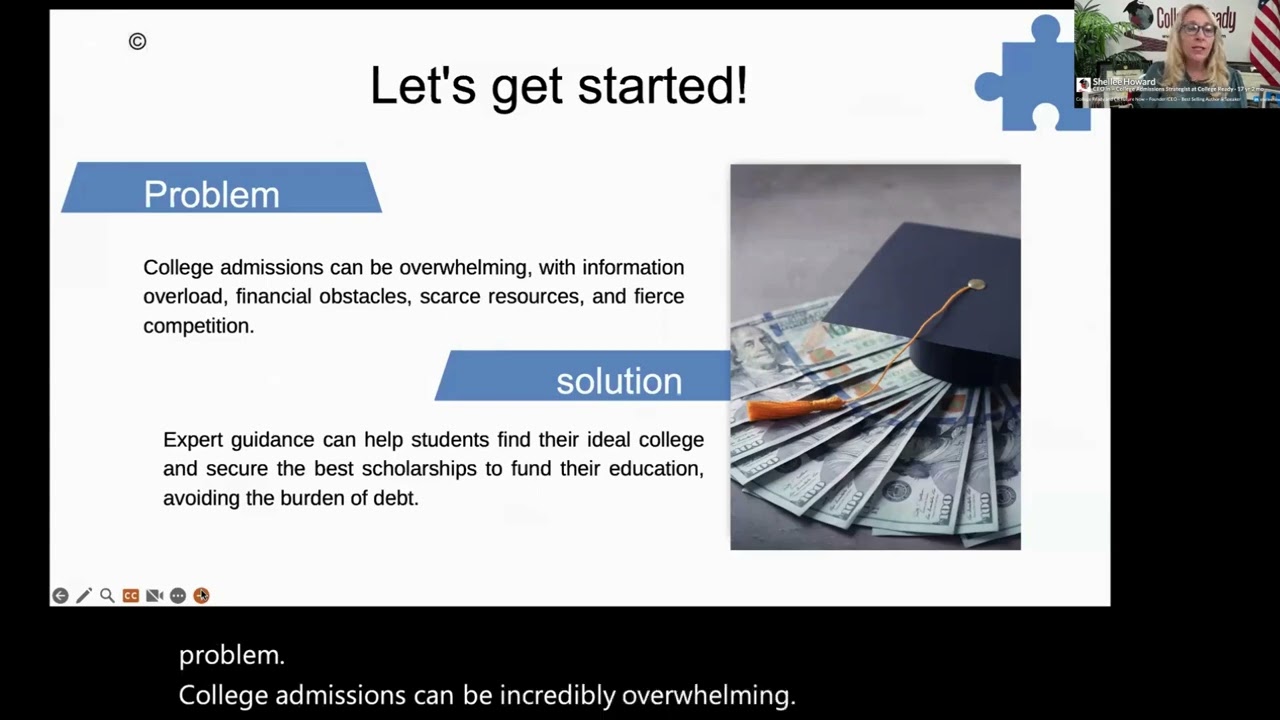
Recording. Excellent. Well, thank you all for being on the call tonight. And as I mentioned, there is a lot around this topic, and I'm getting calls every single day because it is a bit of a— go ahead and mute. That would be great. Um, and if you have questions, Carrie can answer them as we're going through. Otherwise, I will take questions at the end. So again, thank you so much for being here. My name is Shellee Howard. I am the founder and CEO of College Ready. I started down this path 17, a little over 17 years ago. We are going into our 18th application season. I am a professional certified college consultant. I have multiple degrees and I'm a mother of 4, so I'm pretty qualified in this space. All 4 of my children did graduate debt-free, and I want to jump into that straight away. So I did write a, a book that was a bestseller in 24 hours, and that's How to Send Your Student to College Without Losing Your Mind or Your Money. And so that is the foundation. I am actually going to be writing the sequel to that book, the updated version, this fall. So if you would like to get a free copy of that, put in the chat free copy of book, and I'm happy to send that to you for being on the live call. As I mentioned, I am a mom. My two oldest are the reason why this got started. College Ready was created when my firstborn came home in 8th grade and said, Mom, I want to be a brain surgeon. Can you help me? I'm sure all you parents in the house are thinking, of course I can, and then we go figure it out because That's what we do as parents. So my, my firstborn, he applied to, uh, 12 colleges, got into 11, had 3 full rides, had a full ride from USC, and this Southern California mom was pretty excited. And then Harvard came a-knockin' and said, we'll match it. So my son did attend Harvard pre-med, uh, 4 years, graduate— graduated completely debt-free. He then went on to medical school at UC San Diego, which made me very happy for him to come back to California. And he graduated there with only $30,000 total in student loans. He is now 30 years old and he's an orthopedic surgeon with a total of $30,000 in student loans, which he will pay back during his first year as a surgeon. My second born, her dream school was University of Alabama, and that is exactly where she went. When we made a bet that I wouldn't let her leave California unless she got a full ride, she asked me for help and we did it. So she is now a registered nurse, and today is her 26th birthday, and she is now teaching other nurses how to prepare to be a nurse. So, so much fun. Um, I have two stepchildren as well. Uh, my second son, he graduated this year a year early, completely debt-free. And my fourth is studying international in the Czech Republic of Prague. And so I now am very versed in that area as well. She'll be an international business major. She will get a dual US and European degree. And the total cost of that will be $23,000. So for those of you parents in the house who are like, hmm, that sounds pretty good to me, just know that we can help you in all of those areas. So I just put in a new slide, uh, because this information was finally tabulated for College Ready in 2023. We had for, I think it was 43 students who received over $9 million in scholarships. And here are a few examples. Many people think, oh, that's just a random number. We actually track every single number that we share. So our student Kate got a full tuition to USC. Sherman got a full tuition to Northwestern. Posey, Madeline got— whoo, she was the big winner this year. Cassandra, Christina. You know, Christina is, is an interesting story. She, uh, wanted to surprise me and she applied to every University of California school and got into every one of them. So she's like a little special, um, interest for most people who are complaining nobody gets into the UCs. She will be attending UCLA over Stanford this year, which I find very fascinating. So our goal is to help give you the families knowledge so you know how to support them to move forward and save yourself from using your retirement. I am not a financial advisor. I do not sell a financial product. All of this information comes from working with students for so many years. We are heavily referral-based company, and that is because we do what we say we're going to do. Every one of our students receives scholarships, and that is a very important foundation and core value to College Ready. So just wanted to let you know, this is how we want to help you. So again, this is not about us. This is about you and you supporting your child. Our goal today, or my goal today, is what colleges are looking for right now and how to stand out. Stand out means get the big money. How to pay less for college so you can save more for retirement. Again, not a financial advisor, but just feel this is what you deserve as a parent who's worked so hard. How to avoid the biggest mistakes other families have made by understanding the process and planning early. So for those of you on the call, we know that all of you are in a good place. It's never too late. Unless application season is over, and it's never too early. We start working with students as young as 7th and 8th grade. So just know every student grows and changes and develops differently, and that's what we're there to support you. Let's talk about why college. This is the big thing, uh, the big monster in the room right now when I talk to students, and they're debating me, and I love it. I do not have a problem with it at all. If you're on the call, I'm guessing you think college is a pretty good idea, so I'm not going to try to convince you, but I will help you understand how to help your child when they say they want to be an influencer or start their own business or go to trade school or just live with their parents for the rest of their life. Like, these are real stories that I've had on my calls, and the important thing to help them realize is don't wait till after college. Let's do it now. You're like, what are you talking about? I was on with a student and his family today, and the student is like, I just want to start my own business. And I'm like, great, let's do it. And he's like, I can't do it right now. I'm like, well, why not? And the parents are smiling ear to ear because they know how hard it's going to be to start your own business, and they would love for those little bumps in the road early on so they can support their child. So just know we want every student to get into adulthood without going into massive debt, but with a plan. So the first thing I would like you to take away from our time together is how to get the big scholarships, return on your investment. The number one thing is picking the right list of colleges. If you listen to nothing else about what I say, picking the right college list is critical. You want to have some reach, some comfort, some safety. You want some in-state, some out-of-state, because there's a big misconception that in-state is cheaper than out-of-state, and that simply is not true. It is not cheaper to go public than it is private. So now you may be squinting going, what is she talking about? And that's what I want to share with you today, right? The media is sharing one thing, your students might be sharing another, well-meaning friends and family are sharing another, and I'm just here to give you information that way you can make some super wise decisions. So we're going to jump in and I'm going to move pretty quickly. But if you have a question, go ahead and put it in the chat. Either Carrie will answer it or I will do it at the end. So the first thing is, this is the problem. College admissions can be incredibly overwhelming. I've seen parents and students in tears, and it breaks my heart. But remember, I'm the fixer. I'm not the problem. So there is information overload, and what I'm going to share with you today you will not find on Google. This truly comes from being in this industry and staying on top of the trends and working with colleges to know exactly where the struggle is and what they're looking for. There's financial obstacles like a 529. There are scarce resources when it comes to really understanding what is correct, and obviously there's fierce competition. You may not know this, but international students pay double what US students pay, and college is a business. If you were a business, wouldn't you want to put your hand out to somebody who's paying double? I know it's not right and it's not fair. I'm just here to be the messenger. We can help you navigate that. So that's what we're going to do. So tonight I'm going to give you my expert advice. I'm going to help you find ideal colleges, secure the best scholarships to fund their education, and avoid the burnout and college debt. So you'll hear this from me time and time again because it's really important for you to understand: colleges need your student as much as your student needs college. What do I mean by this? If they didn't have your student, there would not be a, a need for a college, right? The other thing is colleges are looking for students who are going to come and make the college better, put the diploma on the wall, and sell the next generation. So it is a generational business, and they have plenty of money at most well-known universities. So the, the business opportunity is pretty huge. So what about Okay, fine, Shellee Howard, but how do I decrease it? I see there's a cost. How do I decrease it? The first thing I want you to think about is college is a business, is the same as real estate or buying a car, right? You can walk up to a home and pull out the flyer and say, I will pay this. Maybe only in California or some of New York or Boston, but for the rest of the world, probably gonna do a little negotiating. Guess what? You can negotiate with colleges. The other thing you want to think about is how am I going to put my student in the best position? Okay, the first thing is you're going to want to make sure they have a strong GPA with rigor. You want to make sure they meet all the A through G requirements, and you want to make sure that they are prepared with the right classes in the right order. Secondly, test scores are not optional. They have never been optional, but it was a really great marketing ploy for colleges to get more kids to apply to college, so they each spend $100 more. Test scores are only the second hard fact about your child. So if they don't do a test score, now all the weight will be put on the GPA if they're applying to a state school. So that's kind of frustrating. The third thing is dual enrollment and AP classes. Do you know when you, your student takes a dual enrollment class, they're actually getting free college credit, right? Nobody talks about that. There are many students in my program who graduate with enough units to start as a sophomore or a junior just by doing it for free in high school. We're talking about decreasing the cost without you spending a dime. Look for colleges with a strong merit scholarship. Remember when I said the number one thing that you must understand is picking the right college? Many colleges are insanely stingy. If a college gets hundreds of thousands of applications, they do not need to give free money away. So if you think that a school is going to give you a ton of free money, I want you to really think about the logic behind that. Choosing a college your student will graduate in 4 years. This was a huge eye-opener on a call yesterday. I was speaking with a family who had no idea that our California state schools are so overburdened that they're capping the units at 16 a semester. If you do the math, there's no way they can graduate in 4 years without summer school and winter session. And the student very loudly said, I am not going to summer school or winter session. So we had to cross some of those schools out. So just know that's counterintuitive. You're thinking that's a 4-year degree. Well, yes, it should be if the school's not overcrowded. The next one, look for out-of-state public colleges or international schools with special pricing. There's a thing called the WUE, I know it sounds really weird, but it is important for you to understand that it will be cheaper for some out-of-state than other out-of-state. Look for private schools that meet 100% of your need. If you are a need-based, a truly needy family, not because you overspend, but because you don't make enough money and you have no assets, then there are some amazing schools. If you get in, they will pay the rest of the money. So just know, don't get discouraged that you can't afford it, because you really can, but your student has to work hard to get accepted. The number one reason families go into debt is not having a balanced list and a college plan. So that's what we're going to dive deeper in. What affects college admissions? The number one thing is admissions has changed. Every 4 years, colleges pivot and they say, "We're now going to focus on this." So you want to know what they're looking for right now. Number 2, grades will always be the number one most important indicator of a student's success, but if the test scores don't match the grades, they're going to think either grade inflation or test anxiety. So number 2 and number 4 are actually bookends. Very, very important. Number 3, a weighted GPA. For those of you families who have not heard, now a weighted GPA is a 5.0. Okay, so you used to think, wait a minute, a 4.0 used to be perfect. No longer is that true because there's so many more weighted classes. Class rank is critical at some schools while other schools don't consider it at all. Number 6, extracurricular activities. Colleges are going to ask, what did you do when you're not in school? How many years did you do it? How, how many months a year and how many hours a week? So if your student is gaming or going to the beach or shopping, whatever they're fun is, just know that's not going to help them. On the, uh, Common App, they will have to list 10 activities, honors, and awards. On the UC app, it is 20. So if your child is not doing things outside of school, they are going to be in a massive disadvantage. Colleges are looking for a unique student. They are not looking for a bunch of students who are tutoring or feeding the homeless or checking boxes to just make colleges and parents happy. They're wanting to know who is that student and what matters to them. Parents, please do not write their essays. Colleges know, and they lose the whole uniqueness. Essays are very important, actually critically important. Make sure you're using a professional essay editor, not a high school teacher. Interests, special skills, and passions. This is one of my favorite areas because our students put together positioning and standout strategies. And what is that? We use their gifts, their talents, their core values, and their advocacy. And what we do is we help them to stand out. So we want you to know that's what colleges are looking for, and we create that for our students. So that's something that you would want to do. Number 10, letters of recommendation. Who you ask, how you ask, and how you follow up are all critical pieces to that puzzle. Diversity and leadership go hand in hand. Colleges are looking for leaders. They're looking for diverse group, but not by ethnicity. They're looking for business majors, they're looking for art majors, they're looking for different types of students. A college cannot be all of the same major. College interviews are so important if a student is offered one. Now let's go into the business of colleges. So I'm sure most of you have put together some kind of list based on the ranking system of the U.S. News and World Report. But what you may not know, and I get a little frustrated by this, is what is happening is when your student takes their PSAT their junior year, their scores are being sent out to all of the universities who then send students emails that say, "Please apply here." Guess what? College is a business. Every application costs you around $100, and If your student has a 2.5 GPA and Harvard asked them to fill out their application, that is just to protect their yield, which means the more people who apply for a school and don't get in, now they are considered a higher-ranking school. So just know, be mindful that that is a business ploy. Really, the most important important person in this process is the strategic enrollment manager. They're the person behind the scenes at the universities who are putting the class together. They're balancing ethnicity, diversity, leadership. They're balancing athletes and VAPA. This person is in charge of it all. Let's talk about Marcus, right? Everybody is like, can you just kind of put this in context, Shellee? I'm not really following you about this whole standout strategy and how to find the right school. So Marcus came to us. He was a high school freshman, and his dream school was UCLA. He had a 4.1 GPA, and he wanted to go into engineering. So what we did is we reached out to the admissions department. We found out that Marcus really loved to play the guitar casually. But he would be willing to learn how to play the bassoon because that's what the music department was interested in. So he picked up the bassoon, Marcus got accepted, and he received a $24,000 free gift. Is a great GPA and test score good enough? This is a really hard one for parents to understand because back in the day it was. A good GPA and a test score is all you needed, and internationally that's all you needed on top of class ranking. But for the US, it's simply not true, and I don't want you to believe it. Application essays are very important to this piece because colleges need to understand what were the extracurriculars, the passions, the talents, the, um, the leadership, the community service, their geography, what's important to them. There's so many pieces to a student, right? The essay is the only way to bring it all together. Everybody wants a roadmap, a timeline, something that they can hold on to tangibly. This is the best I can do because your child may be different than somebody else's child, and I want to give you an example. I had a freshman, um, that started last year, and she was very, very intellectual, and she had already taken Algebra 2 in 8th grade, and I had her take the ACT her freshman year, and she got a perfect 36. That's the best you can get. She got it her freshman year. Do you think colleges are going to find that impressive versus waiting and taking it her junior year or senior year when she has to relearn all of that information she will forget. So it's not fair to assume that everybody's going to go through this system at the same pace. The other thing is you've taught your children, don't brag, don't boast, people don't like it, it's rude. And I'm going to tell them, brag like their life depends on it, boast until colleges see how amazing you are, and tell them. Don't assume they know anything. At one school, National Honor Society is a pizza party. At another school, it's an insanely rigorous, competitive club. If your child just going boom boom boom boom boom and putting National Honor Society, the person reading it may not know and not weight it properly. So we help our students to understand how to rank their activities, honors and awards. And so that will be up to you as the parents because the student has no idea. Here's some most frequently asked questions, and I can see that people are start— starting to leave questions, so that's exciting. My student doesn't know what they want to do or major in. Is community college a better option? If they want to go to community college outside of California, It's a viable option. Inside California, unfortunately, our state schools are so overcrowded that they're stealing community college classes from the students who are going to community college. There is only a 6% chance for those students to go on and get a 4-year degree. It can be frustrating, challenging, and not a good option because Harvard has a 2% transfer-in rate. That is scarier than the 3% entry rate for a freshman. So be mindful. It's not like it used to be. Are Ivy League schools the best option? If your student wants to go to an Ivy League school because it will set them up for their future, yes. If they want to be something like an entrepreneur or something that does not need the same amount of rigor or the same connections, it may not be the best option. And every student is different. Is a more expensive college going to ensure that my student gets a better job? Absolutely not. What if a— what if the career my student has chosen to pursue will not make enough to cover their debt? We want them to know that before they apply to that school. That's the point of having a plan. All of our students start with a series of fun assessments, but that's not where it ends. We meet, and this could be you the parent, we meet with them and we help them understand if you're good at this, here are careers that would be good, and then we could show them how much money they'll make, what kind of education they'll need, how much schooling, what will the cost be, and ultimately how much money they will make when they graduate from college, and finally, if a robot will be, be doing it in 5 years. This is honestly the first generation that we've had to get down into the weeds of the robot and AI. Finally, you may even be asking yourself, why should I send my student to college if I've done fine without a college degree? And statistically, there's plenty of evidence that shows that they just make more money. That may not be the case in your family, but for the majority of the population, statistically, they are put in a better position. Again, that's not my opinion. I'm not here to share my opinion. I'm just here to share the facts. Here are 8 ways to assure that your student gets an affordable degree. Number 1, take the most challenging classes and get an A. Okay, that doesn't mean take all easy classes and get all A's, right? Number 2, have a strategic testing plan. When will they take the test? What score do they need? How many times will they take it? What part of the year they will take it and what location they will take it all has a play on how well they'll do, even how they test prep. Number 3: Test prep and score well on the PSAT. If your student does really well on the PSAT their junior year, they can earn a free education. That's free. That is something that is available to all students. Number 4: Take AP, Honors, IB, or Dual Enrollment classes and earn strong grades. It's important that they challenge themselves. Number 5, have a strategy or plan as to which colleges you will apply. Number 6, plan your college search using the proper tools. Do not use U.S. News and World Report. Number 7, look for colleges with strong financial packages and track and record. They have a, a track record of this is how much money they've given out year upon year upon year. We know the most generous colleges. That's where you want to apply. Leverage your financial awards. So in other words, make sure you're doing financial negotiations. Make sure you're ready for your student to be able to get off the waitlist. Make sure that they're— you're ready with your FAFSA, your CSS Profile, and I'll get into that in just a little bit. What you can do Um, what we do to help your family. So this is what you can do, the parent. Okay, that's the goal of my time with you tonight, is helping you to know how you can help your child, because they're not going to get this help from their school. I have not met a high school that cares about your finances. They care about your students good at math, go to MIT, and good luck. I care about your finances. So first thing you need to do Assess your family finances. Understand what your student aid index is and how much colleges think you should be able to afford. Now, keep in mind, I've never had a family that I run this for that is like, yes, I can't wait to pay that. But we have ways of lowering your student aid index, and it's legal and it's ethical. It's just like knowledge, right? You can do your own taxes or you pay a CPA and they save you tons of money. Same kind of concept. Next one, decide whether the student's desired college is a want or a need. Is UC Santa Barbara to live close to the beach, or is it because that really has their best major and their best, uh, success, uh, story in front of them? Determine if the major they will pick will pay for their wants and needs after they graduate. Had a great student who wanted to be a botanist. Parents were having a really hard time with it. Until we figured out if they, uh, what they really wanted, what she really wanted, was to save the environment. And so, uh, running multiple nurseries actually would save the environment a lot better than planting one plant at a time. So we were able to help the student figure out a different approach. Note the graduation rate at colleges your student is considering. If students are taking 5 or 6 years to get out of a 4-year school, Don't forget, that is 5 or another year of that tuition or another 2 years of that tuition. Learn about the acceptance rates at the college your student would like to apply and consider the size of the college. In other words, is it a large public school where your student will be attending Biology 101 with 500 students, or will the student ratio to teacher be more in alignment with what your child needs? So let's talk about decisions. Do you know how much it will cost if your student picks the wrong college? Many people approach this with, "I'm just going to let my teenager figure it out," or their high school is going to do this and you don't participate. What we have found while we work with a ton of transfer students who did not start in our program is the problem is it's going to cost you. It's about an additional $100,000 every time your child transfers colleges. And the number one reason students transfer colleges is because they do not know when they go to college with a major and they change that major, not every school has every major. So now they're forced to change colleges. So don't make that mistake. There's a ton of misconceptions. If you Google it, you'll know what I'm talking about. The admissions process is extremely complicated, and 1 in 3 students gets help. So I'm going to dive into a big portion of why you're here tonight. How do we maximize free money, right? That's what we all want to know. There's need-based, there's merit-based, and there's institutional-based. Our clients go after all 3 buckets. So it is up to you about how you're going to approach this. So the first thing is, these are common misconceptions. My income is too high. That is strictly not true. We have millionaires in our program and we have need-based. The child's grades are too low. That is not true unless they're under a 2.0, and then it is true. We own a home. Congratulations, that will not hurt you. 8 is only for special groups. Simply not true. It's not that hard to apply, so I'm going to just do it myself. And I tried that, and it is hard. High school advisors are going to do all of this. Well, has your high school advisor asked you anything about your family finances? Enough said. Here are some secrets on how to get scholarships. The number one is the reality is most Fulbright scholarships come from the colleges themselves or an athletic D1 award. If your student is being sought after by a D1 school, they will— you will know by the time they are a sophomore or at the latest a junior. If you're a senior and you're not getting, please come here, then that is probably a good indicator that is not going to happen. We do work with scholar athletes, and I was one, and my two oldest children were scholar athletes as well. So it is like applying twice to college, but we can leverage both sides. It's a, it's a whole strategy. Secret number 2: private scholarships are available to everyone. That is true. There are scholarships for the color of their eyes. Just know, be careful, right? Because your teenager is going to give them way too much information. So help your teenager understand what is off limits to share with people you don't know. There are legitimate websites to help with your college scholarship search, and we can help you with that. There's also some scary monsters out there, so beware who you give your information to. Look for scholarships from your employer, credit unions, department stores. My son won an awesome scholarship from Nordstrom. Probably didn't balance out what I spent there, but it still was pretty amazing. And your high school PTA— these are going to be more of the smaller scholarships. Secret number 5: there are no tricks, but there is just good old hard work. Number 6: passion equals scholarships. I talked about my passion is to help to bring out passion of students. That is what equals scholarships, and you know what? It's fun to do, your child will enjoy it, and they'll receive money for it. Consider your background. Are you a Native American? Are you a first generation? This is all very important. Number 8 is a scholarship— if a scholarship advertises no essay, run. It's too easy and the competition's going to be way too heavy. Number 9, if your student does not look for scholarships, they will not come run into them. And number 10, have your student follow directions clearly. The number 1 reason families don't get money is 91% of families complete the FAFSA wrong. So it's not because they're not qualified. Private scholarships our students have won. So I mean, there's these and so many more. There's a ton of them out there, but here's the forms you must complete, right? You need to complete the FAFSA. You should start with your SAI. You definitely want to make sure that you are completing the application, um, I'm sorry, the SAT and ACT. You no longer need to do the essay. That's no longer part of it. The CSS Profile— not every school requires this, but 25% of the universities do, and that's the one that's going to dig very deeply into your pocket. So if you don't want to dig into your pocket, you may not want to apply to those schools who require the CSS Profile. I talked a lot about the Student Aid Index because it's really the starting point. It considers the top 5 factors: your income, your assets, the student's income, the student's assets, and did you complete the forms properly. So understanding how to do this is a critical piece of the puzzle. So just know, do not have your student do this because it is definitely something a parent must do. Now let's talk about institutional aid. There's gift, free money, right? That's a great merit scholarship you don't have to pay back. There's self-help, there's called work study, and there's student loans. Good loans are subsidized loans. Bad loans are private loans. Any loans you cannot bankrupt. So if your strategy is we're just gonna rack up a bunch of loans and then we're gonna file for bankruptcy, not gonna happen. That is not a strategy. The government is way too wise. But work study is a viable option, and if you have a financial strategy, sometimes a good student loan is a strategic approach to this process. Um, yes, you can ask for more money. I've mentioned it a few times, but you can't just say, "I would like more money, please." You need to have a great financial negotiation letter and strategy, and our students have won every single one of them— oops, um, except for two schools, and I'm not going to rat them out, but they are very stingy. This is what a financial aid award letter looks like. Does it look like a bank statement? A little bit. Is it vague and ambiguous? A lot. What exactly does it mean when it says Federal Perkins Loan? I remember the first time I saw my my oldest, I'm like, yes, look, they're giving us all this money, $55,000. And then I started looking at, wait a minute, most of that is loans. That is not giving. So be very careful that you don't just look at the bottom number. Look very closely to make sure that they're not just giving you a bunch of loans. As I mentioned, these are the 3 most common ways. There's a few outliers, but here's the common ways. Remember, picking the right colleges, uh, marketing your student, their positioning, applying to schools that align to your financial goals, test scores, CSS Profile and FAFSA, all very important. Need-based, you want to know going into it what your SAI will be, and merit-based. Those are how we get our students all of the big money. So now here's your options. How much can your family afford? If you look at the cost of college has gone up significantly every year, and they're predicting that we're going to be well over $100,000 a year very quickly. Right now we're at I think $87,500 is the, the highest I've seen so far. So you have these options. You can do pull from your savings, you can borrow, or you can go after scholarships and grants, right? No-brainer. But it's interesting when you think about if you've saved all this money and other people who haven't saved money are gonna get money I hope you're scratching your head going, that is so not fair, because that's how I felt. I had saved $250,000 in a 529 plan until I found out that that's the first money they were going to take from me before they gave us any scholarship money. Again, I don't sell a plan. I just want you to know, ask questions, do your due diligence. The 529 almost cost my son a full ride at Harvard.
Hey, Shellee.
Yes, really quick.
Um, someone just said, you said parents need to do what and not let the students do it?
This process, this whole process.
All right, I just didn't want someone to forget.
Okay, yes, anything that has to do with your money, parents, I want you involved. I do not want you to let your 17-year-old sign your checkbook without you knowing where that money is going and coming from. That is why I'm saying I have so many well-meaning parents who say, I'm just going to let my child do it, it's time for them to adult, and they're, you know, if they take loans, that's their problem. Well, guess what? They can't take loans. You have to co-sign. They have no assets without you. They can't get a loan. So it really is your money, and I care about your money. So again, these are the things we need to think before you apply to college. Alright, let's keep moving. So it's just as important to think about how you are gonna pay as much as how much you will pay. If you use a traditional 529 plan, make sure it's a good plan for your family. You definitely don't want to use your savings. You definitely don't want to use whole life insurance. You definitely don't want to use your retirement, and you definitely don't want to use private loans, right? These are all things that I don't want for you. So here's your options. You can be in denial. I did that for a little bit. And then you can put your head in the sand, and I tried that for a little bit. And then you can do it yourself, and honestly, That's when I knew I was way over my head, and I went back to school, and I spent 30 hours a week for 4 years helping my child navigate this process. I became an independent certified college consultant, started touring 25 colleges a semester, and now I'm a college consultant. I love what I do. I'm very fortunate I get to hang out with teenagers all day long and help their parents navigate the process. But use experts. If it's not us, use a CPA that you trust. Use somebody who understands the FAFSA and what they look at and what they don't look at and how to lower your student aid index. All of these things are put into place. You just don't know they exist. Save money and time. Understand the rule book, know which colleges are most generous, and file your forms correctly and on time. Do not make these costly mistakes. And this is what we do for all of our families. There are 67 steps, but please don't tell your child that because they will freak out. If you Google how to pay for college, you only have to look at this many results, and I will tell you, most of them are bad. So save yourself and definitely don't do that approach. I wrote a bestselling book because I lost a bet to my firstborn. To be honest, I never planned on writing a book, but it is a bestseller, and it was a bestseller in 24 hours because it gives you the foundation of what your family needs to be doing to not lose their mind or their money. I'm not here to sell you my book. I'm just letting you know it's available. Um, and finally, think of each of these questions really quick and make a tally mark. Are you college ready, or are you feeling: 1, I'm not sure how to pick the best college for my child? If that's you, put a tally mark. 2, I know when the best time to start planning for college is. Put a tally mark. Even if my child gets into college, we have no idea how we'll pay for it. Tally mark. My child has no idea what they want to major in. I am not sure how my child will stand out. My child wants to go away to college, but I'm not ready for them to leave. Is testing really optional? How do I know what is the best test for them to take? Is AP, IB, or dual enrollment better? If you know the difference, awesome. If you don't, put a tally mark. What is a Passion with Purpose project, and how do I help my child start one? I am feeling confused, tally mark. College is competitive. What do I do? Or what if I mess up? If you feel like you may mess up, put a tally mark. I'm feeling overwhelmed. Put a tally mark. How do I learn about everything? Just everything. Put a tally mark. This is really what I'm hoping for you to come away with. And if you have a lot more questions that we may not be able to get to all of them, just know, scan this QR code and we will give you a Clear Vision If your child's college ready, we will identify potential obstacles. This not a sales call. This is an information gathering opportunity for you. We will identify clear next steps for both you and your child, and we will also share the link for our free online Passion with Purpose project. So at this point, Carrie, if you could go ahead and share any questions, we have just about, uh, 10 more minutes, I think.
Okay, perfect. Um, question: if we want to go to a Cal State, would a community college still be a good option?
If you want to go to a community college and a state school in Nebraska, yes. In California, no. Unfortunately, I was just on a college tour at a Cal State that I will not mention, and they made it sound like that is a viable option and that they have a plan for that. And I'm here to tell you, unfortunately, that's just not what we're seeing. It may be what they want, but it's not what we're seeing. So those are the things we want you to understand is when you go on a college tour, that's a sales pitch for that school. They're not going to tell you they're overcrowded. They're not going to tell you they're a party school. They're not going to tell you some of the things that will keep your child from getting in. And remember, if your child starts at a community college and that's where they're headed for their next 2 years, it's really 2 more years of high school, watching all their friends leave for a 4-year institution and hanging out with other community college students.
That—
no judgment, I'm just sharing. And only 6% go on to get a 4-year degree. In California. I only say California because that's the number one place, the number one, um, state schools that people all over the world apply to. It's not that I favor them, it's just that they're the hardest.
Okay, uh, next question: if a family is not qualified for financial aid, or if they think they're not qualified for financial aid, Is there still other aid options out there?
Yes. As I mentioned, the first thing you need to do is your Student Aid Index because you will be surprised. I don't know if you've done it. If you have, congratulations. But it's different for every school. So unless you've picked your schools and you've done your SAI for every school, then you've done your homework.. But if you haven't, just know you're not even close yet. So the first thing you need to do is look at how much each school thinks you should be able to apply, and it's not your income. You can— I have, like I said, I have multimillionaires whose kids are still getting great opportunities. My kid's got a full ride, and I definitely, uh, make more than the, the need base. So please know that's only one of the factors. What I will tell you is get every dime out of your child's name because that's going to be factored against you at 50% versus versus 25%. So that is massively important. But remember, I told you there's buckets. There's merit aid, there's independent scholarships, and there's need. Just because you can't get the need money— oh, and there's athletic too, and VAPA. I mean, there's, there's lots of other ways, but please know that there's lots of other ways. But you also want to know, can I lower my student aid index and get my financial house in order? Speaking of that, another bonus for you on the call is the FAFSA will open October 1st, and it will look at the second semester of your sophomore year and the first semester of your junior year. It is called a prior prior year lookback. So if you made a lot of money 2 years ago, you may want to do a financial negotiation. Just a little bit of free information. Go ahead, Carrie.
Oh, is it best not to put money into a 529?
That is definitely not what I'm saying. I want to be very clear, I am not a financial advisor. Do not go dump your 529. What I'm trying to help families understand, which I didn't know, is when I started saving money when my child was a newborn, that is the only vehicle that the government gives to new financial advisors when they get their financial license. So if you are working with a financial advisor, that may be the only thing they know. And I would tell you that to a lot of financial advisors, they're just like every other industry. They're— they, they have their specialty. I have a team of financials., financial strategists that, that I refer my clients to that have so many techniques. I had some very creative legal ethical things presented to me that blew my mind. So just be careful. The 529 is just the easy thing, right? It's not that it's the best thing or the wrong thing. It's just I don't know your financial situation. And that's why I'm saying if you have that question, you are a perfect candidate for us to talk to because I can show you your student aid index and then I can show you here's why. And you're like, oh, and then I can show you this is what the FAFSA looks at. You might want to make some decisions about this opportunity. And I'm not going to sell you on that because I don't sell anything regarding financials. But I have some great resources.
Okay, so any 529 questions, they should make an appointment with us.
Absolutely, because there's no one answer for the 529. Every answer is unique.
Okay, because there's a couple other questions here. Um, one is asking if it's a student asset. Okay, so any of you that have those questions, you should probably scan the QR code. Yep. And it's a, it's a complimentary half-hour meeting.
Yeah.
Let's see here. What do you mean by first generation?
So if neither of the parents went to a 4-year university, your student is a first generation to go to college. They get a special looking at because colleges are trying to help change the trajectory of that family. There are many scholarships that we, we have up our sleeve for those students.
Okay, how, how is the class rank calculated?
So if your school ranks— not all high schools do— they are the ones who calculate it. So it's not something I can do for you. It depends on the other students at your school. So if you're at a very competitive school with amazing, brilliant students, your student could be brilliant and amazing but not as brilliant as and amazing as others. So all you have to do is ask your administration or look on your, your official transcript, and it will give you the ranking. Or give it to me, and I can tell you in a hot second.
Okay, um, let's see. You said we need to use a 5.0 scale. Can you provide a link for how to calculate your GPA?
Depends what school that you're applying to. I'm so sorry, I wish I had a better solution than that.
It's—
that's why people hire college consultants, right? The, the problem is the UCs are going to calculate it different than Sanford. And if your child's applying to an engineering program, they're going to apply— they're going to calculate it different than a child who's applying as an art major. So I could do it based— if I know what school and what major, I can let you know what that is. But there's way too many variables for me just to tell you straight away, here's a link. That's what I mean by going on to Google. It is terrifying.
Got it. Okay, guys, you've got a lot of great questions. I'm impressed here. Okay, here we go. If the student has a bank account, how much should the maximum balance be if they have one? Should we transfer it out of their name temporarily?
So again, Uh, the, the, the answer to that question is how you worded it, right? I think you know the answer to your question, and I'll leave it at that.
Okay, wink wink. Um, what if, what if mom did a master's program in the US and then it says Travis High School, Richmond, Texas? I'm not—
I, I don't know If, if you did a master's in the US, congratulations, that's awesome. I'm not sure what it has to do with, uh, Texas. Um, Texas has a lot of scholarships and a lot of great programs. Um, but the fact that you have a master's is not going to hurt your child.
Oh, it— oh, she's saying, can it be considered as first generation? Probably not.
No. Okay.
All right, let's see. This one looks like a long one. All right. We just toured a small liberal arts college yesterday with my son, who is a rising 11th grader. That's so exciting. This said the tuition— or they said the tuition was about $73K, where 99% of students receive some form of financial assistance, and the average financial assistance from the college was $45,000. That is not from FAFSA, not need-based financial aid. They had an alumnus or alumnus leave $150 million to the school at his death. So their endowment is huge now. Is the 45,000 assistance average normal?
So there is no normal. And again, they're selling you on that college tour. So what they're trying to say is apply here and see if you're going to get some of that. That's, that's what they're trying to explain to you. So that one school, if it's a good academic fit, social fit, and financial fit, absolutely apply there. But have a strategy of all the other schools you're going to apply to as well. Definitely just don't apply to that one school. That's very dangerous.
Yeah, but we don't even know if that would be a good fit for— I mean, on a balanced college list.
Yeah, right. I don't know that.
Okay, we hope that answered that question, David. Okay, perfect. Let me see. I think we might be good. Does anyone else have any questions?
That is perfect timing. We are spot on time. So thank you all for being on the call. If you need any other support, Carrie and I are here for you.
And one more, Shellee Howard, do we have time for one more?
Okay, I'll do a bonus one.
Okay, how many schools should students apply to?
Um, on average, a good amount is 4 reach, 4 comfort, 4 safety. If you do it well, they'll get into 9. If you do that well, they'll be able to do some financial negotiations. And that is the ultimate strategy. Do not apply to a zillion schools because that student, that child, will start to produce junk. And it is better to do quality than quantity. Happens every year. All right, everybody, I gotta go. I gotta go. Thank you all very much for your time. I hope it was super valuable, and I wish you all the best of success.
Us.
We are here to support you. Just know that we care. Have a wonderful day. Bye-bye.
More from Shellee




The 3 Questions Every Parent Should Help Their Teen Answer Before College | Featuring James McLamb

Helping Your Teen Stand Out for College Through Purpose & Impact | Featuring Aishani Sheth


From Robotics to Cornell: A Father-Son Blueprint for College Success with Aarav & Ritesh Kumar

The Hidden College Credit Strategy That Could Save Your Family Thousands with Josh See

The Truth About Financial Aid: Why Some Families Pay Less for College Than You Think with Jack Wang

Human Skills Every Teen Needs for College, Careers & an AI Future with Rob Heller
