New Podcast: Jenny Beckford from Greater Elevation
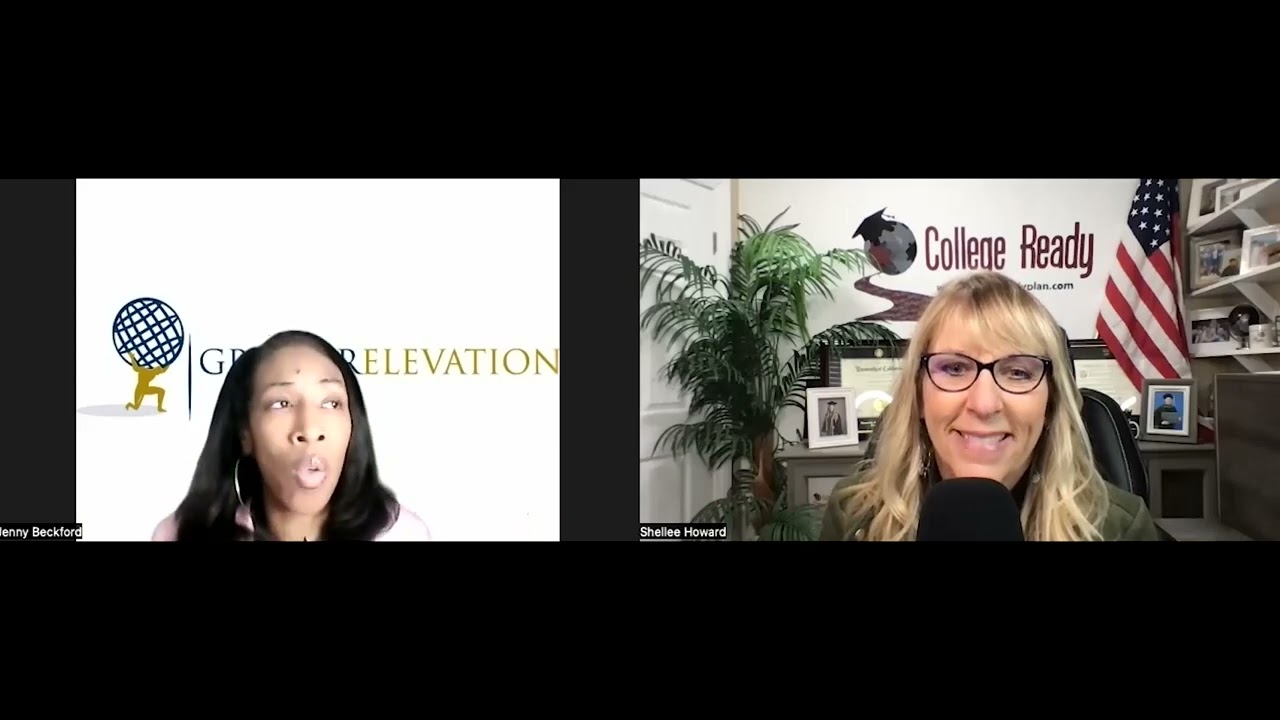
This content was created by Shellee Howard. This content was uploaded by Shellee Howard. This is a YouTube podcast episode (titled "New Podcast: Jenny Beckford from Greater Elevation") published December 19, 2022. It's an interview-style episode of the show "Parents, Is Your Teen College Ready?" hosted by Shellee Howard with guest Jenny Beckford, a UK-based teen coach and founder of Greater Elevation. The conversation covers Jenny's background and coaching approach (mindset, emotional intelligence, habits), the age range she works with (primarily teens 13–20s, with flexibility), program structure (minimum three months, parent involvement, consultations, Facebook group), outcomes and success expectations, and how parents can contact her (Facebook/Instagram and a free ebook via DM). An announcer/producer voice (Speaker A) also appears with intro/outro remarks.
Chapters
Parents, is your teen college ready? Are you feeling overwhelmed, stressed out, or excited about your teen applying to college? Do you know what colleges are looking for? And if your kid gets in, do you know what you'll pay for it? College admission has never been so competitive or expensive. Shellee Howard will take you on a journey to help you and your teen get college ready. Now here's your host, Shellee.
Hello, this is Shellee Howard with College Ready and the podcast Teens or Parents, Are Your Teens College Ready? And today I have a special guest, Jenny Beckford, and she is straight from the UK, and I'm super excited. Welcome to the show.
Thank you, Shellee, for having me. I feel So honored to be on your platform, and it's great, you know, technology. I'm in the UK, you're in the US, so it's absolutely amazing. Thank you.
My pleasure. So can you give our listeners a little bit of background of how you ended up in this wonderful world of teenagers and, and supporting them?
Okay, so, um, so firstly, my name is Jenny Beckford, and I specialize in youth transformation. So I'm a Teen Coach Practitioner, and I support teenagers from all around the world, and I help them with their beliefs, their minds, and emotions. And that's done by using evidence-based concepts. And this is done by delivering one-to-one and group coaching programs, and it helps the teenagers to really kind of step out of their comfort zone, raise their self-esteem, set healthy habits. And I provide the accountability just to give them that push just to make sure that they're on the right track. Now, I've been supporting young people for well over 20 years, and I decided in the different, uh, positions that I had— I was a Level 6 qualified careers advisor, and that would mean I would go into high schools in the UK to help young people with their next steps, you know, if they're going to college or they're going to go for a job, and I would support them. But at the time of supporting them, I noticed that when we're sitting down to go over what the next steps are, a lot of the young people were saying they're lacking confidence, um, you know, they, they don't believe that they can move forward. So I was at that time— coaching wasn't a thing, but looking back, I was coaching them. And I remember my boss saying, you don't have time to do that, you just want to get them in, see if they need to go to college or whatever it is, you don't have time to look at what's going on in the background. And that kind of didn't sit well with me. So this is the reason why it's kind of spurred me on to go ahead and set up my own coaching organization, which is Greater Elevation. And that was founded 2 years ago, um, just at the start of COVID you know, literally started out with my laptop and, you know, decided, right, I'm going to go for it. Got myself a business coach, business mentors, and really kind of started to helping support teens from all around the world. So yeah, Yeah, my delivery is done via Zoom. And, um, in addition to supporting teenagers, I partner with parents. So that means I'm helping parents to connect more closely with their teenagers and help them to navigate through the teen years. Because I'm, I'm a mum of twin daughters who are 25, so I've been through, uh, the teenager years times two, double trouble and all that, all that good stuff. And, um, yeah, really decided now that, yeah, it's great, let's set up And I help the parents in terms of looking not only just to connect with the teens, I also provide parent coaching where I help the parents to be able to look at themselves and maybe seeing, um, might there be ways that they might be able to change certain habits in terms of, you know, with parenting. Um, because sometimes parents— I've been guilty of it— we have like the old school sort of parenting style because there's no manual with parenting. And also with teenagers, it can be an up and down process. So I support teens, um, and the element of me doing the coaching, I have the element where I can help them in terms of looking at career choices for the next steps as well. So I can combine the two. So yeah, my, my mission is to make sure that I'm going to be able to impact a million teenagers in 100 countries or more in 10 years or less. So that is my kind of bigger vision for where we actually, um, going to be able to go. And I, I believe it's achievable because, you know, I can, I can reach, people from all around the world. So yeah, so that's a bit about what I do, and I'm based in, um, rainy UK, London, England.
Fantastic. Outstanding. What a great introduction to your world. So as you think about your mission, and I love how specific it is, it's such a great mission. You know, at College Ready, our goal is to— our mission is to help a million teenagers get into college and graduate debt-free, which in the US is a big, huge ask. In, in Europe, it's a little bit more attainable. But, you know, when my son graduated from Harvard debt-free and my daughter from University of Alabama debt-free, I, I will tell you, their, their launch into adulthood has been so much easier without carrying that debt and then potentially marrying somebody in debt. Now you're double-debted. So when you look at Um, some of the things that impact teenagers, uh, thinking of COVID right? We're post-COVID now for the most part, and some teenagers, if you ask them, they said COVID was the worst thing ever. But I also have students who say, you know what, it was actually a blessing. I got my time back. I got closer to my family. I liked online school. I didn't have to get dressed. I didn't have to worry about who I was going to sit with at lunch. And then you have the other group who's like, I miss my friends, I'm depressed, I'm anxious, I'm lonely. Oh my gosh, like it's all over the place. So is there certain students that you work with that are successful in your program, or maybe you can speak a little bit more to that?
Okay, so with the programs that I have, um, it's not just the challenging, uh, teenagers that I work with. A lot of parents that I've come into encounters with, they've said, you know, my teen's doing really well at school, they don't need support in terms of having a coach. And I'm just wanting to explain to parents that by me supporting their teenagers, it's not a punishment. If anything, it's, it's an advantage. So the way I see it is, um, I'll give you an analogy. It's like, for example, um, you might get up one morning and put your jeans on, uh, try to do jeans up and realize, oh, they're a bit— oh, I can't do the button up. So then suddenly you're like, I'm going to go to the gym because I need to lose weight. Now my question would be Why are we not maintaining our fitness? So it's the same with your teenager. We don't want to kind of wait until things get extremely out of hand. Why not give them that advantage in helping them? Because I'm really tough— I'm really— I specialize in mindset. So my thing is really kind of helping them with their mindset and also like emotional intelligence and habits and things like that. And a lot of young people, they are doing well in college, in high school, and they're thriving, and then that's fantastic. But when I've spoken to some of the teenagers that the parents have said, "Oh, they're fine, they don't need coaching," and I've had a one-on-one on them, we're hearing things like they don't believe in themself, they don't have confidence, they're scared to take the next step. So it's really looking at giving the young person an advantage. It's not a punishment. I do work with challenging teenagers. I have come across that, and that's fine. But for me, I don't rule anybody out. It's, you know, the teens that are really doing well that might just need that little push, which is to give them that advantage or the teens on the other side that, you know, have issues or challenges, you know, I'm able to support them as well. So there's— for me, it's, um, yeah, whoever needs that support, I'm going to be able to hopefully be able to support them. Yeah.
Wow. So without giving away the secret sauce of, of what it is you do, can you help parents understand if they were to reach out to you about their teen, either this behavior or that or, or whatever it may be, what would it look like when they started to work with you? I think that's a lot of the misunderstanding is, okay, I'm going to give my most valuable possession to you to play with their mind. What, what is gonna happen? So maybe you can dispel some of the myths of what, you know, it, it's really like versus what people think it might be like.
Fantastic. So firstly, what I want to stress is that I'm not here to take over the role of the parents. I am working in alliance with the parent and the teenager. So although we have— the sessions are one-to-one, uh, with the teenager, there's not a case for me playing one off on the other. So let's just say, for example, the teenager came to a session and they said, oh, Mum or Dad said that. I wouldn't entertain that and say, oh, Mum shouldn't have said that, Dad shouldn't have said that. We'll be like, right, let's look at you and let's look at maybe the part that you played in it and kind of get the focus on them. So it's really, if they're pointing the finger out, I want them to point the finger back at them. So it wouldn't be like I'd meet— because even though we have the, the one-to-ones, before that I speak with either one parent or both parents alone just to find out exactly what the challenges are and then to see whether or not we think we might be a good fit. And now, and then we don't just go straight into the program. What I do is I speak to mum and dad about having what I call a team meet and greet, and that gives me the opportunity to meet with the young person on a one-to-one, just me and them for 60 minutes. And I can kind of pick up whether or not they're ready, whether they're not the right fit. They may not like me— that's never happened, not going to blow my own trumpet— um, but there has been instances where I feel like, um, they might not be quite ready, and maybe we might touch back base and be able to see how best we can support them. So it's I know what it is like, you know, my daughters are quite precious to me, but the way I look at it is, um, I'm not the parent. So if I'm coaching the teenager, I can remove any emotion from it. Um, you know, I always said that if I had to coach my daughters if they were teens, I probably wouldn't do that. Not because I'm incompetent, but the heartstrings, they kind of play that sort of attachment. So imagine me, um, coaching your son or daughter Although I have empathy, if, if they say something, I'm not going to take it personal because I'm not mum. Um, so, and I know what it is with, uh, young people and their brains, and I do a lot of, um, sort of research. And at the moment I'm doing, um, a coach— a Master in Science Coaching Psychology. I'm in the second year of it, and it's really tapping into looking at the brains and the psychology of people in terms of the coaching. And I'm doing that to add value, not because I need to do it, but it's just to add value. I'm also qualified in NLP as well, so that means that there are certain techniques that I'm able, you know, use depending on the team. And it's all about getting— having a rapport with them before we go, go right in. So, you know, although it's sort of one-on-one at the moment, Mom and Dad are very much kept in the loop as to what's happening, where the progress is. If they're sort of lacking behind, I'll be able to be that connector. So I'm the connector, and the Alliance, we're all going to be on the same page. Because just imagine if I was coaching a teenager and then they're going back into the environment that mom and dad, um, might have a different mindset and then that's going to undo my work. So I have to make sure that we're all on the same page in order for it to be effective. Yeah.
Wow. That's a lot to unpack. And I'm a, I'm a parent of 4, so I, I totally understand. Now I started thinking, at what age do you start working with students?
Okay, so initially I'm, I'm starting with young people from the age of 13, um, sort of going into the 20s. I have had some instances where parents have approached me, they've got 11-year-olds, 12-year-olds. I don't— I wouldn't rule them out because of their age, but I would simply meet with mom or dad just to see if I'm able to support the young person, because I'm very intentional what I do. Um, although I do want to serve everybody. Sometimes it's not possible for whatever reason. So this is why we have a consultation with the parents first, just to get an idea of whether I'm able to support them. Um, in addition to that, I have a Facebook group as well. Um, I think it was about— we started it quite recently— it was about 450 parents from all, all around the world. Um, that means that they have, um, exclusive access to me in terms of masterclasses, resources, strategies, and techniques. So there's also that to complement um, you know, parents as well in order to, to help them and for them to get to know me as well. So yeah.
Wow. So it really is the teenage years, maybe a little bit of the preteen, um, and it sounds like it also could depend on their maturity and if they're ready to receive the information.
Yeah, yeah. Because the thing is, um, you know, some parents say to me What's your success rate? Now, this is how I say it, like, I'll say how it is. It's if the parent and the teen puts in 100%, then we're going to get 100% results. Now, I could give every strategy, technique, you know, tools, resources, and hand that to the teenager, and they might not be on board, and also the parent might not be on board. It's just simply going to be impossible for me. So As long as everybody is all on the same page and we're all doing the work together, then we are going to get that success rate. And I only kind of work with parents and teenagers who are ready to do the work. If they're not ready for change, then I, I won't simply work with them because you find that if you kind of force issues, you know, parents might say, oh, this is not working. Well, the teen's not putting in the work, you're not putting in the work, so we're not going to be able to— it's like sort of banging your head against a brick wall. Like, we, we're coming to a pit stop here. So this is why Before we even talk about enrolling into the programs, I have a consultation with the parents just to find out where they're at, find out, you know, in terms of are they ready for change, and also meet the teenager to find out if they're ready for change. And if everybody's on the green light, then we can, we can move forward with that. Yeah.
And so how long do you typically work with a student and the family?
Okay, so it's a minimum of, uh, 3 months. And the reason why it's a minimum of 3 months is because Sometimes teenagers take a bit more time to warm up to me. They don't know me. You know what teenagers are like, they can be a bit resistant to change, um, and especially if we're helping them to unlearn these old patterns that they may have had in the past, it takes a bit longer than a couple of weeks. So same minimum of 3, 3 months, um, and we can kind of get to that review to see whether or not we've achieved the goals, um, via the 3 months. And if for any reason, you know, I'm a person that I wouldn't just say at the end of the 3 months, all right, Tom, that's it, you've had me, um, you're going back to mum and dad now. If I find that maybe it's taken a bit of time in order for us to get to that accomplished goal, whatever that is, then I'm happy to review that and happy to extend the time. Because my motto is I never give up on any teenager. It's not just a tick box exercise. Well, at the end of the 3 months, you know, we hope that they'll get there, and if not, well, that's it. No, that, that's not fair, because every teenager is, is different. Um, really, ideally, in the ideal world, I'd like them to achieve the goals in the, in the first 30 to 90 days. But sometimes, speaking from experience, it can go on for a bit longer than that. And that's simply because maybe the teen might need that extra support, and I'm open to that. So I do let the parents know, we have to be patient. Um, you, you might want your teen to get up here, but they might be down here, so it might take them a bit more longer to get up there. And I, and I track this, so I'm able to pro— track that with the parent and say, look, this is where we're at because XYZ. Um, if we keep on doing that, then we should be able to hit that milestone. So yeah, it's a minimum of 3 months, I would say. Yeah.
Okay.
Wow. So if a parent was listening to this and they're like, oh my gosh, our family could so use this, how would they get a hold of you? What's the best way to reach out?
Okay, so, um, I'm on two platforms at the moment. So I'm on Facebook. So if you look me up under my name, so that's Jenny, uh, J-E-N-N-Y, Beckford, B-E-C-K-F-O-R-D. You look me up on Facebook, I'm under that name. Um, my, uh, group for the parents is called Elevating Parents to Elevate Teens. I'm also on Instagram under Jen Beckford 1 and also Greater Elevation. So I've got two platforms. So literally, if any parent is listening, um, and they want a freebie, because I'll give out a freebie, um, if you DM me on Facebook the words ebook then I will send you out a free ebook that's going to help you in terms of giving you techniques, uh, in terms of helping your teen to become more assertive. So if you just— you can either get me on Instagram or Facebook, send me a DM with the words ebook, and I'll send out that ebook free of charge for you.
Outstanding. Thank you so much, Jenny. Wow, so much help out there. And thank you, parents. Remember, that every teenager has an opportunity to be a successful adult. And until our next show, thank you so much.
Thanks for listening to Parents, Is Your Teen College Ready? with Shellee Howard. Make sure to check the show notes for our expert guests' contact information, links, and more details on how to get Shellee's free bestselling book, How to Send Your Student to College Without Losing Your Mind or Your Money. Thanks again for listening.
More from Shellee




The 3 Questions Every Parent Should Help Their Teen Answer Before College | Featuring James McLamb

Helping Your Teen Stand Out for College Through Purpose & Impact | Featuring Aishani Sheth


From Robotics to Cornell: A Father-Son Blueprint for College Success with Aarav & Ritesh Kumar

The Hidden College Credit Strategy That Could Save Your Family Thousands with Josh See

The Truth About Financial Aid: Why Some Families Pay Less for College Than You Think with Jack Wang

Human Skills Every Teen Needs for College, Careers & an AI Future with Rob Heller
