New Podcast with Beejel Parmar: Teach Your Children the Value of Money Now
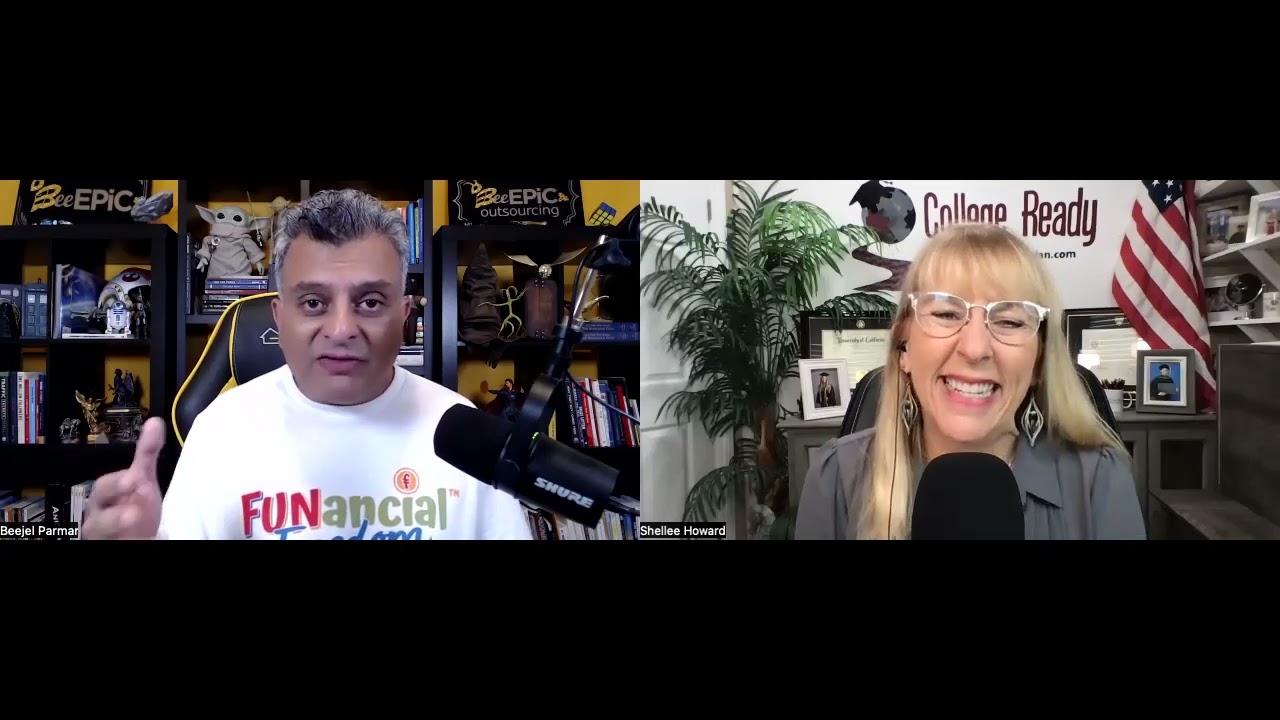
In this interview, Shellee Howard hosts Beejel Parmar, CEO of Financial Freedom, to discuss the urgent need for early financial literacy and entrepreneurship education for children and teens. Parmar shares his personal journey from an aerospace engineering graduate with little financial knowledge to an entrepreneur who realized the importance of mastering basic wealth‑building fundamentals. He argues that money habits, beliefs, and resilience are formed as early as age 3‑5, and that parents must proactively teach these concepts before traditional schooling can. The conversation covers the looming impact of AI on the job market, the necessity of teaching problem‑solving and mental resilience, and how financial literacy is only half of the equation. Parmar describes his company’s gamified curriculum—structured around Learn, Earn, Accelerate, and Play—delivered through animated content for ages 5‑12 and teen‑focused modules for ages 13‑17. Practical tools include the “Home Model” financial diagram, allowance strategies like “We Pay/You Pay,” and real‑world earning tasks (e.g., selling a video‑game card). Success stories of young entrepreneurs, from a 4‑year‑old who started a money‑teaching school to teens running million‑dollar esports businesses, illustrate the program’s impact. The episode also highlights parental communication tactics, such as starting conversations about life visions and budgeting, and provides two key resources: 10thingsaboutmoney.com and financialfreedom.com.
Chapters
Hello, this is Shellee Howard with Parents, Is Your Teen College Ready? And today I have a wonderful opportunity to share a brilliant man with you all. Bajil is the father of two and CEO of Financial Freedom. I love the name of that. He believes that we should all be doing more to help kids and teens prepare and navigate what many describe as an uncertain future, and that the current education system simply will not be enough. Wow, that— I mean, I could go on and on and on, but I'm gonna, I'm gonna just share Jill with you, and you will get so much information. So if you have a teenager and it's not been easy to talk about financial literacy or return on investment for college, please listen to what we have to share. So welcome, Bajil.
Thank you so much for having me on your show.
Outstanding. So maybe you can help our listeners understand, as a father of two, um, what their ages are, maybe some of the challenges. How can you relate to the listener, I think, is a great place to start.
Well, I think I'm going to assume for the moment that most of the people watching on this are parents or grandparents. And so what I want to do is ask a question, which is if we could go back in time, and if you see over my shoulder here, there's a TARDIS right over here. So I'm a big fan of Doctor Who and going back in time travel. If we could go back in time as adults, what will we do differently when it comes to finance, right? When it comes to money, would we have saved more? Spent less, you know, invested in various index funds, whatever it may be, right? And I'm not talking about predicting the future and picking the right stock before it happened. I'm just talking about the fundamentals of wealth building. Because believe it or not, even though we're in a kind of a crypto frenzy and people make what they claim is, you know, 1000x and whatever, the reality is that wealth building has not actually changed if we look at the methodology over decades, right? Maybe 100+ years. Now, so I'm gonna share my own story because I think it's, it's an example. So I graduated with a degree in aerospace engineering, which basically meant that I could technically lead a team of people and put a spaceship on the moon. That was my final year project, but I knew nothing about finance. And that was given my dad was a banker. So my dad was very disciplined. At the end of every month, he would do his finances, go through his statements. And as a kid, I saw that and like, oh, money. God, boring, right? And because, you know, often we kind of reject the things that our parents will often do. So, so I didn't pay a lot of attention to finance. And right after graduation, I found entrepreneurship. And I always believe when you go to these seminars and stuff and you kind of, you know, you have a millionaire mindset, you walk on fire and you break arrows, whatever, that your next thing might be the thing that's going to make you super successful. So, so for me, compounded with not wanting to really know much about finance, you know, believing that my next thing was gonna set me free financially and, and make a lot of money in 3, 4 years, which is kind of what sometimes these industries can, can, you know, convey upon you. I didn't do the fundamental, I didn't follow the fundamentals of finance, right? Fast forward many years later, lots of ups and downs as an entrepreneur. I had this big aha moment, which is, had I just done the basics, right, Shellee Howard? If I'd just done the basics, I would've been a lot better off. Now, here's what we know though about the basics. It isn't just about the tactical aspect of wealth building. It's about the beliefs, the relationship, the habits and routines we have about money. And a lot of them are formed in our actually younger years, not in our adulthood. They get formed, our beliefs and relationship money get formed in even as young as 4 or 5 years old. So the question we should be asking ourselves as parents, as adults, is what message are we actually sending to the younger generation? Now, why did I say 4 or 5 and not the teens? Well, here's the thing. If you've got a teen in your family and you ask a teen to do something as a parent, how willing are they to do it? Even if it's the best thing in the world, for them to do, right? So I hope everyone's relating to what I'm trying to say here because I've got an 18 and 22-year-old now. And even then, we believe that our advice is the best advice, and it may be, but it doesn't mean the kids will automatically take it as such. In fact, if they hear it on TikTok, they might take it more seriously than a 1-hour lecture from a parent, right? However, younger kids are far more accepting of parenting suggestions because they want to spend time with us as parents. They want to, you know, they're still, we're still their heroes at, at that age. And so when we spend a little bit of time, and I'm not talking about hours and hours, just a little bit of time introducing the subject of money to these younger kids, by the time they're teenagers, they can be far more intelligent and money savvy than even most adults on the planet today. We just have to look at the statistics, Shellee Howard, to show that today 95% of people in America, the wealthiest country on the planet, you know, from, from what we are told, right, have a challenge. They're money concerned, they're stressed out about money, right? Which means that as a parent, you know, we want the best for our kids. And yet the one thing that we are not doing, generally speaking, is teaching our kids the fundamentals. You know, this is about— this topic is about money. But there's relationships, there's mental intelligence, there's emotional intelligence, All of these fundamentals we are not teaching as parents very well. Unfortunately, the school systems aren't set up to teach this very well. So we have to look to outside resources to get ahead and really give our kids and teens the support they need if they— if we truly want them to be happy in their future life.
It is so— that is packed with so much brilliance. At College Ready, we focus on the academic, social, and financial fit of college. It is not simply you're good at math, go to MIT and call it a day. That doesn't meet all of the needs. And, you know, starting— we always say starting in 7th and 8th grade, but you're saying helping kids even earlier than that, getting clear what is a good return on investment. Because if you wait, nobody's going to explain that to your child. And when I ask students, does it make sense for this major to go into this much debt in college, they're like, what do you mean? And I'm like, well, how long do you want to work for free? And they're like, well, I don't want to work for free. And I'm like, that's called a student loan. And they're like, no, no, no, my parents are going to pay for it. I don't have to worry. And I'm like, how long do you want your parents to work for free? And they're like, oh. So really what you're saying is we need to start having this opportunity for them to learn this way earlier. So what is a good age?
Well, we have kids as young as 5 and 6 in our program right now learning about starting businesses. In fact, I just talked to a lady yesterday who 20 years ago, her 4-year-old, um, it's a very touching story, Shellee Howard. Her 4-year-old came to her and said, hey mom, I want to learn about entrepreneurship. And I'm talking about 20— 1990s now. And she goes, well It's, you know, she looked around, there's no courses for kids to teach entrepreneurship. And so she learned herself, she learned how to teach her son. And by the time he was 10, they had an organization to teach other kids about money. Now, unfortunately, he passed away right around his 10th birthday, but he got to fulfill his dream of being an entrepreneur and starting a school for entrepreneurs. So it shows that kids as young as 3, 4 can start learning the fundamentals of money. But here's why I believe it isn't just about managing money. Shelly, there's something that's really come to my attention over the last several months. So futurists are telling us that singularity— this is the point that artificial intelligence matches human intelligence— could be as near as 7 to 10 years from now. We are also told from, from other sources that 7 out of 10 jobs Okay, 7 out of 10 jobs may not even be relevant 7 to 10 years from today. So let's put it in perspective. One of the reasons I believe this is more than just a money conversation and more of an entrepreneurship conversation is that are the children being taught resiliency, problem solving, you know, that when they have a bad day, how quickly are they bouncing back? You know, how many kids we hear that when they don't get their 1,000 or 10,000 likes, they have it, they have, they have a breakdown in their life, right? So are we actually giving kids a reason to become resilient, mentally resilient, emotionally resilient, socially resilient, just through their current experience of life, right? So this is more than just becoming financially smart. This is preparing our kids that if the job that they might spend hundreds of thousands of dollars getting educated for does not exist, are they gonna be prepared mentally, emotionally to pivot, to find something new, to create a job where a job may not exist? Now, I don't wanna sound gloom and doom, but we have to start facing reality as parents. Shellee Howard, I can't think, we can't sit here and just think that none of this is gonna happen. It's happening today. You know, a friend of mine is a former Attorney General of Nevada, a futurist. He is, you know, we were talking about the legal profession. That seems like a fairly safe job career choice, but even today, The top law firms are using artificial intelligence to prepare case law in lieu of the, you know, young law students. Why? Because what is AI? AI is an ability to read language patterns, right? Well, what is most law based on? It's based on case law. So AI can literally read through millions of pages of case law, find the relevant information, prepare the documentation, and present it. This is the world today. This is not even 7, 10 years from now. So this is more, as I said, this is more than just financial literacy. Financial literacy is one half of this equation. Here's another thing. I just came back from a private university and of the— I met about 12, I spoke to about 12 to 20 students at the university, at least 60% of them. And this is a private university, which means that their parents have the ability to pay for these kids to go through school. But this is kind of a kind of turned on university. 60% of the kids who are doing business or finance-related courses also had their own business. I'll give you an example. One of the kids I talked to, age 14, he was a professional esports player, right? Um, age 16, he started, started and sold within a year a million-dollar business in esports. He chose to come to university by paying it for himself just for the experience. How amazing is that, that, that a child can make the money and just come to college for, for the, for the experience of college, but never to put himself or his family in financial debt by doing so. I met another kid, he had a lawn mowing business at age 14. Today, age 19, he has a commercial drone business. On the weekends, he goes and flies a drone for people in the real estate industry. He's paying his way through college. So there's so many different reasons, Shellee Howard, that today the resources are there. There's a way to make money online offline. There's no reason why kids as young as 9, 10, 11 cannot learn the fundamentals of entrepreneurship, apply it, develop a much better relationship to money than most adults have in the US today. And we're giving them a reason by helping them make money, a reason to want to start to learn about money. I mean, it's one thing to go to kids, say, hey, you have to become financially literate. Well, why? I've got 100 other things I'm gonna do today. Why? Why do I need to become financially literate? It's the most boring subject on the planet until we learn to make it fun. And how to make it fun? We make it practical. Now, the other part of this, Shellee Howard, is some parents say, well, you know, my son, daughter's got to really focus on education. I understand, right? But by robbing them of the opportunity, are we truly setting them up for success their future.
It's so important, uh, and I— that's the number one thing I hear is my student's too busy, when are they possibly going to do this? And I say, what if they don't do it? So we talk about it at College Ready as just a very, uh, normal part of picking the best college for them, because picking a college is just the stepping stone, it's the path to get to their future. It's not the end game. So a lot of times people don't— they think we don't need to talk about this. But I tell them quite honestly that if we don't, they're going to pick a major that is not going to either provide for them and then they're going to be back at home, or a major that's going to put them in massive debt that they may not get out of for 20 or 30 years. When my son attended Harvard and graduated debt-free at 23 years old, he was making, you know, over $106,000 a year. Okay, that's game-changing for his future. The reason why I know this is he wasn't going to go on to medical school because he didn't want to go into debt, because as we know, medical school is expensive. So we had to figure out a way to get the first 4 years done debt-free so he could then afford to go on to medical school. But he did that because we had talked about the financial impact that each stage would make. So I love that you're starting early. I remember playing with the kids when they were younger, Monopoly, right? The first time, like, you really get to decide, do I want to buy a house, an apartment, or do I just want to go with cash? And so I love what you're doing. So how have you gamified this process? How have you made it fun?
Well, you know, we're, we're kind of a, a team of entrepreneurs. So one day we just, you know, the, the founder just wanted to really give back. So, you know, what he, he did what he knew best, which was create courses. So he created courses and then we realized that courses alone are probably not gonna be enough. So we invested, God, almost close to about $1 million now on a platform that induce, introduces game-based thinking and game elements over the top of the courses. We wanna make it fun and engaging. But more importantly than the platform and the course and technology is getting kids to actually take action. So a lot of our course, at least we have our courses broken up into 6 levels of content, but at each level there's the learn element, which is learning about the fundamentals of money. There's the earn where we teach them dozens of ways to make money. Then there's the accelerate, which is what do we do with the money? And then play, which is how do we get to give back and in our lifestyle. Now in The Urn, you know, we give them literally playbooks like, like step-by-step playbooks. You know, we have stories of kids who've gone the first level, watched The Urn element, you know, and, you know, kids are like adults, don't overthink it, they just go do it. So he found something that he could sell, which is a video game card, and he put it up on one of the sites. I can't remember if it was Depop or one of the sites, but in one of the sites, and within 30 seconds putting it up there, he had a buyer. $48. He made his first $48 within 30 seconds of starting his business, technically speaking. Okay, now, not a game changer, not gonna change your life, not gonna pay your way through college. But now his relationship to money changed. In that moment, he had a different relationship to money than other kids. We also encourage parents to do what we call We Pay, You Pay, regardless of income level, which is, you know, you have as a parent, you know, we hopefully will pay for food and accommodation and, you know, the necessities of life. But we also can trim back what we choose to spend money on for the kids, which means, hey, if the latest iPhone has just come out, we shouldn't automatically go and just buy it for the kids. Give them a reason to earn that difference. And when they ask why, explain it to them, explain to them, you know, what it really takes to make a dollar. You know, how much money you have to really work, how many hours have to be going to make the money. So they start having a relationship to money so they can start understanding why, why do mom and dad sometimes say no? Why do they say yes? What's their responsibility? What's my responsibility? You know, if, if, if the parent, if the child needs money for something, loan it to them, you know. And now it's like, how would I loan my kid money? It's not about the loan, it's about teaching them what is a loan, so that before they go and agree to taking out a loan for college or whatever, they have that sense of self-responsibility. That, as you mentioned, you know, the ROI— what's the return on my investment? Well, what's the reality of taking a loan? What am I responsible for? How much would I have to work to pay that back? And all of the principles, whether it's on $10, $20, or $200,000, are very much the same. Sure.
Yeah. And so a lot of people, they think, um, having their 17-year-old or 18-year-old do this process on their own, plan for college on their own, is a great time for them to adult. And as you can imagine, it's actually a very terrifying time. I relate it a lot to allowing your teenager to buy you a home and you're not involved. That's the same amount of reward or risk that we're taking, or even buying a car on their own. The thought of just sending them off and seeing what happens is a bit scary. So by starting your kids early with your fun way of financial literacy really opens up great conversations for the future. So maybe talk about, you know, what they'll learn in this program and how we'll open up that conversation.
Yeah, so what we've done, we've taken, you know, many of the topics of financial literacy— good debt, bad debt, liabilities, assets. Um, you know, we teach models. One of those called the Home Model, which is simply a diagram of a house in 4 quadrants. We teach them how much money a household has, how much money a household owes, how much money a household makes, and our expenses. That's the Home Model.. So we teach them to, to very simplified financial models that can be taught, you know, so even to someone as young as 5, 6 years old. Then as, so we have two sets of content. We have animated content for the younger kids. It's suitable for kind of kids 7 to 12, we say. And then we have teen content, which is we kind of a teen face of the content for kids who might be say from that 13 to 17 year range. Now, the same type of topics, but just presented very differently. The interactions are a little bit different. So it's applicable for both. Now we're not trying to make them financial gurus. We're just, the purpose is to get them familiar with these concepts, credit, debt, assets, liabilities, you know, investments, et cetera. So that by the time that they are coming to make financial decisions for themselves, this is not unfamiliar topics.
It's so— it's amazing that you've, you've come up with a way to make it fun. I, I remember growing up, I— this is my 7th business. I'm a serial entrepreneur, and I started my first business at 12. And I remember asking my parents for a loan for startup costs, and I remember them looking at me like, how do you even know what that is? And I'm like, well, both you and Mom are entrepreneurs, and I watch you wheel and deal. And but for families who maybe have parents who, you know, go to work, get a paycheck, come home, you know, balance the checkbook, they may not see it in action. Um, one of my favorite things to do with our students is ask them, if I gave them a million dollars and you had 24 hours to spend it or you had to give it all back, what would you do? And I've had a huge range from buying a yacht and an airplane and taking their friends all over the world to— I had a young man say, Siri, what would I do with $1 million? So these are the spectrum. So how do you help? Kids are busy. Kids are distracted with social media. Kids are working hard for their grades. How do you, how do you build this into their, their life, their, their day?
That, that's a great question. And kids will tell you they're busy. But if you look at how much time they sometimes spend on non-busy stuff, they actually have a lot more time than sometimes we give them credit for, right? And for a subject as important as money, now let's, let's look, let's peel back this for a second. I can't remember the statistics exactly, but something like 60% or 70% of divorces are because of money-related matters, right? People, um, people's health— people who, who have said that a lack of money or not having the financial resources is why they say that they are unhealthy, they don't— they can't afford to eat healthy, right? They can't afford gym memberships, etc. Um, so we've got relationships, we've got— we've got health, money stress. How much of the mental, mental health issues, emotional health issues do we see right now are because of households who have the parents having money issues, and they claim that lack of money or money-related issue is why they're feeling stressed out? Now, what does that stress do for kids? Kids are naturally empathic empaths, they pick up on our energy. If we are mentally stressed and emotionally stressed, because of money issues, we are passing that directly on to the kids. Now they are now developing a relationship of stress with money before they even know why, right? So now let's prioritize. If you look in order of prioritization, where would we put learning about money given how important it is for the rest of our life? Do we make it a nice-to-do thing? No, that's— it's ludicrous that would make one of the most important topics of survival and happiness, the last thing we would put on our priority list. So maybe, you know, I mean, I'm not saying we should, but we make that a number one priority and look at some of the other things as being not important. Now, the second part of your question was, well, how do we get kids to get interested? Well, we got to build it into life. Rather than saying, hey, you must go learn about money, then we have to give them a reason to want to learn about money, which is Reduce their allowance. If they want the best things in life, have them go earn it, right? We have to give them a practical reason, but let's not make it like, you know, a heavy burden on them and say, oh, I'll help you, right? You know, whether it's our course or other course or whatever, you know, give them the resources and tools that they need to actually go and do this for themselves because they can. And here's the thing, kids and teens have very, very creative minds. You know, we often look at kids who play games and think, God, all they're doing is playing games. Most parents don't realize that kids who play video games, their brains can problem solve 100 to 1,000 times faster than most adults today, right? They're solving problems every single second of playing the game. They just don't know they can apply the same mental ability to real life. And when we give them something like a, you know, building a business What is business? Sure, you know this. It's a series of problems that have to be solved to create an end solution, right? So we just say, hey, use that brain, that amazing mind of yours that you used to play the games, and now let's solve a real-life game, right? Let's call that game making money or starting a business, right? So we have to start speaking a different language to kids and teens and making it— look, you talk about priority. The reason that money is not a priority is because most adults never made it a priority in their life to learn it. And hence why we have a financial crisis in the country.
Yeah, that impacts so many things for me. I, you know, childhood stuff definitely was coming up. I'm like, whoa, now I know where that comes from. The greatest gift that we can help our children understand is that money is not evil. I, I hear so many people, their number one fear is paying for college. Well, if that's the parent's number one fear, guess whose number one fear it is? The students. Now they're living in fear about this thing called college, and their parents are worried about it. That does not lead to a very fun, I'm looking forward experience. And, and so I have always talked to my, my kids. I'm a mom of 5, and I've always been very open and honest and said, you know what, nothing comes easy, but it, you know, if you want it, it can be brilliant. This is one of those things, financial literacy, having that conversation with your child about why they can't have that at this moment, that takes work versus just, okay, fine, I'll give it to you. And right, that's parenting. We're not here to parent. We're here to give opportunities and suggestions. So when we have these opportunities to play games like you, you have, um, in your program, or to start these conversations, these are important. But how would you start a conversation with, say, a 14-year-old? They're a freshman in high school, and maybe you're just hearing this information for the first time and didn't realize what a crisis it is. How could you open up that? Okay, they're past the, I think my parent is a superhero, and now they're in my parent knows nothing phase. How, how do you bridge that gap?
Well, first thing is, is awareness, right? So we can have conversations about, you know, normally what we ask kids is, what do you want to be, you know, when you grow up, right? And I don't know if you've ever experienced when you've asked a kid that and they're like, Oh, I don't, I don't know. Yeah. So, but, but while they don't know what they want to be, and let's face it, most adults don't know what they want to be, right? So, so, you know, we're asking the kids questions that we as adults find challenging to sometimes answer, but they probably do know or have an idea of what they want in life, right? Where they might want to live, what kind of car they want to drive. So we start the conversation at a level that, that they're able to communicate with us, which is Well, what do you want in your life? I mean, you know, 14-year-olds, fairly more aware than we probably give them credit for, right? And if they're, you know, they've been influenced by any kind of TV shows, whatever, they have, you know, what I want to live in here, I may want to drive this kind of car. Oh, well, what kind of sports do you want to play? Well, I want to go skiing every month. Great. Also, every winter. Great. All right. How much do you think that costs? Right? I'll tell you what, come, come back to me. And let's do some maths. Let's see that, hey, and by when do you want to be living this lifestyle? Now we call this in adulthood, and if anyone's done personal development, having a vision right now, if we just say to kids, oh, what's your vision for life? That's not a language that they are familiar with in most cases. But the end goal is the same, Shellee Howard, is that if we have a vision for life, if they have a vision for life, they can start to put dollar amounts or pounds or whatever country, you know, people are watching from, to those aspects of their vision. And now we can start having a journey. Well, what do you think is good? What kind of job? What kind of lifestyle? What kind of business? What kind of income will actually allow you to create that in the future? Now we've opened up the doors. Now we can open the doors to, hey, you know, every month me and your mom, or, you know, we have to pay bills. I'd like you to be aware of what these bills are, just in case, you know, for any reason we're not here one month, and God forbid. But some people have a very hard time having honest, truthful conversations, and we act like they don't know, right? And we got to stop playing that game of they don't know. They know a lot more than we often give them credit for. And so when we start having adult conversations in a lighthearted way that doesn't feel scary, offensive, they naturally take interest. Now, I'm not saying it's gonna work for every single child. But again, you know, let's, let's, let's try things out. Let's open the door for conversation. And sometimes, Shellee Howard, that word, just having a conversation, is, is the starting point.
Wow, that's a lot of great information. So if our listeners wanted to get in touch with you, learn more about your program, How would that— what would be the best way?
Yeah, I would like to give you two URLs. The first one is 10 Things About Money. So these are kind of some ideas of opening up a conversation. So 10thingsaboutmoney.com, it's a checklist of 10, 10 things that you can actually start doing with the kids like immediately, regardless of how old they are. The other one is our primary main website, which is financialfreedom.com. F-U-N, so financial feeden.com, where you can learn more about our courses and programs and, and what we're doing to help children and teens become both entrepreneurial in their thinking but also financially literate.
Outstanding. Well, thank you so much for your time and your knowledge. We are very grateful.
Thank you so much for having me.
More from Shellee




The 3 Questions Every Parent Should Help Their Teen Answer Before College | Featuring James McLamb

Helping Your Teen Stand Out for College Through Purpose & Impact | Featuring Aishani Sheth


From Robotics to Cornell: A Father-Son Blueprint for College Success with Aarav & Ritesh Kumar

The Hidden College Credit Strategy That Could Save Your Family Thousands with Josh See

The Truth About Financial Aid: Why Some Families Pay Less for College Than You Think with Jack Wang

Human Skills Every Teen Needs for College, Careers & an AI Future with Rob Heller
