Prep for Success: How UC Scout Boosts Your Teen’s College Readiness Podcast with Adra Bowman
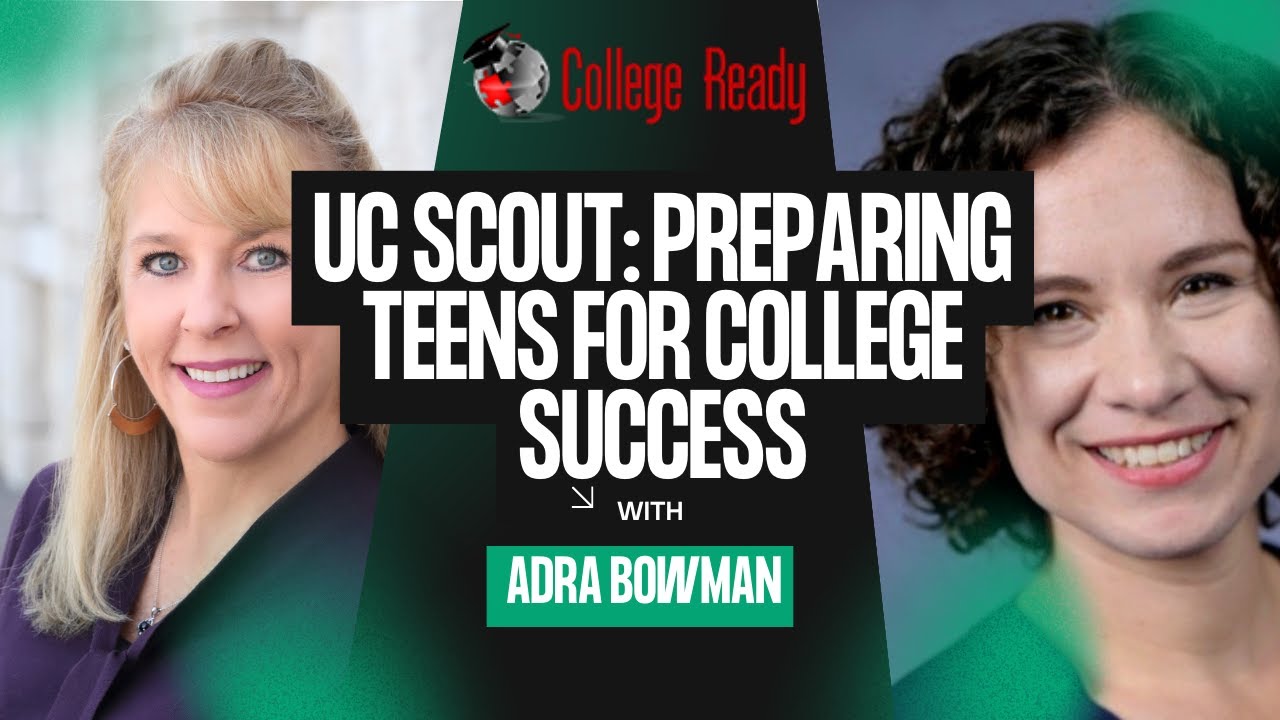
Adra Bowman, an outreach specialist for UC Scout, explains how the free online program helps teens fill gaps in UC A-G course requirements. Parents can use it to identify missing classes in foreign language, computer science, or visual arts, and UC Scout offers non-credit tutoring and teacher professional development too.
Chapters
Hello parents, is your teen college ready? Today I have a wonderful guest and I cannot wait to share her with you. Audrey, um, I always— Adria, I always mess up the name. So sorry, my guests are like, yep, I know how that is. Miss Bowman is on the call and she has a beautiful first name, but you are going to want to listen. She has brilliant information for your children And so without further ado, can you go ahead and introduce yourself, please? Sure.
Thank you so much, Shellee Howard, for having me on today. My name is Adra Bowman. I am an outreach specialist with UC Scout. I formerly worked at UC Santa Barbara in the Office of Admissions, and before that I was a high school teacher. So my background is in teaching education. I have a master's degree in curriculum and instruction. I used to be an English teacher. My undergrad degree is in linguistics, so I've been working in education for a little over a decade, and I just love what I do, and I love working with students, families, and schools to increase knowledge about and access to college.
Oh my gosh, so such a huge resource, right, parents? I, as I listen, and I know that UCLA and I mean the UCs in general are so highly sought after. But there's some interesting things about our UC schools that I think we're going to shed some light on today. So let's go ahead and start with, um, what, what is Scout? Many people may be like, okay, I know the University of California has great schools, but what does Scout have to do with any of it?
Yeah, that's a great question, probably the most common one that I get. UC Scout is a University of California program, so funded provided by the University of California that develops and provides online A-G approved— and we'll talk more about what that means— high school courses and resources and curriculum that we provide to students, parents, and families and schools throughout California and even out of the state, so around the country and internationally as well. Our goal being to increase access to the courses that students need to complete to be college ready. So A through G refers to the courses that the public universities in California require students to complete in high school in order to be eligible to apply. And not every school in California, certainly not every school outside of California, offers or requires all of those courses. So we're trying to increase access to those courses so that all students have options when they graduate high school.
Okay, that was a lot of information. So let's just break it down. I'm a parent, have a freshman. I'm like, what in the world did you just say? So I'm going to take a little bit deeper, and, uh, the first thing I want to break down is, is it true that we can choose as a parent, we can choose the classes we want our children to take? Because as a parent, many may be under the assumption that the high school's just going to pick them and the student's just going to take them and that's the end of it. So can you take it down to just that simplistic first step for a parent who is not in this world?
That's a great question, and unfortunately it doesn't have a simple answer. I think the shortest way I can say it is it depends. It depends on the high school and the district that your student attends. Uh, now what UC Scout can do is provide options for courses or resources that your student does not have access to at their school. So if your high school is saying your student has to take this selection of courses or these courses and they don't have the opportunity to take certain courses that they want to take, that's where they could do them through UC Scout over the summer. Or all of our courses are online and asynchronous, so they can even do them, you know, on the weekends, in the evenings, throughout the school year, depending on what their needs are.
Let's take it one level deeper. Can you give an example of maybe a situation, um, one situation where a student is given their, uh, schedule, and how would you know if it has the right classes or the wrong classes?
Yeah, that's a very good question. Um, so the first thing I always recommend is to work with your counselor. Um, either your school counselor or an independent counselor to make sure that they're aware of your goals. If your goal is to go to college or to go to a certain university system like the University of California, you need to know what are the requirements to get into that system because that might be different than the courses you're required to take to graduate from high school. So doing your research in advance— and there's tons of information online— I'd say the most important thing is to go to the direct source of information, which is the universities themselves. So like the University of California has really robust information on their website about exactly what courses are required. And they have resources that you as a parent can do your research to see, do these courses match up with or line up with the courses that my student is taking at their school? And again, if, if you're not sure, ask your counselor. And if there's a discrepancy, if there's a gap, that's when something like UC Scout could be one solution for filling those gaps and ensuring that your student is meeting the requirements of whatever university they want to apply to if they're not able to meet those requirements through their school.
So parents, is your head spinning right now? Because that's, that's like speaking another language. I can absolutely understand what you're saying. Let me break it down to something that I see often. So I may have a student in Texas and that particular high school does not know anything about the University of California A-G requirements. Not only that, but they call it requirements, and then they, they even simplify it more and they say, well, this would be nice to have, and this is required. And you're like, well, wait a minute, what is nice to have and required, and what is need to have? The best advice I can give you, parent, is if you really would like more information this resource, Scout, is a beautiful opportunity for you to gain knowledge. So even if your high school counselor is not familiar with this, because that's possible, we— the very first thing we do when a student comes into College Ready is we look at their past transcripts, and then we build out their 4-year academic plan based on the colleges that they're considering. Well, if you don't know what your child's considering, you better make sure that you don't mess up, because what happens, Miss Bowman, if they do not meet the A through G requirement?
So the University of California, one of the largest public university systems in the world, very, uh, some of the campuses especially are very competitive. So the A through G requirements are a minimum for threshold, which means if a student does not complete the minimum A through G courses— there are 15 different courses they need to take in high school— they are not eligible for admission. They will not be admitted even if they have the best GPA in the world and, and, and a stellar extracurricular record. So the A through G is a minimum. There are some A through G areas where there's a minimum, you know, like 3 years that are required, 4 years of a certain area, like English for example, is recommended. Um, that was a bad example because you need 4 years of English.
There are some others where— I knew what you were saying—
3 is required, 4 is recommended. And so having that 4th year can really strengthen a student's application and increase their chances of admission. As an example, what we see a lot with students outside of California who want to apply to a University of California is in the visual and performing arts area. Um, so that's Area F of the A through G requirements. Each letter stands for different area. So not, not every high school, especially out of California, requires or offers visual and performing arts courses, and students need to take a whole year of that in order to meet the A through G requirements. So that's where they could do that through UC Scout and have the peace of mind of knowing that they meet that particular requirement, which at least gets their foot in the door to be considered for admission.
Yeah, I just thought I would bring home why parents want to listen to this. It honestly can stop your child from even being able to apply, and that seems so unfair when you're counting on the high school to prepare your child for college. But parents, right, you have to remember high schools don't get paid for your child to go to college. They get paid to graduate your child. So it really is not their responsibility to do this. We'd like to hope that they would, but that's why I bring on resources. So let's take a deeper example. Um, let's go for foreign language. Okay, this is when many students push back on me, and there's recommended, there's required, and then there is what we know to be competitive. Can you talk a little bit about maybe what that looks like using Scout or not using Scout, a little bit about maybe Spanish or French, whatever one you want to talk to. Sure.
So one thing that we see with foreign language is we're actually seeing an increase in students taking those courses at a younger age. So maybe in middle school, completing their foreign language requirement, which then frees them up in high school to take other electives or other courses of interest to them. We also see You know, in California, a lot of schools offer Spanish. Not so many schools offer German and French, which are the other two languages that we offer at UC Scout. So if a student wants to expand their horizon, take a different language, they could do that through our program. We actually just recently posted a very cool video on Instagram with our German teacher talking about how you can actually go to college in Germany for free if you are fluent in German. So you could take German courses through UC Scout or another program to become fluent in German and then go to college for free in Germany. So there's lots of opportunities, uh, like that with programs like ours.
Yeah, another one that, that comes up often is PE. So a lot of students are like, I don't want to do PE. Can you talk about Can you do PE online through Scout?
Yeah, it's a great question. You actually cannot, but that's because PE is not one of the A through G requirements. So the University of California does not require any physical education courses, and that's why we don't offer any. Um, a lot of high schools still require that for admission. I know that when I was in high school, I was so involved in sports outside of my school, um, that I was able to kind of get a an exception or a waiver telling my school I'm doing soccer and gymnastics and I didn't actually have to take a PE course at the school. But that may have been a unique situation because I went to a very small high school.
I got it. I got it. So what would you recommend for a parent listening? And they're like, wow, I didn't even know this existed. What would be a simple step-by-step or a timeline or a path to really start to understand, does their school offer it? Well, what is it? Does their school offer it? If they don't, what can they do about it? And, and then take them from there.
Great question. I'm so excited you asked that because we actually just a couple of days ago updated our website. So UCScout.org, um, is brand, brand new, and we have really detailed information for parents, students, educators, schools to see exactly what UC Scout is and how it can benefit them. So in addition to the online courses that we offer directly to students, we actually provide full curriculum online directly to schools. And for public schools in California, that is 100% free. So if you're a parent and you actually would, would like to see your school offering a particular course, For example, some schools don't allow students to take courses at outside programs and get credit for high school graduation. So if you want to bring UC Scout to your school, we can actually provide the curriculum to the school and partner with them, um, and that can be much more cost-effective, uh, for the student and for the school. Um, so definitely check out ucscout.org and let your school administrator, counselor, teacher know about UC Scout as an option. Uh, we serve schools throughout California and throughout the country and internationally as well.
So I'm glad we have this wonderful resource. What can the parent do as you, as you think about, okay, so maybe the parent's now thinking, wow, my child is at a very small private school or even public school, and I don't know if they have— are they going to meet the A through G requirements? Um, is there a resource they can print and take into their school, or how can they make that bridge? How can they partner with the school?
Yes, definitely. We have a whole suite of shareable publications, uh, that we have on our website, and I can also provide those to you, Shellee, if you have any links you can share out with the podcast. Um, but we've got flyers and catalogs that parents can share with the directly. Uh, we also offer general information webinars throughout the year that are open to the public, so parents can come to those to learn more, and they can also share those with their school if they'd like to contact us for more information.
I love it. So here's a, a more advanced— so parents, if you're listening, I want you to know this is an advanced technique. Say you have a student who is IB, International Baccalaureate. And so they're not taking APs, they're taking IBs, but yet they see the benefit of testing out, getting a 3, 4, or 5 on those APs. Can you help with that?
Good question. Unfortunately, we can't, because at UC Scout, while we do offer AP courses and the AP exam, we only allow students to take the AP exam with us if they took the AP course with us. So if a student wants to take a full AP course and then the exam with us, they can absolutely do that. But if they're taking an IB course and just want to take the AP exam, they can't do that through UC Scout. Uh, there is a website from the College Board, the AP Course Ledger, that I recommend to parents where you can see what schools in your local area offer certain AP courses, and then you can contact those schools and see if they'll offer an exam-only option. Fun fact, there are charts on the UC admissions website and the UC campuses' individual campus websites, admissions websites, that will actually tell you exactly what credit those campuses will award for AP scores of 3, 4, or 5, because that does vary by university and by campus.
Yeah, so brilliant. That was, that was an advanced question, parents. So if that was like over your head, do not worry. Um, so when we think about, um, Scout and what, what would be a good student, or what scenario would be, um, an example of they would reach out to UC Scout?
Sure, there are so many different ones. Uh, one very common one is a lack of access to a course at a student's school. Some of our more most popular courses are the computer science courses we offer, and that's because not as many schools offer those courses. So for students who are interested in computer science, uh, they could take those courses again online. Everything is asynchronous through UC Scout. Um, sometimes we see students who took a course at their school and maybe didn't pass, um, maybe even didn't pass one semester of that course, and they repeat it through UC Scout. Now, In that scenario, you'd have to double-check with your school in advance and make sure they'll accept the UC Scout credit as that repeat. But that's another scenario that we see quite often.
And those are so powerful, what you just shared, parents. That, that to me is incredibly powerful because if you have to take that course over at the same high school with the same teacher, that's like asking for trouble. I think having another resource, but getting it approved gives your, your child another, another adult, another way of being taught. So very important.
And that's actually— oh, sorry.
No, no, you're good.
I was going to say, I think that's a great opportunity also to mention that the best, you know, solution is prevention. And so we also at UC Scout have non-credit courses that can be used as a tutoring resource. So if your child is taking a course and they're struggling in it and they're on the verge of passing or not passing, uh, they could take a UC Scout basic course where they get access to instructional videos that help them to learn the content. But there's no assignments, no pressure, no grading. Um, it's purely there to help them learn. And that's free for public school students in California, and it's only $29 for out-of-state students or private school students in California. So that is a great option to hopefully prevent that, that bad grade in the first place.
Well, so that made me think about how much is UC Scout?
Great question. We should have probably talked about that earlier. Our on-demand plan, those are the courses that we provide directly to students, are $399 per student, per course, per semester. So we have some courses that are one semester long and some courses that are two semesters long. And you could take one semester or both semesters depending on your needs. And we do have a scholarship program that's needs-based for California students only for $349. So that takes the cost down to $50 for students who are eligible for that scholarship.
Love that. That's, that's so powerful. So other than the tutoring and the A-G, Is there anything else that we need to know about the best use of Scout? Sure.
So in addition to the, the tutoring courses, the credit-bearing courses, and the curriculum that we provide to schools, uh, we actually recently launched a professional development series for teachers that is 100% free for everybody. So if you as a parent, if you are a teacher, or if you have teachers in your family or in your network, um, particularly high school teachers, this is a series of two courses that, um, teach teachers how to online, teach online, um, how to improve their online teaching skills. So we saw that as a need out of the pandemic, leveraged our experience with online instruction to help spread that knowledge to teachers throughout the state and throughout the country. So that's called Teaching in the Digital Classroom, and it's 100% free.
I love that. So how can somebody get in touch with you or Scout? Like, what is the best way to to get the, the information? Sure.
I think the first starting place is our website, UCScout.org, because depending on your needs and what you're looking for, we'll have kind of different points of contact. So my team, our outreach team, we work directly with schools and educators. We also have a customer support team. They can be reached at UCScout@ucsc.edu and they provide front-end support for parents and students. So that was UCSC, which stands for UC Santa Cruz. So we actually— UC Scout is technically housed under UC Santa Cruz Extension Programs. So, but we are a fully remote team, mostly in California.
I love it. If there was any words of wisdom or advice that you would give to these parents, anything you would like to share before we end our time?
Yes, I, I would say, and I think that a lot of this comes from my, my previous experience as a teacher and as an admissions counselor, um, there is no one right path. And I think that no matter where your student ends up going to college, if they go to college at all, that is the right path for them. I know that I had my heart set on a college that I didn't get admitted to, and then I had my heart set on a college that was too expensive And I went to like— it was not even in my top 5 colleges because my sister went there too. So I didn't want to go to the same college. And I had a fantastic college experience, changed the course of my life. I ended up working for my alma mater for 6 years. So there really is, you know, you know, trust your student and don't, don't worry, they're going to be fine.
Oh, that's so encouraging. Thank you so much for being on the show. And parents, until next time, really start to help your teenager understand, are they college ready?
Thanks, Shellee.
More from Shellee




The 3 Questions Every Parent Should Help Their Teen Answer Before College | Featuring James McLamb

Helping Your Teen Stand Out for College Through Purpose & Impact | Featuring Aishani Sheth


From Robotics to Cornell: A Father-Son Blueprint for College Success with Aarav & Ritesh Kumar

The Hidden College Credit Strategy That Could Save Your Family Thousands with Josh See

The Truth About Financial Aid: Why Some Families Pay Less for College Than You Think with Jack Wang

Human Skills Every Teen Needs for College, Careers & an AI Future with Rob Heller
