Replay How to Send Your Student to College Without Going Broke with Shellee and Lance
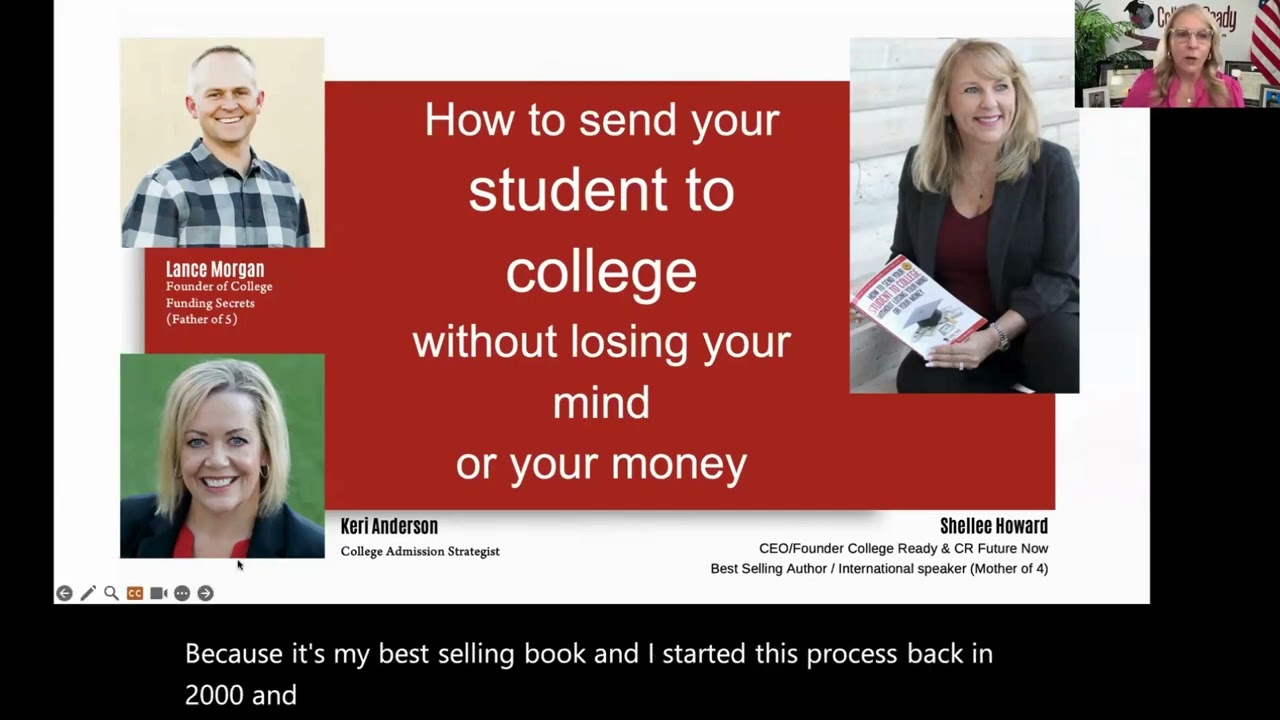
This recorded Zoom webinar, hosted by Lance and featuring college‑admissions expert Shellee Howard (with assistance from Carrie), guides parents and students through the entire college‑planning process with a focus on minimizing cost and avoiding debt. Shellee shares her personal experience of getting her children into Harvard, Alabama, and other schools debt‑free, and outlines a step‑by‑step strategy: understanding what colleges evaluate (GPA, rigor, test scores, essays, extracurriculars), building a standout profile (passion‑with‑purpose projects, leadership, unique talents), creating a balanced college list that maximizes merit aid, and navigating the financial side (FAFSA, CSS Profile, 529 plans, private scholarships, need‑based and merit‑based aid, institutional aid, and financial negotiations). The session includes live Q&A covering topics such as dual enrollment, AP/IB, SAT/ACT strategy, early recruitment for student‑athletes, passion projects, wait‑list tactics, transfer credit, and the cost‑benefit of 529 plans. Throughout, Shellee emphasizes treating college selection like a business, using data‑driven decisions, and leveraging every possible source of "free money" to graduate debt‑free. The webinar ends with a call to action to book a free consultation and an offer of a free copy of Shellee’s bestselling book for participants who answer quiz questions correctly.
Chapters
All right. Looks like— again, put in the chat if you're just joining, put in the chat which of these topics you're the most excited about learning tonight. See here. Oh, Carrie is in as an attendee also.
Okay, I will transition her as well.
Perfect. Again, don't be bashful.
Yeah, this is really about you all. So let us know what you want to learn. And I mean, obviously we're going to teach as much as we can and share as much as we can, but this is really about you and your time.
Awesome. Seth says interested mostly in financial savings and scholarships.
I love it.
Yes. Wendy says number 5 and 8, please.
5 and 8. Okay, we will definitely be touching on those tonight. It's really helpful if we know what are the things that keep you up at night, because it's not necessary. Um, I can't wait to share with you all of the things that we're going to talk about tonight. There she is.
Awesome, awesome.
Okay, we have a full house coming in tonight, Lance, so we'll give people just a bit to get settled in. Um, it may feel like a lot of information tonight. I love for my my, um, people to come and learn and take away. So feel free to take notes, and, um, we will have a recording as long as Zoom participates. That's the only guarantee I can't give.
Love it.
Awesome. If you are just joining us, please put in the chat which of these, or multiple, you can put all of the above if you really want them all. How can we most serve you this evening? What are the topics we can speak about that would be the most helpful to your family?
Awesome. It also looks like Danielle is— asks, says, as a student athlete looking to get early recruited, do you have any suggestions on when to start?
Yes, outstanding, Danielle. And the rest of you, if you can put the age of your student, that would really help me to speak directly to you. Obviously if you're a 7th or 8th grade parent, there's things that you can do now that a rising senior doesn't have the luxury of. So for those of you like Danielle, I was a scholar athlete, and all 3 of my— 3 of my 4 were scholar athletes. And so I know that world really well, and it really depends, interesting enough, on the age of the student and the sport, and if they want to play D1, D2, or D3. So there's a lot of variables that I want to make sure that I can speak to. So if you can put the details in there, we can make sure that we help you navigate that. Awesome.
Very cool. Awesome. I hope I'm saying this right, but Aurelia, Aurelia, Aurelia, uh, looking for private scholarships overall with a 10th grader.
Awesome. Private scholarships. So those of you who came early, you get the bonus information on private scholarships. You do not need to wait until your student is a senior. You can start applying for college scholarships 7th and 8th grade when your students have a lot more time. The challenge is, is their literature skills, writing skills may not be the same. But just know you don't have to wait, and you can apply for private scholarships all the way through college. So it's not one and done. Actually, you need to apply every single year, so it's really not one and done.
Like, welcome, welcome Seth with a, with a 16-year-old, um, a 10th grader. So I love these, uh, I love the 10th graders. We've got some time still, so that's great. Um, and then it says, looks like, all right, and then Danielle says athlete is 15 years old going, uh, to sophomore year and Salem Sailing does not do that.
Ah, I love it.
Typically, especially for Ivy Leagues.
Very fun. So I have a student right now, we just got them into Stanford for sailing, and we used sailing to get them into Stanford. So the neat part is, right, you have to be able to hang with the academics, but sailing is such a unique sport, not a lot of students are doing it. So the sooner you can sign up for the NCAA and the sailing— I forget the acronym right now, I can get it back to you— you'll learn the rules of engagement. There are times you can engage and there are times you cannot engage. If you do it wrong, you disqualify your student. So you definitely want to make sure you have all of the knowledge before coaches start approaching you. Mm-hmm.
Very helpful. Very good. Awesome. It looks like the number of attendees is growing rapidly as we're getting ready to start here. If you're just joining us, we had a little pregame show. So, so we are— if you look on your screen here, just put in the chat if there's anything in particular that you're excited to learn about, or if it's all of the above, put all of the above. And also maybe put where you're calling in from or, or joining us from, and maybe the ages of your students. I think it's always helpful to know if we've got a lot of high school students or a lot of younger students. So just maybe the grade levels of your students and where you're coming in from, and then we can go ahead and we'll go ahead and get started here. But welcome Heather. All of the above, Heather says. Um, Danielle says she is a straight-A student, need to know rules of engagement. Yes, awesome, Danielle. And also, um, you may want to reach out afterwards as well and get some more details on that. Um, Sophia, welcome from Georgia with a rising 12th grader as we enter into our summer months here. Uh, Wendy, I have a senior who received a few scholarships. We have a 529 and got a little from the FAFSA but need to figure out how to fill the gap.
Awesome.
Danielle understood SAT 1500+ opens doors. Yes, and congratulations again for these exceptionally gifted students that we've got here. Um, Jason, welcome from Michigan. One starting college and one going to be a junior in high school. Awesome. Danielle, we also have 529. Perfect. Rhett, welcome, Rhett. Nice to see you. Upcoming 12th and 9th— 12th, 10th, and 9th from Auburn, Alabama. And all of the above is great. David, hi, I'm an AI. Oh, that's the assistant. All right, perfect. Uh, Ashok, I think I say Ashok. Charlotte, rising sophomore. Michael, Um, Michael and Jackie, oh, welcome both of you. Rising 11th grader, rising 9th grader wants to learn about some 529s. Um, wow, okay, everybody's popping in. I don't— I will let Shellee— I will— I don't want to take up too much time because I know Shellee has a lot to cover, but please keep the comments coming because we can read these afterwards as well. So thank you, thank you for joining us. Um, I just want to say welcome real quick and then I'm going to turn the time over to Shellee because I know you all came to listen to Shellee, not myself. So I just want to say thank you. Thank you for Shellee joining us and sharing all this wisdom with us tonight. So very, very excited to have her. We also have Carrie from her team on as well to help us. Carrie and I are going to be trying to tag team the chat and the Q&A. So thank you, Carrie, for helping me out with that. So I just want to say real quick, the one thing that I want to say is that in my opinion, when it comes to college funding and college planning, there's two sides. There's the financial side and there's the academic side. I know which lane I belong in, and I know, I know which lane I need to stay out of. So I love the financial side. I love everything about paying for college and all the college funding related strategies. If you've been on any of my webinars or watched any of my videos, you know that that is my wheelhouse. I love talking about college funding. When it comes to the academic side, I'm the last person you want to talk to. So we have, we have Shellee Howard in the house who is the expert, and she's going to introduce herself obviously, but I just wanted to do a quick introduction. Because she is the woman of the hour here that is going to give us a lot of information on the academic side, which is all about that free money. If you've followed me for a while, you know, I talk about, you know, the 4 secrets or the 3 secrets. I've narrowed it down to the 3 secrets of college funding. And secret number 1, first and foremost, maximize all that free money. We all want free money. Put it in the chat. If you want free money, just type in free money to make sure that you're alive and you're with us. Um, if you're— if you don't want free money for college, then this may be the wrong webinar for you. So, so if you want free money for college and if you want your kids to get accepted to the school of their choice, then that's what we're here for. So put in free money in the chat just to make sure you're with us. Get that chat warmed up. This is going to be interactive. And you can blow up the chat the whole time and also put your questions in the Q&A. And then we're going to try to get to as much of that as we can at the end. So without further ado, I don't want to take up any more time. I want to turn the time over to Shellee Howard, and I want to again say thank you. Thank you very much for joining us and sharing all this information with us.
All right. Well, thank you, Lance. Thank you, Carrie, for being on. We have a full house. We actually filled build up Zoom, and so I'm really excited. All the people in this Zoom room are gonna get so much good content. It may feel like a little bit of a fire hose, but hold on. Um, a little bit about myself. I think it's important to know I love what I do, and what I get to do is I get to inspire your teenagers to be the best version of themselves get into their dream school and graduate without debt. Like, is that not the best job in the whole world, Lance? Come on. My job's pretty amazing.
It's very rewarding.
And very rewarding. So I speak teenager, apparently. I've never grown up because we all like love each other and they enjoy doing the process. So I'm going to talk about what it takes to get into college. I'm also going to talk about the big scholarships, and then I'm going to talk about how do you fund the gap. And we're going to circle right back to Lance on that part. So without further ado, I have a full evening planned for you. So how to send your student to college without losing your mind or your money. I have to start there because it's my bestselling book. And I started this process back in 2008 when my oldest was planning for college. Here are my, um, student, my own children who have graduated. So I think it's important that you understand when you're listening to somebody, it's not a theory that I go by. It is truly a mother's heart to not want her children to graduate from college in debt. That's where I come from, and that is my mission. In '21, '22, and we just added '23, our students received over $29 million in scholarships. We know where the big money is. So the 3 on the left, or the 2 on the left and myself, was at my son's graduation from Harvard. I'm not gonna bore you with the details. Obviously Harvard holds its own, but I think it's important for you to understand that he got into 7 colleges. He had several of them completely for free, and we did a lot of negotiating, and he came out of Harvard pre-med in 4 years completely debt-free, and I did not pay a dime. So that is possible, and I want you all to know I'm going to be sharing how he did it. I want you to know that there are opportunities on social media. It sounds awful, and I feel bad for people who are just entering in this phase of life. Obviously, I've been doing it now 17 years, and my second born, she said, Mom, I want to go to University of Alabama because Harvard people are weird. And I remember having that conversation going, well, everybody's different, yada yada. And so I said, if you can get in for free, and she said, will you help me? And I did. And she went to 4 years at University of Alabama and graduated debt-free. So I now have an orthopedic surgeon with $30,000 total debt and a registered nurse who is zero in debt. And then the young man on the lower left, a couple days ago, just graduated in 3 years with a major and a minor, debt-free, class of 2024. So my techniques are not outdated. They still work. And we've been doing this for hundreds— we're probably up to thousands of students at this point because our strategy is custom to the family. So this is the overview I want to give you because I'm going to tell you it is possible. I have proven it time and time again, and now I want to let you know how you can take advantage of this opportunity. But before we do, I ask every family who I talk to, are you college ready? Do you understand the terminology? Think about it this way. It's kind of like bookkeeping. It's kind of like financial planning. It's kind of like academia. And it's all mixed together to overwhelm you and make you feel like you don't have an idea where to start. I'm gonna help you unpack that as best as I can. So quick quiz, please put in the chat on number 1, what is the term COA in college planning? Is it coat of arms, Council of Admissions, cost of attendance, none of the above, B and C? Please put in the answer. Whoever gets them right will get a free copy of my bestselling book. Number 2, if my student has a high GPA and a high SAT score or ACT, they are assured of being accepted into their dream or desired college. True or false? A or B? We earn too much income to qualify for grants or assistance. A or B? True or false? And number 4, what is the ideal number of colleges to apply for this admission season? A) 1 to 2. B) 6 to 8. C) 10 to 12. Or D) as many as possible. So again, please write those down, put them in the chat. You have to put them in the chat if you want a copy of the free book, and I will come back to these at the end and let you know who won that book or books, because y'all may be winners. All right, so here's what you're going to learn today. What colleges are looking for and how to stand out. Stand out equals dollars. The more the student stands out from their competition, the more money they'll receive. Number 2, how to pay less for college so you can save more for retirement and enjoy the next few years without having a lot of stress and worry about paying back loans. And number 3, how to avoid the biggest mistakes other families have made by understanding the process and planning early. Planning is key. You'll hear me say it time and time again. We're going to briefly go through some things to help you understand, to set yourself up for the strategy of getting in. Once you get in, we will then turn it to scholarships and funding the gap. So just know this is not just about getting in, but if we don't get in, it doesn't really matter how we're gonna fund it. So we gotta start there. All right, so why college? And if not college, then what? When I talk to students, which I get an opportunity to every day, I ask them this question. Some of them would say to get a good job. Knowledge is important. Make more money to enjoy life, better opportunities, status, accomplishment, um, building the right connections, obtain skill set, surround myself with like-minded people. Now recently I have been getting students that say, why? My parents cook for me, they fill the fridge, why would I want to leave? I'm like, wow. Or what about trade school? And we do talk about that in our program. What about if I want to start my own business and be an entrepreneur? I love that. I'm an entrepreneur. I ask them how they're going to build their business plan, and that's when they kind of squint and go, what do you mean? What about an influencer? This is very popular right now. And then a lot of them are like, I don't know, maybe a gap year. Kind of like to travel the world for a little bit. So we need to have this discussion because it will influence the cost of college, and that's why I want to talk about this first. So let's dive in. Here's the problem. College admissions can be overwhelming with information overload. Google it, you'll see what I mean. Financial obstacles— Lance can talk about that. Um, scarce resources and fierce competition. All of those are real. The solution is knowledge, expert guidance, right? Think about it this way. This is really important to help your teenager understand because you can learn how to do your own taxes or pay a CPA or a bookkeeper. You can sell your own home or hire a professional. Your child is not prepared for any of this. And so if you don't help them, they're gonna need help. And that's what I want to give you tonight is help. So when I ask this question, when I'm in person at an event, I will say, which one do you care most about? Which should I spend my time on? Should I talk about the strategies of getting accepted or should I talk about affordability, grants, scholarships, financials. Hands down, everybody wants affordability. The problem is, if you don't get accepted, that all doesn't matter. So again, we wanna make sure that we're doing this in the right order. College is a business. You're gonna hear me say this time and time again. As soon as you treat college like a business and not an emotional decision, you will have the chance at so much money. There's so much money available to you. Colleges wanna see the best in you and you wanna pay the least. So you can kind of see, wait a minute, there's a problem. But here's the reality. Harvard has a $53 billion endowment and many other colleges have incredibly deep pockets. There are scholarship money that's unaccounted for all the time. And so it's really important for you to know there is a ton of money, and it is super important for you to look at college as a business. So planning to pay. Here's how you can decrease the cost, because I want to jump right in and I want to help you to align the two— getting in and the cost. So number 1, GPA will always be queen and king. GPA with rigor. What does that mean? It means your student needs to be challenged academically to show colleges that they want to learn. Does it mean they need to be buried in all AP, IB, dual enrollment? Probably not. Does it mean that they should take being a, you know, I don't know what they call them these days when you help out in the classroom, uh, a TA, um, probably not going to get you into college. Um, teachers will appreciate you, but that's not going to be helpful. The second thing is test scores. I can't, um, tell you how painful it was for everybody who believed that testing was optional. It was optional for those people who were happy to pay full price or take on debt. But for all of our college-ready families, every student who got the big money had test scores. And we had a strategy for them to get the best test score. It's not just throw a book at a student and hope that they can figure it out. There is a whole strategy when to take it, where to take it, how many times to take it. I can go on all day long. But it is no longer optional. I mean, it was never if you wanted money, but now every single day a new college is saying, we're are no longer optional. So be prepared. Those two are the minimum your student needs to do, and if they want money, that is the bare bones minimum. The next thing is dual enrollment and AP classes. Many people don't understand the difference between them. Many students don't. And so it's important that you understand the language first and what it does for your child. For those of you who heard that my third child graduated in 3 years, got a major and a minor, it's because of dual enrollment in AP classes. It's a whole strategy. The next part is look for colleges with strong merit scholarships. In our newsletter that's going out tomorrow— I think tomorrow's June 1st— it's important that all of the colleges that gave all of the full ride, all of the big merit money, We blast it to all of our families because why? We want you to know what are the generous schools and how do we get that money. We don't keep secrets. We want our families to be successful. Choosing a college your student will graduate in 4 years. This is so incredibly important. Our students know if a school takes 5 years or 6 years to get a 4-year degree, you're like, what? Is that a thing? It is a massive thing. Be very careful. That will sink a ship if you're paying $80,000 a year and you add another year and another year. Even community college right now is taking 3 to 4 years to get a 2-year degree in some geographies. Know the graduation rate. Look for out-of-state public colleges or international schools with special pricing for out-of-state students. I mentioned I have one more child in college. She has one more year to go. And she said, well, my oldest did Harvard, the second did Alabama, the third did a state school. I'm going to do international business in the Czech Republic of Prague. She is getting a dual US and international degree in 3.5 years for 27,000 total. And she's traveling the world on weekends. There are so many ways to do this. I can hear somebody giggling right now going, "That is so what I want to do." Um, so there's many different paths you can take, and I want you to know they're all available. The number one reason families go into debt is not having a balanced college list. That's the number one reason. What affects college admission? Admission has changed. It is no longer what it was 4 years ago, pre-COVID. You have to know what it's looking for right now. Grades are critical, GPA weighted. Each college can weight your GPA any which way they want, so you need to understand what that means. ACT, SAT, you don't have to take both. Have a strategy. Class ranking. Critical. Extracurricular activities. There's good, better, and best. Your student needs to be uniquely them. Essays. Third most important part of this process. I will talk about it in a little bit. It is critical. Interests, special skills, and passion. Absolutely game-changing. Letters of recommendation. Diversity, inclusion, and leadership. And college interviews. That's what it takes to get into college now. So all of you parents who are like, um, I applied to 2 schools and mailed it in, it is no longer like that. And that's why we have to start here before we talk about scholarships. I'm going to dive in very quickly to some things that are giving you false information. The U.S. News and World Report is where many people are coming up with their ranking. Unfortunately, it's all based on yield. It is another term we use in college admissions. What I can tell you is you don't want to put all of your education in that world. Just because a school ranks one way, it could be because they invited everybody to apply and then they had a very low yield. That doesn't make it a good school. I could spend a whole webinar on that. Now you need to know, this is a secret nobody wants to talk about, strategic enrollment managers. These are the people who have to balance the class and the school. You can only have so many business students, so many communications, so many VAPA. You cannot have all business students because all the other professors would leave. This position is a real position, and you need to understand that it's a critical part of the process. I get this question all the time, so I just want to address it. A great GPA and a test score are no longer enough. I just have to let you know that they're the beginning. They're not the everything. So you want to understand if your student is going STEM, what their STEM GPA is. If they're gonna go liberal arts, what does that look like? How are they gonna stand out? What is their positioning? Are their test scores needed? All of this equals money. So I'm not telling you this just to tell you this is what they need. This is the, the part that I'm gonna wrap it up with at the end. And I want you to understand how we're building, getting them in. And then getting the big money. So let's take a break here. I've just kind of thrown a lot at you. Let's talk about how to get accepted, and maybe a case study will help you understand what I'm talking about. So let's talk about Marcus. So Marcus is a freshman in high school. His dream is UCLA. He has a 4.1 GPA. He would like to do engineering, but Marcus understands that a 4.1 GPA is not going to get him into engineering at UCLA all by himself. Marcus wants to be part of the band. So guess what? At College Ready, we interviewed UCLA music department and found out they're having a hard time finding a bassoon player. So guess what? Marcus decided, I can learn how to play the bassoon. Got accepted, got money. This is the strategies that need to be utilized in this day and age. Application essays. This is the third most important piece, and it's important that you understand, do not do these. Do not write the essay for your student. Do not be your student's essay editor. Do not write the essay using AI. Okay, it makes sense to us, right? But it's happening time and time again. How do colleges know? I'm gonna just give you guys a little secret sauce. Back in the day, it was a period double space. Now it's a period single space. I know it kind of threw me for a little bit as well. Your student needs to have the same voice in their application as it does in their essay, or it will go in the wrong pile. So let's talk about the standout strategy. I think it's very important that you understand what we're talking about. If your student is a typical student doing what every typical student in their school is doing, why would a college pick them over somebody else? Okay, so you need to look at the school's algorithms. You need to understand what does that university need, what do they want. How will my child stand out from all of the other candidates? And I need to design the strategy to help colleges put all the pieces together. It sounds like building a business. I hope you can see the correlation. Then once you build it, now you get to market it. Now keep in mind, you've spent your child's most of their life telling them, don't brag, don't boast. People don't like it. And now I get to tell them, brag, boast like your life depends on it because you did the work and we need colleges to see what you did. So you need to be able to position and market the student academically, socially, athletically. Scholarship opportunities come here. Again, I'm trying to show you that it's not one place. This is where my son got his first really big scholarship, was in his positioning. He was freshman class president, sophomore class vice president, junior class president, ASB president of a school where his class was 3,000 students. Do you see the standout strategy there? Now, it doesn't mean that your child has to do that same strategy. But it was his plan. He loved leadership. He enjoyed inspiring other students. He enjoyed college prep. That was his stan— one of his. That was one example. So what I'm trying to help you to see is every student does it different, right? You can't do what child 1 does for child 2. So here's what we help students do, and you can do this as a parent. So just know, putting together a strategic college plan, helping them pick the right college major for the right school, 'cause not every school has every major. Then you wanna make sure that they have a test strategy, when to take it, where to take it, how to take it, how many times to take it. You wanna make sure that they lean into a passion with purpose project. That is the second most important part where my son got his biggest bucket of money. You're like, what? Yes, his passion with purpose project equaled thousands of dollars, but it had to be written about in an essay. Extracurriculars need a strategy. The colleges are going to ask them how many years did they do it, how many hours a week, how many weeks per year did they lead it, There needs to be a plan. There needs to be a letter of recommendation strategy— who to ask, when to ask, how to ask. There needs to be an essay strategy. Parents, you may be shocked here, but at schools now, a student will have to write between 0 to 18 essays per college. 0 to 18 per college. So if your student's gonna apply to 20 colleges, that's a lot of essays that have to all have a different topic. That's where the planning comes in. They need to be applying to 10 to 12 schools that can compete financially for your student. Did you hear that? I'll repeat it again. They need to have colleges that will compete for your child. It's not just about picking UC Santa Barbara for the view, or UC Berkeley for whatever many students say about UC Berkeley. It's kind of controversial right now. I won't even mention it. How to align with your school and your family values, right? If you have a family value that's, that's family and you want to be close to your family, don't send your student across the United States. They're going to miss their family. All of that needs to be a part of the strategy. Graduating in 4 years or less. Ding, ding, ding. Money, money, money. Highest ranked schools possible because those schools have more money than other schools. It's all about the money. So here's 8 ways to assure that your student can get an affordable college degree. Again, I'm taking it back to the money. Take the most challenging classes and get A's. Do not get all A's in easy classes. Wrong strategy. Have a strategic testing plan. Test prep and score well on the PSAT their junior year. Take AP, honors, IB, dual enrollment, and earn strong grades while getting college credit for free. Have a strategy or plan as to which colleges you will apply to. That is— number 5 is the quickest way to money. So if you can just take that from tonight, that is the key to the big money. That's how all my students graduated without debt. Plan your college search using the proper tools and structure. Look for colleges with strong financial packages and track and record their graduation rates. Leverage financial awards. Yes, you can leverage them against each other. We're doing that a ton right now. It's legal, it's ethical, and we're getting tons of money. What you can do. This is important. First thing, assess your family finances. Second thing, decide whether your student's desire at college is a want or a need. If your student wants to be a botanist, they do not need to go to Yale. Have those conversations about what is a good return on investment. Determine if the major they pick will pay for their wants and needs after they graduate. Will this degree pay for you to live on your own? That is a fair conversation, and don't be shocked if your teenager has no idea how much it costs to live on their own. Note, um, the graduation rate. You're going to start to hear some repetition. This is the critical part. Learn about acceptance rate at colleges students would like to apply to and consider the size of the college. If they go to a big college, that's big classroom sizes. It's a lot of students without a lot of instruction. Is that the right fit for your student? Then you have decisions. Do you know how much it will cost you if you pick the wrong college. I have to bring this up, not as a scare tactic, as a financial strategy. If your student picks the wrong school and transfers, it is a $100,000 mistake many times. That is terrifying. It is so much easier if you do this right the first time versus saying, oh, we'll just leave it up to our 17 or 18-year-old, and if they screw it up, then we'll jump in. That is a financial disaster waiting to happen. The admissions process is extremely complicated. 1 in 3 students now get help. So what we do is no longer for just the wealthy or the niceties. It's for every student because the process is so complicated. I'm gonna talk about some most frequently asked questions, but I'm gonna save the answers for the end because I wanna put this in your mind and get driving into the scholarships. Number 1, my student does not know what they wanna major in. Is community college a better option? Are Ivy League schools the best option? Is a more expensive college going to ensure my college gets a— my college— my student gets a better job when they graduate? What if a career— what if the career my student has chosen to pursue will not make them enough money, money to cover the debt? If you stay at the end, not only will I answer all of these, I'm going to tell you what my son did to get into Harvard and to graduate debt-free, and I'm hoping that will inspire you to do similar. Now is the time we're going to get into the second part. They got into college, we have a plan, we did everything that Shellee recommended, and now Show me the money. So there's 3 main ways you can get money. And so everybody has a shot at it. It's a big misconception that not everybody can get money. Most of my clients are middle-class families. I do have need-based and I do have multimillionaires, but on average our students have between a 3.0 and a 5.0. And so with that comes different financial opportunities. So the number one thing is need-based. That is going to be based on your student aid index. I will get into that. There's merit-based. That is when a student really wants your student and they're willing to throw a bucket of money at them. And then there's institutional aid. That is where we help you understand the most generous colleges. So here are the misconceptions. My income is too high. My child's grades are too low. Just to be clear, if you want scholarships, anything under a 3.0 is going to be very difficult to get scholarships. So encourage them to bring that GPA up. We own a home. Not a problem. Aid is only for special groups. That is not true. It's not that hard to apply. I can do this. That unfortunately is not true. High school advisors are there to help our family. I'd like to take a brief second to let you know I love high school advisors, but unfortunately they don't know how much your family can afford. So if your student's good at math, they may say go to MIT. Have you seen how much MIT costs? Is it really the best academic, social, and financial fit for your family? It's only for you to know. Now let's talk about scholarships because this is why you came. The number one secret is the reality is that most full-ride scholarships come from the college, um, in merit or athletic. 6% of students get an athletic for a ride scholarship. That is 6, not 60. So if you're spending $10,000 a year for your child to get hockey lessons, think about what are the chances of them getting a hockey scholarship. Just keep in mind, one injury can flip that on its head. I'm a scholar athlete. My children are scholar athletes. I don't disagree with it. I just— my, my job is to help you to understand where you put your eggs in the basket. Number 2, private scholarships are available to everyone. Yes, they are. And you can start applying in middle school. Number 3, there are legitimate websites to help with scholarship search, and there are very scary ones. I'm going to give you another piece of really important information. If you're going to let your child, your teenager, apply to scholarships, Couple things. Make sure you have a throwaway email, one that you can just get rid of after college admissions, because as soon as these people find out that you own a home, you own a car, they're going to want you to refinance and buy a new one. So protect yourself and make sure your child knows not to give out any personal information. They don't need to. Number 4, look for scholarships from your employer, credit union, department stores. My son won a scholarship from Nordstrom for $25,000. I mean, I like to say kind of balance things out, but just kidding. So, so just know there are big scholarships. Target has an awesome one. So they're there. It's just knowing that they're there and when to apply. Nobody told us that my son needed to apply to the Nordstrom one his junior year. Had I not been looking for this, we would have missed it. Number 5, there are no tricks, but there's just good old-fashioned work and follow-through. It can be a part-time job. If your student is truly going on scholarships, the independent ones, it's gonna be 20 to 25 hours a week. To get the kind of money they're going to need. Just so you know. Number 6, passion equals scholarships. Absolutely. This is a critical piece. Our students at CollegeReady have in the last year built 3 schools in Uganda. I am leaving in June to deliver their passion projects and they are going to get international recognition. There is nothing more important or impressive to colleges than international service. I can go into that a whole nother webinar. Number 7, consider your background. There are a lot of opportunities for scholarships with your background. Number 8, if a scholarship advertises no essay, run. If it's not hard to do, everybody's gonna do it. And if you don't have a really sad story, the chances are you probably won't get it. Number 9, if your student doesn't go looking for scholarships, they won't come looking for them. And number 10, have your student follow directions carefully. I'm gonna pause here because this is a big problem. Many students feel like if their parents tell them to go do scholarships, they just turn and burn, turn and burn. They're texting, they're just kind of throwing trash out there. I would kind of spot check and make sure that they're spending the time doing it the best possible. I'm not saying that yours won't, but I'm just saying they want to get this done. It's not super fun. And for parents, 91% of y'all will complete the FAFSA incorrectly. So slow it down, answer the prompts, answer the FAFSA, and you will have a huge chance at scholarships. Here are some scholarships. You can screenshot this that our students have won. I had a student get a full-ride scholarship from the Coca-Cola Foundation to Vanderbilt, and it was real, it was legit. It wasn't easy, but man, is she enjoying her time at Vanderbilt. All right, now, how do you get those scholarships, right? I told you they're there. I told you what's needed. Now let's go and get them. The number one thing you have to do is you have to complete the FAFSA. If you do not complete the FAFSA, you're pretty much telling colleges, I'm fine, I'll pay full price. The other thing is, if you apply early decision, it is a binding agreement that you will pay full price. So if you're looking for scholarships, do not apply early decision. Again, a whole nother webinar. Number 2, SAT, ACT application and essay. They must be done well. And number 3, many colleges will ask you— not all, some— to do the CSS Profile. It is so important that if you choose not to do this, you are choosing not to get scholarships. I have multimillion-dollar clients. I still tell them the same thing. If you want money, you need to do it. Government doesn't learn anything new about you. They just connect it to your taxes. Prior, prior year. So for those of you who are wondering when we need to get started on this, you need to have your financial house in order, which means your student's second semester of the sophomore year, first semester of the junior year is your FAFSA year. That's the first one. You do not complete the FAFSA until the June— I'm sorry, till October of their senior year. So that's why you need to talk to Lance now. He can't help you if you wait until it's too late to help you get your financial house in order. And that's why I partnered with him, because I can help you get in, I can help you get this big scholarships, but you still have to get your financial house in order. So very important that that all comes together. And then, If you don't complete the FAFSA your freshman year, you're done. So say you lost a job or something happened their sophomore year. Unfortunately, it's not going to be pretty. So just know it's important. All right. This is how we start the process. The first thing you need to do is you need to find out your student aid index. It used to be EFC, Expected Family Contribution. As I'm sure you've heard in the news, that's just been a bit messy. We're not going to dwell on that. We're just going to let you know that your student aid index has to happen for you to know what colleges think you should be able to pay for college. Now, I've never had a parent tell me, "Yes, I'm happy to pay that. That makes so much sense. No problem." But it is really important to know Is that going to affect scholarships? So the top 5 factors are: 1 is parent income, 2 is assets and where they're held, 3 is student income, student assets where they're held, and completing the form correctly. We are FAFSA and CSS Profile specialists. We have seen every mistake in the book, and it's so easy to do. So I just encourage you, don't get frustrated that you make just enough money and not enough money. Most of the people I deal with are in that situation. Now we get into institutional aid. It's super important. Lance, how am I doing on time?
You're good. It's about 7:45, 7:46.
Excellent. Okay, I'm trying. There's still so much great information.
You're good.
All right. Two types of institutional aid. There's gift aid, which is free money, and there's self-help, which is work-study, student loans. Okay. First thing, we want the free money. We want the, the big bucket, right? And that is student positioning, standout strategy, all the things that I told you at the beginning. Now we're gonna transition into, all right, if we didn't get that, can we still get this? Yes, you can. So self-help could be work study. What does that mean? Well, with my children, I told them that I was not going to go into debt for their education, and so they had to have a little bit of skin in the game. And my son did, um, tours for guests when they came on Harvard campus, and that money was put right, right into his college fund. So that was one way. My daughter's like, I want to hang out at the gym with all of my friends there. So she checked people in and out of the gym and did her homework. These are fun, easy ways for students to get money. My third got more creative and he's like, you know what, I'm going to be the RA of the dorms and get all the free food and free housing I can. It was brilliant. There's so many ways that students can get through this. Now, here's an important piece highlighted in yellow. Would you pay full price for a car or a home? Why would you pay full price for college? I want you to think about that for a moment, right? You never walk up to a home, maybe in California, but very rarely, and pull up the flyer and go, oh, I'll pay that price. Yeah, and I'll pay it. No, why would you do it for college? You don't need to. You can do financial reconsiderations, financial negotiations. We are doing it with our students all the time, and there's so much money. If you don't ask, you won't receive. That's what we teach our students. This is what a financial award letter looks like. I didn't realize that many people hadn't seen these, so I'm putting this in there. For you to know that every college should offer you one of these if you completed the FAFSA. If you did not complete the FAFSA, you won't receive an award letter. All right, here's the roadmap. You have institutional aid, you have need-based aid, you have merit aid. I talked about all of these, so I'm not going to go into detail. How much will college cost your family? This is where the reality gets very intimidating, right? 4-year private school, 4-year public school. It looks like, oh my gosh, there's no way we're going private school. But what I want you to know is more times than not, a private school costs less than a public school. They get in and out faster. They have smaller classrooms. I, I can go on and on. Again, a whole nother webinar. But just know, do not think your local public school is the cheapest option. That's what I want you to take away. Then we talk about how are you going to pay for college, right? You have your savings, maybe you did a 529. And for those of you who want me to go into a 529, I'm happy to do so. But really, that's kind of— we're getting into Lance's territory. So I'll, I'll give you the top layer. I had a 529. I really did. I started— somebody told me it was a great idea when my son was born, and I'm like, I'm going to be a great parent. I'm going to pad that thing. And we did so good. He had $250,000 in there. Like, I was so crazy about it. And then what happened is I found out that the FAFSA looks at it and Harvard looked at it, and when they found it, They said, you don't need a scholarship. Somebody needs it more than you. And I'm like, whoa, whoa, whoa. I don't know what you're talking about. And I moved that 529 as fast as you can imagine, and I saved myself $70,000 a year. So don't go and ditch your 529. Please don't go and ditch it. For some families, it might make sense, right, Lance? Yes. For some, a lot, it doesn't. Correct. And I want you to be very careful because there are ways of doing it that can help you and hurt you. Again, I'm going to turn it over to Lance when we come to that question because that's really his wheelhouse. But I want you to know, sometimes our savings— I hate to be the messenger on this— can actually harm you as much as help you. Then we get into private loans. Be very careful about private loans. Stay away from them, uh, if at all possible. And then we get into scholarships and grants, and I want you to know that is where I want you to put your focus. That's where the genius is. All right, so how you pay for college is way more important than how much you pay because you don't really want to use a traditional 529. I hate to say that, but some people will. You don't really want to use your savings. That doesn't always make sense. You don't want to use whole life insurance. Whole life isn't the same as cash value. You don't want to use your retirement. That's awful because then your children are going to decide how you do retirement. That sounds horrible. You don't want to use private college loans because even if your child passes away, you still assume the loan. I had a family yesterday who thought that their child at 18 could assume the loan or could get a loan. They had no collateral. So guess what? The parent had to co-sign, and it was unfortunate because the parent said no. So just know, having these conversations now, right? People want to know, when do we start? Now is when we want to start. Understand the cost, or what we call opportunity cost, is so important. And Lance is genius at helping you understand that. So here's some options. This is— I love this. So one of my favorite ways of looking at this. You can be in denial and you can just pretend, I don't want my kid to leave. I don't even want to— I don't want to deal with this. I'm just going to like pretend it's not going to happen. And then I have families who are like, I'm just going to put my head in the sand and hopefully it just passes me on by, or I'm going to let my 17-year-old do it because it's time for them to mature. Or then, you know, I'm just going to do it myself because that sounds like something that would save us some money. And I, you know, I'm pretty good at this kind of stuff, so I'm gonna do it myself. And then there's experts, and I would encourage you to consider what that looks like. There are 67 steps to success for your child to get from point A to point B. Are you able to guide them through that? If not, there's always Google, because if you Google it, you will get this many results. And unfortunately, that's not going to be helpful for you or your student. So let's talk about saving time and money. Let's talk about knowing which colleges are the most generous, filling out your forms correctly. We don't want you to make mistakes. We don't want you to not know how to reduce your SAI. We don't want your 529 to hurt you. These are some things I want you to get some clarity on before we answer questions. How are you feeling? How does this make you feel? Does this keep you up at night? Do you know what you're going to do with how you feel? These are the things people call me with every single day. Not sure how my— how to pick a college or My child doesn't know what they wanna major in, or they don't know when to start. It, it can be really frustrating for a family when they hear that testing is optional, and then they find out, no, it's not optional. And now you don't have time to test prep to be competitive. How do you know which is the best test to take? I mean, should you do AP, dual enrollment, college classes? And, and how do you even find a teenager's passion outside of their phone or their computer? I'm feeling confused. I'm feeling overwhelmed. College is competitive. It's expensive. I just want you to know it doesn't have to be like this. And this is why I started College Ready. When my son came to me and said, Mom, I want to be a brain surgeon, and I panicked and I sat in the chair you're sitting in I felt all of this. I'm not going to lie to you. It was so overwhelming to me. And I took him to his high school counselor and I said, tell her what you told me. And he did. And she said, why would you waste your money and time being a doctor? They don't make money anymore. And I was so discouraged. And I don't want you to be discouraged. And that's why we do these. We don't charge for them. This is to inspire you to either do it yourself or get help. So just know I'm going to be happy to answer your questions. And while I'm doing that, if you would love a clear vision of— yes, I need to know that. If you want to know what your obstacles are, if you want to know your next steps, then either go to collegebook.info or scan the QR code and, and let us help you. We're not going to charge you for it, just like we didn't charge you for this. We're going to give you 30 minutes of focused time just for you because we want you to know that this is possible. We want you to know that this is something that you and your child can do. Because if you think about if you don't get help, what are your possibilities and what are the things that could potentially happen You don't want your child at home frustrated. I'm gonna leave you with one final thought. What is the number one major in college right now that is most unemployed? Lance, do you have any ideas? Carrie, any ideas? I may have an idea. I know, because I've told you this too many times. That's not a fair question. So the number one most unemployed major in college right now is psychology, because when a student gets out of psychology, there's no job called psychology, and nobody has informed them that they must go on to more education and more debt. And that is not a good strategy to release them into the wild of adulthood. So We want to answer your questions now, so if Lance or Carrie can go ahead and ask the question, Lance or I or Carrie can answer them. Oh, Lance, you're on mute.
Sorry, sorry, I got to unmute. I was just going to say I put the link in the chat as well, so you can just click on it.
Awesome.
So click the QR code or scan the QR code, or just click that link I just put in the chat. Perfect. But yes, we have— first of all, before I— or while I'm pulling up the questions, please do me a favor and let's light up the chat with some thanks and gratitude for Shellee and what your biggest takeaway was. So give us a little feedback, put in your biggest takeaway. So type in your biggest takeaway and also your questions as I'm kind of scrolling through here to kind of make sure I find all the questions. I saw them when they were coming in. Um, some comments earlier about this SAT, um, and ACT test scoring or testing being optional, but now it's not. Um, just more of a comment on that. Um, and then What do you mean dual enrollment? Are you talking about in high school?
Yes. So in high school, not every high school offers it. That's number one. What, what happens is if a college professor who's accredited to teach at a college teaches at your child's high school, they can teach what's called dual enrollment, which means your child gets college credit while they're being taught at their high school, they get a grade boost like an AP class, and that way they're double dipping. So now they're getting free college credit, which could be up to $1,000 to $3,000 per credit. So it's a financial strategy, it's an academic strategy, and it's a standout strategy. You need to ask your school Do they have dual enrollment? Not offered to every student, so you have to ask for it.
Perfect. Perfect. Danielle says, good or bad to take the SAT in 9th grade? So this upcoming SAT to gauge her improvement after this summer 3-week SAT camp.
So just to be clear, a 3-week camp is not going to get her ready. I wish that was the case. But unfortunately I've never had a student be successful. What a student needs to do is they need to have a strategy. They need to take a diagnostic test. They need to see where their score is for the SAT or the ACT. It's not a feeling. A student will say, "Well, I've heard this," or "I've heard that." It's not a feeling. It is, "Show me the numbers. Let's make a logical comparison, and I can show you was it a silly mistake, was it a timing issue, Or did they not know the material? Do not have them ever take a real test until they get the score they want to get into their dream school on a practice test. So the answer is absolutely don't do that to them because you can't— you don't want to take any test a bunch of times because it just shows colleges you're throwing spaghetti at a wall.
Awesome. Good, good feedback. Okay, this question, I don't want to slaughter your name, so I'm not even going to try to pronounce it. Koge, K-O-G-E, I think is how you say it. But anyway, what if the child doesn't know what his interest is for the passion project? Do you help them, kind of help them with the passion project?
Yes, absolutely. The nice thing about that is I'm going to show you how you can help them. I'm very much about giving you free resources, giving you opportunities to, to attempt this. And then if you're like, I can't get the kid to do anything, then you just know that we're here to support you. But what that is, is you can go right here to seerfuturenow.com. It is our sister company that I started for your child because the number one complaint I hear is my child has no plans for their future. And so we walk them through how to pick a major, how to pick a college, and how to pick a career. We can show them how much money they'll make with that major, how much money they'll make with that career, and will a robot be doing it in 5 years? So this is the place to start. How we do it is we help the student by doing 8 assessments. We don't just have them go and do a bunch of assessments. We are career strategists, so we unpack each of those assessments of who they are, what matters, how others see them. Their gifts, their talents, their core values. Then we help them to come up with the 3 careers that would be the best fit and the 3 majors that feed into the career. Every one of our students has 3 majors and 3 careers well before they apply. It is totally possible. They just need help because their high school is not going to cover this at all.
Perfect. Excellent. Then we might need further clarification on this because I'm not quite sure your question is, is what if my child doesn't want to go to college but got a partial merit scholarship for out-of-state school? So you, you got a scholarship, but they don't want to go to college. I'm not, I'm not quite sure of that question.
If they don't want to go to college, that's the number one challenge, right? It doesn't matter if they got money. They— the reason why I just want to give you a little feedback from my years of knowledge here is they don't know why they need to go. They don't know what they want to study. They don't know why it's important. They— all they hear is all of this chatter about it's expensive. I don't want debt. La la la. They're not hearing this is the opportunities it will give you. And so that's what we address. Is you don't have to go to college, but what will you do? That's important. Yeah.
No, that's great. Natasha said, do I need to complete the FAFSA to be eligible for scholarships? And Carrie answered that in the chat. But just for everybody else's benefit, yes, you do. Gigi says, are private scholarships fully available still for this fall, or is it about 50% gone? Like, is it too late? No. What about people who have seniors in high school?
Yeah, for those of you who have seen seniors, if you've already accepted a school, it's like buying a house. You can't figure out how you're going to pay for the house after you buy it. But what you can do is apply for independent scholarships. We have two companies that we highly, highly recommend. Be careful otherwise, but there are some really good scholarships you can apply to now until you finish college.
Perfect. Perfect. Ben was giving us a little feedback on psychology. A great degree. He's our psychologist in the group. Jason, where do we get more advice on negotiating more aid? That's— is that one of your services?
Yes. So we have, as part of the College Ready Plan— that, that's funny. That emoji made me laugh. Um, as part of the College Ready Plan, we help families do financial negotiation. We help them with the letters, we help them with the follow-up, we help them understanding you can't just go to a college and say, I would like more money, please. Um, everybody would be in that line. So there's a strategy for that. And so our families are coached on how to do that.
I love it. All right. What do you do if you're waitlisted?
Yeah, so that's part of our— again, part of our strategy is there are things you should be doing prior to being waitlisted and things you do prior— after being waitlisted. And so just know you— there's still a chance you can get off the waitlist up until the day colleges start school. So just know that it's only over until they start school. So there are still things you can definitely do.
Awesome. Mark, I can probably answer this one. It says we have lots of assets, but my husband has retired, or I'm guessing maybe this is your wife on here. Mark, I have lots of assets. My husband has retired and our income is much lower than before. Do we have any options in lowering your SAI or our SAI? So your SAI is calculated every year. So every year you get a new SAI. So your first year going into college, it may be higher than the following years, but there's also a great reason to appeal and negotiate, right? So if your income situation has changed from what's on your tax return from the prior, prior year, we're talking 2 years ago, right? So if something has changed by the time they're going into college, another great reason for negotiation, wouldn't you agree?
Absolutely. Don't ever just take— you wouldn't do it if you were buying a house or a car, right? Take that same mindset and be like, I, I want the best deal I can get.
Yes. Awesome. Michael was asking for to see another one of those, see a slide again. There's going to be a recording, right? We're going to shoot out a recording to everyone.
Yes. Perfect.
Great feedback from everyone. Mark says thanks. Sophia says thank you. Adriana says, thank you very much. This is awesome job. Maria says, thank you. Ben says, thank you. Great stuff. I think this is like how many— how people cut their taxes. If you work the system, the system will work for you. That's a great insight there. Linda says the book wants questions about the book. We'll be able to follow up in the chat on that to see who gets the book. So thank you for that reminder there. Christina says, thank you. August says, thank you. 529 plan, what to do with these? So, Olga, I've got a whole webinar on that. So we've got another hour and a half on just that topic alone. So great questions. But you can also reply to any of the million emails you got from me for this webinar. So just reply to any of those emails. We can also book a call, Olga, and chat individually and give you some ideas on your 529 and some options there. Aurelia says, thank you so much for such important information suggestions. So thank you for your feedback. Crystal says, thank you, Shellee Howard. Takeaway: 529 pros and cons. Yeah, there are some pros and cons to 529, and for some families it's fine, but for other families it may really hurt. So I also agree with what Shellee Howard was saying earlier. Don't just take this blanket advice that people are giving you to just automatically shelter all your assets because you think it's going to automatically give you free money from every school that's out there. That is definitely not the case. This is very specific to your family's situation. And the school or schools that you're looking at. So just randomly taking all your money and sheltering it from the FAFSA and the CSS Profile is not a good strategy. You need to— it's a combined effort between what Shellee Howard is talking about and what we can help you with to, to play with that SAI number. Adriana says, concerned about psychology, my daughter's plan. Okay, no offense, no offense to all of you that are psychologists or looking at going into the psychology world. Just make sure you go in eyes wide open.
For sure, for sure. No problem. I was a psych major for a year, and that's probably why I feel that way. Nobody told me I had to go on and get additional schooling, and I was, I was 4 and done. So for me, that did not make sense.
Oh, I love it. Um, all right, Red says everything was great, it was loaded with information. Thank you, appreciate that. Um, Coke says thank you very much for the information. Uh, Robin applied to at least 10 to 12 colleges, that was her big takeaway. So that's great, great takeaway. Um, Danielle, can you go into IB? Do you know?
Yes. Yes, so International Baccalaureate. Not every school offers IB, that's number one. Number two is if your student wants to study internationally, it could be beneficial, but otherwise it could be an anchor their senior year when they go to do their IB, um, paper their senior year. It's the same time they're doing their applications and their essays, and I've seen more than one student want to explode. So just be mindful, it has to have a good reason to do IB, not because your, your high school says it's a really cool thing.
Yeah, I like it. I like it. Gregor says biggest takeaway is the importance of timing for submitting applications. That's great. Jesse says biggest takeaway is that there's help on the way. I will surely be signing up for this. Awesome. Anybody else booking a call, put it in the chat so we can give you a little congratulations for being smart. If you are booking a call. So, congratulations, Jesse, for— you know, the analogy I used the other day was, you know, you learn about investing in multifamily real estate, you know, being, you know, investing in apartments or something like that. But how many people actually know how to do it? You know, you can just trial and error, buy your first apartment or invest in your first apartment and lose a ton of money, you know, by doing it wrong. Or you can read books and you can Google for years trying to learn it, or you could hire a consultant or somebody to literally hold your hand and walk you through the entire process and do it for you and do it with you, which to me is obviously going to save you a lot of money in the long run. All right. Todd says 529 info was helpful. Yes, Todd, 529 money can be good and it can be Not so good. Um, Aurelia says, I didn't know about 529. It is so sad. Yeah, we're— you know, you get punished for doing what you're supposed to be doing, which is a bummer, right? Um, again, Wendy, suggestions for 529 money, shoot me an email. I'll shoot you a link to our webinar. You can watch or register for a live one. Um, Robin, what is a passion project? Passion project is a project that makes the student stand out, right? You want to—
yeah, absolutely. If you want to see a really good one, go check out my students. I mentor students to lead other students. It's called Empower— Carrie, can you put it in the chat? Empowereducation.world. Empowereducation.world. We will welcome all of the guests on this, um, webinar to try it out. It's student-run. These students are leading others to create the change they wish to see in the world. That's a passion project.
That's cool. That's cool. Very cool. And it's different from an Eagle Scout project, right?
Yes, a little bit different. No, it's a lot different because there's so much more passion that goes into it versus checking a box.
Yes. And your parents did the project for you.
Yeah.
All right, Julia, when should we fill out the FAFSA? How many times for SAT is too many times? So you fill out the FAFSA typically in October of the senior year. This year it was a mess. It was a cluster. So it was kind of late because of the government redoing it all and everything. But typically it opens up October, October 1st of the senior year. And then how many times should they take the SAT or how many times? Too many.
Well, the first thing is, I don't think I fully answered the question. First decision is why are you taking the SAT and not the ACT? That's the first question. Second question is, has your student taken all of the academic necessary. Have they completed Algebra 2? If not, they're not ready yet. I have students who are freshmen who got perfect scores on the SAT and ACT, but they are an advanced track. So your student needs to get the education before they take the test and then decide which is the best test before you take the real test. It's— do not hand them a book. It's just a pillow. I promise you that. A book turns into a pillow. They need strategy and they need how to beat the test. It's not an IQ test. They could be brilliant and not do well. My firstborn self-studied, tanked it. He did it my way, increased 300 points on the SAT and got scholarships.
Yeah, there's real money there.
Yeah. Big money.
It's a very uncomfortable pillow too.
Yeah. I've seen.
All right, Crystal, any help for student transfer? My daughter got an associate's degree with honors from community college. She has at least one scholarship offered to Oregon State University, wants to major in English. We hope she explores what the school has to offer.
So I mean, Carrie can talk about that all day long, but I will just tell you, we help transfer students. The most critical piece on this is not every class will transfer. Okay, which means you need 60 units to transfer. But if not every class you've taken transfers, you may be shy. Carrie's niece got told she could transfer, signed up for housing, found out they didn't all transfer. Okay, there it's, it's dangerous. So just be very careful and make sure that you have all of this documentation. Mhm. Yeah.
Um, Teresa says, thank you. I, I think in insisting on a plan for college selection that involves parents and student was a hard lesson for both my oldest and I to learn. Luckily it worked out really well for us, but I won't be as freewheeling with second and third child.
That's great advice.
Sometimes, sometimes that first kid's like the first pancake, you know, doesn't always turn out the greatest. Luckily, you're— luckily it worked for you. I had 5 kids because I was hoping one of them would turn out right. I had to increase my odds. But, but we all were practicing. We all learn sometimes the hard way on our oldest. And then we realize, man, we should have done a few things differently, right? Heather, what are some good resources or links for finding scholarships? Obviously, that's part of what you can help everybody with, right?
Go to, um, crfuturenow.com and there's resources there.
Perfect. Rhett, I think, also had a question earlier about which sites to avoid and which ones— just go to that site and that will be a good place to start and avoid the rest. Start there. Um, um, and then again, Lynn was asking about where you get, um, scholarships. Um, is that also the site to start with?
Yes. So start there. That's where we have vetted. That's where our students have been successful. And, and not— we call it bait and switch when somebody says, here, you want a scholarship? Give me your information. Don't do that.
Perfect. All right. TG says, thank you, Shellee Howard, for the insight and answering my questions on independent scholarships. Excellent. Thank you, Natasha. What are the things you can do to get off the waitlist?
Yeah, that depends on the student. So it is really one of those conversations that we would have to have off record. Um, there's no one way of doing it. It really depends on the school and the student.
Awesome, awesome. Okay, um, thank you so much from Jesse calling in from Hawaii. Aloha, Jesse! Thanks for joining us. Danielle, uh, she's taking the SAT on June 1st as a gauge before going to 3-week SAT prep to help her do better on sophomore PSAT, and along with continued prep for sophomore PSAT and then SAT again in 10th grade. Before chatting with coaches in summer going into junior year. I think that was a follow-up to your comment. You answered her comment earlier or her question. Jasmine, thank you for all the information. Thank you, Jasmine, for joining us. Mike says to receive any private or non-federal scholarship, you must apply to FAFSA first. Yes, that is correct. Or wait, private. Can you get private scholarships?
You can get private without it.
Okay, so you can get private scholarships without FAFSA, but the big money and a lot of the institutional money institutional money comes from the FAFSA and CSS Profile, those financial aid forms.
Right.
Always says my two cents. I turned my psychology major into a career in finance. I need to have a plan. That's what you call pivot.
I just changed my major, but that's another option.
Uh, my first career was with a Microsoft partner doing technology stuff, and we would recruit psychology majors and then train them on the job. Right. Because we were just looking. Yeah, we were just looking for people skills. All right. Jonathan says, excellent. Thank you. Tree Tang says, great information. Thank you. Ashok says, booking it. Brett says, I'm booking a call. Lance says, I'm booking it. All right. Danielle says, how do we book a call? Danielle, so there should be a link literally right underneath your comment, actually. Danielle, so right under your comment, there should be a link you can just click on that Shellee put in there. I also put it in there earlier. You want to pull the QR code up one more time?
Yes, I will do that.
Just to double check for those of you who haven't been able to get in. Lynn says, how much does it cost for your assistance? You can answer that, but I'll answer it as well. It's going to depend on what they need, right?
Yeah. So our pricing starts at $275 and goes up depending on do you just need a little support or a lot more support. So it really depends on what you need.
Perfect. Awesome. Thank you much, so much, Shellee and Lance. I appreciate you. Robin, you're welcome. I didn't do much, but I'm glad to be on here learning along with you all. Um, but yes, we're grateful that Shellee Howard was here. Um, let's see here, how much did it Okay. Empower. Oh, this was from Carrie. Put in the link. EmpowerEducation.world. Crystal says thanks. Finding merit scholarships from the school are very, very limited. Daughter is a senior with a 4.6, 4.7 GPA, but all the college financial aid said all scholarships are need-based. So again, that's going to be based on the school, right? Like that's going to come back to the school selection.
Yep. It comes back to picking the right college for the right student and looking for the academic, social, and financial fit.
Yes. So Robin says, Shellee, is there a fee to sign up for your service? I am going to call you. So the call is free. It's a free call, right?
Sure.
And then services— the services start less than the cost of a textbook. And go up from there.
Correct.
Okay, perfect. Um, Natasha says thank you, Mike says thank you. Um, Anita says, uh, my child will be attending a private school but they don't offer AP classes. What are we planning for him to take the AP test? Is that a good plan?
Um, if his overall strategy— um, it depends Again, we're getting into the weeds. I'm happy to chat with you about it, but the answer is it depends on the student and where they want to go.
Awesome, awesome questions. Comments are still coming in. Looks like a lot of you are booking your call. That's great. We are way over time, so I'm going to have to cut it off. But again, the best, the best advice is to just book a call. Book a call. You can get your questions answered. You can find out what the best plan is for you. It's a no-brainer. It's free. Just give— just book a call, reach out to them and see how they can help you. If you want to learn more about the financial side, just reply to any of the emails that you got. We are super grateful. Again, I know the questions are still coming in, but we're out of time. Again, thank you, Shellee Howard, for being on. Looks like people are still booking calls. So for those of you who are booking calls, great. Thank you. We appreciate you taking that next step. Um, and yeah, this is awesome. This is very, very helpful. And, uh, if you have more questions, you can get your answers on the call. Any other final thoughts?
Last thought is, for those of you who answer those questions correctly when you get on the call, you will get a free copy of my bestselling book. So just know that it's a free bonus to you, or you can go on Amazon if you prefer.
Awesome. Love it.
All right, thank you so much, Lance.
Again, thank you, Shellee Howard. You guys all have a great night.
Okay, bye for now.
Bye-bye.
More from Shellee




The 3 Questions Every Parent Should Help Their Teen Answer Before College | Featuring James McLamb

Helping Your Teen Stand Out for College Through Purpose & Impact | Featuring Aishani Sheth


From Robotics to Cornell: A Father-Son Blueprint for College Success with Aarav & Ritesh Kumar

The Hidden College Credit Strategy That Could Save Your Family Thousands with Josh See

The Truth About Financial Aid: Why Some Families Pay Less for College Than You Think with Jack Wang

Human Skills Every Teen Needs for College, Careers & an AI Future with Rob Heller
