Rethinking College Readiness: Helping Teens Find Their Strengths in an AI-Driven World
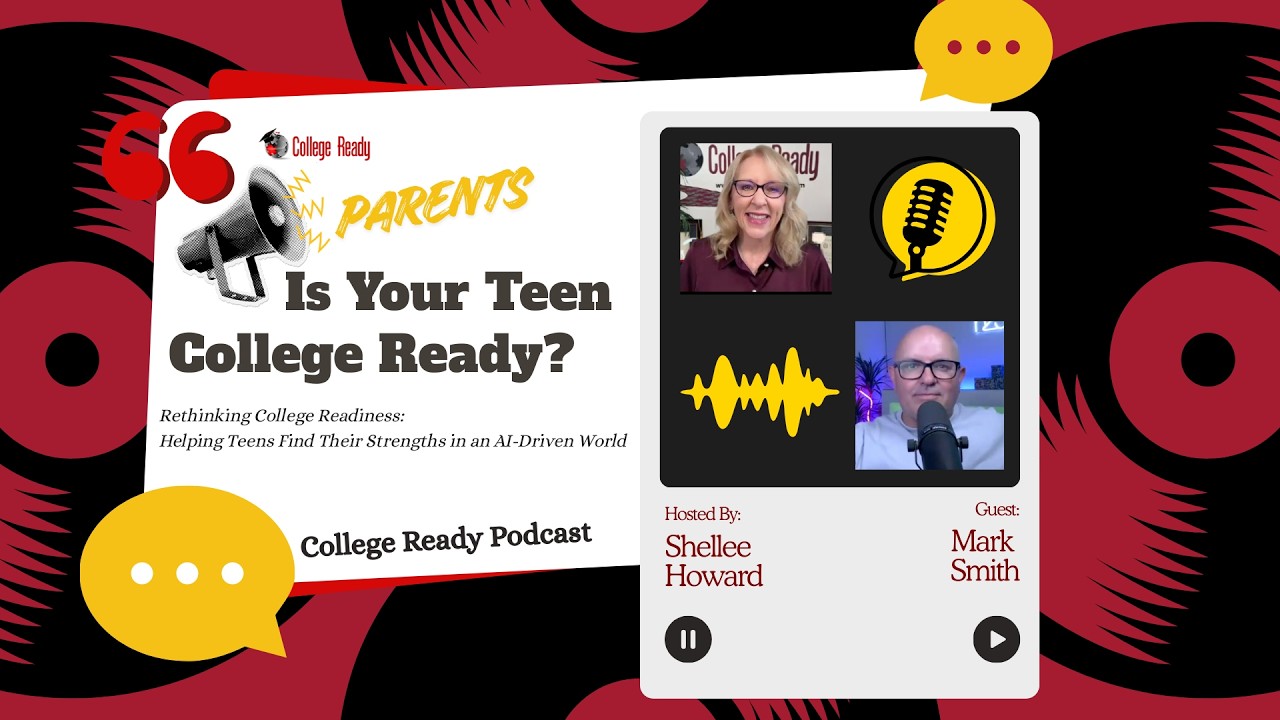
In this episode of "Parents, Is Your Teen College Ready?" host Shellee Howard interviews Mark Smith (NZ365guy), a New Zealand‑based tech mentor who grew up with undiagnosed dyslexia and a non‑traditional career path. Mark recounts how he learned to read through audio, became a prolific self‑educator, and built a 30‑year tech career without a university degree. He stresses that teens should discover their love language and signature strengths (using tools like CliftonStrengths) rather than chasing a single, fixed career. Mark argues that the AI era demands adaptability, humility, and critical‑thinking mindsets; he shares personal practices such as daily AI prompting and using AI to augment real‑world tasks (e.g., beekeeping, gardening). He warns that traditional education and hiring processes are lagging behind AI, urging students to create a digital portfolio and understand how AI evaluates résumés. The conversation offers concrete advice for parents: help teens identify strengths, cultivate an adaptable mindset, practice AI literacy, and build an online presence. Mark provides his online handle (@NZ365guy) and mentions his recent Microsoft Press book on Copilot adoption as ways to connect.
Chapters
Hello parents, this is Shellee Howard with Parents, Is Your Teen College Ready? And on today's show I have Mr. Mark from New Zealand. Welcome to the show.
Thank you so much for having me here.
It is going to be so much fun because we're going to tackle the struggles that one might face, not all, but a good majority of teenagers as they plan for their future. So Mark, maybe you can tell our listeners a little bit about yourself so they know who they're listening to and what you're gonna be sharing.
Excellent. So yeah, my name is Mark Smith from New Zealand. Um, my career's taken me all over the world, and I was one of those students in school that was considered dumb. Uh, I realize I'm in my 50s now that I had dyslexia, and that was never picked up or identified through school. So I personally hated school. In education as such. I couldn't read till I was 12 years old. My mother— I was just about to go off to, um, uh, what we call New Zealand, and my mother realized at that point that I couldn't read. And so at 12 years old, I still couldn't read. And so I started reading. Oh, she got me a tutor that taught me, you know, the bread, uh, the ball, like very simple fundamentals of reading. Um, and so went through my education system feeling very inferior and that I wasn't— I would always be a laborer as, as a career. We labor-based. I was brought up on a dairy farm in rural New Zealand, and, and that was perception, um, on life. And my first job was a groundskeeper mowing lawns at a, um, one of the prestigious schools in New Zealand. And I did that for 3 years and then the internet came along. And what I found is that I discovered my way of learning and my way of learning is through my ears. I listen. If something is read to me, I can receive it so much better than if I read, partially because my dyslexia mucks up what I am reading at any time. Now, in saying that, I've become a prolific reader. My best year I've read, uh, over 82 books in one year. And these were big books like biographies, famous around the world. I read the Bible 3 times, cover to cover. So I have— what I found once I really leaned into the way I read, and particularly for me, I read via listening to it on audio, and I also have the Kindle version, and I, as long as I'm reading on screen at the same time as hearing, I find I stay hawt, so now I can read books at 2 times the normal reading speed. And I'm a, you know, prolific consumer of educational books. But this week I just read Dan Brown's The Secret of Secrets, which was just released about 6 weeks ago. I've read all his and I've become a prolific self-educator, I suppose. And that led me to create mentoring programs of, I've got mentees in 70 countries around the world. Over 1,500 people have gone through those. I've helped people double their incomes in the, their tech. I'm firmly focused in tech. The last 30 years I've worked in the Microsoft space. I work on contract to Microsoft in Seattle, even though I'm based in New Zealand. And my career has taken me all over the world. I've lived and worked in Hong Kong, Singapore, Philippines, and London in the United Kingdom, as well as going to the US multiple times a year for work. So it's, um, what I thought, you know, I didn't do the college route, I didn't go to university, didn't do any of those because through that education progress process I thought I was dumb. I wish I had in hindsight, but now I help so many people actually go into university and I've paid for people to go through university multiple times, um, in my life. And so, yeah, I've learned a lot along the way. I've seen a lot of people face crazy challenges, but when they've really leaned into— one of the things I focus on is leaning into your strengths. And if you've got kids, the sooner you can find out, I feel two things: find out their love language and find out their strengths. And then part of your guidance into career— and I've got a son who's 22 and he's in— sorry, he's 20 years old. He's 20 years old now and he's in his second year in law at university. And all the way through, I've kept encouraging him to not necessarily just focus on one thing. So many people feel that, you know, they've got to choose the right, the right education or the right university. At the end of the day, I think there's a range of fundamental human skills, particularly in the era that we're going into with AI so much. That the need to develop, for example, critical thinking is probably the most important thing in the world that we're in right now. And so any education that, that will teach that fundamentally human skills, you know, human skill of, of critical— don't just the information that's thrown at us even from the education system, because at the end of the day, if you look back, education system came about particularly in the US. With Carnegie and things like that, the goal was to create people to work for corporations and businesses. It wasn't to liberate people and give them self-determination. And I think that there's an opportunity more than ever with AI for people to self-determine and become what they want to be and lean into a very fulfilled life, a very wealthy life. And about wealth, I'm not just meaning money, I mean you know, sense of purpose and purpose. I took off to get to a point, and I did this 20 years ago to find what my purpose was in life. And it's not changed. And I think if you can understand purpose and go— so, so move away from, you know, I need to get into— you need to, you know, I mean, more we see arts and things like that type degrees. And what I've seen in the world in recent times, which is shocking to me, and history and things like that. But I think that if you can lean into and understand, as I say, what are your strengths and what would a fulfilling life for you look like? It's possible. It's, it's, it's available more than any time to achieve that today.
Sure. So parents, as you're, as you're listening, I want you to think about a particular child in your home. Could be your oldest, could be your youngest, but think about that one who You know, they don't know where they want to go to high school. They don't know what kind of career. They don't know what kind of major. When an adult asks them, so what do you want to do? They shrug and then they kind of feel bad about it. And what I've seen over the last 18 years, Mark, is students are being told they need to have life ahead of them all figured out at the age of 17. And what I like to remind them is we didn't ask their parents, and that's a big ask. But if they do nothing and just hope that something's going to jump out at them, that's also a big ask. So what you're— what— why I thought you such a great guest on this show is you find ways to help people look at their strengths to determine what it is they can do for their future. And before we got on the call, you shared some real gem— lots of gems, but the one that really stuck out to me is, you know, we just don't know how to get in, and that feels weird. It just doesn't feel like— why is it so hard? Why does it have to be so hard? So maybe can you talk about You know, if you have a teenager who, at the time, they're really good at a lot of things, and that makes it a little bit challenging. If they're just good at math or science or English, it's a little easier. But these kids now, they're really multifaceted, and that kind of makes it hard for them just to pick what is my greatness. So how do you do it? How do you get there?
I think we need to change the belief. Of the last 100 years and the way our parents were, in that we would have a career for life or we'd do one thing for life. Um, you know, I'm in my third career. Never predicted. There was no— there was no even education system career that I have now, um, for me. And I think that it's to realize everything doesn't have to be done in the next 3 years. You don't have to achieve everything in the next 3 years. You You don't even have to make all the right decisions in the next 3 years, as long as you have an attitude of adaptability. And one of my wife and I share, cause we've got 2 children that are, um, uh, one's, she's almost 5, 2, and another one that's, uh, 3. We, we, one of the things we instill at home is this idea of adaptability and humble curiosity. Never feel like you know everything. And I mean, that's really hard for teenagers particularly, and they start feeling that they do know everything. And I remember this illustration that I got years ago, and it was, you know, someone said to me, how knowledgeable— if you took all the knowledge, how knowledgeable, how big would your knowledge be that you think? And I'd be like, oh well, um, you know, I know a lot about all areas. And they said, well, if we took a, just a sheet of paper, a white sheet of paper, and we looked at all knowledge, how big an area on that sheet of paper would fit? And of course, when you put it in the proportion of the piece of paper, it was lucky if it was a full stop, right? Out of all knowledge. And then you realize, yes, there's— and, and I, I think that it frames in such a way that whatever opportunity comes your way, you'll probably be open to receiving it. It kind of sets you up to— your receptors, your your bias leans towards those opportunities. Get yourself in a mindset. And one of the things I think is, you know, I just did an exercise with, with AI and myself, my thinking of a future. One of the things that I did was ask it to, I said, ask me 10 questions about things that I don't know about myself. Don't, don't give any preamble to the questions. Ask me one question at a time. And one of the things that came out of it, the 10 questions, that really resonated with me is that I have a deep sense of wanting to help people have the right mindset. Having the right— if you have the right mindset, you don't have to have the answer because you have a mindset that will ultimately take you to the right thing. If you have a correct mindset, often we're asked to make a decision, do this or do that, or you need to be going this way, you need to be going that way. And the thing is, is that if you have the right, if you have the right tools in your mind to, to make decisions, you set yourself up for success. You don't need to know what the decision is, but you need to have a framework, a mindset that allows you to make those. And that's why I lean into, years ago, a tool came out, the Strengths Finder, and I think it's, I forget who owns it now. Strengths Finder is the tool. And everybody that goes through my 90-day mentoring challenge, I get them to go through this to identify. Yes, that's it. That's it. CliftonStrengthsFinder. That's the exact book.
I have the one for the students because I believe that this is a great book.
Yeah. So critical. So I have everybody that go through my mentoring challenge go through this because I said, what happens is you go into, you know, once you're in employment and you go and you do a, you sit down with your do a review. Of how you're doing. And, and I've been a manager of my, my team. I've had in my career people working for me, developers. And you sit down, and for the— what we're taught in business is to find out the areas that you need to work on. You need to improve on this, you need to do better at this. And so many— when I looked at myself, the areas they wanted me to improve on was not my strength. Like, if you said to me, you need spell better, as a dyslexic, that's not going to work for me. Because it's not worth my investment of time to learn how to spell better when fundamentally my brain is not wired that particular way. And so what I loved about the Strengths Finder is every person has individual strengths. And if you go through the process of that assessment by the book and get a free code to do the assessment, is what happens is that you— the top 5 strengths identify, you will resonate they are right for you. And then you can go, okay, how do I enhance these strengths even more? And because they're your strengths, you can naturally build on those rather than trying to solve weaknesses in your life. What about downplay the weakness, build to your strengths, and then you will, you'll become indispensable. I feel too, you will have something that's uniquely you to bring to anybody's situation that really excels in what you do best. And people— and for everyone around you, it'll look like it comes naturally. It'll look like you're born with it. But all you've done is decide to lean into your strengths rather than lean into what everybody around you says you should be improving, correcting. And I'm not saying, hey, that means you shouldn't address things that are, you know, there might be areas that you improve on. And to be a good person. And I'm not saying you throw that all away, but I think that if you lean into your strengths, you will never have to worry about your, your destination, your career, where you're going, you'll end up with, any of those things. If you are up to your strengths, you're humble and you're curious and you have a mindset that is has the ability to adjust and adapt whatever the world's throwing. We don't have to live— I think a lot of what we get in the world is fear-based. Um, everything is a fear motivator. And I think that, um, you know, for me, I try to live as peaceful as possible. I like the concept of peace in my life, and I thrive in it. And I live 40 minutes from my closest town, 3 hours from my closest city. I look out over the Pacific Ocean. Across a farmland, and I virtually never go even to town. I don't need to, you know, Starlink provides my internet, everything. But after traveling so much around the world, this almost just a place of peace that allows me to operate and do my best work. Now, I'm still working with corporations. My recent most projects were with the United Nations up in Geneva. I've worked with companies most recently in Portugal and South Africa. And the beauty of an IT-related job is you have this flexibility to work anywhere in the world. But I think that's really important. And you know, one of the things that I think everybody needs, no matter what your age, is to build a digital portfolio, a portfolio of you. And you could say this was a blog, but it's not a blog, but a way for people to find you because as we've moved into a world where now AI is deciding who gets placed in any job, you know, even the smallest recruiting type companies now, AI, and that's even looking at your CV and anything like that anymore. So if you're writing CVs like I was taught to write CVs, they're potentially just missing the mark because an AI is just brushing over it. And I've seen recently people in high executive type roles, so I'm talking you're earning up to half a million a year in income based on the position and their CV, they're getting blocked at the CV stage. Um, and it's only through knowing somebody that said, well, hold on a second, that person is somebody we want to interview that is getting past this. So I think you need to prepare a digital footprint that really allows you to curate to the world your, your strengths and your skills and how you add to the world. That's so genius.
My mind was just all over the place because I found you on LinkedIn. I spend time on LinkedIn and people who inspire me are the ones I bring onto my podcast because I believe they have vision for where we're headed. And I want families to have vision for where their, their family's headed. As much as we could wish not to move forward, that's just really not going to happen. So I want families to know these are the things coming your way. You can embrace them or you can hide from them, but at least you know they're coming. And then I started to think, I'm filling two positions right now. And so I started thinking, how did I decide on how I was going to list my positions? And of course, I ran it through ChatGPT and got, you know, it totally honed in is what, how they're going to do it. But here's the challenge, Mark. This is where I, I'm— I would love your perspective. Is right now, because it's newer to the masses, it's not new. And right now we're telling students you can't use AI to do your applications and your essays because colleges want to know you can think, right, on your own without AI. And so they have AI checkers. And so we have to tell students if there's any AI, including Grammarly, any AI, they're going to be kicked to the curb. And so it's this battle of what we've always done and what's coming, and these kids who are like in this cyberspace world of everybody's perfect day. So my question to you is, how do we keep our students grounded in wanting to have intellectual curiosity and really want to learn versus just running it all through ChatGPT or whatever AI.
Yeah. Yeah. That's interesting. As my wife and I just talked to the faculty on behalf of Microsoft at the Unicross New Zealand a couple of months ago, and this conversation came up around cheating with AI. And I see AI as a mirror. If you intellectually engage with AI, it will intellectually engage back and provide output to you. If you engage it at a non-intelligent way, otherwise you are very simple in how you work with AI, you're gonna get very simple outputs. And so the education as a whole have got a lot of catch-up to do in how, and how education is going to need to evolve, moving into an era where things are going to change quickly. Like if you have a degree program at a university, that program generally is written 7— sorry, written, and they expect to get 7 to 10 years of reuse out of that curricula over that time. You know, I used to say, hey, you can plan 3 years in your life. Now I'm like, you can plan a year ahead because of the changes, adapt, you know, from an adaptability perspective that are coming. I was at high school and in the '80s we weren't allowed to use scientific calculators. It was banned in math. You weren't allowed to use it. And of course, we know now that nobody cares. Like, that would never be mentioned in any math test. Of course you're allowed to use that type of tool. And I think we're just in that phase with AI at the moment. A person using AI is going to be so much more, so much better than a person not using it. Develop the skills to work with AI. And this is where the only way you can develop the skills to work with AI is time. Practice, practice, practice. And about 2 years ago, I'd be telling all people in my sphere, 5 prompts a day. You should do 5 prompts a day minimum every day. Like, I've just come from my greenhouse. I've got a forest I'm growing for all my food production. On property and I have AI open. I had Claude Chat open and I'm talking backwards and forwards saying, hey, type of seed I'm wanting to propagate, what's the optimal temperature, soil conditions, what's the germination time that I'm reading off the seed packet. And it's telling me all that because my phone's just sitting up on the shelf right above you. I use it there. Yesterday I had my bees called swarm, right? The queen took off and took half the hive with her. Well, I've got her back in the hive. I've got her all, um, I've got the hive coming back together. So I caught the swarm. Never done it in my life before. Never caught a swarm before. But guess what? I had AI open on my phone and I was talking in real time with the camera on what was happening, and it was giving me all this research data on what I should do in this situation. Now, how would have that been done in the past? I probably would have needed to call somebody. That had experience because I didn't. This is the first time I'm doing these. But look at the leverage it's created because now if I had just turned on AI yesterday when that happened, I probably would not have got the result that I got. But I've spent the last 3 years working every day with AI and therefore, you know, and just for every— I look at it for my life. How can I be— how can I augment my skills? That's what students need to be encouraged to do. Is how can I augment my skills? And part of that is going, what skills do I have? Right? And then going where the skills are not strong enough. How can I use AI to increase my skill set in this area? And so rather than just saying, hey, I need to write an essay on War and Peace, write it for me, have, you know, I think lecturers, the, um, it took more to Nariyo showing people how to use AI so that the learnings of War and Peace are fully ingested into the individual rather than you just wanted a paper written on it. Here's the output. That's what you asked for. But did learning happen in the process? Is the person richer for the experience? That's where I think that the disconnect is happening between AI should be used effectively effectively to enhance the learning experience, to have the knowledge transfer where it's applicable, and then still write assisted, um, a great white paper or paper, whatever they're writing for, you know, whatever's required.
Yeah. I always equate it to a phone. The first phone was a big— I remember my dad walking around so proud with this brick next to his head. I remember looking at that going, that is so silly. That's not gonna last a day. Who would've thought we would have a teeny tiny in the palm of our hand that can tell you anything and everything in a moment.
Yeah.
And so to your point, if we don't embrace it, we get left behind. So for families who are like, okay, I hear you. We need to help my child get clear on their strengths, right? And how they're going to embrace their gifts and talents. How would they reach you?
Oh, as in I'm easily findable, as in I, I, because I have say, um, my parents gave me a name Mark, and then having a last name Smith is extremely common. I, I often challenge people to guess my middle name without me even giving an initial, and I have 9 times out of 10 had people guess my middle name in keeping with that without guess, without even giving my initial. And so what I had to do, being in New Zealand, and I wanted to play on the international stage I created an online handle, so NZ365guy or NZ365guy, which I think you can see up behind me here, that type that into anything, any AI tool, any search engine, you, the first 10 results will all be pointing to me. So there's, I've got a big digital footprint out there. So NZ365guy, my main social media platform is LinkedIn, of course, business. I actually just had this book published on Amazon. Microsoft Press published this. So there's for somebody— academically written my first book, um, last month just got published. Um, and I did that through press in Seattle. So that, uh, and that's all around Copilot adoption, the Microsoft-specific AI at scale across enterprises, because I've been involved in a lot of enterprise adoptions, uh, programs that have run. So, you Yeah, that's the best way to reach me, um, @N365guy.
I love it. Well, time's when we're having fun, so thank you so much. Um, I love New Zealand. Hopefully I'll be able to come out and get a signed copy.
That'd be awesome.
It has been a pleasure to speak with you.
Thank you.
You're welcome. So parents, until next time, is your teen college ready? If not, Let me know and we'll send you a checklist. Have a wonderful day.
More from Shellee




The 3 Questions Every Parent Should Help Their Teen Answer Before College | Featuring James McLamb

Helping Your Teen Stand Out for College Through Purpose & Impact | Featuring Aishani Sheth


From Robotics to Cornell: A Father-Son Blueprint for College Success with Aarav & Ritesh Kumar

The Hidden College Credit Strategy That Could Save Your Family Thousands with Josh See

The Truth About Financial Aid: Why Some Families Pay Less for College Than You Think with Jack Wang

Human Skills Every Teen Needs for College, Careers & an AI Future with Rob Heller
