Webinar: How to Raise Resilient Teenagers for College Success
In this August 9 2024 YouTube webinar hosted by Shellee Howard, co‑founder Gila Kurtz introduces The Bolo Project—a nonprofit, dog‑centric youth development program she created after a conversation with a high‑school principal about post‑COVID teen challenges. Gila, a former educator and co‑owner of the Dog is Good brand, explains that the program targets four critical teen issues: mental‑health crises, academic pressure and learning gaps, lack of adult‑life preparedness, and social isolation. The Bolo Project uses an "Alpha Reimagined" framework built on four pillars—youth development, financial literacy, leadership training, and emotional/psychological growth—delivered through a two‑day immersive retreat followed by eight weekly 90‑minute sessions that include dog‑assisted activities, habit formation, SMART goal‑setting, and a group fundraising project for a chosen charity. Gila shares quantitative data (e.g., 1 in 5 teens with mental‑health disorders, 5‑month learning gaps in math/reading) and qualitative parent testimonials describing dramatic improvements in confidence, engagement, and academic performance. Shellee then shifts to her "College Ready" expertise, outlining a holistic college‑admissions strategy that moves beyond GPA and test scores. She details components such as career mapping, real‑time financial‑literacy counseling, test‑taking strategy, leadership certifications, extracurricular positioning, recommender and essay strategies, and scholarship acquisition (e.g., $9 million in scholarships for 42 seniors). Practical tools like a "million‑dollar" dinner‑table game, habit‑formation techniques, and SMART goal frameworks are demonstrated. The session concludes with calls to action: visit theboloproject.org, empowereducation.world, and schedule a free 30‑minute consultation via college‑ready‑plan.info. The webinar blends program promotion, evidence‑based teen‑development insights, and actionable college‑preparation guidance for parents.
Chapters
So Gila, can you tell, um, our listeners who may not know you or what you do a little bit about yourself and the Bolo Project?
Yes. So, uh, Gila Kurtz. My background is as a former educator. I used to teach high school students many years ago, but for the past, uh, 16 years plus, I have been one of the co-founders and co-owners of a national brand called Dog is Good. It's a lifestyle brand for dog lovers, and through that created this program, The Bolo Project, to benefit and help to develop confident, empowered future leaders of impact with a dog-centric approach. And I'm excited to share it with you this evening.
Wow. So any dog lovers in the house? I can't see if you raise your hand, so you can just put yes. I know Carrie for sure. Her dog is So spoiled. She so loves her little dog. So, Gila, why don't we go ahead and jump on in if you wanna share your screen, if you wanna.
Yeah, let me get that set up. And I think, I think we're good here. I just need to hit share. There we go. Okay. So Shellee, you should be seeing the Bullet Project. Yes.
Got it.
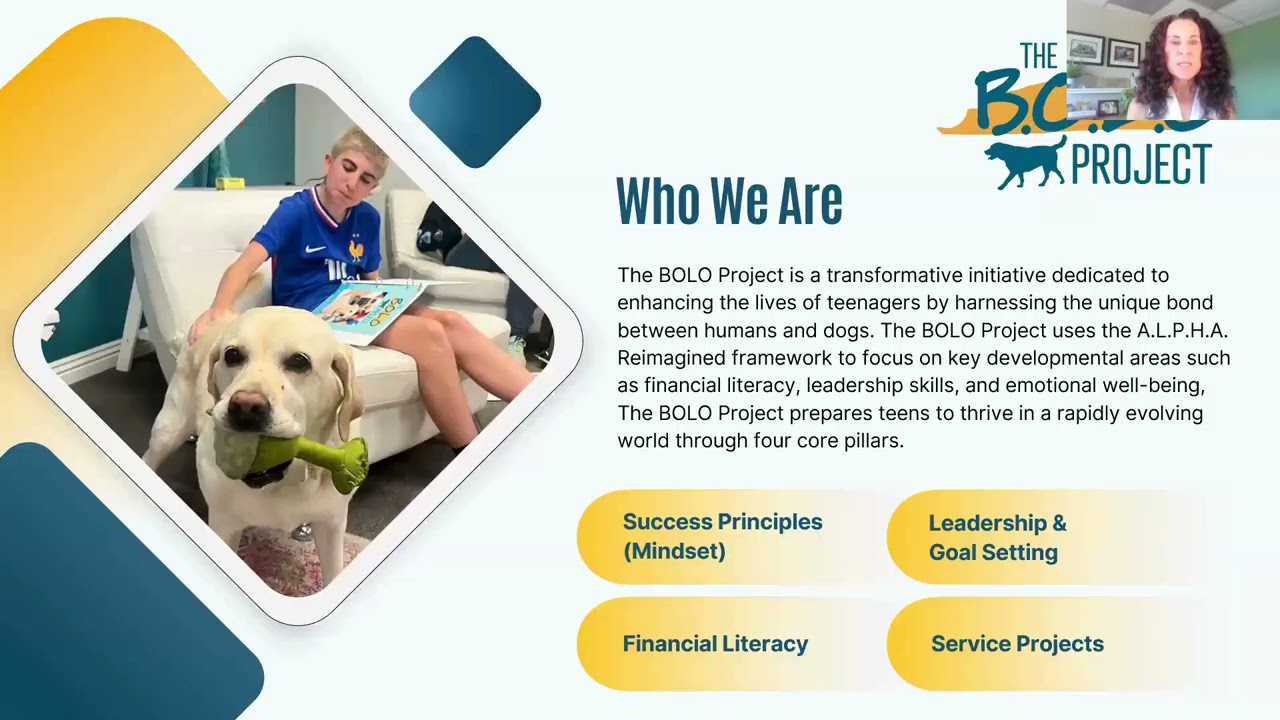
Okay, perfect. So, uh, yes, welcome tonight to this webinar. I am very honored and excited to be talking with you because dogs, teens, education, growth, all of that are some of my favorite things. And this is the perfect time of year. I know it's so exciting. We're going back to school, getting close. We are buying school supplies. We are doing all that fun thing, those fun things. But as the saying goes, it's all fun and games until— and you have a teen, so you know what I'm talking about. We start to get into the throes of the school year and all the things that come up. And I had a very interesting conversation back in 2021 with a high school principal of a local private school. And over coffee, I asked her, hey, what's happening? What's happening with the teens and with the kids right now with all of this school shutdown and stay-at-home learning, etc.? And she turned to me very concerned and basically said, they are in for a really tough time. And as she began to explain why and asked me to kind of project 10, 15 years into the future, I actually had it. I was quite taken aback. And so I thought to myself, okay, I don't want this to happen on my watch. And as a former educator, as a successful entrepreneur, as someone who works with other high-level CEOs and who loves dogs, I was asking myself, well, what can I do to combine all of that experience and all of that knowledge and create something that could change the trajectory or the path that this high school, uh, principal was projecting to me, right? And I looked at my own dog whose name is Bolo, and Bolo stands for be on the lookout. I was fully aware of how many lives she had touched in such a positive and profound way, and I decided I'm, I'm gonna create a program. Specifically for teens and utilize her name as the legacy for the fact that I know a dog can change the way you see the world. And so thus was birthed, if you will, the concept for the Bolo Project. And what I wanted it to address are the very things that we are finding our teens facing, and as a result, parents are addressing. But these are the 4 critical things. That are going on right now for all teens. And I would even have to say even younger as well. Mental health concerns, academic pressures, and the learning gaps that are still present and obvious according to reports and studies, the lack of preparedness for adulting, and social isolation and lack of community. These are things that have perpetuated throughout the COVID timeline. And so when we look at mental health, this alone has become quite a crisis. If you look at the research, the prevalence of mental health issues is, was always high among the adolescents, but definitely on the rise since COVID According to certain studies, approximately 1 in 5 teens experience a mental health disorder each year, uh, with anxiety, depression being the most common. The National Institute of Mental Health has reported that 32% of teens right now report having an anxiety disorder, and nearly 17% experience prolonged, uh, depressive disorders. So that's pretty significant. And when you're looking at the challenges and mental health issues, we know that there are challenges that, that parlays into their school performance. 45% of teens, according to the American Psychological Association, report that they are incredibly stressed by school pressure. Having worked on this program this summer with a group of teens, this is common conversation among them, the amount of pressure to excel and to compete, which leads to a lot of difficulties. It's challenging for them to focus and to stay on task, concentrate on various things. And this can lead to lower grades, things that impact the family when they're going inward and not sharing what's going on inside of them. Many, according to the CDC, are reporting prolonged loneliness and prolonged sadness. You know, they, they, they kind of isolate themselves a little bit with their digital and tech devices, and while they might appear okay on the outside, sometimes there's a lot going on. And you can see this in the changes in family dynamics and also in, um, other things that are going on with their activities. In fact, when they start to have some challenges, it will impact their participation in some of the sports and extracurricular activities that they're engaged in. And overall, this can negatively impact the college admissions process as well. And many young college— new, new college attendees, the freshmen in particular, so many over the past couple of years are struggling. They're returning home. They're not prepared properly to really kick into that very first year of school. The issue of academic pressure and learning gaps. This is still ongoing. You, you, they're not catching up according to a lot of studies. Um, in fact, a study by McKinsey and Company reported that students still are about an average of 5 months behind in math and 4 months behind in reading. And the, uh, as a result of that, those gaps they are finding decreased GPAs. I mean, we always have those superstars that seem to excel, but the average is— and the class rankings have declined over the past couple years. And again, with colleges increasingly looking at so many elements in their review process, this can be a problem because if they are dropping in their academics, many times they may cut back on some of the extracurricular activities or sports activities as a way to catch up because they see that, as do parents, as the prime, uh, component of getting into college. And yet, and Shellee Howard will share and attest to this, that there's a new, more holistic approach in the college admissions process. And so if there is a drop in some of those extracurricular activities, leadership, uh, engagement, and those kinds of things, it will hurt them long-term. Uh, lack of preparedness for adulthood. So last summer when we ran the pilot for the BOLA Project, the number one thing that we heard from the students for the entire curriculum was that this is not taught in schools. Everything that we gained access to was never taught in schools, starting with financial literacy. Now, I know that there are laws coming down the pike, or they're currently been established that in the future this is going to be a proponent for high school and maybe even earlier on. But this lack of financial literacy creates a problem for young adults and, and beyond. Additionally, lack of financial— in addition to the lack of financial literacy, they're not learning basic life skills, communication skills, time management skills, organization skills, and If they are not gaining this in school, in high school, during this critical time of development, they're ill-equipped as they go on into college. And that parlays, as I know as an entrepreneur addressing employees or potential employees, it impacts their performance and their ability to excel in the workplace overall. Lastly, the social isolation and overuse of devices. Any parent, look, it isn't even about being a parent with your teens. All people seem to be overusing their devices at any given time. I don't know about you, but anytime I'm waiting in line and I look around, everyone is on their device. But in that process, they— there is an increased isolation. In fact, I've always believed, why are people so connected to dogs? My belief around that is because in a world where tech has become our access to everything 24/7. It has also become the technology. The technology has made us less connected than ever before. And when it comes to dogs, there's always that instant connection for sure. When we're always on our devices, there's that decline in social skills and the ability to communicate. We see that because Kids are texting all the time, um, lack of written word anymore, so all the email. And we know too that when there is social isolation, when there are mental health things at play, there is an increased risk of abuse and, uh, outside risky behaviors. And this has a negative impact overall. And so when I was looking at all of these four determinants, and challenges that this age group in the general population experiences. And I was thinking to myself, how can I tie in, as I said earlier, the connection with dogs, my knowledge and awareness of personal development, of growth mindset, of the things that make people thrive? What could I do to pull those together? And so I knew with the power of the dog-human bond, that there could be a program that could connect teens in a stress-free capacity where they could learn, where they could understand how to reduce their own stress and anxiety and overwhelm, and how they could also increase their connection to other people. And so the whole concept for the Bola Project was born. My desire and my mission as I see it is to empower teens through the love of dog and to create confident leaders who have impact in our future. And so the BOLA project began as a pilot really last summer and has expanded into its first program this summer and is now moving into a fall, spring, and summer program and ultimately will be expanding on a nationwide scale. So I'm very proud of where we're headed because Already we are seeing some tremendous changes in the kids that we're working with. Uh, we are a transformative initiative that's dedicated to enhancing the lives of teenagers by harnessing the unique bond between humans and dogs. We use a framework, I call it the Alpha Reimagined framework, to focus on key developmental areas such as financial literacy, as I mentioned, the leadership skills and emotional wellbeing. And we prepare the teens to thrive in a rapidly evolving world through 4 core pillars. So when the students are with us, we are working on success principles, all the principles that lead to a successful life, a success in school, success in sport, success in relationships. We focus on growth mindset and the fact that they are taking personal responsibility for the life that they get to lead. We are spending quite a bit of time on financial literacy. I will cover that with you in just a moment. Uh, everything that we do combined provides them with skills in leadership, more effective, uh, SMART goal setting, and gives them the opportunity to work together as a group in creating and executing a fundraising program to benefit a charity of their choosing. So when we are focusing on them, we're looking at the youth development, the financial literacy, leadership training, and emotional and psychological growth with this framework, Alpha Reimagined. So the entire program has a dog-centric approach. Alpha is an acronym And our proprietary process focuses on accountability, that they are responsible for their decisions, they are responsible for their habits, their behaviors, their actions, and that they are accountable as well for their own financial literacy to make the right choices and to make smart, um, money decisions for the future. Leadership, learning how to manage themselves first, self-leadership, and ultimately how to be an effective communicator so that ultimately they could become a leader who is not just a leader by name, but a leader who is worth following. Personal growth— everything centers around personal growth. They need character development, uh, building of their confidence, resilience, and, uh, the growth mindset. So all of that is covered consistently throughout what we do. Habit formation— so the ability to identify habits that are just not working for them and the ones that really will, and how best to cultivate those habits short-term and long-term. And then we accelerate the achievement process through awareness, critical thinking, goal setting, and time management. And this is the framework that we overlay on the pillars that I just mentioned. Um, you know, right now our focus on the youth development component is key. All the Dog Center curriculum has some form of activity or conversation, deep conversations where these students get quite vulnerable, they get very real, but it focuses on how best to develop their character, um, empower them with resiliency and tools to become more resilient, uh, the ways that they can shift on how they see the world., from a more positive growth-oriented mindset and take personal responsibility for all the things that are going on in their lives. I already mentioned goal setting. They establish goals, they put together a system in order to accomplish those effectively, and ultimately they are implementing new and most— more effective success habits. When we get to the financial literacy, this is a lot of fun because Quite honestly, I think it helps them to create a better, um, understanding and appreciation for what their parents do for them. They have no idea when we first start off these lessons. I, I am amazed at how little they know, and they're amazed at how little they know, but they do walk away with a better understanding of needs, all the things that we do need as adults and as people to live properly and in a world that is available to us. And then all the things that are a process of that, you know, so what is banking and how do we actually use a bank account? What's the difference between debit versus credit? How to actually use credit properly so that you can stay out of bad debt. They're learning about credit scores and what it means to take loans, interest and compound interest. They're learning about budgeting. Savings for short-term emergencies and long-term investing. And they had an interesting conversation this past week on taxes. Like, who knew that you actually don't get to take home all the money that you think you're earning? So it was a lot of fun, but they're really gaining quite an awareness and an appreciation for what financial literacy really means. The leadership training, as I mentioned earlier, is very focused on self-leadership. But puts in a lot of emphasis on effective communication and critical thinking and decision-making, and certainly integrity as the core element for, for everything, as a, as a moral compass. Then, um, lastly is the emotional and psychological development. We have dogs at every session. Uh, the power of the dog-human bond is extensive. There's a lot of research out there. You can look into the Human Animal Bond Research Institute for some supportive conversation around this. But the, the stress reduction, the anxiety reduction that takes place, the ability to connect over and through dogs fosters immediate connection with the students. And it also creates elements of mindfulness too, as they spend time, you know, just petting the dogs and having the dogs in their laps and things like that while they're learning. And so it's been a really powerful process of having the dogs integrated into the whole program. Now, how we deliver this is— it's a lot of fun. It starts off with a 2-day retreat where we do a very intense immersive. By the end of the weekend, these kids are bonded. They have been exposed to the initial content for each core pillar. And then we meet once a week for 90 minutes over the course of 8 weeks. And what I find fascinating is that they do not miss. And it's interesting to hear their parents share with me that they really look forward to it. I think there's something powerful about the connection, not only through the dogs, but because of the vulnerable and real authentic conversations that they're getting to have with each other, that this becomes becomes a safe place of connection and communication. They also, throughout this time period, are working together to execute on a fundraising program that they are implementing on behalf of a nonprofit that they've selected, something that showcases the power of the human-animal bond as well. And so, you know, when we talk about the Bola Project, It has a lot of key elements. Community impact, for sure. These kids are going out into the community and they are making a difference. As the program continues to expand, we have students already who want to come back and serve as volunteers for future groups and middle school age groups, et cetera. And it's, it's really aligned with any brand or any person who values any of the core pillars. That we are focused on. But the impact that we're seeing is pretty significant. I have to say I'm quite proud and deeply moved by the feedback already that we're getting from parents of these students. This year already, within just a few sessions, I had a parent share, "Whatever we are doing needs to be in the schools. It needs to be part of mental health practitioners' awareness as well because her daughter was suffering from mental health challenges. She had been really suffering since COVID and since she came into the Bola Project, her mom is reporting that she has not seen her daughter this happy and engaged in life basically in, um, about 3 years since 2021. Um, another parent said the Bola Project is an impressive program. My daughter loves. Each week she shares details of the critical skills she was learning, from setting goals to teamwork to the value of giving back. And her, her mom's favorite moment was watching her confidently approach vendors at a pet fair raffle asking for raffle donations, and just to see her confidence soar. Um, the experience was priceless. I wholeheartedly recommend this program and hope it continues. So my daughter can learn even more. Another parent has said, my girls are so fired up. I am watching my household transform right before my eyes. And another parent writes, my son talks nonstop the whole way home about his retreat day and the Bolo Project. He's just been in a great mood. And so thank you, thank you, thank you from the mom. And these— this feedback comes to us on a weekly basis as we engage with the students. Uh, so I, I am deeply, deeply proud of the impact that we are making. I know that the students benefit on such a deep, deep and profound level, and I know that it will forever change the experiences that they have in school, ultimately in college, and throughout the rest of their lives because of the exposure to the content and the interaction and the programs that they're initiating to create their own impact in the world. We have our fall program starting this fall. I want to invite you to invest in your child's personal and academic success. We have two cohorts starting for the fall of 2024. Class sizes are small, and as I've already shared, the students are seeing rapid transformation. This program is a 501 nonprofit. It is subsidized by very generous tax-deductible individual and corporate donations. And so I would love for you to go visit our website, check out thebolo project.org to learn a little bit more about it. I want to invite you to share this with others. And if you are viewing this at a time after our fall program, just go to the website. We will have programs ongoing all year round, ultimately nationwide. And of course, we're eager to get the support of people who would like to be involved, who would like to facilitate their own classes. And I would be delighted to speak with you about that. I know from my heart a dog can change the way you see the world. I've seen it in my own life personally when I've gone through struggles, and I am watching it literally transform these students on a weekly basis. And so, Shellee Howard, I thank you for your willingness to let me share this. And for the parents who are viewing today here right now, and for anyone else who takes the moment to explore what the Bolo Project is, again, you can go to theboloproject.org or you can reach out to me directly, gila@theboloproject.org. So thank you.
Wow, Gila, I want to be a teenager again. I want to do Parents, what a gift. Uh, you know, I, I always bring people who can enhance our children's life into your world, and so Gila, thank you so much. And now I'm going to help take the parents from— you, you shared a little bit what's going on with the teens. Um, I'm going to help them understand the transition that, that can help them get into college. So I really want parents to have a good understanding of not only is this good for their child, it's good for their future. So I'm going to share a little bit about how you can use the Bolo Project to help your teen prepare for life and also help them to get clarity for college. So I'm going to go ahead and start, start by sharing my screen. We have really leaned into this, and when I talked to, to Gila about doing this, it was because I hear this time and time again. If you feel like you don't know how to help your student become a successful adult because they, they're overwhelmed, then I want you to know this is what we're going to be talking about. And I'm guessing it's pretty much every teenager at some point I do this because I love what I do, but I've been helping students get into college and graduate without debt for over 17 years. And what I do know is when a student, a child is feeling overwhelmed, they are not showing up at their very best. So we're working to help reduce the overwhelm, and that's what I want to talk about tonight. And it's, it's all about planning. It's all about having a strategy. It's all about knowing what you don't know. So I'm just going to briefly walk you through how we're able to support families as you're navigating pre-college from 7th grade all the way through 12th grade and how we can help support families. So if you have an older child, I'm sure you must know somebody younger. So I always start when I'm doing this in person, you know, raise your hand if you know a teenager. Like, everybody knows a teenager. And then I say, raise your hand if you know a teenager who spends too much time on their cell phone, and everybody raises their hand. And then I talk about how many of them are overwhelmed, either academically, socially, or just not knowing what to do with their future. I'm gonna help you understand how you can help them or seek help to get them that understanding. So let's dive right in. So if this is for you, if your child is having a tough time picking their major, picking their college, picking their career, and you really don't want them to go into debt. So back 17 years ago, um, actually it was quite a few years ago, my oldest came home from school and he says, Mom, I know exactly what I want to do. I know exactly what I want to go for college, and I, I, I need your help. And then he walked out, and I was like, what? And then he turned around, he goes, oh yeah, I want to be a brain surgeon. I want to go to one of those top colleges. Can you help me? And I'm like, sure I can. Absolutely. That's what we do. So that's how College Ready got started. Well, I won't bore you with the details of how we got there, but I ended up going back to school. I ended up becoming a Certified Independent College Consultant, a financial strategist. And when my son crossed the stage of Harvard and had zero debt without me paying a dime, he said, Mom, we made a bet. Where's the book? And I thought he forgot all about our bet. So when he got a full ride to USC, this mom says, yes, that is it. I don't— we don't know anybody at USC, but I will learn the fight song. Whatever it takes, I support you. And he's— I was like, yeah, this is great, free education, you know. And then Harvard came and said, we'll match that. And I'm like, what? So I made him a bet that if he could truly get out of Harvard without going into debt, without getting married, without making life-changing bad choices, I would write a book. And so when he crossed the stage, he gave me his Harvard diploma and he says, Mom. And I'm like, this is real. So I took the next 3 months off of work and I poured into this book and I built the foundation just like Gila was talking about the Bolo Project. Preparing for college is no longer a GPA and a test score. It really is. What do colleges want to know about your child? They want to know who are they? And what matters to them and what are they going to advocate for. They are not looking for students to come and take an education and leave. They're actually looking for students who want to learn, create the change they wish to see in the world, impact the world, put the diploma on the wall, and recommend them because college is a business. So we want to be thinking about how this all plays together. This book was a bestseller in 24 hours, and it has helped thousands, no, millions of people. So I want you to know I'm not here to sell the book at all. I'm here to say, from a mom of 4, I poured into this book so you don't have to do what I do, what I did, and go back to school and change my career and all the other crazy stuff I did. That young man is now an orthopedic surgeon at age 30 with zero debt. So if that doesn't give you chills, I don't know what will. So let's go ahead and talk about your child. Our approach is very unique. We are not looking to just recognize a child loves math, go to MIT and take a loan. That is not what we do. We are looking for the academic fit, the social fit, the financial fit, the athletic fit, whatever your student is in need of. And then we help families to do it without debt, which means we want you to know that the FAFSA looks at the second semester of your sophomore year. So if you're going into your sophomore year or your junior year, you might want to like, what? Yes, it's a double look back. And what does that mean? You need to understand what your student aid index is because that's what colleges think you should pay them. Remember, college is a business. Last year we had 42 seniors get over $9 million in scholarships. That was on top of need-based. So what we're talking about here is way bigger than just sending your child to a brand name. It's helping them prepare so they're ready for college, but well beyond, and not go into debt. A little bit about myself. I am the founder of College Ready. The two young adults with me are my two oldest, and it has been a pleasure raising them. I also have two stepchildren who are— one just finished college and the other one has one year left. All graduated without my help and debt-free. My mission is to help a million families get into college and help their child be successful. And that's how Gila and I started sharing our passion. We talk about teenagers and dogs like some people talk about cars and coffee. We get so excited. And so I just spent— it was my 5th time to Africa. You can see here I'm actually building a school out of mud with the children of Uganda. And I have now helped them, which I'll share in just a moment. They have built a nonprofit. It's a student-led organization that I mentor. They raised $18,000 last year, and they are changing the world. This is the impact that we want these students to make so they can help to plan for their future. So you may be thinking, my teen has no plans for their future, and I'm a bit terrified right now because I think they should. Well, remember back when you were 16, 17, and 18? We didn't really have to know. We kind of like hopefully knew and maybe changed our mind. I changed mine 5 times, 5 different majors. But my dad said, I'm only going to, um, support you for 4 years. So I quickly learned that I really needed to figure this out because I didn't want my kids to be struggling like I did. So the first step that we have to figure out is we need them to see their future now. We need them to understand their gifts, their talents, their core values, their advocacy. Why? Because colleges now are asking them to choose when they're 17 and 18 years old. And if they get into a school, they change their major, and that school doesn't offer the major, now they're in trouble. Add an extra $100,000 to that education. So our first meeting that we work with students is we want them to understand who are they, what matters to them, how others see them, how they see themself. Then we start career mapping. What does that mean? We help them to know based on their gifts, their talents, their core values. Here are the best careers for your skills, for what you bring. Then we can show them what kind of education or trade school or being an influencer could get them. Then we can show them how much money they'll make. And let's go back to what Gila said, right? They don't quite understand what all of that means. I was with a student yesterday, and the student was so excited because she wants to be a botanist, and the parent was having a fit. And when I showed her how much a botanist makes, she's like, yes, $20,000 a year. I am gonna be rich. And the dad looked at me like, help me. And we had to help her understand that that's not the lifestyle that she's used to. And how much are groceries and how much is electricity? And we really had to financially help her understand, is that the kind of life she wanted? And if she went into debt for college, how long it would take her to pay that off. So we do financial literacy in real time. Right? Because we want them to understand a good return on their college investment is financial freedom. And then if they go into debt and they marry debt, now they're double-debted. And people are like, what? Yes. Two big loans equal no new car, no new home, all of that stuff that you want for your child. So we have these conversations way before we pick the right college. Then we put it all together for them. We can help them to understand how much money they'll make when they graduate from college after 5 years, and will a robot be doing their job? This is a real thing for this generation. AI is here. So then we talk about college or trade school. College Ready is really Life Ready, but when I tried to name it Life Ready, everybody was like, what? So we went with College Ready, but we're really focusing not to get them into college. We want to get them in, help them succeed, get them out into a successful launch, just like what a parent would want. Then we address the next thing: we don't know how to start. And this is really frustrating for families because back in the day, we used to put a, uh, we used to type our applications, put it in an envelope, maybe send out 1 or 2, stamp it, send it off. That was it. Now these students are competing with students who are achieving over a 5.0 GPA with perfect test scores their freshman year. With leadership skills that would make you wonder what you've been doing. These kids are making everything so much bigger, bigger impact, bigger, um, um, you know, passing through the process is no longer a GPA, no longer a test score. So now you're like, what do we do? Well, we help you understand this is— if you're doing this on your own, this is what you need to do. The first thing is you need an academic strategy. You need to help your student understand, because your high school, regardless of what high school, even private, even boarding school, their job is to get your child through high school. That's what they get paid to do. They're not concerned about what happens after that. They might say they do, but that same high school counselor is dealing with, you know, truancy, mental health, just trying to keep kids moving forward. So I'll never forget when I took my son his freshman year in to his high school counselor and I said, can you please help us? My son wants to go to an Ivy League school and he wants to be a brain surgeon, and I'm just not feeling quite ready. And she said, you just need to relax. He's getting all A's. And I was like, whoa, okay, I guess we're done with this conversation. That's when I learned they're not worried about how many AP or IB or dual enrollment or college prep or college classes. That is a scary thing if you're trying to help your child be successful. Because the students in our program, we have a whole academic strategy for them. Then you want to look at their career strengths as an assessment, but not just having them go online and take an adult career assessment because that is not what they need. They need to have an assessment done in a high school mindset to help them truly unpack what that means. So what does that look like? We have conversations. I have a really fun game I'm going to share with you that you can play with your students at the dinner table. So first thing, there's two rules to the game. The first one is you cannot roll your eyes if your child says something that you want to roll your eyes at. The second thing is the child cannot say that this game is stupid. Those are the only two rules. Then you set the table with, if I gave you $1 million cash, and if they're not smiling, oh yeah, you better bring up that dollar amount. I had to go up to $5 million. These kids have no idea what $5 million is. So if they're smiling at $1 million cash, you're like, all right, And then you say, you have 24 hours to spend it or you have to give it all back to me. What would you do? You find out that one of them might take all their friends on a cruise and then buy a yacht and then a private airplane, and then they would, you know, go and spend time at, uh, a football stadium. And I mean, it just goes on and on and on. You will have some students, some children who say, You know, I'm just going to donate it all. And you're like, whoa, okay, that's pretty impactful. I've had one student tell me, well, first I would invest in small rental properties, and then I would flip them, and then I would buy large rental properties. And I'm like, what does your father or mother do for a living? So you will see what is going on in their brain. If it's, I would buy $20,000 of clothes. There's some concerns, right, that they're, they're missing some impact. So that's what we help them understand. Then we help them with a test strategy. Do they take the PSAT, the SAT, the ACT, AP, IB? If this sounds like out of control, it is. But there's a whole plan. They don't have to take them all, which will save them time. Money, stress, energy, waste of your money. So a test strategy is critical. Leadership strategy. This is what colleges are looking for, and Gila touched on it, and that's why I love the way she thinks. Colleges are looking for leaders to come to their school, make an impact, lead other students to create change. They want to see proof of leadership. We have 4 leadership certifications. This is what colleges are looking for. Extracurricular strategy is not about doing a million clubs. It's about doing mindful things for their positioning. If they want to go into engineering and yet they're spending all of their time advocating in debate, there's like, whoa, what is going on? Now you can do some interesting things. But there has to be some support to why you're applying with that major. The other thing is colleges are looking at national, regional, local, and then school. So if your child's spending all their time at these small little clubs, they're spending a lot of time that's not going to be as impactful as one international or national program. Recommender strategy—truly important. The teachers, the summer programs, these make a difference. We help them to understand how colleges review their resume, what is important and what is least important. Then they need an essay strategy. For many families on here, you may not know that the average student writes between 5 and 18 essays per school. I know, Hila, right? Wha, wha? This one has made parents choke before. And on top of it, if they apply to a Common App school, there are 10 activities and awards they must list. If they applied to a University of California school, it's 20. So if your child is doing one thing and spending all the rest of the time on the computer or on their phone, they're not going to have impact, and somebody else will. So no matter if they come with the best GPA ever, just know essays are critical in this process. We help students understand passion equals purpose, and that's what I want to share with you now. So as we are coming to, um, the next stage, I want you to understand what passion with purpose looks like. Gila, can you see Empower Education? Excellent. So I had told you that I spent some time in Uganda. Well, the first time I went to Africa was to help my son when he was 17 because he thought he wanted to be a doctor, and I as a parent wasn't sure if he wanted the DR and the income Or if he truly wanted to live the life of service. So I did what I thought any good parent would do, and I took him to the slums of Africa. And what I learned is it was so impactful. It absolutely changed his life forever. So what did I do? I did it again for child number 2, only we took it— we went to Peru and we served in the orphanages there. My firstborn is now an orthopedic surgeon. My second is a, a pediatric registered nurse. Talk about life impact. They are living what they dream of. So I share this because I want to give you this as a gift. Everybody on this call has an opportunity to be the changemaker, to make a difference. My students are running this program. This is their website. This is their mission. They are changing lives in Uganda. These students who are teenagers— and most teenagers don't get the best rap— they raised $18,000 last year. They built a school in Uganda that will educate 175 students. They are now, uh, getting donations for food, for education, for clothing. They are impacting the world. This is an essay-worthy opportunity, and I wanted to invite you for taking the time to have your student get involved. All you have to do is go to empowereducation.world or click this button right here. When you get there, this group, you will see what they're doing. They have a mission statement. They've come together, students all over the world, 1 hour a week. They're making changes. We also help orphanages in Oaxaca, Mexico. And so this is 3 weeks ago when I visited Uganda. I'm going to just play it for a few minutes so you can get the feel. And it went on and on. My favorite part of this video— you can go on, on the website and look at it— is I took my Italian exchange student who lived with me for a year to Uganda with me this time to deliver our students' passion projects. And she is crying the whole time we're driving in, and these children are greeting us, and she is just It overwhelmed her. And so I just want— this is essay-worthy. This is impact. This is leadership. This is what the school looked like. This is what the school now looks like. You might think here, wow, they still have a lot of work to do, but it's a big difference from where we were. So these students are making the change they want to see. So I encourage you to join us to be impactful. The reason why I share this is because when we help students get into college and they don't know what they want to do, it's very frustrating for them. They don't want to deal with it. They put their head— hands in their head— in their hands and just They feel ashamed that they don't know their major. They don't know what career. They don't know how to make this impact, and I'm bringing it to you. So if that's something that you would like your student to do, please have them sign up. We use this impact to help them pick careers, majors, help them to pick the right college, help them to do it without going into debt. That is the College Ready mission. So I'm gonna open it up. I know we've gone right to the time. We have about 4 minutes, but Gila and I would be more than happy to take any questions that you have. Okay, anything in the chat? All right. I don't think there's anything in the Q&A either. Okay, perfect. So I guess we did a good job. Is there any last, uh, words you'd like to share with, um, our guests?
No, I thank them for being on this evening and listening to us, and I so enjoyed listening to what you do. It is such a necessary— if, uh, if I had a child again at that age and who was college-bound, I would absolutely want to be using your services because it has changed so much. It really, really has. The whole world has changed. We know it. And it's just changing even more rapidly day after day with all these new technologies. So wonderful. I love learning more about your mission and the things that you do and excited to connect with any parents who want to reach out to me privately for, you know, programs. That can help in this process. Outstanding.
So if you would like to chat with me, I gift you 30 minutes, and all you have to do is go to college-ready-plan.info.
That's it.
If you want to have your child come and see how other teenagers are impacting the world, I encourage you to go to empowereducation.world. Gila, thank you so much. Parents, thank you for being on, and I hope you all have a wonderful rest of your day.
More from Shellee




The 3 Questions Every Parent Should Help Their Teen Answer Before College | Featuring James McLamb

Helping Your Teen Stand Out for College Through Purpose & Impact | Featuring Aishani Sheth


From Robotics to Cornell: A Father-Son Blueprint for College Success with Aarav & Ritesh Kumar

The Hidden College Credit Strategy That Could Save Your Family Thousands with Josh See

The Truth About Financial Aid: Why Some Families Pay Less for College Than You Think with Jack Wang

Human Skills Every Teen Needs for College, Careers & an AI Future with Rob Heller
