Webinar- Using Your Summer Effectively for Successful College Admission
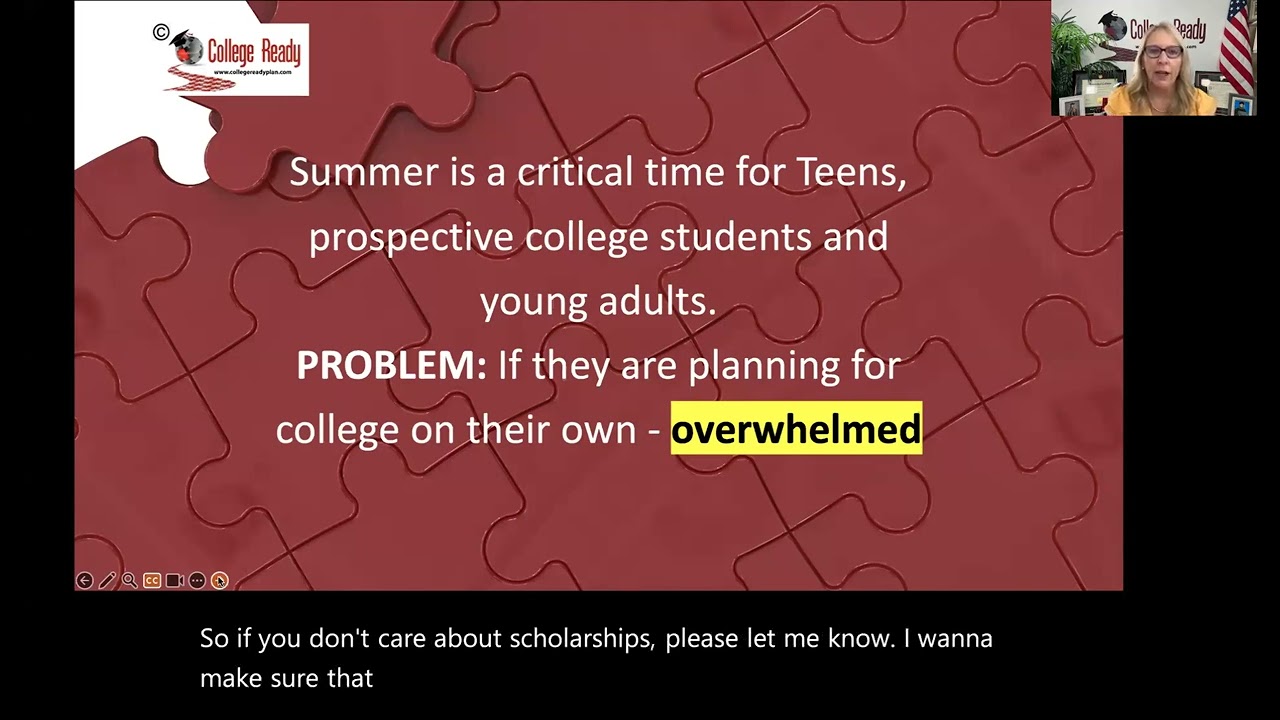
Shellee Howard, founder of CollegeReady, walks through how to use summer strategically for college admissions. She outlines six steps: assess interests, rank activities from good to best, design a Passion-with-Purpose project, pursue academics and test prep, document everything, and apply for scholarships early. Parents should mentor and organize, not just sign kids up for easy volunteer work.
Chapters
I should probably hit— For those of you who just joined us, my name is Shellee Howard, and I am the founder and CEO of CollegeReady. And I have the honor of helping you navigate summer this year. I feel like I've been talking about summer for a long time. We started talking about summer with our CollegeReady students back in January, and people are like, why in the world are we talking about summer now? And it's because opportunity knocks. There are now some summer programs that students have applied for and are no longer available, and then there's some that students just didn't even know about. And so I want to make sure they know that it's available. So without further ado, I'm going to go ahead and jump in. Please forgive my voice. I had laryngitis last week and I lost it completely, so it's now just coming back and I may have to stop and take a few sips every now and again. But, um, if you can please put in the chat where you're located and the ages of your student, I want to speak to the summer of those ages, right? If you have a 7th grader, it's a very different summer than if you have a rising senior. So if that's the case, I can speak to all of it. If not, I wanna speak to you because you showed up. A lot of people have a hard time making the actual live webinar, and I like to make it beneficial for those who do. So let me go ahead and jump in. We are gonna have a lot of fun. Summer is such a brilliant time. Mm-hmm. Excuse me. For those students who haven't figured out their major, their career, they haven't figured out the whole college admissions planning thing, there's a lot to, to be excited about. And so summer is a wonderful time to do that. So let's go ahead and jump in, and I'm gonna share my screen. And talk to you a little bit about enhancing your college application over the summer, right? Summer is a great time to help your child get ready to adult. There's no doubt about it. I remember I have some great stories of my kids adulting with laundry and with the oven and, you know, the little things in life. But tonight we're going to talk about how we can enhance their college application over the summer so they can get a jump start ahead. That's our goal this evening. So, as you can see, these 2 on the right, they're my why. Oops. They are the reason why College Ready was started. My son in the middle is now an orthopedic surgeon, and he is finishing his final year of residency at UCLA. I just got off the phone with him, and he was telling me how hard it is to have to amputate somebody's leg, and I am needle phobic. And so you have to be careful what you ask when they get older, because you may not want to know what they have to share. But he was my why, why I do what I do, why I started College Ready, and why I'm here to share with you how you can help your child or children be successful over the summer. Right next to him is my daughter, who is now a registered nurse in the pediatric emergency room, also doing things I can't talk about. So what I do want to share is what you can do with your children to help them to be successful in life and in their college application. So I, I mention the center of my screen because My passion is helping students all over the world get into their best fit college and graduate debt-free. Last year, our students are in '21 to '23. Our students earned over $29 million in scholarships on top of need-based. We help students from 7th grade on up, from a 3.0 on up. So truly, I want to make sure you're in the right room. If you have students in that age group, then you are going to get a lot out of our time together. So let's jump in. So tonight's discussion is going to be, what will your child do this summer? It seems so simple, hmm, but it's not. Summer is very important. The problem is, this is what I often hear, my son just wants to play games on his computer and my daughter's attached to her phone. Don't know if that made you giggle or if you pointed at your child, but I hear that a lot. So here's the solution I want to share with you this evening. Put a plan in place to help them be successful. They do not know how to do any of this that I'm about to share with you, so they do nothing. It's called analysis paralysis. They look online, they Google it, and they just get straight up overwhelmed, just as though if we were trying to teach ourselves a new career, that they are not capable yet of putting the plan, the strategy, the tenacity, the, the, the whole program in place. So they need your help. They need guidance. They need mentorship. They need encouragement. If that's not you, then I would encourage you to figure out then who, because they are not ready to do this on their own. You're in the right place if you would like to learn how to use Summer to get scholarships, because scholarships are part of the beauty of Summer. It's where they do their extracurricular, their leadership, their community service. It's where they learn about who they are and why it matters. Why is that important? Because it equals scholarships. So if you're thinking, yes, I would like a scholarship, then you're in the right room. If you would like a scholarship, one or many, can you put scholarships in the chat? Because I don't want to talk about scholarships if you all don't care about them. I want to talk about what you care about. Everything I do is completely custom to you. So if you don't care about scholarships, please let me know. I want to make sure that you get your money's worth out of this presentation. Summer's a critical time for teens, prospective college students, and young adults. I think we can all agree. Here's the problem. If they are planning for college on their own, they are overwhelmed. You may ask your child, "What are your plans this summer?" and they may say, "I don't know," and they're being honest. They don't know. High school is definitely not helping them with this. Their high school counselors are not helping them with this. So if it's not you, They're truly not getting help, and that's why I'm hosting this, is really to support you, the parent, or you, the child, whichever one is listening. But I want to honor the fact that it is overwhelming. It's competitive, it's expensive, and there's so much information on Google that your child's head, or yours, can explode. I want to simplify it. So, so, if done correctly, your teen will learn this this summer. This is how you know it is successful. One, they get new ideas from different people, different from their teacher, different from their classes, different from their friends, maybe different from their family. That's a good thing as we're preparing them and having communication with them to grow. They will learn how to collaborate with others. There's an application question that says, "How have you collaborated with others?" So if they don't know how to do this and you're not teaching them this, they will not learn this. We help students understand that collaboration, diversity, and inclusion is critical because they are going to have to write between 0 and 18 essays per college they apply to. Yes, 0 to 18. 0 would be community college and Brown would be 18. That's this year. So if that sounds a little, um, intimidating, I am wanting you to understand that this summer is going to set them up for ease and grace when it comes to essays and applications. So this summer we want them to learn how to be a team player and a leader. Colleges want leaders. They're not looking for followers. Everybody leads in a different way, right? You have the ASB president, you have, um, the lead actor, you have the the, um, scholar athlete. Everybody has leadership, but it all looks different. Colleges want your student to lead others to create the change they want to see in the world. So that's what the summer should be all about— how to manage their time. Is this a gift of all gifts? Because when they get to college and there is no parents telling them what to do, when to do it, or how they should do it, or in the timing they should do it. If they don't have this skill, they're gonna really struggle in college. So the more we can help them to juggle this summer with balance, self-care, and self-realization, that's what they need to do to be successful in college. We don't wanna wait for them to get into college before we set them up for success. So that is summer. They can start writing their essay now. It doesn't matter if they're in 8th grade, 9th grade, 10th grade, or 11th grade. It really doesn't. Our families come to our college essay brainstorming sessions at all ages. We have 3 coming up this summer just to help navigate and launch. We can tell your student in 7th grade the essays they're going to need to write. Why wait until their senior year to start mapping that out and having a strategy? The summer is the best time to do it. Colleges want to know this. I mean, this is the, the magic in, in all that families want to know. They want to know, how has your student grown? And what have they learned? And that is going to be given to them in an essay prompt. So if they can't answer that right now, now's the time to let summer happen. What should your student do this summer? Okay, let's talk about the problem here. They don't know. Honestly, they don't know. You may have one camp that you signed up and paid for, that's called pay-to-play. You may have a church camp that they volunteer at, which is going to be impressive for maybe, you know, some parochial school or, or some type of a leadership, or maybe they want to go into education. But what is it really telling the college about them? So the solution is to focus on what they are interested in. Internationally. Think big. Nationally, regionally. Everybody starts to just want to look at the easy thing. That's not going to impress any college, and that's not going to get them a scholarship. So what they need to be working on is an international project, a national project, a regional project. I'm going to show you how we do it because I want you to know But it's important for you to understand that colleges are not impressed with a student who spends their summer tutoring. One, if they don't want a tutor. Two, if it's a sign up and show up, colleges know how hard was that for your child to get. They're not going to be impressed if it's easy. If it's easy, anybody can do it, and that's not what colleges are looking for. Our students start out with a brainstorming session, then we create a strategy, and then we map out a plan. That's what they need. That's the solution that we're looking for. So here's the other problem: how do I know what's the best use of my team's time? Maybe you have a team that's got this plan, this plan, this plan, this plan, this plan— like, you've got it so over-planned that they don't have time to breathe and enjoy being a teenager. And you may be going, how are they possibly going to get through this summer? I have so overplanned it for them because I don't know what colleges want. I was that parent with my child number one. I called him my guinea pig after that because it was overwhelming. This poor young man did everything I recommended And it was not easy. He sometimes tells me, "Mom, medical school was tougher than the summer you set up my freshman year." And he laughs at it, but it was me. I was the parent who was throwing darts at the dartboard, spaghetti to the wall. I was hoping that I got it right. And I will tell you, I didn't get it all right. Luckily, I had a son who gave me a lot of grace. And who was willing to meet me where I was at. Because if it was easy, everybody would do it, right? Colleges are looking for your student to do something meaningful, to do something strategic, to do something big. They're not looking for the little feed the homeless unless they love to feed the homeless. So again, There's good, better, and best, but just running them ragged and hoping— you really need to hope that they don't burn out. That's really what I learned in the process of 17 years of doing this. For some of our children, they may go along with it. For others, they may push back. For others, they may burn out. And because we help students all over the world, from coast to coast in the US, I can tell you I've watched parents burn out their child, and I've watched parents go head-to-head, tears, crying with their child. And I've had parents hire us just because they didn't want to deal with all of that, and they wanted their child to come home at spring break and winter session and summer school and not fight. So just know I'm, I'm speaking to all of you. I hear you. I hear the students. I hear the parents. Our solution is this. If you're going to do it on your own, you need to research every single college your child may want to apply to, find out what they're looking for in an applicant, and then build a plan. That's what you need to do if you're going to do this on your own. Or I can show you what we do. Again, this is not about Shellee selling College Ready. This is about here's what you can do, and then you decide, do I want to do my own taxes or hire a CPA? Do I want to sell my own home or do I want to hire a realtor? This is really about you and what you can do and what your child's willing to do. So now I'm going to show you how we do it because I think it's important that you understand good, better, and best. So I'm going to stop share real quick, share my screen again, and you can see this is Vincent. He is my fake student because we want you to see how our students do it. It's very important. So Vincent, this is his portal. Everything he does is inside of here. All of his strategy, his planning, his building is all right here. Okay, so important to know that inside of here is 17 years of my intellectual property that I'm going to be sharing with you. So I'm going to come down to activities, honors, awards, and summer resources. So our families have this at their fingertips. So I'm gonna, you know, the, the summer opportunities prior to high school. I didn't see a lot of students prior to high school, so I'm going to skip that for now. We have them understand activities, extracurriculars that are good, better, and best. Let's look at that. So our students have the opportunity to see what colleges think are good, what are better, and what are best., and that's important to understand. Here's one that a lot of students use, and that is National Honor Society, right? That's better than some, but it's not the best, right? Honor roll— that's good, but there are a lot of things better, and there's a lot of things that are best. So we want students to know not only are here are things you can do over the summer, we want them to know, is it worth their time, right? And then we have ranking. So what we do for our students is we rank them so they know, for the Common App, here are the 5 most important things. For the UC schools, here are the 20 most important things. Why is that important? Because if your student is focused on one thing and they want to apply to a UC school and there's 20 spots, that's what summer's for. We don't want them to miss out on that opportunity. So that's important. And then research projects. A lot of students are doing some great research opportunities. We have an activities tracker that our students utilize that I created from scratch. This is my intellectual property and I'm happy to share it with you. Uh, I'm gonna just go make a copy, and you'll be able to see what it is that our students get to see. So we show them, here are activities, honors, and awards. Here's how to find them. Here's where to go to look for them. Here's extracurricular activities. Here's volunteer. Here's educational prep programs, other coursework. Work experience. All of this is what your child needs. So if you're going to do this on your own, just make sure when you do your research that you give them examples, you give them opportunities to see what is good, what is better, what is best, so they can then look at that and know how to spend their time. So we do this for our students so they can have a good idea about what is important to colleges and where they find their information. Otherwise, they get Googling down the wrong superhighway and they get really confused. You know, assessments are a big process, but students who don't know what they want to do, they need assessments, but they need somebody to unpack it for them. So those are some things that you could be doing for your student right now that will help them to know, is this worth my time? I do a lot of discovery calls, and I know that families have a lot of things planned. When we break them down, it doesn't tell the college anything about the student. It doesn't tell the, the college anything about the student's core values, their passions, their advocacy. Summer is a time of exploration. Summer is a time to prove to colleges who they are and what matters to them. So if your student is doing a lot of busy work just to sign up and show up and do this club, what essay is going to come out of it? Everything the student does should have an essay that can come out of it. That's how you know that it's worthy. So I'm going to jump back into my presentation, and I'm going to show you some things that you can do as parents and/or students on the call that would help your student get clarity about what they can do. For us at College Ready, everything we do is custom, And so no two students are the same, and it's super important that every student on this call has their own strategy, right? Because no two students are the same, and that's what colleges want to see is what is going to make your student stand out. So I'm going to go through these quickly because I want to be able to answer your questions and make sure that we are on target. So the first thing is you want to make sure they have academic enrichment. You want to have them take advanced courses exploring who they are academically. You want to help them to understand how they can teach others what they are good at. Summer programs should be important when it's related to their field of interest, especially those offered by universities. Just don't start a school club. You want to start an international club. You want to take an organization and bring it to your region. These are things that are college-worthy. Leadership and initiative. Starting projects like I mentioned. An example of this would be for my students who want to go into business as a major? What have they done to show colleges that they want to do something with business? What is their proof? This is a huge outage for most families, and for families who don't know what to do, this can be a bit frustrating. For, uh, an example that we've done at College Ready is we've created an international organization where our students can earn 8 national awards. Bronze, Silver, and Gold, and 4 leadership certifications. So we want our students to be earning honors and awards and recognition for every single thing they do. So if they're not, you may want to reconsider what they're doing, because on the college application it's going to say, what did your student do? How many years did they do it? How many hours per week and how many weeks per year? If you have a student who's super busy all year long, summer is going to be the fix-it, the patch the holes in the boat. So our students have created a program called EmpowerEducation.World, and I mentored students so they mentor other students. They lead other students to create the change they wish to see in the world, and they've even built the website in which it Sits. I am personally taking their passion projects to Uganda, to the 3 schools that they have built, in June to deliver their passion projects, videotape the experience, do live chatting from Uganda so these students can see the impact of their passion and their commitment. That's what colleges are looking for. So hopefully that gives you a better idea because many people get super frustrated with, I just don't know, can you give me an example? I've got hundreds of examples and that's because every one of our students creates their own Passion with Purpose project with our support. So assume leadership roles. Again, I think you've heard this 3, 4, or 5 times now. Colleges want leaders. College is a business. They are not looking for people to come, take, sit, take an education, and leave. That does nothing for their future. They're looking for future leaders to win awards, to wear their letters proudly, to put the diploma on the wall. That is what they're looking for. So it's important that your student does something impactful. So as I mentioned, starting businesses, developing skills, community service, engaging with community, documenting their impact, creative and personal projects, showcasing their talents, personal growth, athletics. We have scholar athletes. They're looking for them to be more than just scholars, more than just athletes. How are they blending the two? That's what we're helping students understand how to do. Test preparation. They need a test score to match their GPA. Every single day, more colleges are saying we're no longer optional, so don't believe it when you read it. Be very careful. All right, college visits. Now's the time, right? You're going to take your kids on vacation. You're going to show them museums. You're going to show them, um, really neat opportunities to grow in intellect. Now is the time. I remember when we took my son in 5th grade. He was in 5th grade. I know, out of control. And we were visiting Boston, and we went and saw the Mayflower. We went and saw some really great history. And then I took my kids to Harvard and MIT, and then we took them to a baseball game. So it's important that you get to fill their summer with impact. These are the things colleges are looking for. Virtual tours are okay, but colleges are at every destination I've ever been to. I just visited, um, San Francisco. My young— my, my third student just graduated in 3 years with a major and a minor. And we went up for his graduation. Well, while we were there, I was able to see 3 other colleges. You know, I was just in Portland, Oregon, doing a conference. I went and saw 3 colleges. So everywhere you go, go and see colleges. It can be a great family experience. Do some reflecting, help them to journal, help them understand what does the summer mean and how am I going to get ahead? Remember, this is what colleges want. They want to know what would get your teenager out of bed on a Saturday morning. That's what they want to know. And if it's gaming, I don't know what that's going to tell colleges about them if they want to go into, you know, ecology, but there's got to be something that is maybe unexplored. Maybe they have passions that they're not sharing with you. The first thing we do in College Ready and See Our Future Now is we explore who they are, what matters to them, how other people see them, what are careers that would be a good fit for their intellect, for their curiosity. These are the things that are going to be important as they start to navigate. Remember, college is not the endgame. College is the stepping stone to the career so they can provide for their families. So this is where we need to start. A lot of people think passion's not important. Passion's very important if your student doesn't know ultimately what they want to do. We have to start somewhere. So how will you stand out? How will colleges know that they're amazing? You need to prove it. We spend so much time telling our children, don't brag, don't boast, it makes people crazy. And now I have to tell them, brag like crazy, boast, tell them how amazing you are, sell it. And they're like, what do you mean? And they don't know how. So they've done all of the hard work but they don't know how to present it to colleges. And this is the challenge. What makes them unique? You need to patch the holes in their resume. You need to help colleges understand who they are, why they get up early on a Saturday morning. Using passion to create a standout strategy, and then using the standout strategy to create positioning. Is going to equal scholarships. So for those of you who put in the chat, yes, I want scholarships. I do wanna touch on that for you. I appreciate you, your time and your being here, and I wanna make sure you get massive value. So how we help students find their passion is we first have to connect to them. We have to get clear on taking away any of our ideas of who we think they are. We have to have a non-judgment zone, and we have to ask them the right information. So what we do is we help them first figure out their top 10 passions, the top 10 things they advocate for, and then we help them to know what they can do with it. This is how we start the Passion with Purpose project. Of course, it goes layers and layers and layers deep. But the next thing we do is we map out what will they do, what is their mission, what is their timeline, how are they going to map it out. They can't do this on their own, so either they need you or they need somebody else, but they definitely need help. These are the top 10 secrets to help you find and win scholarships. Remember, I want every one of you to leave here feeling like you got massive value, right? That's why College Ready has been in business for so long is because we care about you, the family. So the secret is the reality to a full ride is it comes down to picking the right college list, making sure the student has the right resume, the standout strategy, and the positioning. That is what it takes. I was interviewed on a podcast today where somebody asked me, How was my son able to get into Harvard and graduate debt-free? I would encourage you to listen to the podcast because I really shared it all. All right, number 2, private scholarships are available to everyone. You can start applying to scholarships today when your student is in middle school. You do not need to wait until their senior year, and I just thought that you should know that. Number 3, there are legitimate websites and we can show you which ones are real. Be careful with the bait and switch. If there's no essay, be careful, they're just trying to get your email, the information about you. Do you own a home, a car, so on and so forth? Be very careful letting your 17-year-old share. Number 4, look for scholarships from your employer, credit unions, department stores, even high school PTAs. Number 5, there are no tricks, but there is just good old hard work and follow-through. It is a part-time job. I promise you that if it was easy, everybody would do it. My students, my own children, put in the hard work because I told them that there's got to be a return on investment of their education. Number 6, passion equals scholarships. There are essays they will need to write just on things they're passionate about. Number 7, consider your background. Number 8, if scholarship advertises no essay, run for the hills unless they have a really hard story that they're going to share in the application. Number 9, if your student doesn't go looking for scholarships, the scholarships will not come looking for them. We do provide our students with scholarship opportunities, but they still have to do the work. And number 10, have your student follow directions carefully. 91% of scholarships go unclaimed. Nobody claims them because there wasn't enough candidates who did it properly, as sad as that sounds. The final problem: your student has no idea how to do any of this. And colleges want students to take initiative. That's the real problem in all of this. The solution is you help them and they do what you say, or you— we help you and them because we offer one-to-one custom standout strategies. We offer free resources. We offer do-it-yourself with support group programs and the knowledge that you are giving your child the best chance of success. So at this point, I'd like to offer you a couple of things for spending time with me on this evening. If you would like to receive a list of resources of summer opportunities and a complimentary progress call, which is going to help you understand, are you getting close to being college ready? You can either go to college ready plan dot info and schedule time, or scan the QR code and schedule time, and that will give you the opportunity to get your questions answered. I'm going to now hop into the chat and we'll answer those questions.
More from Shellee




The 3 Questions Every Parent Should Help Their Teen Answer Before College | Featuring James McLamb

Helping Your Teen Stand Out for College Through Purpose & Impact | Featuring Aishani Sheth


From Robotics to Cornell: A Father-Son Blueprint for College Success with Aarav & Ritesh Kumar

The Hidden College Credit Strategy That Could Save Your Family Thousands with Josh See

The Truth About Financial Aid: Why Some Families Pay Less for College Than You Think with Jack Wang

Human Skills Every Teen Needs for College, Careers & an AI Future with Rob Heller
