5 Keys to Leading Virtual Teams in the COVID-19 Crisis
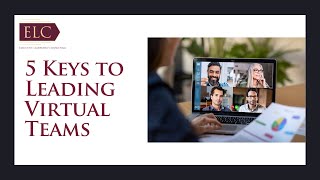
Sonya Shelton, CEO of Executive Leadership Consulting, breaks down five essentials for managing remote teams during COVID-19: confidence in your leadership, clarity on priorities and roles, frequent communication across designated channels, culture-building rituals to fight isolation, and creativity to adapt and innovate.
Chapters
Hi and welcome to Leading Virtual Teams Through Turbulent Times. As most many of us have been asked to work remotely from home, here at Executive Leadership Consulting, we have been talking with our clients about the challenges that they and their teams have been having over the past few weeks. We took their questions along with our own best practices as a company, since we have always operated as a virtual team to give you some tips to consider as you shift into leading virtual teams and teams that work remotely. My name is Sonia Shelton and I'm the CEO of Executive Leadership Consulting where we partner with organizations to align their strategy and their culture. And I'm happy to share some tips with you that we've been sharing with our clients on how to support your team who are now working remotely. So we know that this time of COVID 19 has brought challenges to the workplace. For some people, they've worked from home occasionally, but they haven't worked on a full virtual team before. For others, they've never worked remotely at all before. And yet others may already have a job where they work remotely, but now they have their whole family at home, which then brings additional changes and challenges to their ways of working. Remote work often offers tremendous advantages for productivity, but it also has some downsides. The casual interactions that happen naturally in an office are no longer possible, so you have to make up for those. And there are no hallway conversations or drop in visits or chats around the coffee area. The team can start to feel disconnected and that when teams feel disconnected, that then trust erodes very quickly. So we want to continue to maintain that trust as we're working virtually. So I just wanted to take a moment as we talk about best practices that great leaders are born in times of crisis. If you think of the great leaders that we all know throughout history, whether they're in companies or government or social issues, they led people through a challenge or a crisis. So now as a leader, this is your time and we have put together some tips and guidance as well as best practices to help you lead your teams to be more productive and effective while reducing the stress of these changes and what's happening in their environment. So we're going to cover what I call the five Cs. So we want to focus on the five Cs and as we're leading virtual teams, starting with confidence and your mindset and then going into clarity for structure and objectives and priorities and then communication and the frequency of communication as well as communication tools, and then culture to maintain your culture as you're working virtually. And then finally creativity and using this as an opportunity for both innovation and renovation. So first is confidence. And I love this quote from McKinsey and company. What leaders need during a crisis is not a predefined response plan, but behaviors and mindsets that will prevent them from overreacting to yesterday's developments and help them to look ahead. So this really captures what we're needing to do during this crisis and really building confidence. So you may not have led people through a crisis before, but you're in your role for a reason. So you can find the confidence that you can do this and you can share that confidence with your team. We're all in this together and we've got this. So if you need guidance for how to lead through this crisis, we're here for you. At elc, we're here to help you. But it's really important that you build that confidence first within yourself and then within your team. So focused, motivated and energized. Your job is to do this for everyone, to help keep them focused, motivated and energized. As a leader, you have to project a sense of calm, and that means also being positive and focused yourself. So focus and motivation and energy are a lot easier when there's hope. So continue to reinforce hope for the future as you're going through this with your team. Next is be agile. Agile leadership principles are great in times of crisis. So agile leaders build teams that are small, empowered and connected. They allow and encourage their teams to work in faster cycles of testing and learning and adapting so that they can deliver more value more efficiently and more quickly. Agile leaders help keep their teams focused on creating value for their internal and external customers by understanding and addressing their needs. So it's looking at how can you use this opportunity to be agile to address what's needed and allow your teams to run with it and to test and learn and adapt. Next, you want to focus on your values, your personal values, your team values, and your organization values. And most important, you want to demonstrate empathy. So putting human needs before work and encouraging everyone to work together and support each other during this time, and then finally planning, planning for the future, but at the same time being present in this moment. So in times of great uncertainty, we can only control what we're doing right now in this present moment. The most important thing is to keep each other safe. And right now, the future is just an idea. We can plan for it, but we can't control it. And it doesn't help our energy or focus to live in the what could happen or the what ifs. Of the future. So we need to have a plan for the future and then be present in this moment. If you'd like some tools on how to reduce stress, you can download our free ebook on our website again, how to reduce stress at work. And there's a lot of resources in there and you're welcome to share that with your team as well. So next is within clarity. You want to keep reinforcing your goals and objectives. So focus on purpose over panic. Constantly reminding your team of the purpose and vision of your company and, you know, using things like our customers are counting us to deliver on whatever your purpose is or your vision. And you want to communicate what changes need to be made to your priorities. If priorities haven't changed, keep reinforcing them so that your team will stay focused. The key is to continue to provide clarity as you can when things are uncertain. And it's also okay to say you don't know. So if there's something you don't know, don't make it up. Definitely don't make it up. But keep them focused on their priorities and then also just letting them know that things might change. Right? So these might be the priorities this week, but the priorities might change next week and just communicate them as those changes are happening. And you want to establish clear roles and responsibilities and reinforce or update those roles and responsibilities as changes happen. So as priorities change, you might need to change responsibilities or assign, assign different roles as you're making those changes. And it's okay to do that just to reinforce what those roles or responsibilities are consistently. And then finally, agility is key. So share what you know and what's in progress as well as what you don't know yet. And just reminding everybody that in these times of change, we need to be flexible and agile and be able to test and learn and adapt as we learn more. And as we go through this process, another piece of clarity is creating structure. So you want to review your workflows and clarify decision making. So what adjustments would need to be made in your workflows and decision making when you're a virtual team, where can you be more efficient? So one company adopted agile practices across all of its teams and started implementing daily and weekly check ins. So looking at those agile work processes of sprint planning and review sessions and having shorter meetings to check in and then doing longer meetings for deeper dives when issues come up or decisions need to be made. So that's something that you can look at is more agile practices, especially during times of uncertainty, as well as working virtually another Company that we work with has created smaller subject sub teams for easier collaboration online. So breaking into work groups or smaller departments to be able to collaborate online more nimbly. Next is flexibility. So you want to have structure, but you also want to be flexible when you can. So there's, you know, parents working from home, trying to take care of their kids, trying to home school, you know, can you be flexible with their schedule so that they can, they can accommodate childcare and homeschooling, you know, are there, you know, as if people get sick, hopefully they won't, but you know, being flexible with, you know, who's doing what and reassigning roles to be able to cover for each other and then finally being prepared so discuss, you know, those things that might go wrong and developing contingency plans so everyone knows what to do. So there's a possibility, there is a possibility that someone on your team will get sick. So you don't want to take unnecessary risks. So several of our clients are working in industries that are essential services, but they're splitting up the policy in their organization. So those who are necessary to provide those essential services do that. But those who can work from home do work from home. So, you know, really being prepared, you can do things if you need to bring on contingency workers or new employees in case you need to cover for somebody to design an online onboarding process for them to get acclimated to the team and understand their new role. So you also part of clarity is staying productive and maintaining productivity. And the first, this first stage of this is ways of working. So you want to talk as a team about how you work together in this environment right now, what's the daily rhythm? What are the norms looking at things like ending meetings a little bit early to allow time for bio breaks, for stretching, you know, to talk about not having working lunches unless that's specifically agreed to. So that you're establishing guidelines that give some work life balance and people don't get overwhelmed and overworked. And you want to establish some guidelines for availability, you know, so high achievers will leverage the freedom to work when and where they're most productive. And it's important that you let them do that, but don't expect them to always be on call. So you want to agree as a team on set office hours, when team members should be available to take meetings or respond to messages. And beyond that, you might allow some flexibility in their work time when they can work when they're more productive or, you know, when they're not taking care of their kids. Next is accountability. So you want to establish expectations and accountability and really foster an outcome driven culture that empowers and holds your team accountable for getting things done. So one of our clients is having team members submit a weekly one page status sheet to share with a whole team, complete with plans for the week ahead. So everybody knows what's expected of them, but they're also accountable for getting the things done that you're expecting them to get done. So effective meetings. Meetings are a bit different when you're working remotely. So distance tends to lessen our sense of accountability. And so it's much like being in a large group that makes a remote meeting fertile ground for distraction like multitasking or other forms of non participation and checking out. And you want to head that off by agreeing on standards of etiquette with things like video conferencing. So one team shared that they agreed to have all their cameras on and mics off except when they're speaking. And they discourage answering texts and instant messages or email messages during meetings. So meetings are more effective when the people are there and fully present. But that also means that you need to make your meetings effective. And in order to do that, you need a clear agenda, you need meeting objectives. So you know, is this meeting about, you know, informing? Is it about discussing something? Is it an alignment meeting? Do we need to decide, make a decision in this meeting so that you have clear outcomes and actions for each of your meetings. One of our client organizations put the overarching meeting objective as part of the subject of the invitation. So for example, it might say discuss and then next to the word discuss, it says what the topic of the meeting is. And so people know going into the meeting what it's about and how they should be participating. And you want through this process because it's new for a lot of people to ask for feedback on the effectiveness of the meeting structure and how you can improve it so that you keep iterating and learning and adapting. And of course there's technology that you can use when you're working virtually. And it's great to use technology where it's appropriate, but you don't want to look for productivity tools just for the sake of it or because you hear other companies are doing it. There's enough change that's happening already. So if you find that a workflow is breaking down or issues are being created, you can find a tool to try to solve that. But be clear how it's used and maybe even do a training for it. For example, One Global bank asked their relationship managers to connect with small business customers via WeChat and video calls to understand their situation and help them weather the crisis and to do so effectively at scale. The managers are supported through dedicated product programs and online articles and scripts for communicating with clients, as well as earn internal trainings on how to do the process. And if you need a recommendation for a tool to solve a particular challenge, feel free to reach out to us here at elc. We'd be happy to share what we've seen that works for us, as well as what some of our other clients are using. So you want to take a learning approach to productivity and empower your team to solve problems constructively. So what that means is when a problem arises, the question isn't who caused it, what they did wrong, but what could be done differently, so how can it be fixed for next time? And asking the question what can we learn from this? So it's a choice to look at things in a positive and constructive light. And during this time of crisis and also working virtually, it's important to take that learning approach. And then you also want to be creative about productivity and look at things that instead of postponing something or canceling something that was planned, how can you be creative to make it work virtually? For example, one team had a leadership retreat planned and instead of canceling, they decided to try to create a remote retreat instead. And people on the team came forward to help plan it and think of creative ideas for things to do. So it became a rallying point for the team and it demonstrated how helpful and supportive their culture is of each other. So you can look at things like that and try to be creative and work as a team on being more productive. So good communication is key. Yes, absolutely. So you want your communications to be clear and simple, so clarity and simplicity. There's enough confusion and chaos happening during these times, so the more that you can clarify and simplify your messages, the better. Working from home cuts off the informal communication that occurs in an office. I mentioned that before. So there's no opportunity for a quick question or a brief update in the hallway. And leaders are less likely than their team members to notice that lack. So the leader assumes no news is good news. Meanwhile, the team members can feel isolated or left in the dark. So establish a pattern of communication that allows for passing information or asking questions or making decisions. The key here is consistency. Consistent communication keeps leaders informed and also keeps your teammates on board. So you want to increase the frequency of your interactions as well to make yourself available to your team to answer questions and to address their concerns on a regular basis. So one chief information officer said he's texting the entire company with regular quick updates because it's more of a human way of communicating communicating than their previous official corporate channels. And it just felt more friendly and human to send text messages. You want to be careful with that, that you're not overwhelming people but it but looking at, you know, a way of connecting with them on a human level and encouraging open, honest and productive communication. You also want to be realistic in your outlook. So as you're communicating don't sugarcoat but at the same time don't catastrophize. So use actual data and trends and talk about what you actually can control and what you really know rather than speculation. And again, agility. Agile communication practices work great in a crisis. So using things like quick daily check ins and then scheduling the longer meetings for issues that come up in those check ins and then move things like status updates or reports to email. So determining how you communicate is just as important as what's being said and it needs to be done competently, clearly and consistently. And I love this chart that McKinsey & Co. Came up with. They just sent out recently that communication channels that are crucial for remote working. So as you can see using one on one calls or voice calls for individual catch ups and building relationships and especially for discussing difficult topics. So it could be a one on one call. It could also be a video conference, one on one and then group video conference, more problem solving and co creation. You can use a shared screen or a whiteboard. Video conferences are great for weekly planning and for review sessions. They're great for decisions, for doing trainings like this and then team talks and retrospectives and then using chat for things like process syndication, something that's urgent, an urgent question or where some asking for advice or guidance, something that you need to keep up to date in real time. And chat is also great for talking socially and chatting with each other on a social basis. Another idea that I really liked that they shared was using video captures and voice notes. So using a recording to showcase something or explain work your manager doesn't have. If you as a manager don't have a lot of time and you need to provide guidance on something, you could just record a note on your on your voice recorder on your phone and just send it to them. It's also great to do recordings for debriefs after meetings that somebody may have missed. You could record a video or a voice note to send to them. Or you can also record meetings so that the people that can't make it can watch the video later. And then of course there's emails using for updates and status to large groups of people and for communication both inside and outside the company. So working off site opens up all these possible channels that you might not have used inside the office. And you want to avoid confusion by designating approved channels for certain communications. So for example, one of our clients uses email for all external communications and then they have all their internal communications are on workplace by Facebook. And then they use Zoom for all their video meetings and Slack for collaboration on projects. And then they also use text messaging for occasional urgent messages, but never for standard communications. So it's important to say, you know, how do we want to decide as a team, how do we want to use each of these channels and for what so that we're consistent and we're all committed to that. And video conferences are great for discussing complicated topics in real time, but they're also great for creating a sense of community. But they require some coordination and focus. So you want to have, you know, a clear agenda, you want to have somebody who's watching the time and helping to monitor how the video conference goes. And then you can use channel or chat based communication collaboration software for a quick alignment or easily answered questions. While email can be used to record outcomes and communicate more formally. And there's also some tools that are backlog management tools that can be used to keep on top of tasks and processes. One of our clients said for video conferences that you, in addition to having a clear agenda and a moderator to keep the discussion on track, that they had agreed as a team to have their cameras turned on throughout the meeting. And they said that was essential to build relationships and to pick up nonverbal cues. And in case, you know, your home office isn't presentable on camera, most video conferencing software offers virtual or blurred backgrounds. And then it's, you can use the screen share or virtual white bear whiteboards for joint problem solving or collaboration. You can use, you can co edit documents in some of these, some of these technologies. So next you want to maintain your culture. The most important thing here is that empathy is crucial in this time. You want to make sure that your team knows that you care, that you're communicating, understanding, you're showing your humanness, you know, recognizing that, you know, kids are going to interrupt and interrupt meetings and pets are going to make noise and things like that and just, you know, recognizing that we're all in this together and having empathy for those situations when they happen. You also want to look for opportunities to share success stories, to look at, you know, best practices. How are things working? What's not working? Asking about those challenges. One of our clients has their team meetings start every time with a standing agenda item that celebrates their wins for the week. So starting out with, okay everybody, what were your wins for the week? And really keeping that positive outlook and positive attitude, you also wanted to create opportunities for strengthening the connection and community within your team. So for remote teams, loneliness can sometimes be an issue and a dangerous one unless you consciously counter it. So research has found that the harmful effects of loneliness are comparable to those of smoking up to 15 cigarettes a day, actually. So that's what the research shows. So you want as a leader to make sure that you're continuing to create that community and collaboration and connection. So some of the things that our clients are doing is having a virtual team breakfast or a team lunch or they're doing a coffee break as a team or having a happy hour at the end of the day as a team and having that on video so that everybody can see each other and connect and then scheduling one on one catch ups so that you can quickly surface issues, offer perspectives and solve problems for the people on your team one on one. And then of course, you want to encourage the team to check in with each other personally. So allowing and encouraging them to have that water cooler time together. So some of the things that other companies have done is if they have a collaboration software like Slack, they have a water cooler channel or a social channel which is reserved for that personal back and forth that happens in most offices. And that's where they, they celebrate birthdays and you know, the occasional joke, they're sharing pictures of their kids doing homeschooling or their pets while they're working. So that's something that you can consider. And there's one, one team that said that they were doing Breakfast Club Mondays to get the team together to check in to talk about their weekend and prepare for the week ahead. And then one company, the, the CEO is doing a Monday video that each week and shares with the entire company so that in that Monday video they're sharing everything from birthdays and updates on the business and social things as well. And then there's also an opportunity to have to submit questions for the Monday video so that the CEO can answer questions in that video as well. Some team building things that people are doing, scavenger hunts for items in their House again, sharing funny pet photos or photos of kids, and then of course, coming together to celebrate birthdays and work anniversaries and things like that. So throughout this, you want to follow your company values and you want to make decisions based on those values and you want to refer to them often. So you don't want to force too much too soon in any of this for your culture. If it feels forced or in any way mechanical, it will backfire. So creating a remote culture really means following your heart and being human and staying true to your values and appreciating your employees for who they are, not necessarily as their role, but just as people, especially during this time. So next is creativity. So you want to encourage innovation and renovation. And while business is far from business as usual right now, it is easy for some employees to think of things as in terms of yes, but we can't do this or that right now. It is a tough situation for literally everyone in the world. But we want to challenge your teams to bring you yes, and this is what we can do instead. Solutions. So instead of coming up with excuses, looking of why we can't do things, maybe look at how we can. And it's a subtle shift that can change the thinking for the whole team from a reactive point of view to a proactive point of view. So you can look for new opportunities that are created by the crisis and challenge them to find new ways around roadblocks. So there's a company in China called Alibaba that launched Taobao, which is their their e commerce website. And they launched that while they were working remotely during quarantine on the 2003 SARS outbreak. And now Taobao is the world's biggest e commerce website. The biggest e commerce website in the whole world was made during a remote quarantine. And Trip.com actually did a remote working experiment in 2014 that ended up changing how they did their customer service. And they actually decided to implement a flexible working culture going forward after they did their experiment. So there is opportunities for looking at how things can be more efficient internally with your team, as well as looking at innovation externally. So some of the biggest companies in the world were launched actually during recessions. So companies like General Motors and Disney and Hewlett Packard and Microsoft and General General Electric were all launched during recessions when they saw an opportunity and they responded to that opportunity and innovated and actually launched during a time like this. So there are opportunities. You just have to look for them. So next you want to prepare for what's next, what happens? This crisis is going to be temporary, but the effects are going to be longer lasting. So in fact, for some businesses it may forever change how you operate. So maybe new processes or perhaps technology will need to be created as a result. And your resource needs may change because your original 2020 strategic plans have been sidelined. So it's really important to adopt agile leadership and allow your teams to look at that test, learn and adapt cycle and delivering more value for your customers. And then asking the question, how will you need to change to adapt to the changing environment. When you go back into work and go back into the office as a team, what are some that you'll need to do based on what's happening in the bigger environment? A lot of companies are going to need to change. They're going to need to change their strategy and that might mean changing resources, changing roles, reorganization and getting ready for that. And then personally looking at what mindsets, behaviors or processes do you want to keep when you go back into the office and as you're making note of what you're learning during this time and what you want to keep more long term. So that wraps up our training today. And if you need help, if there's something that we didn't cover, or there's an area that you want to dive deeper into, or you're having a challenge with your team that you'd like to talk about, we're offering 30 minute consulting calls. They're free, and you can go to executiveleader.com if you would like to have a call with one of our consultants. We do have limited availability, but we're happy to help you. We want to support you. We're in this together. And if there are other tools or skills that you would like to see us do a training on, either for you or for your team, feel free to just drop us a note. You can email us through our website@executiveleader.com on our contact page. And we're happy to put together more online trainings like this to help you during these challenging times. So we want you to know that we're all in this together. And I thank you for taking the time to spend with me today during this training and to participate. And we hope that you stay safe, that you stay healthy and positive and hopeful through these challenging times. And if there's anything that we can do for you, feel free to reach out. Thank you. And hopeful through these challenging times. And if there's anything that we can do for you, feel free to reach out. Thank you.
More from Sonya



#Burnout on the Rise: Navigating the Disturbing Trend @wilempowered #workplacetips #toxic


Uncover Your 'Why': The Foundation of Purposeful Living @wilempowered #leadership

How Your Environment Shapes Leadership @wilempowered #leadership #effectiveleadership

Are Leaders Born or Created? Unraveling the Leadership Debate #Leadership @AncaStefaniaIorgulescu

📚 Sonys's Book: Your On-Desk Executive Coach! 💼 #leadershipbooks @AncaStefaniaIorgulescu

Not Happy at Work? Sonya Helps People Feel Fulfilled #LifeTransformation @AncaStefaniaIorgulescu

How My #FamilyBusiness Roots Shaped My #Leadership Journey #SuccessStory @AncaStefaniaIorgulescu
My Experience Working At #disney @debbieheisercoach #executivecoaching #culture