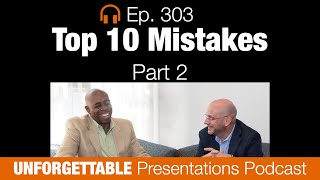
Ep 302 Top 10 Speaking Mistakes PART 1
Darren Lacroix, Mark Brown, and Michael Davis break down the top speaking mistakes. They cover how to nail your ending, make content relevant to your audience, structure sentences for impact, raise the stakes in your story, and use storytelling to stick with people.
Chapters
Hey there, Marc Brown. We started this podcast in 2019, 321 episodes earlier, we talked about the top 10 mistakes, but we have coached a boatload of people since then and we wanted to team up with our friend and our co coach and a guy that I go to for coaching, Michael Davis. So we're gonna dive into the latest and most popular mistakes that we see coaching speakers and presenters and trainers.
Anyone can give a presentation. Few deliver unforgettable presentations. What's the difference? You're about to find out. Welcome to the Unforgettable presentations podcasts with your hosts, world champion speakers and coaches, Mark Brown.
Mark Brown, your life tells a story and there's someone out there who needs to hear it.
And Darren Lacroix. And Darren Lacroix.
Stage time. Stage time. Stage time.
Ready for some powerful presentation? Ahas. Let's dive right in.
Hey there, Michael Davis, welcome.
Thank you, Darren. Always good to be on the podcast. And like I told you earlier, I get to see Mark Brown twice today, so it's my day.
Too much to handle. Yeah. Welcome, man. Good to see you, Mike.
You as all. You as well, Mark.
Excellent. Hey, Aaron, let's just dive right in, buddy. Let's just do it, man.
Yeah, yeah. And so, hey, we are all three coaches. We have different clients, different backgrounds, From Toastmasters to CEOs to professional presenters to entrepreneurs who give presentations to help build their business. And we just said, you know what? It's time to look at those mistakes again. And hey, why not? So we teamed up with Michael Davis and he kind of came up with a list and we're like, ooh, that's good. So these are the mistakes that we see again and again. And Michael Davis, this is brought to us by you. Why don't you start off with number 10? I don't have a drum roll sound effect, so.
Let me grab my list. Number 10, in a letterman style, is that the end with a fizzle, not with a frame or a memorable message.
We talk about conclusions being powerful. We always mention a call to action. We ask, what should the audience think, do, or feel when they hear your presentation? And sometimes we have people who have a pretty good talk, but the ending doesn't quite cut it. And they don't leave the audience uplifted, energized, and eager to. To do more. And what is your suggestion for kind of battling or combating that, Mike?
Well, let's talk about what they shouldn't do. We know, don't end on Q and A and don't end on thank you. There's no one way to do this. And you, you, both of you have taught me over the years. And I always remember Fripp's words. Last words linger. I like to have people circle back to the opening. If they started with a story, they can close with that same story. Because now the listeners have a different perspective on the story based on the presentation they just heard. I also love ending with a question. And it shouldn't be a question that makes them feel all warm and fuzzy inside. It should disturb the audience, because that's the only way people make a change.
Yeah, we gotta make them think. As I love to say over and over again, most important part of a presentation is the thought process in the listener's mind. And as Fripp, Patricia Fripp, our friend, our mentor and co author, it's last words linger. And that's good stuff.
Mike. I did say stuff. Apologies.
You get one stuff per call.
I don't have a drum roll, but let's just use a little rock riff. All right, number nine. Number nine. I'll read it out. No audience relevance or personalization. This is huge. Now, if you're a guy named, like Larry Winget, who is a rock star who just comes and delivers, but he's booked as often as he want at the fees he wants. Look, when you get to that status, okay, but until then, in fact, I remember at the beginning of my career, I did so much personalization that I didn't. Because I didn't have content. So there was. Everything was personalized, it was about them. So I overcompensated because I did not have the content. But what we're saying here is how is this relevant to the person sitting there? When I was speaking to the Water Park Association, Worldwide Water park association, it's like talking about all in. Okay? All in motivational. One decision changes everything. But how does this apply in their personal life? How does this apply to managers? How does this apply to the owners of the water park? How does this apply to the suppliers? We've got to take the time to personalize and make sure the relevance is there.
Yeah, you're right, Darren. If you. If you already wing it, you can wing it. But if you're not, then don't wing it. And in truth, having had the blessing of speaking in different countries on different continents, I found the importance of making the content relevant to that particular audience. Because the mistake we make is we bring our quote unquote back pocket speech.
And.
And sometimes that won't fly. So what's one tip, Michael, to avoid mistake. Number nine.
Don'T go in not knowing what people are thinking. There are three stories we need to master if we want to be master communicators. One is obviously the story we create to go there to tell. Second is the story we're telling ourselves before we get on stage. And number three is what's the story the audience is playing in their minds? Obviously, if you're in front of several hundred people, you can't know every individual story, but you can know what's going on in an organization. And, Darren, this is something you do so well that you influence me on. Go do your homework, talk to the meeting planners, talk to the people who will be there, and you will see trends. The other tool we now have is AI. You can go in and say, what are some issues that you're picking up in all the web searches and crawling that you're doing? What are issues this company is facing? So there's no reason we can't do the homework and know the general stories they're playing that we playing in their heads so that we can appeal to those and help them overcome problems.
Awesome.
So much easier these days to do that research than it was. But there's also still old school talk to people in the hallways when you get there, when your feet hit the ground, when you're going to that cocktail party the night before. And if you're overzealous like me, I do interviews ahead of time. I ask them because I want to take a story from their world and then put it into my presentation to back up my points. At the Water park association, for example, there was a gentleman there. I did my. I tried to do my preview interviews and it just did not work out with the event planner that I was able to do that. Fine, no problem. Okay. Now how can I do it on the ground? And going in day early, which they loved. I saw this guy who got inducted into the Water park hall of Fame, and so I pulled him aside when he had a moment and I said, okay, how does all in my subject. How would you relate that to running a water park? And then he gave me. He goes, every day you wake up and you don't know what you're going to face. You got to be all in. I was like, boom. So I took a picture with him. I took the quote that he said and I put it up there. So it was him saying it, not me saying it.
Awesome. That was cool, man. All right, number eight, repetitive sentence structures or passive voice. That's A mouthful, Michael, how would you break that down for a brand new speaker?
Passive voice is when we talk about a, especially with storytelling. Something that happened in the past is one example. And this is one of the hardest habits to break. But if you can tell your story in present tense, it makes the audience feel like they're sitting right there with you versus telling it in the past tense. It's a report. Doesn't mean it won't impact them, but it doesn't have the same emotional impact.
Biggest. Aha. When I first met Mark Brown, that was my problem. Exactly. I told stories in the past. I thought a story is a story. This dramatic thing happened in my life. I didn't know. I didn't know. So congratulations, you're listening to this podcast. You are a sponge. Nice. Keep it up. Don't stop.
You're a human too. And we found some ways to make it easier for ourselves is words like imagine you are on the highway. So once you say imagine you are present tense, the audience is now given a chance to put themselves in the scene live as it is happening. It's a very simple word, but very powerful to have audiences to be drawn into the present, in the moment and into the scene.
Absolutely. And you use other phrases like picture this or it sounds contradictory, but come back in time with me. It's 1969, it's raining in Mrs. Grimm's first grade class. I mean, you go back in time, but you make it present tense.
Sweet.
Yeah. And also in the Michael Davis coaching playbook, one of the fixes that you mentioned too, is using nouns and verbs up front, ending sentences with punchy concrete words and vary the rhythm. One of the secrets that we talk about that would apply to this is characters give you permission to change your delivery and it is the emotion of the character. So we want to be authentic, we don't want to overact. But it is the emotion of the character that if they are scared, that allows you to change the voice. Like, oh my goodness. Or if they're overly excited, woo hoo. Yeah. As opposed to woohoo. Yeah. You know.
Yeah.
Then that would work for sarcasm. But characters in dialogue give you permission to vary your delivery and that makes it easier for your audience to absorb.
Yeah.
Number eight.
Well, one other thing you taught me, Darren, and other comedians, punch words go last. The most important word in the sentence should be last because that's what has the most impact.
Awesome.
Yeah. Otherwise you're stepping on your thoughts. You have that ooh ah. If it's in the middle of sentence and then the rest of the sentence dilutes the power of the sentence. So whether you're being funny or just being poignant, the punch phrases go at the end. All right, let's go to number seven. Unclear if then stakes.
Well, Mark and I talk about this twice a month on the core calls at Stage Simon University. What's at stake? And Chris McGuire also talks about this a lot. If the main character is facing an obstacle and that person doesn't overcome the obstacle, what will that individual lose? And if it's not very compelling, we're not buying into it, we're going to get bored.
Yeah, it has to be some kind of loss, some kind of consequence. If an action is not taken, or if an action is taken, if someone does not speak up, or if someone does speak up, what can they gain? What can they lose? If those stakes are clear, then the audience is drawn into it, particularly in instances. And please get this where the audience can relate to the circumstance and or the emotion of those stakes.
Absolutely. And I use what's called the if then clause, very common in negotiating and selling by saying if X happens, then the person gets this outcome or if they don't take this action, this is the result. You can use it in a positive or negative sense, but either way it creates more of an emotional connection.
Excellent.
Well said. All right, let's keep this puppy moving.
2 merchants 6 too much tell, not enough show. This is one of the first lessons I learned from you gentlemen. Show us, don't tell us reactions, tell the story. Darren even goes to the point of preactions, tell the story, but let the character's face, voice, body, tonality, show the reactions rather than just tell us a.
Very often narrative style, it comes out in narration. We can just tell it what's going on, you know it happened. But if you can show the audience, and we don't mean to be involved in a dramatic one person play or an act or a dramatic monologue, but if you can, if you can show the audience, even by your body language, your facial movement, the tone of your voice in conversation with characters not just talking about what happened, but having the characters actually interact, that becomes much more meaningful to the audience because they consider it more of an experience and less of a passive watching or listening to a presentation, that can be a big difference. I always say don't give a speech, deliver an experience.
Yes, all the time.
I remember working with Mark on my championship speech and I know I use those of you listening. I know I use examples a lot. Well, it Was my biggest transformation from where I was to who I became as a presenter. And I remember sometimes my challenge was, I'm so literal, I have to tell them. And I tell a story of when I'm on stage bombing, and I have a woman up on stage doing an improv exercise, and I have her standing behind me. And I said, please do something with your hands. And then I literally put my hands over my mouth, pretending they were her hands. And I said, and she covered my mouth. It is what happened. But I'm telling them what happened. Mark's like, no, no, no. Just do it in silence. It's more powerful. I was like, but I got to make sure. He's like, it's pretty clear. I got to make sure. And I was so literal that I was diluting the power of doing it in silence.
And very often, as I said, the action alone becomes clear to the audience, and they get it. It takes a while to master this, but deciding when to let the action speak for itself can be very powerful. As the old adage says, actions speak louder than words.
Yeah. Mark, I don't know if you remember when we were working with Jim Key, he was doing a sign language at the end of his speech, and I thought of what you had just taught me, what we just talked about, and I'm like, no, Jim, don't. Don't say it as you're doing it. You've established it two or three times that you're never too late to live your dream.
Yeah.
And so when he stood on the chair and did it in silence, oh, it was so powerful. So often, don't be a Darren. Where we become too literal and we have to tell the audience and look at if you are willing to do the work that most aren't, and you script out your script and you have a adjective word about the way it was delivered. Don't say it. Do it. Don't say. And he said enthusiastically, jump. Oh, just. He looked at him, jump like, you got this. So. All right, so quick recap. Secrets number. Excuse me, not secrets. Fixing problems, number 10 through 6. So number 10, we got Mark, you want to list them out? You got a better word?
Ending with a fizzle, not a frame was number 10. Number nine, no audience relevance or personalization. Number eight, repetitive sentence structures or passive voice. Number seven, unclear if, then stakes. And number six, too much tell, not enough show.
Nice. Well, thank you, guys. We'll see you next week for part two, where we go from mistake number five to number one. See you next week. Hey, there. This is Darren Lacroix. Thanks for checking out this podcast episode on YouTube. If you want all of them. Not everyone is on YouTube. Check out your favorite podcast platform so you don't miss an episode. Keep being a sponge so you can be unforgettable.
Check out stagetimeuniversity.com where good presenters become unforgettable.