Your ideal customer isn't who you think (the ICP trap)
Colin and Arthur explain why founders mistake their ideal customer. Most assume the buyer and user are the same person, rely on gut feeling, or default to everyone. They cover Jobs-to-Be-Done, BANT, and how to validate your ICP through interviews and discovery.
Chapters
Today, we're going to talk about the ideal customer, and it may not be who you think it is. And in other terms, we've talked about this as an ideal customer profile, and we're going to get into that and have a good discussion of this because it can be— I don't know. I know you guys ask that question all the time. Once we figure out who, you know, what product is or the solution is, or, you know, our vision is, okay, who is our customer? And are we asking all the right questions, right? So we are going to dive into that. Last week or yesterday, we talked about mindset and that was a great conversation. It was a lot of fun and check out the YouTube and check out LinkedIn on Startup Science for that resource. And today we asked some questions out there is, who is your ideal customer in 5 words or less? I threw up one. I found that very difficult, actually. How do we define that, that, you know, well, because I, when I ask that question to others, it's, it's usually drones on for some time and, or there, it's so general. It's like, well, everybody is my customer and that can't be the case, right? Not if you're going to build and drive business, right? One of the questions that kind of came up was, You know, think about the founder version of yourself a year ago and what did that person believe about their ideal customer that we now know was wrong, right? And that's kind of the question that we're going to look at because one of the things that happens is when we ask that question about who your ideal customer is, is it's really not who you want your customer to be and not who your product was designed for you or for them in your head, right? But who actually buys it? And that can be somewhat of a challenge, right? And so I think a lot of business owners, a lot of founders make their ideal customer assumption. We'll talk a lot more about assumptions. In the first week of kind of building their business, right? Building their product, building their solution. They write it down, maybe they build that persona, and then they try to spend the next 12 months validating that, right? Without realizing in a sense that looking for confirmation of what they already believe and not discovering what's actually true, right? So, assumptions and belief of this, and then, but they haven't done the testing or whatever to go, is this my ideal customers? And have I done this right? When we look at the startup lifecycle and with, and the work that Gregory has done, Gregory Shepard, around that startup lifecycle, he talked about that in terms of that includes defining that ideal customer profile and your ideal buyer profile. Right? And they're not the same thing. So the person who uses your product and the person who signs the checks can be entirely different people. Most founders only build for one of them, and that is part of the challenge, right? So when we kind of unpack this ICP assumption with the founder, Colin, what's the most common gap that you find? What is What have you seen in this ICP world for founders?
Uh, yeah, there's a, there's a couple of things going on here. I mean, a lot of the time when a founder decides to create a solution, it's often, not always, but often from something they see in the world or where it would help them. Right. I built a new tool to lift my car because every time I lift my car, it doesn't work. You know, the ones that are out there just frustrate me. So I'm my ideal customer, and so I know it better than anybody. But the problem with that, or the trap with that, is that that's our perspective, and it is maybe even close or accurate at least. But what we're missing is getting a more rounded or more perspective from other people noticing it. Like, we might say, I'll fix this at any cost, and somebody might say, well, I don't really care about that at $500. But if you can fix it for $50, sure. Right? So, there's all these assumptions that go into, well, I'm my ideal client. Right? And so, we have to make sure that we round that out with talking to others and finding out when, why, how, who, how much, and all the things that go along with it. And even to your point, we'll get into this, I'm sure, because not only is our ideal client, it's a company that does this as an example, but there are personas and layers to that because one of them signs the checks. And one of them makes the decisions, and one of them is, you know, that person that's excited about solving the problem, right? Those are 3 different personas within the customer, if you will. So.
Yeah, no, I agree. And a lot of times we see it by demographics, right, versus behavior motivation. And I think that's kind of some of the differences. And When we think of that, and even from the ecosystem side, Arthur, in the ICP, and, you know, I think we were talking about Gammac yesterday, but in the work that you do with founders as well, what's been some of those assumptions made and the advising that happens, you know, with those guys that you've experienced?
Well, I think first, to Colin's point, I think they think Because they figured out and it makes sense to them, this is a great product, everybody's going to embrace it. But especially when you look at Gamic, that is a complex beast because you're dealing with automotive and mobility and the decision-making of OEMs and tier 1s can be in the years, right? So you have to really understand, you know, what product you're selling, who the problem, you know, whose problem are you solving, and who to talk to in the organization in order to— To get the next meeting and get them to bring it up the chain because it's never going to be like, hey, I'm having a meeting and you're going to get a decision. But I mean, even in taking it back to you know a more like practical example of like some of the work we're doing with with petite homes, right? Like we had the assumptions. I had the false assumption. You know when we first said, oh, we're building these prefab modular homes. My my first customer is going to be real estate investors. Makes sense, right? They want better return on their ROI. But they didn't care about having a really great, beautiful, you know, backyard home, ADU. They wanted to make the most return on investment, right? So we're not necessarily their ideal choice. And then speaking to customers and having the discovery calls, more and more of them, we realized, oh, okay, it's people downsizing who want to stay in the same neighborhood, or it's people who are trying to support their adult children have their first home. So those are our customers. And ultimately, to Carlos' point again, and your point, Chris, Yeah. It was somebody else signing the check. Usually it was obviously the parent signing in the young adult's case and, you know, a combination of for the retirees. So it's, 'cause it could be sometimes their kids, sometimes them. So it takes time, it takes a lot of discovery, a lot of conversations, and you have to be open to it. And, you know, specifically with, in the gimmick world, you have to pay attention to what your potential customers are saying because If you don't understand the right narrative, you're never going to get in. So, you can spend years just wasting your time. Yeah.
And those ideas of who buys versus who uses, they can be completely different, right? And so, that ICP and defining that, there's a couple of things to really dive into. And again, a lot of assumptions that we made. I had a client of mine that works in the home care space. And she was advertising in seniors' residence and senior groups and things like that. And one of the things I started to ask her about, while those are the users of some of these things, are they the ones paying and making decisions about that? And through some investigation and talking through it, it's usually the children of the parent that is making a decision or You know, is looking at the service or, you know, or even paying for it. And it changed how she was actually then going to market and she started to connect with those folks, not the, you know, not the home care that required home care people, right? And it was quite interesting, but she was, well, these are the people use it, not necessarily the people that she'd need to sell to, right? You know, so there is a lot of these assumptions that go out there, right? And if We're not careful with, they can kill our startups, right? It's, I think one of the first ones I hear, and I've heard that, and I'm sure you guys have heard is, you know, initially it's like, well, everyone's my customer. I've heard this too many times and I'm just like, no, they're not. And now where do we ask the questions, right? Maybe your customer is everyone, But your marketing budget isn't infinite and you can't position that to everyone, right? The narrower kind of the ICP that we've seen, right? The more narrower that we can get, the stronger the signal, the faster we can find who that ICP is, right? So Colin, when you've heard that in the past, what have you said, right? Our product works for everyone. It doesn't really fly, right? What have you said?
Yeah, there's, I mean, there's a lot of things going on in that, right? Like, I mean, I think one of the things that I found really useful for me is actually really being introspective on the way that I buy, right? Like, I'll give you an example, right? If we walk into, we're in the grocery store line and we're buying something that we forgot bread or whatever, and we had to do that. We're waiting in the grocery store line and there's a chocolate bar there. I love chocolate. So my influencer little personality is going, hey, look, chocolate. And then my pocketbook goes, oh, look, it's on sale for a dollar today. Remember when they were like 25 cents? They're on for a dollar today instead of $2. I'm like, ooh, right? So now I'm more excited. But then, you know, then my third person going off is the decision maker and goes, dude, you're trying to lose weight.
Stop it.
And the whole thing gets shot. And so that's part of it. But even deeper than that, or broader than that maybe, is the reasons why we make the decisions. And I think we're not logical humans. Well, there is no such thing necessarily as a logical human. If we all did and operated the way we ought to, we'd all have six-pack abs and be millionaires. Right? Like, but we don't, right? We are lazy and emotional and all the things that go with it. And so our buying decisions are based on other things, not just logic, right? They're not just the function. I need a better jack for my car. It's, you know, will it make me look good? Will it make me feel good? Right? Is it the right price? And sometimes it's like, meh, status quo. I'll just stay where I am. It's too much difficulty to go and look or search and find or respond or research or whatever it is. So I think that's what happens. So when people say everyone's my customer, sure, everyone you know wears shirts and you're gonna sell a shirt, right? But you're not gonna sell this shirt, Macau. You're not gonna sell this shirt to Chris necessarily. I know he likes Macau, but right, like it's not just because of the shirt. Each of these guys have different style shirts on. And so Just because you're selling shirts doesn't mean everybody's gonna buy your shirt, right? Sometimes they're happy with the holey old, you know, concert shirt that they have and they don't need a new shirt. So there's a lot of things going on there, and I think that's why we, we have to break that down and not just go, of course everybody can buy our shirt, but really we wanna find out the people who actually will buy our shirt, right?
Yeah. Will and do. Who have you sold it to? I think that's the big thing, right? That's the question to ask. That's what I've asked in the past when I'm coaching somebody and that first question comes up. Well, everybody's my customer or my product works for everybody like a shirt. Okay, but tell me the last 3 customers who paid for that. Let's dive into that one, right? Because we're looking, that's the pattern we're starting to look for. Right.
Yeah.
Or if I could build on that a little bit, I mean, it's obviously like if you're selling a shirt, that's pretty straightforward, right? Like somebody can buy it. But if you're building a little bit more of a complex device or a system or a process or a service, and it's not really fully baked, then it's harder to get that traction now. But to your point, Chris, who is— who have you talked to? What kind of traction do you have that even demonstrates that? Right? Like, have you talked to 100 people to see if that makes sense to them? You know, I think with Arthur and Gammack, I mean, it's great to come up with a new fuel-efficient engine, but if nobody actually cares about that engine and you never talk to anybody about it, I'm going to doubt that you have the ability to make this into a business, right? So there has to be some proof of interest.
Yeah.
And I think you alluded to it earlier, Colin, because really what is the second assumption That who did you build this for, right? And that is when we're building things, typically it's, well, I built this because I have this problem. So really all my ideal customers look like me, right? Because I've done it for me. And you assume that the person looks like you, has the same problems. More often they don't, right? And another assumption, and then maybe the third assumption is that You know, my customer is anyone that I can get a meeting with. Again, doesn't make any sense, right? Early-stage founders, we know, often define their ICP as anyone that says yes, right? And, but they may, those people that say yes could be just supporting you and they may not actually need the product, right?
Yeah.
In some of the research methodology and some of the stuff that you've done, Arthur, where does that, those assumptions also play in, whether they're, you know, you built it for you or, you know, you assume everybody is, or you've met somebody that's bought your product, but you haven't done any of that. Where do you take it?
So this is a really interesting question, especially from the ecosystem perspective. And I'm mostly going to obviously reference Canada. That's where I did my research, but I looked at incubators incubator ecosystems globally. So most of them face similar challenges. I think the people that work there are really great people and they want startups to succeed, but they don't necessarily have the expertise to ask the right questions or guide them in the right direction. So you get a lot of cheerleading, right? Awesome, great product, this is fantastic, apply for funding. And then you get funding, you get some government funding, and you're like, oh shit, this is great. But nobody rarely tells you, go get a customer and get somebody to pay for this. And I remember talking to one of the people in my And she was like telling me about this fantastic product. It was hydroponics, and they're building these things for farmers to have the whole ecosystem with the fish and this and that. And I said, "Well, how many have you sold?" She's like, "None. Farmers don't want our product." Like so, you spent two years building this thing. It's crazy. And she had all kinds of funding, probably 150, 200 grand. And you know, the sad part of this is this is taxpayer money, and we're taking a great entrepreneur potentially and. Sending them in the wrong direction. And, you know, when I asked her at the end of the interview, I'm like, okay, what happens next? She's like, oh, I'm taking a job. I'm never doing this again, which broke my heart because I'm like, you're a great entrepreneur. You built something, you tested it, you got funding. It's just nobody questioned you early enough in the process to say, hey, hold on a second. Have you talked to any of these potential customers that you haven't identified the real one who's going to need this, pay for this? And And, you know, promote you. So, yeah, it's quite an interesting piece of the puzzle.
I have another little fun example of that actually just happened the other night. A very dear friend of mine and mentor referred an early-stage entrepreneur to me. And so, we sat down and she's working full-time in a job and she's got this really cool idea. And it is, it sounds really, really cool. And so, It's for women. I'll just say that. I'm not going to say anything about the product. But what was really funny is, yeah, she says, I was talking to the guy and he was telling me this is just a really great idea. And then she goes on and explains what it is and goes through all this stuff. And I'm loving it. Like, I'm just excited about what it is that she's doing. And then afterwards, I'm talking about it. So just so you know, like, I don't care how great that guy is. He's not your customer. So whether he says it's a great idea or not doesn't really matter. I can tell you it's the best idea ever too, but I'm not your target audience. So, you know, it's like the last time I checked, he doesn't, he doesn't deal with these products. Why would you think you care if he likes it or not?
Right?
I mean, we can get the perception that, you know, if it does this for this type of a person, that seems to make sense, but we need to go and prove it. And we need to go and actually get that feedback loop outside of just us. And that's where I think the traction really starts to hit, right? I mean, we've seen it as well. I mean, just to kind of bounce off of that, even sometimes the product isn't always used in the way it's supposed to be used, right? I mean, I don't want to embarrass myself by saying I've sometimes used a wrench as a hammer, right? Or whatever, right? That's a bad example. Even if you think of things like Rogaine or Post-it notes, right? Those are things that were trying to be a product somewhere else and they just didn't work, or they didn't work as well, or they found out that there was a whole other line of business that would make the money, right? So get out and experiment. That's, I think, the big message here is go out and talk to the audience and see what the feedback is. And you'll find out a lot early on, and it's a lot easier to shape and bend things early on than it is to shape it later on, right?
Yeah.
And I think part of the challenge, and maybe this is where we can pivot in some sense, is that we know, we've heard the challenges. We've seen so many examples of founders getting this wrong. So how do they get it right? And you were alluding to around the product and I've used a wrench as a hammer because that's at the time that was handy, right? I get it. But I think one of the interesting things and one of the frameworks that we do talk about in in the Founders Academy and in the work that we do with founders is this concept of the jobs to be done, right? Do you want to explain the framework a bit, Colin? Because that also helps when we start to come back to identifying our ICP. But I always found this framework quite interesting in how we Do this in the Jobs to Be Done framework. So why don't you take us through that a bit?
Well, I mean, okay. So one of the things about Founders Academy and a lot of the work I do, I don't have any real proprietary names for things, right? I just use what's on the internet. Like, I mean, there's, I've been around enough entrepreneurs to see what they talk about and how they talk about things. And so I want to make sure that if there's a tool out there that we can talk about or a framework like this that we can talk about, that you can go and punch it into the internet Googlator and it'll tell you some description to what it is and why it works. So, same last name, Clayton Christensen out of Harvard, genius guy, developed this idea called Jobs to Be Done. And what it is, is we hire something to do a job for us. And my example is I need glasses. Arthur doesn't have glasses. I don't know if he has contacts on, but Arthur doesn't need glasses. Chris and I need glasses. So, right out of the gate, Arthur's not your client if you're selling glasses, right? So there's a functional job that gets us in the ballpark of solving the problem. So the jobs to be done is I'm hiring these glasses to do a job for me. If I don't need glasses, I'm not going to hire a pair of glasses, right? And then we fire the glasses if they're not doing the right job for us. So, but there's 3 parts to jobs to be done, which is functional, social, and emotional. And the functional part is the glasses. Like I said, if we don't need glasses, I don't need them. Socially, it says something about me when I buy these to you about me, right? So, in this case, I could have big Elton John glasses. I could have a monocle. I could have little John Lennon glasses. That will say something to you about me. That's the social aspect of the purchase. the job that I'm hiring them to do. And then there's also the emotional side of the job to be done, which is how I feel about myself. When I look in the mirror, I can say, dude, you're a good-looking, smart guy, right? And if I— that's how I'm doing it, right? Do these glasses make my butt look fat? Right? Right. That's a real thing that we do as humans when we're going through and trying to make a decision about a product. So we as entrepreneurs or founders often focus on the functional. And that goes back to that whole logical idea. We're not that logical. We're dealing with the social and the emotional. And if you look at social for another second, if anybody's ever heard the term, no one has ever been fired for hiring IBM, right? And that's a social statement, right? It's a social statement. I'm not gonna get fired and I'm gonna protect myself emotionally. from losing my job if I bring IBM in to solve our problem. And this wasn't an ad for IBM, it's just a saying that was built on that. But functional, social, and emotional are the 3 parts of a job to be done. And there's another aspect there with status quo, but we can come to that, I'm sure, later. But that's the jobs to be done framework. Clayton Christensen, go and look, there's a great workshop that he does. It's just even a 4-minute video on milkshakes. They're figuring out why people were buying milkshakes at 7:00 AM. And it turns out that there was a job to be done that the milkshake was perfectly designed for and where a sandwich or a bagel or other things weren't. So, it's just kind of cool when you start looking at the customer profile from a job to be done rather than some solution because it's not just that simple.
Yeah. And I think the concept's cool when we started thinking about it. Now, I look at things and go, why am I hiring this coffee right now? I need some energy. I'm on the road for a while. I need something to have in my hand, things like that, or chocolate or My Cow, right? And things like that. But, When you start thinking in those terms of what am I hiring this thing to do, it changes how you look at a lot of different things. And so, it's an important concept because it also then starts to define back to our ICP, right? And we kind of try to go working backwards from there as going, okay, so who are the people that I'm— what job are they hiring this for and what I'm doing? But then, When we look at our ICP and if we've generated some revenue or somebody's bought some of your products, it's then who are those people? What are your best— so this is kind of step 1. How do we understand to start to define our ICP better, right? Best customers, who paid the fastest, who complained the least, who referred the most, who stayed the longest, What do they have in common? What is that pattern that we're looking for, for the ICP, right? To define it. The second one is really who didn't buy it? Like, what are the deals that we lost? Who said no and why, right? If the same objection comes from the same types of buyers, and now you're starting to build out the boundaries of what your ICP is. As good to know who not to as much as it is who does or does buy your product, right?
Right.
We're really trying to wedge into that real specific ICP, and those are one of the tests, right? The other side then is being able to write it down, not just describe it because we can get lost in the lingo and things like that, but that should be part of any documentation, right? When you're building your business plan, that should be On the first page, who describe it. It's got to be out in front of people and talk about it, right? If you are talking with people and they don't recognize themselves immediately, either it's not specific enough or that's not your customer. And so, you're always back to your point, testing and looking at that, right? So, a question for you guys then too as we— one, do you agree with that? And did I miss anything? Two, One of the questions is, how long should the ICP discovery process actually take? Because sometimes I see people take a day or months, and, you know, then they never ship anything, right? But, you know, so 2 questions for you guys. Arthur, you start. Did I miss anything there? You know, and how long should that process take?
No, no, I think that you, you definitely covered it. And just a couple of things to, to echo in terms of like how people make decisions. And it's really, we decide emotionally and then we, we justify it rationally and, and say, this is why we did it logically, right? But most of the time we make decisions and, you know, to the whole, you know, what the customer needs out of it, like we're not selling homes. I'm selling peace of mind. I'm selling independence, right? I'm selling— that's the emotion I'm going after, right? Also the social, like, oh, you got your own place for a young person, or, you know, for somebody who is downsizing, oh, you got to stay in your whole neighborhood and keep your friends, right? Like, that's what I'm selling. It's not simply a house, right? It has a purpose. And you have to really get down to that and understand, right? Like, our job is to help entrepreneurs succeed, right? Like, we're not necessarily We're coaching them to achieve whatever they set out to achieve. And I think on the discovery of the ICP process, I think it really depends because I've seen some really long cycles legitimately in Gammic because the type of product it was and really understanding, because sometimes you're solving a problem that, you know, the timing isn't right there, or maybe your solution answers another problem that an OEM or tier 1 has that you haven't thought of. 'Cause you're like, oh, I wanna tackle this bigger dragon. But they're like, hey, start with this little, you know. So there's a company that's basically creating a new set of brakes, right? That do not rely, it's frictionless, et cetera. It works great with electric cars, but they realize that they're gonna have to go after the retardant market first because that's an easier, you know, lean-in versus like, hey, we're gonna replace the entire braking system on cars. when you're a startup. So, you know, again, I think that that may take months to potentially years, but, you know, if I'm selling cookies, super easy, go to the mall, hand them out, and take some surveys, right? You can find out pretty quickly whether you got a, you know, good product or not.
True. Yeah, I would agree with that. I mean, yeah, to say how long it takes, it's, you know, I define it pretty straightforward. Until you have product-market fit, Keep searching for product market fit. And then once you have product market fit, improve product market fit, right? So how long does that take? Dunno, you know, as long as it needs to. And depending on the thing and the product. But I would say from day one, be out there talking to your customer or potential customers, and you will find out boatloads more than you think you will. Some people are nervous about sharing an idea before it's kind of fully baked. But honestly, like, you know, I've mentored about 2,500 companies and I think I've seen 2 ideas stolen and one of them was a lousy one. And, you know, I mean, it— I wouldn't worry about it. Most people don't have the motivation and the drive that you do, and maybe not even the resources or the possibilities for you to be able to— that you do to carry it out. So socialize it. And guess what? You're going to need help anyway. So find other collaborators and people and share your ideas big and wide and broad and get it out there and start talking and figuring out— build a following.
Right?
If you build a following where you're just getting names on lists and, oh, cool, magnetic braking or whatever it might be, that was the first thing that went into my mind when you said it. Whatever it is that is thinking that, okay, I'm going to start taking names of people that I could put on a list. And even Greg talks about it in the book Startup Lifecycle as well, which is building a user advisory group, right? A buyer advisor group, the people that would want this product. Get them together. It's like a focus group, but way better, right? And it's yours and you can personalize it and talk about it. So that's the first thing I would say. And then the other part is, did you miss anything? Not necessarily, but I think you started alluding to this and I don't know if we're going to go there anyway, but ABC clients, I would say. And I have a really good example of that, right? ABC clients is how I classify clients, right? So this is an A client, right? This is a B client. This is a C client. And very briefly, an A client is somebody that you love and they get you and they love you and they're you feedback and they see you more as a partner. C clients are freaking fire them right now. Like they're wasting your time and money and taking up space and just causing problems. Introduce them to your competitor, honestly. Like they're gonna, you know, that's probably the best thing. And then a B is somebody that's probably new, you know, or they're just hanging in there and doing okay and stuff like that. But maybe they're trending towards an A or trending towards a C. So just watch that and make sure, but be very crystal clear about what they are. Right? Define what an A is. Define what a B, what a C is for you.
For you.
Not for me. For you. And then, the other thing is like I saw, I was working with a huge rapidly growing company and they had a boatload of customers. They were just onboarding people constantly, like really doing a great job of onboarding customers. But when we started looking, they're like, yeah, my margins suck. There's no margin here at all. We need to figure out how to do this. And I started looking at them. I defined the ABC clients or worked with them to define that. And I'm like, you've got all C clients, right? And they're really easy to onboard, right? They're onboarding, but they just, they're arguing about prices every day. They're all this kind of stuff. And they said they had a few A's. I said, you know, who's your A clients? And they described them. And I said, so what's the attributes about them? And they described that. And I'm like, what's your margin on it? And it was like triple what their C's were, triple the margin. I'm like, okay, isn't it worth it to take a little bit longer time in the funnel Get them into an A, define them and kick out the Cs and make 3 times the margin. Because the thing that they needed to get proper investment was to have the margin. They needed to have the margin because in their space, nobody's used to making margin because they're all dealing with Cs, right? If they could go with As, they would make a big difference in their investability and their success and all that kind of stuff. So that's another part of talking about customers.
Well, and I, yeah, I agree. And I think the idea of really defining then that ICP, because one of the things you mentioned, Colin, was, you know, people that want your product. And what I would say is, and even as or more important, that they're willing to pay for it. And that's, you know, a big, because everybody could want something, but, you know, I'd love to be, you know, rocking around in a Lambo. But am I willing to pay for one? No, right? So this is an important aspect of really diving into ICP. Now, when we think of ICP and generating that, and we've mentioned profile and persona, and there's 2 things that kind of come up. One is the company that would buy your stuff, important. And then the critical piece is also, and why you need both of these, is who in that company is going to be the decision maker, that becomes that profile persona, that person that you're going to connect with, right? And the more detailed that we can become in that, this is where the testing piece, where it takes time, is so critical. And Arthur, when we look at the ICP side of that, like how much detail have you seen people go into? Like what's important to know? Because you could You could call out a role, but what are the other things that you should really be investigating or know about that persona or person specifically?
Well, I think there's a couple of things. It's understanding like who is ultimately like signing the check and who might put a stop to this because they fear whatever you're bringing in, it could be like something that may be detrimental to their job or replace them or be perceived that way, right? So, If you're bringing a SaaS solution to a company, you have to understand that if you're dealing with the administrator who I'm selling them this great product that's going to reduce staff hours and admin work, well, maybe she's not going to afford it to her boss who's signing the check, even though technically it could make her job much easier. So I think it's really, really important to really hone in on like, okay, who's this product solving the problem for? But ultimately, who's signing the check? check, especially if you're dealing with a larger organization. So that's typically with GAMIIC, right? It's really, really important to identify both of those. Again, if you're, you know, smaller scale or dealing directly to consumer, that's generally a little bit simpler and more straightforward. But again, to your point, like who's paying for the retirement home? Same thing, they might be paying for the ADU, right? It might not be the final user, right? So certainly in the, in my case with the young adults, it's the parents paying, For the, for the home, not the, you know, not the kids. So, you know, it takes time to understand that, and you got to just keep having the conversations. And, and I think you've made a critical point. It's just like jot down everything. Once you have a meeting with the client, either record it— nowadays we have all the tools necessary if you're having a Zoom, so ask for permission, obviously— but record the conversation, then go through it. Or if not, you know, journal the main points of the discussion. You know, what were some of the barriers? What were some of the concerns. And, you know, they're real. Even if they're real for them, then they're real for you. So make sure you take them into account because you may be like, oh, that— when I talk to founders, like, that doesn't matter. I'm like, if they said it matters, it probably does. So, you know, they're the ones who decide, not you. So.
Yeah, I think the more specific that we can get, at least starting out, we can always, you know, if we get very narrow and specific at the beginning, we can always move up, if you will, right? Some of the best ICP discussions I've had when somebody came back and says, ideal and who I want to connect with, because now I think of how do you support referral partners? How do you tell somebody else out there that here's the connection I'd love to get from you, right? That they're female, 25 to 45, they run a business that is between $1 million and $2 million, And they're in this industry, you know, and, and, and, right? Like if we can really get to those specifics, now we can start to visualize that person in our mind. Right. Because if we, if we say, well, it's any business owner, I know 1,000 business owners, right? I can't help you yet. Right.
Yeah.
So does that, does that resonate? Like, do you guys agree getting more specific and then building up from there or what?
Yeah, I mean, I classify what you're talking about there. And you're exactly right, Chris. Like, don't— I'm not going to take away from it. I'm going to build on it because we often talk about demographics. And a lot of what you said right there is demographics. And you could add to that, and this is the problem they're struggling with right now. They can't get their invoices paid on time or whatever. Okay, so that's good. That's good demographics right there. And then, we talk about psychographics. How do they think? And we don't always understand what that means. But I'm going to give you an example of that. And it's in the Jobs to Be Done framework. Because what we're trying to get them to do is once we have this demographic, this person, this persona that we're trying to deal with, whether it's a company or a person, but let's even take it right down to the person because there's always every persona, even within an organization or even personally as a consumer, we have these different things firing off. Like I said, with the chocolate bar, right? You know, I like chocolate. It's a good sale right now, but I'm not buying it because I'm on a diet or whatever. So, those 3 things personally are going on. But in a company, it's often 3 different people and then they have their own complexities. But here's where the rubber really hits the road on psychographics. In the Jobs to Be Done framework, we're asking them to take their old way and change to a new way, right? There's an old way of doing something and a new way of doing something. And if it's a 25-year-old, 40-year-old woman that runs a company in this industry with this kind of thing, it's like, okay, Okay, she's struggling with this problem, but this is the problem that she has right now, and this is how she's dealing with it. And there's a new way of dealing with it that we're going to propose. And what happens is, though, there is 4 components at least that really, really trigger that when that happens. One is, I hate the old way. It's freaking driving me nuts. Like, that's where they started pounding something into the keyboard looking for you, right? They're like, this is burning my butt. I hate this problem. And so, That's the frustration with the old way. And then there's a potential excitement around the new way, right? It's like, ooh, this looks like it could do it. This looks like it could solve this problem for me. So I want to talk to these people, right? And so there's that kind of excitement. So frustration pushes them away from, you know, pulls them towards a new solution. And then it also, the new excitement of the new thing pulls them towards the new solution as well. But there's 2 other triggers that are detracting from that. One is all the anxieties that go around that new way. Is it going to be too much? Does it work for me? Is it customizable? Is it going to do what I want it to do? Can it fit in with my other systems? Blah, blah, blah, blah, blah, blah, blah. There's anxiety around that. And then there's also, yeah, but this is the way we've always done it, right? We're used to doing it this way. I know this tool. I don't have to learn anything. Let's just keep doing it this way, even though it's frustrating. And I'm excited about a new thing. The anxieties are a little bit, but man, I just, I'm so used to doing it this way. I don't want to change. We've all seen things like that. And so to me, that's the psychographics. That's actually a really good demonstration of psychographics. Just because it makes sense to move to a new way doesn't mean that they're automatically going to do that because they're just used to doing it the old way, right?
Yeah.
So we have to, as founders, come up against that. We have to address each one of those. And so, if you're going to get the details, it's not just about the demographics. It's about all of these things that why are they frustrated? What things are they saying? Can we use language that they use to capture the frustration that they have, to capture the excitement that they have about the new thing, to capture their anxieties, and to capture their status quo, right? Then, we can start writing that down.
Yeah. And I think, you know, in a word is like, what are they feeling as well? Where are they? But what are they feeling? Because people make, for the most part, if products are the same, the decision they're going to make is based on an emotional decision, not, you know, features and benefits, given that they're the same features and benefits. Now it's going to be about how do you, as you know, the founder, the owner of that business, connect with them and how do you make them feel differently or better? Do you understand? What they're feeling, right? Yeah, such an important piece. So can we describe that in our ICP? So go ahead, Arthur.
Yeah, I was gonna say, at it— at our core, all of us want to be understood, right? Like, I want you to understand my needs if I'm coming looking for a product. And the more we as the, the founders and, and the operators who are creating these products and services, the better we understand, the better we describe that and if we can deal with the anxiety in our verbiage before we even talk to them, right? In our communications to them, it makes it a lot easier because I think Greg's point was like, usually your number one competitor is the status quo, right? So it's one thing to have—
Yeah.
To be looking for a new, you know, solution for your problem. But, you know, the pain point has to be dramatic for them to just move on their own. There's always gonna be that little bit of inertia. So the more you can understand them and make the path easy, right? The quickest way to get 'em to, to sign, right? So, I think that's why it's so critical to capture all the information about them and truly listen to them and how they talk and how they express their fears and their anxieties and their excitement. And, you know, how do they describe the problem? And then, when you pitch them, it just feels like the right fit. It's like, oh my God, I've been waiting for you all my life, you know? But it's because you did the work upfront.
So—
It's the language.
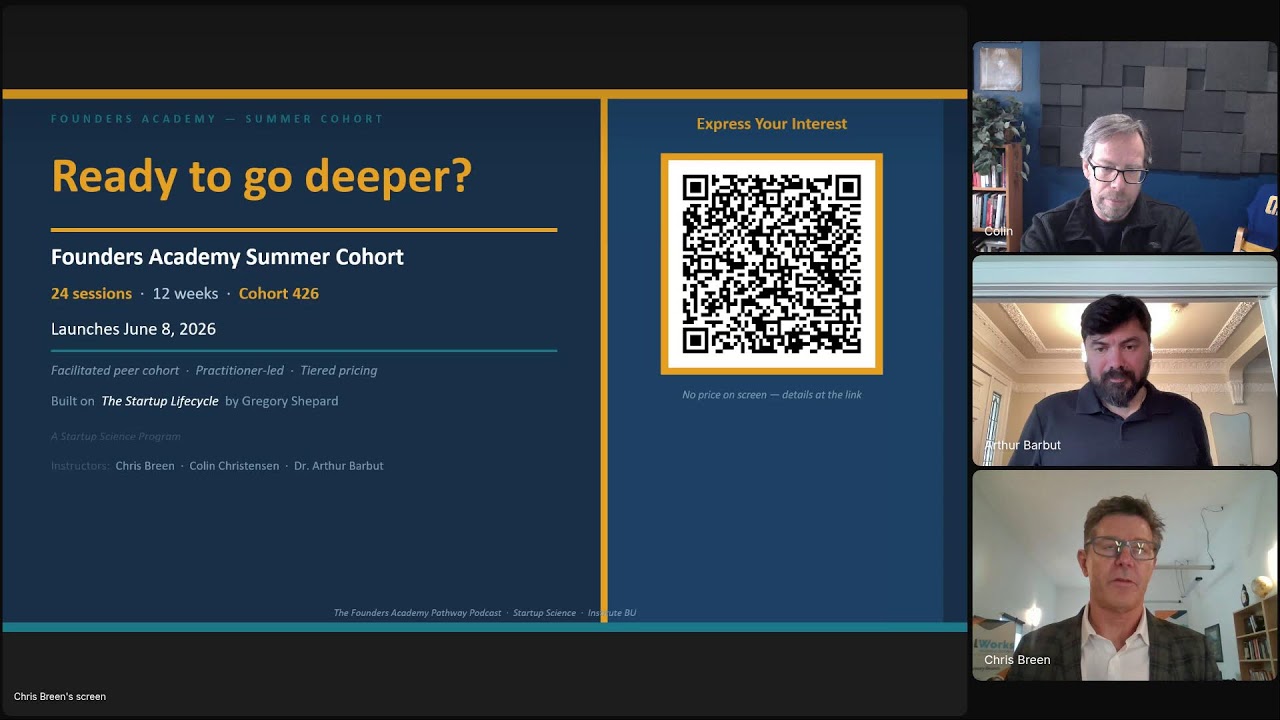
Yeah. Yeah. And then, you know, Ultimately, this is such an important piece of when we look at the 7 stages, right? We're still in stage 2 here, right? We talked vision, mindset. We're in the product phase here because we still need to test all this, not only the product, but then who is that ICP? When we look at the summer cohort coming up starting June 8th, this will probably come up in week 2 or 3 as we get through mindset and vision and, you know, the product you're trying to develop. This is such an important piece. We've seen that people get it wrong too often. And back to where, if we will, founders start to drift, where businesses start to look at changing, or in year 3 or 4 when they're starting to become failures in that sense, because there's a high percentage that do, it's these things that weren't right at the beginning. And so they've locked in and they haven't been able to pivot away because they haven't actually truly got the right persona, the right ICP built in the system, right?
So, it goes back to, I mean, there's a stat, some of it, the 90% failure or whatever, but the CB Insights one is a lot that comes up. And even Greg talks about this in the books and on his podcasts and stuff like that. We know that the stat that has been pretty continuous is that 42% of businesses build something that nobody wants, right?
Yeah.
So, the 42%, that's almost half. And the question becomes, it's not about that, that's a stat, you know, cool stat, bro. Good luck. Have fun. I hope it works out for you. But the stat, the question becomes, well, why? And the answer is what we're talking about. So, half the time people are building something without any outside Perspective. They're building it internally. They're building what they want. They're building their methodology, their idea, their solution, and not getting that feedback loop going early. And that's why you get, nobody wanted it. You know, I've seen it all the time, all the time. Like, that's one of the most common things, especially the developers and the engineers. Love them, but they're the ones that have the means and the capability to do it. So they build it and then you're like, for who? And they're like, well, everybody, right? Taking us full circle back to the beginning of our conversation.
So yeah, awesome, guys. Go ahead, Arthur.
I was just gonna say, we bought a computer, me and my best friend, from my dad one time, and we got it home and we opened it up and it had this crazy keyboard with all these different additions. And we're like, we returned it literally within the hour. We're like, you know, the guy who designed it designed it for himself, who knew all the shortcuts, and it made no sense to to the rest of us. And it's like, totally. But that was like a Samsung or whatever. So it happens at every stage, but clearly the wrong person was designing it and they probably discontinued that. But I'm sorry for cutting in, but it just made me laugh when I was thinking about that. We're like, no.
Yeah, not the ICP. Good. All right, guys. Well, next week we're going to talk on Wednesday. We're going to talk a little bit more then on the simple pitch that rules them all type of thing. And again, I love all of our topics. We're building on something here, right? You get your ICP. With that, now we start to know how we're going to pitch that person, that really specific. And again, there is a framework. And this is a challenge and why we're here really is that 97% of business owners are trying to build a business without any type of roadmap, right? They're doing it and they're building it. And man, oh man, if we can support that, what the lifecycle, the The startup lifecycle that Gregory's done, Gregory Shepard with Startup Science and the things we're building there. I mean, this is all about how can we create and support a bit more of a roadmap. And that is in a sense of a structure in which to find better and more success with business owners that you, when you get into year 3, that you have We won't say guaranteed success, but you've done all the right things early on. And that's where things, again, we, failure doesn't happen. Feels like it happens like that, businesses, right? But it doesn't. It's actually the causes and the indicators start really early, but we get to a point where we don't even know that yet. And so that's what we're building on, right? And so our Founders Academy and the summer stuff we're going to work on, and next week we'll touch on the pitch. That'll be a lot of fun. So thanks, guys. Any other comments before we— on ICP before we let folks get on with their day?
Arthur, go ahead, Paul. Yeah, there's a thing called that Greg often refers to as BANT as well. Just another little framework that you could use, an acronym, which is budget, authority, need, and timing. And that's just kind of an interesting one from looking at, do they have the budget for it? Do they have the authority to make the decision about it? Do they have the need for it even? And timing. We went deeper than this, but I think this is kind of a fun little just checkbox. And there's a number of tools, even the, what's it called actually? The emotional, what is it? It's something like getting into the emotions, right? What do they see? What do they hear? What do they What circles are they in, right? Chris, you do things on that, is talking about the circles. Where are they going and hanging out? Like, these are a lot of ways that we can dig in and talk about it. And we talk about all these frameworks in our cohort. So, just getting in and having some of those resources. But looking at it a lot deeper, really, really important. So.
Yeah, good. Thanks, Colin.
The last thing I want to say is just have the conversations and truly listen. Like, I think that's the most— like, have that as your, you know, part of your persona. Be that person, be curious, be that founder who really wants to find out not what they want to hear, what your potential customer has to say, because it'll make you a much better entrepreneur.
All right. Well, thanks, guys. Great conversation again.
More from Gregory

Startup Science Founders Academy Pathway Podcast | Ep 4/16 | You're Building for the Wrong Person

Run Your Business Like an Investor to Operate Better | Tyrus Shivers x Startup Science
Startup Science Founders Academy Pathway Podcast | Ep 3/16 | The Founder Mindset

Why Our 2024 Financials Don't Tell the Full Story | StartupScience.io Founder Q&A