RMBC II Opening Module (Full Course Overview)
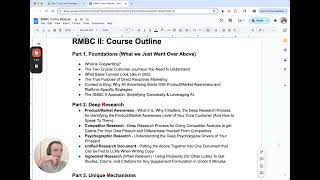
Stefan Georgi walks through RMBC II, a course on AI-assisted direct-response copywriting and funnel design. You'll learn research methods, build a 25-point brief, use Claude to generate copy for ads and sales pages, then design funnels with upsells and email sequences. The focus is keeping humans in control while LLMs handle iteration.
Chapters
Hello and welcome to RNBC 2. I am Stefan. I am so happy you are here and I really believe you're going to be very happy with your decision as well. I am tempted to just give you endless superlatives about how powerful and good and breakthrough ish this course is. But you know, rather than telling you, I'll just let you see it and experience it for yourself and you tell me if you agree. Okay. What I want to do in this quick video is just share a broad overview of what is inside as we get started and then you can dive in. Okay. I'm recording this a couple of days before the launch, so I'm not going to be showing you inside the members area yet. I'll probably maybe do a new video, you know, walking through the members area once we have that all set up. But this is still, I think, good enough to show you what to expect. Okay. And how it's organized. And you may have seen the outline I shared previously, but it changed a little bit as I was creating the course and I think for the better. So the first thing you're going to see after this video is like the kind of intro foundations section which is going to go over kind of what is copywriting, what is direct response copywriting, what sales funnels look like in 2025, why context is king, and then sort of a broad overview of the RNBC 2 approach. Okay. This is a really important module. It's going to set up everything else. And I will be honest with you, there's a lot in RNBC too, but I really would recommend trying to go through as much of it as you can. I really believe if you do that, you are going to have a better understanding of direct response marketing, direct to consumer marketing, E Comm and just selling online than, you know, pretty much anyone who, almost anyone who doesn't go through it. In Foundations Part 1, one of the big parts we're going to talk about, this will be a recurring theme throughout RBC2 is the importance of context. And when we talk about that, we'll be talking about it in a few different frames. One frame is. Platform specific. So what do I mean? I mean that the sales funnel journey, the journey from somebody who maybe doesn't have any idea the brand or the product you know, that you're selling or the service that you're selling exists, you know, goes from unawareness about you to buying. Right. And that looks kind of different on Meta and Native. And it also is different depending on what you're selling and the pricing and all these other things, I'll talk about this in the foundational model or module, but. But it's also really heavily about product and market awareness. And again, I don't want to repeat myself because I'll talk about the next module. But basically the, you know, the thing to understand is like the way you sell to somebody who knows your product or service exists or who's really actively looking for a product or service very similar to what you are offering or you're writing copy for is different than somebody who is vaguely aware that they have a problem and kind of wants to solve it, but isn't looking right. And so there's a lot of importance of context. And I actually think it's one of the key things when it comes to writing great copy and you know, effectively converting people from prospects to customers online. So we go through all of this in the foundations. I won't over share over explain here. We then get into deep research and essentially there are four steps in the core research process. And then I included a section on ingredient research too for people who write supplements. But we're gonna look at product market awareness, what I just mentioned, and I'll give you for all these. I mean, they're kind of bulleted out. I got more in depth with my what's included as I went later in this outline. So maybe I'll add to it. But basically, you know, what it is, why it matters. And also a deep research process for doing product market awareness for any product service, what have you. All right, so sorry, I decided I wanted to add more stuff, so I paused it and restarted. Okay, so kind of what I just said about product market awareness, that's here. Okay. Competitor research, you're gonna give like a deep research process for creating another document that does competitor analysis. Right. So get not just understanding who the competitors are, but what kind of claims do they make. What do your prospects in their specific level of product market awareness. Right? Like what do they like about the competitor products? What do they dislike? Okay, this is really helpful because you know, you, you are even if the, even if your prospect customer isn't like aware of your product or service, like they're aware of other competitors who do similar stuff, like at a broad level, maybe other weight loss companies, other make money online people, whatever it is. Right. So we want to understand that psychographic research is really what the original R was in the original rnbc. There's a deep research prompt for that. But again, what's important in going back to product market awareness is you're Going to see how to do that and understand the psychographic research. And that's kind of the deep psychological drivers for your target customer based on their level of product and market awareness. And so again, this will be one of the first things we go through right after the intro module. But it's actually gonna really flavor a lot of what we do, especially for all copy, but especially on the kind of VSL side. Really everything though. Okay, then you're gonna have at the end of this, three different research documents. One on product market awareness, one on computer awareness. I hate how Loom does the thumbs up thing when you do one. I don't know how to turn off that setting, but it's stupidest thing. One on product market awareness, one on competitor research, one on psychographic research. They're gonna combine them into one unified research document. There's really easy prompt. You just basically feed them to clouds, say, combine them into one, you know. And why is that important? That's important because when we go to generate copy and really go through rnbc, we want to have this one sort of like ultimate research document that's got everything about the product market awareness, what they like, what they don't like, their psychological drivers, their hopes and dreams, everything. Right. We have this perfect brief, kind of brief word because I have a brief later, this perfect document that is all the kind of research information we would need to write great copy. Okay. And then I also include a deep research prompt. I usually use complexity, as you'll see for doing ingredient research. If you need to get studies, claims, citations, all that I mean you can do for any supplement formulation takes less than five minutes to solve. It used to take hours to do that for people say five minutes now it's so nice. Okay, so rmbt, that's research. Then we're gonna be going into mechanisms. Most of you probably know what a mechanism is. I'm the person who popularized it. Really gets talked about a ton these days. It's kind of cool to be the person who popularized it. So yeah, we'll go through an overview of what unique mechanisms are for those of you who don't know. And then we're gonna do a bunch of really cool AI processes for coming up with unique mechanisms. So we'll do ideation with large language models to see how to use again, deep research to come up with actually very good unique mechanism ideas. We'll see examples for Airbnb Arbitrage. We'll see an example for supplements. I think I do one for. Gosh, is it go. I do A bunch, let me tell you. Hold a second. I've got my border here. An eye serum. So skincare, Airbnb Arbitrage, and then I think I share a couple other examples too in there. After that, I think the two I focused on the most were ISERM and Airbnb Arbitrage. Like a high ticket coaching offer. It's like a hypothetical one. There's a process for evaluating them because what happens is you'll get, using these processes, several really good, potentially unique mechanisms. So how do I pick which one's the best? Well, I give you a process to use LLMs, I should probably say, you know, to evaluate them. It's really cool. It's not, you know, if you have a ton of experience, you don't need to depend on lms. I talk about this throughout but like, basically this is a way that if you're between a couple of mechanisms or you're newer and you're not sure which mechanism to go with, this is a pretty consistent, reliable process that will show you what to do. Then you'll see how to expand any unique mechanism ideas you have into kind of copy format and the importance of that. And then they'll show you a cloud project setup that helps to write out those unique mechanisms. But really like the big thing here is that you'll be able to understand the mechanisms well and you'll be able to generate unique mechanism ideas and then select the one that you're happiest with. Okay, so RM bc. So why is B here and C here? What I decided is before we got to the brief and then generating copy, it made sense to put a pretty long core training on sales copy and especially sort of video sales letters. But when I say video sales letters and the original RBC that was really, you know, 15 or 20 to 50 minute hour long VSLs. Okay. And that's still a thing. But these days we talk about BSLs. A lot of them are going to be six to 18 minutes long as well and they're going to be in feed, so they run as meta ads. Others going to be three to seven minutes long and then a lot of them be really short, like two minutes, a minute and a half, two minutes. And they're kind of video ads. So VSL video ads sort of start to get from meta especially start to get kind of interchangeable. And you'll see that there's also a training on hooks, Something I call ADHD hook video ads which are like VSLs, they're three to seven minutes long. They're really effective format. Nobody talks about this publicly to my knowledge, but it's really cool. You'll see some really cool breakdowns from like V shred and svelte people like that. And there's a little module on the difference between in feed and on page VSO that's actually very important. So basically the reason I'm going through VSLs here is because then we're going to brief or creating briefs that you can use to write these different VSLs. And the brief is only valuable and the projects were sent. VSL is only valuable if you really understand how VSLs work. So that's why we're doing this in depth, training on VSLs and the different structure and all that. Then we get to the brief. Brief 2.0. Why I call it brief 2.0. It's very. It's a dramatically expanded version of the brief for anyone who went through RNBC1. Right? So the brief is sort of like a page. Like, here's what you need to go write your copy. In RBC1, you'd have, you know, the target market, what's the product, what's the mechanism, things like that. Then you would take that, you would reference it, you'd follow an outline while you're writing a video sales letter. We're using AI primarily in RMVC2. Pretty much all the writing in RBC2, the heavy writing is done by AI. And then we are more of the commander. We are coming in and we are like, we're the boss, the copy chief. So we get copy from Claude mostly, but it can use other elements too. You'll see examples, LLMs too. And we're saying, hey, this is pretty good. But what about this? What about this? You also see how a lot of the processes using cloud projects, for example, having the referential material telling Claude, hey, give me the game plan. What does the outline look like? What are the different elements make it in depth? Okay. And by this, this is true for PDPs, advertorials, everything all right? Looks pretty good. But what about this? What about this? This doesn't make sense. We need an idea here. What about. What about this? Right? We're thinking about copy more than we're writing copy. You're more like a copy thinker than a copywriter. And that was a really nice little insight I just had. Bam. You're welcome. Thanks for the 997 or 897 or whatever the hell I charged. It was 8. 97 for the presale for a few people, but thanks for 97 because that's like the biggest shift. It sounds stupid, but it's true. You're a copy thinker, not a copywriter. Okay, if you don't like it, this is so valuable. Course. But that is reality for where we're at in 2025. So you have to understand what you're doing, what copy looks like, all that. And then you've got the brief, right? So the brief is like those elements. But now because we're using LLMs, we're basically taking the mechanism, we're taking the research, and we're taking any of their product details, like the ingredients, whatever it is, and we're writing a 25 point document that we're going to give to LLMs that it can then use to write VSLs and ads, advertorials, email sequences, everything else that we're doing. And you're gonna see how to like. I'll go through the brief process with you. You'll see how to use Quad, a cloud project to set it up that sets. I can't talk. You'll set this cloud project that will generate the brief and then you will be able to go beep boop bop and it does it. I mean, I kind of want to show you a really quick example as like a spoiler here. And I'm going to do it, so give me a moment. Wait for it, wait for it. Okay, So there's a bunch of these, but. Let me show you an example. Okay, so we're in this brief generator project. In this case, I'm like, hey, I want you to do a new brief for our brand Opal Beauty CDI serm. Here's the product page where you can pull inputs. Gave it this one, gave it this unified research document, gave it ingredient research. Gave it the UMP and ums. Okay, so basically go ahead and write a brief. In this case I gave it a website, which we'll talk about that you can, you know, for anything where you have existing pages, life becomes very easy. Here's the brief and you'll see how it just sort of goes through everything, right? Demographics, psychographics, what are their pain points? Now again, I'm going to go through this in a whole module. Big promises. What does it look like when their pain points have been solved? Emotional empowerment. What solutions exist? What do they not like? What's the unique mechanism? What are nicknames for it? What are the main ingredients and what are the studies which we had from perplexity? What are bold claims that we can make? What are emotional transformational claims? What's the product? What are the key benefits and fascinations? What makes it unique? Background story. In this case we started with, you know, placeholder thing here. Who's the main speaker? Who's the secondary expert? What are the details of the brand? What are testimonials? What are credibility builders? What are medical endorsements? What is industry recognition? What's the normal retail price? What's the actual price? What are the multiple option savings? What's the guarantee? What are the bonuses, if there are any? What are the scarcity elements? What is future pacing? What do results look like? What are objections and answers? What are specific hooks you could test? Okay, that's pretty cool, right? And what's neat is. And kind of crazy because in that case like, well you gave it a website, so that's true. So let me show you this one. I literally just said here's ingredient research basically during a new brief, use placeholders for now. And it created this brief. This first brief was kind of more like a clickbank style. Like oh, Sarah's this mother of two, she has this horrible blood sugar, you know, she has high blood sugar. She meets an expert. So we should see if we could clickbank type of offer. Then I was like, hey, that's great, let's do a second version where it comes from a doctor, okay, shares a patient. Sorry about a patient who's at their wits end. He helps them discover the real reason for blood sugar issues. And it's like, okay, in this one doctor is here, right? So it created essentially it even created a unique mechanism that wasn't bad. Now again in the process you'll see like you'll have a unique mechanism, you have all that. But the point is you've got this really awesome brief that you can just immediately work with, right? So hopefully that see how that's valuable. Then we get to copy part two. And so I know this is already kind of a long intro video, but it's important I think for you to see how this is all going to go before we get into the overview, like part one kind of overview of the state of Director Sauce marketing. So again you've done your research, you've got a unified research document, you've done the mechanism, you understand copy really well if you didn't already, then you have the brief. Now you've got this brief, this amazing document that you can use to write. And now it's time to create copy. And so here we're going to use cloud projects. We have cloud projects for long vessel, medium length VSLs that are 6 to 18 minutes, let's say 3 to 7 minute VSLs, short VSLs. And you'll see how we just basically give it the cloud projects, the briefs. We say, here's a brief, write a vsl, basically. And that's what it does. It's pretty wild, right? Again, without making this module too long. Let's see here. Sorry guys, I'm just trying to find a quick example. There's a bunch I'm just pointing from cloud projects. I mean, some of them are done in. How do you say it? Like, let me show you, I'll just show you really quickly. Like, Here's a comprehensive brief. Should give everything. Please write it, give a little bit of detail. In this case, I'm telling it like a story because we didn't have one. If you saw a skincare one, I'm like, hey, here's the story we could do. Go ahead and write it, okay? And it gives. It will give me an outline, gives me outline, give a little feedback, give it the classic sales letter outline, gives me outline again, revised. Cool, let's go ahead and write it. And this is for a medium length esl, but goes and writes it. And I promise you, as we get into these projects and you see them like the copy is quite good and you'll see it, but you'll also see very importantly, and I should always put this in here, like. One really important element is. Sorry, I wish this was another bullet. But basically copy cheaping, feedback, tweaking, all of that, right? Because you're copy cheaping too. Okay. After that we'll get to a mid, mid course recap and I'll sort of be recapping at that point all the things I've talked about in this video. But you'll have more understanding. So I'll be like, again, hey. Because there's a lot. You're gonna go into the weeds. I have this in my little intro module, like my opening module thing. But basically you kind of go through how to come back out the other side to like heaven, right? And so it might feel like a little bit like man, like there's a lot going on here. But when we zoom out, It's a pretty simplified process. So go back. This is my one. You know, you start here, the bowels of marketing hell. You make it to the other side, which is sort of like heaven, right? But basically like RNBC. It's just different. You're using LLMs. It's actually way more efficient. It's way faster and you can create any type of copy. Like with this sort of setup process, you're going to go through and understand the theory of and understand the why and the how you can create any type of copy, right? And so from there we'll go into advertorials. And for everything we do with these things, like advertorials, you're going to look at like tons of case studies. What's the purpose? Why long ones versus short ones? What are common elements? Where did we start before the advertorial? We started the ad. We went to the advertorial. The advertorial took us here. Where's here? It's a product page or a landing page, number nine. Or maybe it's a checkout page, right? Maybe it goes right to a checkout page. Maybe it goes to a bsl. You know, like, why and why does that happen? Why? What's the psychology? What's the thought process? Why does one advertorial go to this short, like a Rachel checkout page? Another one goes to a vsl, Another one goes to a short product page. They're talking about the product. One goes to like a Econ product page that's really long, kind of like a. Like a tech sales letter. Like, what's the difference? Right? And if you don't know any of these things mean, don't worry, because that's what all these modules are going to do. They're going to explain it all to you. All right? So we'll look at a bunch of examples. We'll do walkthroughs, and then sure enough, you'll have a quad project for setting up and generating endless advertorials of any length for whatever platform. Doesn't matter. Similar thing with product pages, right? We're going to understand, you know, why are some product pages short? Why are some long? Like I've been loving. I don't know if I can find this. Let's see here. Should be here. Is it like one of the examples we do in the courses this at home cleaning spray. These guys have a great E Comm. Product page, right? Super sexy, really nice. Love it. Another brand we look at in the thing is this. Clarify on Odorex, which. This is an advertorial, which you'll see many times as we go later. Right? But their product page. Wait for it, wait for it. We're waiting, we're waiting, we're waiting, we're waiting and we're here. Their product page is basically like a checkout slash product page, and this is it. Okay, so why do these guys Have a product page like this that's really just a little above the full thing. Product selection, pay FAQs. And meanwhile these guys have this much longer, really sexy highly formatted page. Why is that? Well you'll find out as we go through. We'll do tons of examples for everything like supplements, you know, devices, some like a high ticket like book a call funnels, all these things. And then you'll see how to use AI to create outlines from. I was just say sorry Winnie. PDP structures and instantly generate new ones. So similar concept here and really good, like you'll love it. It's great. You can just write endless product pages and you'll see that, you know, with our friends at Claude. I use Claude a lot. All right, part 10 checkouts. So this isn't a super long module but it's kind of important. It's good, right? So here you know the checkouts pretty like it's a weird checkout. But let's go to Emma, like Emma relief, which is the digest of something, right? Okay, let's go one time, purchase one pack, claim your supply. Okay, this is Emma's checkout. We will also be looking at mobile for those of you wondering like, you know, we'll typically do this. So here's the product check out, right? Go to Dr. Clean. And there's all of this stuff before I get to my proc selection thing which is mentioned again here even though I think it wasn't on the landing page and then you enter your information and then there's a bunch more stuff. So why do they have all this up here on their checkout? Well, Emma goes right to the contact, you know the information and guess what? Turns out there's really good reasons for why the checkouts are different. We'll answer those and you understand it and again within the context of the whole customer journey. Well then get into ads. Okay, so the way we're going back, well not backwards but this is just the way it makes sense to my weird brain. Okay, so it's like, okay, like ads, like what? How do we get them to start the journey? Okay, so we're going to go from like, you know, an ad to maybe an advertorial or maybe a landing page, product page or maybe to a video sales letter, you know, to a checkout to buy. Well, when are we doing what? And we'll find out a lot of that as we go through ads. So I'm doing the meta ads. I have a bunch of examples and a ton of different niches and we'll also look at where the ads go. You know, there's a lot of video ads. We'll also look at static ads. What's the purpose and essentially the length of an ad. Right. If it's like a short little ad, why is it often going to an advertorial or vsl if it's longer, it doesn't like, you know, you'll understand all that. Native ads with din. He is an incredible media buyer on Native. He was part of a really big agency and now is kind of off doing his own thing and does native buying for so my businesses. For Google, we'll have David O' Connell from the O' Connell Agency and he's covering, you know, everything like PMAX, Demand Gen, you know, AdWords, all that good stuff. Maxwell Finn will be doing TikTok. They are incredibly knowledgeable on the TikTok side. So everything and all things TikTok ads, psychology and copy and everything there. And then YouTube. Meet Tom Clason at Tried and True. Tried and True has been one of the best YouTube agencies for forever. They actually run a lot of stuff for Emma, who I just mentioned, and they'll be talking same thing like sort of different YouTube ads placement, copy elements and all that good stuff. And there are AI processes for generating winning ads fast, especially on meta. But you'll see how quad projects can be used to do this for really any type of ad that you're looking. And by this point you should understand and be like a master of quad projects so you can set them up for anything, really. Right. That's a huge part of it too. It's like part of what I'm. You'll look at copy, you'll have a better understanding of everything, you will know how to generate great copy and you'll feel empowered to experiment and do things on your own that work for your specific purposes and needs. All right, at this point here we'll get into the 15 factors that determine your funnel structure. This is a really cool training. I did this for CA Pro and I haven't done it since then, so I'm taking the one from Pro. But it's really cool. And essentially it's a criterion that you can use, like a checklist where you go through, you sort of evaluate the offer, the product, the psychology, the consumer, the product, market awareness and all of that, and the pricing, all these other factors. And based on that, it tells you, okay, here's what your funnel structure will probably look like as a best bet so you don't have to do it. It's not like the written in stone, no exceptions ever. But it's a really nice way to understand if you're trying to figure out how to sell something, where to start? What should your funnel structure look like? Okay, it's really cool. I don't think anyone's ever done anything like this before besides me. It's really awesome. But it makes sense to put it here because you need to understand everything else first, right? The whole journey, the context, the product market awareness, the copy you're generating, why you're doing what copy, where and all that from there we move into upsells quite logically. Okay, so they've completed journey from A to B, now they're going from B to C. How do we get a repeat buyer? And that's where really like you can sort of go like you know, from B to C, you know, nd nef N. Right, like so I'll make this its own big little thing here. So upsells are first and foremost. So we'll talk about upsells but none of us in a vacuum. So again, what are the. How do upsells impact funnel economics, you know, what's the purpose? Right, what are the, what's the psychology? What are the common elements? Like why didn't, you know, why didn't somebody. Or how do we, you know, what do we. What. How do we message them? And like what. How do I. Sorry, I'm stumbling because it's actually a really cool training and I want to kind of show you, I want to kind of spoiler it for you a little bit here. So give me a second, let me just show you why I'm stumbling over my words. Okay Here like what are we selling? Right? Better results, faster results, an improved version, new problems, expanded problems. Like there's a lot of really cool stuff here. I'm just going to tease it because I might show this video in the. If you. Who haven't bought yet but like you, we'll talk about all the sort of psychology, the funnel economics, the purposes, like what we need to address, you know, and what we're doing with a strategy, rate loss strategy is what I'm really trying to say here. So I should put the Buddhist walkthroughs, everything from cleaning products like that doctor Clean spray you saw David protein bars to supplements like Emma and Happy Mammoth. And then like biz op stuff like info products, right? Where the upsell flows. What are the journeys? And a cloud project set up for doing endless upsells or cross sells. So whether you're selling more of the same or you're cross selling and selling a different product. You have the cloud project set up to be able to generate tons of those. Then we get into email marketing journeys. So abandoned carts. And again, what they're really thinking about the psychology, how it impacts funnel economics, how it impacts your ability to scale or the people you're working for or with ability to scale and why people really don't buy. What are the real reasons? We'll look at example flows, supplements for supplements and for a book, a call funnel. They'll do the same thing for a welcome series including both like getting them to buy more. Right. But also for consumption. For example, they buy a high ticket thing and you want them to consume. And for a digital course I should say with. Right. So kind of like this is a really classic E comm supplement. And then we get down to examples. You'll see how to like do more cross sells too. For supplement flow or funnel. Okay. Promotional sequences like holiday promos and flash sales. So like 4th of July sales, an example. Or a Thanksgiving Black Friday sale for supplements for like a biz op, sort of like SAS tool that's like a one time purchase. Also like a 24 hour flash sale. You just get like examples, templates, psychology, everything. Same thing with reorder sequences and win back. So reorder sequences for people who, you know, they bought supplement for example and it's time to buy more of them. Right. They're not a subscription. Also the winbacks for someone who bought a supplement and now they didn't buy more and getting them to buy more and what do we say to get them to actually buy more. And by the way, I took these from my telemedicine platform and I'm just applying them to a supplement example. But they were for telemedicine to really any physical product and you'll see that. And they also included them for a like SAS subscription tool. Right. So you had a. I think it's like a Airbnb arbitrage. Like it helps you like find the right market or the right properties to buy. It's like a tool, it's a hypothetical example, but you know how to get them to resubscribe right. To a SaaS tool and then quad project and set up for generating endless email sequences of any type of product or service. Okay. And then the bonuses which might seem a little skimpy at first, but first of all, frankly the core like RNBC is insane. Like I really feel like I've just. Yeah, I feel like I Solved copywriting entirely. And I just, I don't know what someone else could really create about Copyright after, after RBC2, to be honest with you. I feel like it's like done, nailed it, fixed it. But a couple cool things. There's a CRO kind of best practices training that Ethan from 4080 Marketing did. 48 Marketing is an awesome CRO agency. We've used them for my telemedicine platform, use it for my skincare company. We connected them with like Josh and Snow Teeth Whitening. They've done stuff for Josh, they've done stuff for probably other people. I actually not probably very, very, very, very, extremely high profile people that I probably can't say because some of those people are real big on MDAs and keeping private. These guys are really smart, right. There's a talk on E. Comm and Amazon from Eddie Maloof and he actually is probably working on an additional bonus training. I'll talk about that a second. Funnel economics, like an in depth breakdown of funnel economics and thinking of it that way for me, high ticket webinars, the structure and copy and all the elements of Dylan Vanis and I put n question mark, question mark, question mark because here's the thing, like those are the bonuses I'm launching with to get this on July 7th, but I will end up adding more bonuses for sure. If you look at the original RNBC one, it launched with like five or six bonuses and there was like 20 something bonuses within a few months of that. Because if people ask for certain things like hey, what about this, what about that? Or people loved RNBC and were like hey, I'd love to contribute a bonus, whatever it was, I'm like hey, let's do it. And so I promise you I already have several other things that I actually am in the works on for bonuses, but I promise you more bonuses will come as well. Okay, so this was a pretty in depth overview of everything but I think it was worthwhile to give you the territory and the roadmap of what's happening. So again like you're going to be able to, you have incredible research, generate mechanisms as needed, right? Generate these incredible briefs, take them into an LLM and generate any type of copy you want. That's really at the broad level what it is, right? So and whether that's long video sales letters, medium ones, three to seven minute ones really hook heavy ones, short ones, whether you want to do in feed or on page VSLs, whether you're doing product pages and landing pages, if they're sort of short or they're like long kind of mini sales letters. Whether you want to do short advertorials or long advertorials, whether you're doing meta ads, native ads, YouTube ad video scripts, it doesn't matter. Right? So I'm not sorry I'm not cooked. My nose is itches, upsells, emails, everything. And it'll keep getting better. So enjoy. Dive in. The next module for you is going to be kind of the opening contact center. What is Copy understanding copy in 2025, a little bit more about the platform, specific aspects of things and all of that. And then we'll get to research and you'll be on on your way. All right, thank you so much. And please feel free to give me feedback, share with me, talk to me as you go through all of this. And can't wait to hear from you. Thanks.
More from Stefan











Why Understanding Product-Market Awareness Is More Important Than Ever in 2025