Stefan Georgi - The Royal Flush of Copywriting (REWIND)
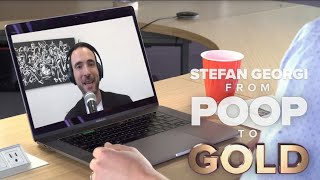
YouTube interview (June 29, 2024) in which Stefan Georgi — a direct-response copywriter and cofounder of Copy Accelerator and Turtle Peak — recounts his journey from aspiring poker player to copywriting success. Key moments: an 18-year-old royal-flush/gold-bar anecdote; his father’s rapid diagnosis and death from stage-four liver cancer in 2011 (a turning point that prompted him to pursue income-generating online work); a chance meeting with a copywriter in Las Vegas that introduced him to the field; early freelance wins via Warrior Forum; later scale working with publishers/clients (ClickBank, health offers) leading to large revenue-generating campaigns. He describes Copy Accelerator (weekly trainings, Facebook compliance, live events) and points listeners to his blog and social profiles (Facebook, LinkedIn). The episode includes sponsor messaging for a 14-day video script challenge.
Chapters
When I was 18, I thought I was going to become a professional poker player. The year before, Chris Moneymaker had just won the Real Series of Poker. It was getting really popular. It was on tv and I was pretty good. I'd read books, I studied, I took it really seriously. And one week when I went in, they had a promotion at the local Indian casino where if you got a royal flush, you would win a gold bar. And of course I got a royal flush and I got this gold bar.
We're all about turning a crappy situation into something positive.
Quarter million dollars of credit card debt. I still remember the day when no one turned up, throw it in the garbage and start from scratch. I could give myself a ch. So I started something.
I mean, I think that counts as.
From Poop to Gold.
Our sponsor for this episode is our 14 day video script challenge.
Yes, we are sponsoring our own show.
Yes, we are.
Welcome back to From Poop to Gold. I'm Benton Crane, your co host and the CEO of Harmon Brothers. And today on the show I am joined by Stefan Georgi. Welcome to the show, Stefan.
Hey, thank you. It's good to be here, Ben.
So. So Stefan is one of the top direct response copywriters in the world. So his work has grossed over $700 million in sales and he is the co founder of Copy Accelerator with Justin Goff. And Copy Accelerator has a weekly training program and he's also the co founder of Turtle Peak, which is a Vegas based contact center. Right?
Yes.
Okay. So Justin, let's talk a little bit about what you're doing at Copy Accelerator and what does it mean to our listeners?
For sure. So Copy Accelerator is a, as you mentioned, weekly training program that helps people who are both copywriters and business owners in the direct response space to create better sales copy and better offers and funnels that can then scale on cold traffic. So a lot of that comes into the form of long form sales copy, sales letters, video sales letters, things of that nature. And we do everything from every week there's a zoom call. We're basically teaching on something, whether that's how to write better headlines or how to write a better lead that hooks a viewer in and keeps them watching or reading the sales copy or how to optimize your upsell so you get a better average order value from your sales funnel. And then in addition to that, we have trainings on Facebook compliance. Because a lot of people who are doing marketing today, especially in the health industry or even financial, a lot of industries have trouble creating advertisements that can really run on Facebook and not end up getting in trouble. And it's usually because of little things. It's not like we're not working with people who are making really outrageous claims, but there's still things that are red flags for Facebook and things like that. And then we have a couple live events per year as well.
Awesome. We're big fans of copywriting around here.
I can imagine.
Yeah. Anyone who follows, follows us knows the lengths that we go to in the copywriting process before we make our videos. So we're big fans of that process. So here in a minute, I want to dive a little bit more into your process. But before we do, this, of course, is the Poop to Gold podcast. And so we've got to uncover your Poop to Gold journey, and then we'll come back to the copywriting piece of it. So. So we know that every successful person has had to go through some crap to become successful. And there's usually a handful of moments, or sometimes it's one defining moment where things get really hard, really black, really dark. The dark of the night type thing where you just can't see the light. You don't know how you're going to get through it. What was that moment for you?
So that moment for me was when my dad was diagnosed with stage four cancer, which happened pretty suddenly. The full story is really. I was thinking about this before I came on. The story is a From Gold to Poop to Gold story. So we get to add in an extra layer of gold there, almost like a poop sandwich, if you will. But basically to kind of give you the quick background. When I was 18, I thought I was going to become a professional poker player. So I'm from San Diego, and there's all these Indian casinos where you could play at the age of 18. So I was 18 in 2004, the year before. Chris Moneymaker had just won the Real Series of Poker. It was getting really popular. It was on tv, and I was going to the Indian casinos every day in my senior year of high school and playing poker. And I was pretty good. I'd read books, I studied, I took it really seriously. And one week when I went in, they had a promotion at the local Indian casino where if you got a royal flush, you would win a gold bar. And it was about an ounce of gold. And so kind of noticed it. And I was playing poker, and of course I got a royal flush and I got this gold bar. And what's funny is, of course, when you're 18 and you kind of feel like the world comes really easy to you. It's like, oh, cool. Royal flush. This is neat. But I played a ton of poker before, and since then, never got a royal flush. Ever since it's extremely rare to get a royal flush. Right.
I was gonna say that a lot of people will play their whole lives and never get one, right?
Yeah, totally. So to get one at 18 and just kind of be like, oh, yay. But when I got home and I told my parents what happened and my dad offered to buy the gold bar off me, and the price of gold at the time was about $420 an ounce. And the reason I remember that is because I was an 18 year old and it's like 420 seemed funny to me, but I sold him the gold bar and took the cash and whatever went on with my life. So Fast forward to 2011, and I've kind of had my own rocky journey of going to school, dropping out, going back to school, working a bunch of jobs and. But at this point in 2011, I'm working in Marble Falls, Texas, at a place called the Outdoor school, which is essentially a large summer camp that this guy bought was like his childhood summer camp. He bought it, and then during the fall and spring, he would turn into like an outdoor ed thing where he. You bring in kids from all over Texas, they stay for four to five days, and you teach them about water quality or nature or living off the land, astronomy, all that. So I'm there, I'm really enjoying myself, and I'm feeling like maybe this is actually my calling in life, that I'm going to be like an outdoor ed instructor and do all that kind of stuff. But I get a call from my mom, and this is in late April, early May of 2011. And it's, you know, your dad has cancer, it's really serious, and, you know, we're not sure how long he's going to last. Oh, man. Yeah. So obviously that's not a call you're expecting, because I knew he was having, we thought kidney stones because he was having stomach pain and things like that, but he, you know, we thought it was just kidney stones. And so I was. Obviously felt bad for my dad for that. But then to suddenly go from, it's not kidney stones, it's a rare form of liver cancer is pretty brutal transition. So this is kind of the poopiest moment of the beginning of the poop, right? So I go home after that. I finished the final week or two of that outdoor school, and I Go back home to San Diego, and I spend the next four months with my mom and my dad. And I'm just trying to help out and be there and support my mom and my family and spend time with my dad and do all of that. And I'm really grateful that I did do that, because I got to be there for the final months of his life. But then In October of 2011, he passed away. And, you know, which is, of course, very difficult. And to go from, to give you context, In April of 2011, I'd come back home for a weekend to kind of surprise my parents and went hiking with my dad, and we hiked up a mountain and seemed totally fine. Right. So to go from hiking up a mound in April to having him dead in October, it's just such a crazy thing. So after that happened, that's.
Even by, like, cancer standards, that's. That's pretty insanely fast, isn't it?
It's. It's pretty fast, yeah. Cause it was. It was stage four. It was pretty developed. Um, you know, they. They. I honestly don't know if the chemo helped or hurt, you know? Cause it's one of those things where I think he did the chemo to. To show the family that he was trying to do something. But when you're really that far advanced with the cancer type of cancer, it's tough. I remember being at a Starbucks in Marble Falls, Texas, because we didn't even have WI fi on that outdoor school where I was and kind of googling the type of cancer he had, and a Wikipedia page, and it said something like it was like a 98% mortality rate in under a year or something crazy. And that was when I really lost it. Because before then, you're kind of in shock. I remember reading that. And then I got in my truck that I had the time, and I just drove around the rural Texas for, I don't know, the next six hours, just kind of crying because it's. It just wasn't one of those things where, like, you know, some people. Some cancers are more beatable. And obviously it depends on how far along it is and everything. But, yeah, in that case, he was. He was. It was pretty advanced already.
Oh, man. I'm sorry. That is brutal.
Yeah, no, I appreciate that. And so what.
What are the. In terms of the impact that an event like that has on the development of your career? Um, you know, what. What are you feeling? What are you thinking at this point? Can you even focus on. On your career at this point? Talk to me about some of those emotions for sure.
So at that point too, what's interesting is maybe two months before my dad passed away, I was pushing him around this like care facility he had, he was at and like a wheelchair. And he kind of turned to me and he said, you know, it seems like you're a bit of an unguided missile. And I kind of took it. I understood why he said it, but I didn't fully agree with him. You know, he said it because up until that point I had jumped around from different things. So I'd worked in a call center for a for profit college but I felt not good about myself with that job. So I had left it. I had worked on political campaigns, going door to door. I'd done all this random stuff and. But I really felt like what I was doing at that time was going to be what the thing. So, you know, I don't know if I had like a career, but I had the starts of a career there. And one of the first things that happened when I came home is to help look after my dad was kind of what can I do that could make money and generate an income while I'm at home being there for my family? So I think I. This is funny because my wife did the same thing and we'll get to her in a minute because she's part of this whole story. But I'm pretty sure I googled like how to make money online or something like that, which you always think like nobody actually searches for that stuff, but they totally do. And I read the four Hour Workweek by Tim Ferriss, which I know a lot of other entrepreneurs have read early on. And so, so I. My whole mentality was can I find a way to make money online? And that was the first time I really ever had thought about that. But I didn't. I wasn't successful at it. I started like a drop shipping store selling sports memorabilia and kind of set it up, but I had no idea what I was doing. It kept me distracted kind of. But you know, I never really made a sale for that. But at least at that point I'm thinking like, how do I, yeah, how do I make money? How do I generate an income? Like, and at least I'm thinking about online for the first time at that point.
So you're in the learning phase at that point.
I'm in the learning phase for sure. Yeah. And what's interesting is to kind of tie this in is after. Because after my dad passed away, I decided to blow off steam and not Right away. But after six weeks or whatever it was. And I remember there was, like, an airfare sale that Southwest was having, and I put a thing on my Facebook and was like, hey, does anyone want to go somewhere and take a trip? And a friend from college in Florida had said, I've never been to Vegas. Do you want to go to Las Vegas? And I said, sure, man. That sounds good. Let's book it. So we booked it for the middle of December, and a few days before I was going to go, I'm standing like, man, I don't have any money at all, But I'm going through my dad's stuff and possessions, and I find the gold bar that I had sold him back in the day. And this is late 2011. And gold was worth $2,000 an ounce, which just shows my dad was thinking a lot more intelligently about that than I was at the time. When you're 18. Um, but I took it to, like, a cash for gold place, and I sold it to have money for this Vegas trip. And I went. And while I'm there, the first day or whatever, we stayed at Circus Circus. It was like, $20 a night. And the first night, I lost, like, several hundred dollars playing blackjack and was kind of freaked out because I really didn't have a job or anything. But the next day, I played poker with my buddy, and we won some money. I hadn't played poker. Remember, I played, like, regularly at age 18, but I hadn't played in, you know, several years. But he had suggested it. I said, sure, why not? We won a couple hundred dollars, and it was great. So, like, hey, let's play poker again. And we picked Caesar's Palace. There's all the places we could go. And we picked Caesar's completely randomly, and we went there, we sat down at the card table, and we're playing poker. And this girl comes into the poker room, and I noticed her immediately, and I joked to the table, oh, I hope she gets seated at our table. Because when you play poker at a Vegas card room, like, you don't get to come in and just walk up to a table. You see the host, the person there, and then they sort of look at the table, the different tables, and see how many empty seats there are, and they'll kind of, you know, balance the table so that there's always as many people at each game as possible. But she did get seated at our table, and I just immediately was attracted to this woman. And somebody asked her pretty early on, like, what do you do for A living. And she said, I'm a writer. And I wanted to talk to her. So I said, what kind of writer? And she said, I'm a copywriter. And I said, wow, copywriting. That's really interesting, you know, so cool. And I got. I had my first generation smartphone or whatever I had, and I pulled it up under my table and I Googled, what's a copywriter? Because I had no idea. I, um. And I kind of. That's the first time I ever heard about copywriting. But to kind of. And feel free to. Obviously, you can stop me at any point, but to kind of, like, tie a. Tie it all together. I ended up taking a job in South Florida after a few, like, a month and a half after that, she came for a weekend to visit. I was like, I don't want you to leave. She didn't want to leave, so she moved in with me. Her car got shipped down from New York, where she was from, and I was doing the sales job, making $200 a day, which was a good job at mid-20s and really, especially for someone who had bounced around a lot. But I still found that I was going out in the hot Florida sun and working all day and sweating and not really feeling fulfilled. And I'd come home and she was in her underwear having a beer, and she. Some days would have made, like, a thousand dollars in the same day. And so I'm like, man, like, I want to do this copywriting thing. And so eventually I asked her, hey, do you think I could be a copywriter? It really wasn't. I'm going to be a copywriter. It was like, do you think I can do it? Because I had no idea. I really didn't know much about copy at that point, but she said, yeah, kind of copy what I do. Check this stuff out. Kind of model off of what I'm writing. And I put an ad up on a website called Warrior Forum, which was like a Internet marketing forum from back in the day. It may still be around. I offered to write other people's sales letters for $149 per. And I woke up the next day of $298 in my PayPal account. Two people had hired me. And then that was the magical aha, oh, my God moment. I can make money online, like, you know, everything. And that was sort of the start of my career. That was my career for, I guess, eight years now.
Gotcha. So give us the. So you have that moment where you're like, okay, this can be done. And you saw Kind of the vision you saw, the light that sets you on a path to get you where you're at today. Give us the abbreviated version of that path that took you from. Hey, I know this can be done to now. You're, you know, you're a world renowned expert in it.
Sure, yeah. It's funny because in some respects it feels like long, but if you look at eight years in a broader kind of scheme, it really isn't, I guess. And it's probably even kind of meteoric. But still, the first two years or so it was a struggle because I was a freelancer. So once I woke up and had $298 in my PayPal account, I quit my corporate job maybe a month and a half after that. And I had all the visions of I can be riding on a beach in Bali. You know, I'd be sitting there in the sand like a tropical drink, typing away. And I can be on an airplane just working and by the time I get there, I'll be vac. Life will be a vacation and amazing and all that. But you know, what really happens is there's. It's a total grind as a freelancer. There's a whole feast or famine kind of thing going on. And I quickly found that there were months where I would make a lot of money, a lot being relative, but five or six thousand dollars and feel like really great about it. And then there's months where I did not get anything. I pawned my Xbox probably four or five times. It was almost an ongoing joke. I would take my Xbox into GameStop and sell it for $200 or whatever so I could pay rent. But then I'd have a really good month and feel like, okay, I can get this Xbox again. But then suddenly, what do you know, there's a cash flow issue and they're back to GameStop. I would go or I would go on vacation. We went to Acapulco with my wife. The girl became my wife, by the way. That's the big. I always kind of forget to mention that. But the girl from the table is now my wife. And we have a young daughter, but got married. We went to Acapulco with her, her dad and her grandma who had a timeshare there. And it was like beautiful. And I should have been able to enjoy myself. But I remember just working on client stuff the entire time, like barely left the hotel room, hardly went on the beach. And so, you know, it wasn't easy. But over time I got, you know, continued to get better and I get got referrals from clients, which was really important. And I'd get like the right clients. I just also got very lucky. And in 2014 I got hired by a guy off of that same website, Warrior forum. And I think I was charging $497 like a sales letter now. And he was like, I'll give you $1,000, just make it really good. And I was like, oh my gosh, like, this is huge, right? So I wrote sales copy for this guy. It did really well. He was working with a partner doing stuff in the survival space at the time. So things about how to make your own home aquaponics system. So essentially you could be like a self sustaining in cases of a disaster or whatever. I started writing copy for them. They invested their time into teaching, training and mentoring me. So they didn't just kind of say thanks for the copy. They'd be like, here are resources you should study. Here are things you should look at. Look at what other people are doing, like break down their sales copy as well. They really gave me a lot of guidance there. And when the guy who had hired me originally, he went on to a health publisher who was in Romania, but they were publishing informational products on health and other stuff. And they brought me along with them. And at that point, what was really cool, this is kind of my big break, I guess, is they really believe that you could write a sales letter. And by a sales letter I mean like a script for like basically an online infomercial for people who don't know what I'm talking about there, and we're talking 6 to 10,000 words long. And they felt like you could write one every day practically. And I'm like, that's crazy. Most sales copywriters are taking two months to write these things. But they were like, we really think you can do it. And if you look at it formulaic and as a step by step process, and they created this whole incentivization structure where if I wrote four sales letters in a month, I would get $4,000. So $1,000 per. If I wrote eight sales letters in a month, I could get $2,000 per sales letter, so 16,000. And if I wrote 12 sales letters in a month, I Would get $4,000 per sales letter, so $48,000. And then on top of that they had some different other bonuses and things I could do to where I could make 60 to 80 thousand dollars a month. Which going from before that. Yeah, having made five or I think maybe I made 10,001 month. Before that ever. So that was obviously a crazy opportunity. And their whole thing was they were going after the blockbuster model, the Hollywood model. We want to put out as many new kind of offers as we can, as many new sales funnels as we can. And we think that two of them will do really well. A handful, three of them are going to do better than average, three of them will do a little worse than average. And then a couple of them are probably going to be total duds.
Kind of a portfolio model.
Exactly, yeah. And the really cool thing with that too is they were basically like, you can sort of invent like ideas for products and we have the team to create it. So like I did a lot of stuff with health, but you know, if I wanted to do self defense, they'd be like, yeah, like we can. You want to do something about like forbidden death touches, which is like a real thing in martial arts. Like you want to create a guy that teaches people these forbidden death touches to help defend themselves. Like you can do it. And I'd be able to like actually come up with that idea and then write the copy for it or stuff about, you know, investing or sports betting or whatever it was. And so I was just really prolific, writing a ton of sales copy. I developed this process called rnbc, which I don't think we fully have time to go into today, honestly, but it's basically just a four step approach that helped me to kind of really map out my sales copy faster. And from there this stuff worked. It was successful. They scaled. They went to 100 million in revenue in a single year. There's a Marketplace Online called ClickBank and at one point I had 8 of the 10 top offers on ClickBank for it was like over a year straight. Like everything that was kind of the top offers, I'd written them. And from there I started my own house supplement company, then got involved in more of those health supplement companies. Still did client work, but I was able to work with more, I guess, advanced clients who had the infrastructure to really scale. Like today I work with the guys at V Shred and Sculpt Nation, which I don't know if you've ever seen their stuff, but they're in the house space. Their run rate this year is like 200 million. I think they did 120 million in revenue last year, which then helps me to sound really cool when I say my copies grossed over 700 million. A lot of that is just getting really lucky with the right clients. But I've been able to do that over time. And to where I'm today. And then at this point in my career, a lot of it is focused on the training, mentorship, teaching and giving back and helping other people because I feel like I got so lucky that that's a huge reason why I do the copy accelerator, mastermind and other stuff like that as well.
So for our listeners who are interested in copywriting, where should they start?
One place would be like my website. I'm not trying to like plug my website and my website's not, it's, it's, it's just loaded with content. It's like my blog and stuff like that. I would say it's worth looking at. And then honestly, basic stuff as funny as this to your website. StephanPaul. Georgi.com Got it. And then if you go forward, slash blog, you'll see I have a lot of content on stuff, including on copy as well. You know, I would look at, there's different Facebook groups I would look at. There's one called the Cult of Copy. It's run by a guy named Colin Terrio and then he has a jobs board as well, which is a separate Facebook group. There's an, honestly, as it sounds like Googling kind of stuff about direct response copy. Looking at, you'll find good articles, you'll find resources, you'll find things to kind of give you the, the broad strokes about what it is, what it, what it looks like and all of that. So it's probably three places you can, you can start.
Awesome. What social platform are you most active on? For our listeners who want to keep.
In touch right now, really, Facebook and LinkedIn.
Stefan, Georgi. So you can, you can look him up on, on LinkedIn. S t e f a n first name and then Georgia is G e O R. Yes, sir. Awesome. Stefan, thank you for coming on the show. We appreciate you taking the time to share your story and share some of your knowledge with our listeners.
Yeah, absolutely. Thank you so much for having me. I really appreciate it.
And for our listeners, please make sure to like and share and subscribe. We'll see you on the next episode. As entrepreneurs and small businesses, we all kind of reach that point where we know we've created something awesome and we want to share it with the world. Right? And it's that very next step that can oftentimes be really intimidating or really scary or you just don't know where to go next. Right. And the beautiful thing about this 14 day script challenge is you get your handheld from. Okay, you have this cool product. Now let's go research and find the exact way to present it and message it to the world in a way that resonates and gets people excited and they're ready to swipe their credit card and purchase. And in the 14 day script challenge, you get the opportunity to go through that step by step with our writers who have done it dozens and dozens of times.
You actually watch us go through each of the steps ourselves and create it with a real client, a real product, and it's a real campaign that's out there that's been very successful.
That's right. And the feedback that we've had on this thing has just been phenomenal. I mean, we get comment after comment and emails flowing in from people all over the world who have just raved about the impact that this has had on their business.
People tell us over and over again it is just a huge value punch for the investment for this 14 day script challenge and really gave them the tool set they needed to walk through it and make it happen.
And we've had dozens of students who have successfully taken the challenge, written their script, launched their ad campaigns and driven success for their business. It's pretty amazing.
For more information, go to hbros co script. That's H B R O S co script.
More from Stefan











Why Understanding Product-Market Awareness Is More Important Than Ever in 2025